

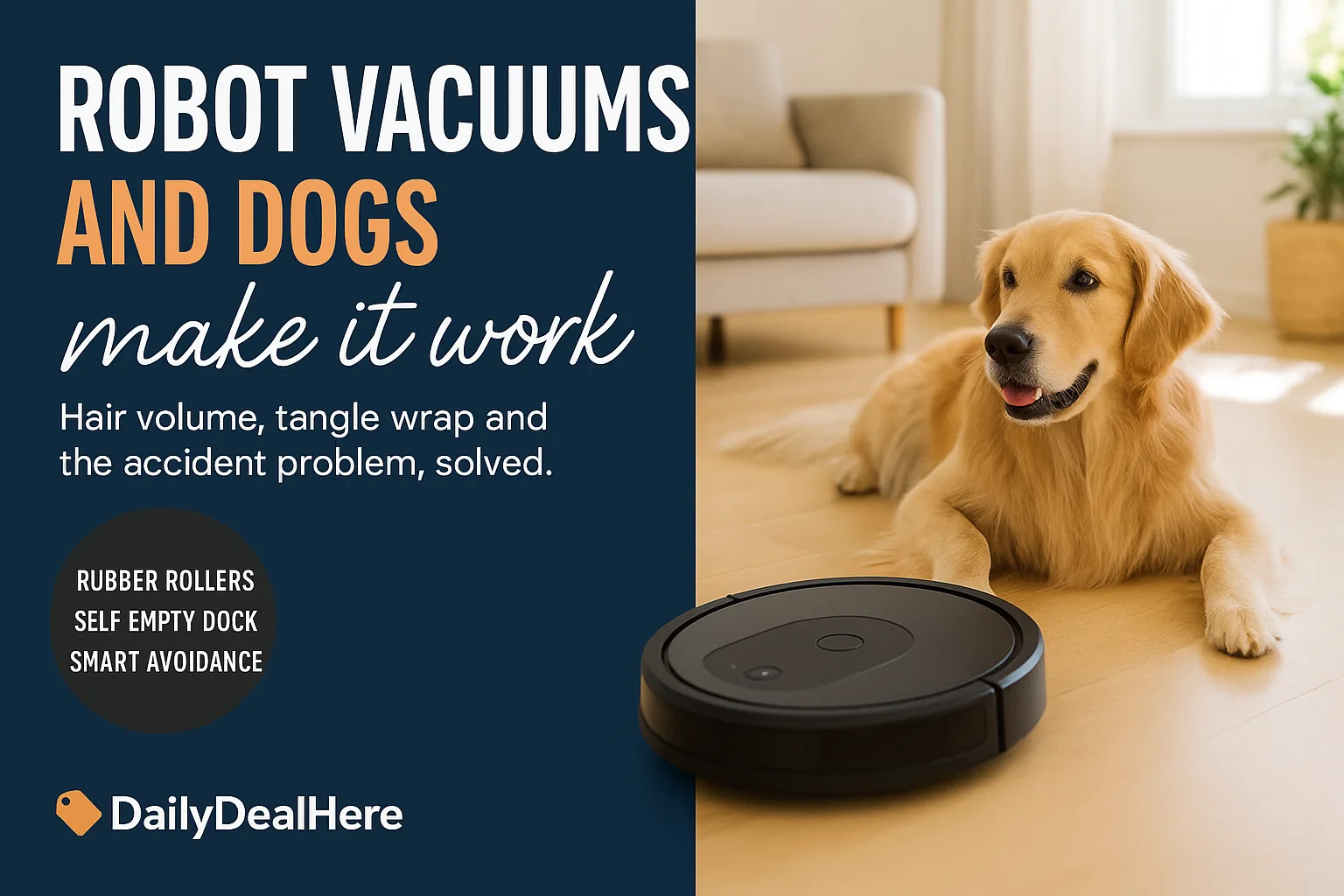
Robot vacuums genuinely work in homes with dogs, and daily hair pickup is the single best argument for owning one. But dog households need three specific things: strong suction paired with a tangle-resistant rubber roller, obstacle recognition good enough to identify and avoid pet waste, and a self-empty dock sized for the volume of hair two dogs produce. Skip any of the three and the robot becomes a chore rather than removing one.
This guide covers what dog hair actually does to a robot, the accident problem nobody enjoys discussing, the feature checklist that matters, the maintenance rhythm a pet home needs, how to help a nervous dog accept the machine, and the realistic expectations that keep the whole arrangement working.
What two dogs actually do to a robot vacuum
Volume. Hair is bulky relative to its weight, and a small onboard bin fills mid-run during shedding season. A robot that stops at seventy percent coverage because its bin is full has not cleaned your house, and emptying it daily is exactly the chore you bought the machine to avoid. This is the strongest argument for a self-empty dock in a dog home.
Tangle. Long hair wraps around bristle rollers and mummifies them, and around wheel axles where it is harder to see. A wrapped roller stops agitating carpet, a wrapped axle reduces traction, and both degrade gradually enough that owners often blame the robot for getting worse when it is simply full of hair.
Obstacles. Water bowls, kibble scattered around a feeding station, chew toys and rawhide are all things a robot will push, drag or eat. None are catastrophic, and all are avoidable with a no-go zone around the feeding area and a quick pickup before each run.
Dander and filters. Beyond visible hair, dander is fine and constant, and it loads filters far faster than in a pet-free home. Filters in a dog household need washing or replacing on roughly half the interval a manual suggests.
The accident problem, stated plainly
A robot that drives blind through pet waste does not clean your floor, it distributes the mess across every room it visits afterwards. This failure is common enough to have earned a nickname among owners, and it is the entire reason camera-based obstacle recognition became a flagship feature rather than a luxury.
How much you should care depends on your dogs. Reliably housetrained adult dogs in a settled routine present low risk, and any robot with decent navigation on a daytime schedule is fine. Puppies, seniors, dogs with digestive issues, and any household where accidents happen occasionally should treat waste-recognizing obstacle avoidance as mandatory rather than optional.
Two habits reduce the risk regardless of hardware. Run the robot when someone is home rather than overnight or while everyone is out for ten hours, so a problem is discovered in minutes rather than hours. And do a ten second visual sweep of the floor before starting a run, which is a small ritual that prevents the worst outcome entirely.
Feature checklist for dog households
| Feature | Why it matters with dogs | Priority |
|---|---|---|
| Rubber anti-tangle rollers | Long hair sheds into the bin instead of wrapping | Essential |
| Self-empty dock | Shedding season fills small bins mid-run | Essential |
| Camera obstacle recognition | Avoids accidents rather than spreading them | Essential if accidents happen |
| Mapped no-go zones | Protects bowls, beds and crate corners | High |
| Strong suction with carpet boost | Hair embeds in carpet more than crumbs do | High |
| Washable filters | Dander loads them fast, replacements add up | Medium |
| Quiet operation | Nervous dogs tolerate a quieter machine better | Medium |
| Tall obstacle clearance | Dog beds and toys are frequent obstructions | Medium |
The roller type deserves emphasis because it is the specification most often overlooked and the one that decides whether weekly maintenance takes two minutes or twenty. Rubber dual-roller designs shed long hair into the bin as they turn; bristle brushes collect it into a dense wrapped band that requires scissors.
Maintenance rhythm for a pet home
Every robot needs maintenance; a dog home needs it on a shorter cycle. The rhythm below keeps a machine performing rather than slowly declining.
- Weekly: check the main roller and clear any wrap, empty the dock bag if it is filling fast, and wipe the sensors.
- Every two weeks: wash or tap out the filter, and clear the side brush, which bends out of shape and then catches more hair.
- Monthly: cut hair from the wheel axles and the front caster, which is where invisible tangle costs you traction and climbing ability.
- Every few months: replace filters, inspect roller ends for wear, and check the charging contacts on both robot and dock.
- Seasonally: expect heavier shedding in spring and autumn and shorten every interval above accordingly.
Empty the dock bag before it compresses solid. A bag packed with hair restricts airflow, which makes the emptying cycle less effective and leaves debris in the robot’s own bin, and it is the most common reason a self-empty system seems to stop working properly.
Scheduling around a dog’s day
Timing matters more in a pet home than anywhere else. Run the robot when the dogs are out on a walk or in the yard, which removes both the stress and the obstacle of a dog lying in the middle of the floor. Avoid nap times if your dog is noise sensitive, and avoid the hour after feeding when scattered kibble is at its peak.
During shedding season, daily runs are not excessive. The bin contents will convince you within a week. Rooms where dogs sleep benefit from a second pass, and many apps let you schedule specific rooms rather than the whole floor, which is a better use of battery than a full run twice.
If your model also mops, mind the muddy paw season. A mop pad meeting fresh mud smears it across a floor rather than cleaning it, so on wet days either towel paws at the door or skip the mop cycle until the floor is dry.
Helping a nervous dog accept the robot
Some dogs ignore a robot from day one. Others bark, chase, herd or flee, and a dog that is genuinely frightened will not simply get over it if you keep running the machine and hope.
The approach that works is gradual. Leave the robot switched off in the room for a few days so it becomes furniture. Then run it briefly while the dog is at a distance and rewarded with something good, ending the session before the dog becomes anxious rather than after. Build up the duration across a week or two.
Predictability helps enormously: the same schedule every day is easier for a dog to accept than random activations. And give the dog somewhere to go, ideally a room the robot does not enter, so it always has an exit rather than being cornered by a machine it cannot reason with.
Dogs that chase and bite the robot are a different problem, and the answer there is supervision rather than exposure, since a determined dog can damage both the machine and its own teeth.
Setting up the home so the robot succeeds
A few environmental changes remove most of the friction. Draw a no-go zone around the feeding station permanently, which ends spilled water and scattered kibble in one step. Raise dog beds slightly or choose ones with a solid base, since a robot that drives under a loose blanket will drag it around the house.
Keep the dock somewhere with clear floor around it and off carpet, because a self-empty cycle over carpet drives hair into fibers directly beneath the dock. Manage cables, which cause more strandings than every pet-related problem combined, and lift chew toys before a run the way you would lift children’s toys.
If your floors also include rugs the robot has to climb to reach the hair, the mechanics of that are a separate problem, and our guide to robot vacuums getting stuck on rugs covers the fixes.
What a robot does not replace
Honest expectations keep people happy with a machine that is genuinely good at one job. A robot handles floors and does it daily, which is where most dog hair lives. It does not do upholstery, stairs, curtains, car interiors or the top of the dog crate, and no robot climbs stairs.
A handheld or stick vacuum remains necessary for furniture and stairs, and a rubber brush or squeegee is still the best tool for hair welded into upholstery. What changes is frequency: with a robot running daily, those jobs become weekly rather than daily, which is the actual benefit.
It also does not reduce shedding, which begins with the dog rather than the floor. Regular brushing, ideally outdoors, removes hair before it lands, and diet and coat health affect shedding volume as well; our dog food guide covers the input side of that equation.
Choosing between models for a dog home
Once the three essentials are covered, the remaining decisions are about budget and tolerance. A mid-range model with rubber rollers, a self-empty dock and lidar mapping handles a dog household well and costs considerably less than a flagship. The premium tier buys better obstacle recognition, more sophisticated mopping and larger dock capacity, and whether that is worth it depends mostly on whether accidents are a realistic risk in your home.
What is rarely worth buying is a budget model with bristle rollers and no mapping in a two dog home. It will work for a month and then become the machine everyone resents: bin full, roller wrapped, stuck under a dog bed, and impossible to tell where not to go.
Our robot vacuum guide flags which models carry the full dog-household feature set, and it is worth reading the roller and dock specifications closely rather than comparing suction figures, since suction is the specification least likely to be your limiting factor.
Hard floors, carpet and what each means for hair
Floor type changes the whole calculation. On hard floors, dog hair sits loose on the surface and gathers into drifts along walls and under furniture, which is easy for a robot to collect and also easy to see when it misses. Suction matters less here than coverage and edge cleaning.
Carpet is the harder case, because hair works down into the pile and needs agitation rather than airflow to release. This is where a robot with genuine roller agitation and a carpet boost mode separates itself from one that mostly pushes air around. It is also where an underpowered machine looks fine on the floor and leaves most of the hair behind.
Mixed homes get the best result by treating the two zones differently: daily runs everywhere for the loose hair, and a slower manual pass on carpet weekly for what the robot cannot lift. That combination beats expecting either machine to do everything.
Multi-level homes and where to put the robot
No consumer robot climbs stairs, which means a multi-level home is really two or three cleaning problems. The common solutions are carrying the robot between floors, which works if the dock lives on the main floor and you accept manual placement, or buying a second machine for the upper level.
If you carry one machine between floors, models that store multiple maps handle it far better, since the robot recognizes which level it is on rather than trying to reconcile a new room layout with an old map. Without multi-floor mapping, moving a robot upstairs produces confused navigation and lost no-go zones.
For a dog household specifically, put the primary machine wherever the dogs spend most of their day rather than wherever the house is largest. Hair concentrates where the animals rest, and a robot cleaning the room with two dog beds in it does more useful work than one covering a rarely used dining room.
Costs beyond the purchase price
Consumables are the ongoing cost, and they run higher in a pet home than the box implies. Dock bags are the most frequent purchase for self-empty models, and a dog household gets through them noticeably faster than a pet-free one. Filters need replacing more often. Rollers and side brushes wear out and are cheap individually but recurring.
Two ways to keep it sensible. Check that consumables for your model are widely available and reasonably priced before buying, because a machine with scarce proprietary parts becomes expensive to keep running. And buy filters and brushes in multipacks during sale events, since they do not expire and you will certainly use them.
The other cost is attention. A robot in a dog home needs the maintenance rhythm above, and a household that will not do it ends up with an underperforming machine and the conclusion that robots do not work with dogs. They do, with roughly ten minutes of upkeep a week.
Realistic results after a month
What a well matched robot delivers in a two dog home: floors that no longer have visible hair drifts, a noticeable drop in hair transferring onto clothing and furniture, and a weekly manual vacuum that takes half the time it used to because the floors are already largely clear.
What it does not deliver: a home indistinguishable from one without dogs, freedom from brushing the dogs, or clean upholstery. Anyone expecting those will be disappointed by any machine at any price.
The households that end up happiest are the ones that treat the robot as the daily baseline and keep a stick vacuum for the rest. That division matches what the technology is actually good at, and it removes the chore that used to happen every single day.
Mopping robots in a dog home
Hybrid machines that vacuum and mop are appealing in a dog household because paw prints and drool marks are part of the daily reality. They work, with two caveats worth knowing before buying.
First, a mop pad needs to lift or avoid carpet, or it will drag damp fabric across every rug in the house. Carpet detection with pad lifting is the feature to look for, and it is worth verifying by watching one run rather than assuming the specification sheet is accurate about your particular rugs.
Second, a mop in a pet home gets dirty faster than the manufacturer’s suggested schedule implies. Pads should be washed after each run rather than every few, and models with automatic pad washing docks earn their premium here more than anywhere else. A dirty pad pushed around a floor is worse than no mop at all.
Water tank capacity matters less than pad hygiene. Most tanks cover a normal floor area comfortably, while a pad that has picked up hair and mud stops cleaning within minutes regardless of how much water is behind it.
Allergies, dander and what a robot contributes
For households where someone reacts to dogs, floor hair is only part of the picture. Dander is fine, light and settles everywhere, and it re-suspends whenever anyone walks across a room. Daily floor cleaning genuinely reduces that reservoir, which is one of the strongest arguments for a robot in an allergy household.
The filter grade matters for this use. A robot that collects hair but exhausts fine particles back into the room is working against you, so a sealed body and a decent filter are worth prioritizing. Empty the dock outdoors rather than over an indoor bin, since that moment releases a concentrated cloud of exactly what you are trying to remove.
Pair it with the rest of the allergy toolkit rather than expecting the robot to solve it: an air purifier sized to the room for the airborne fraction, washing dog bedding weekly, and keeping dogs off beds and upholstery where allergens accumulate closest to where people breathe.
One last piece of practical advice for anyone deciding: borrow the experience of people with the same dog breed rather than the same house. Coat type drives everything in this category, and an owner of two double-coated shedders will tell you more useful things about docks and rollers than any general review, because they are solving the same problem you are.
Short-coated breeds shed constantly but in fine hair that behaves like dust. Double-coated breeds produce seasonal blowouts that overwhelm small bins for a few weeks twice a year. Wire-coated and non-shedding breeds create far less floor hair and shift the value of a robot toward general cleaning rather than hair specifically. Knowing which of those describes your household sets the right expectation before any money is spent.
Frequently asked questions
Are robot vacuums worth it with two dogs?
Yes, with the right features: rubber anti-tangle rollers, a self-empty dock and camera-based obstacle recognition. Daily automated hair pickup is exactly the chore dog homes most need removed, and it turns furniture and stair cleaning from daily to weekly.
Will a robot vacuum handle dog hair without clogging?
Rubber dual-roller designs handle long hair well, shedding it into the bin rather than wrapping. Bristle rollers wrap and need regular scissor sessions, so dog owners should favor rubber designs and still clear the wheel axles monthly.
What happens if a robot vacuum runs over dog poop?
Without obstacle recognition it spreads the mess across every room it visits afterwards. Camera-based waste recognition exists for this, and running the robot while someone is home limits the damage if it happens anyway.
How do I stop the robot from hitting dog bowls?
Draw a no-go zone around the feeding station in the app. It permanently ends spilled water and scattered kibble without moving the bowls, and it is the single most useful zone in a pet home.
My dog is scared of the robot vacuum. What helps?
Introduce it gradually: leave it switched off in the room for a few days, then run short sessions at a distance with rewards, ending before the dog becomes anxious. Keep a predictable schedule and make sure the dog always has a room to retreat to.
How often should I clean a robot vacuum in a pet home?
More often than the manual says. Check the roller weekly, wash filters every two weeks, and cut hair from the wheel axles and front caster monthly. Filters and rollers both wear roughly twice as fast with dogs in the house.
Do I still need a regular vacuum with dogs?
Yes, for upholstery, stairs, curtains and the car, none of which a robot touches. What changes is frequency: with a robot handling floors daily, those jobs become weekly rather than constant.
Should the dock go on carpet?
No. A self-empty cycle over carpet drives hair down into the fibers directly beneath the dock. Put it on a hard floor with clear space around it so the robot can find it reliably.










Write Your Review
No reviews yet. Be the first to share your experience!