
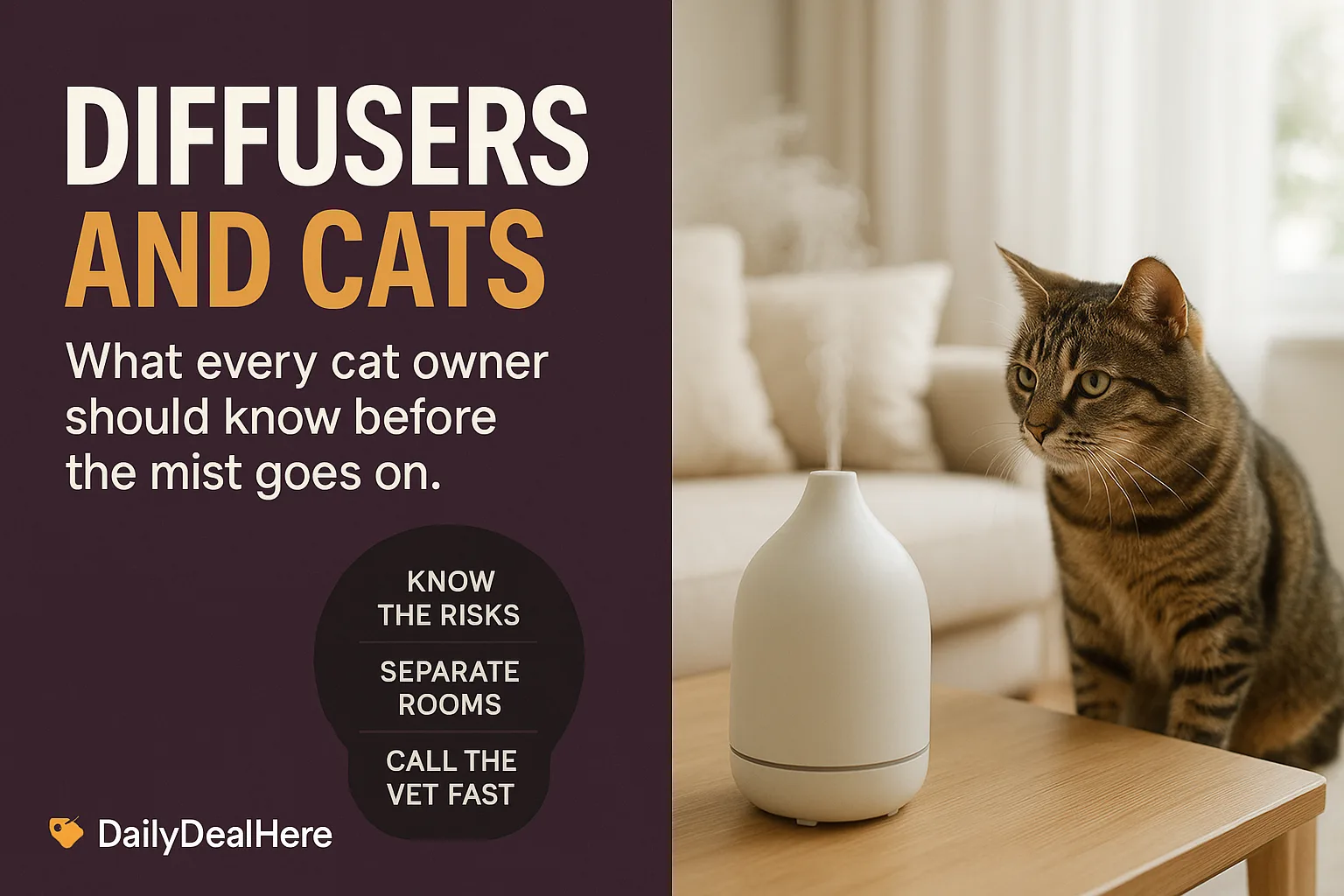
Essential oil diffusers are risky around cats, and several of the most popular oils are genuinely dangerous to them. Guidance from the ASPCA’s poison control specialists flags tea tree, eucalyptus, peppermint, citrus, pine, wintergreen and clove among oils that can cause anything from drooling and vomiting to liver damage in cats. Cats are uniquely vulnerable because their livers lack an enzyme other species use to process these compounds, and a diffuser exposes them two ways at once: through vapor they breathe and through droplets that settle on fur and get swallowed during grooming. This article is general information; call your veterinarian or a pet poison hotline about any actual exposure.
That does not mean every scented home is an emergency. What follows is why cats specifically are at risk, which oils matter most, how different diffuser types compare, the warning signs to watch for, what to do if an exposure happens, and how households that love fragrance can compromise sensibly.
Why cats and not dogs
Cats are missing meaningful amounts of glucuronyl transferase, a liver enzyme that other mammals use to bind and clear phenols and related compounds, which happen to be concentrated in many essential oils. Without that pathway, substances a dog or a person processes and excretes can accumulate in a cat instead.
This is the same reason cats cannot safely take several common human medications, and it is why advice written for dogs does not transfer. A diffuser blend that a dog in the same room tolerates without any sign of trouble can still be a problem for the cat sleeping on the sofa.
Size compounds it. A cat weighing a few kilograms receives a far larger dose per kilogram of body weight than an adult human in the same room, from the same air. Kittens, seniors and cats with existing liver or respiratory conditions sit at the sensitive end of that range again.
Two exposure routes, and why grooming is the bigger one
Inhalation is the obvious route and the one people think about: a cat in a room with a running diffuser breathes whatever is in the air. In a small or poorly ventilated room, concentration builds, and cats with asthma or flat faces react to that irritation more than others.
The route that matters more is grooming. Ultrasonic and nebulizing diffusers put fine droplets into the air, and those droplets land on every surface in the room including the cat. A cat then spends a substantial part of its day licking its coat, which turns a surface exposure into an oral dose delivered repeatedly over hours.
That is the crucial difference between a diffuser and a closed bottle of oil on a shelf. The bottle is only a hazard if it spills; the diffuser distributes small amounts of oil across the room by design, which is what makes it a genuine concern rather than a theoretical one.
The oils to keep out of a cat household
| Oil | Why it is flagged |
|---|---|
| Tea tree, also sold as melaleuca | Implicated in severe cases including tremors and liver damage |
| Pennyroyal | Associated with seizures and liver failure in reported cases |
| Wintergreen | Contains a salicylate cats process poorly |
| Peppermint | Gastrointestinal upset, drooling, lethargy |
| Eucalyptus | Respiratory irritation, weakness, unsteadiness |
| Citrus oils including lemon, orange, bergamot | Vomiting, drooling, skin irritation |
| Pine and fir oils | Vomiting, weakness, liver concerns |
| Clove and cinnamon | Phenol-rich, poorly tolerated |
| Ylang ylang | Reported reactions including weakness and vomiting |
Treat that as a list of the well documented rather than an exhaustive one. New blends and proprietary mixtures appear constantly, and a product sold as a room fragrance may not list its oils individually at all. When a label will not tell you what is inside, a cat household should treat that as a reason to skip it.
Concentration matters as much as identity. Neat oil applied to skin or fur is the most dangerous form by a wide margin, an oil diffused into a room is less concentrated but continuous, and a scented candle or a wax melt puts far less actual oil into the air than either.
How diffuser types compare
Ultrasonic diffusers mix oil with water and disperse it as a fine mist. The mist carries oil onto surfaces and fur, which makes them the highest risk format for the grooming route despite feeling gentle.
Nebulizing diffusers atomize undiluted oil without water, producing the highest airborne concentration of all. They are the strongest performers for fragrance and the least suitable format for a home with cats.
Heat diffusers warm oil to evaporate it, which puts vapor into the air without a droplet spray. Lower surface deposition, but they still fill a room with volatile compounds and they add a hot surface a cat can reach.
Reed diffusers and passive formats release the least into the air by a wide margin. Their hazard is different: an accessible bottle of concentrated oil that a cat can knock over, walk through and then groom off, which is the concentrated-dose scenario. Placement out of reach solves that.
Signs of trouble, and how quickly they appear
Reactions can appear within minutes for respiratory irritation, or over hours for effects following ingestion during grooming, which is why an apparently fine cat in the evening is not proof that nothing happened.
- Drooling, foaming or pawing at the mouth or face, often the first sign after tasting or grooming off oil.
- Vomiting or diarrhea.
- Wobbliness, weakness, tremors or difficulty walking, which indicate systemic effects rather than local irritation.
- Coughing, wheezing or laboured breathing, particularly in asthmatic cats.
- Unusual lethargy, hiding, or a change in behavior.
- Redness or irritation of the skin, or a coat that smells strongly of fragrance.
- Low body temperature or collapse, which is an emergency.
Any of these following fragrance exposure warrants a call rather than a wait-and-see approach. Liver effects in particular can develop without dramatic early signs, and a professional would rather hear from you early than late.
If an exposure happens
Move the cat to fresh air first, away from the source and into a well ventilated room or outdoors if that is safe for that particular cat. Switch the diffuser off and open windows in the affected room.
If oil is on the fur or skin, wash the area with a mild dish soap and rinse thoroughly, because grooming turns a surface exposure into an ingested one and every minute counts on that clock. Do not use solvents, do not scrub aggressively, and dry the cat afterwards so it does not become chilled.
Do not induce vomiting and do not give anything by mouth unless a professional instructs you to. Then call: your veterinarian, an emergency clinic outside hours, or a dedicated pet poison service such as the ASPCA Animal Poison Control Center or the Pet Poison Helpline, both of which handle exactly these calls and are staffed around the clock.
Take the bottle or the product with you, or at least a photograph of the label. Knowing whether it was lavender or wintergreen materially changes the advice, and the ingredient list is more useful to a clinician than a brand name.
If you still want fragrance at home
Most veterinary advice lands on a workable compromise rather than an outright ban, and the elements are consistent.
Diffuse only in a room the cat cannot access, with the door closed, and ventilate that room before letting the cat back in. Keep sessions short rather than running a diffuser all day. Never apply oils to the cat, its bedding, its carrier or its litter area, and never use oil-based flea or grooming products not specifically formulated and approved for cats.
Store bottles closed and out of reach, since a knocked-over bottle is the concentrated exposure that causes the worst cases. Watch the cat rather than assuming: a cat that leaves the room whenever a diffuser runs is communicating something worth respecting.
For lower risk fragrance, passive formats put less into the air, and simply using less is the most underrated option of all. Our scent diffuser guide notes which formats disperse the least, which is the relevant specification in a cat household.
Treating the source instead of masking it
A large share of fragrance use in cat homes exists to cover litter odor, and that is a problem better solved than masked. A well managed litter setup produces very little smell, and the fixes are all things a diffuser cannot do.
Scoop at least daily, use enough litter depth for clumps to form properly, wash the tray periodically rather than only topping up, and provide one tray per cat plus one. Placement in a ventilated spot rather than a closed cupboard makes a bigger difference than any additive. Our scoopable litter roundup covers which litters control odor without heavy fragrance.
For general household smell, ventilation and cleaning beat fragrance every time, and an air purifier with a carbon layer addresses odor without adding anything to the air the cat has to process.
Other scented products worth checking
Diffusers get the attention, but the same oils appear across a household. Cleaning products marketed as natural frequently contain pine or citrus oils, and a floor cleaner leaves residue exactly where a cat walks and then grooms. Reading labels on cleaners matters as much as reading them on fragrance.
Also worth checking: liquid potpourri, which is both a fragrance and a caustic hazard if a cat drinks it; scented candles with oil-heavy formulations; laundry products used on cat bedding; and anything sold as a natural insect repellent, which is very often tea tree or citrus based.
Human topical products deserve a mention too. Cats that sleep against a person who has just applied an oil-containing balm or a muscle rub can pick up a meaningful dose through contact and grooming, which is a route almost nobody considers.
Which cats are most at risk
Vulnerability is not uniform, and knowing where your cat sits changes how cautious to be. Kittens have immature liver function and groom constantly, which puts them at the sensitive end on both exposure routes. Senior cats often have reduced liver and kidney capacity, so they clear compounds more slowly than they once did.
Cats with existing liver disease are the clearest case for avoiding oils entirely, since the organ that would process them is already compromised. Asthmatic cats and flat-faced breeds react to airborne irritation more readily, and for them even an oil not on any toxic list can trigger a respiratory episode simply by being a strong fragrance.
Long-haired cats deserve a specific mention, because a long coat captures far more airborne droplets than a short one and then delivers them during grooming. In a household with mixed coat lengths, the long-haired cat receives the larger dose from the same room.
Dogs, birds and other pets in the same room
Cats are the headline but not the only consideration. Dogs tolerate oils better than cats and are not immune: concentrated oils applied topically or ingested cause vomiting, lethargy and skin irritation in dogs too, and small breeds face the same dose-per-weight problem.
Birds are the most sensitive animals in any household to airborne compounds of every kind, with respiratory systems so efficient that fumes humans cannot detect can be fatal. A home with birds should not run diffusers in shared air at all, and that guidance is stricter than the one for cats.
Small mammals such as rabbits, guinea pigs and rodents also have sensitive respiratory tracts and no way to leave a room. Fish are unaffected by airborne fragrance but their tanks are not: oil films can settle on an open water surface and interfere with gas exchange.
What veterinary and poison control services actually recommend
The consistent professional position is caution rather than prohibition, with a clear hierarchy. Never apply essential oils to a cat, in any dilution, unless a veterinarian has specifically prescribed something. Never add oils to a cat’s water, food, bedding, litter or carrier. Keep concentrated oils stored where a cat cannot reach them.
For diffusing, the guidance is to use it only where the cat cannot go, keep exposure brief, ventilate well, and stop entirely if the cat shows any sign of irritation. Several veterinary sources go further and advise avoiding diffusers altogether in homes with cats, particularly cats with any respiratory history, on the reasonable ground that the benefit is purely aesthetic while the risk is not.
Both major pet poison services operate around the clock and charge a consultation fee, which is worth knowing in advance rather than discovering during an emergency. Saving those numbers in your phone alongside your veterinarian is a five minute task that pays for itself the one time you need it.
Building a cat-safe fragrance routine
Households that want their home to smell pleasant without adding risk have more options than the debate usually suggests. Ventilation is the most underrated: opening windows for a few minutes a day moves more odor out of a home than any product masks.
Cleaning the sources works better than covering them, and the main sources in a cat home are the litter area, food bowls, bedding and soft furnishings. Washing cat bedding weekly and cleaning bowls daily removes more smell than a diffuser hides.
Where you want actual fragrance, prefer formats and placements that keep it away from the cat: a reed diffuser on a high shelf in a room the cat rarely uses, or a candle in a closed room while you are in it, extinguished when you leave. Baking soda in the litter area and an air purifier with a carbon layer both reduce odor without adding anything the cat has to process.
Reading a fragrance product label as a cat owner
Labels in this category are unhelpfully vague, and knowing what the vagueness hides is most of the skill. A product listing fragrance or parfum as an ingredient is telling you nothing, because that single word can stand in for dozens of compounds including any of the oils on the list above. In a cat household, an unspecified fragrance is a reason to put the product back.
Terms that sound reassuring but are not: natural, which says nothing about feline toxicity since many of the most dangerous oils are entirely natural; plant based, same problem; and pet friendly, which is unregulated and frequently means the manufacturer checked nothing and simply believes it is fine.
What actually helps is a full ingredient list naming each oil, which lets you check it against the flagged list. Brands aimed at pet owners increasingly provide this, and the ones that do are signalling that they expect informed buyers. If a company will not tell you what is in the bottle, that is an answer in itself.
Common scenarios and what to do
You ran a diffuser for weeks before learning any of this. Most cats in that situation are fine, particularly if the room was ventilated and the cat could leave. Stop, ventilate, wipe down surfaces the cat contacts, and watch for the signs listed above. Mention it at the next routine appointment rather than panicking.
A guest brings a plug-in air freshener or a scented candle. Politely relocate it to a room the cat does not use, or unplug it while they visit. Most people have simply never heard that cats are different and are not offended once told.
You use oils for your own health routine. Keep the practice and change the logistics: diffuse in a closed room the cat cannot enter, ventilate before letting it back in, and wash your hands after handling neat oils before touching the cat. Topical products on your own skin are worth letting dry fully before a cat sleeps against you.
You are choosing between fragrance and a cat that hides. A cat that consistently leaves a room when a diffuser runs has told you what it thinks. Respecting that costs nothing and removes the question entirely.
Frequently asked questions
Are essential oil diffusers toxic to cats?
They can be. Poison control guidance flags oils including tea tree, eucalyptus, peppermint, citrus, pine, wintergreen and clove as dangerous to cats, and diffusers expose them both through inhaled vapor and through droplets groomed off the fur. Call your vet about any suspected exposure.
Why are cats more sensitive to essential oils than dogs?
Cats largely lack glucuronyl transferase, a liver enzyme used to process phenols and related compounds concentrated in many oils. Without that pathway, doses other animals clear can build up in a cat, and their small body weight increases the dose per kilogram.
What are the symptoms of essential oil poisoning in cats?
Drooling, pawing at the face, vomiting, wobbliness, tremors, weakness, coughing or laboured breathing, unusual lethargy, or a coat that smells strongly of fragrance. Collapse or low body temperature is an emergency. Signs can appear within minutes or over several hours.
Is there a safe way to use a diffuser in a home with cats?
Lower risk rather than zero: diffuse only in a room the cat cannot enter, keep the door closed and the session short, ventilate before letting the cat back in, never apply oils to the cat or its bedding, and store bottles sealed and out of reach.
Which diffuser type is riskiest for cats?
Nebulizing diffusers, which atomize undiluted oil and produce the highest airborne concentration, followed by ultrasonic models whose mist deposits oil on fur and surfaces. Passive formats such as reed diffusers release far less, though an accessible bottle of concentrated oil is its own hazard.
What should I do if my cat gets oil on its fur?
Wash the area with a mild dish soap and rinse thoroughly, because grooming turns a surface exposure into an ingested one. Do not use solvents, do not induce vomiting, dry the cat so it does not get chilled, and call a veterinarian or a pet poison hotline with the product label to hand.
Are wax melts and candles safer than oil diffusers for cats?
They generally put less concentrated oil into the air, which reduces the grooming exposure route, but strong fragrance can still irritate feline airways and liquid potpourri is separately hazardous if drunk. Ventilation and moderation apply either way.
Can cleaning products harm cats the same way?
Yes, and this is commonly overlooked. Cleaners marketed as natural often contain pine or citrus oils and leave residue on floors a cat walks across and then grooms. Check cleaner labels with the same care you would apply to fragrance products.










Write Your Review
No reviews yet. Be the first to share your experience!