

Most garages do not need a compressor, right up until the day they do. A flat tire on a Sunday morning, a nail gun for the deck, sawdust blown out of a router base, a mower tire that will not seat its bead, lug nuts that a breaker bar refuses to move. The problem is that those jobs sit at opposite ends of the airflow scale, and a machine that handles the first four will stall halfway through the last one. We compared 8 garage air compressor options from Makita, California Air Tools, Bostitch and more, sorted by tank shape, airflow at working pressure, and how loud each one is in a room attached to your house.
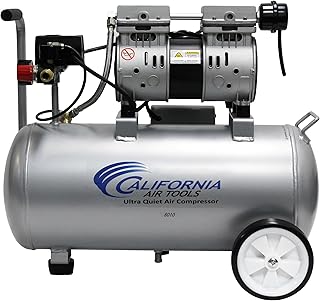
Our top pick is the California Air Tools 8010 Ultra Quiet Air Compressor for its 60 dBA rating paired with an eight gallon tank, which covers the majority of garage jobs without driving you out of the room. One note on wording before you shop: searching for an upright compressor turns up very few true vertical units at this size, because the vertical layout only starts to pay off on much larger tanks that have to stand in a corner permanently. Almost everything sold for a home garage is a pancake, a hot dog or a twin stack. Our tools and home improvement section covers the tools you will be feeding with it.
Pros
- Rated 60 dBA, quiet enough to hold a conversation beside
- Eight gallon tank covers inflation, blowing out and nailing without constant cycling
- Oil-free pump needs no oil checks and starts in a cold garage
- Wheels and a light steel frame make it easy to move out to the driveway
Cons
- Airflow at 90 PSI is modest, so continuous tools such as sanders will outrun it
- The slow-speed motor makes the unit physically larger than a pancake of similar capacity
The California Air Tools 8010 solves the problem most garage compressors ignore. A compressor that lives in a room attached to your house gets used at the hours you are actually home, and a machine that forces the household to stop talking is a machine that stays switched off. At 60 dBA this one does not.
The quiet comes from the pump design rather than a muffler. A low speed induction motor drives a dual piston oil-free pump, so the same air per minute arrives with far less noise than a high speed motor makes doing the same work. The side effect is a pump that runs cooler and wears more slowly than the screaming units it competes with.
Eight gallons on wheels is the right size for the jobs that actually come up. Tires, a blow gun, a brad nailer, a framing nailer in bursts, seating a bead on a mower tire. The tank is large enough that the motor is not cycling every twenty seconds, and the wheels mean the compressor goes to the car rather than the car being pushed to it.
The honest limit is airflow. Rated output at 90 PSI is enough for nailers and inflation but not for a die grinder or an orbital sander, which drain continuously. It is also a physically bigger machine than a six gallon pancake, because a slow pump has to be larger to move the same air.
Bottom line: the compressor most home garages should buy, because quiet is the feature that decides whether it gets used at all.
- Tank: 8 gallon steel, horizontal with wheels
- Motor: 1.0 HP low speed induction
- Pump: oil-free dual piston
- Noise rating: 60 dBA
- Maintenance: no oil changes required
- Power: standard household circuit
Buy this if the garage shares a wall with a bedroom or an office, if you use a compressor for tires, nailers and cleanup rather than for bodywork, and if you want a machine with nothing to maintain. Skip it if your list starts with an orbital sander or a die grinder, because those tools drain air continuously and want the higher airflow of the Makita MAC5200 or a large upright tank.
Drain the tank after every session. Compressing air condenses water inside the tank, and standing water is what rusts a steel tank from the inside out. Keep the intake filter clean, because a blocked filter makes the pump work harder and run hotter. Plug the unit straight into a wall outlet rather than a long thin extension cord, since voltage drop at startup is the usual cause of a compressor that hums instead of starting.
Pros
- Highest airflow at 90 PSI here, enough for an impact wrench without long waits
- Cast iron oil-lubricated pump runs cooler and lasts longer under sustained load
- Twin stack packs more air into the same floor space as a hot dog
- Steel roll cage protects the controls from knocks
Cons
- Heavy enough that moving it is a deliberate decision, not a casual one
- Loud, and the noise carries straight through an attached garage wall
- Needs oil level checks, periodic oil changes and reasonably level ground
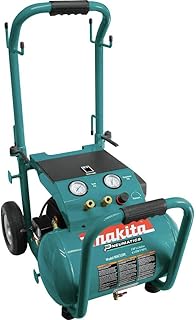
The MAC5200 is the machine in this list that changes what you can do rather than how comfortably you can do it. Everything else here fills tires and drives nails. This one runs air tools, because a cast iron Big Bore pump delivers the airflow that keeps an impact wrench turning instead of stalling between shots.
Oil lubrication is the reason it can sustain that. A cast iron cylinder running in oil sheds heat far better than a sealed oil-free pump, and heat is what kills compressor pumps worked hard. The trade is a maintenance routine: check the sight glass, change the oil on schedule, and keep the machine reasonably level while it runs.
The twin stack layout puts two tanks one above the other, which gives more stored air than a hot dog in the same floor space and keeps the machine narrow enough to walk past. The roll cage around it is not decoration. Gauges and regulators are the parts that break when a compressor tips in a truck bed, and this one keeps them inside a steel frame.
What you accept is weight and noise. It is a two-person lift into a vehicle, and it is loud in the way that job site compressors are loud, which is a genuine problem in a garage attached to a bedroom wall.
Bottom line: the pick for anyone who actually runs air tools, and the wrong pick if quiet matters more than airflow.
- Motor: 3.0 HP
- Pump: cast iron Big Bore, oil-lubricated
- Tank: twin stack cylindrical
- Frame: steel roll cage
- Maintenance: oil level checks and scheduled oil changes
- Power: standard household circuit
Check the oil sight glass before every long session and change the oil on the interval in the manual, using the grade the manual specifies rather than motor oil. Keep the compressor level while running, because a tilted lubricated pump does not oil evenly. Drain the tank after use to keep condensation off bare steel, and wear ear protection: this machine is loud enough in a closed concrete room to matter over a long afternoon.
Choose the MAC5200 when your tool list includes an impact wrench, a cut-off wheel, a die grinder or a sander, and when the compressor will live in one place and get used hard. If your jobs are tires, a brad nailer and blowing out sawdust, you are paying in weight, noise and maintenance for airflow you will never call on, and one of the quiet oil-free units is the smarter buy.

Pros
- Light enough to carry one-handed up a ladder or out to the car
- 150 PSI maximum stores more usable air in a small tank
- Oil-free pump with a high efficiency motor that starts in cold weather
- Flat pancake tank is stable on a sloped driveway and stores on a shelf
Cons
- Loud next to the quiet-designed units in this list
- Six gallons runs out quickly on any tool that draws air continuously
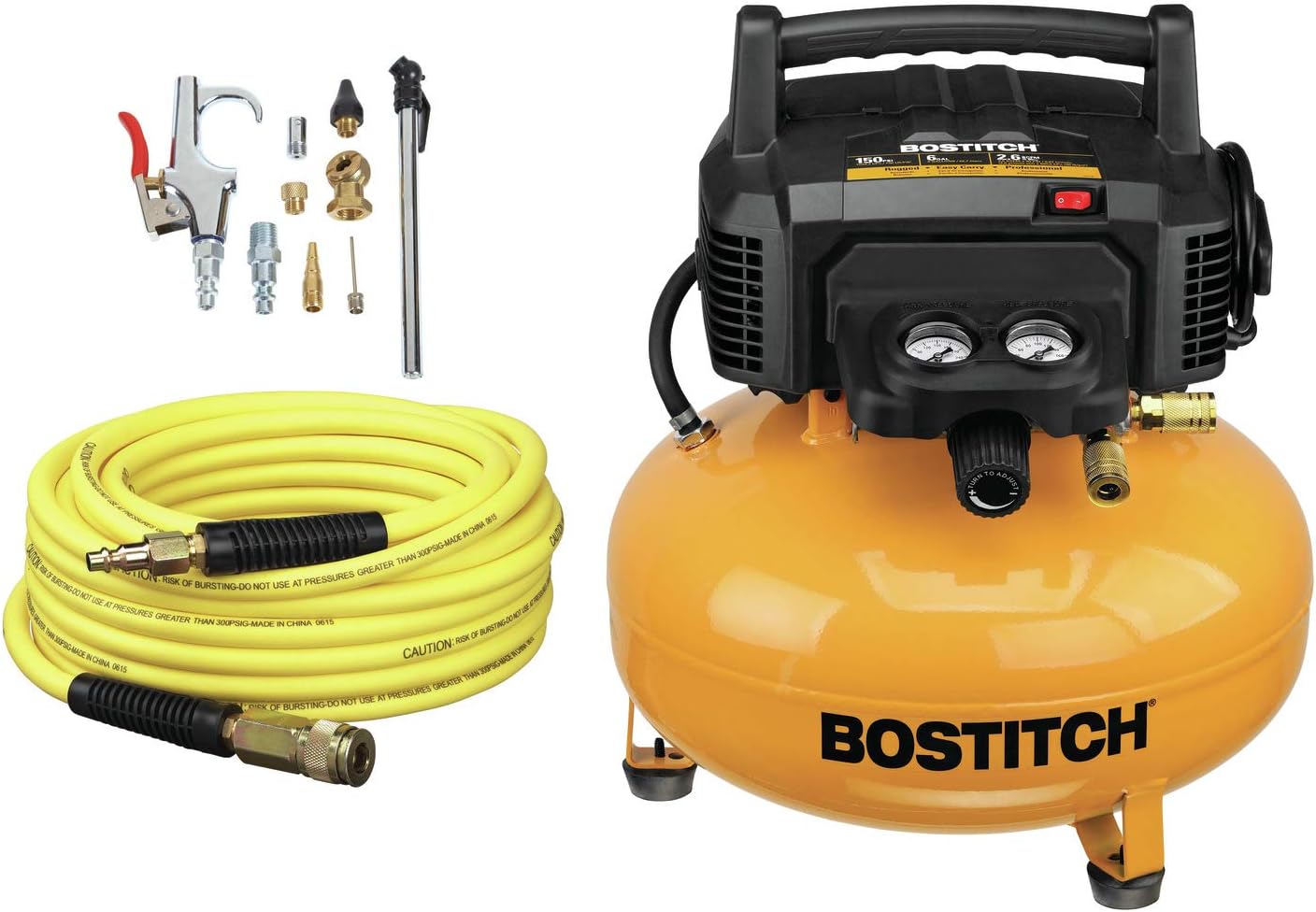
If you have seen a compressor on a job site, you have seen this shape. A six gallon pancake is the default entry point into the category, and the Bostitch version is the one most people end up with because it gets the basics right without asking anything of the owner.
The 150 PSI maximum matters more than the gallon figure suggests. A tank filled to a higher pressure holds more usable air before it drops below what a nailer needs, so a six gallon tank at 150 PSI behaves like a larger tank filled to a lower pressure. That is the trick that makes this size workable at all.
The motor is built for the real conditions these get used in: cold mornings and long extension cords, both of which cause weaker compressors to hum and trip rather than start. Two couplers on the manifold mean two people can work from one machine, which is genuinely useful when someone is holding trim while you nail it.
The limitations are the ones the shape imposes. It is loud, and in an attached garage that is a real consideration. Six gallons will not sustain a sander or a die grinder, and the pump will run almost continuously if you try.
Bottom line: the most compressor per dollar for tires, nailers and cleanup, and the right first compressor for most garages.
- Tank: 6 gallon pancake
- Maximum pressure: 150 PSI
- Pump: oil-free
- Motor: high efficiency, built for cold starts
- Outlets: two universal couplers
- Sold as a kit with air accessories
This is the compressor for someone whose list is tires, a brad or framing nailer, a blow gun and the occasional inflatable. It is also the right choice if the machine has to live on a shelf and come down a few times a year, because carrying it is genuinely easy. Skip it if you need air tools that run continuously, or if noise through a shared wall is the deciding factor.
Let the tank fill completely before you start, then set the regulator to the pressure your tool asks for rather than leaving it wide open, which wastes air and hammers the tool. Use a hose long enough that you can work away from the machine, since that alone cuts the noise you are exposed to. Drain the tank through the valve underneath when you finish, and leave the valve open while it is stored.

Pros
- Largest air reserve in this list, so tools run longer before the pump restarts
- 5.1 CFM at 90 PSI is enough for an impact wrench and light spraying
- Vertical tank occupies a small footprint for the volume it holds
- Oil-free pump means no oil changes on a machine that stays put
Cons
- Not portable in any real sense, it wheels into a corner and stays there
- An oil-free pump worked hard will wear sooner than a lubricated cast iron one
- Needs dedicated floor space and clearance above the tank
This is the machine people are picturing when they search for an upright compressor, and it is the only genuine one in this list. Standing the tank on end gives you 29 gallons of stored air in roughly the footprint of a kitchen bin, which is the whole argument for the shape.
The reserve changes how the compressor feels to use. With this much air behind the regulator, an impact wrench works through a full wheel change without the pump running the entire time, and a small spray gun becomes practical rather than frustrating. The 175 PSI maximum stretches that reserve further, because a tank filled to a higher pressure holds more usable air.
Oil-free is an interesting choice on a stationary machine. It removes the maintenance entirely, which suits a compressor that gets used in bursts and then ignored for weeks. Under genuinely heavy continuous use, a cast iron lubricated pump would last longer, and that is the honest trade being made here.
What it asks of you is space and commitment. Large wheels move it across a level floor, but it is not going into a car and it is not going up a step without help. Decide where it lives before it arrives.
Bottom line: the right buy if you have a corner to give and want tools that keep running, and the wrong buy if the compressor has to be put away.
- Tank: 29 gallon vertical steel
- Motor: 2.5 HP, 120V
- Maximum pressure: 175 PSI
- Airflow: 5.1 CFM at 90 PSI
- Pump: oil-free
- Mobility: large wheels for floor movement only
Buy the upright when the compressor is furniture rather than a tool you carry, and when your work involves continuous air: impact wrenches, ratchets, blow-out work on a whole car, light spraying. If you also want it to come to the driveway or into a truck, the shape is working against you and a twin stack or a wheeled pancake is the honest answer.
Drain the tank after each session through the valve at the base, because a vertical tank collects water at the bottom where the steel is under the most stress. Check that the machine sits on a level floor so it cannot be tipped by a hose pull, and leave clearance around the pump for cooling airflow. Never modify or block the safety relief valve, which is the last defense on a tank holding this much air.

Pros
- Noticeably more airflow than the 8010 while staying quiet for the category
- Ten gallon tank gives longer runs before the motor restarts
- Oil-free pump with no maintenance schedule
- Wheels and a handle for moving it across a garage
Cons
- Louder and heavier than the 8010, so it gives up some of that model's main appeal
- Still not enough sustained airflow for sanders or die grinders
The 10020C answers the obvious complaint about the quiet compressor formula, which is that quiet units tend to be short on air. Stepping up to a two horsepower motor and a ten gallon tank buys meaningfully more airflow and a longer run before the pump cuts in.
It is still quiet by the standards of this category. Seventy decibels is not the near-silent 60 dBA of the smaller model, but it is a long way from the roar of a pancake compressor, and in an attached garage that gap is the difference between working freely and choosing your moment.
The pump is the same oil-free dual piston design, driven slowly, which means nothing to maintain beyond draining the tank and keeping the filter clean. For a machine that spends most of the year switched off, that is the right engineering priority.
The compromises are physical. It is heavier than the 8010 and takes more room, and it still will not sustain a continuous-draw tool such as an orbital sander. If that is your work, the airflow you need lives in the Makita or the 29 gallon upright.
Bottom line: the pick if you liked the 8010 but ran out of air, and you are willing to trade a little quiet for it.
- Tank: 10 gallon steel with wheels
- Motor: 2.0 HP low speed
- Pump: oil-free dual piston
- Noise rating: 70 dBA
- Maintenance: no oil changes required
- Power: standard household circuit
This suits a garage that does more than tires and trim nails: framing, longer inflation jobs, blowing out a whole workshop, an impact wrench used occasionally. It is also for anyone who wants a low maintenance machine that will not make the household complain. If portability up a ladder is the priority, the smaller pancake designs remain easier to live with.
Compare this against the 8010 on one question: do you run out of air before you run out of patience? If the smaller tank keeps cycling during your jobs, the step up is worth the extra size and noise. If your sessions are short bursts, the quieter unit is the better companion. Compare it against the Makita on the opposite question, which is whether continuous air tools are on your list.

Pros
- Twenty gallon tank holds enough air for long inflation and impact wrench work
- 175 PSI maximum increases the usable air stored in the tank
- Two quick couplers let two people work from one machine
- Wheels and a handle make it movable across a garage floor
Cons
- Loud, and heavy enough that moving it off a flat surface takes real effort
- Oil-free pump on a large tank is not built for continuous professional duty
The 20 gallon Craftsman occupies the middle ground that a lot of garages actually want. It stores enough air to stop the constant cycling that makes small pancakes tiring, but it keeps a horizontal tank on wheels rather than committing to a vertical machine that never moves.
Twenty gallons at 175 PSI is a real reserve. Inflating four tires from low, running an impact wrench through a wheel change, or blowing out a whole workshop are all jobs where the difference from a six gallon tank is obvious rather than theoretical.
Two quick couplers are more useful than they look. A blow gun on one and a tire chuck on the other means no swapping fittings mid-job, and it lets a second person work alongside you without a splitter hanging off the manifold.
The weaknesses are noise and duty. This is a loud machine in a concrete room, and an oil-free pump moving this much air is working hard. Used in bursts it will last for years, but it is not the machine for daily professional use.
Bottom line: the compromise pick for a garage that wants a real tank without giving up a permanent corner.
- Tank: 20 gallon horizontal steel on wheels
- Maximum pressure: 175 PSI
- Pump: oil-free
- Outlets: two quick couplers
- Motor rating: 1.8 HP maximum developed
- Power: standard household circuit
Fill the tank fully before starting a long job so you get the whole reserve rather than working while the pump catches up. Set the regulator to the tool pressure instead of running wide open, and put a quick coupler tool on each outlet so you are not swapping fittings. Because the tank is large, draining takes longer: leave the valve open for a minute rather than cracking it briefly.
Drain condensation after every session, since a large tank collects proportionally more water and rust starts at the lowest point. Move it by tilting onto the wheels rather than dragging, which protects the drain valve underneath. Keep the pump shroud clear so cooling air can reach it, and stop and let the machine cool if you have been running it near continuously for a long stretch.

Pros
- 4.0 CFM at 90 PSI is strong airflow for a tank this size
- Ten gallons on wheels stays movable while holding a useful reserve
- Oil-free pump with nothing to maintain
- 150 PSI maximum for more usable stored air
Cons
- Loud in an enclosed garage compared with the quiet-designed units here
- Plastic shroud around the pump feels less rugged than a steel roll cage
This is the quiet achiever of the list on the one number that matters most. Four CFM at 90 PSI from a ten gallon portable is a strong figure, and it is the reason this machine can do work that a six gallon pancake cannot.
Airflow at that level puts an impact wrench genuinely within reach, along with ratchets and longer blow-out jobs. The ten gallon tank supplies the burst and the pump keeps up well enough that you are not standing around between fasteners.
Because the tank stays horizontal and keeps its wheels, the machine is still something you move. That matters more than spec sheets admit. A compressor you can wheel to the far side of the garage, or out to a car on the driveway, gets used for jobs you would otherwise skip.
The compromises are the usual ones for the format. It is loud, the plastic shroud is less robust than a cage, and an oil-free pump asked for this much air is working near its comfortable limit under sustained load.
Bottom line: the best airflow per pound in this list, and the pick if you want air tool capability without a stationary tank.
- Tank: 10 gallon steel with wheels
- Airflow: 4.0 CFM at 90 PSI, 5.0 CFM at 40 PSI
- Maximum pressure: 150 PSI
- Pump: oil-free
- Motor rating: 1.8 HP peak
- Power: 120V standard household circuit
Choose this if you want to run air tools but cannot give up a permanent corner to a vertical tank. It suits someone servicing their own vehicles, doing seasonal tire changes, or running a ratchet and blow gun through a long afternoon. It is the wrong choice if the compressor shares a wall with a bedroom, because there is no quiet engineering here.
Give the tank a full fill before you start on fasteners, then set the regulator to the pressure the wrench is rated for rather than the tank maximum, which is where tool damage comes from. Use a hose with an adequate internal diameter, since a thin hose throttles airflow before the compressor does. Drain the tank at the end of every session and store the machine with the valve open.

Pros
- Compact 6.3 gallon tank that one person can move without help
- Oil-free pump with no maintenance schedule
- Covers the common garage jobs: inflation, nailing, blowing out
- Simple controls with nothing to learn
Cons
- 116 PSI maximum is the lowest here, which reduces the usable air a full tank holds
- Loud for its size, with no quiet-running design
- Support and replacement parts are thinner than the established tool brands
The VEVOR is the budget end of the format, and it is honest about what it is: a small oil-free tank that covers the jobs most people buy a compressor for in the first place. Tires, a nailer, a blow gun, an inflatable at the start of summer.
The number to understand before buying is the maximum pressure. At 116 PSI it fills to a lower ceiling than the 150 and 175 PSI machines here, and that matters because a tank filled to a higher pressure holds more usable air in the same volume. In practice you get less work per fill than the gallon figure suggests.
Against that, it is compact, light enough to move one-handed, and needs nothing from you beyond draining the tank. For a garage where the compressor comes out a handful of times a year, that is a reasonable set of priorities.
The things to accept are noise and support. There is no quiet-running engineering here, and parts and service for the established tool brands are easier to find years down the line.
Bottom line: a workable small compressor for occasional garage jobs, provided you understand what the lower pressure ceiling costs you.
- Tank: 6.3 gallon
- Maximum pressure: 116 PSI
- Motor rating: 2 HP
- Pump: oil-free
- Format: portable with carry handle
- Power: standard household circuit
Compare this directly with the six gallon pancake options on maximum pressure rather than gallons, because that is where the real difference sits. If your work is tires and light nailing a few times a year, the gap will not bother you. If you plan to run a framing nailer through a project or reach for an impact wrench, buy pressure and airflow instead.
This is for the garage that needs a compressor occasionally rather than weekly: seasonal tire pressure, an inflatable, a bike, the odd trim nail, blowing dust off a workbench. It is not the machine for someone servicing vehicles, running continuous tools, or working in a space where noise through a shared wall would cause an argument.
How to Choose a Garage Air Compressor
Start with the hungriest tool you own and work backward from it. Everything else in this category, tank shape, gallons, pump type and noise, follows from the airflow that one tool demands and from where the machine has to sit when nobody is using it.
Pancake, Hot Dog, Twin Stack, or Upright
A pancake has one wide, flat, round tank underneath the pump. It is the most stable shape on a sloped driveway, it stores flat on a shelf, and it is what most six gallon units are. A hot dog is a single cylindrical tank lying on its side, which is narrower and easier to carry in one hand but wants a level surface, because a hot dog on a slope will roll or tip if you tug the hose.
A twin stack is two cylindrical tanks bolted one above the other. It packs more air into the same floor space than a hot dog, it usually rides inside a steel roll cage, and it is the shape you see on job sites where the machine gets thrown into a truck bed. An upright, or vertical, compressor stands its tank on end so the whole machine occupies about the footprint of a kitchen bin.
Uprights are uncommon at the size most garages want, and the reason is simple. Standing a tank on end only saves floor space once the tank is large, roughly twenty gallons and up, and a tank that big stops being something you carry. It becomes furniture: you wheel it into a corner once and it stays there. If your garage has a permanent corner to give and you want long tool runs without waiting, an upright makes sense. If the compressor has to come out of a cupboard and go back in, it does not.
CFM at 90 PSI Decides What You Can Actually Run
Cubic feet per minute is the volume of air a pump can deliver continuously, and 90 PSI is the standard reference pressure because that is roughly where most air tools are designed to work. A rating quoted at 40 PSI always looks better and tells you almost nothing. When two compressors are described in different terms, find the figure at 90 PSI for both, and if a listing hides it, treat that as an answer in itself.
The rough demands run like this. A brad or finish nailer sips air and is happy on almost anything here. A framing nailer fires in bursts and needs a little more. Inflating tires is undemanding but slow on a small pump. An impact wrench pulls several CFM while the trigger is down, and rotary tools such as die grinders, cut-off wheels and orbital sanders are the real ceiling: they run continuously and can ask for more than any single stage machine on a household circuit will give.
Horsepower on the box is the least useful number in the category, because peak or developed horsepower is measured in ways that have little to do with sustained output. Two machines both claiming two horsepower can differ substantially in delivered air. Compare CFM at 90 PSI, then compare maximum pressure, then ignore the rest of the front panel.
Gallons Buy You Time, Not Power

The tank is a buffer, not an engine. It stores compressed air so the pump can rest, which means a bigger tank lets you work longer before the motor kicks in and longer before the pressure drops below what your tool needs. What it cannot do is create airflow the pump was never able to produce. A large tank on a weak pump gives you one good burst followed by a long wait.
That trade-off shows up clearly across this list. A six gallon pancake with a decent pump is genuinely better for nailing than a twenty gallon tank with a slower one, because nailing is a series of short demands that a quick recovery handles well. Sanding is the opposite: it is a continuous drain, and no tank size rescues a pump that cannot keep up with it.
The practical dividing line for a garage sits around ten gallons. Below it you have a portable tool that lives on a shelf and handles inflation, blowing out, nailing and short bursts. Above it you have a rolling machine that stays put and will run an impact wrench through a full wheel change without making you stop. Match that to how the space is used rather than to a number that sounds impressive.
Oil-Free or Oil-Lubricated Pump

Oil-free pumps use permanently lubricated bearings and sealed cylinders. They need no oil checks, they cannot leak oil onto a garage floor, they start reliably in a cold garage, they weigh less, and they can sit at any angle in a truck. The cost is wear: the piston seals are consumable, and an oil-free pump worked hard every week will show its age sooner than a lubricated one.
An oil-lubricated pump, usually cast iron, runs cooler and typically lasts a great deal longer under sustained load. It also tends to be smoother in operation for the amount of air it moves. In exchange you check a sight glass, change oil on a schedule, keep the machine reasonably level, and accept the extra weight that a cast iron cylinder brings.
For most home garages, oil-free is the right default: the machine spends most of its life switched off, and zero maintenance beats slightly longer life on a tool used a dozen times a year. Choose lubricated if you run air tools for long stretches, or if you want the machine to outlast the car.
Noise, Because the Garage Is Attached to the House
Decibels are logarithmic, so the gap between a 60 dBA machine and an 80 dBA one is far wider than the numbers suggest. Sixty is roughly conversation level, and you can stand next to it, take a phone call and work without ear protection. Eighty is a shop vacuum, and in an attached garage it goes straight through the wall into the room on the other side.
Quiet compressors get there by turning the pump slowly. A low speed induction motor driving a dual piston pump moves the same air per minute with far less racket than a high speed universal motor doing the same work. That design is heavier and physically larger for the airflow it produces, which is exactly why the quietest units in this list are not the ones with the highest CFM figures.
If a loud machine is the right one on airflow, the fixes are practical. Put it on a rubber mat, keep it off a hollow wooden platform that acts as a soundboard, and run a longer hose so you work away from it. Ear protection matters more than people assume, because a compressor cycling in a small concrete room is a loud environment. Yard gear has the same problem, and our patio, lawn and garden section covers the outdoor side of it.
Weight, Wheels, and the Outlet It Plugs Into
Weight is the feature that decides whether the machine gets used. A pancake under about thirty pounds goes up a ladder and out to the driveway without thought. Past roughly fifty pounds you want wheels and a real handle, and past eighty pounds it is a two-person lift into a vehicle, which in practice means the compressor stays in the garage for the rest of its life.
Look at the wheels themselves rather than the fact that wheels exist. Small hard plastic casters are fine on smooth concrete and useless on gravel or over a door threshold. Larger wheels with a proper axle roll over a lip without you lifting the tank, which is the difference between wheeling it out to the car and deciding not to bother.
Everything in this list runs on a standard household circuit, and that circuit is the hard ceiling on output. It is also where cold weather problems start: a long, thin extension cord starves the motor at startup, when current draw peaks, and the result is a hum, a trip, or a machine that will not start. Use a short, heavy gauge cord, or plug into the wall and run a longer air hose instead.
| Tank shape | Typical size | Best at | Trade-off |
|---|---|---|---|
| Pancake | Around six gallons | Nailing, inflation, carrying, flat storage | Limited airflow for continuous tools |
| Hot dog | Two to six gallons | One-handed carrying, tight spaces | Wants level ground, smallest air reserve |
| Twin stack | Four to six gallons | More air in the same footprint, rough handling | Heavy, usually the loudest shape |
| Upright | Twenty gallons and up | Long tool runs, permanent corner installation | Not portable, needs dedicated floor space |
Why You Should Trust Us
We build these lists from published specification and from the pattern of what long-term owners report, rather than from marketing copy. For every compressor here we looked at the stated airflow at 90 PSI, maximum tank pressure, tank volume and shape, whether the pump is oil-free or lubricated, the published noise rating, weight, and whether the machine has wheels that can cross a garage threshold.
Where a listing quotes airflow only at 40 PSI or leads with peak horsepower, we say so instead of repeating the flattering number. We also set aside near-identical listings that differ only in bundle contents or color, and we left out handheld cordless tire inflators, which are a useful thing to own but are not compressors in the sense this list means. Every entry is a tank and pump that can run an air tool.
Final Thoughts
Best overall is the California Air Tools 8010. Its 60 dBA rating changes the character of the machine more than any spec sheet suggests, because a compressor you can run at nine in the morning without annoying the house is a compressor you will actually reach for. The eight gallon tank and oil-free pump cover inflation, blowing out, nailing and light air tool work, and the wheels mean it comes to the car rather than the car coming to it.
Best value is the Bostitch 6 Gallon Pancake Air Compressor. It is the standard entry point into the category for good reason: a stable pancake tank, a high maximum pressure that stretches how much usable air the tank holds, an oil-free pump that starts in the cold, and a weight that one person carries without complaint. If your list is tires, a nailer and a blow gun, this is the whole job done.
For specific needs the picks split cleanly. The Makita MAC5200 is the one to buy if you run air tools seriously, because a cast iron lubricated pump and the highest airflow here is what keeps an impact wrench honest. The Klutch 29-Gallon is the genuine upright: pick it if you have a corner to give and want the machine wheeled into place once and forgotten. The Craftsman 20 Gallon is the middle path, a large tank that still rolls, and the California Air Tools 10020C is the answer if you loved the 8010 but need more air from a machine that stays quiet. More picks are indexed across our article archive and the category index.
Garage Air Compressor FAQs
What size garage air compressor do I need for an impact wrench?
Airflow matters more than tank size, but you want both. An impact wrench pulls several CFM at 90 PSI while the trigger is held, so look for a machine rated around four CFM or better at that pressure, and pair it with at least ten gallons so the pump is not cycling constantly through a wheel change. A six gallon pancake will break lug nuts loose, but you will wait between them. The larger rolling machines in this list are the comfortable answer.
Is an upright compressor better than a pancake for a home garage?
Only if you have floor space to surrender permanently. An upright stands a large tank on end, so it holds far more air in about the footprint of a bin, and that reserve is what lets you run continuous tools without stopping. But it is heavy, it does not come out to the driveway, and it needs a corner of its own. If the compressor has to live on a shelf between uses, a pancake is the better machine for you regardless of what the tank chart says.
Does a bigger tank mean more power?
No. The tank stores air, the pump makes it. A large tank buys you a longer run before the motor restarts and before pressure falls below what your tool needs, which feels like power during short jobs. On a continuous tool such as a sander it runs out quickly and then you are working at whatever the pump can deliver, no matter how many gallons sit behind it. Read the CFM figure at 90 PSI first and treat gallons as the second number.
Can a garage air compressor run on a normal household outlet?
Every machine in this list is built for a standard household circuit, which is also the reason none of them delivers shop-grade airflow. The practical catch is startup current: a long or thin extension cord causes voltage drop exactly when the motor draws most, which shows up as a hum, a tripped breaker or a compressor that refuses to start on a cold morning. Plug it straight into the wall and add hose instead of cord. Our tools and home improvement section has more on garage power and storage.
How much maintenance does a garage air compressor need in 2026?
Less than people expect, and the one job that matters is draining the tank. Compressing air condenses water inside it, and water sitting on bare steel is what rusts a tank from the inside and eventually ends its life. Open the drain valve underneath after each session and leave it open in storage. Oil-free pumps need nothing else beyond keeping the intake filter clean. A lubricated pump adds an oil level check and periodic oil changes, and wants to sit reasonably level while it runs.


Write Your Review
No reviews yet. Be the first to share your experience!