

Nobody buys a sidewalk edger because they love edging. They buy one because the lawn has crept two inches over the concrete, the walkway looks half its real width, and a string trimmer held sideways gives a wobbly scalloped line that looks worse a week later. A dedicated edger cuts a vertical wall between turf and pavement, and that vertical wall is the entire point. We looked at 7 edgers from WORX, BLACK+DECKER, BARAYSTUS and more, sorted by mechanism, blade depth control, and how much of the job your arms are expected to do.
Our top pick is the WORX WG896 12 Amp Electric Lawn Edger for pairing a three position depth dial with a corded motor that never fades halfway down a long driveway. Below we split the field into powered walk-behind machines, cordless battery units and manual tools, because choosing the wrong mechanism is the mistake that leaves an edger unused in the garage. For everything else the yard needs, our patio, lawn and garden section is the place to start.

Pros
- Corded motor holds full torque for the length of a long driveway
- Three position depth dial changes without tools
- Guide wheel rides the pavement so the line stays straight
- Doubles as a trencher at full depth for cable and wire
- Light for a powered edger because there is no battery pack
Cons
- Needs an outlet within reach of everywhere you edge
- Cord has to be managed so it does not track under the wheel
- Wheeled body takes real storage space
The WG896 is the archetype of the corded walk-behind edger: a vertical steel blade on a motor shaft, a chassis on wheels, and a guide wheel that rides the concrete so the blade holds a fixed offset from the slab. That last part is what makes the finished line look professional on a first attempt.
Power delivery is the real argument for the cord. A 12 amp motor pulls the same at the end of the driveway as it did at the start, which matters most in late summer when soil near a walkway is dry and compacted. Battery machines are pleasant until that point, and this is where the difference shows.
Depth control is a three position adjustment made by hand rather than with a wrench, which sounds minor and is not. An adjustment you can make mid job gets used, so the deep setting actually sees service for the once a season reset and the shallow setting handles maintenance passes.
The trenching mode is a genuine second job rather than a marketing line. At full depth the same blade opens a narrow channel suited to low voltage lighting cable, irrigation tubing or robot mower perimeter wire, which is often what justifies buying a dedicated machine at all.
Bottom line: the most complete edger here for anyone with a real length of walkway to keep, and the one to buy if you only buy one.
- Power: 12 amp corded electric
- Blade: 7.5 inch steel edger and trencher blade
- Depth: three adjustable positions
- Modes: edging and trenching
- Guide: pavement guide wheel with cutting line indicator
- Cord: requires extension cord rated for the motor
Buy this if you have a driveway, a front walk or a curb strip long enough that runtime would become the deciding factor, and if outlets are within extension cord reach of those areas. It also suits anyone planning a lighting or irrigation project, since the trenching depth covers cable work. Skip it if your only edging is one short path at the far end of a large lot, where a cordless unit removes the cord entirely.
Set the deepest position for the first pass of the season to sever the runners under the surface, then drop to a shallow setting for maintenance. Keep the guide wheel firmly on the concrete and walk at a steady pace rather than pushing into the cut. Route the extension cord over your shoulder and behind you so it cannot be drawn under the wheel, and locate irrigation lines before using trenching depth anywhere near a sprinkler head.

Pros
- Corded 12 amp motor with steady torque in packed soil
- Three height settings cover maintenance and reset passes
- Converts to a trencher without changing the blade
- Established support network for replacement blades
- Familiar controls for anyone with the brand's other yard tools
Cons
- Cord limits how far from the house you can work
- Guide wheel can skip on badly broken concrete
- No battery platform to share with other tools
The LE760FF sits in the same class as the other corded machines here and makes the same core promise: a vertical blade, a guide, and enough sustained power that soil condition stops being an excuse. Where it differs is handle and control layout, which is a matter of fit rather than capability.
Three height settings handle the two real jobs. The lowest position resets an edge that turf has crept across, and the higher positions keep that line without stripping soil every time. Changing between them is quick enough that people actually do it rather than leaving the machine on one setting all year.
Trenching works the same way as on any depth adjustable edger: drop the blade to full depth and the cut becomes a channel for low voltage cable or irrigation line. It is narrow and shallow by design, so plan for wire rather than pipe.
The practical limitation is the cord, and it is worth being honest about it. Managing a cord around curves and gate posts takes attention that a battery machine does not ask for, and outlets have to reach. In exchange nothing about the cut changes twenty minutes in.
Bottom line: a solid corded alternative to the top pick, and the one to choose if the handle layout or an existing brand preference tips the decision.
- Power: 12 amp corded electric
- Blade: 7.5 inch steel
- Depth: three height settings
- Modes: edging and trenching
- Guide: edge guide wheel
- Model: LE760FF
A good fit for a suburban lot with outlets on more than one side of the house, and for anyone who wants a corded machine but prefers this handle and control layout to the alternatives. Less suitable for large properties where the far corners sit beyond cord reach, or for people who already own batteries on a platform that offers an edger.
Inspect the blade before each session for bends and chips, since a blade that has met a root or a fence spike no longer cuts true and puts load on the mounting. Keep the cord behind you and out of the cutting path at all times, and never adjust depth with the machine plugged in. Clear packed soil from around the blade housing after wet jobs so it does not dry into a solid mass, and store the machine indoors so the motor housing stays dry.

Pros
- No cord, so beds and back paths are reachable
- Brushless motor uses the pack more efficiently
- Three adjustable depth settings
- Shares batteries with other tools on the same platform
- Starts instantly with no cord to lay out
Cons
- Runtime ceiling on long driveways or large lots
- Bogs more readily than a corded motor in dry compacted soil
- Battery pack adds weight to carry
The WG898 takes the corded machine's layout and removes the tether. For anyone whose edging includes garden bed borders, a back path or a mailbox strip across the yard, that alone decides the purchase, because dragging an extension cord to those places is the reason edging gets skipped.
The brushless motor is the meaningful part of the specification. Brushless units convert more of the pack into cutting and run cooler, which shows up as more feet of edge per charge rather than as a headline number. On a 20 volt platform that efficiency matters more than it would on a larger system.
Depth adjustment carries over from the corded machines, with three positions covering a seasonal reset and routine passes. The blade is slightly smaller than the corded units here, which is a sensible trade for battery draw rather than a shortcoming.
Where it asks for realism is dense dry ground. A battery motor will slow in soil that a corded machine walks through, and the answer is to work at a slower pace or to water the ground the day before. Owning a second pack removes the other constraint.
Bottom line: the pick if you want powered edging without planning your route around outlets, especially if you already own packs on this platform.
- Power: 20 volt battery platform
- Motor: brushless
- Blade: 7 inch
- Depth: three adjustable settings
- Modes: edging and trenching
- Included: battery and charger
Right for medium lots with edging spread around the property, for gardeners who already own tools on this battery platform, and for anyone who values a quiet instant start over sustained maximum torque. Wrong for very long driveways or large curb strips done in one session, where the pack will need swapping and a cord would simply finish the job.
Charge fully before a session and plan the route so the longest run happens first, while the pack is strongest. Use the deep setting only for the initial reset and stay shallow for maintenance, since deep cuts drain the battery fastest. Let the blade work at its own pace instead of pushing into dense soil, and keep a second pack on the charger if your property needs more than one run.

Pros
- Highest voltage here, which shows in torque through thick turf
- 8 inch blade covers more depth range than the 7 inch units
- Cordless reach with no outlet planning
- Battery and charger supplied
- Shares packs with a broad tool platform
Cons
- 2.0 Ah pack is modest for the voltage, so long jobs need a spare
- Higher voltage packs cost more to duplicate
- Heavier at the handle than the 20 volt machines
Voltage is the headline and for once it corresponds to something you feel. A 60 volt system has more electrical headroom than the 20 volt machines here, so the blade holds speed through thick turf and damp soil instead of slowing at the moment of load. If your lawn is a dense warm season grass that has grown well over the concrete, that headroom is the argument.
The 8 inch blade is the largest in this group. A bigger disc gives a deeper potential cut and a smoother arc through the soil, which helps on a reset pass where the tool has to cut through established runners rather than trim a line that already exists.
The supplied pack is the counterweight to all of that. A 2.0 amp hour battery is a starter capacity for a 60 volt tool, and edging is a continuous load rather than a series of short bursts. On a small property this is a non issue, and on a large one a second pack turns from optional into necessary.
Platform logic decides the rest. If you already run mowers or blowers on this system, the packs you own extend this machine for nothing, which changes the calculation entirely.
Bottom line: the most powerful battery machine here, best suited to owners already on the platform or to short intense jobs in tough turf.
- Power: 60 volt battery platform
- Blade: 8 inch
- Included: 2.0 Ah battery and charger
- Type: cordless walk-behind edger
- Use: lawn edging along walks and drives
- Noise: electric, no engine
Ideal for households already invested in this 60 volt platform, and for lawns of dense warm season grass where lower voltage machines slow down. Less compelling as a standalone purchase for a small front path, where a lighter 20 volt unit or a manual tool does the job with less machine and less battery cost.
Compare on the total system rather than on the machine. Ask what packs you already own, what a spare on this platform adds to the outlay, and how many linear feet of edge you cut in a session. If the answer is a short front walk, the voltage advantage is largely unused. If it is a long curb strip in bermuda grass, this is where the extra headroom pays for itself and a second pack becomes part of the purchase rather than an afterthought.

Pros
- Largest blade diameter in this list
- Adjustable handle suits taller users
- Three position depth control
- Complete kit with battery and charger
- Cordless operation for beds and back paths
Cons
- Large blade on a 20 volt system draws heavily on the pack
- Newer listing with a shorter ownership record than the established brands
- Kit battery capacity limits continuous run time
This is the kit buy of the cordless group: battery, charger and machine in one box, with a 9 inch blade that is larger than anything else here. A wider disc reaches deeper at a given housing height and sweeps a smoother arc, which helps when the first pass has to cut through turf that has fully crossed the slab.
The adjustable handle deserves a mention because handle height is what most people notice after their first session. Being able to stand upright rather than stoop changes how long you are willing to keep going, and fixed handle machines are sized for one height of user whether you match it or not.
The tension in the design is the pairing of a large blade with a 20 volt pack. More blade means more soil moved per revolution and more current drawn, so runtime is the number to watch rather than cutting capability. Keeping the deep setting for the seasonal reset and working shallow the rest of the year manages that well.
It is also a newer listing than the established names in this group, so the long tail of ownership reports is thinner. The specification is straightforward and the format is proven, but there is less accumulated history to lean on.
Bottom line: the most blade for the money in a cordless kit, best on small to medium properties where runtime pressure stays low.
- Power: 20 volt cordless
- Blade: 9 inch
- Depth: three blade positions
- Handle: adjustable height
- Included: battery and charger
- Intended use: lawns, driveways and sidewalk edges
Suits a homeowner who wants one complete cordless kit without buying into an existing platform, and taller users who find fixed handles uncomfortable. Less suited to long continuous jobs or to anyone who wants the deepest ownership record behind the purchase, where the established brands here have more history.
Set the handle to your height before the first pass rather than putting up with the shipped position. Use the deepest blade setting sparingly, since a 9 inch disc at full depth is the heaviest load the pack will see, and keep maintenance passes shallow. Brush soil off the blade and housing after each session so nothing dries hard around the moving parts, and store the battery indoors rather than in a cold shed.
Pros
- Completely silent with no power source of any kind
- Rolling action is faster than a step-on tool over long runs
- Long three section handle keeps you upright
- Nothing to charge, service or store carefully
- Cushioned grip reduces hand fatigue
Cons
- Needs an already defined edge, will not reclaim a covered walkway
- No guide, so a straight line depends entirely on steady pressure
- Physical effort scales directly with run length
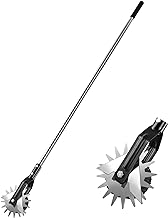
A rotary edger is a serrated disc on a long shaft that you roll along the seam between grass and concrete, using downward pressure to slice. It occupies a useful middle ground: faster than stepping on a half moon blade over a long run, and quieter and simpler than anything with a motor.
The three section handle is what makes it comfortable. At around 58 inches the tool reaches the ground without asking you to bend, and a cushioned grip makes a difference over a driveway length run where the same motion repeats hundreds of times.
Its limitation is the same as every manual edger: it maintains an edge rather than creating one. If turf has fully grown over the walkway, a rolling wheel will not cut through the mat of runners and soil, and you need a powered machine or a step-on blade for that first reset.
Line quality is entirely down to technique, since nothing guides the wheel except the seam itself. Consistent pressure gives a clean result, and any wobble transfers straight into the finished edge, which is the trade you accept for a tool with no moving parts to fail.
Bottom line: a quiet, low effort way to keep an existing edge crisp, provided the edge already exists.
- Type: manual rotary wheel edger
- Cutter: serrated steel wheel
- Handle: 58.3 inch, three sections, stainless steel
- Grip: cushioned
- Power: none required
- Use: maintaining defined edges along walks and beds
Right for someone whose edges are already established and who wants to keep them sharp without noise, fuel or charging, and for smaller properties where a powered machine feels like too much tool. Wrong for reclaiming a walkway that grass has covered, and wrong if you want a guaranteed straight line without developing the technique.
Rinse and dry the wheel after wet work so the serrations do not hold damp soil, and check that the handle sections stay tight, since a section that works loose changes the cutting angle mid stroke. Wear closed footwear: the cutting wheel sits close to your feet throughout. Store it hanging rather than leaning in a corner so the shaft does not take a set, and keep it out of reach of children, as the edge stays sharp with no guard.

Pros
- Cleanest, most controlled cut of any manual tool here
- Wide footplate lets your leg drive the blade instead of your back
- Nothing to charge, service, or store carefully
- Works along curves as easily as straight runs
- Rustproof steel construction for outdoor storage
Cons
- Slow over long runs compared with a powered machine
- Real physical effort in dry or compacted soil
- No guide, so accuracy depends on following the slab edge
The half moon edger is the oldest tool in this group and still the most precise. A crescent blade on a long handle, stepped down against the slab edge, cuts a vertical wall exactly where you place it, and because the blade sits flush against the concrete the line comes out straight without any guide at all.
The footplate is the detail that separates a good one from a frustrating one. A wide plate lets you drive the blade with your body weight through your leg, which is both more powerful and easier on your back than pushing by hand. Combined with a 41 inch handle, that keeps you upright through the job.
Spring steel is the right choice of material here because the blade needs to flex slightly under load and return rather than take a permanent bend. It also means the edge holds through soil contact that would blunt softer steel, and the rustproof finish suits a tool that lives in a shed.
The honest limit is pace. Every cut is a separate step, so a long driveway is a workout rather than a chore, and dry compacted ground makes each cut harder. Watering the line the day before is the trick that makes this tool pleasant.
Bottom line: the best value here by a distance for defined bed borders and short walks, and the tool that produces the sharpest line of anything on this list.
- Type: manual half moon step-on edger
- Blade: tempered spring steel crescent
- Handle: 41 inch with long rubber grip
- Footplate: wide, for leverage
- Material: rustproof manganese steel
- Power: none required
The right tool for garden bed borders, short front paths and anyone who values a perfectly placed line over speed. It is also the sensible choice where noise is a constraint or storage is tight. It is the wrong tool for reclaiming a long driveway that turf has fully crossed, which is a job for a powered machine with a depth setting.
Water the line the day before if the ground is dry, which turns hard work into easy work. Place the blade flush against the slab edge, step down through the footplate with your weight over the handle, then rock the blade back slightly to release the cut before moving one blade width along. Work in overlapping cuts rather than trying to lever out long strips, and lift the severed turf away with a hand trowel afterward so the new edge stays visible.
How to Choose a Sidewalk Edger
Read the first criterion even if you skip the rest. Mechanism decides everything downstream: how straight your line comes out, how long the job takes, and whether you will actually do it twice a season.
Powered, Cordless, or Manual: Choose the Mechanism First

A powered walk-behind edger drives a vertical steel blade on a motor shaft and rolls along on a guide wheel that rides the pavement. It produces the cleanest line of the three types because the wheel does the aiming for you, and it is the only mechanism that will cut a fresh edge through turf that has never been separated from the concrete. The trade-off is bulk: these are wheeled machines that need storage space and a flat surface to run along.
A cordless edger is the same machine with a battery pack instead of a cord. It goes anywhere in the yard, including beds and paths that no extension cord reaches, and it starts instantly. What you give up is sustained cutting power in dense or dry soil, plus the runtime ceiling: when the pack is empty the job stops until it charges, so the size of your property matters more than the specification sheet suggests.
Manual tools split into two shapes. A half moon edger is a flat crescent blade on a long handle that you step on, and it gives a genuinely crisp edge with total control at zero noise. A rotary wheel edger has a serrated disc you roll along the seam. Both need a well defined existing edge and physical effort, and neither will reclaim a walkway that turf has fully covered. They are maintenance tools rather than reclamation tools.
Blade Depth and Why Adjustable Settings Matter
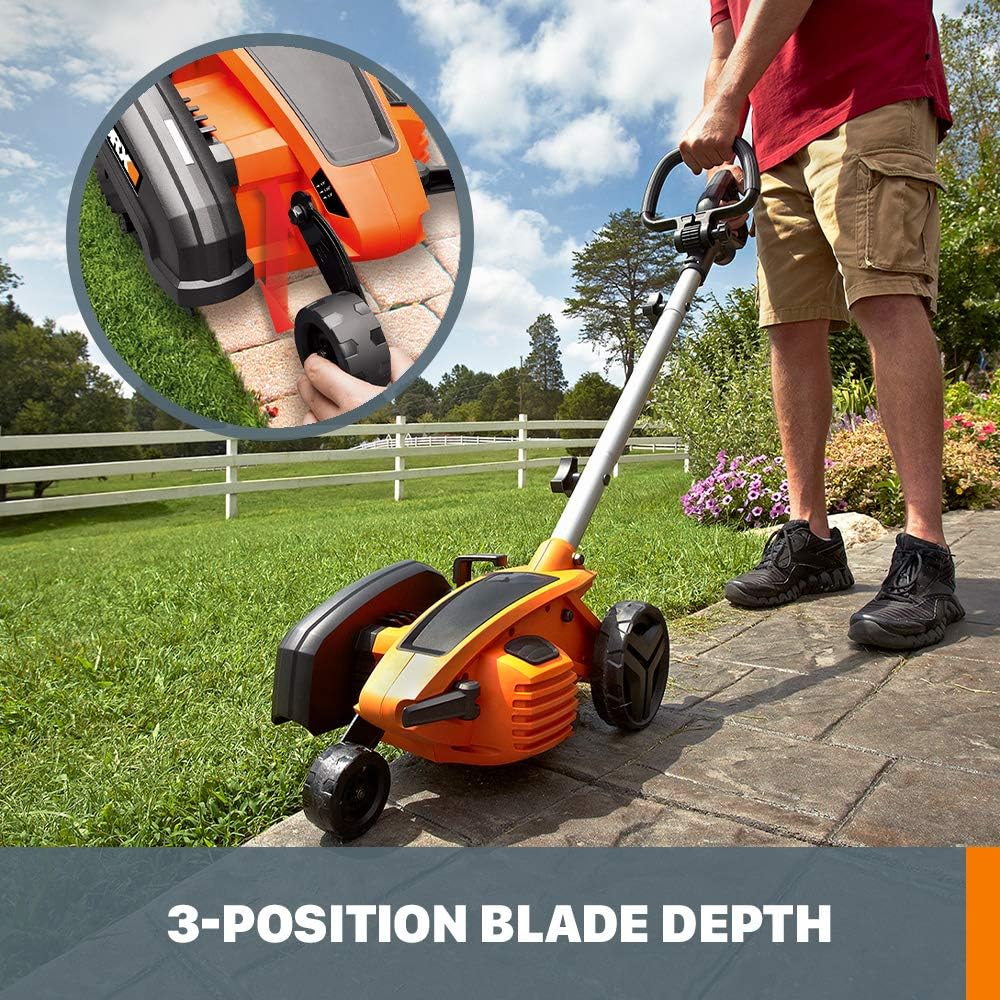
Cutting depth is the single specification that separates an edger that looks good for a month from one that looks good until the next mow. A shallow pass slices the visible grass blades but leaves the runners intact just under the surface, which is why the lawn creeps back within days. A deeper cut severs those runners and buys real time between passes.
Most powered units offer three positions, roughly a shallow maintenance setting, a mid setting for a routine reset, and a deep setting that doubles as a trenching cut. What matters is how the setting is changed. A lever or dial you can move without tools gets used, and a bolt that requires a wrench does not, so the adjustment mechanism is worth more attention than the raw depth number.
Deeper is not automatically better. Cutting to full depth along a sidewalk laid on a shallow gravel base can undercut the slab edge, and doing it every pass removes more soil than the turf can refill. The sensible pattern is a deep cut once at the start of the season to define the line, then shallow maintenance passes for the rest of the year.
Corded Power Against Battery Freedom

Corded electric edgers hold full torque from the first foot of the driveway to the last, which is exactly what you want when the blade meets compacted soil at the end of a dry August. Amperage is the useful comparison figure here, and the practical constraint is not power but geometry: you need outlets within reach and you spend some of your attention managing the cord so it does not track behind the wheel.
Battery platforms trade that consistency for reach. If you already own tools on a given battery system, a bare or kit edger on the same platform is the cheapest way into powered edging and the spare pack you already own doubles your runtime. Voltage tells you something about available torque, and higher voltage systems generally handle thick turf with less bogging, but pack capacity is what decides how far you get.
Match the choice to the run length rather than to the brochure. A short front path and one flower bed is comfortably within any battery. A property with a long driveway, a curb strip and paths around the back is where a cord stops being an annoyance and starts being an advantage, because nothing about the job changes when the machine has been running for twenty minutes.
Edging and Trenching Are the Same Tool
Most powered edgers in this class advertise a dual use, and it is not marketing filler. Set the blade to its deepest position and the same machine cuts a narrow trench, which is the standard way to bury low voltage landscape lighting cable, an irrigation line or the perimeter wire for a robot mower. That single feature is often what justifies buying a dedicated machine instead of adapting a trimmer.
The trench a lawn edger produces is narrow and shallow by design, roughly the width of the blade and a few inches deep. That is right for cable and wire and wrong for pipe, so check your actual project before assuming the machine covers it. For anything deeper you are back to a spade or a rented machine.
Trenching is also the mode that finds buried surprises. Sprinkler lines, old fence spikes and tree roots all sit in the first few inches of soil near a walkway, and a steel blade at full depth will find them at speed. Knowing where your irrigation runs before you start is worth more than any feature on the machine, and links back to how easily the blade can be replaced when something does go wrong.
Guide Wheels, Curb Wheels, and Keeping the Line Straight
A straight edge is mostly a function of the guide system, not of your steady hand. Powered edgers ride on wheels that follow the hard surface, so the blade stays a fixed distance from the concrete no matter how the machine is being pushed. This is why a first attempt with a proper edger looks better than a tenth attempt with a trimmer held on its side.
Look for a dedicated curb wheel if you have raised curbing along a driveway or a street strip. It rolls along the vertical face and holds the machine at a constant offset around gentle curves, which is where freehand edging usually wanders. Without one you can still follow a curve, but you will be correcting constantly and the result shows it.
Manual tools have no guide at all, so the surface itself is the guide. A half moon edger stepped down hard against the slab edge gives a very accurate line because the blade sits flush against the concrete. A rotary wheel edger relies on you keeping consistent downward pressure, and any wobble transfers straight into the finished edge.
Weight, Handle Geometry, and What Your Back Will Tolerate
Powered edgers carry their own weight on wheels, so the number on the specification sheet matters far less than how the machine turns at the end of a run and how it loads into a car or up basement stairs. Corded units are the lightest because there is no battery pack, which is a genuine advantage when the machine has to be carried rather than pushed.
Handle height is the ergonomic detail people notice only after the first session. An adjustable handle lets a tall user stand upright instead of stooping, and on a manual tool the difference between a handle sized for the job and a short one is the difference between using your leg to drive the blade and bending at the waist to push it. Look for a long shaft with a real grip on any step-on edger.
Vibration and noise close the list. Corded and cordless electric machines are quiet enough for a weekday evening in a close neighborhood, and manual edgers are silent, which is not a small thing when the alternative is a gas engine. If your edging window is early Sunday morning, mechanism choice has a social dimension as well as a practical one.
| Mechanism | Best at | Weak at |
|---|---|---|
| Corded walk-behind | Steady power, long driveways, deep trenching | Needs outlets, cord management around curves |
| Cordless walk-behind | Reach anywhere, instant start, quiet running | Runtime ceiling, bogs in dense dry soil |
| Manual half moon or rotary | Silent, precise, no maintenance, tiny storage | Physical effort, will not reclaim a covered edge |
If your shortlist crosses into cable burying or lighting work, the same criteria carry over to the gear indexed in our tools and home improvement section.
Why You Should Trust Us
We build these lists from published specification and from the pattern of what long-term owners report, rather than from marketing copy. For each edger here we compared the cutting mechanism, blade diameter and depth settings, how the depth adjustment is made, whether a curb wheel is included, power source and platform, and whether the maker sells replacement blades separately.
Owner feedback is most useful where it repeats. The complaints that recur across a model are the ones that describe the tool: bogging in dry soil, a depth lever that will not stay set, a guide wheel that skips on rough concrete. We weighted those repeated patterns and set aside one-off reports, and we skipped near-identical listings that differ only in battery bundle so that every entry here is a genuinely different machine.
Final Thoughts
Best overall is the WORX WG896 12 Amp Electric Lawn Edger. It combines a three position depth control, a proper guide wheel and the consistent torque of a corded motor, which together handle the two jobs most people actually have: resetting an overgrown walkway edge once, then keeping it crisp with quick passes.
Best value is the CKLT 41 inch Manual Half Moon Border Edger. It is the simplest tool here, it stores on a hook, it never needs power or maintenance, and for a short front path or a bed border it produces an edge as clean as anything a motor makes. If your edges are already defined and you just want them kept sharp, this is all the tool the job requires.
For specific situations, the WORX WG898 Cordless Lawn Edger is the pick if you want powered edging without an extension cord, the Greenworks 60V Cordless Lawn Edger is the one to choose for the most torque in a battery machine, and the BLACK+DECKER LE760FF Edger and Trencher is the corded alternative if you want a dual purpose machine with a slightly different handle setup. Anyone edging around curves and raised curbing should prioritize a curb wheel over everything else on the list. More outdoor picks are indexed across our article archive and the category index.
Sidewalk Edger FAQs
What does a sidewalk edger do that a string trimmer cannot?
An edger cuts a vertical wall between the turf and the pavement using a steel blade that spins in a vertical plane, guided by a wheel riding on the hard surface. A string trimmer turned on its side cuts horizontally with flexible line, so it removes the grass tops but leaves the runners and the soil shoulder intact, and it wanders because nothing is guiding it. The result is a scalloped line that closes up again within a week or two, which is the exact problem an edger exists to solve.
How deep should I cut along a sidewalk?
Use the deepest setting once to establish the line, then drop to a shallow or mid setting for maintenance. The first pass needs to sever the runners that sit just below the surface, which is what stops the turf creeping straight back, but repeating that depth every time removes more soil than the lawn refills and can undercut a slab laid on a shallow base. Once the line exists, a light pass every few weeks keeps it looking fresh.
Is a corded edger worth the cord, or should I go cordless?
Decide by run length. Corded machines hold torque indefinitely, which matters on a long driveway, a curb strip or dry compacted soil where a battery unit starts to bog. Cordless wins on convenience and reach, especially for beds and back paths no extension cord serves, and it makes obvious sense if you already own packs on that platform. For most suburban lots either works, so the question is really whether outlets are within reach of everywhere you edge. Both types are covered in our lawn and garden category.
Can an edger cut through roots and hard packed soil?
Powered edgers handle small surface roots and compacted soil, though both slow the blade and a corded motor deals with that load more gracefully than a small battery pack. Anything larger than a finger sized root should be cut with loppers or a saw first, because a steel blade meeting a substantial root at speed is how blades bend and mounting bolts loosen. Water dry ground the day before if you are resetting an edge in late summer, since damp soil cuts far more easily.
How often does an edge need redoing in 2026?
Once the line is established, most lawns need a maintenance pass every three to four weeks through the growing season and none at all in winter. Fast spreading warm season grasses such as bermuda push over concrete quickly and may want a pass with every second mow, while cool season lawns hold a line much longer. The practical test is visual: when the concrete looks narrower than it did, the runners have crossed and it is time.



Write Your Review
No reviews yet. Be the first to share your experience!