

Above three thousand pounds per square inch, the pressure rating stops being the number that decides how fast you finish a driveway. Water flow does. A machine rated at 3000 PSI moving 1.76 gallons per minute carries less water to the surface every second than one rated slightly lower at 2.5 gallons per minute, and the surface is cleaned by water arriving, not by pressure existing. Our top pick is the Westinghouse WPX3200 for pairing a high rating with genuine flow rather than trading one against the other. This shortlist of 8 options covers gas and electric machines from Simpson, Westinghouse, VEVOR and more, compared on the pairing of pressure and flow that actually predicts how long a job takes.
Every machine here is a current listing with real customer ratings behind it, spanning consumer gas units, commercial grade frames, and the electric models that now reach into this pressure band. For related outdoor equipment, see our patio and garden picks.

Pros
- High pressure paired with genuine flow rather than traded against it
- Onboard soap tank removes the need for a separate applicator
- Nozzle set covers the useful spray angles
- Rating history is the deepest in this shortlist
- Consumer weight and size rather than a commercial frame
Cons
- Axial pump is not built for hours of continuous daily running
- Gas engine needs oil changes and fuel management
The WPX3200 is our lead pick because it refuses the trade that spoils most machines in this pressure band. Reaching 3200 PSI is not remarkable on its own. Reaching it while still moving two and a half gallons every minute is, and that pairing is what turns a long concrete job from an afternoon into an hour.
The onboard soap tank is more useful than it sounds. Detergent applied through the machine at low pressure and left to dwell does most of the work on organic staining, and having the tank built in means that step actually happens instead of being skipped because the siphon tube is in a box somewhere.
The limits are the ordinary limits of a consumer gas machine. The pump is an axial cam design, which is correct for weekend use and not intended to run for hours every day. The engine needs its oil changed, and fuel left in it over a winter without stabiliser will cause the usual carburettor complaints.
Bottom line: the machine to buy if you want high pressure without quietly giving up the flow that makes it useful.
- Rated pressure: 3200 PSI
- Rated flow: 2.5 gallons per minute
- Power: gas engine
- Pump: axial cam
- Detergent: onboard soap tank
- Included: spray gun, wand, quick connect nozzles
- Frame: wheeled consumer chassis
Confirm your water supply can sustain 2.5 gallons per minute before buying, since a starved pump cavitates and cavitation is what kills pumps. Time a bucket fill through your intended supply hose.
Keep the zero degree nozzle in the box for almost all work. A fifteen degree nozzle does nearly everything it can without carving lines into concrete.
Switch the machine off rather than leaving it idling with the trigger closed. Water circulating in bypass heats up and damages pump seals, and this is the most common cause of premature failure.
Run gas machines outdoors only, never in a garage. Wear eye protection and closed footwear, and keep the wand pointed away from people at all times.

Pros
- Honda GX200 engine with widely available parts and service
- Commercial aluminium frame resists corrosion
- Highest pressure rating in this shortlist
- Full 2.5 gallon per minute flow at that pressure
- Built for sustained rather than occasional use
Cons
- Heavier and bulkier than consumer machines
- More machine than most household jobs require
This is the machine in the shortlist built for work rather than for chores. The aluminium frame does not rust, the layout is designed to be wheeled around a site rather than stored in a shed corner, and the Honda GX200 engine is the reason people specify machines like this in the first place.
Engine choice matters more over years than over weekends. A GX200 is a known quantity with parts on shelves and mechanics who have seen a thousand of them, which means a machine that needs attention in year five can actually get it. Generic engines can run perfectly well and are considerably harder to keep running once something obscure fails.
Combined with the highest pressure rating here and full flow alongside it, this is the fastest machine in the group on large hard surfaces. What you accept is weight, bulk, and capability you may never use. On a small patio it is overkill in a way that makes the job harder, not easier, because surfaces this machine can damage are everywhere.
Bottom line: buy it if the machine will earn its keep, and buy something lighter if it will not.
- Rated pressure: 3600 PSI
- Rated flow: 2.5 gallons per minute
- Engine: Honda GX200
- Frame: aluminium, commercial specification
- Included: professional spray gun, wand, nozzles
- Intended duty: sustained commercial use
- Mobility: wheeled frame
Contractors and heavy domestic users running the machine for hours at a stretch, where frame durability and engine serviceability outweigh weight.
It also suits shared or rental style use, since a Honda engine is the one most operators already know how to start and maintain correctly.
Follow the engine oil schedule rather than the machine's overall usage, since engine hours accumulate faster than the calendar suggests on a working unit. Drain or stabilise fuel before storage.
At 3600 PSI, surface damage happens fast. Test on an inconspicuous area first and start further back than feels necessary.

Pros
- Commercial build intended for regular heavy use
- Full flow maintained at a high pressure rating
- Robust frame and wheels for site movement
- Complete nozzle set for varied surfaces
- Established brand in the professional segment
Cons
- Heavier than consumer machines to move and store
- Capability exceeds what most household surfaces tolerate
The Simpson Cleaning unit sits just below the Aluminum Series in rating and shares its intent. This is a machine specified for commercial use, which in practice means the frame, the gun, and the hose are built to be dragged across concrete repeatedly rather than lifted carefully out of a garage twice a year.
The pairing of 3400 PSI with 2.5 gallons per minute puts it firmly in the fast category for large surfaces. On a driveway or a yard of paving, throughput at this level is the difference between finishing and giving up.
The considerations are the same as for any machine in this class. It is heavy, it needs somewhere to live, and the pressure available will strip more than you intend if the nozzle choice is careless. Gas maintenance applies as usual, with oil and fuel both needing attention.
Bottom line: a serious machine for people with serious amounts of hard surface, and unnecessary for anyone else in this list.
- Rated pressure: 3400 PSI
- Rated flow: 2.5 gallons per minute
- Power: gas engine
- Duty rating: commercial use
- Included: spray gun, wand, quick connect nozzles
- Frame: wheeled, heavy duty
- Hose: commercial specification
Owners of large paved areas, farm and workshop users, and anyone cleaning heavy equipment where a consumer machine would be worked beyond its intent.
Households with a patio and a car will find this more machine than the surfaces can safely take.
Never leave the machine running with the trigger closed for extended periods, as recirculating water heats and damages seals. Switch off between tasks.
Operate outdoors only and keep bystanders clear. Plant your feet before triggering, since kickback at this flow is significant.

Pros
- Honda GX200 engine with excellent parts availability
- Triplex pump runs cooler and can be rebuilt
- High pressure with full flow retained
- Integrated unloader and thermal relief valve
- Commercial frame built for repeated site use
Cons
- Weight makes it awkward for occasional light jobs
- Requires the usual gas engine maintenance routine
The PowerShot occupies the space between the two other Simpson machines here, and its argument is the pump as much as the engine. A Honda GX200 driving a triplex pump rated for 3500 PSI and 2.5 gallons per minute is a combination that starts predictably, holds its rating under load, and can be serviced anywhere.
Triplex matters over years. Where an axial pump is a sealed unit replaced when it wears, a triplex runs cooler, turns more slowly, and can be rebuilt, which is why it appears on machines meant to run for hours rather than minutes. This one also carries an integrated unloader and a thermal relief valve, the safeguard that dumps water once bypass temperature climbs.
The drawbacks are practical rather than technical. It is not a machine you casually carry out to wash a car, and the maintenance routine of oil, fuel, and winter storage is real work that electric owners avoid entirely.
Bottom line: the machine here built to be kept rather than replaced, provided the work justifies the size.
- Rated pressure: 3500 PSI
- Rated flow: 2.5 gallons per minute
- Engine: Honda GX200
- Pump: AAA triplex with integrated unloader
- Safety: thermal relief valve fitted
- Hose: MorFlex polyester braid, kink resistant
- Frame: commercial specification, wheeled
Match the machine to your hardest regular job rather than your most common one, then moderate with nozzle choice for everything else. Buying above your needs in this category costs weight and storage rather than performance.
Verify supply flow before purchase. High flow machines are the ones most likely to outrun a domestic tap.
Change engine oil on schedule and use fresh fuel with stabiliser for storage. A carburettor that has sat on stale fuel is the most common winter complaint.
Wear eye protection, keep the spray path clear of hands and feet, and never run a gas machine in an enclosed space.
Pros
- Induction motor runs quieter than universal motor designs
- No fuel, oil, or exhaust to manage
- Instant starting with no pull cord
- Reaches the 3000 PSI band on household power
- Suited to patios, vehicles, and siding
Cons
- Flow is well below the gas machines here, so large areas take longer
- Corded operation limits working range
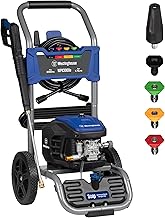
The WPX3000e is the machine to buy when the things you want to avoid are noise, exhaust, and maintenance. An induction motor is a meaningful upgrade over the universal motors common on cheaper electric washers, running quieter and tolerating longer sessions without heat becoming the limiting factor.
It reaches the 3000 PSI band, which is genuinely useful, but the flow figure of 1.76 gallons per minute is where the household power ceiling shows. Multiply the two and this machine produces roughly two thirds the cleaning power of the gas units in this list, which translates directly into time spent on large surfaces.
For its intended work that is entirely acceptable. Patios, garden furniture, vehicles, siding, and bins are jobs where instant starting and quiet running are worth more than throughput, and where the absence of an engine to maintain is a genuine ongoing benefit.
Bottom line: the right electric choice in this pressure band, provided you are honest about the size of the areas you plan to clean.
- Rated pressure: up to 3000 PSI
- Rated flow: 1.76 gallons per minute
- Motor: induction type
- Power: household mains supply
- Included: spray gun, wand, quick connect nozzles
- Emissions: none during use
- Maintenance: no oil or fuel required
Households cleaning patios, cars, furniture, and siding who want to press a switch rather than pull a cord, and who do not want fuel stored in a garage.
Anyone facing a long driveway regularly should look at the gas machines here, where flow is roughly forty percent higher.
Apply detergent at low pressure first and let it dwell before rinsing. On a lower flow machine this matters more, because chemistry is doing work the water volume cannot.
Use the widest nozzle that will do the job and work in overlapping passes rather than concentrating in one spot to compensate for flow.

Pros
- Highest flow figure in this shortlist at its rating
- Consumer weight rather than a commercial frame
- Extension wand included for reach
- Full nozzle set supplied
- Strong cleaning power for the class
Cons
- Shorter rating history than the established brands here
- Generic engine is less widely serviced than a Honda
Run the cleaning unit arithmetic across this shortlist and the VEVOR comes out near the top, because 3400 PSI at 2.6 gallons per minute is a genuinely strong pairing. That is more flow than any other machine here, and flow is what covers ground.
It arrives as a consumer machine rather than a commercial one, which for most buyers is the right shape. It is lighter to move and easier to store than the Simpson units while producing comparable throughput on large surfaces, and the included extension wand solves the common problem of reaching the far side of a vehicle or the top of a wall.
What you accept is a shorter track record and a generic engine. Neither is a fault, but a Honda GX200 has decades of parts availability behind it and a generic engine does not, which matters if you expect to keep the machine for many years rather than a few.
Bottom line: the value pick, delivering commercial class throughput in a package sized for a household.
- Rated pressure: 3400 PSI
- Rated flow: 2.6 gallons per minute
- Power: gas engine
- Included: spray gun, extension wand, five nozzles
- Frame: wheeled consumer chassis
- Pump: axial cam
- Detergent: siphon capability
The high flow figure is the reason to buy this machine and also the thing your water supply must meet. Verify your tap can deliver 2.6 gallons per minute through your supply hose before ordering.
Keep the extension wand for high work only. Extra length adds fatigue and reduces control at ground level.
Follow break-in and oil instructions carefully on a new engine, since the first hours set how the machine behaves later. Use fresh fuel and stabilise it for storage.
Switch off rather than idling in bypass. Wear eye protection and keep the wand pointed away from people and pets.

Pros
- High pressure and high flow together
- 212cc engine sized to sustain the rating under load
- Heavy duty construction for the consumer class
- Nozzle set covers heavy and light work
- Strong throughput for large concrete areas
Cons
- Limited rating history compared with established brands
- Heavy to move for occasional light tasks
The BILTHARD pairs one of the higher pressure ratings here with one of the higher flow figures, and the 212cc engine is the part that makes that pairing credible. Engine displacement determines whether a machine holds its rating once the trigger has been open for a while, and an undersized engine driving an ambitious pump produces numbers on a box rather than performance in a yard.
On large hard surfaces this puts it among the fastest machines in the shortlist. The construction is heavier than typical consumer machines, which helps with stability when the gun kicks at this flow.
The caution is track record. This is a newer listing without the years of accumulated feedback that the Westinghouse and Simpson machines carry, and in a category where pump and engine longevity are the real questions, that history has value. Parts availability for a generic engine is the other unknown.
Bottom line: strong specifications and real throughput, bought with less long term evidence behind it than the established names.
- Rated pressure: 3500 PSI
- Rated flow: 2.6 gallons per minute
- Engine: 212cc, four cycle
- Frame: heavy duty consumer construction
- Included: spray gun, wand, nozzle set
- Pump: axial cam
- Mobility: wheeled chassis
Buyers who want maximum throughput per pound spent and are comfortable with a less established name. It suits large driveways, farm yards, and equipment washing.
Buyers who value a long service record and guaranteed parts availability should choose the Honda powered options instead.
Read the break-in schedule before first use and change the initial oil fill on time, as early oil changes matter most on a new engine.
At 3500 PSI, keep well back from painted surfaces, softwood, and older mortar. Test any new surface from a distance first.
Pros
- Higher flow than most electric machines at this pressure
- Brushless motor with no brushes to wear out
- No fuel, oil, or exhaust
- Quiet enough for residential areas at any hour
- Lighter and more compact than gas alternatives
Cons
- Still below gas machines on total cleaning power
- Corded operation limits range from an outlet
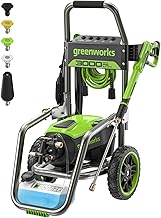
The Greenworks is the electric machine that narrows the gap. Where most household powered washers in the 3000 PSI band settle for flow figures below two gallons per minute, this one reaches two, and that difference is worth more than it looks: it lifts cleaning power by roughly a seventh over the closest electric comparison here.
The brushless motor is the other technical point in its favour. Brushed motors wear their brushes as a consumable and heat up faster during long sessions, while a brushless design has fewer wearing parts and handles sustained running better.
It remains an electric machine on a cord, with the range and flow limits that implies. Against the gas units here it will take longer over a large driveway, and it needs an outlet within reach of a safe extension arrangement. For everything short of that, the absence of engine maintenance is a real and repeated benefit.
Bottom line: the best electric compromise in this shortlist, and the one to choose if you want the 3000 PSI band without an engine.
- Rated pressure: 3000 PSI
- Rated flow: up to 2.0 gallons per minute
- Motor: brushless electric
- Power: household mains supply
- Included: spray gun, wand, quick connect nozzles
- Emissions: none during use
- Maintenance: no oil or fuel
Use a heavy gauge extension cord rated for the machine's draw, or better, position the machine near the outlet and extend the water supply instead. Undersized cords cause voltage drop and heat.
Let detergent dwell before rinsing. On any machine below gas flow levels, chemistry does part of the work the water volume cannot.
Keep electrical connections off wet ground and use a residual current device where available. Never handle the plug with wet hands.
Switch off between tasks rather than leaving the pump in bypass, and store the machine somewhere it will not freeze with water in the pump.
How to Choose a Pressure Washer Over 3000 Psi
The criteria below are ordered by how much they change the outcome, starting with the arithmetic that the box never shows you.
Pressure Times Flow Is the Number That Matters
The trade uses a figure called cleaning units, which is simply the pressure rating multiplied by the flow rating. It exists because neither number alone describes a machine. Pressure is what breaks the bond between dirt and the surface. Flow is what carries the loosened dirt away and covers ground. A machine strong on one and weak on the other feels disappointing in a way the specification sheet does not explain.
Run the arithmetic on the models in this list and the ranking changes. A 3200 PSI machine at 2.5 gallons per minute produces eight thousand cleaning units. A 3000 PSI machine at 1.76 gallons per minute produces just over five thousand. The second machine has ninety four percent of the pressure and sixty six percent of the cleaning power, and on a large concrete area that difference is measured in hours.
This is why the gas machines in this shortlist dominate the top of it. Reaching high pressure is not difficult. Reaching high pressure while still moving two and a half gallons every minute requires an engine with enough power to drive a pump that big, and that is where the electric models run into their limit.
Why Electric Machines Reach the Rating but Not the Flow

An electric pressure washer on a standard household circuit has a hard ceiling on the power it can draw, and that ceiling sets the total work the pump can do. Manufacturers can spend that budget on pressure or on flow, and marketing rewards pressure, so machines advertised at 3000 PSI on household power almost always arrive with modest flow figures attached.
This is not a criticism of the machines, it is a description of what they are for. The Westinghouse WPX3000e and the Greenworks electric model in this list are quiet, they start instantly, they produce no exhaust, and they need no fuel or oil. For a patio, a car, garden furniture, or siding around a house, all of that is worth more than raw throughput.
The point at which electric stops making sense is large area concrete. Cleaning a long driveway with a low flow machine is not impossible, it is slow, and slow work at that pressure is also work where you are tempted to hold the nozzle too close to compensate.
Pump Type Decides How Long the Machine Lasts
Two pump designs appear in this category and they have very different service lives. Axial cam pumps are compact, sit directly on the engine shaft, and are used across almost all consumer machines. They are also sealed units in most cases, which means when they wear they are replaced rather than serviced.
Triplex pumps use three pistons driven by a crankshaft, run cooler, turn more slowly, and can be rebuilt. They are heavier and considerably more expensive, and they are what separates a machine intended for weekend use from one intended to run for hours daily. The Simpson PowerShot in this shortlist states an AAA triplex pump with an integrated unloader and thermal relief valve, which is exactly the specification that distinction describes.
For most buyers an axial pump is the correct choice and the rebuild question never arises. The reason to know the difference is honesty about use: if the machine will run for several hours at a stretch on a regular basis, an axial pump is being asked to do a job it was not designed for.
What Engine Displacement Actually Buys
Gas machines in this band commonly use engines around 200 cubic centimetres, and several of the listings here state 212cc directly. Displacement matters because the engine has to supply enough power to drive the pump at its rated pressure and flow simultaneously, and an underpowered engine will hold rated pressure only until the trigger has been open for a while.
Engine brand is worth noticing too. Several machines in this shortlist specify a Honda GX200, which is a known quantity with widely available parts and service knowledge. Generic engines can be perfectly reliable, but when something needs replacing years later the difference between a common engine and an obscure one becomes very practical.
Note that gas machines need oil changes, fuel stabiliser over winter, and a carburettor that objects to stale fuel. None of that is difficult, and all of it is work that electric owners never do.
Nozzles Change the Machine More Than the Rating Does
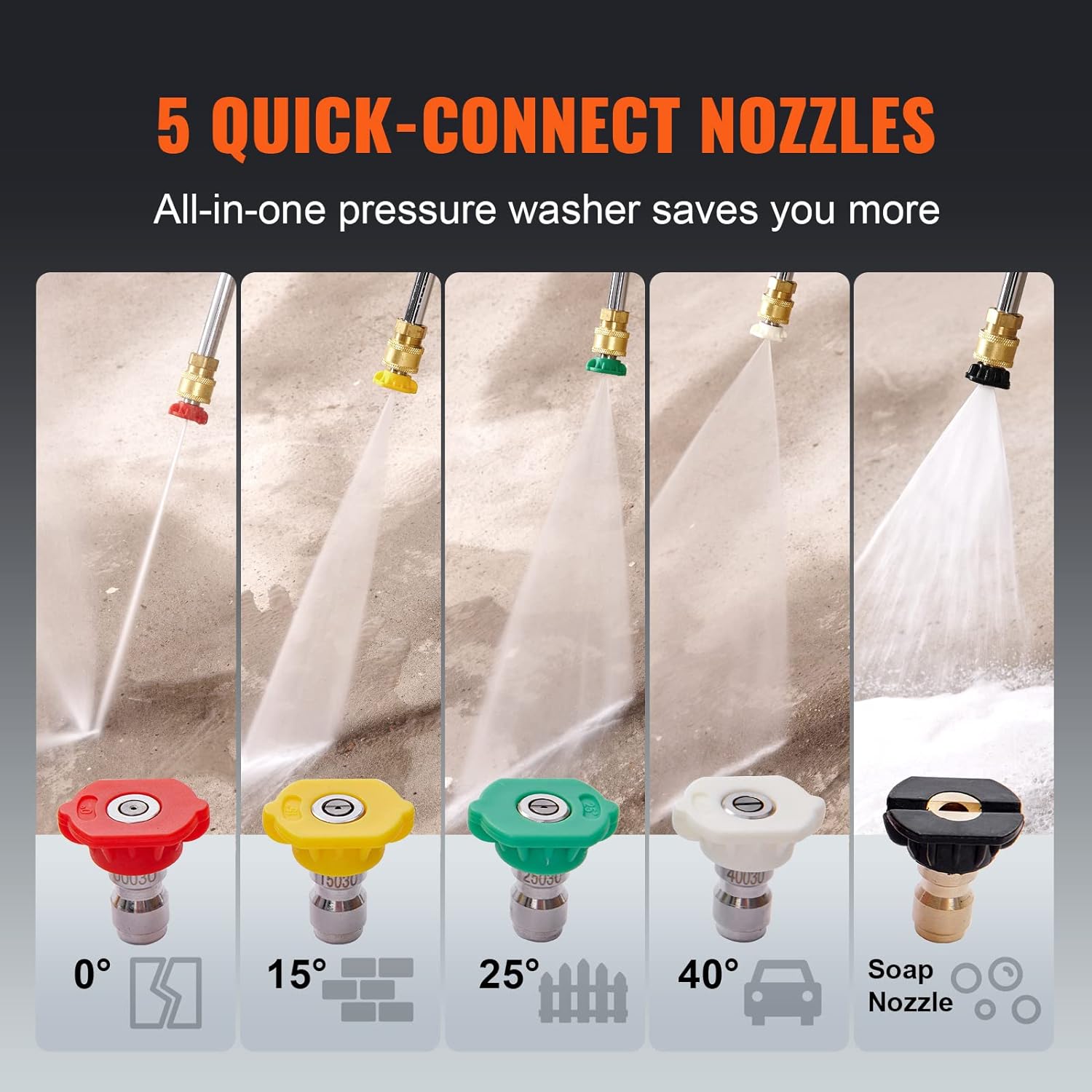
Every machine here ships with a set of quick connect nozzles, colour coded by spray angle, and swapping between them changes the effective pressure at the surface far more dramatically than the difference between two machines. A zero degree red nozzle concentrates the entire flow into a pencil jet. A forty degree white nozzle spreads the same flow across a wide fan at a fraction of the intensity.
The practical consequence is that a well used 2800 PSI machine with the right nozzle outperforms a 3500 PSI machine used with the wrong one. It also means the zero degree nozzle is the most dangerous item in the box and the one with the fewest legitimate uses, since almost anything it can do a fifteen degree nozzle can do without carving a line into the surface.
Turbo or rotary nozzles deserve a separate mention. They spin a zero degree jet in a cone, which gives you concentrated impact spread over an area, and on concrete they are the single accessory that most changes how quickly a job goes. Several machines in this list include one.
Hose Length and Diameter Cost You Pressure

Pressure is measured at the pump, and what reaches the nozzle is lower because every metre of hose has friction. Longer hoses lose more, and narrow hoses lose considerably more than wide ones. A machine sold with a long thin hose can deliver noticeably less at the trigger than its rating suggests, which is invisible when comparing boxes.
Hose material matters for handling rather than performance. Plastic hoses are cheaper and stiffen badly in cold weather, coiling into shapes that fight you. Rubber and hybrid hoses stay flexible and are much less prone to kinking, which on a long job is worth real money in frustration avoided.
If you extend a hose, go wider rather than longer where you have the choice, and check the maximum working pressure of any replacement against the machine. A hose rated below the pump is a failure waiting for the moment you are holding it.
Do Not Hold the Trigger Closed
When the trigger is released but the machine is running, the pump keeps turning and the water has nowhere to go. A valve called the unloader diverts flow back to the pump inlet to handle this, which works, but the water being circulated is doing no work and it heats up. Leave a machine idling in bypass for several minutes and the pump can reach temperatures that damage seals.
The habit that prevents this costs nothing: if you are stopping for more than a minute or two, switch the machine off. It is the single most common cause of premature pump failure on machines that were otherwise treated well.
Some machines include a thermal relief valve that dumps hot water once bypass temperature climbs, and the Simpson PowerShot names one in its specification. It is a useful safeguard rather than a licence to idle, and not every machine has one.
Your Water Supply Has to Keep Up
A pressure washer cannot deliver more water than it receives. A machine rated at 2.5 gallons per minute needs a supply that provides at least that much continuously, and a garden tap on a long thin hose sometimes does not. Starve the pump and it cavitates, which means the pump is drawing air along with water, and cavitation destroys pumps faster than almost anything else.
Check your supply before buying a high flow machine. Time how long your tap takes to fill a bucket of known volume, at full flow, through the hose you intend to use. If the answer falls short of the machine’s rating, either the machine or the supply hose needs to change.
Use the widest, shortest supply hose that reaches, and keep the inlet filter clean. Both are trivial and both protect the most expensive component in the machine.
What This Much Pressure Does to Surfaces
Above three thousand pounds per square inch, many household surfaces are no longer candidates. Softwood decking furs up and splinters. Painted surfaces lose paint. Mortar between older bricks erodes. Vinyl siding takes water behind it if the spray angles upward under a lap. Car paint is out of the question at close range with a narrow nozzle.
The control you have is distance and nozzle angle, not the machine’s rating, and both need to be practised somewhere that does not matter before starting on something that does. Begin far away with a wide nozzle and move closer only as needed.
This is a real argument for buying flow rather than peak pressure. High flow at moderate pressure cleans large areas quickly and forgives mistakes. High pressure at low flow tempts you to work close, and working close is where damage happens.
Treat the Wand as a Tool That Can Injure
A jet at this pressure can break skin, and injection injuries from pressure washers are a recognised medical emergency precisely because they look minor. A small entry wound on a hand can carry water and contaminants deep into tissue, and the damage is far greater than the surface appearance suggests. This is not a theoretical risk and it is why zero degree nozzles deserve their reputation.
Wear closed footwear and eye protection, keep the wand pointed away from people and pets at all times including when the machine is off, and never brace a workpiece with your free hand near the spray path. Kickback at high flow is significant, so plant your feet before pulling the trigger.
Gas machines add carbon monoxide to the list. They must be run outdoors, never in a garage with the door open, and never near an air intake or an open window.
| Model | Power | Rated PSI | Rated GPM | Frame type |
|---|---|---|---|---|
| Westinghouse WPX3200 | Gas | 3200 | 2.5 | Consumer, onboard soap tank |
| Simpson Aluminum Series | Gas, Honda GX200 | 3600 | 2.5 | Commercial aluminium frame |
| Simpson Cleaning | Gas | 3400 | 2.5 | Commercial use |
| Simpson PowerShot | Gas, Honda GX200 | 3500 | 2.5 | Commercial frame |
| Westinghouse WPX3000e | Electric, induction | 3000 | 1.76 | Consumer |
| VEVOR | Gas | 3400 | 2.6 | Consumer frame |
| BILTHARD | Gas, 212cc | 3500 | 2.6 | Heavy duty consumer |
| Greenworks | Electric, brushless | 3000 | 2.0 | Consumer |
Whichever machine you pick, a hose reel keeps the run tidy and stops kinks forming. Our guide to pressure washer hose reels covers that, and our general pressure washer roundup covers lower pressure options.
Why You Should Trust Us
We compare machines on the specifications that predict real outcomes, which in this category means pressure and flow together rather than the headline figure alone. Every model here is a current listing with enough customer rating history to show how it behaves past the first season, which is when pump and engine issues surface.
We do not accept payment for placement, and where a machine trades flow for a bigger pressure number we say so plainly, because that trade is the single most common source of disappointment in this category.
Final Thoughts
The Westinghouse WPX3200 is our best overall pick because it pairs a high rating with real flow instead of choosing between them, and it adds an onboard soap tank that makes detergent application straightforward rather than an accessory purchase.
The VEVOR is our best value choice among the gas machines, delivering flow in the same class as the commercial units in a lighter consumer package. If the machine will run for hours at a time, the Simpson Aluminum Series with its Honda GX200 and commercial frame is the one built for that duty, and if noise, exhaust, and maintenance are what you want to avoid entirely, the Greenworks electric holds a useful flow figure for a machine on household power.
Whatever you choose, check that your water supply can feed it, keep the zero degree nozzle in the box, and switch the machine off rather than leaving it idling in bypass. More outdoor equipment is covered in our latest guides.
Frequently Asked Questions
Is a pressure washer over 3000 psi too powerful for home use?
For concrete, brick, and heavy equipment cleaning it is appropriate. For softwood decking, painted surfaces, older mortar, and vehicles it is more machine than the surface can take at close range. The nozzle and your working distance are what make it usable across those jobs, so buy the machine for your hardest surface and moderate it for the rest.
Should I buy gas or electric in 2026?
Gas if you are cleaning large concrete areas regularly, because household electrical supply limits how much flow an electric machine can produce at this pressure. Electric if you value instant starts, quiet running, and no fuel or oil maintenance, and your jobs are patios, siding, furniture, and vehicles rather than long driveways.
What does GPM mean and why does it matter more than PSI?
Gallons per minute is the volume of water the machine delivers. Pressure breaks dirt loose, flow carries it away and covers area, and the product of the two is what determines how fast a job finishes. Two machines with the same pressure rating can differ by a third in actual cleaning power because of flow alone.
Can my garden tap supply enough water?
Test it before buying a high flow machine. Time how long the tap takes to fill a container of known volume through the supply hose you plan to use, and compare that rate against the machine’s rating. A pump starved of water draws air and cavitates, which causes damage quickly, so a short wide supply hose is worth arranging.
How dangerous is a pressure washer at this rating?
Serious enough to warrant respect. A jet at this pressure can break skin and drive water and contaminants into tissue, producing an injury that looks small and is not. Wear eye protection and closed shoes, keep the wand pointed away from people and animals, and treat the zero degree nozzle as the specialist tool it is. See more outdoor gear in our category directory.





Write Your Review
No reviews yet. Be the first to share your experience!