

The voltage on the box tells you less than almost any other number in this category. Forty volts describes the potential the pack can deliver, but how long the tool runs comes from amp hours, how much of the charge reaches the cutting head comes from whether the motor is brushless, and how much lawn you cover per pass comes from cutting width. A 40V trimmer with a small pack and a brushed motor will disappoint next to one with the same voltage and better specifications everywhere else. Our top pick is the Greenworks 40V string trimmer and blower combination for pairing a proven platform with a second tool that shares the battery. This shortlist of 6 40v cordless string trimmer options from BLACK+DECKER, Greenworks, Worx and more compares the specifications that actually determine how a Saturday goes.
Every tool here is a current listing with real customer ratings behind it. For related outdoor equipment, see our patio and garden guides.

Pros
- Two tools sharing one battery from one purchase
- Answers the platform question immediately
- 390 CFM blower handles clippings after trimming
- 12 inch head is manageable around borders
- Established cordless garden platform with a wide tool range
Cons
- Brushed motor is less efficient than brushless designs
- 2.0 amp hour pack is modest for large gardens
This combination takes the top spot because it settles the decision that costs the most money over time. Batteries are the expensive part of cordless garden tools, so arriving with two tools already sharing one pack means the second tool cost a fraction of what it would have as a separate purchase.
The blower is genuinely useful rather than a token inclusion. Trimming produces clippings across paths and drives, and clearing them with the same battery that just did the cutting turns two chores into one continuous job.
The specification compromises are visible. The motor is brushed rather than brushless, so the same pack does not go as far as it would on a more efficient tool, and the 2.0 amp hour battery is modest, which for a large garden means either a second pack or a break halfway. The twelve inch head is easier around obstacles and slower across open ground.
Bottom line: the smartest first purchase in this shortlist, because it starts a platform rather than just buying a trimmer.
- Voltage: 40V
- Cutting width: 12 inches
- Motor: brushed
- Battery: 2.0 amp hours included
- Second tool: 390 CFM blower
- Charger: included
- Conversion: edger capability
Treat this as a platform purchase and check the wider tool range on the same battery before committing, since that range is what you will be buying into for years.
For gardens over a modest size, budget for a second or larger pack at the same time. Runtime, not power, is what ends most sessions.
Let a hot pack cool before charging. Charging a warm battery adds heat to heat, and heat is what shortens lithium pack life over years.
Wear eye protection whenever the head is spinning, since line throws stones and grit at speed. Clear the area of pets and debris first.

Pros
- Telescoping shaft adjusts to the user's height
- Edger conversion built into the design
- 13 inch cut covers ground faster than 12 inch heads
- Widely available spares and line
- Long established model with deep rating history
Cons
- Brushed motor uses battery less efficiently
- Automatic feed can advance line faster than needed
The telescoping shaft is the reason this is the value pick. Working a trimmer at the wrong length is what produces back ache after twenty minutes, and being able to set the tool to your height rather than adapting to it matters far more for anyone unusually tall or short than any specification on the box.
Edger conversion is built in rather than improvised, and the thirteen inch cut covers meaningfully more ground per pass than the twelve inch heads here while still being controllable around beds. Line and spares are available everywhere, which is worth something over the life of a tool.
Two things to know. The motor is brushed, so runtime per pack is shorter than a brushless equivalent, and the automatic feed system is the type that can advance line more eagerly than necessary, which shows up as a spool emptying faster than expected.
Bottom line: the best balance of comfort, capability, and cost here, particularly if the tool will be shared between people of different heights.
- Voltage: 40V MAX
- Cutting width: 13 inches
- Motor: brushed
- Shaft: telescoping, adjustable length
- Feed: automatic line advance
- Conversion: edger mode
- Handle: adjustable auxiliary grip
Set the shaft length and auxiliary handle position before the first use, standing upright with the head flat on the ground. Most owners never adjust either and work uncomfortably for years.
Buy line on bulk spools rather than pre wound cartridges once you know the diameter, since rewinding takes minutes and costs far less over a season.
Clear stones and debris from the area before starting, as line throws whatever it hits at speed. Eye protection is not optional.
Store the pack indoors rather than in an unheated shed over winter, and avoid leaving it on the charger indefinitely.

Pros
- Light and manoeuvrable around beds and obstacles
- Battery and charger included in the box
- 12 inch head wastes less battery on small jobs
- Same platform as a wide range of other tools
- Simple, proven design
Cons
- Narrow cut means more passes on open lawn
- Brushed motor limits runtime per charge
This is the standalone version of our top pick without the blower, and it makes sense for anyone who already owns a blower or does not need one. Twelve inches is a narrow cut, which sounds like a limitation and is the right choice for gardens where the work is intricate rather than open.
A narrower head draws less from the battery per minute and is easier to control around tree bases, flower beds, and fence posts, so on a small plot with many obstacles it can actually finish faster than a wider tool that has to be worked carefully.
On open lawn the arithmetic reverses. More passes are needed, and a brushed motor means the pack does not stretch as far as it would on a brushless tool. For a large garden this is the wrong end of the range.
Bottom line: the right size for small intricate gardens, and underpowered for large open ones.
- Voltage: 40V
- Cutting width: 12 inches
- Motor: brushed
- Battery: 2.0 amp hours included
- Charger: included
- Conversion: edger capability
- Weight: light for border work
Small gardens with lots of borders, beds, and obstacles, where control matters more than coverage, and households already on the Greenworks platform.
Large open lawns are better served by the fifteen or sixteen inch tools here.
Keep the guard fitted at all times. It sets the line length as well as protecting you, and running without it lets line extend beyond what the motor can drive.
Let packs cool before charging and store them out of freezing conditions over winter.
Pros
- Push button feed advances line only when you ask it to
- Dual exit cutting head for an even 13 inch swathe
- Accurate in line edging along paths and drives
- Light at around six and a half pounds with two packs
- Established platform with many compatible tools
Cons
- Brushed motor rather than brushless
- Feeding line still needs a deliberate press mid job
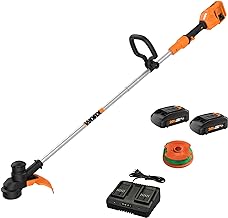
The WG183 sits in the middle of this shortlist on size and takes a considered position on line feeding. Rather than an automatic system that advances whenever it senses shortening, it uses a push button command feed, so line comes out when you press and not otherwise.
That is a genuine advantage over automatic systems, which can advance when they did not need to and quietly empty a spool over a season. It is also less effortless than automatic feeding, since it still requires a deliberate press mid job, but you keep control of consumption.
The dual exit head cuts an even thirteen inch swathe, in line edging is accurate along a path, and at around six and a half pounds with two packs fitted it is light enough for a long session. The motor is brushed, so runtime per pack trails the brushless options here.
Bottom line: a comfortable mid sized trimmer whose feed system respects your line supply, at the cost of brushless efficiency.
- Voltage: 40V
- Cutting width: 13 inches, dual exit head
- Motor: brushed
- Feed: push button command feed
- Conversion: in line edging
- Weight: around 6.4 lbs with two 2.0 Ah packs
- Platform: Worx 40V system
Press the command feed button briefly rather than holding it, since a long press advances more line than a cut needs and the guard simply trims the excess away.
Set the auxiliary handle where your arm falls naturally with the head at cutting height, rather than leaving it at the factory position.
Check the spool at the start of a session rather than discovering it empty halfway down a path.
Wear eye protection and clear stones from the working area before starting.
Pros
- Brushless motor extends runtime from the same pack
- 15 inch cut covers open ground quickly
- Holds speed better in thick growth
- Batteries and charger included
- Suits larger gardens where passes add up
Cons
- Wider head is less precise around beds and obstacles
- Heavier than the 12 and 13 inch tools here
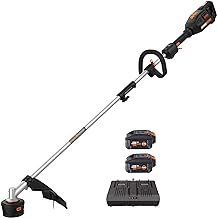
The WG186 pairs the two specifications that matter most for a large garden. A fifteen inch cut covers twenty five percent more ground per pass than a twelve inch head, and a brushless motor means that wider swathe does not simply drain the battery faster in proportion.
That combination is the point. A wider head on a brushed motor trades runtime for coverage, while a wider head on a brushless one buys coverage with efficiency gained elsewhere. Under load in thick growth the brushless motor also holds speed rather than bogging, which is where brushed tools stall.
The costs are precision and weight. Fifteen inches is harder to work around flower beds and tree bases than a narrow head, and the tool is heavier in the hands over a long session. For a small intricate garden it is the wrong shape.
Bottom line: the best choice here for large open gardens, and more tool than a small plot needs.
- Voltage: 40V
- Cutting width: 15 inches
- Motor: brushless
- Batteries: included
- Charger: included
- Conversion: edger capability
- Platform: Worx 40V system
Large lawns and long boundaries where the number of passes is what determines whether a session finishes on one charge.
Also suits properties with heavier growth, where the brushless motor's ability to hold speed under load prevents stalling.
Use the line diameter the tool specifies. Heavier line than intended slows the head, drains the pack faster, and stresses the motor.
Let packs cool before charging after a long session, and store them indoors over winter.

Pros
- Multi head system takes other attachments on one power unit
- Widest cut in this shortlist at sixteen inches
- Brushless motor for efficiency and load handling
- Saves storage space compared with separate tools
- Attachments cost less than complete tools
Cons
- Newer listing with limited long term feedback
- Widest head is least precise around obstacles
The SKIL takes the platform argument further than anyone else here. Rather than buying separate tools that share a battery, you buy one powered shaft and add heads to it, which means the motor, the shaft, and the battery are all bought once.
For storage that is the most efficient arrangement available: a shed holding one power unit and three attachments instead of three complete tools. The brushless motor and sixteen inch cut also make it the fastest tool here across open ground.
Two reservations. This is a newer listing with less accumulated feedback than the established platforms, and multi head systems live or die on how many attachments the manufacturer supports over time, which is not knowable at purchase. Sixteen inches is also the least precise width here for intricate borders.
Bottom line: the most space efficient and forward looking option, bought with more platform risk than the established names carry.
- Voltage: 40V PWR CORE 40
- Cutting width: 16 inches
- Motor: brushless
- System: multi head attachment shaft
- Kit contents: trimmer head, battery, charger
- Expansion: additional attachment heads available
- Storage: one power unit for multiple tools
Check which attachments are currently available for the system before buying, since the value of a multi head tool depends entirely on that range.
Consider whether a sixteen inch head suits your garden. In a plot full of beds and obstacles, the widest cut is a disadvantage rather than a feature.
Check the attachment is fully seated and locked before starting, as a partially engaged head on a spinning shaft is the main hazard specific to this design.
Wear eye protection, clear debris from the area, and let packs cool before charging.
How to Choose a 40v Cordless String Trimmer
The criteria below are ordered by how much they change what the tool can actually do on your lawn.
Volts Are Potential, Amp Hours Are Runtime
Voltage and amp hours describe two different things and are routinely confused. Voltage relates to the force available to spin the head, which is why higher voltage tools handle thicker growth without bogging down. Note also that the forty volt figure is the maximum measured without a workload: BLACK and DECKER states plainly that the nominal voltage of its 40V MAX packs is thirty six volts, which is the number the tool actually runs at. Amp hours describe the size of the tank, which is how long the tool runs before it stops.
A 40V tool with a 2.0 amp hour pack and a 40V tool with a 4.0 amp hour pack cut identically and run for very different lengths of time. If a listing quotes only voltage, the pack size is the thing to find out before buying, because it is what determines whether your garden takes one session or two.
Runtime also depends heavily on what you cut. Light grass along a path draws a fraction of what thick weeds against a fence do, so any runtime figure quoted by a manufacturer describes the easiest possible work rather than the job you bought the tool for.
Brushless Motors Change the Arithmetic
A brushed motor uses carbon brushes to transfer current to the spinning part, and those brushes create friction, heat, and wear. A brushless motor switches electronically instead, which removes the friction losses, removes a wearing part, and lets the tool sense load and adjust.
The practical effect on a cordless tool is larger than on a corded one, because every watt lost to friction is a watt taken from a battery you have to recharge. The same pack runs noticeably longer on a brushless tool, and the motor holds speed better when the head hits thick growth rather than stalling.
The Worx WG186 and the SKIL PWR CORE 40 in this shortlist are the brushless options. Brushed motors remain perfectly serviceable for light garden work, and they cost less, so the question is how much cutting you do rather than which is technically better.
Cutting Width Sets the Number of Passes
Cutting width is the diameter the line sweeps, and it determines how many passes a given area takes. Going from twelve inches to fifteen is a twenty five percent increase in coverage per pass, which on a large garden is the difference between finishing and running the battery flat.
Wider is not automatically better. A wider swathe demands more from the motor, drains the pack faster per minute, and is harder to control precisely around flower beds and tree bases. For a small garden with lots of obstacles, a twelve inch head is easier to work with and wastes less battery.
Match the width to the shape of the job: large open edges favour the sixteen inch SKIL or the fifteen inch Worx, while intricate borders favour the twelve inch Greenworks models.
Line Diameter Is Limited by the Motor
Trimmer line comes in different thicknesses, and thicker line cuts tougher growth and lasts longer before breaking. It also takes more power to spin, and fitting line heavier than a tool was designed for will slow the head, drain the pack faster, and in some cases overheat the motor.
Each tool states a line diameter, and that figure is a specification rather than a suggestion. Line shape matters too: round line is cheapest and most durable, twisted or square profiled line cuts more aggressively and wears faster.
Buy line in bulk spools rather than pre wound cartridges once you know what the tool takes. The saving is substantial over a season and rewinding a spool takes a couple of minutes.
How the Line Feeds
Three systems exist. Bump feed advances line when you tap the head on the ground, which gives you control over exactly when more line comes out. Automatic feed advances it whenever the tool senses the line has shortened, which is convenient and can be wasteful, since a system that misjudges will keep feeding line you did not need.
Fixed line heads take short pre cut pieces that clip in, with no spool at all. They eliminate tangling and winding entirely, and they need replacing more often, which suits people who found spool winding the most irritating part of owning a trimmer.
Both appear here. The BLACK and DECKER uses an automatic feed spool that advances without bumping, while the Worx WG183 uses a push button command feed that only releases line when you press it, and the SKIL uses a twist load head that reloads by inserting line and turning. The complaint to watch for with automatic systems is line fed too eagerly, which shows up as a spool that empties surprisingly fast.
Straight Shaft or Curved

A curved shaft puts the head closer to the operator, which makes the tool feel lighter and more manoeuvrable for trimming around a lawn edge. A straight shaft puts the head further out, which lets you reach under shrubs and benches without bending, and generally suits taller users better.
Telescoping shafts, as on the BLACK and DECKER model here, let you set the length to your height rather than adapting to the tool. That adjustment matters more than it sounds for anyone unusually tall or short, because working with a trimmer at the wrong length is what produces back ache after twenty minutes.
If reach under obstacles matters, straight shafts win clearly. If most of your work is a tidy lawn edge, a curved shaft is more comfortable.
You Are Buying a Battery Platform

This is the decision with the longest consequences. Every manufacturer uses its own battery fitting, so the trimmer you buy today determines which blower, hedge trimmer, chainsaw, and mower you can buy cheaply later, because subsequent tools can be bought as bare units without packs.
Batteries are the expensive part of any cordless tool, so a second tool on the same platform costs a fraction of a second tool on a new one. Committing to a platform with a wide range of tools is worth more over five years than any single tool specification.
Two products here address this directly. The Greenworks combination arrives with a blower already in the box, and the SKIL multi head system takes different attachments on one power unit, which is the most space efficient version of the same idea.
Edging Is a Second Job the Tool Can Do
Most trimmers here convert to an edger by rotating the head ninety degrees so the line cuts a vertical line along a path or driveway. Done regularly it keeps a crisp boundary that a mower cannot produce.
Conversion quality varies. Tools with a dedicated pivot and a guide wheel hold the line steady and produce an even cut. Tools where you simply twist the shaft and hold it at an angle work, but keeping a consistent depth by hand along thirty feet of path is harder than it sounds.
A guide wheel is the feature to look for if edging is a regular job rather than an occasional one. Line wears faster when edging against concrete, so expect to feed more often.
Weight Is Felt at the Hands, Not on the Scale
Cordless trimmers carry their battery on the tool, usually at the rear, and total weight matters less than how that mass is distributed. A tool balanced so the head sits naturally at cutting height is comfortable for an hour. A nose heavy one has to be held up by the front hand throughout.
A larger pack adds runtime and weight together, which is a real trade on a long session. For big gardens, two smaller packs are often more comfortable than one large one, since you swap when the first runs down rather than carrying the extra mass all day.
Adjustable auxiliary handles let you set the second grip where your arm naturally falls. It is the cheapest comfort improvement available and the one most often left at the factory setting.
Charge Time Against Run Time

The number that decides whether one battery is enough is the ratio between how long the tool runs and how long the pack takes to refill. A tool that runs forty minutes and charges in sixty means a break rather than a stop. One that runs forty minutes and charges in three hours means the job takes two days unless you own a second pack.
Rapid chargers change this considerably and are worth checking for, since some kits include a standard charger while a faster one is available separately on the same platform.
Let a hot pack cool before charging. Charging immediately after heavy use adds heat to a battery that is already warm, and heat is the main thing that shortens lithium battery life over years.
| Model | Cutting width | Motor | Notable |
|---|---|---|---|
| Greenworks combo | 12 inch | Brushed | Includes a 390 CFM blower |
| BLACK and DECKER 40V MAX | 13 inch | Brushed | Telescoping shaft, edger conversion |
| Greenworks 40V | 12 inch | Brushed | Battery and charger included |
| Worx WG183 | 13 inch | Brushed | Push button command feed |
| Worx WG186 | 15 inch | Brushless | Wider cut with brushless efficiency |
| SKIL PWR CORE 40 | 16 inch | Brushless | Multi head attachment system |
If you also spray or feed the lawn, our guide to lawn and garden sprayers covers that, and battery powered rototillers for bed preparation.
Why You Should Trust Us
We treat the battery platform as the main purchase because over several years it costs more than any individual tool, and it is the decision buyers make without realising they are making it. Every tool here is a current listing with enough customer rating history to show how the feed system and the motor behave past the first season.
We do not accept payment for placement. Where a tool uses a brushed motor or a narrower head, we say so plainly rather than describing every model as suitable for every garden.
Final Thoughts
The Greenworks 40V string trimmer and blower combination is our best overall pick because it answers the platform question immediately. Two tools arrive sharing one battery system, which is the cheapest way to end up with a cordless garden kit rather than a cordless trimmer.
The BLACK and DECKER 40V MAX is our best value choice, with a telescoping shaft that adjusts to the user rather than the other way round and a straightforward edger conversion. For larger gardens, the Worx WG186 pairs a fifteen inch cut with a brushless motor so the wider swathe does not cost you the whole battery, and the SKIL PWR CORE 40 is the one to choose if you would rather buy attachments than whole tools.
Check the pack size rather than the voltage, match cutting width to how open your garden is, and think about which platform you want to be buying into for the next five years. More garden equipment is in our latest guides.
Frequently Asked Questions
Is a 40v cordless string trimmer powerful enough for thick weeds?
For garden weeds and long grass, yes. Forty volts provides enough force to keep the head spinning through growth that stalls lower voltage tools, and a brushless motor holds speed better under load. Woody stems and brush are a different job that wants a brush cutter with a blade rather than line.
How long will the battery last in 2026?
Per charge, that depends on amp hours rather than voltage, and on what you are cutting, since thick growth draws far more than light grass along a path. Over years, lithium packs lose capacity gradually, and heat is the main accelerant, so let packs cool before charging and store them somewhere temperate.
Is brushless worth paying for?
On a cordless tool the case is stronger than on a corded one, because friction losses in a brushed motor come directly out of a battery you have to recharge. Brushless tools run longer per pack, hold speed better in thick growth, and have one fewer wearing part. For light garden work a brushed motor remains perfectly adequate.
Can I use these as an edger?
Most convert by rotating the head so the line cuts vertically along a path. How well that works depends on whether the tool has a dedicated pivot and a guide wheel, which hold a consistent depth, or whether you are holding the angle by hand along the whole run. Line wears faster when edging against concrete.
Will the battery fit other tools?
Only within the same manufacturer’s platform. Every brand uses its own fitting, which means the trimmer you buy determines which blower, hedge trimmer, or chainsaw you can add cheaply later as a bare tool without a pack. Since batteries are the expensive part, that decision matters more over five years than any single specification. More garden picks are in our category directory.




Write Your Review
No reviews yet. Be the first to share your experience!