

A patio umbrella fails in wind the way a sail does: the canopy catches a gust, the pressure has nowhere to go, and either the ribs invert or the whole thing goes over the fence. Choosing among outdoor umbrellas for windy conditions is therefore less about how big or how pretty the canopy is and more about how it lets air through, how the frame flexes instead of snapping, and how much weight is holding the pole down. For October 2026 we gathered 9 of the highest rated options on Amazon from Sunnydaze, AMMSUN, Blissun and more, then sorted them by the features that actually matter when the forecast turns.
Our top pick is the EliteShade USA 9 ft 3-Tier Market Patio Umbrella for its triple-vented canopy that bleeds off gusts, commercial-grade frame and crank-open design that makes it easy to drop the moment the wind picks up. Below it sit a vented aluminum-pole classic from Sunnydaze, several 8-rib market umbrellas with push-button tilt, a heavy-duty beach parasol with a sand anchor, and a square cantilever for people who want shade without a pole in the middle of the table. Every pick is rated at least 4.0 stars by real Amazon customers, and if you are outfitting the whole patio, our patio, lawn and garden guides cover the furniture and bases that go with it.

Pros
- Triple-tier vented canopy bleeds off gusts better than a single vent
- Commercial-grade frame built for daily use
- Crank opens and closes quickly
- Fabric backed by a long non-fading claim
Cons
- Base sold separately, and it needs a heavy one
- Three-tier canopy sits taller than a standard umbrella
- Fewer color options than budget brands
The EliteShade USA 9 ft 3-Tier Market Umbrella is the most wind-focused canopy in this roundup. Instead of a single vent, the top is stacked in three tiers, so air pushing up under the fabric has two generous gaps to escape through, and the umbrella stops behaving like a sail.
The frame is described as commercial grade, which in practice means it is built for being opened and closed every day rather than left up all season, and the crank makes that routine painless. The fabric carries a long non-fading claim from the brand, which matters on a south-facing patio.
It ships without a base and, like every umbrella here, needs a heavy one; the three-tier canopy also stands a little taller than a standard market umbrella. Neither is a flaw so much as a reminder that venting is only half the job.
Bottom line: the market umbrella to buy when wind is the main reason you are shopping.
- Type: center-pole market umbrella
- Canopy: 9 ft, 3-tier vented
- Opening: crank
- Fabric: fade-resistant with a long non-fading claim
- Grade: commercial
- Base: not included
Windy decks, rooftop patios and restaurants that open and close umbrellas daily. Less ideal if you want the lowest possible profile or a base in the box.
Pair it with a base of 50 pounds or more if it stands free, tighten the base collar on the pole, and crank it closed whenever you leave. Strap the closed canopy and cover it in the off season.

Pros
- Powder-coated aluminum pole resists rust
- Vented canopy for gusty afternoons
- Tilt to angle the shade
- Wind and weather resistant per the maker
Cons
- Base not included
- Aluminum pole is lighter than steel, so base weight matters more
- Striped fabric is a style choice not everyone wants
The Sunnydaze 9 ft Patio Umbrella is the pick for a coastal or humid patio, where the enemy is rust as much as wind. Its pole is powder-coated aluminum, the canopy is vented, and the maker describes the whole thing as wind and weather resistant.
Tilt lets you turn the canopy so a gust slides over it, and the vent lets pressure escape. The aluminum pole is light, which is a convenience when moving it and a reason to give it a heavier base than you might for steel.
The Catalina beach stripe is distinctive; other colors exist. It ships without a base.
Bottom line: the corrosion-resistant vented classic for a windy waterfront patio.
- Type: center-pole market umbrella
- Canopy: 9 ft, vented
- Pole: powder-coated aluminum
- Tilt: yes
- Base: not included
Coastal patios and anyone who has watched a steel pole rust. Not for someone who wants the heaviest possible pole.
Rinse salt spray off the frame occasionally, use a heavy base, and return the canopy to upright before closing it on windy days.
Pros
- Eight ribs spread wind load better than six
- Vented canopy
- Push-button tilt and crank
- Very large owner base
Cons
- Base not included
- Budget fabric fades faster than premium canopies
- Needs a heavy base to match its shade area
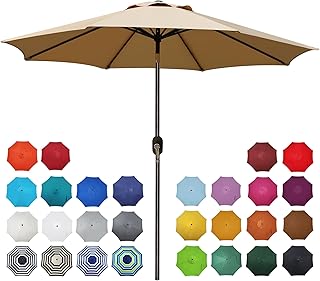
The Blissun 9 ft Outdoor Patio Umbrella is the value pick because it delivers the features that matter in wind, a vent, eight ribs and a lockable push-button tilt, at a price that leaves room in the budget for a serious base. It is also one of the most widely owned patio umbrellas on Amazon, which means the failure modes are well documented and mostly come down to under-weighted bases.
The crank is smooth and the tilt is quick. Fabric is standard polyester and will fade sooner than premium canopies on a sun-baked deck.
Bottom line: the sensible first umbrella for a table hole or a well-weighted stand.
- Type: center-pole market umbrella
- Canopy: 9 ft, vented
- Ribs: 8
- Tilt: push button
- Opening: crank
- Base: not included
Budget patios, rentals and anyone replacing a flipped umbrella without overspending. Pair it with a proper base.
Use it through a table hole where possible, tighten the base knob, and close it when you go inside; that discipline is what keeps a budget umbrella alive for years.

Pros
- Eight ribs and a vented canopy
- Push-button tilt with a firm lock
- UV-protective fabric
- Crank opening
Cons
- Base sold separately
- Similar spec to cheaper 8-rib umbrellas
- Fabric colors can vary from photos
The Abba Patio Lyon is a well-built 9 ft market umbrella with the wind essentials covered: eight ribs, a vented top, a push-button tilt that locks firmly and a crank. Its UV-protective fabric is a small step up on sun-heavy patios.
It competes directly with other 8-rib vented umbrellas here, so the choice often comes down to color and current price. It ships without a base.
Bottom line: a solid mid-range market umbrella that does everything a windy patio asks of it.
- Type: center-pole market umbrella
- Canopy: 9 ft, vented, UV protective
- Ribs: 8
- Tilt: push button
- Opening: crank
- Base: not included
Dining patios that want a step above budget without paying for commercial grade.
Check the tilt lock on arrival, weight the base generously and store the canopy closed and strapped.

Pros
- Eight sturdy ribs and a vent
- Water-repellent, UV-protective canopy
- Tilt and crank
- Neutral beige suits most furniture
Cons
- Base not included
- Water repellency fades with age
- Tilt is crank style rather than push button
The JEAREY 9 ft Patio Umbrella adds water repellency to the usual 8-rib, vented, tilt-and-crank formula, so light rain beads off the canopy rather than soaking in, which also helps the fabric dry before mildew sets in.
Wind handling matches the other 8-rib umbrellas here: the vent bleeds gusts, the ribs share the load, and a heavy base does the rest. Tilt is by crank, which is smooth but slower than a push button.
Bottom line: the 8-rib market umbrella for a patio that sees showers as well as wind.
- Type: center-pole market umbrella
- Canopy: 9 ft, vented, water repellent, UV protective
- Ribs: 8
- Tilt and crank: yes
- Base: not included
Patios in showery climates. Not for someone who needs push-button tilt.
Let the canopy dry open after rain before closing it, weight the base, and close it in gusts.

Pros
- Vented canopy
- Push-button tilt and crank
- Budget price
- Simple to set up
Cons
- Base not included
- Basic fabric
- Fewer ribs than the 8-rib competitors on some versions
The Simple Deluxe 9 ft Patio Umbrella is the plain, well-reviewed budget option: a vented canopy, push-button tilt and a crank, in a 9 ft size that fits a standard table hole.
It does not add premium fabric or extra ribs, so it depends more than the others on being used through a table or on a heavy base. For a first patio or a rental it covers the essentials.
Bottom line: the no-frills 9 ft umbrella for a table hole and a careful owner.
- Type: center-pole market umbrella
- Canopy: 9 ft, vented
- Tilt: push button
- Opening: crank
- Base: not included
Budget buyers with a table hole. Not for exposed freestanding use.
Use it through the table, tighten the base, and close it every time you leave.
Pros
- 10 ft canopy shades a larger table
- Vented canopy
- Push-button tilt
- Wide color range
Cons
- Six ribs give less wind margin than eight
- Bigger canopy catches more wind
- Base not included and must be heavy
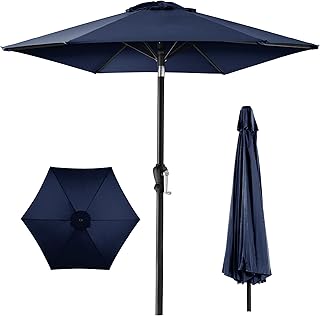
The Best Choice Products 10 ft Patio Umbrella buys you an extra foot of shade, enough to cover a six-seat table properly, and it keeps the vent and push-button tilt that matter in wind.
The trade is a six-rib canopy on a bigger sail. It is fine on a breezy afternoon with a heavy base and a table hole, but it has less margin than the 8-rib 9 ft umbrellas, and it should be closed earlier when gusts build.
Bottom line: the pick for a big table in a sheltered spot, not for the windiest deck.
- Type: center-pole market umbrella
- Canopy: 10 ft, vented
- Ribs: 6
- Tilt: push button
- Base: not included
Large dining tables in a courtyard or partly sheltered patio. Not for open, exposed decks.
Use the heaviest base you can find, always through the table, and close it at the first sign of lifting.

Pros
- Screw-in sand anchor holds it in loose sand
- Vented canopy and tilt for wind
- UPF 50+ sun protection
- Compact 7 ft size is easy to control
Cons
- Not a patio umbrella; no table or base fit
- Smaller shade footprint
- Anchor takes effort in packed sand
The AMMSUN 7 ft Heavy Duty High Wind Beach Umbrella solves the wind problem the way a beach demands: a screw-in sand anchor instead of a base, a vent instead of a solid canopy, and a tilt so you can lean it low toward the wind. At 7 ft it is small enough to control and carry.
UPF 50+ fabric handles the sun side. It is not a patio umbrella; there is no table fit and no base, and the shade footprint is modest.
Bottom line: the umbrella for windy shorelines, and the only beach pick you need on this list.
- Type: beach umbrella
- Canopy: 7 ft, vented, UPF 50+
- Anchor: screw-in sand anchor
- Tilt: yes
- Use: beach and sand only
Beachgoers on windy coasts. Not a substitute for a patio umbrella.
Screw the anchor deep, tilt the canopy low into the wind, and take it down when gusts strengthen. Rinse sand and salt off before storing.

Pros
- Base included in the box
- Aluminum pole and arm
- Square canopy covers a full seating area
- No pole in the middle of the table
Cons
- Cantilevers catch more wind and lever the base
- Square canopy is a bigger sail than a round one
- Must be closed and locked when unattended
The Grand patio 10 by 10 ft Cantilever Square Umbrella is here for people who want shade over a sofa set or a table without a pole in the middle, and it is the one umbrella in the roundup that ships with a base. The aluminum pole and arm keep the weight manageable.
The wind caveat is real. An offset canopy acts on a long lever, and a square one catches more air than a round one, so the included base should be filled to capacity and the canopy closed and locked whenever you are not sitting under it. Used with that discipline, it is the most flexible shade here.
Bottom line: the choice for layout freedom, with the strictest close-it-when-you-leave rule.
- Type: cantilever, offset
- Canopy: 10 by 10 ft square, vented
- Pole: aluminum
- Base: included
- Opening: crank
Lounge areas and sofa sets that need clear space beneath. Not for the most exposed sites unless you add weight and close it religiously.
Fill the base to its maximum, position the arm so the canopy is not broadside to the prevailing wind, and lock it closed before you go inside.
How to Choose the Right Outdoor Umbrellas For Windy Conditions
Vents Are the Single Most Important Wind Feature

A vent is a second layer of canopy raised above an opening at the top of the umbrella. Air that would otherwise build pressure under the fabric escapes through the gap, and the umbrella stops behaving like a parachute. A single vent helps; a double or triple-tier canopy, like the EliteShade USA 3-tier design, opens up far more area for air to move through and is the closest thing to a windproof umbrella that still gives shade.
When you compare listings, look for the word vented in the description and count the tiers in the product photos. Umbrellas without a vent are fine on a still afternoon and are the first to flip when the breeze arrives. Sunnydaze, JEAREY, Abba Patio, Blissun and AMMSUN all list vented canopies here, and it is the first filter we applied.
Rib Count and Rib Material: Why Eight Beats Six, and When Flex Beats Stiff

Ribs are the spokes that hold the canopy open. More ribs spread the load of a gust across more points, so an 8-rib canopy like the Blissun, JEAREY and Abba Patio umbrellas holds its shape better than a 6-rib canopy of the same diameter. It is not that 6-rib umbrellas fail immediately, but they have less margin, and the Best Choice Products 10 ft umbrella here is worth pairing with a heavier base for that reason.
Rib material matters too. Fiberglass ribs bend under load and spring back, which is why they show up on beach and high-wind umbrellas; steel and aluminum ribs are stiffer and stronger to a point, then bend or snap. Listings rarely spell this out, so look for phrases like sturdy ribs, flexible ribs or fiberglass in the specification block, and treat a rib that inverted and popped back as the design working, not failing.
Pole Material, Diameter and the Weakest Point
The pole takes the whole bending load from the canopy, and it fails at two places: the joint where a two-piece pole meets, and the point where the pole enters the base. Powder-coated aluminum, which the Sunnydaze umbrella specifies, resists rust and is light enough to lift; steel is heavier and stiffer. Thicker poles handle wind better, and a two-piece pole with a metal collar at the joint is stronger than one with a plastic sleeve.
For a market umbrella that goes through a table hole, the table itself braces the pole and helps enormously. For a freestanding umbrella, the base does all that work, which is why the base section below is not optional reading. Cantilever umbrellas move the pole off to the side and rely on an arm, which is elegant and puts more leverage on the base than any center-pole design.
Market Umbrellas Versus Cantilevers in Wind

A center-pole market umbrella is the more wind-tolerant design because the load path is straight down through the pole into the table and base. Every 9 ft umbrella in this list works that way. A cantilever, like the Grand patio 10 by 10 ft square umbrella, hangs the canopy from an offset arm so nothing sits in the middle of your seating, and that convenience costs you in wind: the canopy acts on a long lever and tries to lift or tip the base.
That does not make cantilevers a bad choice, but it changes the rules. They need a much heavier base or a base filled with sand and water, they should be closed and locked whenever you leave the patio, and a square canopy catches more wind than a round one of similar reach. Buy one for the shade layout, and budget for the base and the discipline of closing it.
| Umbrella | Size and type | Vent | Ribs and tilt | Wind note |
|---|---|---|---|---|
| EliteShade USA 3-Tier Market | 9 ft market, commercial grade | Triple tier | Crank open | Most venting in the group |
| Sunnydaze Patio Umbrella | 9 ft market, aluminum pole | Vented | Tilt | Wind and weather resistant, powder-coated |
| Blissun 9 ft Market | 9 ft market | Vented | 8 ribs, push-button tilt, crank | Huge owner base, needs a good base |
| Abba Patio Lyon | 9 ft market | Vented | 8 ribs, push-button tilt, crank | UV fabric |
| JEAREY 9 ft Market | 9 ft market | Vented | 8 ribs, tilt and crank | Water-repellent canopy |
| Simple Deluxe 9 ft | 9 ft market | Vented | Push-button tilt, crank | Value pick for a table hole |
| Best Choice Products 10 ft | 10 ft market | Vented | 6 ribs, push-button tilt | Bigger sail, pair with heavy base |
| AMMSUN 7 ft Beach | 7 ft beach parasol | Vented | Tilt, sand anchor | Built for high wind at the shore |
| Grand patio 10×10 Cantilever | 10 by 10 ft offset, base included | Vented | Crank, aluminum pole | Needs the most base weight |
Base Weight: The Number Most Umbrellas Ship Without
Most patio umbrellas ship without a base, and the base is where wind resistance is won or lost. A common rule of thumb for a freestanding 9 ft market umbrella is a base in the range of 50 pounds or more, and heavier is better; through a table, a lighter base is acceptable because the table braces the pole. Cantilevers need far more, often a filled cross base or multiple weight plates.
Check the pole diameter of the umbrella against the base opening, and prefer a base with a tightening knob that clamps the pole rather than one that lets it rattle. If you already have a base and are choosing an umbrella to fit it, our guide to the best cantilever umbrella bases covers the weight math for the offset designs.
Canopy Size: Bigger Shade Means a Bigger Sail
The 9 ft canopy is the patio standard because it shades a dining table for four to six without becoming unmanageable, and it is why most of the umbrellas here are 9 ft. The 10 ft Best Choice Products model gains shade at the cost of more surface for wind to push, and the 10 by 10 ft Grand patio square gains a lot more.
Smaller is not automatically safer, but it is easier to control. The AMMSUN 7 ft beach umbrella is compact enough to tilt into the wind and anchor in sand, which is why it survives conditions that would send a 10 ft market umbrella down the beach. Match the canopy to the table or the space, then match the base to the canopy, in that order.
Tilt Mechanisms and Why the Lock Matters
Tilt lets you angle the canopy as the sun moves, and on a windy day it lets you turn the canopy so a gust slides over it rather than under it. Push-button tilt, found on the Blissun, Abba Patio and Simple Deluxe umbrellas, is quick; crank tilt, where you keep turning the crank past fully open, is smoother but slower.
What matters in wind is that the tilt locks firmly. A tilted canopy that can flop back and forth under gusts is worse than a canopy that stays upright, because it hammers the joint. Test the lock when the umbrella arrives, and on truly windy afternoons return the canopy to upright or, better, close it.
Fabric, Fading and Water: What Lasts a Season and What Lasts Several
Canopy fabric takes sun, rain and wind flex all season. Solution-dyed or fade-resistant polyester keeps its color, and EliteShade USA leans on a long non-fading claim for its fabric. UV protection ratings, like the UPF 50+ that AMMSUN lists, tell you how much sun the fabric blocks. Water repellency, which JEAREY highlights, means light rain beads off rather than soaking through.
Fabric that tears at a rib pocket in the first season is usually a sign of a thin weave or poor stitching at the stress points, and wind finds those first. Look for double-stitched rib pockets and a canopy that pulls taut without straining when open. A canopy that sags is one that will flap, and flapping is what shreds fabric over a summer.
Anchoring at the Beach: Sand Anchors, Vents and Tilt
A beach has no table hole and no 50 pound base, so a wind-worthy beach umbrella solves the problem differently. The AMMSUN 7 ft umbrella comes with a sand anchor that screws deep into the sand, a vent to bleed off gusts, and a tilt so you can lean the canopy into the wind. Used together, those three features are the difference between an umbrella that stays and one that becomes a hazard.
Set it deep, angle it low toward the wind rather than straight up, and take it down when gusts get strong. If you spend more time on windy shorelines than on a patio, our guide to the best sun shelters for a windy beach covers the tent-style alternatives.
Every Umbrella Has a Wind Limit, and the Crank Is Your Safety Feature
No consumer patio umbrella is rated to stay open in a storm, and even the best-vented commercial-grade canopy is meant to be closed when the wind gets serious. Wind claims on listings are marketing more than engineering; the honest approach is to buy the most vented, best-braced umbrella you can, weight it properly, and close it when gusts start lifting the canopy edge.
That is where the crank matters. A smooth crank, which every 9 ft market umbrella here has, lets you drop the canopy in seconds without wrestling it. Add a wind strap or the built-in tie to hold the closed canopy tight, and a cover if it lives outside. The umbrellas that last years are the ones their owners close; the design just buys you a wider margin before you have to.
Why You Should Trust Us
We built this shortlist from the highest rated patio, market and beach umbrellas on Amazon, then read each listing, its specification block and the owner feedback with wind in mind: whether the canopy is vented and how many tiers, rib count and material, pole construction, tilt and crank design, and what the manufacturer says about wind. We do not claim to have flown each umbrella through a storm; the comparisons come from published specifications and the pattern of real owner reports about gusty days.
Ratings on the cards are pulled from Amazon and update over time. We do not print prices in the guide because they change constantly, and we do not accept payment for placement. Where an umbrella is sold in many colors, we linked one representative color.
Final Thoughts
The best overall pick is the EliteShade USA 9 ft 3-Tier Market Patio Umbrella. Its triple-tier vented canopy moves more air than any single-vent design here, the commercial-grade frame is built for daily open-and-close, and the crank makes it quick to drop when the wind turns, which is the habit that keeps any umbrella alive.
The best value is the Blissun 9 ft Outdoor Patio Umbrella: eight ribs, a vent, push-button tilt and a crank at a price that leaves room for the heavy base it deserves. The Sunnydaze aluminum-pole umbrella is the pick for a coastal patio where rust is the enemy, the AMMSUN 7 ft parasol with its sand anchor is the beach answer, and the Grand patio cantilever is for anyone who wants the table clear and is willing to weight the base properly. Whichever you choose, the two rules do not change: vent it and weight it, then close it when the gusts start. For the seating underneath, our guide to the best outdoor sofas is the natural next read.
Frequently Asked Questions About Outdoor Umbrellas for Windy Conditions
What makes an outdoor umbrella good for windy conditions in 2026?
Three things: a vented canopy, ideally with two or three tiers, so gusts escape instead of lifting the umbrella; eight or more ribs, preferably flexible ones, to spread the load; and a heavy, properly fitted base. The best outdoor umbrellas for windy conditions combine all three, and the EliteShade USA 3-tier design is the most vented option in our list.
How heavy should the base be for a windy patio?
For a freestanding 9 ft market umbrella, treat 50 pounds as a floor and go heavier if you can; through a table hole you can use less because the table braces the pole. Cantilever umbrellas need far more, usually a filled cross base or several weight plates.
Are cantilever umbrellas bad in wind?
They are less wind-tolerant than center-pole designs because the canopy acts on a long lever, but they work if you buy a heavy base, close and lock the canopy when you leave, and accept that a square canopy catches more wind than a round one.
Can I leave a patio umbrella open in the wind?
No consumer umbrella is meant to ride out strong gusts open. Vents and good ribs buy you margin on a breezy day, but the crank exists so you can close it in seconds when the canopy edge starts lifting. Strap it closed and cover it between uses.
What is the best outdoor umbrellas for windy conditions for the beach?
A compact vented parasol with a sand anchor and tilt, like the AMMSUN 7 ft beach umbrella here. Screw the anchor deep, tilt the canopy low toward the wind and take it down when gusts strengthen. For a tent-style alternative see our best waterproof sun shade sails guide for fixed shade at home.


Write Your Review
No reviews yet. Be the first to share your experience!