

Ordering a small helmet and still finding it wrong is one of the most common experiences in motorcycle gear, and the reason is that head size is two measurements pretending to be one. Circumference tells you which size to order. Shape decides whether that size actually fits, and a rider with a genuinely small circumference can still end up with pressure on the forehead and a gap at the sides. We compared 8 helmets from ILM, 1Storm, GLX and more on shell sizing, shape, and how each one behaves at the smaller end of its range.
Our top pick is the GLX GX11 Compact Full Face Helmet, because a smaller shell rather than more padding is what makes a helmet fit a smaller head properly. For gear that travels with the bike, our guide to the best motorcycle panniers covers luggage.

Pros
- Compact shell rather than thicker padding to reach small sizes
- Lower weight sits better on a smaller frame
- Tinted visor included alongside the clear one
- DOT certified full coverage
Cons
- Full face styles run warmer in traffic than open face
- Tinted visor is not suitable for night riding
The reason this leads a small head list is construction rather than features. Many brands mould two or three shells and reach the smaller sizes by adding padding, which produces a helmet that measures correctly and still looks oversized. A compact shell approaches it the other way.
The practical effects go beyond appearance. A smaller outer profile means less weight held out from the neck, less surface for wind to push against and generally less noise at speed, all of which matter more to a rider with a smaller frame.
The tradeoffs are those of any full face helmet. It runs warmer than an open face in slow traffic, and the supplied tinted visor is a daylight item that needs swapping before riding at night. Neither is a fault, but both are worth planning around.
Bottom line: the most complete answer here for a small head, because it fixes the shell rather than padding around the problem.
- Style: full face
- Shell: compact profile
- Certification: DOT
- Visor: tinted visor included
- Coverage: full chin and jaw
- Sizing: check the model chart against your measurement
Fasten the strap and check that the helmet does not rotate independently of your head, and that it cannot be rolled forward off the head from behind.
Swap the tinted visor for a clear one before riding after dark, and replace any helmet that has taken an impact even if no damage is visible.
Measure circumference an inch above the eyebrows and read this model's chart rather than relying on a size letter from another brand.
If you fall between sizes, the smaller one usually settles correctly as the liner compresses over the first weeks.

Pros
- Full coverage at a modest price
- Very large body of customer feedback to draw on
- DOT certified
- Straightforward design with few failure points
Cons
- Shell sizing is less compact than purpose built small profiles
- Ventilation is basic compared with premium helmets
This is the volume seller of the group, and that matters practically: a very large body of buyer feedback makes sizing behaviour easier to predict than with an obscure model.
As a helmet it is straightforward. Full coverage, DOT certification, a clear visor and not much else, which keeps the cost down and removes mechanisms that can fail.
For a small head the caveat is shell sizing. It is not marketed as a compact profile, so a smaller rider may find it sits higher and wider than a purpose built small shell would. Ventilation is also basic, which shows up in slow traffic on a warm day rather than at speed.
Bottom line: the value option for full coverage, with the usual compromise that a general shell makes on a smaller head.
- Style: full face
- Certification: DOT
- Visor: clear
- Coverage: full chin and jaw
- Ventilation: basic vents
- Sizing: check the model chart before ordering
Riders who want full coverage without spending much, and anyone who values a long track record of buyer feedback when judging sizing.
Less ideal for a rider specifically trying to reduce helmet bulk.
Run the rotation and roll-off checks with the strap fastened before accepting the fit.
Clean the visor with water and a soft cloth rather than solvents, which craze the plastic over time.

Pros
- Chin bar lifts for stops, fuel and conversation
- Internal sun visor drops without changing the outer one
- Easier to put on over glasses
- Full coverage when closed
Cons
- Hinge mechanism adds weight at the front
- More moving parts than a fixed full face
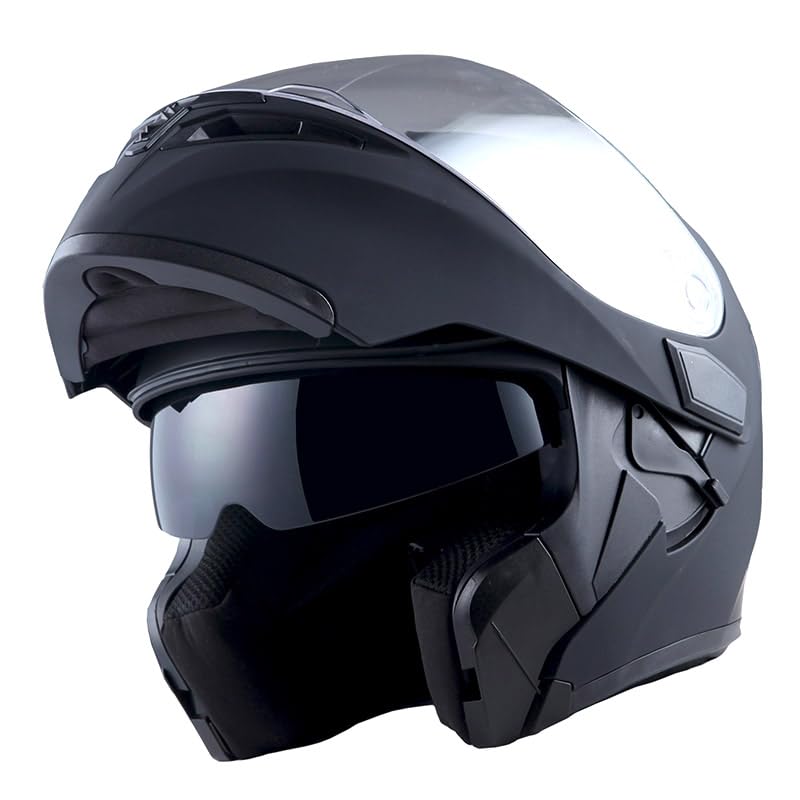
A modular helmet solves a specific irritation: taking a full face on and off repeatedly during a day of short trips, especially over glasses.
The internal sun visor is the underrated part. Dropping a shade behind the main visor avoids carrying a second outer visor and avoids the situation where a tinted visor is fitted at dusk.
The costs are weight and complexity. A hinge and its locking mechanism add mass at the front of the helmet, which is exactly where a smaller rider notices it over a long ride. There are also more parts that can wear, though the mechanism is not usually a reliability problem in normal use.
Bottom line: the convenience choice, worth the extra front weight if you stop often or wear glasses.
- Style: modular flip up
- Certification: DOT
- Visor: outer clear plus internal sun shield
- Coverage: full when closed
- Weight: heavier than a fixed full face
- Sizing: check the model chart before ordering
Commuters, riders who stop frequently, and anyone who wears glasses and finds pulling a full face on and off tiresome.
Less suited to riders prioritising the lowest possible weight.
Ride with the chin bar locked down. A modular helmet provides its full coverage only when closed and latched.
Keep the hinge clean and check the latch engages positively rather than partially.

Pros
- Complete coverage in a conventional design
- DOT certified
- Solid alternative if other brands do not match your head shape
- Straightforward, few failure points
Cons
- Not specifically built around a compact shell
- Ventilation is adequate rather than generous
The value of a third full face option on a small head list is head shape. Interiors differ in profile between brands, so a rider who finds one small helmet presses on the forehead may find another in the same size sits correctly.
As a helmet it is conventional in the useful sense: full coverage, DOT certification, a standard visor and no mechanisms to go wrong.
It is not marketed as a compact shell, so if reducing bulk is the goal a purpose built compact profile does that better. Ventilation is adequate rather than generous, which matters most in slow traffic.
Bottom line: worth trying when another brand's small does not match your head profile.
- Style: full face
- Certification: DOT
- Visor: standard clear
- Coverage: full chin and jaw
- Use: street riding
- Sizing: check the model chart before ordering
Riders whose head shape has not matched other brands, and anyone wanting straightforward full coverage for street use.
Less relevant if you have already found a brand profile that fits well.
If a previous helmet pressed on your forehead, you likely have a rounder profile than that interior, and a different brand is the fix rather than a different size.
Check the chart for this model specifically, since size letters do not carry between brands.

Pros
- Flip up chin bar for stops and glasses
- Internal sun shield deploys without swapping visors
- Well established model with broad feedback
- Full coverage when closed
Cons
- Modular weight sits forward on the head
- Bulkier profile than a compact full face
This model covers the same ground as other modulars here and has been on the market long enough that its sizing behaviour is well documented by buyers, which is genuinely useful when ordering without trying it on.
The internal sun shield is the feature that earns its keep day to day, letting you deal with low sun without carrying a spare visor or riding home at dusk behind a tint.
As with any modular, the hinge adds weight where it is felt most, at the front. On a smaller rider that shows up as neck fatigue on longer rides rather than as a problem around town. The profile is also bulkier than a compact full face.
Bottom line: a well proven modular, with the front weight tradeoff that comes with the format.
- Style: modular flip up
- Certification: DOT
- Visor: outer plus internal sun shield
- Coverage: full when closed and latched
- Weight: heavier than fixed full face
- Sizing: check the model chart before ordering
Always latch the chin bar before riding, and confirm it locks positively rather than resting closed.
Retire any helmet after an impact, and store it where it cannot be dropped onto a hard floor.
Commuters and tourers who value convenience and sun management over minimum weight.
Less suitable for short, frequent town trips where lighter is better.

Pros
- Lightest option here by a clear margin
- Excellent airflow in hot weather
- Quick release strap is easy with gloves
- Sun visor included
Cons
- Minimal coverage compared with full face
- Half helmets are the hardest style to fit securely on a small head
A half helmet is a comfort choice and it should be understood as one. It is the lightest thing here, the coolest in traffic and the easiest to live with on short trips in hot weather.
The quick release strap is a small practical advantage, since it can be operated with gloves on rather than fumbling a double D ring.
Two things need stating plainly. Coverage is minimal compared with a full face, and half helmets are the hardest style to fit securely on a smaller head because less shell touches you and sizing bands are often broad. The rotation and roll-off checks are more important here, not less.
Bottom line: the comfort option for hot weather and short distances, with fit deserving extra attention.
- Style: half helmet, open face
- Certification: DOT
- Visor: sun visor
- Strap: quick release
- Weight: lightest style here
- Coverage: minimal, crown only
Check that the helmet cannot rotate on the head or be rolled off from behind with the strap fastened, which matters more on this style than any other.
Understand the coverage you are choosing. A half helmet leaves the face and jaw unprotected.
Riders in hot climates doing short, low speed trips who prioritise airflow and weight.
Not the choice for highway riding or for anyone wanting full coverage.

Pros
- More coverage than a half helmet
- Face stays open for airflow and vision
- Visor included for wind and sun
- Suits scooters and lower speed riding
Cons
- No chin bar, so jaw is unprotected
- Wind noise higher than a full face at speed
A three quarter helmet sits between a half and a full face, wrapping the sides and back of the head while leaving the face open. For scooter and moped riding it is a common and sensible middle ground.
The visor makes a real difference over a bare half helmet, keeping wind, insects and low sun out of the eyes without enclosing the face.
The limits are structural. There is no chin bar, so the jaw is unprotected, and an open face admits more wind noise at speed than a full face does. For town riding at moderate speeds that is an acceptable trade for many riders; for highway use it is a larger one.
Bottom line: a reasonable compromise for lower speed riding, more protective than a half helmet without the enclosure of a full face.
- Style: three quarter open face
- Certification: DOT
- Visor: included
- Coverage: crown, sides and rear, face open
- Use: scooters, mopeds, town riding
- Sizing: check the model chart before ordering
Scooter and moped riders and anyone doing moderate speed town riding who wants airflow with more coverage than a half helmet.
Not the right choice for sustained highway speeds.
Fit checks still apply. The helmet should not rotate on the head or roll off from behind with the strap fastened.
Consider eye protection separately if you ride without the visor down.

Pros
- Very light and unobtrusive
- Maximum airflow of any style here
- DOT certified
- Simple with nothing to fail
Cons
- Least coverage of any helmet in this list
- Broad sizing bands make a secure small fit harder
This is the most minimal helmet in the group, and its appeal is exactly that. Very little weight, very little bulk and the most air of anything here.
There is nothing mechanically to go wrong, which suits a helmet that spends its life being thrown in a top box between short trips.
The honest framing is that you are choosing the least coverage available. On a smaller head the fit question is also sharper, since minimal helmets are often sold across broad size bands and there is less shell in contact to hold position. Run the fit checks carefully before settling for it.
Bottom line: the lightest and airiest option, and the one that asks the most from your fit checks.
- Style: half helmet
- Certification: DOT
- Visor: minimal or none
- Coverage: crown only
- Weight: very light
- Sizing: broad bands, verify fit carefully
Verify that the helmet cannot rotate or be rolled forward off the head with the strap fastened before riding in it.
Use separate eye protection, since this style offers little or none.
Riders in hot climates doing brief, low speed trips who want minimum weight and maximum airflow.
Not suitable for highway riding or for anyone wanting face and jaw protection.
How to Choose a Motorcycle Helmet for a Small Head
Small Is Two Measurements, Not One

Circumference is the number that picks a size off a chart. Measure around the head roughly an inch above the eyebrows, at the widest point, and that figure maps to a small, medium or large in whichever brand you are looking at.
Shape is the number nobody measures and it decides comfort. Heads differ in how oval they are from front to back, and helmet interiors are built around one of a few common profiles. A rider whose head is rounder than the helmet’s profile feels pressure at the forehead and the back of the skull with space at the temples. A rider whose head is longer front to back feels the opposite, squeezed at the sides with a gap above the brow.
This is why a size small in one brand can feel wrong while a size small in another feels right. Both are the correct circumference, only one matches the shape. When someone reports that no helmet fits their small head, shape mismatch is usually what they are describing.
Measure First, Then Read That Brand’s Chart
Helmet sizing is not standardised across brands. A small in one range can correspond to a different centimetre span than a small in another, and buying by letter rather than by measurement is how riders end up with two helmets in the same nominal size that fit nothing alike.
Use a soft tape measure, take the measurement a few times, and use the largest reading rather than the smallest. Then find the specific chart for the specific helmet, not a general guide, and match the number. If you fall between two sizes, most fitting advice favours the smaller one, because liners compress with use while a loose helmet only gets looser.
Watch for models sold as one size fits most. That phrasing usually means a single shell with generic padding, and it is the least likely construction to suit a small head properly.
Shell Size Versus Liner Padding
Here is the manufacturing detail that matters most for small heads. Producing a helmet shell is expensive, so many brands mould two or three shell sizes and cover the full size range by varying the thickness of the interior padding. A size small might be a medium shell with thicker cheek pads inside.
The result is a helmet that measures correctly and looks oversized, sitting high and wide on a smaller rider, with more weight further from the neck than necessary. It also affects noise and buffeting, because the outer profile is larger than the head inside it.
Helmets described as compact are usually addressing exactly this, with a smaller outer shell for the smaller sizes. Where a brand does not state how many shell sizes it moulds, photographs of the helmet on a rider give a rough idea of how bulky the profile is.
Too Loose Is the Bigger Problem
A tight helmet is uncomfortable and you know about it immediately. A loose one feels fine and is the more serious mistake, because a helmet that can move on the head is not held where it needs to be at the moment it matters.
The standard checks are simple. With the strap fastened, the helmet should not rotate independently of the head when you try to turn it, and the skin of the cheeks and forehead should move with the liner. Try to roll it forward off the head from the back: it should not come off. Any of those failing means the fit is wrong regardless of what the size chart said.
Expect a new helmet to feel snug. Liners compress over the first several hours of use, so a helmet that fits perfectly in the first ten minutes is often too loose a month later.
Full Face, Modular or Open Face
Full face helmets enclose the chin and jaw and are the most complete coverage available. They are also the easiest style to fit well, because the shell wraps the whole head and there is more structure holding position.
Modular helmets add a hinged chin bar that lifts, which suits riders who stop frequently or wear glasses. The hinge mechanism adds weight and complexity, and that extra weight sits at the front where it is most noticeable on a smaller frame.
Open face and half helmets leave the face exposed and are the hardest to fit securely on a small head, since less of the shell is in contact and several are sold in broad size bands. If comfort in heat is the priority, a well fitted open face with a sun visor is a reasonable choice, but the fit checks matter more here, not less.
What DOT Certification Actually Means

Every helmet in this list carries a DOT marking, which indicates the manufacturer certifies it as meeting the federal safety standard for motorcycle helmets in the United States. It is the baseline legal requirement in most states rather than a ranking of protective performance.
Other standards exist and some helmets carry more than one. Their presence tells you the helmet has been through additional independent testing regimes, which is a meaningful signal but not the only one worth weighing.
Certification also assumes correct fit and a fastened strap. A certified helmet that rotates on the head is not delivering what the certification describes, which is another reason fit deserves the attention this guide gives it.
Break-In, Cheek Pads and Adjustment
Helmet interiors change shape in the first weeks. Cheek pads compress the most, followed by the crown liner, and a helmet typically loosens by a noticeable amount before settling. This is why the advice to size down when between sizes exists.
Some models allow the cheek pads to be swapped for thicker or thinner ones, which is the single most useful adjustment for an awkward fit. A rider with a small circumference and a rounder profile can often fix a helmet that is nearly right by changing pad thickness rather than changing helmets.
Pressure points that persist past the break-in period do not go away. A hot spot on the forehead after two weeks is a shape mismatch, and no amount of further wearing will resolve it.
Weight, Noise and Neck Fatigue
Weight matters more to smaller riders because the load is carried by the same neck regardless of frame size. A heavier modular helmet that feels manageable in a shop becomes tiring on a two hour ride, and the effect is worse when the shell is larger than it needs to be.
Noise follows the same logic. A helmet that is oversized for the head inside admits more air at the neck roll and buffets more in wind, both of which raise noise levels. A properly fitted smaller shell is usually quieter than a bigger one with thicker padding, even before considering earplugs.
If you ride mostly short distances in town, weight matters less and ventilation matters more. For longer rides the balance reverses, and a lighter, well fitted helmet is the difference between arriving fresh and arriving sore.
| Helmet | Style | Visor | Best For |
|---|---|---|---|
| GLX GX11 Compact Full Face | Full face | Tinted visor included | Smaller shell profile on a small head |
| ILM Full Face Helmet | Full face | Clear visor | Full coverage at a low cost |
| ILM Modular Flip Up | Modular | Dual visor | Riders who stop often or wear glasses |
| TRIANGLE Full Face | Full face | Standard visor | Street riding with full coverage |
| 1Storm Modular Flip Up | Modular | Dual visor | Convenience with an internal sun shield |
| ILM Half Helmet Open Face | Half helmet | Sun visor | Hot weather and short trips |
| YEMA Open Face Three Quarter | Open face | Visor included | Scooters and moped use |
| GLX M14 Half Open Face | Half helmet | Minimal | Maximum airflow, minimum coverage |
For the rest of the garage, our automotive guides cover tools and accessories, and the full library sits at our article index.
Why You Should Trust Us
We approached this list as a fitting problem rather than a product ranking, because the complaint behind the search is almost never that helmets are poorly made. It is that a correctly ordered size still does not sit right, and that traces back to shell sizing and head shape rather than to quality.
We then weighted real customer ratings with attention to repeated comments about sizing running large or small, since a pattern across many buyers describes the helmet while a single report may describe one rider. Where a brand lists the same helmet twice under near identical entries, we counted it once.
Final Thoughts
For most riders with a smaller head, the GLX GX11 Compact Full Face Helmet is the easiest recommendation. A compact outer shell rather than extra internal padding is what keeps a small helmet from looking and feeling oversized, and it brings weight and noise down at the same time.
The ILM Full Face Helmet is the value pick for full coverage, and the ILM Modular Flip Up is the one to consider if you stop frequently or wear glasses, accepting the extra weight at the front that a hinge brings. For hot weather and short trips, the ILM Half Helmet and the YEMA Open Face are the airier options, though open styles are the hardest to fit securely on a small head.
Whichever you choose, measure your circumference, read the chart for that specific helmet, and run the rotation and roll-off checks with the strap fastened before deciding it fits. Browse more of our category guides for the rest of the riding kit.
Frequently Asked Questions
What is the best motorcycle helmet for a small head in 2026?
The GLX GX11 Compact Full Face Helmet is our overall pick for 2026 because it uses a smaller outer shell rather than thicker padding, which keeps the profile and the weight down. Measure your circumference and check that specific model’s chart before ordering.
How do I measure my head for a helmet?
Run a soft tape around the head about an inch above the eyebrows, at the widest point, and take the reading several times, using the largest. Then match that number to the chart for the specific helmet rather than assuming a size letter carries across brands.
Why does a correctly sized helmet still feel wrong?
Usually head shape rather than size. Helmet interiors are built around particular oval profiles, so a head that is rounder or longer than the profile produces pressure at the forehead or gaps at the temples even when the circumference is right. Trying a different brand with a different profile often solves it.
Should I size down if I am between sizes?
Generally yes. Liners and cheek pads compress over the first weeks of use, so a helmet that feels snug at first tends to settle, while one that feels comfortable on day one often becomes loose. Persistent hard pressure points are a different matter and indicate a shape mismatch.
Are half helmets a good option for small heads?
They are the hardest style to fit securely, because less shell is in contact with the head and several are sold in broad size bands. If you choose one, the rotation and roll-off checks matter more rather than less. Our automotive guides cover other riding gear.


Write Your Review
No reviews yet. Be the first to share your experience!