

A power outage that lasts hours is an inconvenience. One that stretches into days can spoil a freezer full of food, knock out a sump pump, and leave a home without heat or air conditioning. That is the gap a permanently installed standby unit is built to close. Unlike a portable model you roll out and refuel by hand, the best standby generators sit on a pad beside the house, sense the moment utility power drops, and start on their own within seconds. To build this shortlist of 7 units for September 2026, we focused only on fixed, professionally installed whole-home and essential-circuit systems from Champion, Generac, Honeywell, and we left every portable “home backup” model for a separate roundup. Our top pick is the Generac Guardian 22kW Home Standby Generator for its service-rated 200-amp automatic transfer switch and proven whole-house coverage. If you want something you can move or take camping instead, our guide to the best inverter generators is the better place to start.
Be clear about what these machines are before you buy. Every unit on this list is a stationary appliance wired directly into your electrical panel through a transfer switch, fueled by natural gas or liquid propane, and installed by a licensed electrician under a permit. There is no gas can to fill and no cord to drag through a window. That permanence is the whole point: automatic starting, hands-free operation, and enough output to run real loads like a well pump, furnace, or central air. The tradeoff is a higher upfront cost and a professional install, so we ranked these by usable output in kilowatts, transfer switch capability, fuel flexibility, and how much of a typical home each one can realistically carry, not by how many customer ratings each listing happens to have.

Pros
- Service-rated 200-amp switch powers the entire panel
- 22 kW carries central air and large appliances
- Runs on natural gas or propane
- Wi-Fi remote monitoring included
- Proven air-cooled G-Force engine
Cons
- Requires a licensed electrician and a permit
- Air-cooled engine hums during the weekly self-test
The Generac Guardian 22kW is the unit most homeowners should look at first. It pairs an air-cooled 22-kilowatt engine with a service-rated 200-amp automatic transfer switch, which means it manages your entire electrical panel rather than a handful of chosen circuits. When utility power fails, it disconnects the home from the grid, starts, and restores power in seconds without anyone lifting a finger.
Twenty-two kilowatts is the sweet spot for a typical single-family home. It has the headroom to run central air conditioning, a well pump, and everyday appliances at the same time, with intelligent load management stepping in only if demand climbs unusually high. It runs on natural gas or liquid propane, so you can tie it to a gas main or a tank depending on what your property offers.
Generac's Mobile Link platform lets you check the generator's status over Wi-Fi from your phone, which is genuinely useful when a storm hits while you are away from home. The aluminum enclosure stands up to sun, rain, and salt air, and the weekly self-test confirms the unit is ready before you need it.
Bottom line: for whole-home coverage, brand support, and a service-rated switch at a sensible size, the Guardian 22kW is the best overall standby generator on this list.
- Output: 22 kW on propane, 19.5 kW on natural gas
- Fuel: natural gas or liquid propane
- Transfer switch: 200-amp service-rated, automatic
- Cooling: air-cooled G-Force engine
- Monitoring: Wi-Fi Mobile Link
- Enclosure: aluminum, all-weather
- Warranty: five-year limited
At 22 kilowatts, this unit is sized for whole-home backup in most houses, including those with central air conditioning and a well pump. The 200-amp service-rated switch handles the full panel, and built-in load management sheds only the heaviest loads if demand spikes. If your home is unusually large or runs multiple electric heat sources, step up to a 26-kilowatt model instead.
This is a permanent install. A licensed electrician sets the unit on a pad, wires it to the transfer switch and panel, and a plumber connects the gas supply. A permit and inspection are required in almost every jurisdiction. Budget for that labor on top of the hardware, and confirm the placement meets local clearance rules from windows, doors, and the property line.

Pros
- 26 kW handles large homes and heavy loads
- Whole-house transfer switch included
- Cellular and Wi-Fi remote monitoring
- Runs on natural gas or propane
- Strongest air-cooled output here
Cons
- Higher price than mid-size units
- Professional install and permit required
When 22 kilowatts is not quite enough, the Generac 26kW Whole Home unit steps in. At 26 kilowatts it is the largest air-cooled residential generator on this list, giving larger homes and heavy-load households the capacity to run central air, electric appliances, and a well pump together during an extended outage.
It ships with a whole-house transfer switch and adds cellular monitoring on top of Wi-Fi, so you can confirm the generator is healthy even if your home internet is down, which is exactly when it tends to matter. Like the rest of the Generac lineup, it runs on natural gas or liquid propane and performs a weekly self-test to stay ready.
The tradeoff is cost and footprint. This is more generator than the average home needs, and the price reflects the extra capacity. But for a large house or one with demanding electrical loads, the extra headroom means you are far less likely to shed circuits during a long outage.
Bottom line: choose the 26kW when your home is large enough that a 22-kilowatt unit would be working near its ceiling.
- Output: 26 kW, largest air-cooled on this list
- Fuel: natural gas or liquid propane
- Transfer switch: whole-house automatic
- Cooling: air-cooled engine
- Monitoring: cellular plus Wi-Fi
- Self-test: weekly
- Warranty: limited manufacturer coverage
Twenty-six kilowatts is aimed at larger homes and households with heavy electrical demand, such as multiple air handlers or electric heat. If your load calculation lands close to the ceiling of a 22-kilowatt unit, this model gives you comfortable headroom so the generator is not running flat out for days at a time.
The standout feature here is cellular monitoring, which reports the generator's status over a mobile network rather than depending on your home Wi-Fi. During an outage your router may be dark, so cellular is the more reliable channel for alerts. Generac's dealer network handles service and warranty support after the install.

Pros
- Dual fuel runs on natural gas or propane
- 200-amp aXis whole-house transfer switch
- 22 kW whole-home output
- Long warranty coverage
- Fuel flexibility during emergencies
Cons
- Smaller dealer network than Generac
- Professional install and permit required
The Champion aXis 22kW is the strongest non-Generac option on this list and the pick for buyers who prize fuel flexibility. It matches the whole-home category with 22 kilowatts of output and Champion's aXis 200-amp automatic transfer switch, which manages the full panel just like the service-rated switches on the Generac units.
Its defining feature is dual fuel. The unit runs on either natural gas or liquid propane, so you can tie it to a gas main and keep a propane tank as a fallback, or vice versa. During a regional emergency when one fuel becomes hard to get, that flexibility is a real advantage over single-fuel designs.
Champion backs the unit with a long warranty, which signals confidence in the engine. The dealer and service network is smaller than Generac's, so it is worth confirming local support before you buy, but the hardware itself is well matched to whole-home backup.
Bottom line: pick the aXis 22kW when you want whole-house coverage plus the security of switching fuel sources.
- Output: 22 kW whole-home
- Fuel: dual fuel, natural gas or liquid propane
- Transfer switch: aXis 200-amp, automatic, whole-house
- Cooling: air-cooled
- Self-test: weekly
- Warranty: long limited coverage
Dual fuel is the reason to choose this unit. It accepts natural gas piped from the street or liquid propane from a tank, and it can be configured for whichever source your property supports. Keeping a propane tank as a backup to a gas line, or the reverse, means a single-fuel shortage during a widespread emergency will not leave you dark.
Like every unit here, the aXis 22kW is a professional install. An electrician mounts it on a pad, wires the aXis switch into the panel, and a plumber connects the fuel supply, all under a permit and inspection. Confirm a Champion service option exists in your area before committing, since the dealer footprint is smaller than some competitors.

Pros
- 14 kW suits smaller homes
- 100-amp automatic transfer switch
- Wi-Fi Mobile Link monitoring
- Natural gas or propane fuel
- Lower cost than whole-home units
Cons
- Not sized for large central-air loads
- Professional install and permit required
The Generac Guardian 14kW brings the brand's reliability to smaller homes and tighter budgets. At 14 kilowatts with a 100-amp automatic transfer switch, it is built to cover the important circuits and moderate loads of a smaller house rather than a large home running multiple air handlers.
You still get the hands-free experience that defines a standby unit: automatic starting within seconds of an outage, natural gas or propane fuel, and Generac's Mobile Link Wi-Fi monitoring so you can check status from your phone. The smaller output keeps the price and the footprint down, which helps on lots where space is limited.
Be honest about your load before you buy. If you want to run central air, an electric range, and a well pump all at once, this unit will be working hard and may shed loads. For a smaller home or an essential-to-mid coverage plan, it is a well-judged, cost-effective choice.
Bottom line: the right Generac for a smaller home that does not need whole-house capacity.
- Output: 14 kW
- Fuel: natural gas or liquid propane
- Transfer switch: 100-amp automatic
- Cooling: air-cooled
- Monitoring: Wi-Fi Mobile Link
- Self-test: weekly
- Warranty: five-year limited
This unit fits smaller homes, homeowners on a tighter budget, and anyone whose goal is reliable coverage of essential and moderate loads rather than the entire panel at full draw. If your load calculation is modest, the 14kW delivers Generac reliability without paying for capacity you will not use.
The 14kW is a professional install like the rest of the list. An electrician sets and wires the unit and the 100-amp switch, a plumber connects the fuel, and the work is permitted and inspected. Its smaller footprint can be an advantage on lots where clearance from windows and the property line is tight.

Pros
- 14 kW for smaller-home backup
- Automatic transfer switch included
- Built on a proven air-cooled platform
- Natural gas or propane fuel
- Automatic start during outages
Cons
- Fewer visible owner ratings online
- Professional install and permit required
The Honeywell 14kW Home Standby Generator is a strong alternative for smaller homes, and there is a useful fact behind it: Honeywell home standby generators are engineered and built on the same air-cooled platform as Generac, so the underlying hardware is a known quantity. At 14 kilowatts with an automatic transfer switch, it targets the same essential-to-mid coverage as the Generac Guardian 14kW.
Operation is the standard standby experience. The unit senses an outage, starts on its own, and switches your circuits over in seconds, running on natural gas or propane with a weekly self-test to stay ready. For a homeowner who prefers the Honeywell name or finds a better local install package under that brand, it delivers the same core benefits.
The main caveat is that fixed standby units like this one attract very few online ratings, so you will find less owner feedback than on a portable generator. That is normal for a professionally installed appliance in this price range and not a mark against the hardware.
Bottom line: a solid smaller-home standby unit on a proven platform, worth comparing against the Generac 14kW on local install pricing.
- Output: 14 kW
- Fuel: natural gas or liquid propane
- Transfer switch: automatic, included
- Cooling: air-cooled engine
- Platform: shared with Generac residential units
- Self-test: weekly
- Warranty: limited manufacturer coverage
This unit suits smaller homes and buyers who want automatic standby power on a recognized brand. Because it shares an engineering platform with Generac's residential line, it is a sensible pick when a local dealer offers a better package under the Honeywell name for the same coverage goal.
Installation follows the same rules as every unit here. A licensed electrician mounts and wires the generator and its transfer switch, a plumber connects the gas supply, and the job is permitted and inspected. This is not a do-it-yourself appliance, and professional setup protects both the warranty and your safety.

Pros
- 200-amp aXis transfer switch on a mid-size unit
- Dual fuel natural gas or propane
- 14 kW for mid-size homes
- Whole-panel switch at a smaller output
- Automatic start and self-test
Cons
- Smaller service network than Generac
- Professional install and permit required
The Champion aXis 14kW is an interesting middle option because it pairs a mid-size 14-kilowatt engine with a full 200-amp aXis automatic transfer switch. That means you get whole-panel switching hardware at a smaller output, which can be a smart fit for a mid-size home that does not need 22 kilowatts but still wants the entire panel managed automatically.
It is a dual-fuel unit, running on natural gas or liquid propane, so it carries the same fuel-flexibility advantage as its larger aXis sibling. When power fails, it starts on its own and transfers the load in seconds, then runs a weekly self-test to stay ready for the next event.
As with other Champion standby units, confirm local service and dealer support before buying, since the network is smaller than Generac's. But the combination of a 200-amp switch, dual fuel, and mid-size output makes this a versatile choice for the right home.
Bottom line: a mid-size dual-fuel unit with whole-panel switching, best for homes between essential and full whole-house needs.
- Output: 14 kW
- Fuel: dual fuel, natural gas or liquid propane
- Transfer switch: aXis 200-amp automatic
- Cooling: air-cooled
- Self-test: weekly
- Warranty: Champion limited coverage
Dual fuel gives this unit a fallback that single-fuel designs lack. It runs on natural gas from the street or liquid propane from a tank, and it can be set up for whichever your property supports. During a widespread emergency, being able to switch sources keeps the generator running when one fuel is hard to find.
This is a professional install. An electrician mounts the unit and wires the 200-amp aXis switch into your panel, a plumber makes the fuel connection, and the work is permitted and inspected. Verify a Champion service option is available locally before you commit.

Pros
- Lowest entry cost on the list
- Dual fuel natural gas or propane
- 50-amp outdoor-rated transfer switch
- Simple essential-circuits install
- Automatic outage response
Cons
- Not sized for whole-home or central air
- Covers essential circuits only
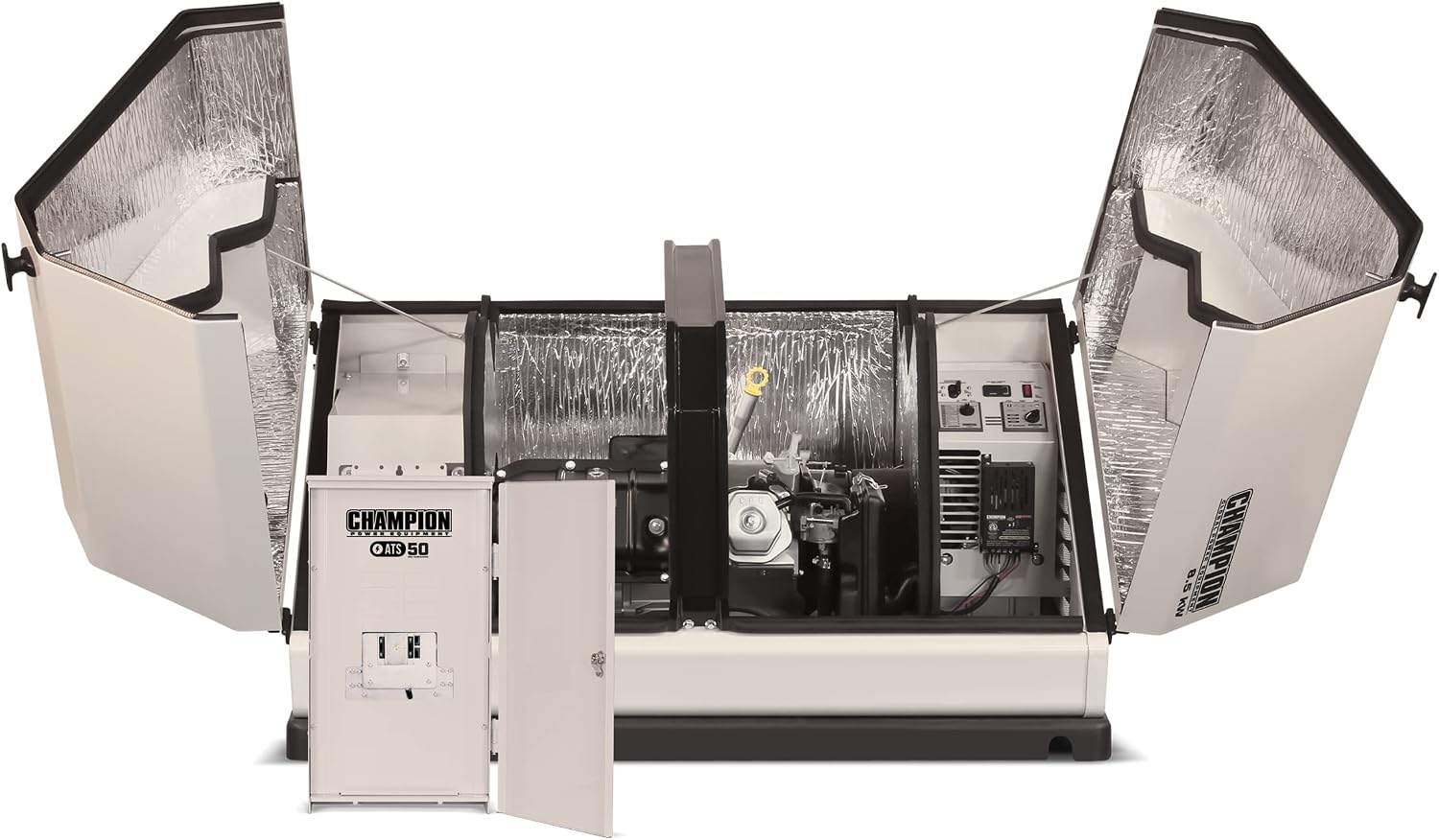
The Champion 8.5kW is the best value on this list because it does exactly what many homeowners actually need and nothing they do not. At 8.5 kilowatts with a 50-amp outdoor-rated transfer switch, it is built to keep essential circuits alive during an outage: a furnace or heat pump air handler, a refrigerator, a sump pump, and a few key outlets and lights.
It runs on dual fuel, accepting natural gas or liquid propane, and starts automatically when the power drops just like the larger units. Because the transfer switch covers a defined set of essential circuits rather than the whole panel, the install is simpler and the total cost is the lowest here, which is what earns it the value pick.
Set expectations correctly. This is not a whole-home unit and will not carry central air conditioning alongside everything else. If your goal is to survive a multi-day outage with heat, refrigeration, and safety circuits intact without a whole-home budget, it is the smart buy.
Bottom line: the most affordable way to get automatic, hands-free standby power for the essentials.
- Output: 8.5 kW on propane, 7.5 kW on natural gas
- Fuel: dual fuel, natural gas or liquid propane
- Transfer switch: 50-amp outdoor-rated, essential circuits
- Cooling: air-cooled
- Self-test: automatic
- Warranty: Champion limited coverage
At 8.5 kilowatts, this unit is sized for essential circuits, not the whole house. Think furnace, refrigerator, sump pump, and a handful of outlets and lights. It is not intended to run central air conditioning at the same time as everything else. Choose it when your priority is riding out an outage with the essentials rather than powering the full panel.
Even this smaller unit is a professional install. An electrician mounts the generator and wires the 50-amp outdoor-rated switch to your chosen essential circuits, a plumber connects the fuel, and the work is permitted and inspected. The essential-circuits approach keeps the install simpler and less costly than a whole-panel switch.
How to Choose the Best Standby Generators for Your Home
Sizing a standby system is different from picking a portable one. Because these units wire into your panel and run for days at a time, the decisions you make about output, fuel, and transfer switch matter far more than the color of the enclosure. Work through the criteria below in order and you will land on the right unit for your home rather than the biggest number on the shelf.
Sizing: How Many Kilowatts You Actually Need

Output is measured in kilowatts, and the right figure depends on what you want to keep running. An essential-circuits setup covering a furnace, refrigerator, sump pump, and a few lights can run comfortably on a smaller unit in the 8 to 14 kilowatt range. A whole-home approach that also carries central air conditioning, an electric range, and a well pump usually calls for 20 kilowatts or more. Air-cooled residential units top out around 26 kilowatts, which is where the largest models on this list sit.
It is tempting to buy the biggest generator you can afford, but oversizing wastes money and fuel while undersizing leaves you shedding loads during an outage. A good rule is to add up the running wattage of the circuits you truly need, account for the surge draw of motors like an air conditioner compressor, and choose a unit with headroom above that total. A licensed electrician can run a proper load calculation as part of the quote.
Fuel: Natural Gas, Propane, or Dual Fuel
Standby units run on natural gas piped from the street or on liquid propane stored in a tank on your property. Natural gas is convenient because the supply is effectively unlimited and you never refuel, but output drops slightly compared with propane and you depend on the utility line staying pressurized. Propane stores a large amount of energy and works well in areas without a gas main, though you have to monitor the tank and arrange refills.
Several Champion models on this list are dual fuel, meaning they accept either natural gas or propane so you can switch sources if one becomes unavailable. That flexibility is genuinely useful during a regional emergency, and it is one reason dual-fuel units have become popular for whole-home installs.
Transfer Switch: Whole-House or Essential Circuits

The transfer switch is the brain of the system. It watches utility power, disconnects your home from the grid the instant it fails, and reconnects to the generator, all automatically and safely so power never back-feeds onto the utility line. A service-rated 200-amp automatic transfer switch manages the entire panel and lets the generator power the whole house, shedding large loads only if demand climbs too high. A smaller switch, such as a 50-amp or 100-amp unit, covers a defined set of essential circuits you choose in advance.
Match the switch to your goal. If you want lights-out to feel like nothing happened, a 200-amp whole-house switch is the target. If you only need the fridge, heat, and a few outlets to survive a storm, a load-managed essential-circuit switch keeps the install simpler and the price lower.
Installation, Permits, and Professional Setup
This is the biggest difference between a standby unit and a portable one. Every generator here must be installed by a licensed electrician, often alongside a plumber for the gas connection, and the work requires a permit and an inspection in almost every jurisdiction. The unit sits on a composite or concrete pad, ties into your gas supply, and connects to the transfer switch and panel. Plan for that labor and permitting cost on top of the hardware, and treat any listing that suggests you can wire one yourself with real caution. You can compare the fixed-install approach against grid-free options in our roundup of the best solar generators.
Noise, Placement, and Local Codes
A standby unit runs a self-test every week and can run for days during an outage, so where it sits and how loud it is will matter to you and your neighbors. Air-cooled residential models produce a steady hum in the range of a central air conditioner, and manufacturers publish a decibel figure you can compare before you buy. Placement is governed by code: most jurisdictions require a minimum clearance from windows, doors, and the property line, plus a safe distance for the exhaust. Your electrician will factor those setbacks into the pad location, but it is worth checking your lot before you commit, because a tight side yard can limit which size you are allowed to install.
Runtime, Monitoring, and Warranty
Because these units draw from a gas main or a large propane tank, runtime is measured in days rather than hours, and most run a brief weekly self-test to stay ready. Modern models add remote monitoring over Wi-Fi or cellular so you can confirm the generator is healthy from your phone, which matters when an outage hits while you are away. Warranty coverage ranges from five to ten years across the brands here, and a longer term signals confidence in the air-cooled engine that does the work. The table below lines up the shortlist by the factors that should drive your decision.
| Model | Output | Fuel | Transfer Switch | Best For |
|---|---|---|---|---|
| Generac Guardian 22kW | 22 kW | Natural gas / propane | 200-amp whole-house | Most homes, best overall |
| Generac 26kW Whole Home | 26 kW | Natural gas / propane | 200-amp whole-house | Larger homes, heavy loads |
| Champion aXis 22kW | 22 kW | Dual fuel | 200-amp whole-house | Fuel flexibility |
| Generac Guardian 14kW | 14 kW | Natural gas / propane | 100-amp | Smaller homes |
| Honeywell 14kW | 14 kW | Natural gas / propane | Automatic | Essential to mid coverage |
| Champion aXis 14kW | 14 kW | Dual fuel | 200-amp | Mid-size dual fuel |
| Champion 8.5kW | 8.5 kW | Dual fuel | 50-amp essential | Essentials, best value |
Why You Should Trust Us
We build these guides by studying the specifications, transfer switch options, fuel systems, and real owner feedback for each unit, then curating a shortlist that reflects how these machines are actually bought and installed. For a category like this one, that curation matters more than usual. Fixed standby generators are professional installs that cost thousands of dollars, so they attract far fewer online ratings than a portable model an owner buys and reviews the same week. We deliberately set aside the raw rating count and judged each unit on output, transfer switch capability, fuel flexibility, brand engineering, and whole-home coverage instead.
Our editorial team is independent, and we do not accept payment from manufacturers to place a product on a list. When a listing marketed itself as “home backup” but turned out to be a portable unit rather than a permanently installed one, we removed it, because mixing the two categories would only mislead a buyer trying to power a whole house through a multi-day outage.
Final Thoughts
For most homeowners, the Generac Guardian 22kW Home Standby Generator is the best overall choice. Its service-rated 200-amp automatic transfer switch powers the entire panel, its air-cooled engine has a long track record, and 22 kilowatts is enough to carry the loads that matter in a typical house, including central air. If your home is larger or you run heavy electric appliances, step up to the Generac 26kW Whole Home Generator, which adds capacity and cellular monitoring for the biggest air-cooled draw on this list.
Buyers who want fuel flexibility should look hard at the Champion aXis 22kW, which delivers whole-house output on either natural gas or propane and backs it with a long warranty. And if your goal is simply to keep the essentials alive without a whole-home budget, the Champion 8.5kW Home Standby Generator is the best value here: it covers a furnace, refrigerator, and key circuits through a 50-amp switch at the lowest entry cost on the list. Whichever you choose, remember these are permanent installs that need a licensed electrician and a permit. If you would rather have something portable, compare the quieter options in our guide to the best quiet generators, or browse more home power projects across our tools and home improvement coverage.
Frequently Asked Questions
What is the difference between a standby generator and a portable one?
A standby generator is permanently installed on a pad beside your home, wired into your electrical panel through a transfer switch, and fueled by natural gas or propane. It starts automatically within seconds of an outage and needs no refueling by hand. A portable generator is a movable unit you start manually and refuel from a can. If you want hands-free, whole-home backup, a standby unit is the answer. If you need something you can move, see our guide to the best inverter generators.
How many kilowatts do I need in a standby generator in 2026?
It depends on your goal. To power essential circuits like heat, a refrigerator, and a sump pump, a unit in the 8 to 14 kilowatt range is usually enough. To run the whole home including central air conditioning and large appliances, plan on 20 kilowatts or more. The best standby generators for your house come down to a proper load calculation, which a licensed electrician performs as part of the installation quote.
Can I install a standby generator myself?
No. These units must be installed by a licensed electrician, usually with a plumber for the gas line, and the work requires a permit and an inspection in nearly every area. The generator connects directly to your gas supply, your electrical panel, and a transfer switch, all of which involve code requirements and safety interlocks. Attempting a do-it-yourself install can void the warranty and create a serious safety hazard.
Should I choose natural gas or propane?
If your home already has a natural gas line, that is usually the easiest choice because the fuel supply is continuous and you never refuel. Propane is the better option when there is no gas main, and it stores a large amount of energy in a dedicated tank. Several dual-fuel units on this list accept either source, which gives you a fallback if one becomes unavailable during a regional emergency.
How long can a standby generator run during an outage?
Because standby units draw from a natural gas main or a large propane tank, they can run for days, far longer than a portable model limited by a fuel can. A unit on natural gas can run essentially as long as the supply holds. On propane, runtime depends on tank size and load. Most units also run a short weekly self-test to confirm they are ready before the next storm.







Write Your Review
No reviews yet. Be the first to share your experience!