

A compact microwave is bought for one of three reasons: the kitchen is small, the room is not really a kitchen at all, or the appliance has to disappear under a cabinet without eating the entire counter. Those buyers get pushed toward the same wall of 0.7 and 0.9 cubic foot boxes, and the listings make them look interchangeable. They are not. Our shortlist covers 10 small countertop microwave models from COMFEE, BLACK+DECKER, Farberware and more, and the differences that matter turn out to be turntable diameter, wattage, and whether the thing beeps loudly enough to wake a roommate.
Our top pick is the COMFEE’ 0.7 cubic foot model for combining a mute function, an eco standby mode, and a child lock in the size class where those features are usually stripped out. If your constraint is power rather than footprint, our guide to 1000 watt microwaves covers the tier above this one. This list is current for September 2026.

Pros
- Sound can be switched off entirely
- Eco mode cuts standby draw
- Child safety lock included
- By far the longest rating history in this size class
Cons
- Turntable diameter is not published
- 700 watts is slow for frozen meals
The COMFEE' is the compact microwave to pick when the room it lives in is also a room somebody sleeps in. The sound on and off control is the reason. Most ovens in this class end a cycle with a string of loud beeps that cannot be disabled, and in a studio apartment or a dorm that single design decision determines whether the appliance is usable at night.
Around that it is a conventional and well-sorted 700 watt machine: one-touch express cook buttons for the common durations, a child safety lock, and an eco mode that trims standby power. The eco mode matters more than it sounds, because a microwave spends the overwhelming majority of its life idle with a clock lit.
The compromises are the ones inherent to the class. Seven hundred watts means adding roughly 40 to 50 percent to package times written for a full-size oven, and COMFEE' does not publish a turntable diameter, so buyers with large dinner plates should measure before ordering.
Bottom line: the best-rounded compact microwave here, and the one we would choose for a shared living space without hesitating.
- Capacity: 0.7 cubic feet
- Cooking output: 700 watts
- Sound: on and off control
- Eco mode: yes
- Child safety lock: yes
- Controls: one-touch buttons
- Finish: black
Students, studio apartment dwellers, and office kitchens where noise is a genuine issue and the microwave is used at odd hours.
Less suited to households that cook frozen meals daily, where a 900 watt model will be noticeably faster.
Leave roughly three inches of clearance behind the unit and a couple of inches at each side so the cooling vents can work.
Plug it into a wall outlet rather than a power strip. A 700 watt oven draws far more from the wall than its cooking rating suggests.

Pros
- Publishes a 10 inch turntable, unusual at this price
- Digital LED display with touch controls
- Takes a full dinner plate
- Lowest cost of entry on this list
Cons
- No stated sound control
- 700 watt output limits frozen meal performance
Most 0.7 cubic foot microwaves quietly ship a turntable of around 9 inches, and most buyers discover this the first time a dinner plate jams against the wall and stops rotating. The Commercial Chef CHM7MW publishes a 10 inch plate, and at this price that single specification is the whole argument for it.
Everything else is deliberately plain: touch controls, a digital LED display, 700 watts of output, and a white cabinet that disappears in a rental kitchen. There is no mute function and no eco mode, which is how the price is kept where it is.
Treat it as the sensible default for a first apartment, a workshop, or a second microwave in a basement. The rating history is substantial for a value model, which suggests the build survives ordinary use rather than merely arriving intact.
Bottom line: the value pick, chosen because it solves the dinner plate problem that sends so many cheap compacts straight back.
- Model: CHM7MW
- Capacity: 0.7 cubic feet
- Cooking output: 700 watts
- Turntable: 10 inches
- Controls: touch with digital LED display
- Finish: white
Buy this if the budget is firm and plate clearance matters. Skip it if you need the microwave to be silent at the end of a cycle, since sound control is not offered.
Check your counter depth against the external dimensions; the internal gain over rival 0.7 models comes from efficient packaging rather than a larger box.
Wipe the interior while it is still warm, before spatters bake on. The glass turntable is dishwasher safe on the top rack in most cases.
Keep the vents clear and never operate the oven empty.
Pros
- 900 watts heats noticeably faster than the 700 watt group
- 10.6 inch turntable takes a full dinner plate
- Ten power levels give finer control
- Child safety lock included
Cons
- Push-button doors need a firmer action than a handle
- Turntable size appears only on the product images, not the bullets
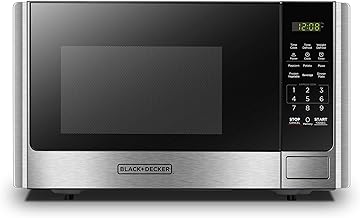
Stepping from 700 to 900 watts changes how a compact microwave behaves. Package instructions written for a full-size oven need roughly 15 to 20 percent more time rather than 40 to 50 percent, and food heats more evenly because there is less time for the edges to overcook while the middle catches up. This BLACK+DECKER is the straightforward way to get that.
Ten power levels is more than most rivals offer and the difference shows on anything delicate: melting chocolate or softening butter at 30 percent is far more controllable than pulsing full power in short bursts. Six auto cook settings cover the usual suspects.
The push-button door divides opinion. It keeps the cabinet narrower, since there is no handle protruding, but it needs a deliberate press and some buyers find it stiff for the first few weeks. The turntable measures 10.6 inches, large enough for a full dinner plate, although BLACK+DECKER prints that number on its product images rather than in the listing bullets where buyers would actually look for it.
Bottom line: the least fussy way to get 900 watts in a compact footprint.
- Capacity: 0.9 cubic feet
- Cooking output: 900 watts
- Turntable: 10.6 inches
- Power levels: 10
- Auto cook settings: 6
- Door: push-button release
- Child safety lock: yes
- Finish: stainless steel
The natural pick for anyone reheating batch-cooked meals, where even heating across a full container matters more than absolute speed.
Ten power levels also suit anyone who uses a microwave for melting and softening rather than only for reheating.
Press the door release squarely rather than at the edge; angled pressure is what wears push-button latches over time.
Maintain rear and side clearance for the vents, and plug directly into a wall outlet.

Pros
- 10.6 inch removable turntable takes a full dinner plate
- Mute function for shared spaces
- 900 watt output
- LED interior lighting is brighter than typical
Cons
- Shorter rating history than the older models here
- Black stainless shows fingerprints
The Toshiba is the specification sheet most buyers in this class actually want. It publishes a 10.6 inch removable turntable, which is the largest stated figure on this list and comfortably takes a standard dinner plate, and it pairs that with 900 watts of output and a mute function.
That combination is rarer than it should be. Most models that offer sound control sit in the 700 watt group, and most 900 watt models stay silent about the turntable. Having both in one cabinet removes the usual compromise between plate clearance and heating speed.
A removable turntable is also easier to clean properly, since it goes in the sink rather than being wiped in place. The interior LED lighting is brighter than the dim bulbs common at this size, which sounds trivial until you are checking whether something has finished heating.
Bottom line: the specification-led pick, and the one to choose if a full plate has to fit and the beeping has to stop.
- Capacity: 0.9 cubic feet
- Cooking output: 900 watts
- Turntable: 10.6 inches, removable
- Auto menus: 6
- Mute function: yes
- Child lock: yes
- Finish: black stainless steel
Buyers who eat off full-size dinner plates and are tired of compact microwaves that cannot rotate them, and anyone in a shared space who needs the alarm silenced.
Not the pick if you want the longest possible rating history behind a purchase.
Lift the turntable out to wash it rather than wiping it in place; the roller ring underneath collects spills that cause the plate to grind.
Black stainless marks easily, so use a microfibre cloth rather than an abrasive pad.

Pros
- Mute option and eco mode together
- Memory function recalls the last used setting
- Six presets cover common jobs
- Highest rating average in the 900 watt group here
Cons
- Turntable diameter is not published
- Preset menus duplicate what manual timing does
Chefman has aimed this one at people who use the same two or three settings every day. The memory function recalls your last used setting, which sounds like a gimmick until you realise how much of microwave use is repetition: the same mug of coffee, the same bowl of soup, at the same power.
It is also one of only three models here with sound control, and the only one that pairs a mute option with an eco mode and a memory function in the same cabinet. At 900 watts it sits in the faster group, so frozen meals need only a modest time adjustment over package instructions.
The presets are less compelling. Six auto cook menus are useful for popcorn and defrost by weight and largely redundant beyond that, since manual timing at a chosen power level is more predictable. The turntable size is not published, which remains the persistent gap across this whole category.
Bottom line: the pick for habitual users who want the oven to remember what they always do.
- Capacity: 0.9 cubic feet
- Cooking output: 900 watts
- Presets: 6
- Eco mode: yes
- Mute option: yes
- Memory function: yes
- Child safety lock: yes
- Finish: digital stainless steel
Set your most common job once and let the memory function hold it; that is where this model earns its keep over a plain 900 watt oven.
Use defrost by weight rather than a timed defrost, which is the one auto setting that consistently outperforms guessing.
Wipe the stainless exterior along the grain with a damp microfibre cloth. Abrasive pads leave permanent swirls.
Keep the vents clear and never run the oven empty, which stresses the magnetron.

Pros
- Stainless finish at a compact price
- Smaller footprint than the 0.9 sibling
- Familiar, simple control layout
- Very large rating history
Cons
- Lowest rating average on this list
- 700 watts is slow with frozen food
This is the smaller, slower sibling of the 0.9 BLACK+DECKER above, and the reason to choose it is footprint. If the microwave has to fit under a wall cabinet or into a shallow rental counter, those saved inches decide the purchase and no feature list changes that.
In stainless steel it looks more expensive than it is, which matters in a kitchen where the appliance is on permanent display. The controls are conventional and easy to learn, with no menu diving.
Be clear about the trade-off. At 700 watts, package times need roughly 40 to 50 percent added, and its rating average is the lowest here, which in this category usually reflects door and turntable complaints appearing after a year or two rather than problems out of the box.
Bottom line: buy it for the dimensions, not for the performance.
- Capacity: 0.7 cubic feet
- Cooking output: 700 watts
- Finish: stainless steel
- Controls: button
- Intended use: dorm, apartment, small kitchen
Measure the space first. If you have room for the 0.9 version, take it; the extra width is small and the wattage difference is not.
Choose this only when the opening genuinely will not take a larger cabinet.
Stainless shows every fingerprint around the door edge, so keep a microfibre cloth nearby and wipe along the grain.
Leave clearance at the rear and sides for the vents.

Pros
- Easy clean interior finish
- Auto cook and defrost settings
- Child safety lock
- Established rating history
Cons
- No published turntable size
- No sound control
Farberware's compact is built around a virtue that rarely makes the headline of a listing: the interior wipes clean. Anyone who has scrubbed dried tomato sauce off a textured microwave cavity understands why that belongs near the top of the specification list rather than the bottom.
The rest is competent and familiar. Seven hundred watts, auto cook settings, defrost, and a child safety lock, in a stainless finish. There is no sound control, so this is not the model for a room where somebody sleeps.
It sits in the middle of this list on almost every axis, which makes it a reasonable default when the standouts are unavailable. The rating history is long enough to be meaningful.
Bottom line: an unremarkable but honest 700 watt compact, picked for how easily it cleans.
- Capacity: 0.7 cubic feet
- Cooking output: 700 watts
- Auto cook settings: yes
- Defrost: yes
- Child safety lock: yes
- Interior: easy clean finish
- Finish: stainless
Steam the cavity with a bowl of water for two minutes before wiping, and even baked-on spatter lifts without chemicals.
Do not use abrasive cleaners inside; they damage the finish that makes cleaning easy in the first place.
Households where the microwave takes a beating and gets cleaned often, such as family kitchens and shared houses.
Not the pick where silence at the end of a cycle is required.

Pros
- Soft close door removes the slam entirely
- Build quality above the class norm
- Considered control layout
- Quiet in normal use
Cons
- Costs considerably more than rivals here
- Cooking wattage is not stated in the listing
The Compact Wave is the outlier on this list, and it earns its place on one feature: the door does not slam. A soft close mechanism catches it and draws it shut, which sounds like a small thing in a showroom and stops sounding small at eleven at night in an open-plan apartment.
The rest of the machine follows the same logic. Controls are laid out for the two jobs people actually do, reheating and defrosting, rather than burying them under auto menus. The build feels closer to a full-size appliance than to the thin steel used at the budget end of this category.
Two honest caveats. It costs substantially more than anything else here, and the listing does not state a cooking wattage, so buyers who want to calculate package time adjustments will need to check the manual. Neither is a defect, but both should be known before ordering.
Bottom line: the premium pick, bought for the door and the quiet rather than for the specification sheet.
- Model: BMO650SIL
- Format: compact countertop
- Door: soft close
- Functions: reheat, defrost, cook
- Finish: silver
- Cooking wattage: not stated in listing
Open-plan apartments and households where the kitchen shares a wall with a bedroom, and buyers who value build quality over the lowest price.
Not the pick for a dorm room where the appliance may not survive four years of shared use.
Let the soft close mechanism do its work rather than pushing the door shut; forcing it defeats the damper and wears it early.
Keep the vents clear and clean the interior with a damp cloth rather than sprays.

Pros
- 900 watt output in a compact cabinet
- Stainless steel finish
- Manufacturer with deep microwave heritage
- Simple, uncluttered operation
Cons
- Sparse published specification
- Short rating history so far
Sharp has been building microwave ovens since the category existed, and the SMC0962KS is what that experience looks like when applied to a budget compact: 0.9 cubic feet, 900 watts, stainless steel, and very little else to talk about.
That is not a criticism. In this class, the failures that matter are door latches, turntable motors, and magnetrons that give up early, and a manufacturer with decades of production behind it is a reasonable hedge against all three.
What you do not get is information. The listing is unusually sparse, with no published turntable diameter, no preset count, and no mention of sound control. The rating history is also short compared with the veterans on this list, so there is less accumulated evidence to lean on.
Bottom line: a safe 900 watt choice on brand pedigree, for buyers who do not need a feature list.
- Model: SMC0962KS
- Capacity: 0.9 cubic feet
- Cooking output: 900 watts
- Finish: stainless steel
- Format: countertop
Choose this if you weigh manufacturer track record above published features. Choose the Toshiba instead if you want the numbers stated up front.
Confirm the external dimensions against your counter, since the listing gives little else to go on.
Standard compact microwave care applies: clearance at the rear and sides, direct wall outlet, and never run it empty.
Wipe stainless along the grain to avoid swirl marks.

Pros
- Retro styling stands out in an open kitchen
- Eight auto cook menus
- Auto defrost and five power levels
- Compact 0.7 cubic foot footprint
Cons
- Newest listing here with the least rating history
- Retro cabinets are usually deeper than plain ones
Appearance is a legitimate reason to choose an appliance that sits in your eyeline every day, and that is the case for the Frigidaire Retro. In a kitchen where the microwave is visible from a dining table, a period-styled cabinet reads as a deliberate choice rather than as an appliance parked on the counter.
Underneath, it is an ordinary and adequate 700 watt compact: eight auto cook menus, auto defrost, five power levels, and an LED display. Five power levels is fewer than the ten offered by the BLACK+DECKER 0.9, which shows up when you want gentle heat rather than pulsed full power.
Two practical notes. Retro cabinets tend to be deeper than plain ones because the styling adds material at the front and sides, so measure your counter carefully. And this is the newest listing on our list, with the least accumulated customer feedback to judge long-term reliability.
Bottom line: buy it because you want it on your counter, and accept an ordinary specification underneath.
- Capacity: 0.7 cubic feet
- Cooking output: 700 watts
- Auto cook menus: 8
- Auto defrost: yes
- Power levels: 5
- Display: LED
- Styling: retro cabinet
Open kitchens and apartments where the microwave is on show and the styling of the room matters.
Not the pick for anyone who wants maximum specification per dollar.
Measure counter depth including the door swing before ordering, since styled cabinets carry extra depth.
Keep the vents clear and plug directly into a wall outlet.
How to Choose a Small Countertop Microwave
Capacity in this class is quoted in cubic feet, a number that tells you almost nothing useful on its own. What you actually need to know is whether your plate fits, how long the machine takes to heat, and how much counter it eats. Those three answers come from three different specifications, and only one of them is printed in large type on the box.
Turntable Diameter Beats Cubic Feet

This is the specification that decides whether you will be happy, and it is the one most listings bury. A standard American dinner plate measures 10.5 to 11 inches across. Many 0.7 cubic foot microwaves ship with a turntable around 9 inches, which means a dinner plate either does not fit at all or fits but scrapes the walls and stops rotating, leaving you with a cold ring in the middle of the food.
Three models on this list give a usable number, though only two of them do it in the listing text. The Commercial Chef CHM7MW states a 10 inch turntable and the Toshiba 0.9 cubic foot model states a 10.6 inch removable turntable. The BLACK+DECKER 0.9 also runs a 10.6 inch turntable, a figure that appears only on the manufacturer’s product images rather than in the bullet points, which is exactly the kind of detail worth digging for. If a listing does not state the turntable size, assume it is small and measure your plates before ordering. Where a manufacturer stays silent on a number this basic, it is rarely because the answer is flattering.
Wattage: What 700 Watts Really Costs You
Compact microwaves split cleanly into 700 watt and 900 watt groups, and that gap is larger in practice than it looks on paper. Package instructions on frozen food are almost always written for a 1000 or 1100 watt oven. On a 700 watt machine you should expect to add roughly 40 to 50 percent to the stated time, and on a 900 watt machine roughly 15 to 20 percent.
The practical consequence is not just waiting longer. Lower wattage heats less evenly because the food has more time to conduct heat outward from the hot spots, so a 700 watt oven benefits far more from stopping halfway to stir. If you mostly reheat coffee and leftovers, 700 watts is fine. If you cook frozen meals several times a week, the 900 watt models here are worth the small extra footprint.
Noise, Mute Functions, and Shared Spaces

Microwaves in dorm rooms, studio apartments, and offices get used at hours when a five-beep end-of-cycle alarm is genuinely antisocial. A mute function is therefore not a novelty feature in this size class, it is one of the main reasons to pick one model over another. The COMFEE’, the Chefman 0.9, and the Toshiba 0.9 all offer sound control. Most of the rest do not, and there is no way to add it later.
Door mechanism matters for the same reason. The Breville Compact Wave uses a soft close door that stops the slam entirely, which is a small luxury that becomes obvious at midnight. Push-button doors, used on the BLACK+DECKER models, need a firmer action than the handle-style doors but take up less width.
Footprint, Ventilation, and Where It Will Actually Sit
External dimensions and internal capacity are only loosely related. A 0.9 cubic foot oven with efficient packaging can occupy less counter than a poorly designed 0.7. Measure the depth of your counter and remember that the door needs clearance to swing, which is usually the constraint in a corner.
Ventilation is the part people skip and regret. Every model here needs clearance at the back and sides for the cooling vents, and pushing the unit flat against a backsplash makes the magnetron run hotter and shortens its life. Three inches at the rear and a couple of inches at the sides is a reasonable working rule. Never place a microwave inside a cabinet that was not designed as a microwave garage, and never stack anything on top of the vents.
Power Draw and Dorm Circuits
Wattage on the box is cooking output, not the electricity the appliance pulls from the wall. A 700 watt oven typically draws somewhere around 1000 to 1200 watts, and a 900 watt oven draws proportionally more. On a shared dorm or office circuit already carrying a mini fridge, a kettle, and a space heater, that is enough to trip a breaker.
Plug the microwave directly into a wall outlet rather than a power strip or an extension lead. This is not a manufacturer’s disclaimer to be ignored; the current draw is genuinely at the limit of what light-duty strips are rated for. Check your building rules too, since some dorms cap appliance wattage.
Controls, Presets, and Child Locks
One-touch express cook buttons are the most used control on any compact microwave, and their layout varies more than you would expect. Dial-based interfaces survive greasy hands better; membrane touch panels clean more easily but wear at the most-pressed buttons over years. Auto cook menus are mostly marketing, with two exceptions worth having: a defrost-by-weight setting and a popcorn setting calibrated to a standard bag.
A child safety lock appears on most of this list and costs nothing extra. If the microwave sits at counter height in a home with small children, treat it as a requirement rather than a bonus.
Where Compact Microwaves Run Out of Road
It is worth being clear about what this class does not do, because the listings rarely spell it out. None of these ovens offer sensor cooking, the humidity-detecting feature that stops a cycle when the food is actually hot rather than when a timer expires. Sensor reheat is the single feature that most reduces the number of cold-centre disasters, and it is reserved for larger and more expensive machines.
Convection and grill elements are likewise absent. A compact microwave will not brown, crisp, or bake, and combination ovens that do are both physically larger and several times the price. If your reason for buying is to avoid switching on a full oven for one portion, a compact microwave will reheat that portion but will not roast it.
Interior height is the third limit and the least discussed. Even where the turntable is wide enough for a dinner plate, cavity height in this class is low, so tall mugs, casserole dishes with domed lids, and standard mixing bowls often will not clear the roof. Measure the tallest container you regularly heat and compare it against the stated internal height, not the external one.
If any of those limits are dealbreakers, the honest advice is to buy a mid-size 1.1 to 1.2 cubic foot oven instead and give up the counter space. The compact class rewards people whose constraint is genuinely physical, not people trying to save fifty dollars.
| Pick | Capacity | Output | Stated turntable | Sound control |
|---|---|---|---|---|
| COMFEE’ 0.7 | 0.7 cu ft | 700 W | Not stated | Yes, sound on/off |
| Commercial Chef CHM7MW | 0.7 cu ft | 700 W | 10 inches | Not stated |
| BLACK+DECKER 0.9 | 0.9 cu ft | 900 W | 10.6 inches | Not stated |
| Toshiba 0.9 | 0.9 cu ft | 900 W | 10.6 inches, removable | Yes, mute function |
| Chefman 0.9 | 0.9 cu ft | 900 W | Not stated | Yes, mute option |
| Breville Compact Wave | Compact | Not stated | Not stated | Soft close door |
For the rest of the small-kitchen setup, our home and kitchen guides cover the appliances that usually share the same stretch of counter.
Why You Should Trust Us
Every model on this list was checked against its live product listing for the numbers that decide whether a compact microwave works in a small space: stated capacity, cooking wattage, turntable diameter where the manufacturer publishes it, and the presence of a mute function or child lock. Where a specification is not published, we say so in the table rather than filling the gap with an estimate, because a guessed turntable size is worse than an admitted blank.
We also weigh the shape of the customer rating history rather than the headline average. In this category the complaints that matter cluster after the first year, around door latches and turntable motors, and a model with a long rating history tells you more than a new listing with a perfect score. We have not run these ovens on a laboratory bench, and we do not pretend otherwise. More of our appliance coverage sits in the appliances section.
Final Thoughts
The COMFEE’ 0.7 cubic foot model is our best overall pick because it bundles the three things that make a compact microwave livable in a shared space, namely sound control, an eco standby mode, and a child lock, in the size class where those are normally the first features cut. It has also accumulated a rating history far longer than anything else here, which in this category counts for a great deal.
For best value, the Commercial Chef CHM7MW earns the nod partly on price and partly because it is one of the few models in the 0.7 class that publishes a 10 inch turntable. That single number solves the dinner plate problem that sends so many compact microwaves back.
If you cook frozen meals rather than reheat leftovers, step up to the 900 watt group: the Toshiba for the largest stated turntable and a mute function, the BLACK+DECKER 0.9 for the lowest fuss, or the Chefman 0.9 if you want presets and memory. The Breville Compact Wave is the pick for anyone who values a soft close door and a quieter routine, and the Frigidaire Retro exists for buyers who care how the thing looks on the counter, which is a legitimate reason to choose an appliance you will see every day. Small-kitchen cooking gear continues in our guide to microwave egg poachers.
Frequently Asked Questions
Will a dinner plate fit in a small countertop microwave?
Only if the turntable is large enough. A standard dinner plate is 10.5 to 11 inches, while many 0.7 cubic foot ovens use a turntable of about 9 inches. Look for a published turntable diameter, such as the 10 inch plate in the Commercial Chef or the 10.6 inch plate in the Toshiba, and measure your own plates before you order.
How much longer does a 700 watt microwave take?
Package instructions are usually written for a 1000 or 1100 watt oven, so add roughly 40 to 50 percent to the stated time on a 700 watt model and 15 to 20 percent on a 900 watt model. Stirring halfway through matters more at lower wattage, since uneven heating is the real cost rather than the extra minute.
Can I plug a compact microwave into a power strip?
You should not. Cooking wattage is not the same as the power drawn from the wall, and a 700 watt oven typically pulls around 1000 to 1200 watts. That is at or beyond what most light-duty strips and extension leads are rated to carry continuously. Use a wall outlet directly, and check the appliance rules if you are in a dorm.
Is 0.7 or 0.9 cubic feet the better choice in 2026?
Choose 0.7 only if counter space is the binding constraint. The 0.9 class usually pairs with 900 watt output and a larger turntable while adding only a couple of inches of width, so it heats faster and takes a full plate. If the microwave is going in a cabinet cutout or under a wall unit, measure the opening first and let that decide.
How much clearance does it need around the vents?
Around three inches at the rear and a couple of inches at each side is a sensible working minimum, and nothing should sit on top of the unit. Restricting airflow makes the magnetron run hotter and shortens its service life, which is the most common way a compact microwave dies early. Our wider buying guide library covers the rest of the small kitchen.





Write Your Review
No reviews yet. Be the first to share your experience!