

A poached egg used to mean a saucepan of simmering water, a splash of vinegar, and a swirl you had to get right on the first try. A good microwave egg poacher removes all of that. You add a little water, crack in an egg, snap the lid on, and pull out a set white with a soft yolk before the toast finishes browning. That is why this humble bit of plastic and silicone has quietly become one of the most useful pieces of gear in a small kitchen.
For September 2026 we pulled together a shortlist of 8 microwave egg poachers from brands including Nordic Ware, Chef Buddy, Sistema and more, ranked using real customer ratings and review volume rather than marketing copy. Our top pick is the Sistema Easy Eggs Microwave Egg Cooker for its vented lid and single-cup design that produce a consistent soft poach in about a minute. Below you will find picks for batch cooking, silicone cups that also work on the stovetop, and budget sets that cost less than a single brunch. If you are still building out the rest of your kitchen, our guide to the best cookware sets pairs well with everything here.

Pros
- Steam release vent keeps the white from bursting
- Cooks a single poached egg in roughly a minute
- BPA-free and rated dishwasher safe
- Compact enough to store with mugs
- Klip It style lid stays put when you lift it
Cons
- Only cooks one egg at a time
- Cook time still needs dialling in for your wattage
- Red colouring will not suit every kitchen
The Sistema Easy Eggs is the simplest expression of what a microwave egg poacher should be: a 270 ml cup, a lid with a steam release vent, and nothing else to go wrong. You add water to the marked level, crack in an egg, clip the lid on, and microwave. It is aimed squarely at the person who wants one poached egg on toast without dragging out a saucepan.
The vent is the reason it lands at the top of this list. Trapped steam is what makes eggs erupt in a microwave, and the release channel in the lid bleeds off pressure as it builds, so the white sets into a neat dome instead of blowing sideways. Sistema also gets the proportions right: the cavity is deep enough that the yolk sits protected in the middle rather than pressing against the lid, which is where overcooked spots usually appear.
The obvious limit is capacity. This is a one-egg device, and if two people want brunch at the same moment you are running two cycles. The plastic is light enough that a full cup can slide on a spinning turntable, and as with every poacher here the printed timing is a suggestion rather than a rule, so the first two or three eggs are a calibration exercise for your own microwave.
Bottom line: for a single serving, this is the most reliable and the least fussy option in the roundup. If your household needs more than one egg at a time, look at the four-egg tray further down, but for everyday solo breakfasts the Easy Eggs is the one to buy.
- Capacity: 270 ml, one egg
- Material: BPA-free plastic
- Lid: clip-on with steam release vent
- Colour: red with clear base
- Microwave safe: yes
- Dishwasher safe: yes, top rack
- Pack size: 1 count
Fill the base to the marked line with cold water, crack one egg into the cavity, and pierce the yolk once with a toothpick so pressure cannot build inside it. Clip the lid on and microwave for about 45 seconds at 1,000 watts, then check and add ten-second bursts until the white is fully opaque.
Let it stand for around 20 seconds before opening, and lift the lid away from your face. Slide the egg out with a spoon rather than tipping the whole cup, which keeps the yolk intact.
This is the pick for solo cooks, students in small kitchens, and anyone who eats a poached egg most mornings and wants the process down to under two minutes including cleanup.
It is not the right choice for families cooking several eggs at once or for anyone who wants a poacher that doubles on the stovetop.

Pros
- Well-made cup from an established kitchen brand
- Handles both poached and scrambled eggs
- Neutral white finish suits any kitchen
- Simple two-part design cleans easily
- Strong customer rating across thousands of reviews
Cons
- Costs more than generic plastic cups
- Single-egg capacity only
- Lid gets hot and needs a mitt
OXO built its reputation on getting small ergonomic details right, and the Good Grips Microwave Egg Cooker is that philosophy applied to a simple everyday gadget. It is a single-egg cup in plain white, with a lid and a base and nothing decorative in between, and it is the pick for anyone who wants a poacher that looks like kitchen equipment rather than a toy.
The strength is finish quality. The plastic feels denser than the generic cups on this list, the lid seats cleanly instead of wobbling, and the interior walls are smooth enough that a poached egg slides out without a fight. It is also genuinely dual-mode: beat two eggs with a splash of milk and it scrambles them in the same cup, which makes it more useful than a poach-only design.
Against that, you are paying a brand premium for a category where the physics is identical across every product. Capacity is one egg, so it shares the same limitation as our top pick without the deep vented cavity that Sistema uses, and the lid retains a lot of heat, so an oven mitt is not optional.
Bottom line: buy this if you value a solid, understated piece of kit from a brand you already trust and you mostly cook for one. If you want the absolute cheapest way to poach, the silicone multi-pack below does the same job for less.
- Capacity: one egg
- Material: microwave-safe plastic
- Colour: white
- Modes: poached and scrambled
- Dishwasher safe: yes
- Brand: OXO Good Grips
Rinse the cup while the egg residue is still warm, since dried egg protein bonds hard to plastic. The dishwasher top rack is fine for routine cleaning, but keep it away from the heating element in the base of the machine.
Always pierce the yolk before cooking and open the lid with the vent side angled away from you. The cup itself stays cooler than the lid, but neither should be handled bare-handed straight out of the microwave.
Choose this over a generic cup if you replace cheap kitchen plastic often and would rather buy once. The material quality is the main thing your money is buying here.
Choose something else if you regularly cook two or more eggs at a time, or if you want a poacher that can also go into a pan of simmering water when the microwave is busy.
Pros
- Poaches up to four eggs in one cycle
- All four eggs finish at the same doneness
- Clear lid lets you watch the whites set
- Solves eggs Benedict for two people
- Comes apart into simple pieces for washing
Cons
- Large footprint needs turntable clearance
- Lower average rating than the single-cup models
- Takes up a full shelf when stored
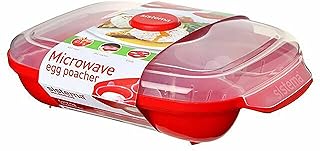
This is the batch cooker of the group. Sistema's four-egg poacher is a rectangular tray roughly 29 cm long with four moulded cavities under a clear lid, and it exists to solve the one problem single cups cannot: getting four poached eggs onto the table at the same temperature at the same moment.
In use it is straightforward. Water goes in the base, an egg goes into each cavity, and one longer cycle cooks the lot. For eggs Benedict, avocado toast for the family, or a Sunday brunch, that is a meaningful upgrade over four consecutive one-minute rounds. The clear lid also helps, because you can see the whites turn opaque and stop the cycle at the right second instead of guessing.
The compromises are real. It is big, so check your microwave turntable will actually turn with it inside, and it needs a proper shelf rather than a spot in a drawer. Its average customer rating also sits below the single-cup picks, largely because uneven results are more likely when four eggs of different sizes cook together and because the outer cavities can run slightly ahead of the inner ones in some machines.
Bottom line: if you routinely poach more than two eggs, the time saved makes the size worth tolerating. If you cook for one, this is the wrong shape and a single vented cup will serve you better.
- Capacity: up to 4 eggs
- Dimensions: approximately 28.7 x 20.5 x 8.4 cm
- Material: BPA-free plastic
- Colour: red base with clear lid
- Microwave safe: yes
- Dishwasher safe: yes
Use eggs of a similar size so they set together, and add water to the fill line rather than eyeballing it, since four cavities need more steam than one.
Start with the manufacturer's suggested time minus fifteen seconds, then add short bursts. Once you find the number for your microwave, write it on a sticky note inside a cupboard door and stop guessing forever.
Families, couples who both eat eggs, and anyone who preps poached eggs ahead for the week will get the most out of this format.
Skip it if your microwave is compact, if cupboard space is scarce, or if you only ever cook one egg at a time.

Pros
- Cooks two eggs in one short cycle
- Very fast quoted cook time
- Small enough for a dorm or office microwave
- Inexpensive way to try microwave poaching
- Simple parts with nothing to break
Cons
- Lightweight plastic feels basic
- No measuring cup included
- Timing varies a lot between microwaves
The Chef Buddy Microwave Egg Maker is the middle ground between a single cup and a full tray. It holds two eggs and the packaging promises a 45-second cook, which makes it a natural fit for breakfast sandwiches where you want two rounds of egg ready at once.
What it does well is speed and simplicity. There is no measuring cup, no complicated lid mechanism, and no assembly beyond dropping the lid on top. Two eggs cooking side by side in a shallow cavity set quickly and evenly, and the resulting discs slide onto a muffin or a slice of toast without breaking apart. It is also cheap enough to keep a second one at the office.
The build is where the price shows. The plastic is thin compared with the Sistema and OXO cups, the lid rests rather than clips, and without a fill line you are estimating the water volume, which is exactly the variable that determines whether the edges dry out. Cook times also swing widely with wattage, and 45 seconds is optimistic on a lower-powered machine.
Bottom line: a sensible budget choice if breakfast sandwiches are the goal and you accept a basic build. For a longer-lasting cup, spend a little more on one of the branded single poachers above.
- Capacity: up to 2 eggs
- Quoted cook time: about 45 seconds
- Material: microwave-safe plastic
- Measuring cup included: no
- Dishwasher safe: yes, top rack
- Intended uses: poached, steamed, sandwich rounds
Add roughly two tablespoons of water per cavity, crack in the eggs, and pierce each yolk. Cover and cook for 45 seconds, then check and continue in ten-second bursts.
For sandwich rounds, cook slightly longer so the yolk sets firm, which stops it running out of the bun on the first bite.
Because the lid is not clipped, lift it with a mitt and tilt the far edge up first so the steam vents away from your hand.
Hand washing is gentler on the thinner plastic than a hot dishwasher cycle, and it takes about ten seconds if you do it while the cavity is still warm.

Pros
- Four cups in one inexpensive pack
- Silicone flexes so eggs release cleanly
- Works in the microwave and on the stovetop
- Ring standers keep cups upright in a pan
- Nests down to almost no storage space
- Oil brush included
Cons
- Soft walls can tip on a turntable
- Silicone can hold odours over time
- No lid, so cooking is less contained
The KRGMNHR set takes a different approach from every rigid cup here. Instead of one moulded plastic chamber, you get four soft silicone cups with ring stands and a small oil brush, and they work either in the microwave or floating in a pan of simmering water on the hob.
Release is where silicone wins outright. A poached egg that clings to hard plastic has to be prised free; in a silicone cup you push up from underneath and the whole egg lifts out with the dome intact. The flexibility also means the set collapses into a stack that fits in a drawer, which is a real advantage over the four-egg tray. Being able to move to the stovetop when the microwave is occupied makes it the most versatile pick on the list.
The tradeoffs come from the same softness. Filled cups can lean or tip on a spinning turntable unless you seat them carefully, and there is no lid, so you are covering them with a plate if you want contained steam. Silicone also picks up faint odours after months of use, which a soak in warm water and bicarbonate of soda clears.
Bottom line: the smartest buy for the money. Four cups, two cooking methods, and the cleanest release in the roundup, as long as you accept a less structured cooking setup than a lidded cup.
- Pack size: 4 cups
- Material: food-grade BPA-free silicone
- Accessories: ring standers plus oil brush
- Compatible with: microwave and stovetop
- Dishwasher safe: yes
- Storage: cups nest inside each other
In the microwave, brush the inside lightly with oil, crack in an egg, add a teaspoon of water on top, cover the cup with a small plate, and cook in short bursts.
On the stovetop, bring a pan of water to a gentle simmer, sit the cups on their ring stands so they float upright, cover the pan, and cook for three to four minutes until the whites are set.
Silicone stays cooler than plastic but the egg and water inside do not, so still use a mitt when lifting cups out of a pan or the microwave.
Wash with hot soapy water or run the cups through the dishwasher. If a faint egg smell lingers, soak them in warm water with bicarbonate of soda for an hour and it clears.

Pros
- Measuring cup takes the guesswork out of water volume
- BPA-free and dishwasher safe
- One of the cheapest single poachers available
- Small enough for any microwave
- Straightforward two-piece design
Cons
- Average rating sits at the lower end of this list
- Generic build with no brand support
- Results vary if the water level is off
This generic poacher earns its spot for one reason: it ships with a measuring cup. Water volume is the single biggest variable in microwave poaching, and a poacher that tells you exactly how much to add removes the most common cause of a dry or watery egg.
Everything else is deliberately plain. It is a BPA-free plastic cup with a lid, rated dishwasher safe, at roughly the lowest price in the category. For someone who is not sure whether they will use a microwave poacher at all, it is a low-risk way to find out, and the measured approach means the first attempt is more likely to work than with an unmeasured cup.
The weaknesses show in the ratings. Its average customer score sits at the bottom end of our shortlist, and the complaints centre on inconsistency: get the water or the timing slightly wrong and the result swings from underdone to rubbery. There is no brand behind it to lean on if a part cracks, and the plastic is noticeably lighter than the Sistema and OXO cups.
Bottom line: a fine starter poacher and a good gift-price gadget, but if you already know you will poach eggs several times a week, one of the branded cups will last longer and behave more predictably.
- Capacity: single egg
- Material: BPA-free plastic
- Included: measuring cup
- Dishwasher safe: yes
- Microwave safe: yes
- Uses: poached and steamed eggs
Pick this if you want the lowest possible entry price and like the idea of a measured water routine rather than estimating by eye.
Look elsewhere if you want a vented lid, a heavier plastic that will survive years of dishwasher cycles, or the ability to cook more than one egg per cycle.
Fill the supplied cup to the marked level and pour it into the base. Crack the egg in, pierce the yolk, and cover.
Cook for 40 to 50 seconds on a 1,000 watt microwave, adding ten seconds at a time until the white is fully set, then let it rest briefly before serving.

Pros
- Cooks eggs in the shell without a stovetop
- Long-running design from an established US brand
- Handles soft, medium, and hard results
- Sturdier plastic than the generic cups
- Very large body of customer reviews
Cons
- Boils rather than poaches
- Requires careful timing to avoid cracked shells
- Bulkier than a single poaching cup
The Nordic Ware Microwave Egg Boiler is the outlier in this guide, and it is here because plenty of people shopping for a microwave egg gadget actually want boiled eggs rather than poached ones. Instead of cracking an egg into a cup, you place whole eggs in the shell into the chamber, add water, and let steam do the work.
It is a genuinely useful device for meal prep. Hard-cooked eggs for salads, lunchboxes, or a week of snacks come out of a microwave with no pan to watch and no boil-over to mop up, and the same unit produces soft-cooked eggs if you cut the time. Nordic Ware has been making it for years, which shows in a heavier, better-finished body than the anonymous cups elsewhere on this list.
The caveats matter. This is not a poacher, so if runny-yolk eggs on toast are your goal, buy one of the cups instead. Shell-on microwave cooking is also the most timing-sensitive method here: run it too long and shells crack inside the chamber. It takes up more room than a single cup as well.
Bottom line: the right pick if your real need is hard or soft boiled eggs without a saucepan. For classic poaching, treat it as a companion rather than a substitute.
- Cooking style: eggs in the shell, steam boiled
- Doneness range: soft to hard cooked
- Material: microwave-safe plastic
- Brand: Nordic Ware
- Dishwasher safe: top rack
- Made for: standard household microwaves
Add water to the fill line, seat the eggs in the holder, and close the unit. Cook at the recommended time for your wattage, starting shorter than you think you need.
Transfer the eggs straight into cold water when the cycle ends. That stops the cooking, prevents a grey ring around the yolk, and makes the shells peel far more easily.
Never open the unit immediately after the cycle, as the chamber is full of pressurised steam. Wait half a minute, then lift the lid away from your body with a mitt.
Rinse the base after every use so mineral deposits from the water do not build up, and check that the vent is clear before the next cycle.

Pros
- Two tools in one inexpensive kit
- Poaches two eggs at once
- Omelet pan folds a proper microwave omelet
- Nordic Ware build quality
- Covers most breakfast egg styles
Cons
- Two pieces take more cupboard space
- Omelet pan prefers hand washing
- Poaching cavities are shallow compared with dedicated cups
Nordic Ware's Easy Breakfast Set is the most versatile package here. You get a microwave omelet pan alongside a two-cavity egg poacher, which means one purchase covers poached eggs on toast, a folded omelet, and scrambled eggs without a frying pan ever coming out.
The poacher half handles two eggs at a time, which is the sweet spot for a couple or for anyone building two breakfast sandwiches. The omelet pan is the more interesting piece: you pour beaten eggs in, microwave briefly, and fold the hinged pan to turn out a neat omelet with fillings inside. For a dorm room, an office kitchen, or a small flat with a single hob, that combination replaces a surprising amount of cookware.
Compromises come with the format. Two pieces need more storage than one cup, the nonstick coating on the omelet pan is happier with hand washing than a hot dishwasher cycle, and the poaching cavities are shallower than a dedicated 270 ml cup, so a very large egg can sit close to the lid.
Bottom line: the best choice when you want one kit for several breakfast styles rather than the single best poacher. If poaching is all you do, a dedicated vented cup will give you a slightly better egg.
- Pieces: omelet pan plus 2-cavity egg poacher
- Poaching capacity: 2 eggs
- Material: microwave-safe plastic with nonstick omelet surface
- Brand: Nordic Ware
- Cleaning: hand wash recommended for the pan
- Uses: poached, scrambled, and folded eggs
Ideal for students, small households, and anyone whose kitchen has more microwave than hob. It is also a practical gift because it covers several breakfast styles instead of one.
Less suitable if cupboard space is at a premium or if you only ever want a single poached egg.
Hand wash the omelet pan with a soft sponge and no metal utensils so the nonstick surface stays slick. The poacher section tolerates the dishwasher top rack.
Both pieces get hot, so lift with a mitt and open lids away from your face. Let the omelet pan rest for a few seconds before folding it out onto a plate.
What to Look For in Microwave Egg Poachers
Every poacher on this list does the same basic job, but they get there in very different ways. Some are rigid trays that hold four eggs at once, some are single cups sized for one breakfast, and some are floppy silicone pods that float in a pan of water when the microwave is busy. Working out which shape suits your morning is most of the decision. The criteria below are the ones that actually change how the eggs come out.
Capacity and How Many Eggs You Cook at Once
Single-cup poachers are the fastest and the easiest to clean, and they suit one person eating alone or a household where everyone drifts into the kitchen at a different hour. You crack one egg, cook it, eat it, rinse the cup. There is no juggling of cook times and no cold egg waiting on a plate while the second one finishes.
Four-egg trays change the math for families and for anyone who meal preps. Eggs Benedict for two people needs four poached eggs at the same temperature, and doing that one cup at a time is genuinely annoying. The tradeoff is size: a four-egg poacher takes up real estate in a cupboard and needs a microwave with enough turntable clearance, which is worth measuring before you buy.
Multi-packs of silicone cups sit in the middle. You get four small cups that stack inside each other for storage, and you can run two or four at a time depending on how hungry the table is. They are the most flexible option if your egg count changes from day to day.
Material: Rigid Plastic, Silicone, or Nonstick Coating

Rigid BPA-free plastic is the most common material, and it holds its shape so the egg cooks in a predictable cavity. It also survives the dishwasher on the top rack without warping. The downside is that yolk residue can cling in corners, so a quick rinse right after breakfast saves you scrubbing later.
Silicone is the friendliest material for release. The cup flexes, so a stuck egg pops free with a gentle push from underneath rather than a knife. Silicone cups also handle a pan of simmering water, which makes them the only truly dual-purpose option here. The catch is that soft walls can tip in a crowded microwave, so give them a flat, stable spot on the turntable.
Nonstick-coated aluminium shows up on hybrid breakfast sets that pair an omelet pan with a poaching insert. The coating releases eggs cleanly, but it asks for hand washing and no metal utensils if you want it to stay slick for years.
Lid Design and Steam Venting

This is the detail most shoppers overlook and the one that causes the most complaints. Eggs cook in the microwave through trapped steam, and steam that has nowhere to go builds pressure until the white bursts against the lid. A poacher with a proper vent releases that pressure gradually, which is why vented models tend to produce a smoother, rounder white.
Lids that lock or clip on also matter for lifting. A hot poacher full of water is awkward to carry, and a lid that stays put lets you move the whole thing to the counter with one hand. If a lid simply rests on top, keep an oven mitt nearby and lift it away from your face so the escaping steam does not catch your wrist.
Cook Time Consistency and Microwave Wattage
Microwave wattage varies enormously, from around 600 watts in a compact dorm unit to 1,200 watts in a full-size countertop model. A poacher that takes 40 seconds in one kitchen can take 70 seconds in another, and that gap is the difference between a runny yolk and a rubbery puck. Every poacher here ships with a suggested time, but treat it as a starting point and adjust in ten-second steps until you learn your own machine.
Models with a measuring cup or a fill line take a lot of the guesswork out, because the amount of water in the base directly controls how much steam is generated. Too little water and the egg dries at the edges; too much and the white turns loose and watery. Consistent water plus consistent time is the whole trick.
Cleaning, Storage, and Dishwasher Safety
Egg protein bonds to surfaces once it cools, so the easiest poachers to live with are the ones that come apart into two or three simple pieces with no narrow channels. Dishwasher-safe parts are close to essential if this gadget is going to earn a permanent spot on your counter rather than migrating to the back of a cupboard.
Storage is worth a thought too. Nesting silicone cups take almost no space, single cups stack neatly with mugs, and four-egg trays generally need a shelf of their own. If your kitchen is tight, the smaller formats win on convenience even when the larger ones cook more at once.
Versatility Beyond Poaching

Several picks here scramble, steam, or hard-cook as well as poach. That flexibility matters if you want one tool instead of three: the same cup that poaches an egg for avocado toast can scramble two eggs for a wrap or steam an egg for a salad. Hybrid sets go further and add an omelet pan, which turns the poacher into a small breakfast station.
If you already have a countertop appliance that handles eggs, weigh whether you need the overlap. Our roundups of the best air fryers and the best toasters cover the rest of a fast breakfast, and a microwave poacher slots in beside them rather than replacing anything.
| Format | Typical capacity | Best for | Cleaning |
|---|---|---|---|
| Single vented cup | 1 egg | Solo breakfasts, fastest cook | Rinse or top rack |
| Four-egg tray | 4 eggs | Families, eggs Benedict | Top rack, needs shelf space |
| Silicone cup multi-pack | 1 to 4 eggs | Microwave plus stovetop use | Flexes clean, nests for storage |
| Two-cavity plastic poacher | 2 eggs | Couples, quick sandwiches | Two simple pieces |
| Hybrid breakfast set | 2 eggs plus omelet | Varied breakfasts in one kit | Hand wash the coated pan |
Why You Should Trust Us
We build every roundup from live marketplace data rather than press releases. For this guide we pulled current listings for microwave egg cookers and poachers, filtered out anything below a 4.0 average customer rating or with too few ratings to be meaningful, and then sorted what remained by review volume so that the picks reflect products thousands of households have actually bought and rated.
From that pool we curated by hand. Duplicate colour and multi-pack listings of the same mould were collapsed into a single entry, and products that only cook eggs in a different way, such as sandwich moulds, were left out so the list stays true to poaching. What you see is a deliberately short set of genuinely different formats, with the compromises of each one written out plainly in the cons. You can browse the rest of our kitchen coverage in the home and kitchen section.
Final Thoughts
Best overall goes to the Sistema Easy Eggs Microwave Egg Cooker. It is the pick that gets the fundamentals right: a vented lid that keeps the white from blowing apart, a single-egg cavity that cooks quickly and evenly, and a shape simple enough to rinse in seconds. If you want one poacher and no thinking, buy that one.
Best value is the KRGMNHR Silicone Egg Poacher Cup Set. Four flexible cups for the price of a coffee gives you the easiest release of anything here plus the option to poach on the stovetop when the microwave is occupied, which no rigid plastic model on this list can do. For batch mornings, the Sistema Microwave Poacher for up to 4 Eggs is the one to reach for, since four eggs finish together at the same doneness instead of arriving one at a time.
Two picks deserve a mention for slightly different jobs. The OXO Good Grips Microwave Egg Cooker is the tidiest design for anyone who wants a cup that also scrambles well, and the Nordic Ware Easy Breakfast Set turns the poacher into a small breakfast kit with an omelet pan included. Whichever you choose, keep an eye on our latest guides and the wider category index for more kitchen picks.
Frequently Asked Questions
How do microwave egg poachers actually work?
You pour a measured amount of water into the base, crack an egg into the cup or cavity, close the lid, and microwave for roughly 30 to 60 seconds. The water turns to steam, the steam cooks the egg gently from all sides, and the vent lets excess pressure escape so the white sets smoothly instead of bursting. It is the same physics as a stovetop poach, just contained in a cup and driven by a microwave instead of a burner.
Why did my egg explode in the microwave?
Almost always because steam had nowhere to go. An intact yolk membrane traps pressure inside the yolk, so pierce it once with a toothpick before cooking. Beyond that, use a poacher with a vent, never seal a lid completely airtight, and stop the microwave the moment the white turns opaque. Overcooking by even fifteen seconds is the other common cause of a mess on the turntable.
Do I need vinegar or oil in a microwave poacher?
Vinegar is not needed, because the cup already holds the white in shape and there is no swirling water to tear it apart. A very light film of oil or cooking spray on the cup helps release with rigid plastic models, though silicone cups usually release cleanly with nothing at all. If eggs stick repeatedly, add a few drops of water under the egg rather than more oil.
Are microwave egg poachers safe and BPA-free in 2026?
The mainstream models sold today, including every pick in this guide, are made from BPA-free plastic or food-grade silicone and are rated as microwave safe by their manufacturers. The practical safety issue is heat rather than materials: the cup and the water inside get very hot, so use a mitt, open the lid away from your face, and let it stand for a few seconds before you tip the egg out.
How much should I expect to spend on microwave egg poachers?
This is one of the cheapest upgrades in a kitchen, and the gap between the entry-level sets and the name-brand cups is small enough that the decision comes down to format rather than budget. Silicone multi-packs and basic plastic cups sit at the bottom, brand-name cups and four-egg trays sit a step up, and hybrid breakfast sets cost the most because they include a pan. Deals appear regularly, so it is worth checking the home and kitchen deals page before you buy.
Can a microwave poacher cook anything other than poached eggs?
Yes, and this is where the better designs earn their space. Most cups scramble two beaten eggs in about the same time, several will steam an egg to a firm set for salads or sandwiches, and boiler-style units cook eggs in the shell to soft or hard doneness. Hybrid sets add an omelet cavity as well, so a single kit covers poached, scrambled, and folded eggs without touching the stove.





Write Your Review
No reviews yet. Be the first to share your experience!