

Almost every complaint about a meat cleaver comes down to one mismatch: a blade bought for splitting poultry joints turns out to be a thin vegetable cleaver, or a slab of steel bought for slicing scallions is too heavy to control. The two tools look nearly identical in a product photo and behave nothing alike on the board. We sorted 7 cleavers from Winco, Juvale, Utopia Kitchen and more by blade weight, steel and construction so the one you order matches the job you had in mind.
Our top pick is the imarku 7 Inch Meat Cleaver for its high carbon blade paired with a full tang and a hand-filling handle, the combination that stays predictable whether you are portioning chicken or flattening garlic. Below we separate the heavy bone choppers from the lighter multipurpose blades so you can pick a side before you pick a brand. For the rest of the drawer, our home and kitchen section covers the boards, steels and storage that go with it.

Pros
- Weight sits in the controllable middle of the range rather than the extreme
- High carbon stainless blade takes a keen edge and resists staining
- Full tang construction handles the shock loads bone work generates
- Tall blade gives knuckle clearance and a broad face for scooping
- Contoured handle stays secure with wet hands
Cons
- Not a dedicated bone splitter for large cuts or dense joints
- Needs hand washing and immediate drying to keep the finish clean
The imarku 7 Inch Meat Cleaver is the entry that comes closest to being a single answer in this category. It is heavy enough to fall through a chicken joint with a relaxed swing but light enough that you can still use it for an ordinary pile of vegetables without your forearm complaining.
The blade is a high carbon stainless steel, which is the deliberate compromise most kitchen cleavers make. You get an edge that holds through a session of real work and a surface that shrugs off the acid in onion and tomato, provided you dry it rather than leaving it on the rack.
Construction is the reason it ranks first. The tang runs the full length of the handle and is visible top and bottom, which is the layout that survives repeated impact. Handles that work loose at the joint are the classic long-term failure in cleavers, and a full tang with proper rivets removes most of that risk.
The honest limitation is that it is a multipurpose blade rather than a butcher tool. Rib sections, dense joints and anything a band saw would normally handle are outside its remit, and treating it as a splitting maul will chip the edge. Factory sharpness is also variable enough that a few minutes on a stone is worth budgeting for.
Bottom line: the most sensible single cleaver here, and the one to buy if only one is going in the drawer.
- Blade length: 7 inches
- Steel: Japanese high carbon stainless
- Construction: full tang with riveted scales
- Class: mid-weight multipurpose cleaver
- Intended use: protein prep, produce, light bone work
- Care: hand wash and dry immediately
Buy this if you want one cleaver that handles a whole chicken on Sunday and a board of vegetables on Tuesday. It suits the cook who breaks down poultry occasionally rather than weekly. Skip it if your actual job is ribs and dense bone, where a thicker dedicated chopper is the right tool, or if you only ever slice produce, where a lighter Chinese cleaver is more pleasant.
Wash by hand in warm water and dry the blade straight away rather than leaving it wet against a board. Keep it off glass, stone and bamboo boards, which are what chip cleaver edges. Hone before a session and sharpen properly a couple of times a year. Store it on a magnetic strip or in a guard: a tall heavy blade loose in a drawer is a hazard and loses its edge against other steel.

Pros
- Hand-forged blade carries real mass for chopping through joints
- German high carbon steel favours a tough edge that rolls rather than chips
- Full tang construction with visible steel through the handle
- Extra blade length over the common seven inch size
Cons
- Heavier than needed for everyday vegetable prep
- Forged finish means more variation between individual blades
The ENOKING is the mass option in this list. A hand-forged blade is thicker through the spine than a stamped one and carries its weight forward, which is exactly what you want when the job is dropping through a poultry joint rather than slicing.
German high carbon steel sits at the tougher end of the hardness range. That means it will not hold a razor finish for as long as a harder Japanese blade, but when it meets bone the edge tends to deform rather than chip, and a rolled edge comes back on a honing rod in seconds.
The full tang matters more here than on a lighter knife, because the heavier the blade the more energy goes into the handle joint on every stroke. Steel running the full length with rivets through it is the arrangement that survives that over years.
The trade-off is versatility. This is not a blade you reach for to slice scallions, and the extra half inch of length wants a board with room around it. Hand-forged blades also vary more unit to unit than machine-ground ones, so check the edge along its whole length when it arrives.
Bottom line: the pick when you want the most authority behind the edge and accept a specialist rather than an all-rounder.
- Blade length: 7.5 inches
- Steel: German high carbon stainless
- Forming: hand forged
- Construction: full tang
- Class: heavy chopping cleaver
- Care: hand wash, dry immediately, hone regularly
Let the weight work. Raise the blade and drop it with a guided swing rather than pushing down, and keep the wrist loose so the mass does the cutting. For poultry, find the joint with the tip first and cut through cartilage rather than aiming at bone. On a board, keep the food square to the edge so the blade meets it along the flat rather than at an angle, which is what causes glancing strikes.
Use an end grain wood or thick polypropylene board so the impact is absorbed rather than reflected back into the edge and your wrist. Wash and dry by hand, and never leave a forged blade soaking. Hone before each heavy session. With a blade this weight, keep your guiding hand well clear and never try to catch it if it slips off the board.

Pros
- Eight inch blade gives extra reach for large cuts and brisket work
- Broad blade face is useful for scooping and for flattening
- Traditional wooden handle is comfortable over long sessions
- Simple stainless construction with little to go wrong
Cons
- Too large for a small board or a shallow knife drawer
- Wooden handle needs hand washing and occasional oiling
The Juvale is the big blade in this list, and its case is reach. An eight inch cleaver covers a wider cut in one stroke, which matters when you are portioning brisket or working across a rack rather than dealing with a chicken.
The blade area also makes it the best scoop here. Prep tends to pile up, and a broad flat face that lifts a whole board of chopped food into a pan in one movement saves more time than any edge geometry.
Stainless steel with a wooden handle is a traditional butcher combination and a fair one. Stainless keeps its appearance through acidic work, and wood gives a warmer, more secure grip than moulded plastic when your hands are dry. Neither part is exotic, and neither part is likely to surprise you.
The size is the cost. On a compact board there is no room for the swing this blade wants, and in a standard knife drawer it will not lie flat. The wooden handle also rules out the dishwasher permanently, and treating it otherwise is what turns pale wood grey and loosens the scales.
Bottom line: the right pick if you work on large cuts and have the board space, and the wrong one for a small kitchen.
- Blade length: 8 inches
- Blade: stainless steel
- Handle: wood with rivets
- Class: butcher style cleaver
- Intended use: large cuts, brisket, general chopping
- Care: hand wash only, dry immediately
This suits home cooks who buy meat in large primal cuts, smoke brisket or pork shoulder, or process game. It also suits anyone who values the scooping face as much as the edge. It is the wrong choice for a small kitchen, for a compact cutting board, or for a cook whose main need is portioning a single chicken, where a seven inch blade is easier to control.
Keep the wooden handle out of the dishwasher and away from prolonged soaking, and give it food safe mineral oil once or twice a year to stop the wood drying and shrinking away from the rivets. Dry the blade immediately after washing. Store it on a magnetic strip rather than a crowded drawer, because a blade this size is difficult to retrieve safely from among other utensils.

Pros
- Straightforward stainless blade with no maintenance surprises
- Seven inch size fits a standard board and a standard drawer
- Wooden handle is comfortable and grips well when dry
- Sensible weight for occasional use rather than daily butchery
Cons
- Factory edge usually needs work before it performs
- Not built for repeated heavy bone splitting
The Utopia Kitchen cleaver is the honest baseline of this list. A stainless blade, a wooden handle, three rivets and no story attached. For a lot of kitchens that is precisely the requirement.
Seven inches is the size that works on a normal board without needing a rearrangement of the counter, and the weight is enough to chop through cartilage and poultry joints without being tiring for general prep. The tall face does the usual cleaver duties of scooping and flattening garlic.
What you are not buying is a specified steel with a hardness figure or a documented spine thickness. That is the honest difference between this and the blades above it, and it shows up as an edge that dulls sooner and a factory grind that varies. Neither is fatal for occasional use.
Plan on sharpening it when it arrives. A few minutes on a stone or a guided sharpener turns it from adequate to genuinely useful, and repeating that a couple of times a year keeps it there. Treat it as a home cleaver rather than a butcher tool and it holds up.
Bottom line: the value pick, and enough knife for anyone who wants a cleaver in the drawer rather than a knife to fuss over.
- Blade length: 7 inches
- Blade: stainless steel
- Handle: wood with rivets
- Class: general purpose home cleaver
- Intended use: poultry, vegetables, general chopping
- Care: hand wash, dry immediately
Choose this if a cleaver is a tool you need a few times a month rather than a knife you want to own. Compare it against the mid-weight blades above on two points only: whether you need a documented steel and hardness, and whether bone work is regular or occasional. If both answers are occasional, the extra spend elsewhere buys refinement rather than capability. Budget for a sharpener alongside it, because that is what closes most of the gap.
Hand wash and dry immediately, and keep the wooden handle out of the dishwasher, where heat and long wet cycles loosen the scales. Use a wood or plastic board rather than glass or stone. Hone before use once the edge starts crushing rather than cutting, and store it with a blade guard so the edge is not knocking against other utensils.
Pros
- German high carbon steel gives a tough edge that rolls instead of chipping
- Consistent machine grind means less variation between units
- Seven inch size is easy to store and control
- Polymer handle stays grippy with wet hands
Cons
- Will not hold a keen edge as long as a harder blade
- Handle material lacks the feel of wood or pakkawood
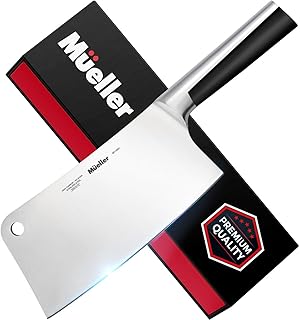
The Mueller takes the opposite view of steel to the Japanese-styled blades in this list. German high carbon stainless is ground softer and tougher, which is a real advantage in a knife whose job description includes hitting bone.
A softer edge deforms rather than fracturing. In practice that means the failure mode is a rolled edge you fix in seconds on a honing rod, instead of a chip that needs a stone and patience to grind out. For a cleaver used on poultry and cartilage, that is the more forgiving arrangement.
Seven inches keeps it in the practical size band. It fits a normal drawer, works on a normal board and stays controllable for produce. The moulded handle is the least charming part of the knife and the most sensible: it does not care about water and it does not get slippery.
The compromise is keenness. If you want a blade that slices tomato skin without pressure a month after sharpening, a harder steel will do that better. Here you trade some edge retention for the confidence to use the knife the way a cleaver is meant to be used.
Bottom line: the tougher, more forgiving choice, and a good match for anyone who dislikes sharpening.
- Blade length: 7 inches
- Steel: German high carbon stainless
- Handle: moulded polymer
- Class: mid-weight butcher cleaver
- Intended use: meat, poultry joints, vegetables
- Care: hand wash and dry
This suits the cook who wants a cleaver that tolerates being used carelessly. If you would rather run a honing rod over a blade for ten seconds than set up a whetstone, the softer, tougher steel here is the right side of the trade. It is a weaker choice if fine slicing is most of your work, where a harder edge holds its keenness noticeably longer.
Hone often and sharpen rarely, which is the whole point of this steel. Wash and dry by hand even though the polymer handle would survive a dishwasher, since the heat and detergent are hard on any edge. Keep the blade off stone and glass boards. Check the edge along its full length after heavy bone work, because a rolled section is easy to miss and feels like dullness.

Pros
- Finer grind slices produce and boneless protein cleanly
- Lighter in the hand than the bone-rated blades here
- High carbon stainless resists staining from acidic food
- Tall face makes it a capable everyday chopping knife
Cons
- Not the blade to take to bone, joints or frozen food
- Finer edge needs more frequent honing to stay keen
This is the second imarku entry and it plays a different role to the first. Where the Meat Cleaver is ground and weighted to cope with impact, the Cleaver Knife is the slicing side of the family, with a finer edge and less mass behind it.
That makes it the better knife for the work most home cooks actually do. Cabbage, squash, boneless chicken and a board of aromatics all go faster with a lighter blade and a keener edge, and the tall face still gives you the scoop and the garlic smash.
The high carbon stainless steel takes a fine finish and holds it reasonably well through produce work. Acidic vegetables will not stain it if you dry it, and the full tang keeps the handle solid even though this blade sees less shock than its heavier sibling.
The failure mode to avoid is obvious once stated: it looks like a bone chopper and it is not one. Chicken joints are borderline and rib bone is not, and a fine edge meeting bone chips rather than rolls. Keep it for the soft work and it will outlast a heavier blade used badly.
Bottom line: the slicing cleaver of the pair, and the more useful one if bone work is rare in your kitchen.
- Blade length: 7 inches
- Steel: Japanese high carbon stainless
- Grind: slicing focused
- Construction: full tang
- Class: multipurpose slicing cleaver
- Care: hand wash, dry immediately, hone regularly
Use a push cut rather than a chopping swing. Guide the blade forward and down through the food with the tall face against your knuckles, which is where a cleaver of this weight is genuinely faster than a chef knife. For flattening garlic, lay the blade flat and press with the heel of your hand rather than striking it. Keep it away from joints and bone, and use one of the heavier blades in this list for that work.
Hone before most sessions to keep the fine edge working, and sharpen on a stone when honing stops restoring it. Wash by hand and dry the blade immediately, especially after onion, citrus or tomato. Use wood or plastic boards only. Store it with a guard or on a magnetic strip so the keen edge is not being knocked about in a drawer.

Pros
- Thin blade slices produce cleanly with very little effort
- Commercial kitchen build that shrugs off heavy daily use
- Large flat face is excellent for scooping and smashing
- Dishwasher safe polymer handle simplifies cleanup
Cons
- Must never be used on bone, which the cleaver shape invites
- Plain commercial finish with unrounded spine edges
The Winco is a restaurant supply item rather than a consumer knife, and that is the reason to consider it. Commercial Chinese cleavers are made to be used all day, sharpened often and replaced without ceremony, and the build reflects those priorities exactly.
The blade is thin, which is the defining characteristic of a cai dao. It slides through cabbage, carrot and squash with far less resistance than any of the thicker blades here, and the eight inch length plus the tall face makes short work of a full board of prep.
The handle is plain polymer that tolerates dishwashers and wet hands. The finish elsewhere is functional rather than pretty: the spine is not rounded, which you notice during a long session with a pinch grip, and there is no attempt at cosmetic polish.
The critical caveat is that this is not a bone chopper and never was. The shape says cleaver to most buyers and the grind says slicing knife, and using it on joints will chip the edge quickly. Understood correctly it is a superb produce tool.
Bottom line: the vegetable cleaver of the group, and outstanding at that job as long as bone stays off the board.
- Blade length: 8 inches
- Blade: stainless steel, thin grind
- Handle: polymer, dishwasher safe
- Class: Chinese vegetable cleaver
- Intended use: produce, slicing, boneless protein
- Not for: bone, joints, frozen food
This is for the cook who does a lot of vegetable prep and wants a single blade for it, or for anyone who has used a Chinese cleaver in a restaurant kitchen and wants the same tool at home. It is emphatically not for someone shopping for a bone chopper, and buying it under that misunderstanding is the most common way people end up disappointed with a cleaver.
Ask one question before choosing it: does bone ever come near your board? If the answer is yes, buy one of the heavier blades in this list instead, or buy this alongside one. If the answer is no, a thin commercial cleaver outperforms every thicker option here on the work you actually do. Consider a honing rod at the same time, because thin edges reward frequent light maintenance more than occasional heavy sharpening.
How to Choose a Meat Cleaver
Read the first criterion even if you skip everything else. Buying the wrong class of cleaver is the mistake that produces chipped edges, and no amount of steel quality rescues it.
Bone Chopper or Vegetable Cleaver

Two very different knives share the cleaver shape. A bone chopper is thick through the spine, often a quarter inch or more at the heel, ground to a wide included angle, and heavy enough that gravity does most of the work. A Chinese vegetable cleaver, sometimes sold as a cai dao or a chef cleaver, is a thin rectangle of steel with a fine edge meant to glide through produce and slice protein off the bone rather than through it.
Take a vegetable cleaver to a chicken thigh bone and the fine edge rolls or chips, because there is no shoulder of steel behind it to absorb the impact. Take a heavy bone chopper to a pile of scallions and you will hate it: the weight that splits a joint makes fine slicing tiring and imprecise, and the thick grind wedges rather than cuts.
The listing usually tells you which one you are looking at if you read past the headline. Words like bone chopper, butcher, cleaver for poultry and heavy duty point one way. Words like ultra sharp, multipurpose, slicing and vegetable point the other. Blade thickness at the spine is the single most useful figure, and any maker confident in a bone-rated blade publishes it.
Blade Weight and Where the Balance Sits

Weight is the feature that does the chopping, and it is also the feature people most often over-buy. A cleaver in the range of most home models carries enough mass to fall through poultry bone and cartilage with a relaxed swing. Heavier is not automatically better: past a certain point you stop guiding the blade and start dropping it, and accuracy on a small board suffers.
Balance matters as much as total mass. A cleaver balanced forward of the bolster hangs into the cut and needs almost no effort, which is what you want for repetitive bone work. A cleaver balanced at or behind the pinch grip feels lighter in the hand and gives finer control for slicing, which is why vegetable cleavers are built that way even when they are large.
If you cook with one hand busy holding the food, prefer the lighter, more neutral balance. If your cleaver only ever comes out for breaking down a whole bird or portioning ribs, take the forward-heavy one and let it do the work. Trying to make one blade cover both extremes is how people end up with a knife that lives in the block.
Steel Type, Hardness and Sharpening Intervals
Most cleavers in this class use a high carbon stainless steel, which is a compromise engineered on purpose. Higher carbon holds an edge longer and takes a keener finish, while the chromium keeps the blade from staining every time you cut an acidic vegetable. Makers describing their steel as German high carbon are usually working in the softer, tougher end of the range, which suits impact work.
Hardness on the Rockwell scale explains the trade-off. A harder blade stays sharp longer but is more brittle at the edge, so it chips rather than deforms when it meets bone. A softer blade dulls sooner but rolls instead of chipping, and a rolled edge comes back on a honing steel in seconds. For a dedicated bone chopper, softer and tougher is the right side of that line.
Plan for maintenance rather than hoping to avoid it. A cleaver used weekly on bone wants a few passes on a honing rod before most sessions and a proper sharpening a couple of times a year. Whetstones give the most control over the bevel, while a pull-through guided sharpener is the realistic option for most kitchens. Our tools and home improvement picks cover the sharpening hardware if you do not own any yet.
Full Tang, Rivets and Handle Security
A cleaver takes shock loads no other kitchen knife sees, and that load goes straight into the handle joint. Full tang construction, where the steel runs the whole length of the handle and is visible along the top and bottom edges, is the layout that survives it. Partial tangs and rat-tail tangs glued into a hollow handle can and do work loose after enough impacts.
Look at how the scales are attached. Three rivets through a full tang is the traditional and dependable arrangement. Check the seam between the scale and the steel in the product photos too: a visible gap collects moisture and food debris, which is what turns a wooden handle loose and dark over a year of washing up.
Handle material is a genuine choice rather than a marketing tier. Natural wood feels the best in the hand and needs occasional oiling and no dishwasher. Pakkawood is resin-impregnated wood that keeps most of the feel with far less maintenance. Moulded polymer handles are the least attractive and the most forgiving, and they stay grippy with wet hands, which is not a small thing when the blade weighs what these do.
Blade Height, Length and Board Clearance

Blade height is the dimension that makes a cleaver a cleaver. A tall blade gives you knuckle clearance above the board, a broad flat face for scooping chopped food, and a surface for smashing garlic and ginger. It also means the blade meets the board along its whole length, so a warped or bowed edge shows up immediately as a section that will not cut through.
Length is mostly about board size. A seven inch blade covers a standard home board and a standard home chicken. An eight inch blade gives more reach for larger cuts and pork ribs, but it needs a board with room to swing and a drawer or magnetic strip that can take it. Measure the drawer before you assume the bigger one fits.
Board choice follows the blade. End grain wood and thick polypropylene absorb the impact and let the edge bite in slightly instead of bouncing. Glass, stone and bamboo boards are the fastest way to ruin a cleaver edge, and they also send the shock back up your wrist with every stroke.
Edge Angle and Out-of-the-Box Sharpness
The bevel angle written on a spec sheet tells you what the maker intended the knife for. A narrow included angle, in the range associated with Japanese slicing knives, produces a keen edge for produce and boneless protein. A wider angle puts more steel behind the cutting edge and is what a bone chopper needs. When a listing claims both a very acute angle and full bone capability, one of those claims is doing marketing work.
Factory sharpness varies more than any other quality in this category, and it is the most common early complaint. Even a well-made cleaver can arrive with an edge that has been ground quickly, and the fix is ten minutes on a stone rather than a return. Expect a heavy bone chopper to arrive less keen than a slicing cleaver by design, not by accident.
Finish quality around the spine and the choil is worth a look in close-up photos. Sharp, unfinished edges on the spine dig into your index finger during a pinch grip and make a long prep session uncomfortable. A rounded, polished spine costs the maker an extra step and is a reliable signal of how much attention the rest of the blade received. Browse the full category index if you are building out the rest of the kit at the same time.
| Cleaver class | Best at | Avoid |
|---|---|---|
| Heavy bone chopper | Poultry joints, ribs, cartilage, splitting through small bone | Fine slicing, herbs, anything needing precision |
| Mid-weight multipurpose | Everyday protein prep, squash, garlic, light bone work | Repeated heavy bone splitting on large cuts |
| Chinese vegetable cleaver | Produce, thin slicing, scooping, smashing aromatics | Any bone at all, frozen food, prying |
Why You Should Trust Us
We build these lists from published specification and from the pattern of what long-term owners report, not from marketing copy. For every cleaver here we compared the stated steel and hardness, spine thickness where the maker publishes it, blade dimensions, tang construction and handle material, then read owner feedback for the failures that only show up after months: edges chipping on bone, handles loosening at the rivets, and wooden scales darkening after dishwasher cycles.
We also set aside listings that were the same blade in a different colourway or bundle, so every entry is a genuinely different knife. Where a maker markets a thin slicing cleaver with language that implies bone capability, we say so in the entry rather than repeating the claim, because that mismatch is the single biggest source of disappointment in this category.
Final Thoughts
Best overall is the imarku 7 Inch Meat Cleaver. It sits in the middle of the weight range where a cleaver is still controllable, the high carbon blade takes and holds a usable edge, and the full tang with a contoured handle is the construction that survives impact work. If you want one cleaver and you are not running a butcher counter, this is the shape of the answer.
Best value is the Utopia Kitchen 7 Inch Meat Cleaver. It is the plainest execution here, a stainless blade with a wooden handle and no pretensions, and it does the ordinary jobs of a home cleaver without asking much. For an occasional user who wants the tool in the drawer rather than a knife to fuss over, it is enough.
For specific needs, the ENOKING 7.5 Inch Cleaver is the hand-forged option if you want the most mass behind the edge, the Juvale 8 Inch Meat Cleaver is the pick for large cuts and brisket work where reach matters, and the Mueller 7 Inch Meat Cleaver is the German steel choice if you want a tougher edge that rolls rather than chips. The imarku Cleaver Knife 7 Inch is the lighter slicing blade of the two imarku entries, and the Winco 8 Inch Chinese Cleaver is a commercial vegetable cleaver, so keep it away from bone entirely. More kitchen picks are indexed across our article archive.
Meat Cleaver FAQs
Can a meat cleaver cut through bone?
A heavy bone chopper can handle poultry joints, rib sections, fish heads and cartilage. It is not meant for beef leg bone or anything a butcher would put on a band saw, and forcing it there chips the edge or bends the blade. A thin Chinese vegetable cleaver should never touch bone at all, even though it wears the same rectangular silhouette. If the listing does not describe the blade as a bone chopper and does not publish a spine thickness, assume it is a slicing blade and treat it accordingly.
What is the difference between a cleaver and a butcher knife?
A butcher knife has a long, curved, relatively thin blade designed to slice and separate meat along the seams, working around bone rather than through it. A cleaver is short, tall and thick, and it uses mass and a wide edge angle to chop. They are complementary rather than competing: the butcher knife breaks a cut down into pieces, the cleaver deals with the joints and bone sections that a slicing blade cannot. Most home kitchens get more use out of the cleaver because it doubles as a produce tool.
How do I keep a carbon steel cleaver from rusting?
The high carbon stainless blades in this list resist staining but are not immune to it. Wash by hand in warm water, dry immediately rather than leaving the blade on a draining rack, and never leave a cleaver soaking or sitting wet against a cutting board. Acidic foods such as tomato, citrus and onion will discolour a high carbon blade if left on it. Skip the dishwasher entirely: the combination of heat, salt and long wet cycles is hard on the edge and worse for wooden handles, whatever your kitchen appliance manual says is technically safe.
What size cleaver should I buy?
Seven inches suits most home kitchens. It clears a standard cutting board, handles a whole chicken comfortably, fits a normal knife drawer and is light enough to use for ordinary chopping without fatigue. Move up to eight inches only if you regularly break down larger cuts, portion ribs or work with big squash and melon, and check your board and storage first. Blade height matters more than length for knuckle clearance and for scooping, so compare that dimension rather than assuming a longer blade is a bigger one.
How often does a cleaver need sharpening in 2026?
For a home kitchen using the cleaver a couple of times a week, a few passes on a honing rod before use and a proper sharpening two or three times a year is a realistic rhythm. Bone work dulls an edge far faster than produce, so a dedicated bone chopper needs attention sooner than a vegetable cleaver that only sees onions. The tell is behaviour rather than the calendar: when the blade starts crushing the outer layer of a tomato instead of biting straight in, it is due.



Write Your Review
No reviews yet. Be the first to share your experience!