

Nobody buys a lime squeezer because they enjoy shopping for one. They buy it because half the lime ended up on the counter, a seed landed in the drink, and their hand hurt afterwards. The tool that fixes all three is simple to the point of being dull, which is exactly why the differences between models hide in places the product photos do not show: the size of the bowl relative to the fruit, what the metal is actually made of, and where the pivot sits. We sorted 8 presses from IMUSA, Chef’n, New Star Foodservice and more by bowl diameter, material and lever geometry rather than by the colour they come in.
Our top pick is the Zulay Metal 2-In-1 Lemon Squeezer for nesting two bowl sizes into one press, so the same tool handles limes properly and lemons without slipping. Below we split the field by bowl size and metal so you can match one to the fruit you actually use. For the rest of the drawer, our home and kitchen section covers the tools that sit next to it.

Pros
- Nested bowls give a proper fit for limes and lemons in one tool
- Heavy cast body that does not flex under a hard squeeze
- Long handles keep the required grip force reasonable
- Perforations spread across the base rather than clustered in the middle
- Opens wide enough to brush out the hinge
Cons
- The insert bowl is one more part to rinse and keep track of
- Bulkier in a drawer than a single-size press
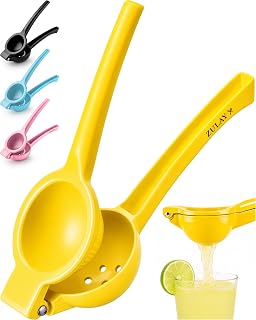
The Zulay 2-In-1 exists to fix the most common complaint in this category, which is that a press sized for lemons does a poor job on limes. It carries a smaller bowl nested inside the main one, so the fruit seats properly at either size and the press crushes flesh rather than biting rind.
That fit is not a small detail. A lime skidding inside an oversized bowl throws juice sideways past the rim and leaves half the fruit unpressed, which is why people end up squeezing the same half twice. With the insert in place the fruit stays centred through the whole closing arc and one pass is enough.
The body is a heavy casting with long handles, and the combination matters more than any single feature. Length gives you leverage, and the mass stops the halves flexing apart under load, which is what causes juice to escape at the sides. The perforations are spread across the base rather than gathered in the centre, so the juice drains as the flesh collapses.
The honest cost is complexity. There is one more part to wash and to lose, and the assembled press takes more drawer space than a plain lime squeezer. Anyone who squeezes only limes and nothing else is carrying that bulk for no reason.
Bottom line: the press to buy if your fruit varies, and the one that stops the tool being the wrong size half the time.
- Design: two-in-one nested bowls, manual hand press
- Fruit fit: limes in the inner bowl, lemons in the outer
- Body: cast metal with coloured finish
- Handles: long lever arms
- Bowl base: perforated across the full base
- Care: rinse immediately, brush the hinge
Buy this if you use limes and lemons in roughly equal measure, or if you make drinks with one and cook with the other. It is also the sensible choice for a shared kitchen where nobody wants to own two presses. Skip it if limes are the only citrus you ever touch, in which case a single small press is lighter and has nothing to lose, and skip it if drawer space is genuinely tight.
Roll the fruit on the counter and let it come to room temperature before squeezing, which softens the segments and takes real effort off the handles. Cut across the equator rather than end to end, and lay the half cut side down against the perforated base so the press inverts the rind as it closes. Use the far end of the handles for leverage rather than gripping near the hinge, and give one firm squeeze rather than several small ones.

Pros
- Geared hinge keeps the halves in register so pressure stays even
- Noticeably less grip force needed than a plain pin hinge
- Comfortable handle profile rather than a bare metal edge
- Well-established design with a long track record
Cons
- The geared hinge has more places for pulp to lodge and is harder to brush clean
- Bowl is scaled for lemons, so limes have room to move
The FreshForce is the press that addresses effort directly. Instead of a simple pin at the pivot, it uses a pair of interlocking geared arcs, which keeps the two halves aligned as they close and spreads the load rather than concentrating it at one point.
The practical difference is that the press does not twist. A plain hinge under a hard squeeze lets the halves wander slightly out of register, and every degree of twist is pressure applied to the rim instead of the fruit. Keeping them square means more of your effort ends up as juice, which is why people with weaker grip get on with this design.
The handles are shaped rather than flat-edged, which sounds cosmetic until you have squeezed a dozen lemons. A rounded profile spreads the force across the palm instead of concentrating it on a narrow edge, and that is the difference between finishing the job and stopping halfway.
Two things to weigh. The geared pivot has more crevices than a plain hinge, so pulp lodges in it and it takes a brush rather than a rinse. And the bowl is lemon scaled, so limes have room to shift and you may need to seat them carefully.
Bottom line: the pick when hand strength is the constraint, provided you are willing to brush the hinge.
- Design: manual hand press with dual-gear pivot
- Fruit fit: lemons and larger limes
- Hinge: interlocking geared arcs
- Handles: contoured lever arms
- Action: inverts the fruit half against a perforated base
- Care: brush the geared pivot, rinse immediately after use
The geared pivot is the part that needs attention. Pulp works into the teeth, dries there and stiffens the action, so rinse under a hot tap and run a washing-up brush through the gears while they are still wet. Open the press fully and let it dry that way rather than closing it damp, which is how the pivot gets sticky. Keep it out of hot dishwasher cycles if the finish is coated, and never force a fruit that does not seat, since a jammed gear takes more damage than a plain hinge would.
Choose this over a plain bar press if grip strength, arthritis or squeezing volume is the reason you are shopping. Choose a nested two-in-one instead if you need a proper fit for limes as well as lemons, and choose a stainless press if you want the least cleaning fuss. If you already own a bar press that works fine and your only complaint is effort, this is the upgrade that actually addresses it.

Pros
- Simple one-piece design with no parts to lose
- Heavy cast body that does not flex under load
- Enamel coating keeps citrus acid off the aluminium
- Correctly scaled for limes rather than oversized
Cons
- Coating chips at the rim if dropped or run through a hot dishwasher
- Bare handle edges concentrate the force on your palm over a long session
This is the press most people picture when they think of a lime squeezer, and the IMUSA is the plainest honest version of it. A cast body, an enamel coating, two handles and a perforated bowl. There is nothing to assemble, nothing to remove and nothing to lose.
The scale is the important part. It is sized for limes rather than sold as a general citrus press, so the fruit seats instead of skidding, and a lime that seats properly gives up its juice in a single squeeze. That is the whole reason a dedicated small press still makes sense next to the two-in-one designs.
The coating is doing real work rather than decoration. Bare aluminium reacts with citrus acid and leaves a dull film and a faintly metallic edge, so the enamel is what keeps the juice clean. It survives normal use well as long as you keep the press away from hot detergent cycles.
The limits are honest ones. The handles are bare edges, so a long session concentrates the force across your palm, and a dropped press chips at the rim. Neither is a defect so much as the price of a simple, heavy, inexpensive tool.
Bottom line: the value pick, and the right answer if limes are most of what you squeeze.
- Design: one-piece manual bar press
- Fruit fit: limes and small lemons
- Body: cast metal with enamel coating
- Bowl: perforated base, inverting action
- Parts: none removable
- Care: hand rinse, avoid hot dishwasher cycles
Rinse it under a hot tap the moment you finish, since dried citrus is what stains and what clogs the perforations. Keep it out of the dishwasher despite what the packaging may allow: hot detergent dulls enamel, then crazes it, then lifts it at the rim where the coating is thinnest. Do not force oversized fruit, which is how the rim chips and how the pivot bends. Store it open on a rack until dry rather than closing it damp in a drawer.
Buy this if limes are your main citrus, you want one solid tool with no parts, and you are happy to rinse it by hand. It suits anyone making drinks at home or cooking with lime regularly. Skip it if lemons are equally common in your kitchen, since the bowl is on the small side, and skip it if you know the press is going to end up in the dishwasher, in which case stainless is the material to choose.

Pros
- Stainless steel does not react with citrus and has no coating to lose
- Seed filter catches everything without a separate strainer
- Non-slip handle covering keeps grip when your hands are wet
- Genuinely dishwasher safe rather than nominally so
Cons
- The seed filter is one more part to rinse and drains slightly slower
- Thinner stainless handles can flex under a very hard squeeze
The Bellemain press answers the one structural weakness of the classic bar design, which is the coating. Stainless steel does not react with citrus acid and there is no enamel to chip at the rim, so the failure mode that eventually retires most coloured presses simply does not apply here.
The seed filter is the second differentiator. It sits over the perforated base and catches seeds and coarse pulp, which is a real convenience if the juice is going into a cocktail or a dressing and you would otherwise be straining it afterwards. If you cook with the juice and want the pulp, it comes out and stays in the drawer.
Non-slip handle covering sounds like a small thing and is not. By the second fruit your hands are wet, and a press that rotates in your grip mid-squeeze sprays juice sideways and costs you the leverage at the end of the handle. A textured grip keeps the tool where you put it.
The trade against a heavy cast press is stiffness. Stainless built to a sensible weight is thinner than cast aluminium, and under a really hard squeeze the handles have a little more give. In practice that shows up only with large, cold, firm fruit.
Bottom line: the press to buy if you want one that will look and work the same in ten years.
- Design: manual hand press with removable seed filter
- Material: stainless steel
- Fruit fit: lemons and limes
- Handles: non-slip covered grips
- Care: dishwasher safe
- Extras: seed filter plate
Choose this if the idea of a coating that will eventually chip bothers you, or if the press is going to live in a household where everything goes in the dishwasher. Choose an enamelled cast press instead if you want maximum rigidity and the lowest cost, and choose the nested two-in-one if the fit across lime and lemon sizes is your main problem. The seed filter is a genuine plus for drinks work and irrelevant for cooking.
Fit the seed filter for drinks and leave it out when you want the pulp in a marinade or dressing. Cut the fruit across the equator, place it cut side down on the base and close firmly in one motion rather than pumping the handles. Hold the press over the glass at a slight angle so the juice runs off the lip instead of collecting in the bowl. Rinse the filter separately, since that is where pulp collects fastest.

Pros
- Commercial grade casting is noticeably more rigid under load
- Correctly scaled for limes and small lemons
- Thick enamel carried over the rim rather than a thin painted finish
- Built for repeated daily use behind a bar
Cons
- Heavy and bulky for a domestic drawer
- Still an enamelled aluminium press, so hot dishwasher cycles will damage the coating
The New Star press is the same shape as a domestic bar squeezer built to a different standard. It is a commercial casting, which means more metal in the section and less give when the handles are under load, and that rigidity is what shows up over hundreds of limes rather than over five.
Rigidity translates directly into extraction. When a press flexes, the two halves part slightly at the rim and juice escapes sideways instead of going through the perforations. A heavy casting keeps the halves parallel, so the same effort puts more juice in the glass and less on the counter.
The enamel on a commercial press is generally thicker and carried further over the rim than on a cheap painted finish, which is exactly where domestic presses chip first. It is still enamel over aluminium, so the same care rules apply, but it starts from a better place.
The cost is that it is heavy and it is bulky, and a domestic drawer is not really where it wants to live. If you squeeze in volume, or you make drinks for a crowd regularly, that weight is the reason to buy it. If you squeeze one lime a week, it is overkill you have to store.
Bottom line: the volume pick, and the one to buy if presses keep failing on you.
- Grade: commercial restaurant use
- Material: enamelled cast aluminium
- Fruit fit: limes and small lemons
- Build: heavy section casting
- Action: inverting press over a perforated base
- Care: hand wash, keep out of hot dishwasher cycles
Buy this if you squeeze in quantity, host often, or have already worn out a lighter press. It also suits anyone who would rather hang a tool on a rail than fit it in a drawer. Skip it if your citrus use is occasional, since the weight and bulk buy you nothing at low volume, and skip it if you want a press you can put in the dishwasher, because the coating rules have not changed just because the casting is heavier.
Rinse it immediately under hot water and brush the hinge, since a commercial press sees more pulp and the pivot is where it collects. Keep it out of the dishwasher: a thicker enamel lasts longer under detergent but it does not survive it indefinitely. Because it is heavy, store it where it cannot fall on a tiled floor, which is the most common way a coated press chips. Dry it open rather than closed so the pivot does not sit wet.

Pros
- Large bowl handles lemons and small oranges as well as limes
- Solid stainless construction with nothing to chip
- Heavy section resists flexing at the handles
- Dishwasher safe without qualification
Cons
- Limes have room to move in the oversized bowl
- Large and heavy for a drawer
This is the large-bowl stainless option, and it is the press to look at if your citrus runs bigger than limes. The bowl is scaled to take a full lemon comfortably and a small orange at a push, which is a size the classic bar presses generally do not cover.
Built in stainless and in a heavy section, it sidesteps both weaknesses of the coated aluminium designs at once. There is no enamel to chip, and there is enough metal in the walls that the halves stay parallel under a hard squeeze rather than splaying at the rim.
Because the bowl is large, the perforated base is large too, and that helps with big fruit: the flesh collapses across a wide drain area instead of being pushed through a small central patch. For a lemon that is exactly right.
The obvious catch is limes. In a bowl this size a lime has room to shift as the handles close, so you have to seat it deliberately and you may lose a little at the rim. If limes are most of your work, a smaller bowl or a nested design will serve you better.
Bottom line: the big-fruit stainless pick, and the wrong choice if limes are the whole reason you are shopping.
- Design: large bowl manual citrus press
- Material: solid stainless steel
- Fruit fit: lemons, small oranges, limes with care
- Build: heavy duty section
- Care: dishwasher safe
- Action: inverting press over a wide perforated base
Choose this if lemons and larger citrus are your main fruit and you want stainless. Choose the nested two-in-one if you need both sizes covered properly in one tool, and choose a small enamelled bar press if you squeeze limes and nothing else. If you are buying for a household that makes fresh lemonade or cooks with a lot of lemon, the extra bowl size is the reason to pick it over a standard press.
Seat larger fruit cut side down and make sure it is centred before you close the handles, since a big bowl gives the fruit room to move. Roll and warm the fruit first, which matters more with thick-skinned lemons than with limes. When squeezing something small in this bowl, place it toward the hinge side rather than the middle so the closing force reaches it earlier in the arc.
Pros
- Simple single-bowl design with no removable parts
- Long handles keep the required force manageable
- Cast body with the familiar bar press geometry
- Flatter in a drawer than the nested two-in-one
Cons
- Lemon-scaled bowl leaves limes room to skid
- Coated finish needs hand washing to survive
This is the plain sibling of the two-in-one press: the same familiar geometry with a single lemon-sized bowl and nothing to remove. If the nested insert sounds like a part you would lose, this is the version that removes the question.
The handles are the same long lever arms, which is the feature that quietly does most of the work. Length is mechanical advantage, and the difference between long and stubby handles is felt in the wrist rather than seen in a photograph.
Because the bowl is lemon scaled, this is the press to buy if lemons are your default fruit. It seats them properly, the base drains across its width, and the inverting action turns the rind out so very little flesh escapes unpressed.
Limes are the compromise. In a lemon bowl they have room to shift, and a fruit that shifts loses juice past the rim. It is workable if you seat the fruit carefully, but it is not what this size is for, and the two-in-one exists precisely because of that gap.
Bottom line: the simple one-bowl choice for a lemon-first kitchen.
- Design: single bowl manual hand press
- Fruit fit: lemons, limes with care
- Body: cast metal with coloured finish
- Handles: long lever arms
- Parts: none removable
- Care: hand rinse and brush the hinge
Buy this if lemons are the citrus you reach for most, you want the long-handle leverage, and you would rather not manage a nested insert. It is a good single-purpose tool for a kitchen that cooks with lemon regularly. Skip it if limes are your main fruit, where the bowl is too generous, and skip it if you want both sizes covered, which is what the two-in-one version is for.
Rinse straight after use before the pulp dries in the perforations, and run a brush through the hinge, which is where juice collects and turns sticky. Keep coated presses out of hot dishwasher cycles, since detergent dulls and eventually lifts the finish at the rim. Do not force fruit that does not seat, which bends the pivot. Leave it open to dry rather than putting it away closed and damp.

Pros
- Light in the hand and easy to store
- Familiar bar press geometry that needs no learning
- Straightforward one-piece tool with no parts to lose
- Coated finish keeps acid off the metal while intact
Cons
- Lighter section flexes more under a hard squeeze than a heavy casting
- Coating is the first thing to go if it meets a hot dishwasher cycle
The Y-ME press is the lightweight entry in this list, and its appeal is exactly that. It is easy to pick up, easy to store and needs no explanation, which is a genuine virtue in a tool this simple.
The geometry is the standard bar press: perforated bowl, inverting action, two handles on a pin hinge. It does what that design does, which is get considerably more out of a half than your hand can, and it does it without any parts to fit or remove.
Where the lighter section shows is under load. A thinner casting gives a little at the rim when you squeeze hard, and any parting between the halves is juice escaping sideways rather than draining through the base. With ripe, room temperature fruit that barely matters. With a cold, firm lemon it does.
The coating carries the usual caveat. It is doing a real job keeping acid off the metal, and it will not survive hot detergent cycles, so this is a hand wash tool if you want it to keep looking right.
Bottom line: a light, simple everyday press, best with ripe fruit and a hand rinse.
- Design: manual hand press, classic bar shape
- Fruit fit: lemons and limes
- Material: coated metal
- Weight: light
- Parts: none removable
- Care: hand wash, rinse immediately
Get the most from a lighter press by preparing the fruit rather than by squeezing harder. Roll it firmly on the counter, bring it to room temperature and cut across the equator. Close the handles in one smooth motion using the far ends for leverage, and hold the press at an angle over the glass so the juice runs off the lip. If a fruit resists, cut it into quarters rather than forcing the handles.
Choose this if you want the simplest possible tool for occasional use and light weight matters to you. Choose a heavy cast or commercial press if you squeeze in volume or work with cold firm fruit, choose stainless if the press will go in the dishwasher, and choose the geared design if hand strength is the issue. For a drawer that sees a few limes a week, the simple version is enough.
How to Choose a Lime Squeezer
Six things separate a press you keep for a decade from one that lives in the back of a drawer. Read the first section even if you skip the rest, because a bowl that does not match your fruit is the mistake that sends these back.
Match the Bowl to the Fruit, Not to the Name

These presses are sold under three loose sizes and the names on the box are unreliable. The small bowl is roughly lime sized, the medium is the common lemon size, and the large is aimed at oranges. A lime dropped into a lemon-sized bowl skids sideways when you close the handles, so the press bites the rind instead of crushing the flesh and you get juice on the hinge rather than in the glass.
Going the other way is worse. A lemon forced into a lime bowl will not seat, and closing the handles hard against a fruit that does not fit is how the pivot gets bent and how a coated bowl chips. If you make margaritas and cook with lemons, that mismatch is a daily annoyance, and it is why the nested two-in-one design exists at all.
A two-in-one press carries a smaller insert bowl inside the main one, so the same tool covers limes and lemons with a proper fit at both sizes. It costs a little bulk in the drawer and one more part to wash. If you genuinely only ever squeeze limes, a dedicated small press is lighter and simpler, and if your fruit varies week to week the nested design is the one that stops the tool being wrong half the time.
Coated Aluminium, Stainless Steel, or Bare Metal
The classic Mexican-style press is cast aluminium with a coloured enamel coating, and it is the design most bars use. Aluminium is light and cheap to cast in a heavy section, which is why these feel solid. The coating is there because bare aluminium reacts with citrus acid, leaving a dull grey film and a faintly metallic taste, so the enamel is doing a real job rather than a decorative one.
The failure mode follows directly. Once the coating chips, usually along the rim or where the two halves meet, the exposed aluminium is back in contact with acid. Chips come from dropping the press, from forcing oversized fruit, and above all from hot dishwasher cycles. A commercial-grade enamel on a thick casting survives far longer than a thin painted finish, and it is worth looking at the rim in the product images to see how the coating is carried over the edge.
Stainless steel avoids the whole question. It does not react with citrus, it does not chip, and it takes the dishwasher without complaint. The trade is weight and cost: stainless presses are either heavier for the same strength or thinner and more prone to flexing at the handles. If you want a press that will look the same in ten years, stainless is the safer material; if you want the traditional feel and the lowest cost, a well-coated aluminium press is still the workhorse.
Lever Geometry and How Much Effort You Spend

A citrus press is a class-one lever, and the two numbers that decide how hard you work are the handle length and the distance from the pivot to the bowl. Long handles with a bowl close to the hinge multiply your grip strength most. Short handles look neater in a drawer and cost you real effort on every squeeze, which you notice by the fourth lime rather than the first.
Some presses add a geared pivot, where a pair of interlocking arcs at the hinge keeps the two halves aligned and spreads the load through the closing arc. The practical benefit is that the press does not twist as it closes, so the pressure stays even across the fruit and less juice escapes past the rim. It also stops the two halves from wandering out of register over years of use, which is the slow failure of a plain pin hinge.
If hand strength is a real constraint, look at handle length first and gearing second, and treat any press with stubby handles as a no. Squeezing a lime that has been rolled on the counter and brought to room temperature also takes noticeably less force than squeezing one straight from the fridge, and that is free.
Seed Filtering and Pulp Control

The holes in the base of the bowl are the filter, and their size and pattern decide what ends up in the glass. Many small holes hold back seeds and most of the pulp, which is what you want for a cocktail or a dressing. Fewer larger holes let pulp through and clog less, which suits cooking where the pulp is welcome. Neither is better in the abstract, but the fine pattern is the one most people want from a lime press.
Pattern matters as much as hole size. Holes concentrated in the middle of the bowl leave the outer flesh unpressed against solid metal, so you squeeze twice to get everything. Holes spread evenly across the whole base drain as the fruit collapses and get more out in one pass. This is easy to check in a photograph of the bowl and it is one of the clearest quality signals in the category.
A separate seed filter plate is a feature some stainless presses add on top of the perforated base. It catches everything, at the cost of one more part to rinse and a slightly slower drain. If you mainly make drinks and hate straining, it is worth the extra part; if you cook with the juice, it is a part you will stop using within a month.
Cleaning, Dishwasher Safety and Where Pulp Hides
The hinge is where every one of these tools becomes unpleasant. Pulp and a little juice work into the pivot, dry there, and turn sticky, and no amount of rinsing under a tap reaches it. Presses that open wide, ideally past a right angle, can be scrubbed at the hinge with a brush. Presses with a tight pivot and a shroud over it cannot, and they are the ones that develop a smell.
Dishwasher safety splits along the material line. Stainless presses go in without a second thought. Coated aluminium presses are frequently described as dishwasher safe and frequently come out worse for it, because hot detergent is aggressive toward enamel and the coating dulls, then crazes, then lifts at the rim. Rinsing a coated press immediately after use takes fifteen seconds and doubles its useful life, which is the trade most owners eventually make.
Rinse straight away in either case. Citrus acid left to dry is the thing that stains, and dried pulp in the perforations needs a brush rather than water. A press that lives in a drawer still wet at the hinge is also the press that gets stiff, so shake it out and leave it open on the rack rather than closing it damp.
Handle Comfort, Grip and Where It Lives
Bare metal handles are the most durable and the least comfortable, because the whole force of the squeeze concentrates on a narrow edge across your palm. A rounded or slightly flared handle edge spreads that load and is the difference between squeezing twenty limes comfortably and stopping at six. Silicone or rubber overmoulding goes further but adds a seam that traps juice and eventually peels.
Non-slip handles matter more than they sound, because your hands are wet with juice by the second fruit. A textured or coated grip keeps the press from rotating in your hand mid-squeeze, which is what sprays juice sideways. A press that stays put also lets you use the full length of the handle, which is where the leverage lives.
Finally, think about storage, because these are awkward objects. A press with a locking or nesting closed position lies flat in a drawer, while a sprung one takes up its full open height and catches on everything above it. Commercial presses are heavier and are usually happier hanging on a rail than living in a drawer at all. More kitchen picks sit in our article archive.
| Type | Material | Best fruit fit | Watch out for |
|---|---|---|---|
| Nested two-in-one press | Coated or bare metal | Limes and lemons in one tool | Extra insert to wash and keep track of |
| Classic bar press, small bowl | Enamelled cast aluminium | Limes and small lemons | Coating chips at the rim, dislikes hot dishwasher cycles |
| Classic bar press, large bowl | Enamelled cast aluminium | Lemons and small oranges | Limes skid inside an oversized bowl |
| Stainless press with seed filter | Stainless steel | Mixed citrus, drinks work | Thinner handles can flex under load |
| Commercial enamelled press | Heavy enamelled aluminium | High volume limes and lemons | Heavy and bulky for a domestic drawer |
Why You Should Trust Us
We build these lists from published specification and from the pattern of what long-term owners report, rather than from the copy on the packaging. For every press here we looked at the stated bowl size and which fruit it is scaled for, the base material and whether it is coated, the hinge design, the perforation pattern in the bowl, the handle length and finish, and what the maker says about dishwasher use.
We set aside near-identical listings that differ only in colour or in a two-pack, so every entry is a genuinely different press rather than the same one counted twice, and we left out powered citrus juicers, which keep appearing in this category and solve a different problem. Where a maker describes a coated aluminium press as dishwasher safe, we say what owners consistently report happens to the coating rather than repeating the claim.
Final Thoughts
Best overall is the Zulay Metal 2-In-1 Lemon Squeezer. The nested bowl is the feature that solves the most common complaint in this category at once, because it means the press fits the fruit whether you are making a drink with limes or a dressing with lemons, and a fruit that seats properly is the whole game.
Best value is the IMUSA Lemon or Lime Manual Squeezer. It is the plain enamelled bar press in its most straightforward form, it does exactly one thing with no parts to lose, and if your citrus is mostly limes it will sit in the drawer for years provided you keep it out of the dishwasher.
For specific needs, the Chef’n FreshForce is the pick if hand strength is the constraint, since the geared hinge keeps the halves aligned through the whole closing arc, and the New Star Foodservice press is the one to buy if you squeeze in volume and want a commercial casting rather than a domestic one. Anyone who wants a press that will never chip should take the Bellemain stainless press with its seed filter, and the large Zulay Kitchen stainless bowl is the choice if oranges are also on the list. More kitchen tools are indexed across our category index and the home and kitchen archive.
Lime Squeezer FAQs
What size lime squeezer do I need for limes and lemons?
If you only squeeze limes, buy the small bowl, which is usually the one labelled for limes and sits around two and a half inches across. If lemons are in the mix, either buy the medium bowl and accept that limes will move around inside it, or buy a nested two-in-one press that carries a small insert inside the large bowl. Buying the large orange size for limes is the worst of the three options, because the fruit skids and the press bites the rind rather than crushing the flesh.
Is the coloured coating on an aluminium press safe?
The enamel used on food-grade citrus presses is there specifically to keep the acid away from bare aluminium, which would otherwise react and leave a dull film and a metallic edge on the juice. Intact, it is doing its job. Once it chips, the exposed metal is back in contact with the fruit, and that is the point at which most people replace the press. If chipping worries you, a stainless press removes the question entirely, since there is no coating to lose.
Do these actually get more juice than squeezing by hand?
Yes, and the reason is that the press inverts the half as it closes, turning the rind inside out and pushing the flesh through the perforations from the outside in. Your hand can only compress the fruit, which leaves the segments nearest the peel largely untouched. The other advantage is consistency: a press gets roughly the same amount from every half, which matters when you are following a drinks recipe rather than cooking by taste. Roll the fruit firmly on the counter first and squeeze it at room temperature for the best result.
Can I put a lime squeezer in the dishwasher?
A stainless press, yes, without qualification. A coated aluminium press is often described as dishwasher safe and usually should not go in anyway, because hot water and aggressive detergent dull the enamel, then craze it, then lift it at the rim where it is thinnest. A fifteen second rinse under a hot tap with a brush at the hinge does the job and keeps the coating intact for years. In either case do not put it away closed and damp, since a wet pivot is how these get stiff and start to smell.
Will a lime squeezer work for oranges or pomegranates?
Only if the bowl is scaled for it. An orange in a lemon-sized press either will not seat or will need so much force that you risk the hinge, so use the large size or a dedicated orange press. Pomegranates are a different matter and generally a bad idea in a citrus press: the seeds are hard, the pith is bitter and crushing them together forces both through the perforations. For pomegranate, halve it and use a reamer or the back of a spoon instead. Our grocery and gourmet food section covers what goes in the glass afterwards.




Write Your Review
No reviews yet. Be the first to share your experience!