

A dedicated incline bench for home gym turns a spare corner into a legitimate pressing station, but only if it fits the room you actually have. Our top pick is the PASYOU Foldable Adjustable Weight Bench for its fold-flat frame, 660 lb weight rating, and wide seat that still stores in a closet. For October 2026 we rounded up 8 benches from Marcy Exercise, BARWING, FF Finer and more, and we judged every one of them on storage first: how small the bench gets when you finish training, not just how solid it feels mid-set.
This guide is built for lifters training in apartments, garages shared with cars, and spare bedrooms that still have to work as spare bedrooms. If you care most about pad feel, angle counts, and locking hardware on full-size frames, our roundup of the best incline weight benches digs into that side of the decision. Here we focus on folded footprint, setup speed, and how many stations one frame can replace, because in a home gym the bench you can put away is the bench you keep using.

Pros
- Folds flat in seconds for under-bed or closet storage
- 660 lb weight rating with an ASTM certification claim
- Arrives about 95 percent pre-assembled
- Wider seat than most folding benches
- Quick ladder adjuster covers incline, flat, and decline
Cons
- Pad runs firmer than plush commercial benches
- Decline range is shallower than dedicated FID platforms
- Tall lifters may want a longer backrest
The PASYOU adjustable bench is the rare budget-friendly folder that does not feel like a compromise, and it is the bench we would point most home lifters to first. It is built for people pressing dumbbells in a bedroom, a garage bay, or a corner of the living room, where the bench has to disappear once the workout ends.
Three things stand out. The frame carries a 660 lb rating with an ASTM certification claim behind it, the seat is wider than most folding designs so your hips are not perched on a ledge, and the bench arrives about 95 percent pre-assembled. Unbox it, fit the last piece, and you are pressing the same afternoon. The ladder adjuster moves the backrest from decline through steep incline in seconds.
The pad runs firm, which lifters coming from plush commercial benches will notice, and the decline range is shallower than a dedicated FID platform. Very tall users may also want more backrest length for full head support on incline work.
Bottom line: no other folding bench in this group balances capacity, seat comfort, and stored size this well. It is the default choice for a small home gym.
- Type: folding adjustable bench with incline, flat, and decline positions
- Stated capacity: 660 lb with an ASTM certification claim
- Backrest: quick ladder adjustment from decline to steep incline
- Extended backrest length for pressing support
- Assembly: about 95 percent pre-assembled out of the box
- Seat: widened design for seated pressing
- Folds flat for under-bed, closet, or against-wall storage
Measure your storage target before the bench arrives: under-bed clearance, closet depth, or the wall gap behind a door. Folded, this bench stores flat, so a few inches of clearance is enough.
Keep a pair of adjustable dumbbells under the same footprint and the whole station occupies about one doormat of floor. A rubber mat underneath protects flooring, quiets the feet on hard surfaces, and marks out the training zone in a shared room.
Choose the PASYOU if you press dumbbells at home a few days a week, share the room with furniture or a car, and want one bench that covers incline, flat, and decline without a permanent footprint. Skip it if you need a deep decline range or plush commercial padding, and look at the REP Fitness AB-3000 in this guide if you press very heavy and want a buy-once frame.
Pros
- Slim footprint fits narrow corners and small rooms
- Upright, incline, flat, and decline positions
- Simple pop-pin adjustments with no hinges to wear
- Budget price from a brand with decades of history
Cons
- Does not fold, so it keeps its floor space
- 300 lb combined rating limits heavy pressing
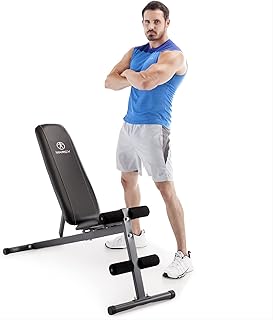
Marcy has been building entry-level home gym equipment for decades, and the SB-261W is the brand at its most practical: a slim, fixed-frame utility bench that covers upright, incline, flat, and decline positions without asking for much floor.
The steel frame keeps a footprint of roughly 42 by 19 inches, small enough to live permanently beside a dumbbell rack. Adjustment is a simple pop-pin affair, and because nothing folds, there are no hinges to work loose over time. The upright setting is genuinely useful for seated shoulder presses and supported rows, and it is a position many folding benches skip.
The 300 lb combined rating is the honest limit here. That covers most beginner and intermediate dumbbell training, but heavy pressers and anyone approaching the rating with body weight plus loaded dumbbells should size up to one of the four-digit frames in this guide.
Bottom line: if your budget is tight and your dumbbells are moderate, this is the most bench for your money in the group, from a name with a long track record.
- Type: fixed-frame utility bench, model SB-261W
- Positions: upright, incline, flat, and decline
- Stated capacity: 300 lb combined user and weight
- Frame: powder-coated steel
- Listed dimensions: about 42 x 19 x 51 inches
- Adjustment: pop-pin backrest
- Does not fold; designed for a permanent spot
The SB-261W shines as a dumbbell station: seated shoulder presses in the upright slot, incline presses and curls at the middle notches, and chest-supported rows leaning into the incline pad. The compact frame keeps a small corner productive without crowding it.
Respect the 300 lb combined rating, which means your body weight plus both dumbbells. Lighter lifters have plenty of headroom, while heavy pressers should look at the higher-rated frames on this list.
Check the pop-pin and frame bolts monthly, since fixed benches loosen slowly rather than obviously. Wipe the vinyl down after sweaty sessions and keep the bench off damp concrete to protect the powder coat. With that basic routine, Marcy frames routinely serve for many years of home training.

Pros
- 1000 lb rating, with a 1300 lb version listed
- Wide backrest and seat adjustment spread
- Stays planted under heavy dumbbell work
- Folds for storage despite the heavy build
Cons
- Heavier to carry than budget folding benches
- Seat can leave a gap against the backrest at some angles
BARWING's adjustable bench is the pick for lifters who want maximum adjustment range in a frame that still folds. It targets home gym owners who press heavy and want the seat and back set exactly right rather than close enough.
The stated capacity runs from 1000 lb up to a 1300 lb version, which translates into a bench that stays planted under heavy dumbbell work. The backrest and seat adjust across a wide spread of positions, so you can fine-tune a low incline for upper chest work or drop into decline for anchored sit-ups and pressing. Despite the heavy build, the frame folds down for storage against a wall.
The tradeoff is mass. This bench is noticeably heavier to shuffle around than the lighter folders in this list, and the seat can leave a gap against the backrest at certain angles, which some lifters find distracting on flat presses.
Bottom line: pick the BARWING when adjustment precision and a high weight rating matter more than having the lightest bench in the room.
- Type: folding adjustable bench with incline, flat, and decline positions
- Stated capacity: 1000 lb, with a 1300 lb version listed
- Adjustment: multi-position backrest plus adjustable seat
- Foot hold-down support for decline and core work
- Assembly: simple bolt-up with most of the frame pre-built
- Folds for upright storage against a wall
Use the wide adjustment spread to work in small steps: low incline settings load the upper chest without turning the movement into a shoulder press, while steeper slots support seated overhead work. The seat adjustment matters as much as the backrest, so tilt it up on incline days to stop yourself sliding down the pad mid-set.
Plan a ground-level parking spot, leaned against a garage wall or slid behind a door. The weight that makes this bench stable also makes lifting it onto anything a two-hand job, so keep the path from training spot to storage spot short and flat.

Pros
- Five training stations in one folding frame
- Build quality a clear step above generic imports
- Covers pressing plus anchored ab work
- Folds flat for under-bed or closet storage
Cons
- Station changes take longer than a simple ladder adjuster
- Tall lifters may want a longer pad
Finer Form built its reputation on gym-quality home benches, and the 5-in-1 is its space-saving multitool: one folding frame that covers flat, incline, and decline pressing plus sit-up and dumbbell stations.
The draw is consolidation. Instead of a bench plus a separate ab bench, you get one padded platform that locks into each role, with build quality a clear step above generic imports. Folded, it stands flat against a wall or slides under a bed, and the upholstery and welds hold up to daily use.
Reconfiguring between stations takes a little longer than flipping a simple ladder adjuster, and lifters over six feet may want a longer pad for full support on flat work. The 800 lb capacity figure lives in the brand's product images rather than the listing text, so it is easy to miss when comparing.
Bottom line: the best choice when one bench has to be your entire strength setup, ab work included.
- Type: 5-in-1 folding workout bench
- Stations: flat press, incline press, decline press, anchored sit-ups, and dumbbell work
- Adjustment: locking positions for each station
- Stated capacity: 800 lb, published in the brand's product images
- Folds flat for storage
- Brand: Finer Form, a home strength equipment specialist
- Flat bench pressing and dumbbell work
- Incline pressing and curls
- Decline pressing
- Anchored sit-ups and weighted core work
- A stable platform for rows and step-ups
One frame, five jobs, one folded footprint: that is the pitch, and it holds up in daily use.
Best for lifters furnishing a complete strength corner with a single purchase, especially where ab training matters as much as pressing. Less ideal for very tall users and max-effort barbell work, where a longer pad with a stamped rating earns its space.

Pros
- No assembly, ready to use out of the carton
- 1050 lb rated heavy-duty steel frame
- 8 backrest positions from decline to steep incline
- Folds flat in seconds for storage
Cons
- Pad length runs short for tall lifters
- Brand support history is shorter than legacy names
The K KINGKANG bench answers the most common complaint about home gym gear: the box that sits unassembled in the hallway for a week. This bench unfolds out of the carton ready to use, with no tools and no hardware bag.
The steel frame carries a 1050 lb rating, among the highest in this group, and the backrest locks into 8 positions from decline through steep incline. Fold-down is genuinely fast, taking a few seconds to flatten the bench for storage under a bed or in a closet, which makes it easy to keep a shared room tidy.
The pad length sits on the shorter side for tall lifters, and K KINGKANG does not have the decades-long support history of legacy fitness brands, which matters if you value long warranty relationships.
Bottom line: the zero-assembly pick. If you want to press the day the box lands and stash the bench the same evening, this is the one.
- Type: folding adjustable bench with incline, flat, and decline positions
- Stated capacity: 1050 lb
- Backrest: 8 locking positions
- Frame: heavy-duty steel, factory assembled
- Assembly: none required
- High-density cushion pads
- Folds flat for under-bed or closet storage
This is the bench for spaces where gear cannot live in the open. It folds in seconds and stands flat, and because it never needed assembly, there is no wobble from user-torqued bolts. Pair it with a folding mat and the whole gym vanishes into a closet between sessions.
Inspect the folding joints and locking points every few weeks, since hinge hardware is the wear point on any folder. Confirm the backrest pin is fully seated before loading up, and keep fingers clear of the hinge when collapsing the frame. The 1050 lb rating leaves a wide safety margin for typical home dumbbell training.

Pros
- Light and easy to fold away or carry between rooms
- Covers incline, decline, and flat at a budget price
- Fast ladder-style adjustments
- Good starter bench for dumbbell workouts
Cons
- Not built for heavy barbell work
- Pad runs narrower than premium benches
The LINODI folding bench is the starter option: a light, inexpensive FID design for new lifters building a first dumbbell corner in an apartment, dorm, or shared bedroom.
It covers the essentials with incline, decline, and flat settings, adjusts with a simple ladder, and folds small enough to lean inside a closet. The low frame weight that limits it under heavy loads also makes it the easiest bench here to carry between rooms, which suits renters who train in whatever space is free that day.
This is not a bench for heavy barbell work. The frame and pad are built to a price, the pad runs narrow, and serious pressers will outgrow it. Treat it as the entry point rather than the destination.
Bottom line: the lightest, most storable way to add incline work to a small space, best for beginners with moderate dumbbells.
- Type: folding adjustable bench
- Positions: incline, decline, and flat
- Adjustment: ladder-style backrest
- Stated capacity: 660 lb, published in the brand's product images
- Light frame, easy to carry
- Folds compact for closet storage
- Intended use: dumbbell pressing, rows, curls, and ab work
A starter strength corner needs three things: this bench, a pair of adjustable dumbbells, and a mat to define the training space. That setup covers presses, rows, curls, lunges, and core work in roughly the floor area of a yoga mat, and every piece stores flat when the room goes back to normal life.
Pick the LINODI if you are new to lifting, train with light to moderate dumbbells, and value easy storage above everything else. Move up this list once your pressing weights grow, and let this one live on as the incline curl and ab bench.

Pros
- Leg extension and back extension stations included
- 1000 lb stated frame capacity
- Full flat, incline, and decline range
- Folds for storage after the session
Cons
- Attachments add bulk and setup time between stations
- Folded package is chunkier than a plain bench
JOROTO's folding bench stretches the definition of a bench: with its leg extension and back extension stations, it borrows work usually done by two dedicated machines.
The core bench is stout, with a 1000 lb stated capacity and a full flat, incline, and decline range. Add the leg extension for quad and hamstring isolation and the back extension setup for posterior chain work, and one frame covers a training spread that would otherwise need a wall of equipment. It still folds for storage when the session ends.
The attachments add bulk and a little setup time whenever you switch stations, and the folded package is chunkier than a plain bench. If you would never use the extensions, a simpler frame stores smaller.
Bottom line: the multi-station pick for lifters who want legs and lower back covered without buying separate machines.
- Type: folding adjustable bench with attachment stations
- Stated capacity: 1000 lb
- Positions: flat, incline, and decline
- Attachments: leg extension and back extension
- Foam rollers for leg work
- Folds for storage; attachments detach
The leg station isolates quads through extensions and flips position for hamstring curls, while the back extension arrangement supports hip hinges and lower-back work that most benches simply cannot host. Rotate these in after pressing and one frame delivers a genuinely full-body session.
Leave clearance at the foot of the bench for the leg station's swing arc, roughly one stride of open floor. If the room is truly tight, detach the extensions and store them beside the folded frame; the core bench packs down close to a standard folder.

Pros
- Commercial-grade build in a folding design
- Extremely stable under heavy dumbbell and barbell work
- Smooth adjustments with positive, solid locks
- Transport wheels make it easy to roll aside
- Strong reputation among home gym owners
Cons
- Costs several times more than budget folders
- Heavier than entry-level options
REP Fitness is the brand serious home gym owners graduate to, and the AB-3000 series folding FID bench shows why: commercial-grade steel, a rock-solid lockout in every position, and hardware that feels closer to a gym floor than a living room.
Under heavy dumbbell and barbell work the bench simply does not move. The 1000 lb rating and dense pad are chosen for support rather than sofa softness, adjustments run smooth and positive, and wheels make it easy to roll the frame aside. The folding design keeps all of that commercial build livable in a shared space.
You pay for it. This is by far the biggest investment in the group, and the frame is heavier than any budget folder. Casual dumbbell users may never stress the extra engineering they bought.
Bottom line: the buy-once bench. If pressing heavy for the next decade in the same home gym is the plan, the AB-3000 is the endgame pick.
- Type: commercial-grade folding FID bench, AB-3000 series
- Stated capacity: 1000 lb
- Positions: flat, incline, and decline
- High-density pad built for heavy pressing support
- Transport wheels for easy repositioning
- Folds for storage despite the commercial build
Stability is the whole story. Heavy single-arm rows, seated presses near the top of the dumbbell rack, pause work in the decline slot: the AB-3000 stays silent and square through all of it. Locks that seat with authority change how hard you are willing to push at home.
REP builds to commercial standards and supports its equipment accordingly, and used REP gear holds value in a way budget benches never do. Spread over a decade of training, the step up in cost buys the last bench most home gyms ever need.
How to Choose an Incline Bench for Your Home Gym
Every bench here presses fine on paper. The differences show up in the room itself: the closet depth, the ceiling height over a basement floor, the strip of space left between the couch and the wall. Before the criteria, here is how the group compares on the factors that decide whether a bench survives in a shared space.
| Bench | Folds for Storage | Stated Capacity | Standout Trait for Home Gyms |
|---|---|---|---|
| PASYOU Adjustable Bench | Yes, folds flat | 660 lb | Arrives about 95 percent pre-assembled with a wide seat |
| Marcy SB-261W | No, fixed frame | 300 lb | Slim utility footprint at an entry price |
| BARWING Adjustable Bench | Yes | 1000 lb, with a 1300 lb version | Huge adjustment spread for pressing angles |
| Finer Form 5-in-1 | Yes, folds flat | 800 lb | Five training stations in one frame |
| K KINGKANG Bench | Yes, folds in seconds | 1050 lb | No assembly required out of the box |
| LINODI Bench | Yes | 660 lb | Light starter bench that stows anywhere |
| JOROTO Bench | Yes | 1000 lb | Leg extension and back extension stations |
| REP Fitness AB-3000 | Yes | 1000 lb | Commercial-grade build with transport wheels |
Folded Footprint: Measure Where the Bench Will Live

Start with the storage spot, not the bench. Measure the gap under the bed, the depth of the closet, or the wall section behind the door, and buy a bench whose folded shape actually fits that space. A folder that stands flat against a wall needs only a few inches of clearance, while a fixed frame like the Marcy claims its patch of floor permanently and pays you back by always being ready.
Think about the rest of the room too. If a treadmill already owns half the floor, our guide to the best treadmills includes folding options that free up a bench-sized rectangle. In a genuinely tight room, the winning combination is usually a fold-flat bench plus adjustable dumbbells, a full strength corner that packs into the area of a doormat.
Two measurements people forget: ceiling height and door swing. Overhead pressing from a seated upright position adds arm length to your sitting height, which matters under basement joists, and a bench parked behind a door only works if the door still opens. Five minutes with a tape measure prevents the most common home gym regrets.
Stability You Can Feel vs. Weight You Can Move

Stability and portability pull in opposite directions. The mass that keeps the REP Fitness AB-3000 silent under heavy presses also makes it the hardest bench here to carry upstairs, while the light LINODI moves anywhere but will not feel as planted under serious loads. Be honest about which end of that spectrum your training lives on.
Look for the details that add steadiness without adding bulk: wide rear feet, rubber contact points that grip hard floors, and a locking mechanism that seats with a positive click. Transport wheels are the best compromise feature in the group, letting a heavy frame roll to the wall instead of being lifted.
FID Versatility: One Bench, Several Stations
FID stands for flat, incline, and decline, and in a home gym that range is the difference between a bench and a whole station. Flat covers presses and rows, incline shifts work to the upper chest and shoulders, and decline opens up anchored sit-ups and decline pressing. The more honest positions a bench locks into, the fewer machines you will miss.
Some frames stretch even further. The JOROTO adds leg extension and back extension stations that stand in for two machines a small room could never host, and the Finer Form 5-in-1 folds ab work and dumbbell stations into one silhouette. If your training is mostly pressing, a clean three-position folder is enough; if the bench is your entire gym, the multi-station designs earn their extra bulk.
A quick way to gauge how much range you need is to sketch a normal training week. A push, pull, legs split can run almost entirely off one FID bench: incline and flat pressing on push day, chest-supported and single-arm rows on pull day, step-ups, split squats, and hip work on leg day. If every session in your plan touches the bench, spend more for range and stability, because that one purchase is carrying your whole program.
A Realistic Weight Rating for Your Training

The number to compare is your body weight plus every pound you plan to press, with room to grow. A 300 lb rating like the Marcy’s honestly covers a lighter lifter with moderate dumbbells, while four-digit ratings on the BARWING, K KINGKANG, JOROTO, and REP frames leave margin that most home lifters will never touch.
Capacity numbers do not always sit in the product title, either. Two of the benches here publish their ratings inside the brand’s product images rather than the listing text, so dig one layer deeper before ruling a frame out. High ratings also tend to travel with thicker steel and better welds, so the capacity figure doubles as a rough proxy for overall build.
Third-party certification is worth a small premium when you can get it. The PASYOU listing points to ASTM certification behind its 660 lb figure, which means the number reflects a recognized method rather than a marketing round-up. On an item you load and then lie under, that kind of backing is more useful than an extra hundred pounds of unverified capacity.
Noise, Floor Protection, and Training in a Shared Space
Home training happens above downstairs neighbors, next to sleeping kids, and on flooring you may have a deposit riding on. A bench contributes more to that problem than people expect: metal feet clank on hard floors, a frame that rocks taps out a rhythm with every rep, and dropping the backrest carelessly sounds like a door slam one room over.
The fixes are cheap and worth planning at purchase time. A rubber mat under the bench kills most contact noise, protects the floor from both the frame and the dumbbells, and marks out the training zone so the rest of the household knows where gear will appear. Rubber-capped feet, which most of the benches in this list include, do the same job at the contact points.
Folding designs also help with the social side of a shared room. A bench that vanishes after each session keeps the peace in a living room gym, while a permanently parked frame is easier to justify in a garage or basement. It is a small consideration per session and a large one per year.
Setup Friction: Assembly, Adjustments, and the Daily Habit
Friction decides whether home equipment gets used. A bench that unfolds in seconds, like the K KINGKANG, removes every excuse between you and the first set, while a fussy mechanism quietly turns training days into rest days. Favor ladder-style adjusters you can move without tools and frames that arrive mostly or fully assembled.
Run the daily routine in your head before buying: unfold, adjust, train, wipe down, fold, stow. If any step in that loop sounds annoying with a particular bench, it will be twice as annoying in week six. The best incline bench for a home gym is the one whose loop you will actually repeat.
Why You Should Trust Us
We build our shortlists the way a careful buyer would with unlimited patience. For this guide we compared manufacturer specifications across every bench, read through large volumes of verified buyer feedback with extra weight on long-term reports of wobble, hinge wear, and pad breakdown, and cross-checked capacity and dimension claims against brand documentation wherever it exists.
Because this guide is about home gyms, we scored space efficiency as heavily as pressing performance. A bench only earned a spot here if it either stores small, holds more than one training role, or squeezes an unusual amount of stability out of a compact frame. We do not accept payment for placement, and our picks change when the products or the feedback around them change.
Final Thoughts
The PASYOU Foldable Adjustable Weight Bench is the best overall pick for a home gym: a 660 lb rating, a seat you can actually sit on, near-zero assembly, and a frame that disappears into a closet between sessions. It is the bench that fits the most rooms and the most training styles at once.
The Marcy SB-261W is the best value if you can give a slim frame a permanent corner, trading foldability for a trusted name and pop-pin simplicity. At the other end, the REP Fitness AB-3000 is the buy-once upgrade for serious lifters, and the JOROTO earns its spot when one bench has to cover legs and lower back as well as pressing.
The rest of the field maps neatly onto specific rooms. The K KINGKANG suits anyone who wants zero assembly and a bench that folds in seconds, the BARWING rewards lifters who obsess over exact pressing angles, the Finer Form 5-in-1 works as an entire strength corner in one frame, and the LINODI is the light, low-commitment way for a beginner to find out how much they will actually use a bench.
Whichever way you go, match the bench to the room first and the training second, because the room is the constraint that does not change. For more gear that earns its floor space, browse the rest of our sports and outdoors coverage or see every buying guide we publish on our articles page.
Frequently Asked Questions
What should I look for in an incline bench for home gym?
Prioritize four things in order: a folded or fixed footprint that fits your actual storage space, a weight rating comfortably above your body weight plus your heaviest planned dumbbells, honest flat, incline, and decline positions with locks that seat firmly, and adjustments quick enough that daily use never feels like a chore. Everything else, from pad stitching to color, is secondary in a small training space.
How much space does a folding weight bench save in 2026?
A set-up adjustable bench occupies roughly the floor area of a hallway runner once you include room to move around it. Folded, most of the benches in this guide compress to a slab that stands against a wall, slides under a bed, or leans inside a closet in a few inches of depth. In a studio apartment or a shared garage, that is the difference between owning a gym and living in one.
Can one FID bench replace several machines in a small home gym?
For most lifters, yes. A solid FID bench plus adjustable dumbbells covers pressing at every angle, rows, curls, shoulder work, step-ups, and anchored core training, which is the bulk of what a machine circuit provides. Multi-station frames like the JOROTO stretch that even further with leg and back extension work. To keep the training honest, many home lifters log sets and progress with one of the best fitness trackers instead of guessing.
Should I pick a folding bench or a fixed utility bench for an apartment?
Choose folding if the training space doubles as living space, since the entire point is reclaiming the floor between sessions. Choose a fixed utility frame like the Marcy SB-261W if you have one corner you can sacrifice permanently, because a bench that is always ready removes the last bit of friction from showing up. Renters who move often should also favor folders, which pack flat for transport.
Do folding incline benches hold up to heavy pressing over time?
The good ones do. Hinges and locking pins are the wear points, so the habit that matters is a quick monthly check that pivot hardware stays tight and the backrest pin seats fully before every session. Frames with four-digit capacity ratings, like the K KINGKANG, JOROTO, and REP Fitness models here, carry enough structural margin that normal home pressing loads sit far below their limits.




Write Your Review
No reviews yet. Be the first to share your experience!