

Frying bacon is the clearest case for this tool. The pan is doing exactly what you want, and the stove, the backsplash and the front of your shirt are paying for it. A splatter screen sits over the pan and catches the oil while letting the steam out, which is the one thing a lid cannot do. We compared 8 grease splatter screens from OXO, BergKoch, U.S. Kitchen Supply and more, sorted by construction, diameter and how each one handles the steam.
Our top pick is the BergKoch 13 Inch Stainless Steel Splatter Screen for its fine mesh and simple one piece build, which is the combination that catches oil without turning a crisp cutlet soft. Below we split the field into fine mesh steel, perforated steel and flexible silicone, because those three behave very differently on the same pan. This roundup is current for September 2026, and the rest of the stovetop kit sits in our home and kitchen section.

Pros
- Thirteen inches overhangs a standard twelve inch skillet properly
- Fine woven mesh stops oil while steam escapes, so crust survives
- Simple one piece build with nothing to loosen or break
- Light enough to lift on and off with one hand while cooking
Cons
- Grease bakes into a fine weave if it is not rinsed while warm
- Fixed handle makes it an awkward shape to store in a drawer
- No resting feet, so it leaves an oil ring if you set it face down
This is the plain, correct version of the tool. A thirteen inch disc of woven stainless mesh with a handle riveted to the rim, sized so it rests on the lip of a twelve inch skillet and overhangs slightly, which is the geometry that keeps oil from escaping around the edge.
The fine weave is what makes it work. Oil droplets hit the wire and stop, while water vapor passes straight through, so a cutlet or a piece of fried chicken keeps its crust instead of steaming soft under a lid. That single behavior is the entire argument for owning a splatter screen rather than covering the pan.
Because it is one piece with no hinge, no folding joint and no silicone trim, there is nothing on it to fail. Screens like this outlast the pans they sit on, and the only realistic damage is a dent from being stacked under something heavy, which stops it sitting flat.
The honest drawbacks are storage and cleaning. A rigid thirteen inch disc with a fixed handle is an awkward shape to put away, and grease left to cool in a woven mesh takes real effort to remove. Rinse it under hot water with a drop of detergent while it is still warm and the problem disappears.
Bottom line: the screen to buy if you want the job done and nothing else, and the one most kitchens should default to.
- Material: stainless steel woven mesh
- Diameter: 13 inches
- Fits: frying pans and skillets up to about 12 inches
- Handle: long, fixed
- Construction: one piece, no moving parts
- Care: rinse warm with hot water and detergent, dry before storing
Buy this if you fry regularly in a full size skillet and want the most effective barrier with the least to think about. Look at the OXO folding model instead if drawer space is your real constraint, and at a silicone disc if you want something that also covers a bowl in the microwave. If your pans are small, a thirteen inch screen will feel oversized.
Rinse it while the pan is still warm, before the grease sets in the weave. Dry it fully before it goes in a drawer, since moisture sitting at the rim and the handle rivet is the usual cause of the discoloration people report on steel screens. Lift it away from you when you remove it so escaping steam goes up rather than across your wrist, and never rest it face down on a clean counter.

Pros
- Resting feet keep the greasy face off the counter between turns
- Comfort grip handle stays easier to hold over a hot pan
- Fine mesh blocks oil mist while venting steam
- Full thirteen inch diameter suits a standard skillet
Cons
- Fine weave still needs a warm rinse rather than a cold dishwasher cycle
- Rigid handle does not fold, so storage is the same problem as any disc
- Feet add a small snag point when sliding it into a packed drawer
U.S. Kitchen Supply builds the same fine mesh screen as everyone else and then adds the two details that decide whether a tool gets used: somewhere to put it down, and a handle you can hold.
The resting feet are the standout. Two small legs on the underside let you set a greasy screen on the counter without printing an oil ring, and they let it stand while you turn the food. Anyone who has balanced a hot screen on the edge of the sink will recognize why that matters.
The mesh itself is fine enough to stop the mist that a perforated sheet lets through, and at thirteen inches it overhangs a standard skillet the way a screen should. The comfort grip handle is longer than it looks in the photos, which keeps your knuckles out of the steam column.
What it does not solve is storage. This is still a rigid disc with a fixed handle, so it lives flat against the side of a cupboard or on a hook. The mesh also needs the same warm rinse as any woven screen if you want to avoid scrubbing later.
Bottom line: the fine mesh screen with the practical details, and the pick if you cook with the screen coming on and off repeatedly.
- Material: stainless steel fine mesh
- Diameter: 13 inches
- Underside: two resting feet
- Handle: comfort grip
- Use: frying pans and cooking pots
- Care: dishwasher safe, warm rinse recommended for greasy work
Rest the screen on the rim of the pan rather than pressing it down inside, and lift it away from you so the steam goes up. Use the feet: set it down mesh up on the counter while you turn food, then put it straight back. Over a bowl it works as a coarse strainer for pasta water or rinsing produce. Rinse it under hot water before the grease cools, and dry it before it goes away.
Choose this over a plain screen if you cook in stages and keep taking the cover on and off, since the feet and the grip are what you notice every time. Choose the folding OXO instead if the drawer is the problem. If your kitchen runs several pan sizes, the three piece set from the same brand covers them with the same mesh and handle design.

Pros
- Three diameters cover a skillet, a saucier and a small saucepan
- Lets you cover two burners at once when you are cooking in parallel
- Same fine mesh construction across all three sizes
- Smaller screens are far less awkward to handle on a small pan
Cons
- Three screens take three times the drawer space
- Most households use the thirteen inch one and leave the others
- Fine mesh on all three means three things to rinse while warm
This is the same fine mesh screen as the single thirteen inch model, supplied in three diameters, and it answers a real problem rather than padding a bundle. A thirteen inch disc balanced on a small saucepan is unwieldy and does not sit properly, and that is the moment people stop bothering with a splatter screen at all.
The nine and a half inch screen is the one that surprises owners. It fits the small pan you actually fry an egg in, it is light, and it is easy enough to grab that you use it for jobs where you would never have fetched the big one.
Covering two burners at once is the other genuine benefit. Anyone who fries a protein while a sauce spits in a second pan gets the whole point of a set immediately, and it also means one screen can be soaking while another is in use.
The cost is storage, and it is a real cost. Three rigid discs with handles need a dedicated slot, and if you honestly only ever fry in one skillet, you will use one screen and store two. Buy the set for the pans you own, not for the idea of them.
Bottom line: the right buy for a kitchen that fries in several sizes, and overkill for one that does not.
- Material: stainless steel fine mesh
- Diameters: 13, 11.5 and 9.5 inches
- Pieces: 3 screens
- Handles: comfort grip
- Use: frying pans, sauciers, cooking pots
- Care: dishwasher safe, warm rinse recommended after frying
Buy the set if you cook several things at once, if your pans range from a small egg pan to a full skillet, or if a spare screen while one is being washed sounds useful. Buy a single thirteen inch screen instead if you fry in one pan and your drawers are already full, since that is the size that covers most cooking on its own.
Treat all three the same way: rinse under hot water while the grease is still soft, and dry fully before stacking. Stacking damp screens is how rims discolor. Do not nest them with anything heavy on top, because a dented mesh no longer sits flat on a pan rim, which is the one failure that ends a screen. Lift each one away from your body so escaping steam clears your hand.

Pros
- Folding handle turns an awkward disc into something a drawer will take
- Perforated sheet wipes clean instead of trapping grease in a weave
- Rigid construction that will not dent out of shape
- The soft grip handle is the one OXO is known for
Cons
- Punched holes let more fine mist through than a woven mesh
- The hinge is the only moving part and the only thing that can loosen
- Heavier in the hand than a plain mesh screen
OXO takes the opposite approach to everyone else here. Instead of a woven mesh it uses a solid stainless sheet punched with holes, and instead of accepting the storage problem it puts a hinge in the handle.
The perforated sheet is the more pleasant surface to live with. There is no weave for grease to sit inside, so cleaning is a wipe rather than a scrub, and the panel is rigid enough that it will not deform if something gets stacked on it. For anyone who abandoned a mesh screen because cleaning it was miserable, this is the fix.
The folding handle is the other half of the pitch. A rigid disc with a fixed handle is genuinely difficult to store, and hinging the handle flat lets the screen slide in beside baking trays. It is a small mechanism doing a job that mattered enough for OXO to build the product around it.
Physics sets the limit. Punched holes are larger and fewer than the gaps in a fine woven mesh, so very fine oil mist passes through more readily. It stops the splatters that make a mess and lets a little haze through, which is a fair trade for the cleaning and storage advantages.
Bottom line: the practical choice for a crowded kitchen, and the easiest of the steel screens to clean.
- Material: perforated stainless steel
- Fits: pans up to 13 inches
- Handle: folds flat, soft non slip grip
- Surface: solid sheet with punched holes, no woven mesh
- Care: dishwasher safe
- Storage: lies flat once the handle is folded
Unfold the handle until it locks straight before lifting, then rest the screen on the pan rim rather than inside it. Fold the handle only once the screen is cool and clean, since folding a greasy hinge is what makes the joint sticky over time. Wipe the sheet down with a cloth while it is warm and the whole thing takes a few seconds; the hinge area is the one spot worth drying deliberately.
Choose the OXO if storage or cleaning is what has stopped you using a splatter screen before. Choose a fine mesh screen instead if you want the most complete barrier against oil mist and do not mind rinsing a weave. If you fry very often, owning both is not unreasonable: mesh for the long fries, the folding perforated screen for everything quick.
Pros
- Flexible silicone folds or rolls into a drawer
- Cannot dent, rust or lose its shape
- Rated oven safe, so it can cover a dish that spits
- Quiet to handle and gentle on pan rims
Cons
- Less open area than steel mesh, so it traps a little more steam
- Silicone stains and can pick up cooking odors over time
- Has a heat limit that steel does not, so keep it clear of a bare flame
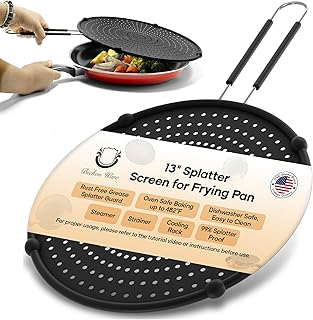
Silicone changes what a splatter screen is. Instead of a rigid disc you cannot put anywhere, this is a flexible sheet that folds into a drawer and springs back flat, which removes the single most common reason these tools stop being used.
It will not rust, it will not dent, and dropping it does nothing. On a coated pan rim it is also gentler than a steel edge, and it is quiet, which sounds trivial until you compare it with metal ringing on a cast iron pan at six in the morning.
The oven safe rating opens a second use, covering a dish that spits in the oven, and the same disc works over a bowl to stop a microwave making a mess. That flexibility is why silicone owners tend to keep the thing on the counter rather than in a cupboard.
The compromises are real. Moulded holes give less open area than woven mesh, so a little more steam stays under the screen and very crisp results are slightly harder to hold. Silicone also stains, particularly with turmeric and tomato, and it has a stated heat limit that steel simply does not, so it belongs above the pan and away from a bare flame.
Bottom line: the pick if storage and durability matter more to you than the last few percent of crispness.
- Material: food grade silicone
- Size: 13 inches, fits 12 to 13 inch pans
- Rating: oven safe
- Flexibility: folds and rolls for storage
- Color: black
- Care: dishwasher safe, keep clear of direct flame
Buy this if drawer space is tight, if you have dented or rusted a steel screen before, or if you want one cover that works on the stove, in the oven and over a bowl. Choose fine mesh steel instead if you fry things where maximum crispness is the whole point, since a woven screen breathes more freely than moulded holes.
Keep the silicone above the pan and off the burner. Gas flames licking up the side of a skillet will exceed what silicone tolerates, and the damage is permanent. It is dishwasher safe, though staining from turmeric and tomato is cosmetic and will not wash out. Store it folded rather than under something heavy, and check the rim occasionally for nicks, since a torn edge is where silicone starts to fail.

Pros
- Two screens means one can be washed while the other is in use
- Covers two burners at once when you are frying in parallel
- Doubles as a strainer over a bowl, which is a genuine second job
- Full thirteen inch diameter on both screens
Cons
- Two rigid discs take twice the storage space
- Bright handles will not suit every kitchen
- Same warm rinse requirement as any mesh screen
Buying these in pairs turns out to make more sense than it first appears. A splatter screen goes from clean to greasy in one fry, and the moment it is in the sink you are back to splattering the stove. A second screen removes that gap entirely.
The pair also covers the way people actually cook. Frying a protein in one pan while something spits in another is a normal weeknight, and a single screen forces you to choose which mess to prevent.
Both discs are the standard thirteen inch size, so each one overhangs a twelve inch skillet properly, and the handles are long enough to keep your hand out of the steam. The red grip is a matter of taste but it does make the handle easy to find on a crowded stovetop.
Alpha Living also sells these as strainers, and that use is legitimate: rest the disc over a bowl and it holds back pasta or rinses berries. The trade-off is straightforward, since two rigid screens need twice the storage, and if you only ever fry in one pan the second will sit in a cupboard.
Bottom line: the value buy, and the sensible pick for anyone who cooks on more than one burner at a time.
- Material: stainless steel mesh
- Diameter: 13 inches each
- Pack: 2 screens
- Handle: long, red grip
- Second use: strainer over a bowl
- Care: rinse warm, dry before storing
Keep one screen at the stove and one in the cupboard rather than storing both together, so a clean one is always within reach. Rest each screen on the pan rim and lift it away from you. Over a bowl, hold the handle steady while you pour so the disc does not tip. Rinse under hot water before the grease sets, and let both dry fully before they are stacked.
Take the two pack if you cook on two burners, if you fry often enough that a screen is usually dirty, or if you want a spare that also works as a strainer. A single screen is the better buy if drawer space is the constraint, and the OXO folding model is the answer if it is the shape rather than the count that bothers you.

Pros
- Flexible disc stores anywhere and will not dent
- Food grade silicone with a stated heat resistance rating
- Works as a bowl cover and a microwave splash guard as well
- No rim or rivet to rust
Cons
- Moulded holes vent less freely than a woven steel mesh
- Light enough that a strong extractor draft can lift the edge
- Silicone picks up stains and odors over time
INYOU sells the silicone approach at its simplest: a flexible perforated disc that sits over a thirteen inch pan and blocks the oil. There is no rim, no rivet and no weave, which removes every part of a steel screen that can rust or clog.
Where it earns its place is versatility. The same disc covers a bowl in the fridge, sits over a plate in the microwave, and folds into a drawer instead of demanding a flat slot. People who buy one tend to use it well beyond frying.
Handling is pleasant. Silicone stays cooler at the edge than bare steel, it does not clang against a cast iron rim, and it is impossible to dent out of shape. For a household where the previous screen was retired because it got bent, that is the whole argument.
The compromises follow the material. Moulded perforations give less open area than fine mesh, so more steam stays under the screen and very crisp frying is marginally harder to hold. It is also light, so a strong extractor draft can lift an unweighted edge, and silicone stains with turmeric and tomato.
Bottom line: the flexible everyday cover, best in a kitchen that wants one disc to do several jobs.
- Material: food grade silicone
- Size: suits 13 inch pans
- Rating: heat resistant to hot oil
- Uses: frying pan cover, bowl cover, microwave splash guard
- Care: dishwasher safe
- Construction: single moulded piece, no rim or rivet
Buy this if you want one flexible cover for several jobs and value storage over the last degree of crispness. It suits smaller kitchens and anyone who has already dented or rusted a steel screen. Cooks who shallow fry frequently and care about crust should take a fine mesh steel screen instead, and keep silicone for the microwave.
Keep it above the pan and away from any flame that climbs the side of the pan, because exceeding the silicone rating damages it permanently. Wash it in the dishwasher or by hand; staining from spices is cosmetic. Check the edge for nicks now and then, since a small tear in silicone spreads. Store it flat or loosely rolled rather than crushed under heavy cookware.
Pros
- Eight inches suits egg pans and saucepans that a big screen cannot sit on
- 304 stainless steel resists the rust that ends cheap screens
- Folding knob makes it flat and easy to store
- Light and quick to grab, so it gets used for small jobs
Cons
- Far too small for a twelve or thirteen inch skillet
- A knob keeps your hand closer to the steam than a long handle
- Small diameter means less coverage of the surrounding stovetop
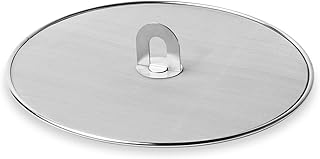
Most splatter screens are built for the biggest pan in the kitchen, which leaves the small pans uncovered. This eight inch Homestia screen exists for those, and it fills a genuine gap: frying an egg or a couple of rashers in a small pan still throws oil everywhere.
The 304 stainless specification is worth noticing. That grade is the one that holds up to repeated contact with hot oil and moisture without pitting, and rust at the rim is the single most common complaint about inexpensive screens.
Rather than a long handle it uses a folding knob in the center. That keeps the whole thing compact and lets it lie flat in a drawer, which is a sensible design choice on a screen this small since there is nowhere for a long handle to go.
The limits are exactly what the size implies. It cannot cover a twelve inch skillet, and a central knob puts your fingers nearer the steam than a side handle does, so lift it with the pan turned down or use a cloth. Treat it as the small pan specialist it is rather than a main screen.
Bottom line: the right answer for small pans, and a poor substitute for a full size screen.
- Material: 304 stainless steel mesh
- Diameter: 8 inches
- Handle: foldable center knob
- Fits: small frying pans and saucepans
- Finish: rust resistant
- Care: rinse warm, dry before storing
Match it to a pan of about eight inches so the rim of the screen sits on the rim of the pan rather than inside it. Fold the knob up to lift, and turn the heat down for a moment before you remove it, since a center knob puts your hand directly over the steam. Rinse it warm and dry it, then fold the knob flat and it stores like a saucer.
Buy this as a second screen for the small pan you use every morning, not as your only one. If you own a single pan and it is a full size skillet, buy a thirteen inch screen instead. If you want both sizes covered in one purchase, the graduated three piece set is the more economical route, at the cost of drawer space.
How to Choose a Grease Splatter Screen
Two decisions cover most of it: what the screen is made of, and whether it is wide enough to overhang your pan. Everything else is comfort and cleanup.
Fine Mesh Steel, Perforated Steel, or Silicone

Fine mesh stainless steel is the traditional design and still the most effective. A tight woven mesh stops oil droplets on contact while steam passes straight through, so the pan keeps frying rather than steaming. Mesh is also the lightest option, which matters when you are lifting it on and off a hot pan with one hand.
Perforated stainless is a solid sheet punched with holes, the design OXO uses. It is more rigid than mesh, easier to wipe clean because there is no weave to trap grease, and it stops the larger splatters just as well. Very fine mist gets through the holes more readily than through a woven mesh, so it is a slightly less absolute barrier in exchange for being far less annoying to clean.
Silicone screens are flexible discs with perforations moulded in. They are quiet, they will not dent, they double as a microwave cover, and they are the only type you can roll or fold into a drawer. The trade-off is heat: silicone belongs above the pan, not touching the rim of a searing hot skillet, and the good ones state a temperature rating you should respect.
Diameter, and Why Bigger Beats Exact
Measure your largest frying pan across the top rim, not the base, then buy a screen at least as wide. Thirteen inches is the standard size in this category because it overhangs the twelve inch skillet most kitchens own, and the overhang is what keeps hot oil from escaping around the edge.
A screen that is too small is worse than none at all in one specific way: it sits down inside the pan, its rim touches the oil, and it becomes something you have to clean rather than something that protects the stove. If you are between sizes, go up. A wide screen resting on a small pan is merely a little unwieldy.
Multi size sets exist for households that fry in everything from a saucepan to a wok, and they solve a real problem if you often cook two things at once. The honest counterpoint is storage: three screens take three times the drawer space, and most people find one thirteen inch screen covers ninety percent of what they cook.
Steam Has to Get Out

This is the whole reason a splatter screen exists rather than just using a lid. A lid traps steam, the steam condenses, the water drips back into the pan, and your fried chicken skin goes limp. A screen lets that moisture escape while blocking the oil, so the crust that took you ten minutes to build survives the last five.
Open area is the property doing the work, and it varies more than you would expect. A tightly woven mesh has a surprising amount of open space between the wires; a silicone disc with a modest number of moulded holes has less. If you fry things where crispness is the point, favor mesh or a generously perforated design.
There is a reasonable exception. When you are shallow frying something that benefits from a little trapped heat, a lower open area screen behaves like a gentle lid and speeds the cooking. Some cooks keep both a mesh screen and a silicone one for exactly that reason.
The Handle Decides Whether You Use It

The screen spends its life over a hot pan, so the handle is the part that has to stay cool enough to grab without a towel. Silicone sleeves and hollow steel handles both work, and a long handle keeps your hand out of the rising steam, which is the burn people actually get with these.
Folding handles are the answer to the storage problem. A thirteen inch disc with a rigid handle is a genuinely awkward shape, and a handle that hinges flat turns it into something you can slide beside a baking tray. Check the hinge design, because a folding joint is the one moving part on an otherwise unbreakable object.
Resting feet are a small feature with an outsized effect. Two little legs on the underside let you set the greasy screen down on the counter without printing an oil ring, and they let it stand while you turn the food. It is the kind of detail that separates a screen you keep reaching for from one that lives at the back of a cupboard.
Cleaning, and How Grease Behaves in Mesh
Everything here is dishwasher safe or claims to be, but the honest picture is more nuanced. Baked on grease in a fine woven mesh does not always come out in a normal cycle, because the water has to hit both faces of every wire. Rinsing the screen with hot water and detergent while it is still warm takes seconds and prevents the problem entirely.
Perforated sheet and silicone are the easy ones. A flat surface with clean holes wipes down with a cloth, and neither traps residue in a weave. If the thing that stops you using a splatter screen is the thought of cleaning it, that is a strong argument for one of these two designs over fine mesh.
Watch the rim on mesh screens. The metal binding around the edge is where oil collects and where cheap examples eventually discolor or corrode. A stainless rim on a stainless mesh is what you want, and 304 grade steel is the specification worth looking for on any part that meets hot oil repeatedly.
Build Quality and What Fails First
These are simple objects, so failures are predictable. On mesh screens the weave loosens or dents if the screen is dropped or stacked under heavy pans, and a dented screen no longer sits flat on the rim. On folding models the hinge is the weak point, and on silicone the failure is discoloration and stiffening from heat exposure over time.
Rust is the complaint that comes up most often in owner feedback, and it almost always traces back to two things: a non stainless rim or rivet, and storing the screen while it is still damp. Dry it before it goes away, particularly around the handle joint where water sits.
Weight is a reasonable proxy for sturdiness but not a target in itself. A screen light enough to lift one handed while you are holding tongs in the other hand is more useful than a heavy one you need two hands for. Look for a firm rim and a handle that does not flex when you lift it, and ignore the rest.
| Type | Best at | Weak at |
|---|---|---|
| Fine mesh stainless | Stopping fine oil mist while keeping food crisp | Grease in the weave, needs a warm rinse |
| Perforated stainless | Rigidity and fast wipe down cleaning | Very fine mist passes through the holes |
| Silicone disc | Storage, quiet handling, doubles as a cover | Heat limits, less open area, can stain |
| Multi size set | Matching saucepans, skillets and woks | Takes three times the drawer space |
One last thing worth checking before you buy is what else the screen is rated to do, because several of them earn their drawer space twice. A steel mesh disc sits over a bowl as a strainer for pasta or a colander for rinsing berries, and some are declared oven safe so they can go over a dish that spits. Silicone versions are the ones usually rated as microwave covers. None of these secondary uses should decide the purchase, but between two screens that are equal on diameter and handle, the one with a stated second job is the better buy. For the pans these sit on and the tools that go with them, the category index lists every department we cover.
Why You Should Trust Us
We build these lists from published specification and from the pattern of what long term owners report, rather than from marketing copy. For every screen here we checked the stated diameter against the pan sizes it claims to fit, the material and steel grade where the maker declares it, whether the mesh is woven or the sheet perforated, the handle design and heat protection, and the stated dishwasher and oven ratings.
We also read owner feedback for the failures that only appear after months of frying, which in this category are consistent: rust at the rim or rivet, grease that will not leave a fine weave, and folding hinges that loosen. Near identical listings that differ only in color or count were set aside, so each entry here is a genuinely different screen rather than the same product twice.
Final Thoughts
Best overall is the BergKoch 13 Inch Stainless Steel Splatter Screen. Thirteen inches overhangs the skillet most people fry in, the fine woven mesh stops oil while letting steam out, and there is nothing on it to break. It is the plain, correct version of this tool.
Best value is the Alpha Living 2 Pack Splatter Guard, which gives you two thirteen inch screens for the price most brands charge for one, so you can cover two burners at once or keep a spare when the first is in the dishwasher. It also doubles as a strainer over a bowl, which is a genuine second use rather than a marketing line.
For specific needs, the U.S. Kitchen Supply Stainless Steel Splatter Guard is the pick if resting feet and a comfort grip handle matter to you, and its 3-Piece Set is the answer for a kitchen that fries in three different pan sizes. The OXO Good Grips Splatter Screen is the one to buy if drawer space is your constraint, thanks to the folding handle. The Beckon Ware and INYOU silicone screens suit anyone who wants a flexible cover that also works over a bowl in the microwave, and the Homestia 8 Inch Splatter Screen is the small pan specialist. More kitchen roundups are indexed in our article archive.
Grease Splatter Screen FAQs
What size grease splatter screen should I buy?
Measure the top rim of your largest frying pan and buy a screen at least that wide, which for most kitchens means thirteen inches. The screen is supposed to rest on the rim and overhang slightly, because that overhang is what stops oil escaping around the edge. A screen that drops down inside the pan touches the oil and simply becomes another greasy thing to wash. If you often fry in a small saucepan as well, an eight inch screen or a graduated set covers both.
Does a splatter screen make fried food soggy?
No, and that is precisely the difference between a screen and a lid. A lid traps steam, which condenses and drips back into the pan, softening any crust you have built. A screen blocks oil droplets while letting water vapor escape, so the food keeps frying. The one thing to watch is open area: a mesh screen breathes freely, while a silicone disc with few holes behaves a little more like a lid, which is occasionally useful and occasionally not what you want.
Can splatter screens go in the dishwasher?
Most are rated for it, though fine woven mesh does not always come out clean because the spray has to reach both sides of every wire. The reliable habit is a rinse under hot water with a little detergent while the screen is still warm, which takes seconds and stops grease baking into the weave. Dry it before storing, since trapped moisture at the rim or handle joint is the usual cause of the rust people report.
Will it stop the mess completely?
It stops the overwhelming majority of it, not all. Very fine oil mist finds its way through any opening large enough to pass steam, so expect a light film on the surrounding surfaces after a long fry rather than the sprayed spots you would otherwise be scrubbing off the backsplash. Using a slightly deeper pan and keeping the oil at a steady temperature does as much for splatter as the screen itself.
Is a splatter screen still worth buying in 2026?
For anyone who fries on a stovetop, yes, because nothing else does the same job. Air fryers have taken over some of the cooking that used to splatter, but bacon, cutlets, fried eggs and anything seared in a hot pan still throw oil, and the alternative is cleaning the stove afterward. This is also one of the few kitchen tools with no consumable parts and no way to break under normal use. If you are stocking a kitchen, our home and kitchen picks cover the rest of the stovetop.



Write Your Review
No reviews yet. Be the first to share your experience!