

Search this category and the results are dominated by cameras claiming 44 or 48 megapixels for less than the price of a phone case. Almost none of them have a sensor capable of resolving anything close to that, and the number is arrived at by software rather than by optics. That single piece of context explains why our shortlist of 6 cheap point and shoot digital cameras is built entirely from established camera manufacturers with lower headline numbers. Our top pick is the Kodak PIXPRO FZ45 for pairing a real 16 megapixel sensor with a 4X optical zoom at a genuinely low price.
The cameras here come from Nikon, Sony, Kodak. None of them will match a modern phone for computational processing, and that is not the point: a compact with optical zoom does things a phone cannot, and it does them without draining the device you need for navigation and payments. The buying guide below covers what to look at instead of the megapixel count. For a more serious camera, our guide to cameras under 100 covers the budget end of the wider market.

Pros
- 27mm equivalent wide lens in a pocket sized body
- Runs on AA batteries you can buy anywhere
- Very simple point and shoot operation
- Light enough to carry all day
- Low cost second camera for travel
Cons
- Small sensor means daylight is its comfort zone
- Only 4x optical zoom
- Basic 1080p video with no stabilization to speak of
The FZ45 is the least complicated camera on this page and, for some buyers, the most practical. Its 27mm equivalent lens is wide enough for group shots, street scenes and most interiors, and the whole thing fits in a jacket pocket. There is no app, no reframing and no settings maze.
The AA battery design deserves more credit than it usually gets. On a long trip, or anywhere charging is unreliable, being able to buy power at any corner shop removes a genuine anxiety that proprietary battery cameras create.
Image quality is what you expect at this size and price. Daylight photos are perfectly usable and share well, while indoor and evening shots get noisy. The 4x zoom is short, and video is a basic 1080p mode rather than a feature to buy the camera for.
Think of it as a wide angle snapshot camera rather than a hobbyist tool. In that role, especially as a camera you hand to a child or take somewhere you would rather not risk a phone, it makes complete sense.
Bottom line: a cheap, genuinely wide pocket camera for daylight travel and family photos, with AA batteries as its quiet advantage.
- Wide angle: 27mm equivalent
- Zoom: 4x optical
- Sensor: 16MP
- Video: 1080p Full HD
- Screen: 2.7 inch LCD
- Power: AA batteries
- Compact point and shoot body
Buy this if you want a light, cheap camera with a wide lens for holidays and family use, or a spare body you do not mind exposing to sand and crowds.
Step up to the bridge model if you also need zoom reach, or to an action camera if water resistance and mounting matter.
Keep it at the wide end for rooms and group shots and get slightly closer rather than zooming, since the lens is sharpest and brightest at its widest setting.
Carry lithium AA cells for cold weather trips. They last considerably longer than alkaline cells in low temperatures.

Pros
- Sony optics and support at the lowest price here
- 5X optical zoom in a genuinely pocket sized body
- Rechargeable pack costs nothing to refill
- Simple operation with automatic modes
Cons
- An old design with dated screen and processing
- Rechargeable pack must be charged before use after storage
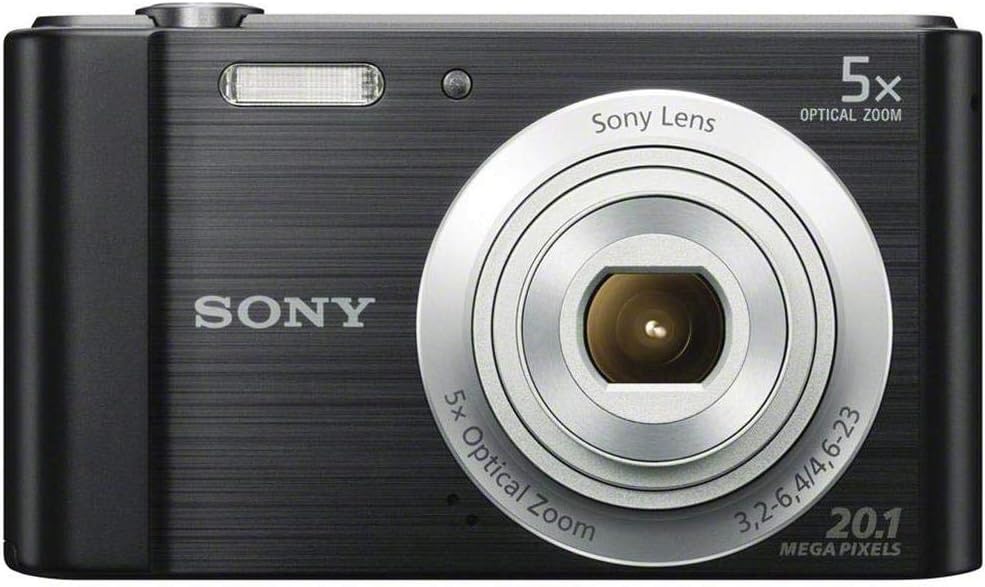
The W800 has been on sale a long time and continues to sell because it occupies a specific slot: the cheapest compact from a manufacturer whose name means something. Sony optics, Sony support, and a 5X optical zoom in a body that fits a coat pocket.
It is unquestionably an old design. The rear screen is low resolution by current standards and the processing is basic. In good light, for the snapshots this camera exists to take, none of that matters much.
The rechargeable pack is the main behavioural difference from the AA powered cameras here. It is cheaper to run and lighter to carry, and it needs charging before a trip rather than being fixed with a shop purchase.
Bottom line: the value pick, and the sensible choice for family occasions and simple snapshots.
- Resolution: 20.1 megapixels
- Lens: Sony 5X optical zoom, f/3.2 to 6.4
- Power: rechargeable battery pack
- Format: pocket compact, fits in one hand
- Modes: automatic shooting modes
- Storage: memory card, not included
Anyone wanting the cheapest camera from a recognised manufacturer, and households buying a simple camera for family events. Less suitable for travel where charging is unreliable, since it depends on its own pack.
Charge the pack fully before any trip, since a pack that has sat unused for months will be flat. Buy a spare pack at the same time if the camera will be used away from power for a full day, and remember a memory card is not included.

Pros
- 5X optical zoom, longer than the FZ45
- Real 16 megapixel sensor specification
- Updated body and controls
- Compact enough for a pocket
Cons
- Fewer reviews than the longer established FZ45
- Same small sensor limits, so low light is still weak
The FZ55 is the newer sibling to the FZ45 and the differences are modest: a slightly longer 5X optical zoom and an updated body. The sensor specification is the same honest 16 megapixels, which remains the point of buying Kodak in this bracket.
The extra zoom is worth having if your photographs tend to be of people across a room or landmarks across a square, where 4X runs out. It does not change the fundamental character of the camera.
Being newer, it carries fewer reviews than the FZ45, which is worth weighing if you prefer a model with a long track record behind it.
Bottom line: pick this over the FZ45 for the longer zoom, and the FZ45 if AA power matters more to you.
- Resolution: 16 megapixels
- Optical zoom: 5X
- Video: 1080p
- Format: pocket compact
- Line: Kodak PIXPRO
- Storage: memory card, not included
Buyers who want the honest Kodak specification with a little more reach than the FZ45 offers. A sensible everyday compact for holidays and family use.
Confirm the power arrangement of the specific variant you are buying, since Kodak sells both AA and rechargeable models across this line and the listing images do not always make it obvious. Budget for a memory card either way.

Pros
- 5X optical zoom at a very low price
- Simple enough for a first camera
- Compact and light to carry as a spare
- Established manufacturer specification
Cons
- Small rear screen by current standards
- Basic feature set with few manual controls
The FZ53 is the most basic camera here and it makes no attempt to be otherwise. A 5X optical zoom, a small screen, automatic modes, and a price that makes it disposable in the sense that losing it on a trip is annoying rather than expensive.
That is exactly why it has a place. A camera you are relaxed about is a camera that comes out of the bag, and there are plenty of situations, from beaches to festivals, where taking a phone out is the thing you would rather avoid.
The screen is small and the controls are minimal. For a first camera for a child, both of those are arguably features rather than faults.
Bottom line: the spare, the child's camera, and the one to take where you would rather not take anything valuable.
- Resolution: 16 megapixels
- Optical zoom: 5X
- Screen: small rear LCD
- Controls: automatic modes
- Format: pocket compact
- Storage: memory card, not included
Children learning photography, and adults who want a camera they can treat carelessly. Not a primary camera for anyone who cares about image quality, where the FZ45 or the Sony are better spent money.
Check the battery type of the version listed, and buy a memory card at the same time. For a child's first camera, a wrist strap is worth adding, since the most likely failure mode for a camera this size is being dropped.

Pros
- 40X NIKKOR optical zoom reaches subjects no phone can
- Vibration reduction stabilises the long end of the range
- AA power works anywhere without a charger
- Tilting screen plus WiFi, Bluetooth and NFC
Cons
- Too large for a pocket
- Small sensor still limits low light quality
The B500 exists for reach. A 40X NIKKOR optical zoom running from 4.0 to 160 mm brings in birds, aircraft and sport from the stands, which is the one thing no phone at any price in this bracket can do, and it does it with real glass rather than by cropping.
The bridge body earns its size. A proper grip and a body you hold in two hands make a long lens usable, where the same zoom on a slim compact would be unsteady at full extension, and Nikon's VR stabilisation compensates for the shake that a 40X magnification exaggerates. AA power means a spare set in the bag rather than a charger, and the tilting screen helps at awkward angles.
What you give up is portability, and the sensor is the same small type used across this class, so low light images remain noisy regardless of how long the lens is.
Bottom line: the reach option, and the right camera if your subjects are far away.
- Resolution: 16 megapixels
- Lens: NIKKOR 40X optical zoom, 4.0 to 160 mm, f/3 to 6.5
- Stabilisation: VR vibration reduction
- Power: AA batteries
- Screen: tilting rear LCD
- Connectivity: WiFi, Bluetooth, NFC, stereo microphone
Birdwatchers, parents photographing sport from the sidelines, and anyone whose photographs are of things they cannot walk closer to. Not for anyone who wants a camera in a pocket.
At the long end of the zoom, brace against something solid or use a support, since camera shake is magnified along with the image and stabilisation only compensates so far. Use rechargeable NiMH AA cells rather than alkalines, which sag under the demands of a long zoom motor and flash.

Pros
- Long optical zoom at a low price
- AA cells available anywhere
- Bridge body gives a steady hold
- Simple automatic operation
Cons
- Older design with a fixed, lower resolution screen
- Superseded by newer models with better processing
The L330 is the older generation of the same idea as the B500: a bridge body, a long optical zoom, and AA power. It has been superseded, which is precisely why it is cheap, and the zoom reach it offers still costs considerably more in any newer camera.
Processing and screen quality show the age. Images take fractionally longer to write and the fixed screen is lower resolution than the tilting one on the B500.
For a first superzoom, or for someone who wants reach without spending much, none of that is disqualifying. The lens is doing the work that matters.
Bottom line: the budget route to superzoom reach, with the compromises an older design brings.
- Zoom: long optical superzoom
- Power: AA batteries
- Screen: fixed rear LCD
- Format: bridge camera
- Modes: automatic scene modes
- Stabilisation: optical image stabilisation
Buyers who want superzoom reach at the lowest possible cost, and anyone buying a first bridge camera to find out whether they will use the focal length. Not the pick if screen quality or speed matters.
Check the maximum supported memory card capacity, since cameras of this generation frequently cap at 32 gigabytes and will not recognise a larger card. Bring rechargeable AA cells and a spare set, as a long zoom motor draws more power than a compact.
How to Choose a Cheap Point And Shoot Digital Cameras
Budget compacts are the category where specification numbers have drifted furthest from reality. These are the ones that still mean something.
Why 44 Megapixels Costs Less Than 16
A megapixel count describes the output file, not the sensor. Interpolation takes an image captured by a smaller sensor and enlarges it mathematically, inventing pixels between the real ones. The file gets bigger. The detail does not. This is why a listing can claim 44 megapixels while an established manufacturer sells a 16 megapixel camera for more money.
What actually governs image quality at this price is sensor size, and almost every camera in this class uses a sensor around 1/2.3 of an inch. That is a small piece of silicon, similar in area to what sits in a mid range phone, and it sets a hard ceiling on how much light the camera can gather. More pixels crammed onto the same small sensor means each pixel collects less light, which increases noise rather than detail.
The practical test when reading any listing: find the stated sensor size and the stated optical zoom. If a listing quotes a huge megapixel figure and does not state sensor size at all, that omission is the answer. Manufacturers who publish real numbers are the ones whose numbers survive scrutiny.
Optical Zoom Is the Only Zoom That Counts

Optical zoom moves glass elements to magnify the image before it reaches the sensor, so the detail is genuinely captured. Digital zoom crops the centre of the frame and enlarges it, which anyone can do afterwards on a computer with the same result. A listing advertising 18X total zoom on a 4X optical lens is quoting the second kind.
This is where a compact still beats a phone. A phone with a single lens simulates zoom by cropping, and even multi lens phones jump between fixed focal lengths rather than moving smoothly through a range. The Nikon B500 runs a 40X optical zoom from 4.0 to 160 mm, which is a reach no phone in this price bracket can touch, and the Kodak FZ45 covers 27 to 108 mm equivalent in a body that fits a pocket.
Long zooms bring one complication: camera shake is magnified along with the image. Optical image stabilisation matters far more at 40X than at 4X, so check that a long zoom camera has it rather than assuming, and expect to need a steady surface at the far end of the range regardless.
| Model | Type | Zoom | Power | Best for |
|---|---|---|---|---|
| Kodak PIXPRO FZ45 | Pocket compact | 4X optical, 27-108 mm | AA batteries | Everyday and travel |
| Sony DSCW800 | Pocket compact | 5X optical | Rechargeable pack | Simple snapshots |
| Kodak PIXPRO FZ55 | Pocket compact | 5X optical | Rechargeable | Newer alternative to the FZ45 |
| Kodak FZ53 | Pocket compact | 5X optical | AA batteries | Budget travel spare |
| Nikon B500 | Bridge superzoom | 40X optical | AA batteries | Distant subjects |
| Nikon Coolpix L330 | Bridge superzoom | Long optical zoom | AA batteries | Wildlife and sports at range |
Pocket Compact or Bridge Camera

Two shapes dominate this list and they suit different people. A pocket compact genuinely fits in a pocket, which is the entire argument for owning one, since a camera left at home takes no photographs. A bridge camera has a large grip and a long lens, giving you reach a compact cannot match while being too big for anything smaller than a bag.
Buy the compact if the camera is for holidays, family occasions, a child learning photography, or as a phone backup. Buy the bridge if the subjects you care about are far away: birds, sports from the stands, wildlife, or aircraft. Both use similarly sized sensors at this price, so the decision is about reach and portability rather than image quality.
One consideration specific to bridge cameras at this price: the electronic viewfinder is often low resolution or absent entirely, meaning you compose on the rear screen. In bright sunlight that screen can be difficult to see, which is worth knowing before choosing one for outdoor sport.
Batteries: AA Cells Versus a Rechargeable Pack
This looks like a minor detail and turns out to shape how a camera gets used. AA cells, used by several models here, mean you can buy power at any shop in the world and carry spares that never need charging. For travel, for a camera that lives in a drawer between holidays, and for a child’s camera, that is a real advantage since a rechargeable pack left uncharged for six months is a dead camera on the morning you need it.
A proprietary rechargeable pack is lighter, gives more shots per charge, and costs nothing to refill. It is the better choice if the camera is used regularly and you are disciplined about charging. It is the worse choice for occasional use, and replacement packs for older models can be hard to source, which quietly ends the life of otherwise working cameras.
If you choose AA, buy rechargeable NiMH cells rather than alkalines. Alkaline cells sag under the current draw of a camera flash and can report empty while still holding charge, and a set of NiMH cells pays for itself within a few charges.
What a Cheap Compact Still Does Better Than a Phone
A modern phone will beat any camera here on image processing, low light, and convenience. Being honest about that makes the remaining advantages clearer, and there are four that still hold.
Optical zoom is the first, particularly on the bridge models, where the reach is simply unavailable on a phone at this price. The second is battery separation: a day of photography does not leave you unable to call a taxi. The third is durability of purpose, which matters most for children and for environments where you would rather not take an expensive phone out of your pocket, such as a beach, a boat, or a festival.
The fourth is subtler. A camera does one thing, and handing a child or an older relative a device with a shutter button, a zoom lever, and nothing else removes every barrier between them and the photograph. That is why these cameras continue to sell in volume long after phones were supposed to replace them.
Who Actually Makes the Camera on the Box
Worth understanding before you compare warranties, because two of the names on this list work differently from each other. Nikon and Sony design, manufacture and support their own cameras, so a Nikon warranty is a claim against Nikon. Kodak PIXPRO cameras are made and supported by JK Imaging under a brand licence from Eastman Kodak, which means the name on the front is licensed and the company behind the product is a different one.
This is not a criticism and it is not unusual. Brand licensing is common across consumer electronics, and it sits at a completely different level from the unbranded listings this guide excludes, because a licensee is a real company with a support operation, a warranty process, and a commercial interest in protecting the name it has licensed. It is simply worth knowing which entity you would be contacting.
The practical consequence shows up in two places. Support channels and warranty registration go through the licensee rather than the parent brand, so search for the correct company when something goes wrong rather than assuming the historic name. And parts or accessory availability follows the licensee’s product line rather than the parent brand’s back catalogue, which matters most for chargers and battery packs a few years after purchase.
The wider point for this price bracket: there is a spectrum rather than a binary. Manufacturer owned brands sit at one end, licensed brands with a real company behind them in the middle, and listings with an invented name and no corporate presence at the far end. All three appear in search results looking equally legitimate, and only the first two give you someone to call.
What Is Not in the Box
Budget compacts arrive incomplete more often than any other consumer electronics category, and the missing parts are the ones you need on day one. A memory card is almost never included. Check the maximum supported card capacity in the specifications rather than buying the largest card available, because older cameras frequently cap at 32 gigabytes and will not read a larger one.
Cards also have a speed class, marked with a number inside a C or a U symbol. Video recording needs sustained write speed, and a slow card is the usual reason a camera stops recording mid clip or drops frames. A Class 10 or U1 card is the practical minimum for any camera shooting 1080p video.
Two more absences to plan for. AA powered cameras rarely include batteries, and cameras with rechargeable packs sometimes ship without a mains charger, expecting you to charge over USB from a plug you already own. Neither is a scandal at these prices, but discovering it on a birthday morning is avoidable for the cost of reading the box contents line in the listing.
Why You Should Trust Us
Every camera here comes from an established camera manufacturer. We deliberately excluded the large number of listings from unidentifiable brands claiming 44 or 48 megapixels, even where review counts ran into five figures, because those numbers describe interpolated output rather than sensor resolution and there is no manufacturer behind them to honour a warranty.
Selection started from verified customer ratings and review volume on current Amazon listings, then narrowed on sensor specification, optical zoom, and power arrangement. Our editorial picks are independent. More technology guides are in our electronics section.
Final Thoughts
The Kodak PIXPRO FZ45 is our best overall because it is the most honest camera in the category. A real 16 megapixel sensor, a 4X optical zoom, AA power that works anywhere, and a price that makes it a reasonable thing to hand to a child or throw in a beach bag.
The Sony DSCW800 takes best value. It is the oldest design here and it is still the cheapest way to get a compact from a major manufacturer, with a 5X optical zoom and a rechargeable pack. For simple snapshots at family occasions it does everything asked of it.
Choose the others by need. The Kodak PIXPRO FZ55 is the newer alternative if you prefer a rechargeable pack to AA cells. The Kodak FZ53 is the spare to leave in a bag. And both Nikon bridge models, the B500 and the Coolpix L330, exist for one reason: reaching subjects that a pocket camera and a phone simply cannot. Our other buying guides cover the rest of the camera market.
Frequently Asked Questions
Is a cheap point and shoot digital cameras better than a smartphone?
For image quality in good light, generally no. A modern phone applies computational processing that a budget compact cannot match. Where the compact wins is optical zoom, keeping your phone battery free for everything else, and being a device you are willing to hand to a child or take somewhere risky. Buy one for those reasons rather than expecting better photographs.
What does interpolated megapixels mean?
It means the camera enlarges the image after capture, inventing pixels between the ones the sensor actually recorded. A 44 megapixel file from a sensor capable of eight contains no more real detail than the original eight, it is simply a larger file. Sensor size and lens quality determine detail, which is why established manufacturers quote lower and more honest figures.
Do these cameras come with a memory card?
Almost never. Budget the cost of a card into the purchase, and check the maximum supported capacity first, since many cameras in this class cap at 32 gigabytes and will not recognise a larger card. Choose at least a Class 10 or U1 speed rating if you plan to record video, because a slower card causes recording to stop unexpectedly.
Are AA batteries better than a rechargeable pack?
They are better for occasional and travel use, since you can buy replacements anywhere and spares never go flat in a drawer. A rechargeable pack is better for regular use, giving more shots per charge at lower running cost. If you choose AA, use rechargeable NiMH cells rather than alkalines, which sag under flash current and report empty prematurely.
What should I look for buying one in 2026?
Look for a named manufacturer, a stated sensor size, and an optical zoom figure quoted separately from digital zoom. Ignore the headline megapixel number entirely at this price level. Then decide between a pocket compact and a bridge camera based on whether portability or reach matters more, since that choice affects your experience far more than any specification on the box.




Write Your Review
No reviews yet. Be the first to share your experience!