

Setting up a home recording space often leads vocalists into a frustrating dilemma. You want to capture pristine, nuanced vocal tracks with rich harmonics and crisp top-end presence, but high-end studio gear demands massive financial investments. Built-in computer microphones and cheap dynamic handhelds frequently produce dark, muffled vocal takes that lack depth, making vocal production an uphill battle. Fortunately, securing a dedicated cheap condenser mic for vocals allows you to achieve studio-grade articulation without draining your savings. Condenser capsules utilize an ultra-responsive, lightweight diaphragm that reacts instantly to sound waves, delivering the high-frequency air and intimate detail essential for commercial vocal releases, streaming, and podcasting.
To help you discover the perfect balance between acoustic performance and budget practicality, we compared 10 cheap condenser mic for vocals options from Audio-Technica AT2020, Behringer, Audio-Technica AT2035 and more for September 2026. Our research explores everything from straightforward USB desktop microphones for beginners to full XLR vocal bundles with shock mounts and scissor boom arms. If you are also outfitting the rest of your creative space with instruments, exploring our broader coverage of musical instruments can help guide your setup decisions. Our top pick is the RØDE NT1 Signature Series Studio Condenser for its exceptionally low self-noise and legendary warm studio voicing.

Pros
- Complete bundle with boom arm, shock mount, and pop filter
- Effortless plug-and-play setup on desktop and laptop computers
- Clear cardioid pickup for vocal recording and voiceover
- Generous 8.2-foot USB cable enables flexible desk routing
Cons
- Incompatible with Xbox consoles
- Lacks a built-in headphone jack for zero-latency monitoring
- No dedicated physical mute button on the microphone
The FIFINE T669 is a complete desktop audio solution aimed at vocalists, streamers, and home studio creators. It pairs a sensitive condenser capsule with an entire assortment of mounting hardware, making it a reliable starting point for anyone recording vocal tracks, spoken word, or commentary on a computer.
Its cardioid polar pattern focuses on sound directly in front of the capsule, reducing unwanted background noise from your surrounding environment. The included suspension scissor arm offers 30 inches of reach and smooth articulation, while the dual-layer pop filter and shock mount help eliminate plosives and desk vibrations before they reach your track.
The kit does have a few limitations. Console gamers should note that it is completely incompatible with Xbox systems, and the mic body lacks a dedicated mute button or a headphone jack for direct zero-latency monitoring. Creators requiring hardware monitoring during live performances may need to look elsewhere.
Bottom line: The FIFINE T669 provides an efficient and capable vocal recording setup for desktop creators who want a fully articulated boom arm and clear audio capture without extra equipment.
- Microphone Type: Cardioid condenser capsule
- Connectivity: USB (plug-and-play)
- Cable Length: 8.2 feet (USB-B to USB-A/C)
- Boom Arm Reach: 30 inches with 13-inch horizontal arm
- Boom Arm Rotation: 180 degrees vertical, 135 degrees extension
- Mounting Style: C-clamp desktop mount
- Platform Compatibility: PC, laptop, Mac (Incompatible with Xbox)
- FIFINE USB condenser microphone
- All-steel suspension boom scissor arm stand
- Studio-grade shock mount
- Double-layer pop filter
- Heavy-duty C-clamp desktop mount
- 8.2-foot USB-B to USB-A/C cable
- User manual and support documentation
Setting up the microphone is straightforward thanks to its driver-free USB interface. Simply clamp the scissor arm to your desk, attach the shock mount and pop filter, and connect the included 8.2-foot USB cable to an open USB port on your PC or laptop. The system recognizes the microphone immediately without third-party software installation.
This microphone works smoothly with major operating systems and popular communication apps, including Discord, Zoom, Skype, and standard digital audio workstations. Keep in mind that while it functions across standard computers, it does not support Xbox consoles.

Pros
- Dual USB and XLR connectivity
- Comprehensive all-in-one accessory kit
- Detailed 192kHz/24-bit audio resolution
- Onboard DSP and EQ controls via companion software
- Effective cardioid off-axis noise rejection
Cons
- XLR cable is not included in the box
- Companion software features are restricted to USB mode only
- Incompatible with Xbox gaming consoles
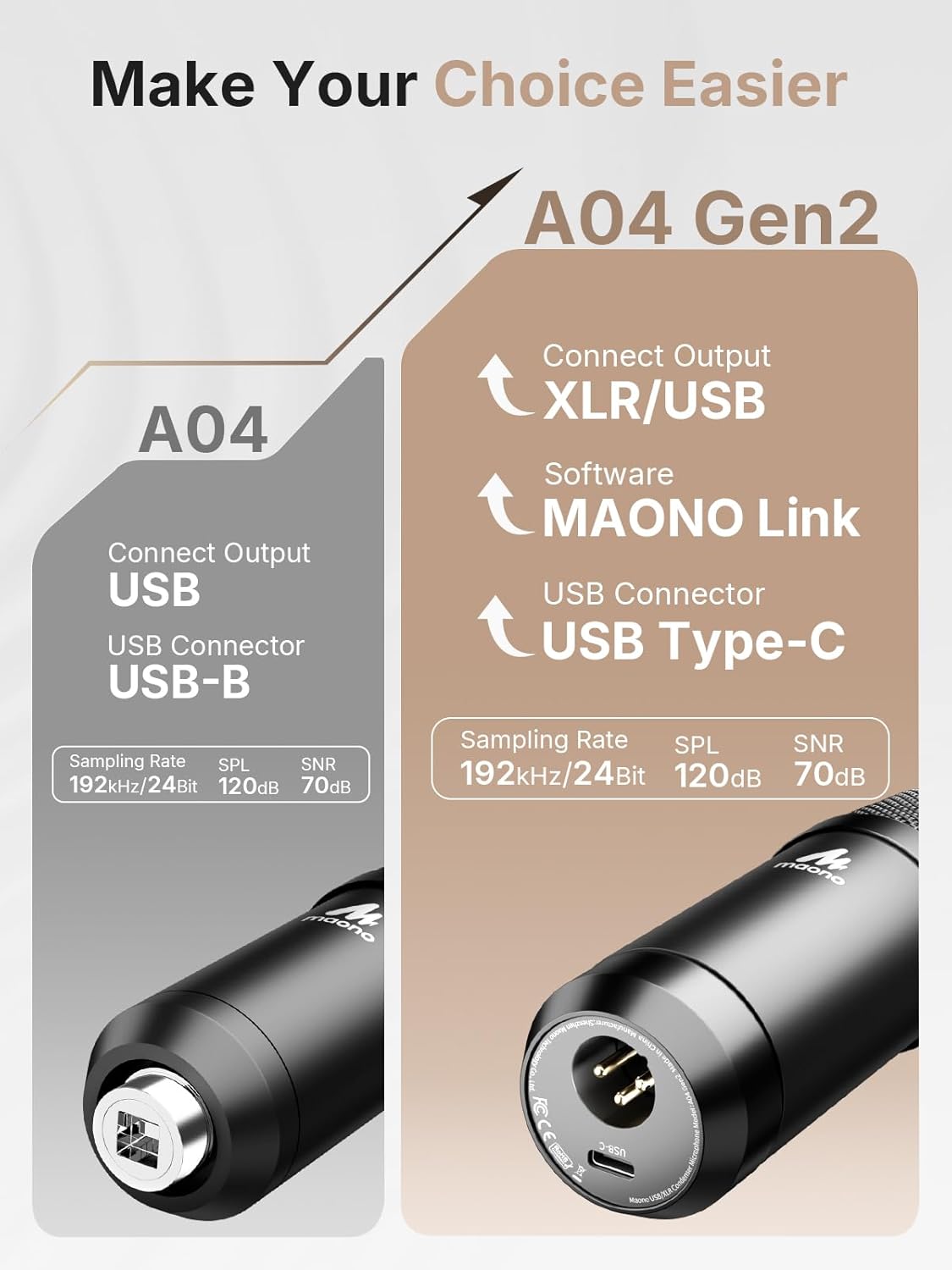
The MAONO A04 Gen2 is an all-in-one recording bundle tailored for vocalists, podcasters, and creators looking to upgrade their audio setup. Featuring a 16mm electret condenser capsule, it relies on a focused cardioid polar pattern to highlight vocal clarity while minimizing room reflections and background interference.
Dual connectivity stands out as a core benefit, allowing users to plug straight into a PC using the supplied USB cable or connect directly to analog mixers and interfaces. When connected via USB, the MAONO Link desktop app opens up helpful processing controls, such as customizable equalization curves, digital compression, and adjustable noise gating.
Vocalists planning to use the XLR connection immediately should note that an XLR cable is omitted from the bundle, and a source of 48V phantom power is mandatory for analog operation. In addition, console streamers should keep in mind that the microphone does not support Xbox hardware.
Bottom line: The MAONO A04 Gen2 is a flexible, highly capable studio kit for vocal tracking and content creation, offering an effortless upgrade path from standard USB convenience to professional XLR hardware.
- Capsule Type: 16mm electret condenser
- Polar Pattern: Cardioid
- Connectivity: Dual USB and 3-pin XLR
- Sample Rate / Bit Depth: 192kHz / 24-bit
- Frequency Response: 30Hz to 16kHz
- Optimal Vocal Distance: 2 to 6 inches
- Desk Clamp Fit: Surfaces up to 2.1 inches thick
- Compatibility: Windows, macOS, iOS, Android, PS4, PS5 (not compatible with Xbox)
The A04 Gen2 offers driver-free plug-and-play functionality via USB for Windows PCs, Macs, PlayStation consoles, and mobile devices. Using the digital USB connection activates the MAONO Link software, giving you direct control over vocal gain, tone presets, compression, and noise reduction.
For professional studio mixers and audio interfaces, the microphone switches over to analog XLR output. Operating in XLR mode bypasses the digital software and requires standard 48V phantom power from your interface, as well as an external XLR cable.
- MAONO A04 Gen2 XLR/USB condenser microphone
- Adjustable suspension scissor arm stand
- Desk mounting clamp base
- Elastic suspension shock mount
- Dual-layer mesh pop filter
- Fitted foam windscreen
- USB interface cable
- User manual

Pros
- Excellent off-axis sound rejection
- Handles loud vocal dynamics without clipping
- Durable, all-metal body construction
- Clear, natural transient response
Cons
- Requires an external audio interface with phantom power
- Does not include an XLR cable or shock mount
The Audio-Technica AT2020 is a side-address cardioid condenser microphone built for home studios, voiceover artists, and vocalists. Its custom low-mass diaphragm captures detailed vocal nuances while maintaining a smooth and natural frequency response across various vocal styles.
Its standout capability is handling high sound pressure levels without distortion, making it versatile enough for powerful singing and loud acoustic instruments. The tight cardioid polar pattern effectively rejects off-axis ambient noise, keeping recordings focused directly on the primary performance.
Because it operates via an analog 3-pin XLR connection, it requires an external audio interface or mixer capable of delivering 48V phantom power. Creators looking for direct plug-and-play computer connectivity without extra hardware may want to consider a dedicated USB microphone instead.
Bottom line: The Audio-Technica AT2020 remains an exceptional vocal condenser mic that delivers durable construction, high SPL tolerance, and dependable studio-quality audio.
- Brand: Audio-Technica
- Microphone Type: Side-address studio condenser
- Polar Pattern: Cardioid
- Output Connector: Integral 3-pin XLRM
- Signal-to-Noise Ratio: 74 dB
- Diaphragm: Custom-engineered low-mass design
- Color: Black
- Primary Use: Project and home studio applications
The AT2020 features a standard 3-pin XLR male connector and requires 48V phantom power to operate. You will need an XLR cable to link the microphone directly to an audio interface, dedicated preamp, or hardware mixer.
Because this is an analog studio microphone, it cannot plug directly into a computer USB port or 3.5 mm headphone jack without an intermediate interface. It pairs seamlessly with most desktop audio interfaces across both Windows and macOS recording environments.
This microphone is best suited for vocalists, voice actors, and podcasters building a home recording setup with an audio interface. Its cardioid polar pattern makes it practical for untreated spaces where background reflections and ambient room noise must be minimized.
It is also well suited for dynamic singers who transition quickly between soft spoken passages and loud belted vocals, thanks to its high SPL handling and wide dynamic range.

Pros
- Physical hardware knobs for gain, monitoring volume, and echo
- Included Lightning and USB-C adapters for mobile flexibility
- Zero-latency direct headphone monitoring
- Active noise reduction toggle built into the mute button
Cons
- Echo knob can introduce unwanted vocal reverb if turned accidentally
- Top-addressed form factor requires speaking directly into the microphone tip
- Sampling rate tops out at 46kHz rather than standard 48kHz
The ZealSound K66 is a versatile USB condenser microphone built for vocalists, streamers, and podcasters who need an all-in-one desktop recording solution. With a cardioid pickup pattern and a top-addressed orientation, it focuses on your voice while rejecting ambient room sounds.
Its standout feature set lies in its hands-on hardware controls. Users get independent dials for mic gain, headphone volume, and echo effect, along with an instant mute switch that doubles as an active noise cancellation toggle. The inclusion of both USB-C and Lightning adapters makes switching between a computer, an iPhone, or an iPad effortless without needing extra hubs.
Vocalists seeking pristine, unprocessed tracks should note that the built-in echo effect must be dialed all the way down, as it is easy to activate by mistake. Serious studio producers might also prefer higher native sampling rates than the 46kHz supported here, along with a standard side-address layout for traditional studio shock mounts.
Bottom line: The ZealSound K66 offers exceptional utility, physical controls, and cross-platform mobile compatibility, making it a dependable pick for entry-level vocalists and multimedia content creators.
- Microphone Type: Electret condenser capsule
- Polar Pattern: Cardioid
- Frequency Response: 40Hz to 18kHz
- Sampling Rate: 46kHz
- Sensitivity: -45dB ±3dB
- Audio Output: USB digital output, 3.5mm zero-latency headphone monitoring jack
- Included Adapters: USB-C and Lightning adapters
- Cable Length: 70.87 inches
- Stand: Solid metal weighted base with 360-degree tilt
- ZealSound K66 cardioid condenser microphone
- Solid metal anti-vibration desktop base
- 70.87-inch USB audio connection cable
- USB-C adapter for modern laptops and Android devices
- Lightning adapter for iPhone and iPad
- Form-fitting foam windscreen
- User manual with technical support contact details
Setting up the ZealSound K66 requires no external drivers or software installation. The microphone runs on standard class-compliant USB power, allowing you to connect directly to Windows PCs, Macs, Chromebooks, PS4, and PS5 gaming consoles for instant recognition.
Mobile creators can take advantage of the bundled USB-C and Lightning adapters to record directly to iPhones, iPads, and Android smartphones. It integrates smoothly with popular recording and streaming apps, including GarageBand, Audacity, OBS Studio, Streamlabs, Discord, and Zoom.

Pros
- Handles high sound pressure levels up to 150 dB
- Switchable -20 dB pad and 300 Hz bass-cut filter
- Durable all-metal chassis construction
- Clear and accurate high-frequency response
Cons
- Requires an audio interface with 48V phantom power
- Includes a basic stand mount instead of a shock mount
- Higher self-noise level than higher-tier condensers
The AKG Pro Audio P120 is an XLR studio condenser microphone designed for home vocalists, voiceover artists, and acoustic musicians. Built around a sensitive 2/3-inch low-mass diaphragm, it captures speaking and singing voices with natural clarity and crisp high-frequency presence.
A major advantage is its pair of onboard hardware switches, including a -20 dB preattenuation pad and a 300 Hz low-cut filter. These controls allow the microphone to handle sound pressure levels up to 150 dB without clipping while taming rumble and proximity effect directly at the hardware stage.
Because it is a traditional studio condenser, it requires an audio interface or mixer capable of supplying 48V phantom power. Its equivalent noise rating of 19 dB-A also means very soft acoustic instruments or whispered vocals in silent rooms may exhibit a faint background hiss.
Bottom line: The AKG P120 combines rugged build quality with crisp, articulate vocal capture, making it a reliable recording workhorse for home studios.
- Transducer: 2/3-inch low-mass diaphragm condenser
- Polar Pattern: Cardioid
- Frequency Response: 20 Hz to 20,000 Hz
- Sensitivity: 24 mV/Pa
- Signal to Noise Ratio: 75 dB-A
- Equivalent Noise Level: 19 dB-A
- Preattenuation Pad: -20 dB
- Bass Cut Filter: 300 Hz (6 dB/octave)
- Max Sound Pressure Level: 150 dB SPL (with pad engaged)
The AKG P120 features an industry-standard 3-pin XLR connection. It requires an audio interface, dedicated preamp, or mixing console that provides 48V phantom power, meaning it cannot be plugged directly into a computer USB port without hardware.
Once connected through your audio interface, it operates smoothly with any recording software, digital audio workstation, or streaming application on Windows and macOS.
The included stand adapter mounts to standard mic stands and boom arms. For desktop voice recording, adding an external shock mount and a pop filter helps reduce handling vibrations and vocal plosives.
Home vocalists and voice actors who want to step up from entry-level dynamic microphones will appreciate the detailed transient response and open top end of the condenser capsule.
Podcasters and streamers working in untreated rooms can use the cardioid pickup pattern and 300 Hz bass-cut filter to reject off-axis room reverberation and low-frequency desk vibrations.
Acoustic guitarists and home recording enthusiasts looking for a versatile utility microphone that can transition seamlessly between delicate string instruments and loud guitar amplifiers.
Pros
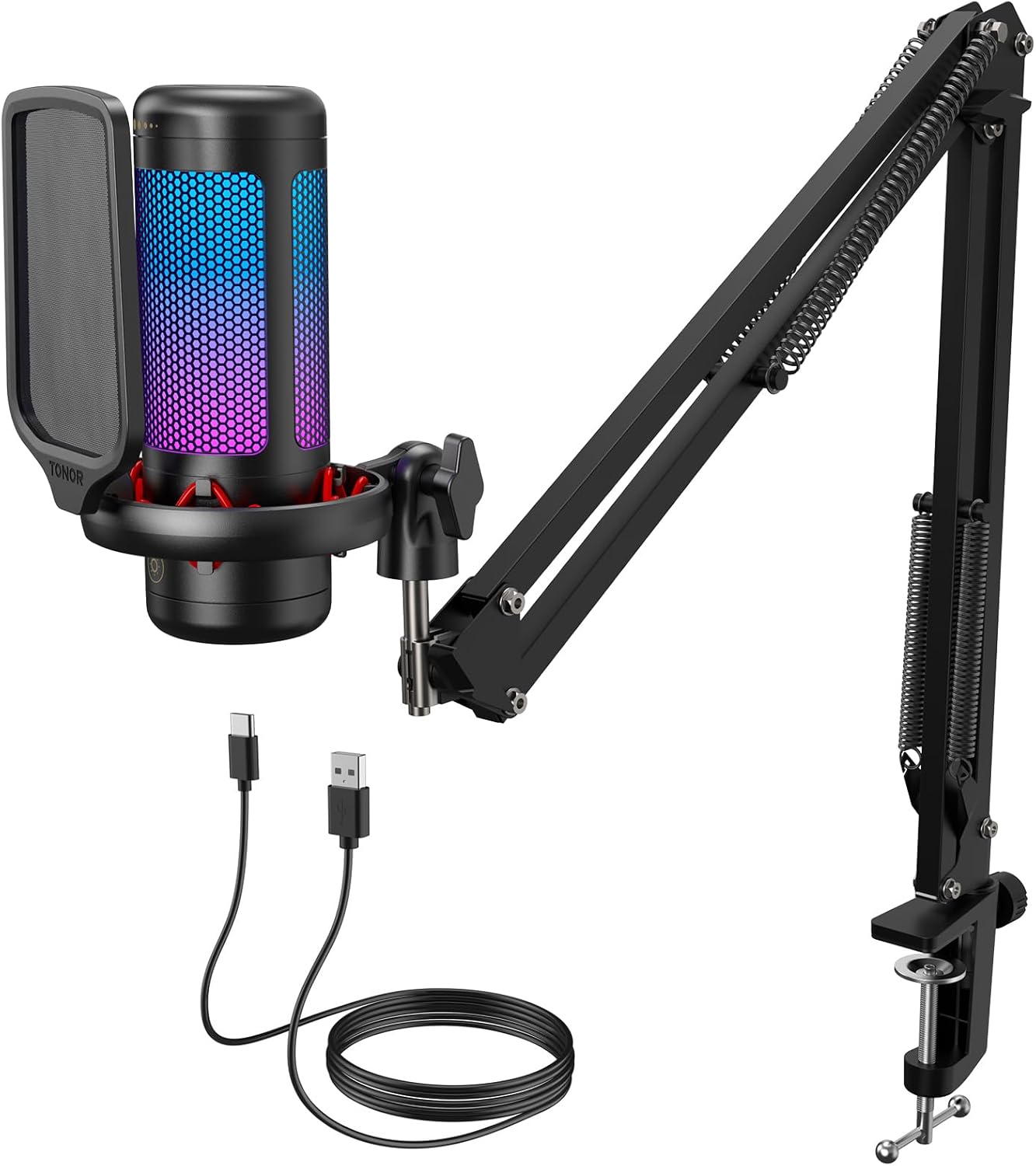
- Sturdy metal boom arm included
- Convenient tap-to-mute sensor and gain dial
- Customizable RGB lighting with brightness control
- Simple plug-and-play USB connectivity
Cons
- Desk clamp is limited to surfaces under 2.36 inches thick
- Condenser capsule may capture background room noise without sound treatment
- No integrated hardware headphone monitoring jack
The TONOR TC310+ is an all-in-one USB condenser microphone package designed for creators who want an elevated audio setup without sourcing separate mounting gear. Tailored for vocal recording, streaming on Twitch, and everyday PC communication, it combines a sensitive condenser capsule with convenient desktop mounting.
A standout feature is the onboard hardware control layout, which places both a silent tap-to-mute pad and a rotary gain dial right at the top of the microphone. The package also includes a durable metal boom arm that clamps to desks up to 2.36 inches thick, paired with customizable RGB lighting that features four distinct visual modes and adjustable brightness.
Because the condenser capsule is tuned for high-fidelity vocal pickup, it can register ambient room noise and keyboard clicks if your space lacks sound dampening. Vocalists or streamers working in untreated, noisy environments may prefer a dynamic mic with tighter off-axis rejection instead.
Bottom line: The TONOR TC310+ provides an accessible, fully articulated microphone solution with crisp vocal capture and handy hardware controls for entry-level content creators.
- Brand: TONOR
- Model: TC310+
- Transducer Type: Vocal Condenser
- Connectivity: USB Type-C to USB 2.0 or 3.0
- Lighting Modes: 4 RGB modes (static, gradient, breathing, mixed) with brightness control
- Audio Controls: Tap-to-mute sensor, top rotary gain dial
- Mounting Arm: Metal boom arm with multi-joint adjustment
- Clamp Compatibility: Fits desks up to 2.36 inches thick
- System Compatibility: PC, streaming software, voice chat platforms
The TC310+ connects via a standard USB connection to your PC, operating without specialized drivers or external audio interfaces. For the most stable audio signal, connect directly into a standard USB 2.0 or 3.0 port rather than an unpowered hub, and verify that the USB Type-C plug is firmly seated into the base of the microphone.
Mounting is straightforward using the included C-clamp, which secures to desk edges up to 2.36 inches thick. The articulated metal arm features multiple tension joints, allowing you to position the capsule near your mouth while keeping your desk surface clear.
This microphone kit is ideal for live streamers, Twitch broadcasters, and podcast hosts seeking clear vocal pickup paired with modern RGB aesthetics. The included boom arm eliminates the need to purchase aftermarket stands, making it an excellent starter kit for voiceover artists and gamers.
Users who need to frequently mute their audio during conference calls or gaming sessions will benefit from the instant tap-to-mute sensor, while the gain dial makes on-the-fly volume adjustments effortless.

Pros
- Clean, detailed vocal reproduction
- Built-in low-cut filter and 10 dB pad
- Effective custom shock mount included
- Durable, all-metal construction
Cons
- Requires an external audio interface with 48V phantom power
- Fixed cardioid pattern offers no multi-pattern versatility
- XLR microphone cable sold separately
The Audio-Technica AT2035 is a side-address cardioid condenser microphone designed for vocalists, home studio producers, and content creators. Its large-diaphragm capsule provides a detailed and natural frequency response, making it well suited for tracking lead vocals, voiceover projects, and acoustic instruments.
Onboard controls give this microphone impressive utility in untreated rooms. The switchable 80 Hz high-pass filter eliminates low-end rumble from air conditioners or street traffic, while the 10 dB pad accommodates louder vocal deliveries without clipping. Additionally, the included custom shock mount attenuates mechanical vibrations and handling noise.
Because this is a pure analog XLR microphone, users will need an audio interface or mixer with phantom power to operate it. Those searching for a simple plug-and-play USB setup without additional audio hardware might prefer a dedicated digital mic instead. The fixed cardioid pattern also means it cannot switch to omnidirectional or bidirectional modes for multi-person recordings.
Bottom line: The Audio-Technica AT2035 stands out as a dependable workhorse condenser that delivers exceptional vocal clarity, reliable acoustic isolation, and essential tone-shaping controls for any desktop studio.
- Microphone Type: Side-address large-diaphragm condenser
- Polar Pattern: Cardioid
- Output Connector: 3-pin XLR
- High-Pass Filter: Switchable 80 Hz
- Attenuation Pad: Switchable 10 dB
- Mounting: Custom shock mount included
- Storage: Protective pouch included
Connecting the Audio-Technica AT2035 requires a standard 3-pin XLR cable plugged into an audio interface, mixer, or dedicated preamp capable of supplying 48V phantom power. It will not work when plugged directly into a computer headphone or USB port without proper conversion hardware.
The included shock mount threads onto standard 5/8-inch-27 microphone stands and boom arms. For best results with vocal tracking, place the microphone roughly 6 to 8 inches away from the singer, oriented with the Audio-Technica badge facing directly toward the sound source.
- Audio-Technica AT2035 cardioid condenser microphone
- Custom isolation shock mount for 5/8-inch-27 threaded stands
- 5/8-inch-27 to 3/8-inch-16 threaded adapter
- Soft protective storage pouch

Pros
- Matched stereo pair for accurate spatial recording
- Built-in low-cut filter and input attenuation pad
- Effective cardioid rejection of off-axis noise
- Compact pencil condenser design for easy placement
Cons
- Requires external phantom power to operate
- Sensitive to plosives without an external pop filter
- Small diaphragm design provides less low-end warmth than large vocal mics
The Behringer C-2 microphone pair delivers matched true condenser performance for musicians and podcasters working on multi-source or stereo audio projects. Engineered with a compact pencil design, these microphones are tailored for capturing nuanced sound sources such as vocal duets, choirs, and acoustic accompaniment.
A standout feature is the inclusion of onboard switches for input attenuation and low-frequency roll-off. The cardioid pickup pattern effectively isolates performance audio from ambient room noise, while the low-mass diaphragm reproduces high frequencies with crisp clarity and quick transient response.
Because these are small-diaphragm pencil condensers, solo vocalists seeking rich proximity effect and low-end warmth may find them somewhat clinical. Users will also need proper pop filters to tame plosives during close vocal delivery, along with audio interfaces capable of supplying phantom power.
Bottom line: The Behringer C-2 set provides an accessible and capable matched stereo condenser solution for project studios, vocal groups, and acoustic performers needing reliable dual-mic capture.
- Microphone Type: True condenser
- Diaphragm: Low-mass design
- Polar Pattern: Cardioid
- Pack Size: Matched pair (2 microphones)
- Controls: Switchable low-frequency roll-off and input attenuation
- Application: Studio recording and live sound reinforcement
- Connector Type: Standard 3-pin XLR
The Behringer C-2 microphones connect via standard 3-pin XLR cables to compatible audio interfaces, mixers, or preamps. Because they are true condenser microphones, they require standard +48V phantom power from your audio equipment to function properly.
For vocal tracking, positioning them on dedicated mic stands with shock mounts and external pop filters will significantly reduce vibrations and harsh plosive sounds. Their matched pairing allows for quick configuration in standard stereo setups such as XY or spaced pair arrangements.
This matched pair is ideal for home recordists and audio engineers who need flexible multi-mic setups without cluttering their workspace. They excel when capturing acoustic instruments, group vocal performances, background harmonies, and natural room ambiance.
Solo vocalists looking for a traditional warm broadcast tone may prefer a dedicated large-diaphragm condenser instead. However, creators who need a versatile pair of microphones for simultaneous vocal and instrument tracking will appreciate the utility of this set.

Pros
- Industry-leading 4dBA self-noise level
- Complete studio accessory bundle included
- Smooth, balanced high-frequency response
- High SPL handling for loud sound sources
- Sturdy all-metal build quality
Cons
- Requires an external audio interface with phantom power
- Fixed cardioid pattern with no multi-pattern switching
- Bulky shock mount takes up significant desk space
The RØDE NT1 Signature Series is a large-diaphragm XLR studio condenser microphone engineered for vocalists, voiceover artists, and podcasters who want professional sound. It combines classic analog warmth with modern acoustic engineering to deliver clear, detailed vocal recordings right out of the box.
Its standout capability is an astonishingly quiet 4dBA self-noise rating, making it one of the quietest studio microphones available. Paired with the custom HF6 one-inch true condenser capsule and high SPL tolerance, the microphone captures delicate vocal nuances without background hiss while comfortably handling powerful, dynamic performances.
Because this is a pure analog XLR microphone, creators who want direct USB plug-and-play simplicity will need to look elsewhere or invest in an audio interface with phantom power. Additionally, the fixed cardioid pickup pattern lacks multi-pattern flexibility for group podcasts or bidirectional interviews around a single desk.
Bottom line: For solo vocal tracking, voice work, and acoustic instruments, the RØDE NT1 Signature Series delivers studio-grade clarity, whisper-quiet performance, and essential accessories that make home recordings sound polished.
- Capsule Type: HF6 1-inch true condenser
- Acoustic Principle: Pressure gradient
- Polar Pattern: Cardioid
- Self-Noise: 4dBA
- Connector: 3-pin balanced XLR
- Sound Pressure Level: High SPL capability
- Included Accessories: SM6 shock mount, pop filter, XLR cable, dust cover
- Country of Origin: Sydney, Australia
- RØDE NT1 Signature Series Studio Condenser Microphone (Black)
- Studio-grade SM6 shock mount with integrated detachable pop filter
- Premium balanced XLR microphone cable
- Protective drawstring dust cover
The NT1 Signature Series connects via a standard 3-pin XLR output and requires an external audio interface, mixer, or standalone preamp capable of delivering +48V phantom power. It is an analog microphone and will not function if plugged directly into a computer without intermediate audio hardware.
The included SM6 shock mount attaches securely to standard studio boom arms and microphone floor stands using standard 3/8-inch and 5/8-inch threading. The integrated pop shield can be articulated to sit directly in front of the capsule to reduce vocal plosives during close-mic sessions.

Pros
- Comprehensive all-in-one studio accessory kit
- Durable all-metal microphone body and shock mount
- Clean off-axis noise rejection via cardioid pattern
- Includes both foam windscreen and pop filter
Cons
- Requires an external 48V phantom power supply or audio interface
- Cannot plug directly into a computer without an interface
- Lacks onboard gain controls or mute toggles
The MAONO PM320S is an entry-level XLR condenser microphone kit designed for home studio recording, vocal tracking, and podcasting. It is built for aspiring singers, voiceover artists, and content creators looking to transition from basic USB gear to a traditional audio interface setup.
The core of the unit is a 16mm condenser capsule paired with a cardioid polar pattern, capturing clear vocal nuance while keeping off-axis room noise at a minimum. The included hardware adds substantial utility, giving users a sturdy metal boom arm, a metal shock mount, and dual plosive management via a foam windscreen and pop filter.
Because this is an analog XLR microphone, it cannot connect straight into a computer and requires an audio interface or mixer capable of delivering 48V phantom power. Creators seeking a simple single-cable USB setup without extra desktop equipment should look toward dedicated digital mics instead.
Bottom line: The MAONO PM320S delivers dependable vocal clarity and an all-metal accessory bundle, making it an effective entry point for users building out their first XLR audio workstation.
- Transducer Type: Condenser
- Capsule Size: 16mm
- Polar Pattern: Cardioid
- Power Requirement: 48V phantom power
- Connector Type: Standard 3-pin XLR
- Microphone Body Material: Metal
- Boom Arm Material: Metal
- Shock Mount Material: Metal
- 1 MAONO PM320S XLR Condenser Microphone
- 1 Adjustable Metal Boom Arm Bracket
- 1 Metal Shock Mount
- 1 Pop Filter
- 1 Foam Windscreen
- 1 XLR to XLR Cable
- 1 User Manual
Operating the MAONO PM320S requires an external audio device such as a dedicated USB audio interface, mixer, or standalone preamp equipped with standard 48V phantom power. The included XLR cable runs directly from the microphone base into your hardware input.
The microphone does not connect directly to PC or Mac USB ports on its own. Once your audio interface is connected to your computer and configured in your preferred digital audio workstation or streaming software, the PM320S is ready for recording.
How to Choose the Best Cheap Condenser Mics for Vocals: Buying Guide
USB Versus XLR Connectivity for Vocal Recording

The primary fork in the road when shopping for a cheap condenser mic for vocals is choosing between USB and traditional XLR connectivity. USB microphones streamline your workflow by integrating an internal audio interface, analog-to-digital converter, and preamplifier directly into the microphone chassis. Models such as the FIFINE T669 Studio Condenser USB Microphone for and the TONOR Gaming Microphone Set with Boom Arm connect straight to your laptop or PC with a simple cable. This eliminates the requirement for outboard hardware, drivers, or secondary power supplies, making them exceptionally appealing for content creators, voiceover artists, and casual vocalists who prioritize rapid setup and portable convenience over gear expansion.
In contrast, traditional XLR studio microphones like the Audio-Technica AT2020 Cardioid Condenser Studio and the MAONO PM320S Condenser PC Microphone with XLR transmit a balanced analog signal that requires an external audio interface or mixer equipped with a 48V phantom power supply. While this setup demands an additional hardware purchase, the XLR route provides superior long-term versatility, cleaner gain staging, and the freedom to upgrade your preamplifiers, analog compressors, and conversion hardware independently. For singers tracking intricate vocal arrangements, an analog XLR connection provides unmatched control over vocal headroom and noise floors, preventing digital clipping before the signal ever hits your digital audio workstation.
If you find yourself split between instant computer connectivity and future-proof analog expansion, hybrid options present a compelling middle ground. The MAONO A04 Gen2 XLR/USB Condenser Microphone Kit features dual XLR and USB outputs, enabling you to plug directly into a laptop for quick demo recordings or patch into a professional interface during full studio tracking sessions. Similarly, the ZealSound Podcast Microphone for PC offers broad cross-platform digital support through included USB-C and Lightning adapters, giving mobile vocalists direct access to mobile phones and tablets. Choosing the right connection style ultimately hinges on whether your priority is plug-and-play simplicity or modular studio growth.
Diaphragm Size, Capsule Transducers, and Vocal Warmth
The heart of any condenser microphone is its internal capsule, specifically the physical size and tuning of its conductive diaphragm. Large-diaphragm condenser microphones, such as the RØDE NT1 Signature Series Studio Condenser and the Audio-Technica AT2035 Cardioid Condenser, excel on lead vocal tracking because their larger surface area generates a warm, silky character with a pronounced low-frequency body. These designs capture intimate chest resonance and smooth vocal contours, producing the polished, radio-ready sound profile that singers expect on professional pop, rock, and urban tracks.
Medium and smaller diaphragm capsules offer their own unique acoustic advantages, trading a touch of bass warmth for lightning-fast transient response and extended high-frequency accuracy. The AKG Pro Audio P120 - Affordable 2/3-Inch Diaphragm utilizes a custom 2/3-inch low-mass diaphragm engineered to articulate subtle vocal details, sibilant clarity, and spoken consonants without becoming boomy. If you frequently record acoustic instruments alongside your singing, small-diaphragm capsules like the matched pair found in the BEHRINGER C-2 provide an ultra-wide frequency response and consistent off-axis phase linearity, making them fantastic companion microphones for stereo acoustic guitar and choral vocal recording.
Capsule architecture also dictates how effectively a microphone translates dynamic vocal performance into clean electrical signals without unwanted distortion. The MAONO PM320S Condenser PC Microphone with XLR and the MAONO A04 Gen2 XLR/USB Condenser Microphone Kit both employ 16mm electret condenser transducers tuned for acoustic vocal reproduction and podcasting. These capsules balance strong low-end responsiveness with high sound pressure level handling, allowing vocalists to transition seamlessly from delicate whispered verses to aggressive, belting chorus sections. Evaluating diaphragm size helps ensure your microphone complements your vocal timbre rather than fighting against it.
Cardioid Polar Patterns and Room Isolation

When recording vocals in an untreated bedroom, dorm, or basement studio, microphone polar patterns make the difference between a pristine vocal take and an unusable recording loaded with room echo. Every entry on our roster implements a cardioid pickup pattern, which prioritizes acoustic sensitivity directly in front of the capsule while actively rejecting noise from the sides and rear. In typical home environments filled with computer fan noise, street traffic, and hard wall reflections, cardioid rejection keeps your vocal signal focused and upfront in the mix.
Microphones like the Audio-Technica AT2020 Cardioid Condenser Studio and the RØDE NT1 Signature Series Studio Condenser are renowned for their tight cardioid directivity. By ignoring off-axis sonic reflections, these side-address microphones create a drier vocal capture that responds predictably to digital reverb, delay, and pitch correction software during post-production. If you sing into a microphone that picks up too much room ambiance, artificial compression will exaggerate the flutter echoes, making your final mix sound distant and amateurish. If you are also tracking instruments in your project room, pairing a tight cardioid vocal mic with one of the best acoustic guitars for intermediate players helps maintain clean instrument separation.
Form factor also influences how you position the microphone to exploit its cardioid null points. While side-address units require you to sing directly into the front grille mesh, top-addressed models such as the ZealSound Podcast Microphone for PC capture sound when you project directly into the top of the capsule. This top-address orientation, combined with its 360-degree rotatable metal base, lets you angle the dead rear zone of the microphone directly at your computer keyboard or air conditioning vents. Proper physical positioning maximizes the directional advantages of cardioid geometry, keeping your vocal tracks crisp and free of distracting environmental clutter.
Hardware Pads, High-Pass Filters, and Software Sound Sculpting
Vocalists with naturally powerful voices or dynamic singing styles need tools to tame excessive bass buildup and prevent signal overload. Integrated hardware filters and attenuation pads provide critical insurance against digital clipping. The Audio-Technica AT2035 Cardioid Condenser stands out in this budget category by incorporating a switchable 80 Hz high-pass filter and a 10 dB pad directly on the microphone body. Engaging the 80 Hz filter cleans up low-frequency rumble caused by foot tapping, passing trucks, or air conditioning duct vibrations before that acoustic mud reaches your recording interface.
Similarly, the AKG Pro Audio P120 - Affordable 2/3-Inch Diaphragm features a dedicated 300 Hz bass-cut filter with a gentle 6 dB per octave slope, alongside a preattenuation pad of minus 20 dB. This generous pad allows the microphone to handle sound pressure levels up to 150 dB without distortion, making it equally capable of capturing screaming rock vocals or loud brass instruments. The BEHRINGER C-2 also includes switchable low-frequency roll-off and input attenuation switches, demonstrating that tactile frequency management is fully achievable even on entry-level hardware.
On the digital side, modern USB condenser microphones approach sound shaping through built-in digital signal processing or companion software suites. The MAONO A04 Gen2 XLR/USB Condenser Microphone Kit pairs with proprietary MAONO Link software, giving creators access to multi-band equalizer presets, an onboard vocal compressor, a peak limiter, and adjustable noise reduction profiles while operating in USB mode. Meanwhile, the ZealSound Podcast Microphone for PC provides an intelligent noise reduction mode toggled via its mute button, as well as an onboard echo control knob to add real-time ambient depth without external plug-ins.
Physical Vocal Controls and Real-Time Hardware Monitoring
Nothing ruins a passionate vocal delivery quite like audio latency, which occurs when there is a split-second delay between singing into the microphone and hearing your voice in your headphones. For USB microphone users, onboard zero-latency monitoring is an indispensable feature that eliminates software buffer delays. The ZealSound Podcast Microphone for PC solves this challenge with an integrated 3.5mm headphone jack and a dedicated monitoring volume dial, allowing vocalists to monitor their pitch, breath control, and dynamics in real time with zero acoustic lag.
Tactile control knobs directly on the microphone body streamline the vocal tracking process, allowing you to execute immediate gain corrections without touching a mouse. The TONOR Gaming Microphone Set with Boom Arm features a smooth gain adjustment ring on top alongside a tap-to-mute sensor, allowing streamers and singers to react instantly to unexpected level spikes. Rapid mute controls with visual LED indicators, such as the clear status lighting on the ZealSound unit, provide visual peace of mind, ensuring you never accidentally broadcast warm-up vocalizations or private conversations during live streams.
While traditional XLR microphones lack onboard buttons and dials, they shift monitoring and level responsibilities to dedicated audio interfaces or analog mixers. Microphones like the RØDE NT1 Signature Series Studio Condenser and Audio-Technica AT2020 Cardioid Condenser Studio maintain an unadorned, all-metal chassis optimized purely for acoustic fidelity. For home studio vocalists who already own an interface, keeping physical controls off the microphone body reduces the risk of accidental bumping or handling noise mid-take. Balancing onboard physical controls against outboard hardware adjustments depends entirely on your preferred recording workflow.
Mounting Hardware, Pop Filters, and Studio Bundles
A sensitive condenser capsule picks up micro-vibrations from desks, floors, and mechanical air currents just as readily as it captures your singing voice. For this reason, selecting a microphone with appropriate mounting hardware and plosive management is essential for clean vocal tracking. Several budget microphones ship as comprehensive vocal packages. The FIFINE T669 Studio Condenser USB Microphone for includes an all-steel broadcast suspension scissor arm stand, a studio-grade shock mount, and a double-layer pop filter, shielding your capsule from explosive vocal bursts.
Similarly, the MAONO PM320S Condenser PC Microphone with XLR bundles an adjustable metal boom arm, an integrated metal shock mount, a foam windscreen, and an XLR-to-XLR cable in the box. Having an articulating boom arm allows you to position the microphone at the optimal height and angle while standing or sitting, keeping your posture relaxed and diaphragmatic breathing unhindered. For creators who produce multimedia content alongside vocals, our comprehensive library of all buying guides and reviews offers additional insights into optimizing audio-visual setups.
Premium studio XLR microphones also recognize the necessity of high-grade acoustic isolation. The RØDE NT1 Signature Series Studio Condenser includes the professional SM6 shock mount with a detachable dual-axis pop shield and a studio XLR cable, giving vocalists an elite isolation setup straight out of the packaging. The Audio-Technica AT2035 Cardioid Condenser also comes with a custom-engineered shock mount designed to decouple the microphone body from mechanical floor vibrations. Investing in a package that includes robust mounting hardware saves you the added expense of hunting down compatible third-party shock mounts.
| Product | Connection Type | Capsule or Diaphragm | Polar Pattern |
|---|---|---|---|
| Audio-Technica AT2020 Cardioid Condenser Studio | Integral 3 pin XLRM type | Custom engineered low mass diaphragm | Cardioid polar pattern |
| Audio-Technica AT2035 Cardioid Condenser | XLR Output | Large diaphragm | Cardioid polar pattern |
| AKG Pro Audio P120 - Affordable 2/3-Inch Diaphragm | XLR Connector | 2/3-inch diaphragm | Cardioid |
| MAONO PM320S Condenser PC Microphone with XLR | XLR | Large 16mm condenser capsule | Cardioid polar pattern |
| MAONO A04 Gen2 XLR/USB Condenser Microphone Kit | Dual XLR & USB connections | 16mm electret condenser transducer | Cardioid polar pattern |
Why You Should Trust Us
At Daily Deal Here, our editorial team brings decades of combined experience across musical instruments, audio production, recording engineering, and consumer electronics. When evaluating audio gear for vocalists and creators, we refuse to rely on marketing hype or manufacturer press releases. Instead, our methodology centers on exhaustive technical specification analysis, cataloging acoustic data points such as diaphragm mass, maximum sound pressure level ratings, polar pattern directivity, and self-noise figures to identify gear that delivers genuine audio performance.
We combine this technical analysis with deep exploration of thousands of verified Amazon customer reviews and real-world user feedback themes. By examining how these microphones hold up across diverse recording environments, from untreated bedroom studios to semi-pro vocal booths, we uncover practical insights regarding build quality, background hum, boom arm stability, and connector durability. We never accept free sample units, promotional kickbacks, or sponsored placements from audio brands. Every recommendation in our buying guides is purely editorial, designed to help home studio creators invest their budget wisely in reliable, high-fidelity recording tools.
Final Thoughts
Upgrading your vocal setup with a dedicated cheap condenser mic for vocals is one of the most cost-effective decisions you can make as a singer, voiceover artist, or digital creator. Moving past the compressed, boxy sound of dynamic stage microphones or laptop microphones introduces a level of breath detail, frequency clarity, and sonic presence that elevates every project you produce. Whether you are cutting lead vocal tracks for an album or hosting a weekly podcast, modern budget condenser microphones deliver fidelity that rivals high-end studio gear from years past.
For vocalists seeking uncompromised studio performance, our top pick is the RØDE NT1 Signature Series Studio Condenser. Its remarkably quiet self-noise architecture, classic large-diaphragm studio voicing, and included SM6 shock mount make it the premier choice for serious vocal tracking. If your priority is maximum value in an all-in-one desktop package, the FIFINE T669 Studio Condenser USB Microphone for is our top value recommendation, offering plug-and-play USB simplicity, a sturdy scissor arm stand, and dual pop filtering without requiring an audio interface.
If you require ultimate flexibility between computer-based voice work and analog studio growth, the MAONO A04 Gen2 XLR/USB Condenser Microphone Kit serves as an exceptional hybrid solution, combining dual XLR and USB connectivity with onboard digital sound processing. For singer-songwriters who pair vocal tracking with classical or folk guitar accompaniment, exploring our guide to the best nylon string guitars will help complete your acoustic setup. Whichever option you select, matching the microphone capsule and features to your personal vocal style and recording environment guarantees clear, inspiring takes every time you hit record.
Frequently Asked Questions About Cheap Condenser Mics for Vocals
What makes a cheap condenser mic for vocals better than a dynamic microphone for singing?
A cheap condenser mic for vocals uses an ultrathin, electrically charged diaphragm positioned close to a solid backplate rather than a heavy moving coil. Because the diaphragm possesses minimal mass, it responds significantly faster to subtle acoustic transients and high-frequency overtones. This allows condenser capsules to capture the natural air, breathiness, and delicate vocal dynamics essential for studio-quality singing. While dynamic mics handle loud stage feedback well, budget condensers provide far greater frequency detail, acoustic openness, and presence in home recording environments.
Do I need phantom power to use a cheap condenser mic for vocals?
Whether you need phantom power depends entirely on the connection type of your chosen microphone. Analog XLR condenser models require an external 48V phantom power supply, which is standard on most modern audio interfaces and mixers, to charge their internal active circuitry and capsule. In contrast, USB condenser microphones draw all the necessary electrical power directly from your computer or mobile device through the USB cable. If you choose an XLR mic, ensure your audio interface explicitly provides switchable 48V phantom power before recording.
Is a USB cheap condenser mic for vocals good enough for serious vocal recording in 2026?
Modern USB condenser microphones offer impressive 24-bit audio resolution and high sampling rates that easily meet commercial standards for podcasts, voiceovers, and vocal demos in 2026. While high-end commercial music production still favors analog XLR microphones paired with dedicated outboard preamplifiers, modern USB options provide pristine, broadcast-ready clarity for indie releases and online content. If you want to expand your equipment collection further, you can check out current savings through our store coupons and deals to find audio accessories and studio gear at competitive prices.
How should I position a cheap condenser mic for vocals to avoid plosives and distortion?
To achieve clean vocal takes, position your condenser microphone roughly four to eight inches away from your mouth, angled slightly toward your nose or upper lip rather than aimed directly down your throat. Always utilize a mesh or metal pop filter placed two to three inches in front of the grille to disperse sudden air bursts from plosive consonants like “P” and “B.” Setting your preamp gain so vocal peaks sit around minus twelve decibels ensures your vocal track stays clean and distortion-free.
Why is room treatment important when using a cheap condenser mic for vocals?
Condenser capsules are exceptionally sensitive instruments that pick up quiet room reflections, air conditioning hum, and computer fan noise along with your voice. In an untreated room with bare walls and hardwood floors, sound waves bounce off hard surfaces and enter the microphone slightly out of phase, resulting in a hollow or boxy vocal tone. Hanging heavy acoustic blankets, utilizing portable vocal isolation shields, or recording inside a clothes-filled closet will dramatically improve clarity by preventing unwanted environmental reflections from coloring your takes.
Write Your Review
No reviews yet. Be the first to share your experience!