

Cutting the cord does not mean giving up your local news, weather, and network shows. A good antenna for local tv stations can pull in ABC, CBS, NBC, FOX, and PBS affiliates for free, with no monthly bill once it is set up. We looked at 8 models for September 2026 based on real owner ratings, comparing how they mount, whether they include a signal booster, and how far they realistically reach. Our top pick is the TV Antenna for Smart TV Indoor with Signal Booster for its combination of a huge base of verified owner reviews and a detachable booster that adapts to both close and far reception areas. If you would rather browse other electronics picks first, our full roundup is below.
The antennas on this list cover a wide range of mounting styles, from magnetic bases that stick to any metal surface to flat panels built for a window or wall. Some rely purely on passive reception, while others add a signal booster for households sitting farther from local towers. Reading through the differences below should make it easier to match a model to your specific room layout and distance from broadcast towers, rather than just picking whichever antenna has the biggest number printed on the box.

Pros
- Backed by one of the largest owner review counts in the category
- Freestanding cylindrical base needs no mounting bracket or wall hardware
- Detachable signal booster helps pull in stations from a wider radius
- Long coax cable reaches a TV that sits away from the nearest window
- Works with 4K and 1080p smart TVs as well as older HDTVs
Cons
- Boosting the signal can also amplify interference if you live close to a broadcast tower
- No wall-mount hardware in the box for anyone who wants to place it higher
This cylindrical antenna is built for anyone who wants a straightforward, freestanding way to pull in local news, sports, and network channels without paying a monthly bill. Instead of a flat panel that has to be taped to a window, it stands upright on its own base, which makes it easier to tuck next to a TV stand or media console.
The signal booster is the main feature that sets it apart from basic models. It clips onto the cable line and gives the antenna extra reach for anyone who lives a moderate distance from local broadcast towers. Because the booster is detachable, owners who live close to towers can remove it if they notice pixelation or dropouts from an overloaded signal.
Setup follows the same pattern as most indoor antennas: connect the coax cable to the TV, plug in the booster if needed, run a channel scan from the TV's menu, and adjust placement until the signal bars look strong. The long included cable is a real advantage here since it reaches TVs that are not within a few feet of an exterior wall.
The main tradeoff is that amplification is not always a pure upgrade. In dense urban areas with towers nearby, a booster can actually overload the tuner and cause the opposite of the intended effect. Households in that situation may get a cleaner picture running the antenna without the booster attached.
Bottom line: a well-reviewed, easy-to-place option for households that want a no-drill antenna with the flexibility to boost the signal only when needed.
- Design: freestanding cylindrical base
- Resolution support: 4K and 1080p, compatible with older HDTVs
- Signal booster: detachable, in-line amplifier
- Placement: rated for indoor and outdoor use
- Cable: long-run coax included
- Reception: local VHF/UHF over-the-air channels
Best suited to households that want an antenna they can simply stand up rather than mount, and who live far enough from towers to benefit from the extra boost. It also works well for a bedroom or den TV that sits a few feet from the nearest window.
Keep the antenna away from other electronics that generate RF noise, such as routers or baby monitors, since interference can cut into reception. If used outdoors, choose a covered spot like a porch or eave rather than fully open weather exposure, since the unit is designed primarily for indoor conditions.

Pros
- Detachable amplifier lets you fine-tune performance for your distance from towers
- 16.5ft coax cable gives real flexibility in where the TV sits
- Flat, thin panel is easy to hide behind a TV or picture frame
- Picks up both VHF and UHF frequencies used by local network affiliates
Cons
- Thin adhesive strips on some units wear out faster than a permanent mount would
- Amplifier needs a nearby outlet, which some renters may not have close to a window
Vansky's amplified indoor antenna takes the flat-panel approach rather than a freestanding shape, which makes it a natural fit for anyone who wants to tape or tack it to a window or wall and mostly forget about it. The panel itself is thin enough to sit behind a TV or picture frame without standing out in the room.
Like the other amplified models in this list, the booster is detachable, so it is worth trying the antenna both ways after the first channel scan. Owners closer to broadcast towers often get a cleaner scan with the amplifier unplugged, while those further out benefit from leaving it connected.
The 16.5ft coax cable is longer than what ships with many budget antennas, which matters more than people expect. A short cable can force compromises on placement, while this length allows the panel to sit near the best-performing window even if the TV itself is on the opposite wall.
Reception on both VHF and UHF bands means it can pull in the full range of major network affiliates rather than just the higher UHF channels some antennas favor. Performance still depends heavily on distance from towers and any obstructions like hills or dense tree cover.
Bottom line: a solid flat-panel pick for anyone who wants an antenna they can mount out of sight, with enough cable length to place it wherever the signal is strongest.
- Brand: Vansky
- Design: flat panel, wall or window mount
- Amplifier: detachable, powered
- Cable length: 16.5ft coax
- Frequency coverage: VHF and UHF
- Resolution support: 1080p and compatible with 4K TVs
If you are unsure whether to leave the amplifier connected, run a channel scan both ways and compare the results. More channels found is not always better if some of them break up during playback, so weigh signal stability over a longer channel list.
Mount the panel on a window facing the general direction of local broadcast towers when possible, connect the coax cable to the TV's antenna input, plug in the amplifier if using it, then run the TV's built-in channel scan to lock in available stations.

Pros
- Highest average owner rating of any antenna in this roundup
- Magnetic base sticks to metal surfaces without drilling or adhesive strips
- 360-degree design does not need to be aimed at a specific tower direction
- Compact size is easy to tuck behind a TV or on a metal shelf
Cons
- Needs a metal surface for the magnetic base to work as intended
- Smaller footprint means less amplification range than larger panel models
This antenna leans on a magnetic base instead of adhesive or screws, which makes it one of the easiest models in this list to install and, just as important, to move if the first spot does not pull in a strong signal. Anyone with a metal TV mount, appliance, or shelf nearby can reposition it in seconds.
The 360-degree reception design means it is not built around pointing a flat panel at a single tower direction. That is especially useful for households near multiple broadcast towers in different directions, where a directional antenna would force a compromise.
It carries the highest average rating of any pick in this guide, which lines up with its reputation as a simple, low-fuss option rather than a feature-packed one. Owners consistently mention the ease of the magnetic mount over raw reception distance.
The tradeoff for that compact, mountable design is a smaller antenna surface than the larger panel models here, so households at the outer edge of their local stations' broadcast range may still get better mileage from a longer-range pick.
Bottom line: a genuinely easy, budget-friendly antenna that earns its strong ratings on convenience as much as reception, making it the best value pick in this list.
- Mount type: magnetic base
- Reception pattern: 360-degree, non-directional
- Resolution support: 4K and 1080p
- Installation: no drilling or adhesive required
- Reception: local VHF/UHF over-the-air channels
A good fit for renters who cannot drill into walls, and for households near broadcast towers in more than one direction where a directional antenna would mean picking a side. Less ideal for anyone in a fringe reception area who needs maximum range.
Make sure the magnetic base sits on a clean, dry metal surface for the strongest hold, and keep the antenna away from large metal appliances that were not intended as its mounting point, since they can affect reception rather than help it.

Pros
- 18ft coax cable is among the longest included with any antenna in this list
- Signal booster is built to extend range for households farther from towers
- Slim panel design is easy to mount flat against a window or wall
- Supports 4K and 1080p reception
Cons
- Long-range marketing claims should be treated as a best-case scenario, not a guarantee
- Performance drops noticeably behind hills, dense trees, or thick exterior walls
Lyrwihn's antenna is built around long-range claims backed by a genuinely long 18ft coax cable, which is the real practical benefit here regardless of how far the signal actually reaches. That length lets the panel sit at the best window in the house even when the TV itself is set up on a completely different wall.
The built-in signal booster works the same way as on other amplified models in this guide: it helps in fringe reception areas but can occasionally overload the tuner for households close to towers. Trying the antenna both with and without the booster after the first scan is worth the few extra minutes.
Its slim panel profile keeps it unobtrusive once mounted, and the dark grey finish is less noticeable against most window frames than a stark white or black panel would be. That makes it easier to leave in a living room without it standing out.
As with any long-range antenna claim, actual results depend heavily on terrain, distance to towers, and obstructions like hills or trees, so households should treat mile-range marketing numbers as a ceiling rather than an expectation.
Bottom line: a capable amplified panel antenna whose standout feature is real placement flexibility thanks to its unusually long cable.
- Brand: Lyrwihn
- Design: slim panel, wall or window mount
- Amplifier: built-in signal booster
- Cable length: 18ft coax
- Resolution support: 4K and 1080p
- Reception: local VHF/UHF over-the-air channels
Because the cable is unusually long, this model is worth considering for anyone whose best reception window is not near where the TV actually sits, such as a den TV that needs to reach a front-facing window down the hall.
Mount the panel on the highest, most unobstructed window available, run the cable to the TV, connect power to the amplifier, and rescan channels. If reception is inconsistent, try unplugging the amplifier and rescanning again to compare results.

Pros
- Straightforward flat-panel design with no extra accessories to manage
- 16ft cable covers most living room and bedroom layouts
- Supports 4K signal reception on compatible TVs
- Simple one-step channel scan setup
Cons
- Fewer owner reviews than the top picks in this list, so its track record is shorter
- No detachable amplifier, so range is fixed rather than adjustable
DAANT's antenna keeps things simple: a flat panel, a 16ft coax cable, and no separate amplifier to plug in or manage. For households that just want to connect it and run a channel scan without extra steps, that simplicity is the main appeal.
The 16ft cable is generous enough to reach most TVs from a nearby window without needing an extension, though it falls a bit short of the longest cables in this guide. Placement near a window, ideally facing the general direction of local towers, still makes the biggest difference in performance.
Without a built-in amplifier, this model relies purely on passive reception, which tends to work best for households that are reasonably close to broadcast towers rather than in a fringe reception zone.
Owner feedback is generally positive, though the review count is smaller than the top sellers in this list, so it is worth treating its long-term reliability as less proven than the more established options.
Bottom line: a no-frills antenna that works well for households within reasonable range of local towers and who want a simple setup without an amplifier to fuss over.
- Brand: DAANT
- Design: flat panel, indoor use
- Amplifier: none, passive reception
- Cable length: 16ft HDTV coax cable
- Resolution support: 4K compatible
- Reception: local VHF/UHF over-the-air channels
Best suited to households within a moderate distance of local broadcast towers who want the simplest possible setup. Anyone in a fringe reception area will likely get more consistent results from an amplified model instead.
Attach the panel to a window that faces the open sky, connect the coax cable directly to the TV's antenna input, and run the TV's built-in channel scan. Reposition and rescan if the initial results feel thin.

Pros
- Magnetic base allows quick, tool-free placement and repositioning
- 360-degree reception removes the need to aim at a specific tower
- Simple setup suited to first-time antenna users
- Supports 4K and 1080p smart TVs
Cons
- Requires a metal surface nearby for the magnetic base to be useful
- Fewer owner reviews than the higher-volume sellers in this list
ATVFuture's antenna follows the same magnetic-base approach as the value pick in this list, giving households another tool-free option for households that want to avoid drilling or heavy adhesive. It attaches to any nearby metal surface and can be repositioned easily while checking for the strongest signal.
Reception is non-directional, so there is no need to research which way local towers sit before mounting it. That makes it a friendlier option for first-time antenna buyers who do not want to fuss over aiming.
Setup follows the standard pattern: attach the base, connect the cable to the TV, and run a channel scan. Because it has no separate step for an amplifier, there is one less thing to configure compared to amplified panel models.
Its owner review count is lower than the highest-volume sellers in this guide, which is worth factoring in if a long track record matters more to you than raw features.
Bottom line: an easy, beginner-friendly magnetic antenna for households that want a simple, no-drill setup without worrying about tower direction.
- Brand: ATVFuture
- Mount type: magnetic base
- Reception pattern: 360-degree, non-directional
- Resolution support: 4K and 1080p
- Reception: local VHF/UHF over-the-air channels
A good starting point for first-time antenna buyers or renters who want an easy, reversible install without committing to drilling or adhesive strips.
Choose a clean, dry metal surface for the magnetic base and keep the antenna clear of large appliances or metal ductwork that were not intended as the mounting point, since those can interfere with reception.

Pros
- Top-mount design sits on top of the TV rather than needing wall space
- 360-degree reception does not require aiming at a tower
- Supports 4K and 1080p HDTV reception
- Covers both VHF and UHF frequency bands
Cons
- Top-mount placement is fixed by the TV's own position in the room
- Smaller review base than the top sellers in this list
UltraPro's Hover model takes a different placement approach than most of the other picks here: instead of mounting to a window or wall, it perches on top of the TV itself. That makes it a practical choice for rooms without a nearby window or for renters who do not want anything attached to the wall at all.
Reception is 360-degree and covers both VHF and UHF bands, which means it should pick up the full range of local network affiliates rather than just the higher UHF channels some antennas favor.
Because placement is tied to wherever the TV sits, this model gives up some of the flexibility that a longer-cable, window-mounted antenna offers. Households whose TV sits in an interior room with no line of sight to the outside may see weaker results than they would from a window-mounted option.
Its review count is smaller than the highest-volume antennas in this guide, so it is a newer entrant compared with some of the more established options here.
Bottom line: a convenient top-mount antenna best suited to TVs already positioned near an exterior wall or window, where its fixed placement is not a disadvantage.
- Brand: UltraPro
- Design: top-mount, sits on TV
- Reception pattern: 360-degree, non-directional
- Frequency coverage: VHF and UHF
- Resolution support: 4K and 1080p
Best for households whose TV already sits near an exterior wall or window and who would rather avoid mounting anything separately. Less ideal for TVs in interior rooms far from an outside wall.
Place the antenna on top of the TV cabinet, connect the coax cable to the antenna input, and run a channel scan. If reception is weak, try relocating the TV and antenna closer to an exterior wall before assuming the antenna is at fault.

Pros
- Rated for both indoor and outdoor installation, unlike most panel antennas here
- Built-in signal booster aimed at longer-range reception
- Works with smart TVs and other digital devices
- Weather-resistant construction for an outdoor mount
Cons
- Very new listing with a much smaller review history than the rest of this list
- Outdoor mounting requires more setup effort than a simple indoor panel
Most of the antennas in this list are built strictly for indoor use, which makes Nelapsano's model worth a look for households that have already tried an indoor panel and want more range from an outdoor or attic mount instead.
The built-in signal booster is aimed at households farther from broadcast towers, and the weather-resistant build gives it an edge over indoor-only antennas if it ends up mounted outside on a porch, eave, or attic space.
Setup for outdoor placement takes more effort than plugging in an indoor panel: it typically means running a longer cable back to the TV and securing the antenna against wind and weather, so it is a bigger project than the other picks here.
As a newer listing, it has far fewer owner reviews than the established sellers in this guide, so its early ratings look strong but its long-term track record is still being written.
Bottom line: worth considering for households that need outdoor or attic mounting to get a usable signal, but a riskier pick than the more established indoor antennas above given its short review history.
- Brand: Nelapsano
- Placement: rated for indoor and outdoor installation
- Amplifier: built-in signal booster
- Build: weather-resistant for outdoor use
- Resolution support: 4K and 1080p
Best for households in weaker signal areas who have already tried an indoor antenna and need the extra range an outdoor or attic mount can provide.
If mounting outdoors or in an attic, follow standard antenna grounding practices and keep the mount away from power lines. Secure it firmly against wind, since a loose outdoor mount can affect reception even if the antenna itself is working properly.
Buying Guide: How to Choose an Antenna For Local Tv Stations
Not every antenna performs the same way in every home, and the biggest factors are often about your specific location rather than the antenna’s marketing claims. The criteria below cover what actually changes results in the real world.
Your Distance From Broadcast Towers
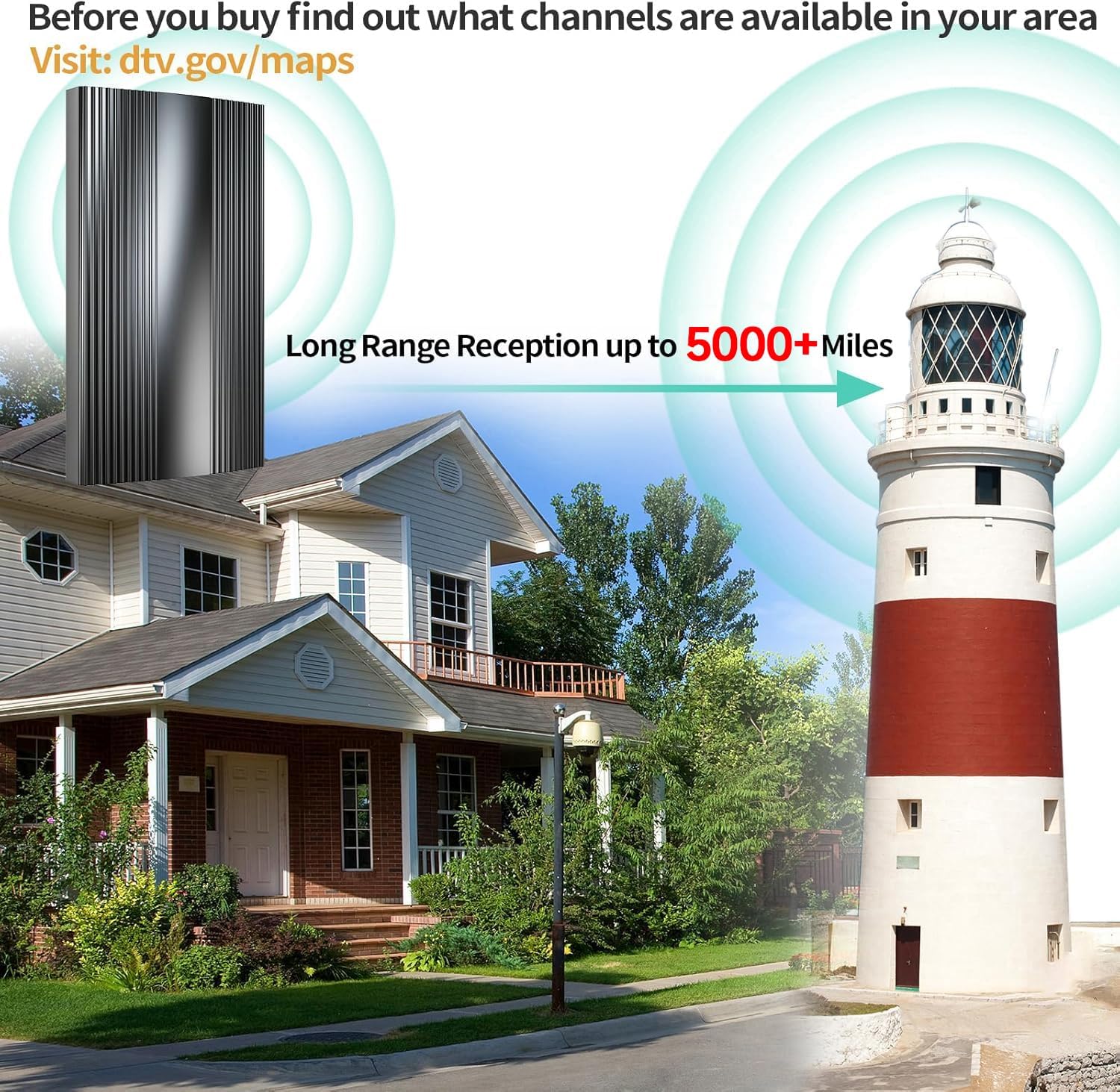
Every indoor antenna’s realistic range depends on how far you sit from the local stations’ transmitters, not just the “mile range” printed on the box. Households in dense suburbs a few miles from towers can often get away with a basic, unamplified antenna, while households ten or more miles out usually need a model with a built-in or detachable signal booster.
Terrain matters too. Hills, dense tree cover, and thick exterior walls all weaken the signal before it even reaches your antenna, so two households the same distance from a tower can get very different results depending on what stands between them and the broadcast.
A quick way to get a rough sense of your situation before buying is to check an online broadcast tower map for your zip code. It will not predict exact results, since walls, elevation, and building materials all play a role, but it gives you a starting point for deciding whether a basic antenna will likely be enough or whether you should plan for an amplified or outdoor-rated model from the start.
Amplified vs. Non-Amplified Antennas
An amplifier boosts a weak signal so your TV tuner can lock onto it, which helps households farther from towers. But amplification is not automatically better: in areas close to towers, a booster can actually overload the tuner and cause the picture to break up rather than improve.
Models with a detachable booster give you the flexibility to try both configurations after your first channel scan, which is generally the safest choice if you are not sure how strong your local signal already is.
If you notice pixelation, freezing, or channels dropping in and out rather than a clean signal loss, that is often a sign of an overloaded tuner rather than a weak one. Unplugging the amplifier and rescanning is usually the first troubleshooting step worth trying before assuming the antenna itself is defective.
Mounting Style and Placement

Flat panel antennas are designed to mount on a window or wall, magnetic-base models stick to any nearby metal surface, and top-mount designs simply sit on the TV itself. Each style trades off differently between install effort and placement flexibility.
Renters who cannot drill into walls often prefer magnetic or top-mount designs, while households with a clear line of sight from a specific window tend to get the best results from a flat panel placed there.
Height and window orientation both matter more than most buyers expect. A higher placement, such as an upstairs window, generally beats a ground-floor spot with the same antenna, and facing the general direction of local towers can make a noticeable difference even for a non-directional, 360-degree model.
VHF and UHF Frequency Coverage
Local network affiliates broadcast across both VHF and UHF frequencies depending on the market, so an antenna that only handles UHF well can miss certain channels entirely. Checking that a model covers both bands helps avoid a surprise gap in your channel scan results.
Most markets lean UHF-heavy today, but VHF stations still exist in many areas, and they can be trickier for a compact antenna to pick up cleanly. If your channel scan comes back missing a station you expected, checking whether it broadcasts on VHF is a useful troubleshooting step before assuming the antenna is at fault.
Cable Length and Indoor vs. Outdoor Rating

A longer coax cable gives you the freedom to mount the antenna at the best-performing window even if your TV sits on a different wall. Most models here are indoor-only, but a few are rated for outdoor or attic installation, which can meaningfully extend range for households in weaker signal areas.
If you have already tried an indoor antenna in a few different spots without success, moving to an outdoor or attic-rated model is usually the next step rather than buying a second indoor unit. The added installation effort tends to pay off in more consistent reception for fringe areas.
Number of Local Stations in Your Market
Some markets have a dozen or more over-the-air subchannels between the major networks, PBS affiliates, and local independent stations, while smaller markets may only carry a handful. Knowing roughly how many stations broadcast in your area sets realistic expectations before you compare your channel scan results against an antenna’s marketing claims.
A quick channel scan on your TV, even with a basic starter antenna, will usually tell you more about your local market than any spec sheet. If the scan turns up far fewer channels than you expected for your area, that is often a sign to try a different window, add an amplifier, or move up to an outdoor-rated model rather than assume your market simply has fewer stations.
| Priority | Look For | Best Fit |
|---|---|---|
| Maximum simplicity | Magnetic or top-mount base, no amplifier steps | First-time antenna buyers, renters |
| Farther from towers | Built-in or detachable signal booster | Suburban and fringe reception areas |
| Flexible placement | Longer coax cable (16ft or more) | TVs not near an exterior window |
| Weakest signal areas | Outdoor or attic-rated antenna | Households that already tried an indoor model |
For more ways to trim your monthly bills, see our full articles section or browse other home electronics guides.
Why You Should Trust Us
Our picks are built from real, verified customer ratings rather than manufacturer marketing claims. We only include antennas that clear a minimum rating and review-count bar, then rank them using our internal scoring system, which weighs both how well an antenna is rated and how many owners stand behind that rating.
We looked specifically at how each listing described its mounting style, cable length, amplifier setup, and indoor or outdoor rating, then grouped the strongest performers by what kind of household they suit best rather than ranking every antenna against a single generic criterion. That approach matters more in this category than in most, since a magnetic-mount pick that earns glowing reviews from apartment renters is not necessarily the right fit for a household several miles from the nearest tower.
We also flag where marketing language, like extreme “mile range” claims, should be taken with a grain of salt, since real-world reception always depends on your distance from towers and the terrain in between. Our goal is to help you match an antenna’s actual strengths to your specific setup rather than chase the biggest number on the box.
We keep this list updated as new models gain a meaningful track record of owner reviews, and we call out newer listings with a shorter review history separately from the more established sellers, so you know how much weight to give each rating.
Final Thoughts
For most households, the TV Antenna for Smart TV Indoor with Signal Booster is the best overall pick thanks to its large base of verified owners and the flexibility of a detachable amplifier that adapts to different reception distances. It is a safe first choice whether you live close to broadcast towers or several miles out, and its freestanding base means you are not committed to drilling into a wall before you know how well it performs in your specific room.
Households that want a simple, tool-free install without an amplifier to manage should look closely at the magnetic and top-mount options above, which trade a bit of raw range for a setup that takes only a few minutes and can be repositioned as many times as needed while you find the strongest signal in your home.
If you want the best value, the Digital TV Antenna with Strong Magnetic Base and 360-Degree Reception earns the highest average owner rating in this list while keeping installation genuinely tool-free, making it a smart pick for renters or anyone who wants a no-drill setup. Households in weaker signal areas that have already tried an indoor model may want to consider the Nelapsano pick above, since it is one of the few here rated for outdoor or attic mounting.
Whichever model you choose, pair it with our other electronics buying guides to round out your home entertainment setup without adding to your monthly bills.
Remember that no antenna can overcome a truly blocked line of sight to local towers, so if reception stays weak after trying a few placements, moving up to an outdoor or attic-rated model is a more reliable fix than swapping between similar indoor antennas.
FAQs
Do I still need an antenna for local tv stations if I already stream TV?
Yes, in many cases. Local news, live sports, and network premieres are not always included in every streaming subscription, and an antenna gives you those channels for free without an extra monthly fee. It also acts as a reliable backup during an internet outage, when streaming apps stop working but an over-the-air signal keeps coming through.
How far can an indoor antenna realistically pick up channels?
It depends heavily on your distance from local towers and any obstructions like hills or trees. Marketing claims about extreme mile ranges represent a best-case, unobstructed scenario rather than a typical result, so treat the number on the box as a ceiling rather than a promise for your specific address.
Do I need to rescan channels after setting up my antenna?
Yes. Most TVs require you to run a channel scan from the settings menu after connecting the antenna, and it is worth rescanning again if you reposition the antenna for better reception. Local stations occasionally change their broadcast frequencies too, so an occasional rescan every few months can restore a channel that seemed to disappear.
Does an amplified antenna always perform better?
Not always. Amplifiers help in fringe reception areas, but households close to broadcast towers can sometimes get a cleaner picture without the booster connected, since it can overload the tuner. If your antenna has a detachable amplifier, comparing a scan with and without it is the easiest way to find out which setup works better at your address.
Can one antenna for local tv stations work for more than one TV?
Some setups allow this with a signal splitter, though splitting the signal typically reduces strength to each TV, which can be a problem for households already sitting at the edge of a station’s broadcast range. For the most reliable results, check our full category guides for splitter-compatible models and dedicated multi-room setups, and consider a stronger, amplified antenna if you plan to split the signal across two or more TVs.

Write Your Review
No reviews yet. Be the first to share your experience!