

Introduction
In the world of 3D printers, the right machine turns a digital sketch into a part you can hold, and the technology has matured fast over the last few years. Whether you are a first-time maker printing your very first model, a teacher running a classroom lab, or a seasoned hobbyist chasing crisp multi-color detail, this guide to the best 8 3D Printers for October 2026 walks through what actually matters. Our top pick is the Bambu Lab P1S for its fully enclosed CoreXY frame, quiet operation, and dependable multi-color output that suits beginners and enthusiasts alike. Around it, trusted brands like Flashforge, Bambu Lab, Elegoo and more fill out a shortlist that runs from easy open-frame starters to detail-focused resin machines.
We looked closely at 8 standout 3D printers you can buy today, weighing each one on print speed, build volume, calibration, material range, and how forgiving it is for someone who is still learning. Buying a printer is only half of a home workshop, so if you also handle documents and photos at your desk, pair your setup with a pick from our guide to the best home printers and keep both your paper and plastic workflows simple.

Pros
- Fully enclosed frame handles ABS and other high-temp materials
- Fast, stable CoreXY motion with vibration compensation
- Near-automatic bed leveling and calibration
- Expands to multi-color with the AMS system
- Huge community and a mature Bambu Studio slicer
Cons
- Full multi-color needs the extra AMS unit
- Enclosed design costs more than an open frame
The Bambu Lab P1S is a fully enclosed CoreXY printer aimed at makers who want reliable results without babysitting the machine. It suits beginners who value a hands-off first layer and enthusiasts who need an enclosed chamber for ABS and other demanding filaments.
Its strengths are hard to overstate: fast and stable motion, near-automatic calibration, and a sealed build volume that keeps heat in and noise down. Add the optional AMS unit and it becomes a capable multi-color machine that rivals printers costing far more.
The main drawbacks are that full multi-color needs the extra AMS hardware, and the enclosed design carries a higher entry point than a bare open frame. Neither is a dealbreaker for most buyers.
Bottom line: for a printer a newcomer can grow into and an expert can rely on daily, the P1S is the most complete all-rounder on this list.
- Technology: FDM, fully enclosed
- Motion: CoreXY
- Top speed class: high, 500mm/s range
- Multi-color: optional AMS, up to 16 colors
- Calibration: automatic bed leveling and flow tuning
- Extras: onboard camera and failure detection
Ideal for the maker who wants one printer to cover everything, from quick PLA toys to functional ABS parts. Beginners appreciate the automatic setup, while experienced users lean on the enclosure and multi-material support for serious projects.
Decide up front whether you need multi-color, since adding the AMS later is easy but costs more. If you mostly print single-color functional parts, the base unit already delivers the enclosure and reliability that define this machine.

Pros
- Full automatic calibration with almost no setup
- Quiet operation for bedrooms and shared spaces
- Includes multi-color AMS Lite in the combo
- Excellent Bambu Studio software and profiles
- Beginner-friendly touchscreen workflow
Cons
- Open frame is less suited to ABS and high-temp filaments
- Bed-slinger motion trails enclosed CoreXY at the extremes
The Bambu Lab A1 Combo is an open-frame FDM printer built to remove every excuse a beginner might have. Full automatic calibration measures the bed and filament flow so your first print stands a real chance of success.
Its highlights are how quiet it runs, how little setup it needs, and the included AMS Lite that brings four-color printing to newcomers. Bambu Studio profiles do the tuning for you, which flattens the learning curve dramatically.
Because it is an open bed-slinger, it is happiest with PLA, PETG, and TPU rather than ABS, and it will not match an enclosed CoreXY at the absolute limits of speed. For its target user, none of that matters.
Bottom line: if you want the gentlest possible entry into 3D printing without giving up color, the A1 Combo is the friendliest machine here.
- Technology: FDM, open frame
- Motion: bed-slinger with vibration compensation
- Multi-color: AMS Lite, four colors
- Calibration: full automatic
- Noise: quiet, under 50 decibels
- Control: touchscreen and mobile app
Perfect for first-time makers, students, and families who want reliable color prints without a technical hobby attached. It also makes a great quiet second printer for experienced users.
Unbox, run the guided calibration, load a Bambu Studio profile, and print. Keep the AMS Lite spools dry and start with PLA before exploring PETG or flexible filament.

Pros
- High-speed CoreXY motion in the 600mm/s class
- One-click automatic leveling for fast starts
- All-metal structure for durable, stable prints
- Quick-swap nozzle simplifies maintenance
- Trusted by a very large owner base
Cons
- Single-color out of the box
- Compact build volume limits very large prints
The Flashforge Adventurer 5M is a CoreXY workhorse that brings high-end motion to an affordable price. It targets hobbyists who want speed and reliability without paying for extras they will not use.
Its all-metal frame keeps prints stable at pace, one-click leveling gets beginners going quickly, and the quick-swap nozzle keeps maintenance painless. A very large base of owners means help and spare parts are easy to find.
It prints a single color out of the box and its build volume is compact, so ambitious multi-color or oversized projects will point you elsewhere. For everyday making, those limits rarely bite.
Bottom line: if you want the most capability per dollar, the Adventurer 5M is the value champion of this roundup.
- Technology: FDM
- Motion: CoreXY, all-metal
- Top speed class: high, up to 600mm/s
- Build volume: compact, 220mm range
- Leveling: one-click automatic
- Nozzle: quick-swap, detachable
Delivers CoreXY speed and automatic leveling at a price that undercuts most rivals, making it the smart pick for makers on a budget who still want modern convenience.
Swap the nozzle when flow drops, keep the build plate clean for adhesion, and store filament dry. The all-metal frame shrugs off long print sessions with minimal fuss.

Pros
- Large 350mm class build volume
- CFS system supports up to sixteen colors
- Fast printing with dual AI cameras
- Full automatic leveling
- Handles big props and batch prints in one go
Cons
- Large footprint needs dedicated desk space
- Multi-color printing consumes extra material and time
The Creality K2 Plus Combo is a large-format FDM printer built for makers whose projects have outgrown a compact machine. Its roughly 350mm build volume swallows helmets, tall vases, and batches of parts.
The star feature is the CFS multi-material system, which can drive up to sixteen colors for genuinely striking results, backed by high-speed motion and dual AI cameras that watch for failures. Automatic leveling keeps that big bed true.
All that capability needs room, so plan for a dedicated desk, and remember that heavy multi-color use adds material waste and print time. For its intended projects, the payoff is worth it.
Bottom line: when size and color are the priority, the K2 Plus Combo is the enthusiast pick that turns big ideas into single prints.
- Technology: FDM
- Build volume: large, 350mm class
- Multi-color: CFS, up to 16 colors
- Speed class: high, 600mm/s range
- Leveling: full automatic
- Monitoring: dual AI cameras
The generous bed is made for cosplay armor, big functional parts, and batch runs, letting you print in one piece what smaller machines force you to slice apart.
The CFS system shines for layered, multi-color models. Reserve it for showpieces where the extra time and material pay off, and print everyday parts in a single color.

Pros
- Native four-color printing that expands to more
- Fast printing in the 600mm/s class
- Quiet operation around forty-five decibels
- AI camera watches for print failures
- Approachable price for a multi-color machine
Cons
- Color changes add waste and time
- Newer platform with a smaller community than the leaders
The Anycubic Kobra X is a value-focused FDM printer that puts multi-color output within easy reach. Native four-color printing, expandable further, lets families and beginners make vivid models without a premium price.
It prints quickly and quietly, and an AI camera keeps an eye on jobs so small failures do not waste a whole spool. For makers who love color but not the cost, it hits a sweet spot.
As with any multi-color system, expect extra material use and longer prints, and note that the Anycubic community, while growing, is smaller than the largest ecosystems. Neither should deter its target buyer.
Bottom line: the Kobra X is the budget route to colorful printing, ideal for makers who want fun results without spending big.
- Technology: FDM
- Multi-color: native four colors, expandable
- Speed class: high, 600mm/s range
- Noise: quiet, around 45 decibels
- Monitoring: AI camera
- Audience: beginners, families, makers
Few printers this affordable offer real multi-color printing. The Kobra X is the pick for makers who want playful, layered models without stepping up to a flagship price.
Great for families, classrooms, and hobbyists who value colorful, eye-catching prints and a quiet machine that fits into shared living spaces.
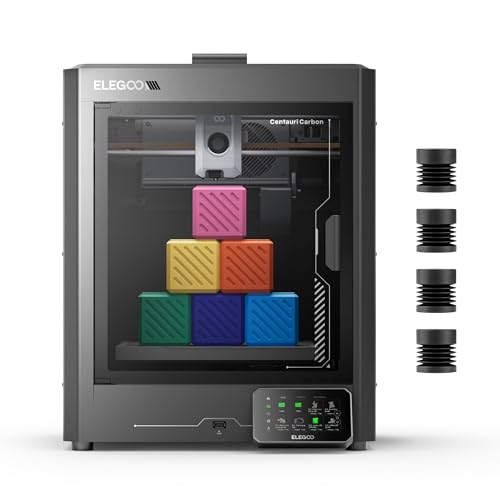
Pros
- Enclosed CoreXY chamber for high-temp materials
- Built to handle abrasive carbon-fiber filament
- Fast and stable motion
- Auto leveling for easy starts
- Strong value for an enclosed machine
Cons
- Smaller community than the market leaders
- Enclosure adds size versus an open frame
The Elegoo Centauri Carbon is an enclosed CoreXY printer that punches above its price by focusing on engineering materials. Its sealed chamber and hardened flow path are built for ABS, ASA, and abrasive carbon-fiber blends.
You get fast, stable motion and automatic leveling in a package that costs less than most enclosed rivals, which makes durable functional printing accessible to more makers. For strong, heat-resistant parts, it is a compelling value.
Its community is smaller than the biggest names, and the enclosure naturally takes up more room than an open frame. Buyers focused on engineering materials will happily accept both.
Bottom line: if you want an affordable route into enclosed, high-temp printing, the Centauri Carbon is the value enclosure pick here.
- Technology: FDM, enclosed
- Motion: CoreXY
- Materials: PLA, PETG, ABS, ASA, carbon-fiber
- Flow path: hardened for abrasives
- Leveling: automatic
- Best use: functional, durable parts
The enclosed chamber and hardened components make it a natural home for ABS, ASA, and carbon-fiber filament, so functional parts come out strong and warp-free.
Choose the Centauri Carbon if durable, heat-resistant prints are your goal. If you only print PLA decorations, a simpler open frame will save money and space.

Pros
- High-resolution 10K mono LCD for fine detail
- Fast curing for a resin printer
- Stable light source for even exposure
- Compact desktop footprint
- Excellent for miniatures and detailed art
Cons
- Requires washing and curing after each print
- Resin handling demands gloves and ventilation
- Small build volume versus FDM
The Anycubic Photon Mono 4 is a resin MSLA printer built around a high-resolution 10K mono LCD. That screen resolves the fine features that make miniatures, busts, and jewelry masters look professional.
It cures quickly and evenly for a resin machine, and its compact size fits on a desk corner. For makers who prize detail over size, the results are in a different league from filament printing.
Resin printing asks more of you: every print needs washing in alcohol and curing under UV, and you should wear gloves and work in a ventilated space. The build area is also small by FDM standards.
Bottom line: for the sharpest possible detail, the Photon Mono 4 is our favorite resin pick, provided you embrace the extra post-processing.
- Technology: resin, MSLA LCD
- Screen: 10K mono LCD
- Curing: fast, even exposure
- Build volume: compact, detail-focused
- Post-processing: wash and cure required
- Best use: miniatures, jewelry, detailed art
The high-resolution screen captures crisp layers that FDM cannot match, making it the go-to for tabletop miniatures, sculpture, and intricate prototypes.
Wear nitrile gloves, work in a ventilated area, and keep isopropyl alcohol on hand. Wash prints thoroughly, cure them under UV, and store resin away from light and living space.

Pros
- 9K LCD delivers high detail
- Smart automatic leveling, rare for resin
- Fast printing speed
- WiFi transfer for convenience
- Iconic, well-supported Mars line
Cons
- Still requires washing and curing
- Resin handling needs gloves and ventilation
- Compact build volume
The Elegoo Mars 5 Ultra brings the famously popular Mars resin line up to date with a 9K LCD and, unusually for resin, smart automatic leveling. That single feature removes the fiddly manual step that trips up newcomers.
It prints quickly, supports WiFi transfer, and benefits from one of the largest resin communities around, so profiles and advice are easy to find. For a first resin machine, it is remarkably approachable.
Like any resin printer, it still needs washing and curing after each job, plus gloves and good ventilation, and the build volume is compact. These are the standard trade-offs of the technology, not flaws unique to this model.
Bottom line: the Mars 5 Ultra is the friendliest way into resin, pairing high detail with conveniences that beginners will genuinely appreciate.
- Technology: resin, MSLA LCD
- Screen: 9K LCD
- Leveling: smart automatic
- Speed: fast, high-speed curing
- Connectivity: WiFi transfer
- Post-processing: wash and cure required
Automatic leveling and WiFi transfer take much of the friction out of resin printing, making the Mars 5 Ultra the easiest starting point for makers new to the technology.
Use gloves, ventilate the room, and keep alcohol nearby for cleanup. Wash and cure every print, and store leftover resin sealed and away from sunlight.
3D Printers Buying Guide: How to Choose in 2026
FDM vs Resin: Two Very Different Ways to Print

The first fork in the road is technology. FDM printers, sometimes called filament printers, melt a plastic string and lay it down layer by layer. They are versatile, print larger objects, use inexpensive and widely available filament, and forgive small mistakes, which is why most of our picks, including the Bambu Lab A1 Combo and the Flashforge Adventurer 5M, are FDM machines. If you want functional parts, brackets, toys, cosplay props, or classroom projects, FDM is almost always the right place to start.
Resin printers work in the opposite way. They shine ultraviolet light through an LCD screen to cure liquid photopolymer, one thin slice at a time. The reward is astonishing detail, which is why miniature painters, jewelers, and dental labs love machines like the Anycubic Photon Mono 4 and the Elegoo Mars 5 Ultra. The trade-off is a smaller build area, plus extra steps after the print finishes: you wash the model in alcohol and cure it under more UV light. Resin also demands care, so plan for gloves, good ventilation, and a dedicated corner before you commit.
If you are unsure which camp you belong to, begin with FDM. It teaches the fundamentals of slicing, bed adhesion, and filament handling with far less mess. You can always add a compact resin machine later once you know you crave fine detail rather than raw size.
Print Speed and the Motion System
Speed is the headline number on every modern box, but the motion system behind it is what really counts. CoreXY printers move a lightweight print head on two motors while the bed only travels up and down, so they stay stable at high acceleration. The Bambu Lab P1S, the Flashforge Adventurer 5M, and the Elegoo Centauri Carbon all use this layout and comfortably reach the 500 to 600 millimeter per second class without turning fine walls into a blur.
Bed-slinger designs, where the plate carries your model back and forth, remain popular because they are simple and affordable. The Bambu Lab A1 Combo shows how far the format has come, pairing quick motion with active vibration compensation so prints stay clean. Whatever the frame, look for input shaping or resonance tuning, because raw speed without it just means ghosting and ringing on your surfaces. For most makers, a printer that holds quality at a sensible pace beats one that hits a marketing peak it cannot sustain.
| Model | Motion System | Speed Class | Best For |
|---|---|---|---|
| Bambu Lab P1S | Enclosed CoreXY | High | All-round reliability |
| Flashforge Adventurer 5M | CoreXY | High | Value and speed |
| Bambu Lab A1 Combo | Bed-slinger | Medium to High | Beginners and color |
| Elegoo Mars 5 Ultra | Resin LCD | Fast curing | Fine detail |
Build Volume and What You Can Actually Make
Build volume decides the size of a single print, so match it to the projects you daydream about. Compact FDM machines in the 220 millimeter cube range, such as the Flashforge Adventurer 5M and the Bambu Lab A1 Combo, cover the vast majority of household needs: phone stands, replacement knobs, board game inserts, and figurines. They also fit neatly on a shelf and heat up quickly.
When your ambitions grow to helmets, large cosplay armor, or batches of parts printed in one go, a bigger bed pays off. The Creality K2 Plus Combo stretches to a roughly 350 millimeter cube, giving you room for tall vases and full-size props without slicing them into pieces. Resin printers pull in the other direction: the Anycubic Photon Mono 4 and Elegoo Mars 5 Ultra trade size for precision, which is exactly what you want for tabletop miniatures and jewelry masters. Buy the volume you will use often, not the largest number you can find.
Materials and the Enclosure Advantage

The filament you can run shapes what your printer is good for. Every machine here handles PLA, the easy everyday plastic, and most also take PETG and flexible TPU for tougher or bendable parts. The jump to engineering materials like ABS, ASA, and carbon-fiber blends is where an enclosed chamber earns its keep. A sealed box holds heat around the print, which stops big parts from warping and cracking as they cool, and it traps fumes and noise at the same time.
That is why enclosed models like the Bambu Lab P1S and the Elegoo Centauri Carbon appeal to makers who want durable, functional prints rather than just decorative ones. The Centauri Carbon in particular is built to chew through abrasive carbon-fiber filament thanks to a hardened flow path. If you only plan to print PLA models and toys, an open frame such as the Bambu Lab A1 Combo keeps things affordable and quiet enough for a bedroom. Buyers who expect to print engineering parts should budget for the enclosure from the start, since retrofitting one later is rarely worth the effort.
Auto-Leveling and Hands-Off Calibration
Nothing scares off a new owner faster than a fussy first layer, which is why automatic calibration has become the single most valuable feature on this list. The best 3D Printers probe the bed at many points and adjust on the fly, so you press print and walk away. Bambu Lab machines run a full sequence that measures the plate and even the flow of the filament, while the Flashforge Adventurer 5M offers one-click leveling that gets beginners printing in minutes.
Calibration matters on the resin side too, where a tilted plate ruins an entire tray of models. The Elegoo Mars 5 Ultra adds smart automatic leveling, a genuine convenience in a category that traditionally demanded manual paper tests. Look also for filament runout sensors and resume after power loss, both of which quietly save long jobs from disaster. These conveniences do not make a printer better on paper, but they are the difference between a machine you enjoy and one that gathers dust.
Multi-Color and Multi-Material Printing

Color is where the current generation of 3D printers shows off. Bambu Lab pairs its printers with an automatic material system that swaps between spools during a print, so a single model can carry several colors without you standing guard. Creality answers with its CFS units on the K2 Plus Combo, which can juggle up to sixteen colors for genuinely eye-catching results, while the Anycubic Kobra X leans into native four-color printing that expands even further for makers who love bold, layered designs.
Be honest about the cost of all this variety. Every color change purges a little material and adds time, so multi-color prints are slower and hungrier than single-color ones. For occasional flourishes it is worth every minute, but if you mostly print functional parts in one color, you can save money and stick with a simpler machine. Match the feature to how you actually create rather than to the demo reel.
Ease of Setup, Software, and Community
A great printer is only as good as the ecosystem around it. Almost every pick here arrives largely pre-assembled, so setup is a matter of minutes rather than an afternoon of bolts. Just as important is the slicer, the software that turns a model into printer instructions. Bambu Studio, Orca Slicer, and Creality Print are mature and beginner-friendly, with tuned profiles that take the guesswork out of your early prints. If you already run a capable desktop, browse our roundup of the best gaming PCs to make sure slicing and model editing stay smooth.
Community is the hidden feature no spec sheet lists. Popular platforms have huge libraries of ready-made models, active forums, and a steady supply of spare nozzles and belts, so a stuck print rarely stays stuck for long. That momentum is a big reason the Bambu and Creality ecosystems feel effortless for newcomers. For more workshop gear and accessories that pair with your printer, explore our Computers category and build out the rest of your bench.
Why You Should Trust Us
We build every recommendation on published specifications, documented feature sets, and the patterns we see across large volumes of verified owner feedback. Our focus is on the criteria that decide day-to-day happiness with a printer: calibration reliability, motion quality, material flexibility, and how gentle the learning curve is for a first-time owner in 2026.
We are transparent about method. We do not claim to have run every one of these machines by hand, and we will never pretend otherwise. Instead we compare real-world capabilities against how each printer is actually used, then weigh the trade-offs so the shortlist reflects genuine needs rather than marketing peaks. When a feature adds cost without adding value for most makers, we say so plainly.
Final Thoughts
After weighing these top 8 3D Printers, the Bambu Lab P1S remains our best overall choice. Its enclosed CoreXY frame handles engineering materials, its automatic calibration is close to foolproof, and its multi-color support scales with your ambition, which makes it equally rewarding for a nervous beginner and a demanding enthusiast.
For the best value, the Flashforge Adventurer 5M is hard to beat. It brings high-speed CoreXY motion, one-click leveling, and a durable all-metal build at an approachable level, so hobbyists get pro-grade convenience without the complexity. New makers who want the gentlest possible start should look at the Bambu Lab A1 Combo, while anyone chasing big, colorful showpieces will love the large bed and sixteen-color system on the Creality K2 Plus Combo. If fine detail is your goal, the Anycubic Photon Mono 4 is our favorite resin pick, and the Elegoo Mars 5 Ultra makes resin friendlier for first-timers. Ready to keep upgrading your bench? Browse more guides in our articles hub for your next project.
FAQs
What is the best 3D printers in 2026?
The best 3D printers in 2026 depends on your goals, but the Bambu Lab P1S tops our list for its enclosed design, near-automatic calibration, and reliable multi-color printing. It balances performance and ease better than anything else here, which is why it suits both newcomers and experienced makers.
Should a beginner start with FDM or resin?
Beginners should almost always start with FDM. Machines like the Bambu Lab A1 Combo and the Flashforge Adventurer 5M are forgiving, use affordable filament, and involve far less cleanup. Resin printers such as the Anycubic Photon Mono 4 deliver finer detail, but they add washing, curing, and safety steps that make more sense once you have the basics down.
How much space and ventilation do 3D printers need?
Most FDM picks fit on a sturdy desk or shelf and only need room for the door and spool to move. Resin machines like the Elegoo Mars 5 Ultra ask for more care: set them up in a well-ventilated area, wear gloves when handling liquid resin, and keep isopropyl alcohol nearby for cleanup. A dedicated corner away from living space is ideal for any resin workflow.
Can 3D printers print multiple colors?
Yes, and this is one of the biggest recent advances. The Creality K2 Plus Combo can manage up to sixteen colors through its CFS system, the Anycubic Kobra X supports native four-color printing that expands further, and Bambu Lab printers use an automatic material system to swap spools mid-print. Keep in mind that multi-color jobs use more material and take longer than single-color prints.
What can I actually make with the best 3D Printers?
Almost anything that fits the build volume. FDM machines are ideal for functional parts, household repairs, toys, cosplay props, and educational models, while resin printers excel at tabletop miniatures, jewelry masters, and highly detailed art. To see how a printer fits alongside your other tech and hobbies, browse our full categories page and plan your next build.


Write Your Review
No reviews yet. Be the first to share your experience!