

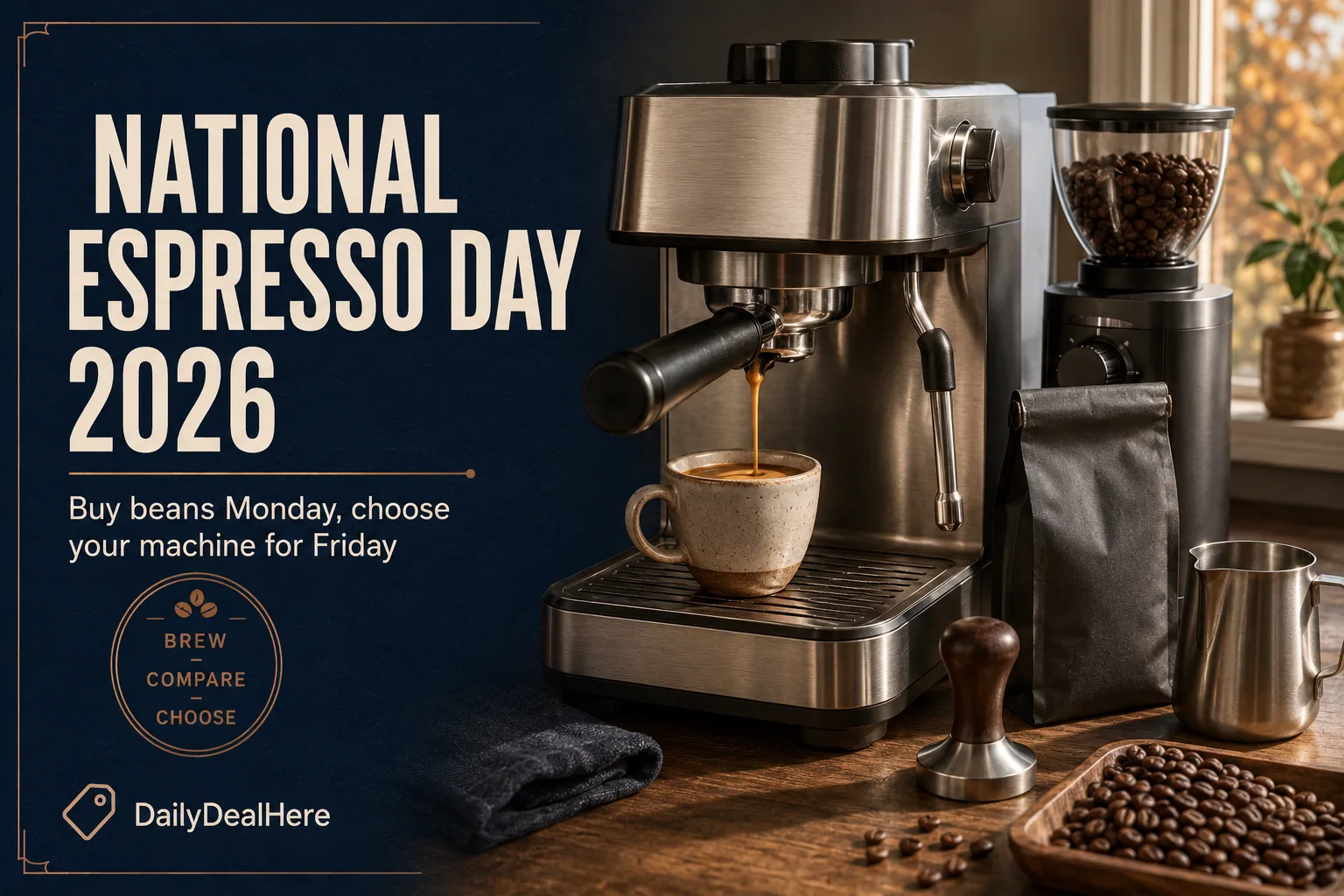
National Espresso Day falls on November 23 every year, which in 2026 lands on a Monday, three days before Thanksgiving and four days before Black Friday. That placement is the single most useful thing to know about it, because it means the day itself is a poor moment to buy an espresso machine and an excellent moment to decide which one you want.
Coffee brands run promotions on the day. Equipment discounts land later in the same week and go considerably deeper. Knowing which is which turns a novelty date into a genuinely useful one.
The 2026 dates in one place
| Date | Day | What happens |
|---|---|---|
| November 23 | Monday | National Espresso Day. Beans, pods and cafe offers |
| November 26 | Thursday | Thanksgiving |
| November 27 | Friday | Black Friday. Machines and grinders discount |
| November 30 | Monday | Cyber Monday. Online equipment offers continue |
The practical reading: buy coffee on the Monday, buy hardware on the Friday. Our guide to Black Friday 2026 dates covers the wider calendar, and Black Friday versus Prime Day covers which event prices better on what.
What espresso actually is
Espresso is not a roast level and not a type of bean. It is a brewing method defined by pressure, and that distinction clears up most of the confusion in the category.
Hot water is forced through finely ground, compacted coffee under pressure, producing a small, concentrated drink in roughly half a minute. The pressure is what creates crema, the layer of fine foam on top, and it is what makes the result different from anything a drip machine produces.
Because the method is defined by pressure rather than by the coffee, any bean can be used for espresso. Bags labelled espresso roast are usually roasted darker because that profile has traditionally suited the method, but it is a recommendation rather than a requirement.
Espresso against everything else on the counter
The differences between brewing methods come down to time, grind and pressure, and understanding that makes the equipment choices obvious.
| Method | Grind | Contact time | Result |
|---|---|---|---|
| Espresso | Fine | Around 30 seconds under pressure | Small, concentrated, crema on top |
| Drip | Medium | Several minutes, gravity fed | Larger, lighter bodied |
| French press | Coarse | Four minutes steeping | Heavy bodied, some sediment |
| Moka pot | Fine to medium | Minutes, low pressure from steam | Strong, closer to espresso than drip |
| Cold brew | Coarse | Twelve hours or more, cold | Low acidity, concentrate |
A moka pot is worth singling out because it is often described as making espresso and does not. It brews under far lower pressure, which produces a strong cup without the crema or the texture. It is also a fraction of the price, which makes it the sensible starting point for anyone unsure whether they want espresso enough to buy a machine.
The four kinds of espresso machine
Machines fall into four groups, and the right one depends far more on how much involvement you want than on budget.
Manual lever machines put you in charge of the pressure directly. They reward practice and punish inattention, and they suit people who want the process as much as the drink.
Semi automatic machines handle the pressure and leave you the grind, the dose and the timing. This is where most home espresso lives, because it is the point at which your decisions still change the result.
Super automatic machines grind, dose, tamp and brew at the press of a button. They cost more, they take up more counter, and they turn espresso into an appliance rather than a hobby. For a household that wants three drinks before work without a conversation, that is exactly right.
Capsule machines are the fourth group and the largest by volume. They are consistent, they are simple, and the ongoing cost sits in the capsules rather than in the machine. Our roundup of specialty coffee makers covers the categories that sit outside standard drip.
The grinder is not optional
This is the single most common expensive mistake in home espresso: buying a good machine and pairing it with a cheap grinder or with pre-ground coffee.
Espresso is unusually sensitive to grind size because the water is forced through the coffee rather than passing through it. Too coarse and the water runs through fast, producing something thin and sour. Too fine and it chokes, producing a slow, bitter trickle. The window between those two is narrow, and hitting it requires a grinder that produces consistent particles and adjusts in small steps.
Blade grinders cannot do this. They chop rather than mill, producing dust and chunks together, and no amount of skill on the machine compensates. A burr grinder with fine adjustment is the requirement, and if the budget is fixed, spending less on the machine to spend more on the grinder is the better division.
Pre-ground espresso coffee exists and works in a basic machine, but it removes the main variable you would otherwise use to fix a bad shot.
Choosing beans for espresso
Since any coffee can be pulled as espresso, the question is which one suits the method and your taste.
Darker roasts are the traditional choice because the method concentrates everything, including acidity, and a darker roast arrives with less of it. They also produce the heavier body most people associate with espresso. Lighter roasts pulled as espresso are brighter and more acidic, which some people love and others find sharp.
Freshness matters more here than in any other method. Coffee releases carbon dioxide for days after roasting, and very fresh beans can pull unevenly, while stale beans produce thin crema and a flat cup. A roast date on the bag is more useful than a best-before date.
If acidity is the thing you want to avoid, our roundup of low acid coffee is the relevant category, and organic coffee covers the certified side of the shelf.
Milk drinks, and what separates them
Most espresso at home ends up with milk in it, and the names are simply ratios rather than recipes.
- Espresso on its own, a small concentrated shot.
- Americano is espresso with hot water added, which is not the same as drip coffee even though the volume is similar.
- Macchiato is espresso marked with a small amount of milk foam.
- Cortado is roughly equal espresso and warm milk.
- Cappuccino is espresso with steamed milk and a thick layer of foam.
- Latte is espresso with more steamed milk and a thin layer of foam.
If milk drinks are the goal, the steam wand matters as much as the brewing. Machines vary enormously here, and a machine that pulls a good shot but steams poorly will disappoint someone who mostly drinks cappuccino.
The running costs nobody mentions
An espresso setup has ongoing costs beyond the coffee, and they are worth knowing before the machine arrives rather than after.
Descaling is the main one. Espresso machines heat water constantly, and scale builds inside them, showing up as slow flow, lower temperature and eventually a fault. Hard water areas need it far more often. Water filters reduce it, which is why many machines include one and why replacing it is a recurring cost.
Then there are cleaning tablets for backflushing on machines that support it, replacement gaskets and shower screens over time, and the milk routine, since a steam wand needs wiping and purging after every use rather than at the weekend.
None of this is difficult. It is simply the part of ownership that the product page does not lead with.
How to celebrate the day without buying anything
The most useful version of National Espresso Day for most people is not a purchase at all.
Cafes and roasters often run offers on the day, which makes it a cheap opportunity to try a style you have not had before: a cortado if you always drink lattes, a single origin pulled as espresso if you normally drink blends. Tasting before buying equipment is the most sensible research available.
If you already own a machine, it is a reasonable prompt to descale it, replace the water filter, and dial in a grind you have been living with rather than adjusting. Most home espresso improves more from maintenance than from new hardware.
If you are buying a machine this season
Espresso equipment is one of the categories where the November discounts are real, so the timing question is worth taking seriously.
Decide the type first, since that narrows the field faster than any specification. Then set a combined budget for machine and grinder rather than a machine budget, because the pairing is what determines the result. Then wait for the Friday, given that November 23 is four days before Black Friday and equipment prices move on the later date.
Watch for bundles that include coffee. Price the machine alone, price the coffee alone, then judge the bundle, because included coffee is often listed at full price to inflate the apparent saving. Our roundup of coffee makers covers the broader category if a straightforward brewer would actually suit you better.
Espresso as a gift
The day sits close enough to the gifting season to make espresso a natural present, with one caution.
Machines are a large gift and a personal one, since they take counter space and imply a routine. Unless someone has asked for one specifically, the safer versions are consumables and accessories: good beans, a decent tamper, a milk jug, a scale, or a set of proper cups. All are useful to someone who already owns a machine and none of them commit the recipient to anything.
For someone who does not own a machine and is curious, a moka pot is a genuinely thoughtful gift. It is inexpensive, it makes a strong cup, and it answers the question of whether they want to go further without anyone spending seriously to find out.
What a good shot looks like, and how to fix a bad one
Most home espresso problems are one of two faults, and both are diagnosed by watching the shot rather than by tasting it afterwards.
A shot that gushes out quickly, pale and thin, has been under extracted. The water found an easy path through the coffee and took very little with it, which produces a sour, watery cup. The usual cause is a grind that is too coarse, sometimes combined with too little coffee in the basket or an uneven tamp.
A shot that drips slowly and darkly has been over extracted. The water struggled through and took too much, which produces bitterness and a burnt edge. The usual cause is a grind that is too fine, or too much coffee packed into the basket.
The fix in both cases is the grinder rather than the machine, which is why fine grind adjustment matters so much. Change one variable at a time and give it two or three attempts before judging, because a single shot after an adjustment tells you very little. Beans also change as they age, so a setting that worked last week may need nudging this week.
Water, and why it decides more than the beans
An espresso is overwhelmingly water, and the water going in shapes both what comes out and how long the machine lasts.
Very hard water leaves scale inside the boiler and the pipes, which reduces flow and heat over time and eventually causes faults. Very soft or distilled water sits at the other extreme and is not the answer either, since some mineral content is needed for the coffee to taste of anything. Water with almost nothing in it produces a flat, hollow cup.
Filtered tap water is the practical middle ground for most households, and many machines take an inline filter for exactly this reason. If you live in a hard water area, the filter is maintenance rather than an accessory, and replacing it on schedule costs far less than descaling a neglected machine or replacing it early.
This is also the cheapest upgrade available to anyone unhappy with their coffee. Changing the water costs a fraction of changing the machine and frequently makes a bigger difference.
Capsule machines deserve a fair hearing
Capsule machines get dismissed by people who care about coffee, and that dismissal is often about identity rather than about outcomes.
What they do well is consistency. Every cup is the same, there is no grind to dial in, no tamping, no cleaning of a portafilter, and no learning period. For a household where one person drinks espresso occasionally, or where mornings are chaotic, that reliability is worth more than the ceiling a semi automatic machine offers in the right hands.
The trade-offs are real too. The cost per cup is higher and continues forever, the capsule range limits what you can drink, and there is waste to deal with even where recycling schemes exist. You also cannot improve the result, because every variable has been decided for you.
The honest way to choose is to ask whether you want better coffee or easier coffee. Both are legitimate answers, and buying a machine that matches the wrong one is how expensive equipment ends up unused at the back of a counter.
Setting up in a small kitchen
Counter space is the constraint people underestimate, because an espresso setup is rarely one object.
A semi automatic machine needs room for the machine itself, a grinder beside it, a place to tamp, and clearance above for the water tank lid, which on many machines opens upwards. Add a knock box, a milk jug and somewhere to put cups, and a corner that looked generous becomes tight.
Measure the height as well as the footprint before buying, since cupboards over a counter are the most common surprise. Check where the water tank is accessed too, because a machine that must be pulled forward every morning to be refilled gets tiresome quickly.
Super automatic machines take more space than they look and capsule machines take the least. In a genuinely small kitchen, that difference matters more than any specification on the box.
Where National Espresso Day came from
Like most food days on the calendar, the origin is not documented in any authoritative way. It has no founding organisation and no official recognition, and it appears in lists of unofficial observances alongside dozens of others.
What is documented is the drink itself. Espresso emerged in Italy in the early twentieth century from machines built to brew coffee quickly for one person at a time, and the pressure driven method that defines it developed from there over several decades. The word refers to speed and to the drink being made to order rather than to any pressing of the coffee.
The practical value of the date is not its history. It is that a fixed day in late November gives roasters, cafes and retailers a reason to run offers in the same week the rest of the coffee category is already discounting, which is useful whether or not the day means anything.
A short buying order for the week
Reduced to a sequence, the week of November 23 runs like this.
On the Monday, buy coffee rather than hardware, and use the cafe offers to taste something you would not normally order. If you already own a machine, descale it and replace the water filter, because both are overdue in most households and neither costs much.
Between the Monday and the Friday, decide the machine type and set one combined budget covering machine and grinder together. Measure the counter, including the height and the water tank access. Read what the ongoing costs will be.
On the Friday, buy the hardware. Price any bundle apart before accepting it, and if the budget is tight, put the money into the grinder rather than into a higher tier machine. That single decision changes what comes out of the cup more than anything else you can buy this week.
One last thing worth doing on the day, and it costs nothing. Write down the grind setting, the dose and the shot time that currently work for you, and stick the note somewhere near the machine. Espresso drifts as beans age and as the seasons change the humidity, and having a known good starting point turns a frustrating morning into a two second adjustment.
People who enjoy their machine for years tend to be the ones who kept notes early on. People who abandon an expensive machine after six months are usually the ones who never found a baseline to return to when a batch of beans behaved differently.
Frequently asked questions
When is National Espresso Day 2026?
Monday, November 23, 2026. The date is fixed at November 23 each year, which in 2026 places it three days before Thanksgiving on November 26 and four days before Black Friday on November 27.
Should I buy an espresso machine on National Espresso Day?
Usually not. Offers on the day itself tend to be on beans, pods and cafe drinks, while machines and grinders discount later in the same week around Black Friday. The day is a good moment to decide what you want and a poor moment to buy hardware.
What is the difference between espresso and regular coffee?
Espresso is a brewing method rather than a bean or a roast. Hot water is forced through finely ground compacted coffee under pressure in roughly thirty seconds, producing a small concentrated drink with crema. Drip coffee passes through a medium grind by gravity over several minutes.
Do I need a special grinder for espresso?
Yes, a burr grinder with fine adjustment. Espresso is very sensitive to grind size because water is forced through the coffee, so too coarse runs thin and sour while too fine chokes and turns bitter. Blade grinders cannot hold a consistent size, and no machine compensates for that.
Does a moka pot make espresso?
No, though it is often described that way. A moka pot brews under much lower pressure than an espresso machine, so it produces a strong concentrated cup without true crema or the same texture. It is a good inexpensive way to find out whether you want an espresso machine at all.









Write Your Review
No reviews yet. Be the first to share your experience!