

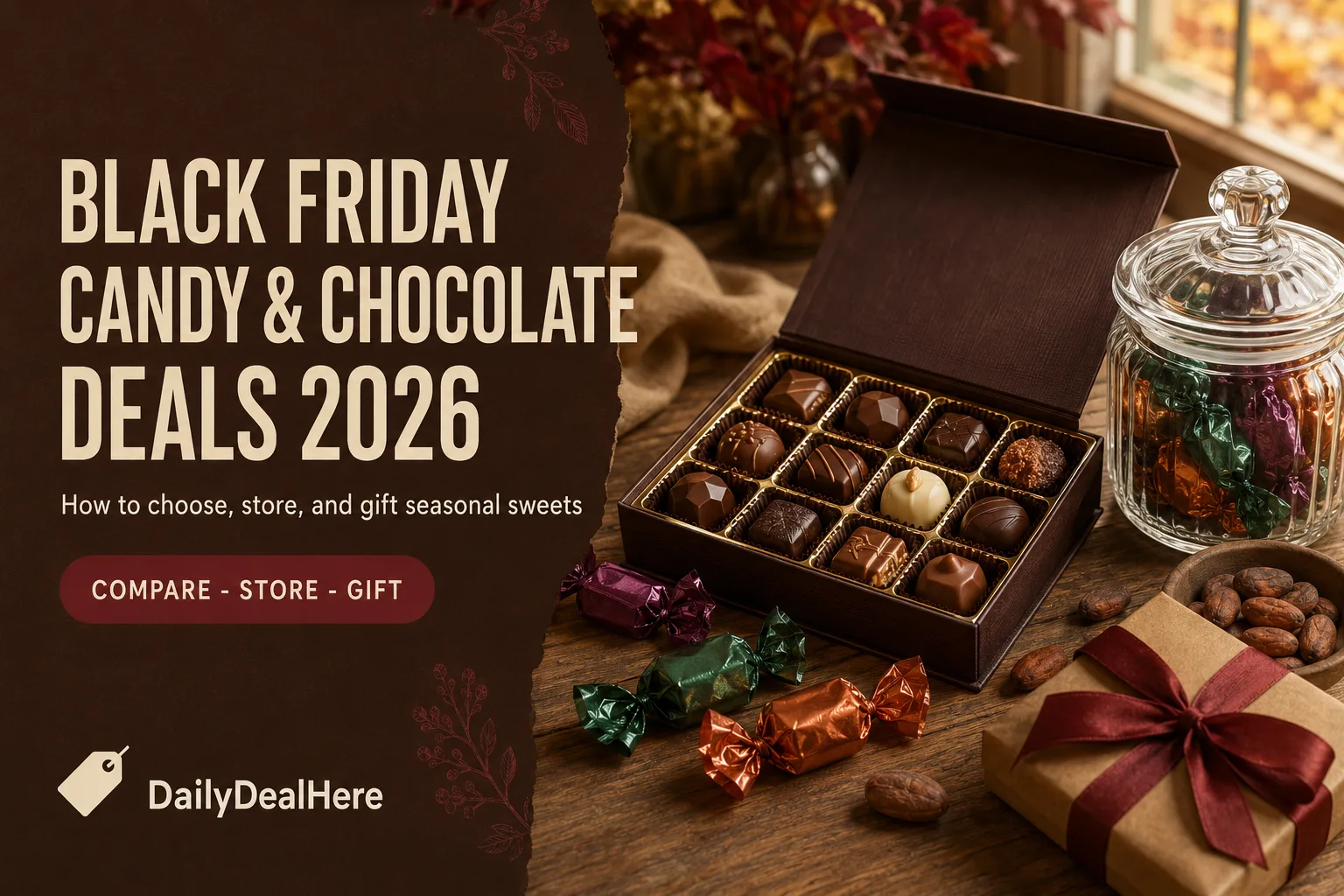
Chocolate and candy discount twice in the space of five weeks, and the two events are nothing alike. The first is Halloween clearance in early November, when retailers dump seasonal packaging at the steepest prices of the year. The second is Black Friday on November 27, 2026, which is about gifting rather than clearance and prices accordingly.
Knowing which of the two you are shopping decides everything: what is worth buying, how long it will keep, and whether the discount you are looking at is generous or ordinary.
Two sales, five weeks apart
| Window | What it is | Best for |
|---|---|---|
| Nov 1 to 7 | Halloween clearance | Bulk bagged candy, deepest prices |
| Nov 8 to 26 | Gift range launches | Advent calendars, boxed assortments |
| Nov 27 | Black Friday | Premium boxes, chocolate gifts |
| Nov 30 | Cyber Monday | Online-only bundles |
| Late December | Holiday clearance | Festive packaging, ordinary chocolate inside |
The pattern repeats every year because it is driven by packaging rather than by the food. Orange and black wrappers become worthless to a retailer on November 1. Red and green wrappers become worthless on December 26. The chocolate inside is the same chocolate.
Halloween clearance is the better price, if you can store it
The first week of November delivers discounts that Black Friday does not match on ordinary candy. Retailers need the shelf space and the seasonal wrapper has no value to them.
What makes it work is that most mass-market candy has a long shelf life. Individually wrapped chocolate bars, hard candy and gummies bought in early November will comfortably reach December, which is when the same items get bought again at full price for stockings and party bowls.
Our guide to how much Halloween candy to buy covers the quantity question from the other direction, and the same maths applies in reverse when you are buying clearance to use later.
The limit is storage, not price. Chocolate that spends five weeks in a warm cupboard arrives at December in poor condition, which cancels the saving entirely.
How to store chocolate so it survives until December
Chocolate has two failure modes that look similar and are not. Both are cosmetic rather than dangerous, and both make a gift look old.
Fat bloom is the pale grey film that appears after chocolate warms and cools. Cocoa butter migrates to the surface and recrystallises there. It is harmless and it tastes fine, but it looks like dust and nobody wants it in a gift box.
Sugar bloom is the gritty surface that appears when chocolate meets moisture, usually from condensation after it comes out of a fridge. Sugar dissolves at the surface then recrystallises coarsely.
The storage rules follow directly. Keep chocolate cool, dry, dark and at a steady temperature, ideally in a cupboard rather than the fridge. If it must go in the fridge because the house is warm, seal it in an airtight container first and let it come back to room temperature inside that container before opening, so condensation forms on the box rather than on the chocolate.
Keep it away from anything aromatic. Chocolate takes on the smell of its neighbours, and a bar stored beside coffee or spices will taste of them.
Reading a chocolate label properly
Chocolate is a category where the front of the box is marketing and the ingredient list is the actual specification.
The cocoa percentage tells you how much of the bar comes from the cocoa bean, counting both cocoa solids and cocoa butter. A higher number means less room for sugar, which is why dark chocolate tastes less sweet. It is not a quality score: a poorly made high percentage bar is worse than a well made lower one.
Ingredient order matters more than the percentage. In a good bar, cocoa or cocoa mass appears before sugar. When sugar comes first, you are buying a sweet with chocolate flavour rather than a chocolate bar.
Two terms worth knowing. Chocolate flavoured coating and similar phrases usually mean vegetable fat has replaced some cocoa butter, which changes the melt and the mouthfeel. White chocolate contains cocoa butter but no cocoa solids, which is why it behaves differently in heat and why it is not interchangeable in recipes.
Advent calendars: buy early, they do not discount
Chocolate advent calendars are the clearest example of a product where waiting costs you. They are made in limited runs for a date that cannot move, and the good ones sell out in November rather than getting marked down on Black Friday.
By the time the Friday arrives, what remains is the leftover selection. Our roundup of chocolate advent calendars covers the range, and the same buy-early rule applies to coffee calendars and tea calendars.
One thing to check before buying for a child: the chocolate quality in cheaper calendars varies widely, and a calendar is twenty-four separate opportunities to be disappointed. It is one of the few cases where the middle of the price range is more reliably satisfying than the bottom.
Boxed assortments and where the value hides
Premium boxed chocolate is the category Black Friday actually serves, and it is also where the reference price is softest.
Work out the price per ounce rather than reading the percentage on the banner. Boxed assortments carry a lot of packaging weight, and two boxes at the same price can hold noticeably different amounts of chocolate. A large box with a deep tray insert and a smaller box packed solid are not the same purchase.
Check the assortment itself. Most boxes contain a few pieces everyone likes and several that get left until January. A smaller box of one thing the recipient actually eats beats a large mixed box on every measure except appearance.
Chocolate ships badly, and November is when that starts to matter less
Chocolate is temperature sensitive in transit, which is why many sellers restrict shipping during warm months or add cold packs at extra cost. From November the ambient temperature works in your favour across most of the country, which is part of why the gifting season sits where it does.
It is not universal. Warm regions still see melted deliveries in November and December, and a parcel left on a doorstep in afternoon sun is at risk regardless of the month. If you are shipping chocolate to somewhere warm, choose a delivery method you can time, and avoid ordering on a Thursday or Friday when a parcel may sit in a depot over the weekend.
If chocolate does arrive melted and reset, it is generally safe but cosmetically ruined. Sellers usually treat that as a replacement case rather than a refund, and claims are easier with a photograph taken before you unpack.
Allergies make candy the riskiest food gift
Confectionery concentrates the most common allergens in one place: nuts, milk, soy, wheat and eggs all appear routinely, often in the same box.
Shared production lines mean advisory labelling is widespread, and a box with no nuts in the ingredient list can still carry a may-contain warning. For someone with a diagnosed allergy that warning is not decorative. This is general information rather than medical advice, and anyone buying for a person with an allergy should follow the guidance that person already has.
Practical approach: buy single-variety rather than assorted when allergies are in play, because one ingredient list is easier to verify than twelve. And keep the packaging until the gift is opened, since the recipient may want to read the label themselves.
Sugar-free and lower sugar options
Sugar-free confectionery is a growing part of the November shelf, and it comes with a practical caveat worth knowing before you buy a large bag.
Many sugar-free sweets use sugar alcohols such as maltitol, sorbitol or xylitol. In quantity these commonly cause digestive discomfort, which is why packages often carry a warning about excessive consumption. That makes them a poor choice for a party bowl where people graze, and a reasonable choice as a small controlled treat.
Xylitol carries a separate and serious risk to dogs, so anything containing it should be kept where a pet cannot reach it. If you are baking rather than buying, our roundup of sugar substitutes covers which ones behave in recipes.
Buying for a party versus buying for a gift
These are different purchases and mixing them up is how people overspend.
Party candy should be cheap, individually wrapped, familiar and bought in bulk during clearance windows. Nobody examines the brand in a bowl. Individually wrapped matters because it survives being handled and because leftovers store cleanly.
Gift chocolate should be bought for one person, in a format they will finish, from a range they recognise or would enjoy discovering. This is where paying more per ounce is justified, because the purpose is the experience rather than the volume.
The failure mode is buying gift-grade chocolate for a bowl, or clearance candy as a present. Both waste money in opposite directions.
Baking chocolate has its own window
If your December involves baking rather than gifting, the products you need discount alongside the rest of the baking aisle in November: cocoa powder, chocolate chips, baking bars, condensed milk, vanilla.
These store well and get expensive at the last minute, which makes them one of the safest bulk buys of the month. Cocoa powder in particular keeps for a long time when sealed and away from moisture.
Do not substitute eating chocolate for baking chocolate on price alone. They differ in cocoa butter content and in how they behave when melted, and a bar formulated to snap in the hand does not always set well in a recipe.
What to skip
Skip novelty seasonal shapes bought for later, because the wrapper dates the gift and hollow moulded chocolate is fragile in storage. Skip bulk premium assortments for a household of two. Skip anything with a short best-before date bought months ahead, which is common in clearance and easy to miss.
And skip buying chocolate on the warmest week of the month if it has to travel. The discount does not survive a melted delivery, and neither does the gift.
Why chocolate prices behave the way they do
It helps to understand why the discounts land where they do, because it tells you which offers are structural and which are theatre. Confectionery is a high volume, low margin business at the mass-market end and a high margin one at the premium end, and the two halves discount for opposite reasons.
Mass-market candy discounts when the packaging expires. A retailer sitting on pallets of orange wrappers on November 1 has a shelf space problem, not a pricing strategy, which is why the reductions are steep and the selection is whatever nobody bought. Nothing about the chocolate has changed, and it will not change again for another eleven months.
Premium boxed chocolate discounts to win gifting spend against other categories entirely. It is competing with candles and gift cards and bottles of wine, not with other chocolate, which is why the offers arrive in the gifting weeks and why they lean on presentation. That is also why the reference price is soft: a box exists to look like a gift, and gift packaging can carry almost any list price.
The practical takeaway is that a large percentage on a premium box tells you less than a small percentage on a familiar bar. One is discounting from a number the seller chose, the other from a price you can check anywhere.
Dark, milk and white: what changes and who it suits
Matching the type to the person is the difference between a gift eaten immediately and one that migrates to the back of a cupboard.
Dark chocolate carries more cocoa and less sugar, so it tastes more bitter and more intensely of the bean itself. It also keeps better than the other two, because milk solids are what shorten shelf life. Someone who describes chocolate as too sweet is almost always a dark chocolate person, and giving them a milk assortment is a wasted gift.
Milk chocolate is the default for a reason: it is sweeter, softer in the mouth and broadly liked, which makes it the right choice for a party bowl or a household with mixed tastes. It is also the least interesting to someone who has opinions about chocolate, so it is a safe gift rather than a memorable one.
White chocolate divides people more sharply than either. It contains cocoa butter but no cocoa solids, which is why it is pale, why it tastes of dairy and vanilla rather than of cocoa, and why it burns more easily when melted. Buy it for someone who has actually asked for it rather than as a third option to round out a hamper.
Buying candy for children
Buying for children changes the calculation, because the person choosing and the person eating are different, and because parents have views.
Individually wrapped is the practical format. It portions itself, it survives a school bag, and it lets a parent ration without an argument about an open box going stale. Large sharing bars sound generous and create a negotiation every afternoon.
Hard candy and anything small and round carries a choking risk for younger children, which is why age guidance appears on packaging and is worth reading rather than assuming. If you do not know the child’s age precisely, chocolate is the safer default than boiled sweets.
And ask before you send confectionery to someone else’s house. Households manage sugar differently, some are dealing with allergies you cannot see, and a large tin arriving unannounced is a gift to the child and a problem for the adult.
Best-before dates on clearance stock
Clearance is where date checking earns its keep, and it is the step most people skip because the discount is doing the thinking for them.
Best-before is a quality date rather than a safety one. Chocolate past it is generally fine to eat and may simply have lost some aroma or developed a bloom. That distinction matters because it means a short date is acceptable for candy you will finish in weeks and a poor buy for something you are holding until Christmas.
Milk and white chocolate carry shorter dates than dark because of the milk solids, so a bulk clearance buy of white chocolate is the riskiest version of this purchase. Filled chocolates with cream or caramel centres are shorter still.
The habit worth building is simple: read the date before the price. If the date is comfortable, the clearance discount is genuinely the best price of the year. If it is tight, you are buying something you must eat on a schedule, which is not the same as saving money.
Hampers and towers: check what is inside
Gift towers are the most promoted confectionery format of the season and the one where value varies the most, because the presentation is doing a lot of work.
The pattern to watch for is a tower where one or two boxes carry the value and the rest are filler: plain biscuits, a small bag of pretzels, a sachet of cocoa. These are cheap to include and they make the stack look substantial in a photograph. Adding up what you would pay for the components individually usually takes two minutes and settles whether the tower is generous or clever.
The second thing to check is whether the seller lists the same items separately. Many do, which makes the comparison straightforward. When the contents are described vaguely, in phrases like assorted chocolates or seasonal selection, treat the vagueness as information: precise descriptions accompany contents worth describing.
A single well chosen box, matched to what the recipient actually likes, tends to land better than a tower of things nobody asked for. That is true almost every year and it stays true regardless of what the tower is discounted by.
A short buying order for November
If you want the whole month reduced to a sequence, it runs like this. In the first week, buy clearance candy for December use and buy any advent calendar you actually want, because one is at its cheapest and the other is about to disappear.
In the middle weeks, sort out storage before the volume arrives, and decide who you are buying gifts for rather than browsing for inspiration. A list of names turns a chocolate aisle into a short errand instead of an afternoon.
On the Black Friday weekend itself, buy the premium boxes for the people on that list, priced per ounce rather than by the banner. Then stop. The late December clearance will still be there for anyone who bakes, and the chocolate inside those red and green wrappers is exactly the same chocolate it was a week earlier.
Frequently asked questions
When is the best time to buy candy and chocolate in November 2026?
There are two windows. Halloween clearance in the first week of November gives the deepest prices on ordinary bagged candy. Black Friday on November 27 is aimed at gifting, so premium boxed chocolate discounts then. Advent calendars should be bought early because they sell out rather than getting marked down.
How long does chocolate keep if I buy it early?
Most mass-market chocolate comfortably lasts from early November to December if stored cool, dry, dark and at a steady temperature. Storage is the limit rather than the date on the pack, since warmth causes fat bloom and moisture causes sugar bloom.
What is the grey film on my chocolate?
Fat bloom. Cocoa butter migrates to the surface after the chocolate warms and cools, then recrystallises there. It is harmless and the chocolate is fine to eat, but it looks dusty, which matters if the chocolate was meant as a gift.
Should I keep chocolate in the fridge?
Usually no. A cool cupboard at a steady temperature is better. If the house is too warm, seal the chocolate in an airtight container before refrigerating and let it return to room temperature inside that container, so condensation forms on the container rather than on the chocolate.
Is sugar-free candy a good bulk buy?
Only in small quantities. Many sugar-free sweets use sugar alcohols such as maltitol or sorbitol, which commonly cause digestive discomfort when eaten in quantity, and packages often carry a warning to that effect. Anything containing xylitol should also be kept away from dogs.






Write Your Review
No reviews yet. Be the first to share your experience!