

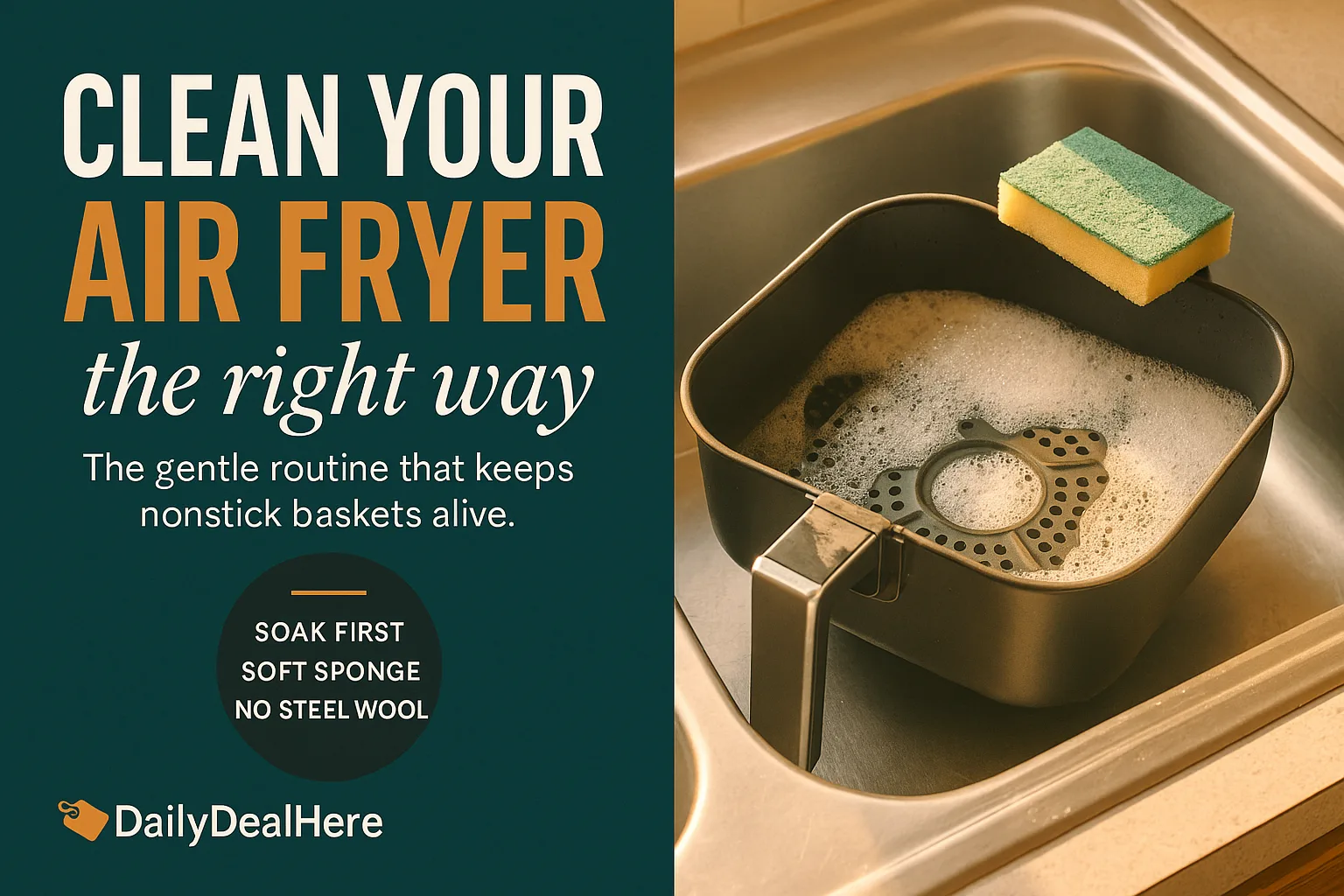
The safe way to clean an air fryer basket is warm water, dish soap, a soft sponge and patience: let the basket cool completely, soak it for twenty to thirty minutes, wipe rather than scrub, and never touch the nonstick surface with steel wool, metal utensils or abrasive powders. Almost every ruined basket we hear about died the same way, from aggressive scrubbing or harsh chemicals rather than from age or ordinary cooking.
That is the short version, and for a lightly used basket it is genuinely all you need. But most people arrive at this page with a specific problem: grease baked into the corners, a surface that feels tacky no matter how long it soaks, a smell that transfers into the next meal, or a coating that has started to lift. This guide covers the full routine, from the two minute wipe after dinner to the deep clean that rescues a neglected machine, plus the habits that decide whether your basket lasts one year or five.
What you need before you start
Nothing exotic, and that is the point. Everything on this list is already in most kitchens, and the specialty cleaners marketed for air fryers rarely outperform the basics.
- Dish soap. Ordinary liquid dish soap is the workhorse. It lifts cooking oil without attacking the coating.
- A soft sponge or microfiber cloth. The non-scratch side only. If a sponge has a green scouring layer, that layer never touches the basket.
- Baking soda. Mixed with water into a paste, it is mildly abrasive at a level nonstick tolerates, which makes it the right tool for baked-on spots.
- White vinegar. Useful for odors and mineral haze, and for loosening residue when combined with a soak.
- A soft brush or old toothbrush. For the crevices where the basket meets the drawer and around rivets and mesh.
- A dry towel. Drying matters more than people expect, because trapped moisture is where smells begin.
Notice what is absent: no oven cleaner, no bleach, no scouring powder, no steel or copper wool, no wire brush. Each of those either strips the nonstick layer outright or scratches it enough that food starts sticking within a few uses, and once the surface goes, no amount of gentle care brings it back.
The after-every-use routine that takes two minutes
The single biggest factor in how long a basket lasts is whether it gets cleaned while the mess is fresh. Grease that sits overnight polymerizes into a varnish that needs real effort to remove, and it is that effort, not the cooking, that damages coatings. Two minutes tonight saves twenty minutes and a scrubbing session next week.
Step one: let it cool. Pull the basket out so it cools faster, but do not run cold water over hot metal. Thermal shock can warp a thin basket and stresses the bond between the coating and the metal underneath. Ten to fifteen minutes on a heatproof surface is enough.
Step two: dump and wipe. Tip out crumbs and loose debris, then wipe the interior with a damp cloth or paper towel. For anything you cooked without breading or heavy sauce, this alone often finishes the job.
Step three: wash with warm soapy water. Fill the basket at the sink, add a squirt of dish soap, and go over the interior, exterior and the underside with a soft sponge. The underside matters: grease that drips down the outside bakes onto the heating chamber next time and is the usual source of smoke from a machine that has never been opened up.
Step four: rinse and dry fully. Rinse until the surface stops feeling slippery, then dry with a towel rather than leaving the basket to air dry inside the machine. Water pooling in the seams around handles and rivets is how discoloration and odor start.
If dinner involved anything sticky, sugary or heavily marinated, add one extra step before the wash: fill the basket with hot water and a squirt of soap and let it sit while you eat. By the time the table is cleared, the residue lifts with a gentle wipe instead of a fight.
The deep clean for baked-on grease
Sooner or later a basket accumulates a brown film in the corners and along the sides that ordinary washing skips over. That film is polymerized oil, and it responds to soaking and mild chemistry rather than force. Work through these methods in order and stop as soon as the surface is clean.
Method one: the long soak
Fill the basket with water as hot as your tap runs, add a generous squirt of dish soap, and leave it for thirty minutes to an hour. If the drawer also needs help, stand the basket inside the drawer and fill both. Long soaks do most of the work on their own, and everything that comes loose here is residue you do not have to scrub off later.
Method two: baking soda paste
Mix baking soda with just enough water to make a spreadable paste, roughly three parts powder to one part water. Spread it over the stubborn areas, let it sit for fifteen to twenty minutes, then work it gently with a soft brush in small circles. Rinse and inspect. This is the strongest tool that is still safe for nonstick, and it handles the majority of baked-on grease that survives a soak.
Method three: the vinegar and baking soda combination
For a basket that has been neglected for months, sprinkle baking soda over the damp surface, then spray or drizzle white vinegar over it. The fizzing reaction helps lift residue out of texture and mesh. Let it settle for ten minutes, wipe with a soft cloth, then wash normally with soap and rinse thoroughly so no vinegar smell carries into the next meal.
Method four: repeat rather than escalate
If residue remains, the correct move is a second soak, not a harder tool. Two gentle rounds always beat one aggressive round, because the aggressive round takes coating with it. A basket that needs four rounds is telling you the cleaning interval is too long, not that it needs a scouring pad.
Which cleaner for which problem
| Problem | Use this | Avoid |
|---|---|---|
| Everyday grease and crumbs | Dish soap, warm water, soft sponge | Anything abrasive |
| Baked-on brown film | Long soak, then baking soda paste | Oven cleaner, scouring powder |
| Sticky, tacky surface | Hot soak plus baking soda paste, then review your oil habits | Cooking spray, which caused it |
| Odors that transfer to food | Vinegar and water soak, then soap wash, then air dry | Bleach or scented cleaners |
| White mineral haze | Diluted white vinegar wipe | Descaling acids meant for kettles |
| Burnt sugar or sauce | Soak in hot soapy water, repeat as needed | Metal scrapers and knives |
Can you put an air fryer basket in the dishwasher?
Many manufacturers mark their baskets dishwasher safe, and an occasional cycle will not destroy one. The honest picture from long term owners is more nuanced: daily dishwashing ages nonstick coatings faster than hand washing, because dishwasher detergent is far more aggressive than dish soap and the heat cycle runs long. Detergent tablets contain enzymes and alkaline salts designed to strip baked food from stoneware, and a nonstick layer sits in that bath for the entire cycle.
Our practical position: treat the dishwasher as the exception and the sink as the rule. Use it when a basket needs rescuing and you would rather not scrub, or when life is too busy for the sink, and hand wash the rest of the time. If you do run a cycle, place the basket on the top rack away from the heating element, skip the heated dry, and take it out while it is still warm so it dries without water spots.
One firm exception: if your manual says hand wash only, believe it. Some baskets have coatings or bonded handles that fail in a dishwasher, and running one anyway usually voids the warranty on the part most likely to need replacing.
Why the basket feels sticky even after washing
This is the most common complaint we hear, and the cause is almost always aerosol cooking spray rather than dirt. Most sprays contain lecithin as an emulsifier along with propellants, and at air fryer temperatures those ingredients polymerize into a hard, slightly tacky lacquer that bonds to the coating. Ordinary washing slides right over it, which is why people conclude their basket is defective when it is actually varnished.
To remove existing buildup, run a long hot soak followed by baking soda paste, and expect to repeat the pair two or three times on an older basket. Some of it may never come off entirely, and that is worth knowing before you spend an evening on it.
To prevent it from returning, change how oil gets into the basket. Toss food with oil in a bowl before it goes in, or brush oil directly onto the food, or use a pump-style oil mister filled with plain oil rather than a commercial aerosol. The food still crisps, and the basket stays clean because oil that lands on food does not bake onto metal.
Cleaning the interior, the heating element and the drawer
The basket gets all the attention, but grease that reaches the chamber above it is what makes a machine smoke, smell, and eventually cook unevenly. Once a month, or sooner if you cook bacon and other fatty foods often, give the machine itself the same care.
Unplug the unit and let it cool completely. Turn it upside down or tilt it so you can see the heating element at the top of the chamber, and wipe the element and the surrounding surfaces with a damp cloth. For stuck residue, a cloth dampened with soapy water works, followed by a clean damp cloth to remove any soap. Never spray liquid into the chamber, never submerge the main unit, and never touch the element with anything abrasive.
The drawer needs the same treatment as the basket, since it catches every drip. Pull it fully out, soak it if the corners have browned, and pay attention to the seam where the basket seats, because that ledge collects grease invisibly. Finish with the exterior and the vents: a greasy film across the intake and exhaust makes the fan work harder and holds odors between sessions.
How to get smells out of an air fryer
Fish, garlic and heavily spiced marinades leave odors that follow into the next meal. Start with the mechanical fix, because smell usually means residue somewhere: clean the basket, drawer and chamber thoroughly, especially the element and the seams.
If the smell survives a proper clean, soak the basket and drawer in a solution of one part white vinegar to two parts warm water for thirty minutes, then wash and dry. A slice of lemon left in the basket overnight helps neutralize whatever remains. For a persistent case, run the empty machine at a moderate temperature for a few minutes with a small heatproof dish of water and lemon slices inside, which steams the chamber gently.
Storage matters too. A machine put away with the drawer fully closed traps moisture and odor together. Leaving the drawer slightly open between uses lets the chamber breathe and prevents that closed-container smell entirely.
The habits that ruin a coating
| Habit | What it does | Do instead |
|---|---|---|
| Steel wool and scouring pads | Scratches through the nonstick layer | Soft sponge plus a soak |
| Metal tongs, forks and knives in the basket | Gouges the surface at contact points | Silicone or wooden utensils |
| Oven cleaner and harsh degreasers | Chemically attacks the coating | Dish soap or baking soda paste |
| Aerosol cooking sprays | Builds a tacky lacquer that will not wash off | Oil the food, or use a plain-oil mister |
| Dishwasher every single day | Ages many coatings faster than hand washing | Hand wash as the default |
| Cold water on a hot basket | Warps metal, stresses the coating bond | Cool first, then wash |
| Cutting food inside the basket | One slip ends the coating | Move food to a board |
The utensil rule deserves emphasis because it is the easiest one to break by habit. Keep a pair of silicone tongs next to the machine so reaching for metal never happens by accident. It costs almost nothing and removes the most common cause of deep scratches.
Liners, parchment and accessories: helpful or harmful?
Perforated parchment liners genuinely reduce cleanup for sticky foods, and they are safe when used correctly, which means only ever placed under food that weighs them down. A loose liner can lift in the airflow and touch the heating element, which is a fire risk rather than a convenience. Never preheat with an empty liner in the basket.
Silicone liners and baskets are reusable and gentle on the coating underneath, at the cost of slightly less crisping because they block some airflow through the mesh. Foil is workable in small pieces under food, but it should never cover the whole base or block the perforations, and acidic foods react with it.
None of these are a substitute for cleaning. They reduce how much lands on the surface, which is worth something, but grease still reaches the drawer and the chamber, and a machine that never gets opened up still ends up smoking.
When the coating is scratched or flaking
Light scratches are cosmetic. Food starts sticking a little sooner in the scratched spots, and cleaning gets marginally harder, but the basket is still doing its job. Keep using it and be gentler than before, since scratches spread from their edges.
Active flaking is different, and it is the point where a basket should be retired. Not because a stray flake is a crisis, since PTFE is understood to pass through the body inert, but because a flaking basket is a worn tool: the exposed metal grabs food, the wear accelerates from the damaged edges, and cleaning becomes a chore you will resent.
The good news is that replacement rarely means a new machine. Baskets and drawers for popular models are sold as spare parts, and checking that spares exist is a genuinely good reason to choose a mainstream model in the first place, which is one of the things we weigh in our air fryer guide and our Ninja air fryer roundup. If the health side of coatings is what is bothering you, we cover it separately in our look at air fryer coating safety.
Notes for popular models
The routine above works for every basket-style air fryer, but a few design differences change the details.
Dual-basket models double the surface area and, in practice, halve how often each side gets cleaned properly. Rotate attention deliberately so the less-used zone does not accumulate a film nobody notices until it smokes.
Baskets with a removable crisper plate hide their worst grease under the plate, where the mesh meets the base. Always separate the two for washing; the ledge between them is where neglected machines go bad first.
Oven-style air fryers with racks and a glass door need the door and interior walls wiped as part of the routine, since spatter lands everywhere rather than being contained. Racks and trays usually tolerate soaking well, and many are genuinely dishwasher friendly because they are uncoated metal.
Ceramic-coated and stainless baskets follow the same gentle rules. Ceramic tolerates baking soda paste well; stainless can take slightly firmer treatment but scratches visibly, and food sticks more, so soaking is the standard move rather than the rescue move. If you are weighing a broader move away from nonstick surfaces, our cookware set roundup compares the materials side by side.
A cleaning schedule that actually gets followed
| How often | What to do | Time |
|---|---|---|
| After every use | Cool, wipe, wash basket and drawer with soap, dry | Two to three minutes |
| After fatty or sticky foods | Add a hot soak before washing | Plus a hands-off soak |
| Weekly | Check the crisper plate seam and the drawer ledge | Two minutes |
| Monthly | Wipe the chamber and heating element, clean vents and exterior | Ten minutes |
| When food sticks more than usual | Baking soda paste treatment, then inspect for wear | Twenty minutes |
| When flaking appears | Order a replacement basket | One order |
The schedule works because the daily step is short enough that nobody skips it, and the monthly step is the only one that requires setting time aside. Machines that die early almost always died from the daily step being skipped, not from the monthly one.
Mistakes worth naming one more time
First, washing while the machine is hot. It feels efficient and it warps baskets. Second, soaking the main unit or getting water into the housing, which is the one mistake that turns a cleaning session into a replacement purchase. Third, scrubbing before soaking, which is doing the hard version of a job that patience does for free. Fourth, cleaning the basket but never the chamber, so the machine smells and smokes while the part you can see looks spotless.
And fifth, storing it wet with the drawer closed. Every persistent odor complaint we have seen traces back to moisture sealed inside a warm plastic and metal box overnight.
Frequently asked questions
Can I use steel wool on an air fryer basket?
No. Steel wool and scouring pads scratch through the nonstick layer and are the fastest way to ruin a basket. Use a soft sponge with a soak, or a baking soda paste for baked-on spots.
Why is my air fryer basket sticky even after washing?
Usually it is polymerized cooking spray. Aerosol sprays contain lecithin and propellants that bake into a tacky lacquer at air fryer temperatures, and normal washing does not remove it. A long hot soak followed by baking soda paste helps, and oiling the food instead of the basket prevents it from returning.
Is it safe to put an air fryer basket in the dishwasher?
If the manufacturer marks it dishwasher safe, an occasional cycle is fine. Daily dishwashing ages nonstick coatings faster than hand washing because detergent is far more aggressive than dish soap, so the sink is the better default. If your manual says hand wash only, follow it.
How do I remove baked-on grease from an air fryer basket?
Soak in hot soapy water for thirty minutes to an hour, then apply a baking soda paste, let it sit fifteen minutes and work it gently with a soft brush. Repeat the soak rather than escalating to an abrasive if residue remains.
How do I clean the heating element of an air fryer?
Unplug the machine and let it cool, then tilt or invert it so you can reach the element, and wipe it and the surrounding chamber with a damp cloth. Never spray liquid inside, never submerge the main unit, and never use anything abrasive on the element.
How often should I clean my air fryer?
Wash the basket and drawer after every use, check the crisper plate seam weekly, and wipe the chamber, element and vents monthly or more often if you cook fatty foods. The daily step is the one that decides how long the machine lasts.
How do I get the smell out of my air fryer?
Clean the basket, drawer and chamber thoroughly first, since odor usually means residue. If it persists, soak the removable parts in one part white vinegar to two parts warm water for thirty minutes, wash, and dry fully. Storing the machine with the drawer slightly open prevents the smell from returning.
Should I replace a flaking air fryer basket?
Yes. Light scratches are cosmetic, but active flaking means the basket is worn out: food sticks to the exposed metal and the damage spreads from the edges. For popular models the basket is sold separately, so you rarely need a whole new machine.










Write Your Review
No reviews yet. Be the first to share your experience!