

A tension rod is the only curtain hardware that asks nothing of your walls, which is why it ends up in rentals, dorms, RVs and every bathroom where nobody wants to drill into tile. It is also the piece of hardware people replace most often, because the rod that holds a shower liner for three years and the rod that slides down the wall by morning look almost identical in a product photo. The difference is in the mechanism, the diameter and what is on the ends. We sorted 8 rods from Zenna Home, Ivilon, AIJIEGUANG and more by how they grip, how far they extend and how much they can honestly carry.
Our top pick is the Ivilon Spring Tension Curtain Rod for its wide adjustment range and a spring mechanism that works over a window or across a shower without changing hardware. Below, the list splits into two jobs that are easy to confuse: slim rods for windows, doorways and cupboards, and thicker steel rods built to carry a shower curtain and liner in a wet room. Buy for the job, not for the finish. More fittings for the house sit in our home and kitchen section.

Pros
- Positioned for windows and showers rather than one or the other
- Wide adjustment range covers most standard openings
- Decorative finish meant to be seen rather than hidden
- Spring mechanism installs in seconds with no tools
- Available in several finishes to match existing hardware
Cons
- A spring mechanism has less holding force than a twist to tighten rod
- At the top of its range the tube overlap is short, so heavy curtains will bow it
The Ivilon is the rod on this list that does not force you to choose a room. Most tension rods are sold either as slim window hardware or as thick bathroom hardware, and this one is positioned for both, which is genuinely useful when you are furnishing a rental and do not want two different products.
The span is the strongest argument. A range that runs from fifty four to ninety inches covers standard windows, most tub alcoves and a good number of doorways, and it does so without landing at the extreme end of the adjustment where tension rods get unreliable.
Finish is part of the point here. This is a rod meant to be visible above a curtain header rather than buried behind one, and the choice of colourways reflects that. On a window where the rod is part of the look, that matters more than another quarter inch of diameter would.
The honest limitation is the mechanism. A spring generates less outward force than a threaded twist rod, so at the wide end of the range with a wet shower liner you are asking a lot of it. Keep the load moderate, or move to a heavy duty twist rod for the bathroom.
Bottom line: the most versatile pick here, and the right default if you want one rod that suits both a window and a shower.
- Mechanism: spring tension
- Adjustment range: 54 to 90 inches
- Use: windows or shower
- Finish: warm gold, other finishes available
- Installation: no drilling, no tools
- End caps: non slip
Measure the opening at the exact height you plan to mount, then check that the figure sits comfortably inside the fifty four to ninety inch range rather than at either end. If your opening is close to ninety inches, choose a thicker twist rod instead. If it is well under fifty four, one of the short spring rods further down this list is the correct size.
Compress the rod, seat one end against the wall, then let the spring extend into the opposite side and check that it sits level before hanging anything. Load the curtain evenly rather than bunching it at one end, and give the rod a firm downward tug before you trust it. If it slips, shorten it by an inch and reseat rather than forcing more compression.

Pros
- Very wide adjustment range for a bathroom rod
- Rust resistant finish suited to constant humidity
- Anti slip end caps rather than bare plastic
- No drilling, which suits tiled walls and rentals
- The most widely owned rod in this list
Cons
- The widest spans in its range leave little tube overlap
- Straight profile gives no extra elbow room inside the tub
The TEECK is the mainstream bathroom answer here, and the range is why. Thirty two to eighty inches covers everything from a narrow shower alcove to a full tub, so it is the rod most likely to fit whatever bathroom you are dealing with without a second trip.
Rust resistance is the specification that matters in this room and the listing leads with it. A painted steel tube that chips in a wet environment corrodes from the inside where nobody sees it until the rod stains a towel, so a finish designed for humidity is not a small feature.
The end caps are anti slip rather than bare plastic, which is where a shower rod succeeds or fails. Tile is smooth and a hard cap skates on it, especially once the curtain is pulled sideways. Rubber style caps spread the load and hold on a glazed surface far better.
Treat the range with the usual caution. At the eighty inch end the two tubes barely overlap, and that is the configuration where a wet liner produces a visible bow. If your alcove is near the top of the range, a thicker one inch rod is the safer purchase.
Bottom line: the sensible default for a rental bathroom, provided your span sits in the middle of its range rather than at the end.
- Mechanism: spring tension with adjustable tubes
- Adjustment range: 32 to 80 inches
- Finish: rust resistant silver
- End caps: anti slip
- Installation: no drilling
- Use: shower, tub, RV and alcove
This is for renters and anyone who cannot drill into tile, and for bathrooms whose measurements sit somewhere in the middle of a wide range. It is not the right pick if you want the curtain pushed away from the tub, which needs a curved rod, or if your liner is unusually heavy and the span is near eighty inches.
Wipe the rod dry where it meets the wall now and then, since standing moisture at the caps is what eventually loosens grip and marks paint. Check the tension every few months by pushing up on the middle of the rod. Do not use a shower rod as a grab bar or a towel rail under load, because friction mounted hardware is not designed to take body weight.

Pros
- Full one inch diameter, which is the class that resists bowing
- Rust resistant steel construction for wet rooms
- Sag resistant design aimed at wide tub spans
- No tools or drilling required
- Sized for tubs, RVs and apartment bathrooms
Cons
- Thicker tube is more visible than a slim window rod
- Needs flat, square walls on both sides to hold properly
The ENJOYBASICS sits in the heavy duty half of this list, and the diameter is the reason. A full one inch tube carries far more steel than the slim window rods, and stiffness is what stops the middle of a rod dipping once a wet liner hangs from it.
Thirty to seventy six inches is a practical range for a bathroom, and unlike the wider ranging rods it does not stretch so far that the tube overlap disappears. That is part of why the sag resistant claim is credible here: it is a shorter maximum span on a thicker tube.
Steel with a rust resistant finish is the right material choice for the room. The black finish also hides water spotting better than a bright chrome tube, which is a small but real advantage in a bathroom that does not get wiped down daily.
Two things to plan for. A one inch rod is visually chunky, so it reads as hardware rather than disappearing behind a curtain header. It also needs two flat, parallel walls to develop its grip, which older bathrooms with rounded corners do not always provide.
Bottom line: the pick when the liner is heavy and the span is wide, as long as the walls are square.
- Mechanism: tension, no drilling
- Diameter: 1 inch
- Adjustment range: 30 to 76 inches
- Material: rust resistant steel
- Finish: black
- Use: tubs, RVs and apartment bathrooms
Choose the one inch class if you are hanging a curtain and a liner together, or if a previous rod bowed in the middle. Measure the alcove at the height you intend to mount, not at the floor, because tub surrounds are frequently out of true. If your measurement lands above seventy six inches, this is the wrong rod and no amount of tightening will fix that.
Set the rough length first, seat both caps flat against clean dry tile, then tighten until the rod is firm rather than until it stops turning. Overtightening does not add grip, it just prints a ring into the wall. Hang the liner inside the tub so its weight pulls straight down, and keep the curtain rings distributed rather than bunched at one end.

Pros
- Correctly sized for narrow windows and doorways rather than oversold on span
- Seven eighths inch diameter is stiff enough for light lined panels
- Spring load installs in seconds with no tools
- White finish disappears against most window reveals
- Works in kitchens, closets and wardrobes as well as windows
Cons
- Range stops at 48 inches, so it is no use on a wide window or a tub
- Light duty by design, so blackout drapes are out of scope
The MEXAU is a window rod that knows it is a window rod. Twenty eight to forty eight inches is a modest range, and that restraint is a feature: the rod is never asked to stretch to a span its diameter cannot support, which is where most tension rod failures start.
Seven eighths of an inch is a useful middle diameter. It is noticeably stiffer than the very slim cafe rods, so a light lined panel does not produce a visible dip, while staying slim enough to sit inside a window reveal without dominating it.
Installation is the spring loaded routine: compress, seat, release, check level. It takes seconds, needs no tools and leaves nothing behind, which is the entire reason this category exists for renters and anyone in student housing.
The limits are clear from the specification. This is not a bathroom rod and not a wide window rod, and hanging thermal blackout curtains on it will end with the rod on the floor. Within its span and its weight class, it is exactly the right tool.
Bottom line: the correct choice for a narrow window, a doorway or a wardrobe, and the wrong one for anything wide or heavy.
- Mechanism: spring loaded tension
- Adjustment range: 28 to 48 inches
- Diameter: 7/8 inch
- Finish: white
- Installation: no drilling, no tools
- Use: windows, doorways, closets, cupboards
Buy this for a narrow window, a kitchen or a wardrobe interior where a light curtain needs to hang and nothing can be screwed into the wall. It suits renters, dorm rooms and temporary set ups. It is the wrong rod for a bathroom, for a wide living room window, or for any curtain with a thermal lining.
Wipe the wall contact points before installing, because dust under a cap is the most common reason a new rod slips. Check tension after the first week, since a spring settles slightly once it has been loaded. Keep the rod out of reach of small children where possible, as a friction mounted rod comes down if a curtain is pulled hard enough.

Pros
- Curved profile pushes the curtain away from the body and adds room in the shower
- Rustproof finish suited to permanent humidity
- Non slip ends for tiled walls
- No drilling, which suits rentals and tile surrounds
- Established name in bathroom fittings
Cons
- A curve puts outward twist on the end caps, so it needs square, solid walls
- Narrower adjustment range than the straight rods here
- Bronze finish will not match every bathroom
The Zenna Home is the one rod here that changes the shower rather than just holding the curtain. A curved rod bows outward at the centre, which pushes the curtain away from your shoulders and buys real space inside a standard tub. It is the reason hotels use them.
Zenna Home is a long standing name in bathroom fittings, and the specification reflects that focus: a rustproof finish for permanent humidity, non slip ends for tile, and a tension mount so nothing gets drilled into a tiled surround.
The range is narrower than the straight rods on this list, running from fifty to seventy two inches. That is deliberate rather than limiting, since a curved rod carries load differently and stretching one to an extreme span would undermine the grip at both ends.
The trade off is what the curve does to the mounting. Bowing the rod outward means each cap is pushed both sideways and slightly outward, so the walls need to be flat, square and solid. In an older bathroom where the surround is out of true, a straight rod is more forgiving.
Bottom line: buy it if elbow room in the tub is the actual complaint, and check your walls are square before ordering.
- Mechanism: tension mount, no drill
- Profile: curved
- Adjustment range: 50 to 72 inches
- Finish: bronze, rustproof
- End caps: non slip
- Use: standard tubs and shower alcoves
This suits anyone who finds a standard tub cramped, or whose shower curtain clings inward during a shower. It works best in a bathroom with flat, square tiled walls. It is not the right pick for an out of true alcove, for a very wide opening, or for a bathroom where the fittings are chrome and a bronze rod would look out of place.
Set the rod just above the tile line where the wall is flat on both sides, not as high as it will go, because height adds leverage against the caps. Seat one end fully before extending into the other, then check the curve is even from the front. Keep the liner inside the tub so water runs down into the bath rather than onto the floor.

Pros
- Stainless steel rather than painted steel, so corrosion is not a concern
- One inch diameter for the heaviest liners
- Very wide adjustment range for a heavy duty rod
- Non slip ends for tile and glass
- No drilling and no wall fixings
Cons
- Heavy and visually substantial in a small bathroom
- At the eighty inch end even a thick tube will show some bow under load
The CorkLatta is the heaviest duty option here, and it earns that with material rather than marketing. Stainless steel does not rust from a chipped coating the way painted steel does, which is the failure that eventually stains towels and marks a curtain in a humid bathroom.
A one inch tube across a thirty one to eighty inch range makes this the pick for a wide alcove carrying a heavy liner. Diameter is the main defence against sag, and this is at the top of the class for a tension rod that still installs without tools.
Non slip ends do the gripping work, which matters more as the rod gets heavier. A substantial steel tube plus a wet liner puts real load on two small contact patches, and a hard plastic cap on glazed tile would not hold it.
Two practical notes. In a small bathroom a one inch black rod is a visible piece of hardware rather than a discreet one. And even stainless steel bows somewhat at the far end of an eighty inch span, so treat the top of the range as the limit rather than the target.
Bottom line: the strongest choice for a heavy liner on a wide tile wall, and overkill for a narrow window.
- Mechanism: tension, no drilling
- Diameter: 1 inch
- Material: stainless steel
- Adjustment range: 31 to 80 inches
- End caps: non slip
- Finish: black
Pick this when the previous rod bowed or fell, when the liner is heavy, or when the alcove is wide. Measure at mounting height and aim to land in the middle of the range. If your span is under about forty inches, a slimmer rod does the same job with less bulk, and the extra steel is doing nothing for you.
Stainless steel needs little maintenance, but the wall contact points still benefit from being wiped dry, since moisture under a cap reduces grip. Retighten every few months. Never hang on the rod or use it as a support when stepping into the tub, because a friction mounted rod is not rated for body weight no matter how heavy the tube is.
Pros
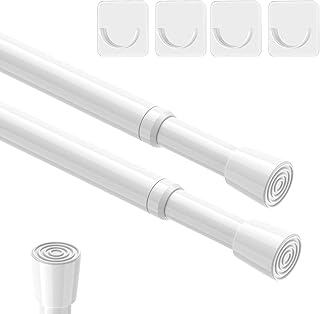
- Two rods in one pack, which covers a pair of windows or a top and bottom door panel
- Short span is where a spring mechanism is at its most reliable
- Installs in seconds with no tools or fixings
- White finish blends into most window reveals
- Useful in cupboards, wardrobes and camper vans as well as windows
Cons
- Short range only, so it is no use on a standard window or a tub
- Slim tube is for light curtains only, not lined panels
The AIZESI is the pack to buy when the job is small and there is more than one of it. Two short spring rods in a single pack covers a pair of kitchen windows, a top and bottom door panel, or a window and a cupboard, which is the situation most people are actually in.
Short spans are where spring tension is at its best. There is little length for the tube to bow across, the spring is working near its designed compression, and the load from a light panel is modest. That is why cupboard and cafe rods almost all use this mechanism.
Twenty six to thirty nine inches is precise about its purpose. The listing points at doors and windows in the twenty eight to thirty six inch range, which is a realistic working span rather than the outer limit of the adjustment.
Keep expectations in line with the tube. This is a slim rod for sheers, net panels and light cafe curtains. Hanging a lined or blackout panel on it, or trying to press one into bathroom duty, is asking for the rod to come down.
Bottom line: the cheapest sensible way to solve two small curtain problems at once, within a strict weight limit.
- Mechanism: spring loaded tension
- Quantity: 2 rods per pack
- Adjustment range: 26 to 39 inches
- Suggested opening: 28 to 36 inches
- Finish: white
- Installation: no drilling, no tools
This is for small openings in multiples: door panels, kitchen and bathroom windows, cupboard fronts, campervan and RV windows. It suits renters and anyone furnishing on a budget. It is not for wide windows, heavy curtains or shower duty, all of which need a thicker rod with a stronger mechanism.
Extend each rod to slightly wider than the opening, compress, then seat and release so the spring holds it. For a door panel, use one rod at the top and one at the bottom so the fabric stays flat instead of swinging when the door moves. Wipe the contact points first, because dust under a cap is the usual reason a short rod slips.
Pros
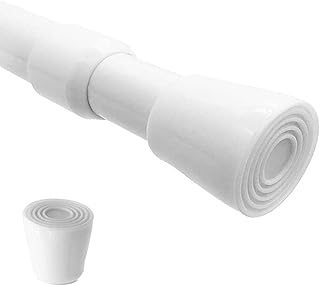
- Steel tube rather than the lighter aluminium used in many short rods
- Compact range that keeps the rod stiff across its whole span
- Expandable spring load with no drilling
- Works in kitchens, cupboards and doorways as well as windows
- Short enough to stay firm without a locking collar
Cons
- Range tops out at 43 inches, so it is a small opening rod only
- Plain utility finish rather than a decorative one
The AIJIEGUANG is the short rod for people who found the very slim ones too flimsy. Steel construction across a compact twenty eight to forty three inch range gives it more stiffness than the usual cafe rod, and stiffness across a short span is what stops a curtain sagging in the middle.
The intended jobs are spelled out on the listing: windows, kitchens, doorways, bathrooms and cupboard bars. That last one is worth noting, because a stiff short rod is genuinely useful as a hanging bar inside a cupboard where a flexible tube would bend.
Spring loading keeps installation to a few seconds and leaves nothing behind on the wall, which is the point of the whole category. Within this span the spring has plenty of authority, and there is no threaded collar to fiddle with.
Its limits are the range and the look. Above forty three inches it simply does not fit, and the finish is functional rather than decorative, so this is a rod to hide behind a curtain header rather than to display above one.
Bottom line: the sturdier short rod, best suited to cupboards, doorways and small windows where a slim tube would bend.
- Mechanism: spring loaded tension
- Adjustment range: 28 to 43 inches
- Material: heavy duty steel
- Installation: no drilling, expandable
- Use: windows, kitchens, doorways, cupboards
- Finish: plain utility
Choose this over a slimmer short rod if your last one bowed under a light curtain or if the rod doubles as a hanging bar. Measure the opening and aim for the middle of the twenty eight to forty three inch range. Anything wider than that needs a longer rod with a larger diameter, not this one stretched to its limit.
Clean and dry both wall contact points before fitting, and check the tension after a week of use. In a bathroom, dry the ends occasionally so moisture does not sit at the cap. Do not hang anything heavy from a short rod used as a cupboard bar, since the friction mount has no mechanical fixing to fall back on.
How to Choose a Tension Curtain Rod
Six things decide whether a tension rod stays up. None of them is the colour, and only one of them is visible from across the room.
Spring Loaded or Twist to Tighten

There are two mechanisms in this category and they fail in different ways. A spring loaded rod has an internal spring that pushes the two tubes apart: you compress it, drop it into the opening and let go. Installation takes seconds and needs no strength, which is why the short rods for cupboards and small windows almost all work this way.
A twist to tighten rod uses a threaded inner tube instead. You set it roughly to length, wedge it in place and then rotate one half so the thread walks the tube outward against the wall. It develops far more force than a spring can, and that force is what holds a wet shower curtain up for years. It also takes two hands and a little patience to get square.
Choose by load, not by convenience. Spring rods are correct for sheer panels, cafe curtains, closet dividers and anything light. Twist rods are the right answer for a shower curtain plus liner, for blackout panels, and for any span over about five feet where a spring simply runs out of push. Several rods here combine a spring with a locking collar, which is the middle ground.
Match the Adjustment Range to the Opening
Every rod here quotes a range, such as thirty to seventy six inches or twenty eight to forty eight. Measure the opening at the exact height you plan to mount, because window reveals and tub alcoves are rarely square and the number at the top is often different from the number at the sill.
The important rule is to land in the middle of the range rather than at either end. A rod stretched to its last inch has almost no tube overlap left, which is where the sag and the sudden collapse come from. A rod compressed to its shortest has the opposite problem: the two tubes bottom out and the spring never gets to do its job. Aim for an opening that sits comfortably inside the quoted span.
Wide ranges look generous and hide a compromise. A rod that claims thirty to eighty inches is a long thin tube at full extension, and it will bow visibly under a heavy liner even though it technically fits. If your opening is near the top of a rod’s range, size up to the next model rather than pushing that one to its limit. Our category index lists the wider home fittings aisle.
What a Tension Rod Can Honestly Carry
This is the part the listings are quietest about. A tension rod holds nothing up by mechanical fixing. It stays in place through friction between two end caps and two walls, and every pound you hang increases the downward force trying to break that friction. That is a genuinely different situation from a bracket screwed into a stud, and it caps what you can hang.
In practice, a slim spring rod is comfortable with sheers, net panels and light cafe curtains. A one inch steel twist rod handles a shower curtain with a liner, or a pair of lined cotton panels, provided the span is not extreme. Heavy blackout drapes with thermal backing are where tension rods stop being the right tool, and no amount of tightening changes that.
Weight is not the only load. Anything that yanks the rod sideways or downward, a child pulling on a curtain, a shower liner catching wind from an open window, a wet towel thrown over the rod, applies a shock load far above the static weight. If the rod lives somewhere that happens, pick the thickest steel option you can and treat the stated capacity as a fair weather figure.
Diameter, Wall Thickness, and Sag
Diameter is the fastest read on how serious a rod is. The slim rods in this category run around half an inch to seven eighths of an inch and suit windows, doorways and cupboards. The one inch rods are a different class: thicker tube, more steel, and enough stiffness to cross a bathtub without bowing in the middle.
What the listing rarely states is wall thickness, and that is what actually resists bending. Two rods can share an outer diameter while one is noticeably heavier in the hand because the tube is thicker. Weight in the specification is a reasonable proxy: for the same length and diameter, the heavier rod is the stiffer one.
Material matters at the wet end of the category. Rust resistant or stainless steel is worth insisting on for a bathroom, since a painted steel tube that chips will rust from the inside where you cannot see it. Aluminium resists corrosion well and is lighter, but it is also softer, so an aluminium rod at a long span bends where a steel one would hold.
End Caps Are the Whole Grip

Everything a tension rod does happens in the last half inch at each end. A rubber or silicone cap spreads the force over a wider patch and grips painted drywall, tile and glass; a bare plastic cap skates on gloss paint and gouges matte. The non slip language in these listings refers to that cap, and it is the single most useful feature on the page.
The surfaces have to cooperate too. Tension needs two parallel, flat, solid faces. Tile and plaster are ideal. Textured wallpaper, soft plasterboard with no backing and rounded window reveals are all poor, and a rod that seems fine on day one slowly works loose on them. Mounting inside a wooden window reveal is usually the most reliable option in a room.
Wall marks are the common complaint and mostly preventable. The force concentrated on a small cap will print a ring into soft paint over months, so the fix is a wider cap or a small clear adhesive pad on each wall as a sacrificial layer. Both keep the deposit conversation short when a rental ends. Basic wall repair supplies are grouped in our tools and home improvement section.
Shower Rods Are a Different Job

A bathroom rod faces problems a window rod never sees. It carries a curtain and a liner, both of which get heavy when wet, it is pulled sideways every time somebody closes the curtain, and it lives in permanent humidity. That is why the shower rods here are thicker, are almost always the twist to tighten type, and make a point of their rust resistance.
Curved rods solve a specific complaint. Bowing the rod outward at the middle pushes the curtain away from the tub and buys real elbow room in the shower, which is why they are standard in hotels. The trade is that a curve puts an outward twist on both end caps, so a curved rod needs a firm, square wall on each side and is less forgiving of an out of true alcove than a straight one.
Height affects grip more than people expect. Mounting a shower rod high looks tidy, but the higher it goes, the more leverage a tug on the curtain applies to the caps. Set it just above the tile line where you get flat, solid wall on both sides, and keep the liner inside the tub so its weight pulls down rather than out.
| Rod type | Typical span | Comfortable with | Watch out for |
|---|---|---|---|
| Short spring rod | Around 26 to 48 inches | Cafe curtains, cupboards, small windows | Runs out of spring force on wide openings |
| Standard window tension rod | Around 28 to 66 inches | Sheers and light lined panels | Sags near the top of its range |
| Heavy duty steel shower rod | Around 30 to 80 inches | Shower curtain plus liner | Needs flat, square walls on both sides |
| Curved shower rod | Around 50 to 72 inches | Standard tubs where elbow room matters | Outward twist on the end caps |
Why You Should Trust Us
We build these lists from published specification and from the pattern of what long term owners report, not from marketing copy. For every rod here we checked the tension mechanism, the quoted adjustment range against the diameter, the stated material and finish, what the end caps are made of, and whether the maker positions the rod for a window, for a shower, or for both.
We set aside near identical listings that differ only in colour or in a single size increment, so every entry is a genuinely different rod. Where a listing promises a span far beyond what its diameter can hold without bowing, we say so rather than repeating the headline number, and we separate the bathroom rods from the window rods because the two are not interchangeable.
Final Thoughts
Best overall is the Ivilon Spring Tension Curtain Rod. It is the one rod here that the maker positions for a window or a shower without qualification, the adjustment range covers most standard openings without stretching to its limit, and the finish is meant to be seen rather than hidden behind a curtain header.
Best value is the AIZESI Spring Tension Curtain Rod, which arrives as a pair. Two short rods in one pack covers a kitchen window and a cupboard, or the top and bottom of a door panel, and short spans are exactly where a simple spring mechanism is at its most reliable.
For specific needs, the TEECK Spring Tension Shower Curtain Rod is the pick for a bathroom that needs a wide span with anti slip caps, the Zenna Home Curved Shower Curtain Rod is the one to buy if elbow room in the tub is the actual complaint, and the CorkLatta Heavy Duty Shower Curtain Rod is the choice for the heaviest liner on a tile wall. For a narrow window, doorway or wardrobe, the MEXAU and AIJIEGUANG rods are correctly sized and the wide span models are not. More picks for the house are indexed across our article archive.
Tension Curtain Rod FAQs
How much weight can a tension curtain rod hold?
Less than most people assume, because nothing is fixed to the wall. The rod stays up through friction between two end caps and two surfaces, so every pound hung on it works against that grip. A slim spring rod is happy with sheers and cafe curtains. A one inch steel twist rod will carry a shower curtain with a liner, or a pair of lined panels, if the span is moderate. Heavy thermal blackout drapes are past the point where a tension rod is the right hardware, and tightening it further does not change the physics.
Will a tension curtain rod damage the paint?
It can, and the damage is usually a pressure ring rather than a gouge. All the force sits on two small caps, so soft or freshly painted walls slowly take an impression over months. Rubber or silicone caps spread that load better than hard plastic ones, and a small clear adhesive pad on each wall acts as a sacrificial layer that takes the mark instead of the paint. Avoid sliding the rod sideways once it is under tension, since that is what turns a ring into a scuff.
Spring or twist: which one stays up longer?
Twist to tighten, in almost every case where load is involved. A threaded inner tube can generate far more outward force than a spring, and that force is what resists the downward pull of a wet liner. A spring rod is quicker to install and perfectly reliable for light curtains over short spans, which is why cupboard and cafe rods use it. If your rod has fallen before, moving to a twist mechanism fixes the problem more reliably than buying the same type again.
Can I hang blackout curtains on a tension curtain rod?
Only the lighter ones, and only on a thick steel rod at a modest span. Lined blackout panels are among the heaviest curtains sold, and a slim rod will either bow in the middle or lose grip at one end within weeks. If blackout is the goal in a rental, two better routes are a lighter blackout panel on a one inch twist rod, or a blackout liner clipped behind an existing light curtain. More fittings and fixings for the house sit in our home and kitchen section.
Why does my tension curtain rod keep falling down in 2026?
Four causes cover nearly all of it. The rod is near the top of its adjustment range, so there is too little tube overlap left. The end caps are hard plastic on a glossy or textured surface that gives them nothing to grip. The load is beyond what friction can hold, usually a wet liner on a slim rod. Or the two walls are not parallel, which is common in older bathrooms and window reveals. Work through them in that order, and switch to a thicker twist rod with rubber caps if the answer turns out to be more than one of them.





Write Your Review
No reviews yet. Be the first to share your experience!