
Almost everyone arrives here after the same conversation at a checkup, and almost everyone leaves the shop with the wrong shape of product. What is on the shelf is not one category but three that happen to sit together: chews that clean by being chewed, brushes and pastes that clean the way your own toothbrush does, and additives you pour into water or sprinkle on food. They do different jobs, they suit different dogs, and the one your dog will actually accept every day beats the one that scores better on paper. We looked at 9 products from Greenies, Pedigree, Virbac and more, sorted by mechanism first, then by dosing, texture and how easily they fit into a normal week. Related supplies sit in our health and household section.
Our top pick is the Greenies Original Dental Dog Treats for combining a chewable texture that reaches the gumline with the daily compliance that makes any home routine work. Below we separate the three mechanisms so you can match one to the dog you actually have rather than the dog on the packaging. Nothing here replaces an examination by a veterinarian, and the products are described by what their labels state.

Pros
- Texture deforms around the tooth rather than shattering
- Sold in weight bands so the size can be matched to the dog
- Most dogs take it willingly, which is what makes a routine stick
- Maker states it cleans to the gumline
Cons
- It is a treat with calories that need taking off the food bowl
- Wrong size band can be swallowed whole by an eager dog
- Chews suit dogs that chew, not dogs that gulp
Greenies is the chew that made this a category, and the reason it stays at the top is not clever chemistry. It is that dogs eat it every day without argument, and a home dental routine only works if it survives contact with a normal week.
The texture is the engineering. It is firm enough to resist the tooth for several seconds and soft enough to deform around it, which is what puts the surface in contact with the gumline instead of skating over the crown. Chews that shatter on the first bite do not do that.
Sizing is more than packaging. The range is banded by the dog's weight, and matching the band matters in both directions: too small and an enthusiastic dog swallows it whole, too large and it goes uneaten. Read the weight range on the pack rather than guessing by breed.
The cost people forget is calorie load. A daily chew is a daily treat, and for a small dog that is a meaningful share of the day's intake. The label states the figure, and the sensible approach is to subtract it from the food bowl rather than adding it on top.
Bottom line: the routine that actually gets kept, which is why it is the first thing to try.
- Mechanism: chewable dental treat, cleans by abrasion
- Size band: teenie, stated for dogs 5 to 15 pounds
- Flavor: original chicken
- Maker claims: cleans to the gumline, cleaner teeth after 28 days
- Format: individually shaped chews in a resealable pack
- Feeding: one per day, calories count toward daily intake
Buy this if your dog chews rather than gulps and you want a routine that needs no cooperation beyond accepting a treat. Skip it if your dog swallows things whole, in which case supervision is not enough and a passive additive is safer, and skip it if weight management means there is no room in the daily calorie budget for a treat.
Match the size band to your dog's actual weight and give the chew where you can watch, taking the last small piece away from a fast eater. Fresh water should always be available alongside. Subtract the treat calories from the daily food rather than adding them, and speak to a veterinarian before starting any dental routine on a dog with a known mouth problem.

Pros
- Paste, long brush and finger brush supplied together
- Enzymatic paste is made to be swallowed, so no rinsing step
- Finger brush is the gentler starting point for a nervous dog
- Brushing is the mechanism with the most direct tooth contact
Cons
- Needs a dog that tolerates handling around the mouth
- Requires owner commitment rather than a passive routine
- Paste flavor will not suit every dog on the first try
Brushing is the mechanism with the most direct contact of anything in this list, and this kit is the cheapest sensible way to find out whether your dog will tolerate it.
Supplying both a long handled brush and a finger brush is the practical part. Dogs vary enormously in what they accept, and having both means the first attempt is a test rather than a gamble on the wrong tool.
The paste is enzymatic and formulated to be swallowed, which removes the step no dog can perform. There is no rinsing, no spitting, and nothing to wipe away, so the whole procedure is shorter than a first time owner expects.
The honest requirement is you. This mechanism asks for consistency in a way a chew does not, and a kit that lives in a drawer after week two does less good than an additive poured into a bowl without thinking. Start with the finger brush and a few seconds at a time.
Bottom line: the most direct method here and the least expensive way to try it properly.
- Mechanism: brushing with an enzymatic paste
- Included: toothpaste, long handled brush, finger brush
- Rinsing: none required, paste is made to be swallowed
- Brush heads: two sizes on the long handle
- Suitable for: dogs that tolerate handling around the mouth
- Use: aim for daily, per the label instructions
Start by letting the dog lick paste off your finger for a couple of days so the flavor becomes a reward rather than a surprise. Move to the finger brush next, doing only a few teeth on the outside surface at a time, since the outside is where deposit gathers most and the inside is where dogs object most. Build up in short sessions rather than trying to complete the mouth on the first attempt.
Never substitute human toothpaste, since many contain xylitol which is dangerous to dogs and none are formulated to be swallowed. Rinse the brushes after use and replace them when the bristles splay. Stop and consult a veterinarian if you see bleeding, if the dog flinches from a particular area, or if brushing appears to cause pain rather than mild annoyance.

Pros
- Dual enzyme system named on the label
- Poultry flavor is widely accepted by fussy dogs
- Sold as paste only, so no duplicate brushes
- No rinsing needed after brushing
Cons
- Brush is not included, so it needs pairing
- Flavored pastes are not universally accepted
- Small tube gets through quickly with a large dog
This is the paste to buy when the brush is not the problem. Plenty of owners already own a soft brush or a finger brush and only need a pet safe paste to go with it, and buying a full kit again is waste.
The formulation is enzymatic, and the label names a dual enzyme system as the active approach rather than relying on abrasives. Like all pet pastes it is made to be swallowed, so the routine is brush and finish with nothing to rinse.
Flavor is the practical differentiator, and poultry is the version most owners report the least resistance to. Palatability is not a marketing nicety in this category, it is the whole reason a dog stands still for the procedure.
The limitation is quantity. A small tube goes a long way on a terrier and disappears quickly on a large dog brushed daily, so factor the reorder into the routine rather than being surprised by it.
Bottom line: the straightforward paste refill, and a sensible pairing with a brush you already trust.
- Mechanism: enzymatic toothpaste used with a brush
- Active approach: dual enzyme system per the label
- Flavor: poultry
- Rinsing: not required
- Species: dogs and cats
- Format: tube, brush sold separately
Choose this if you already own a brush or a finger brush and only need paste. Choose a full kit instead if you are starting from nothing and want to try both tool styles. If your dog has refused one flavor of pet paste before, try a different flavor rather than abandoning brushing, since acceptance is usually about taste rather than the procedure.
Keep the cap on and the tube out of reach, as a flavored paste is attractive enough that a dog will help itself given the chance. Never swap in human toothpaste, which may contain xylitol and is not made to be swallowed. Introduce the paste on a finger for a couple of days before a brush goes anywhere near the mouth.

Pros
- Requires no cooperation from the dog at all
- Marketed as having no strong taste or smell in the bowl
- One bottle covers a long stretch of daily dosing
- Works for dogs that will not tolerate handling
Cons
- Chemical action only, with no mechanical cleaning
- Dose is per volume of water, so a topped up bowl drifts off dose
- Some dogs still notice a change in the bowl
Water additives exist for the dogs that make brushing impossible, and there are far more of those than product marketing admits. This one is dosed into the bowl and asks nothing of the animal beyond drinking as usual.
Oxyfresh markets its formula as unobtrusive in taste and smell, which is the specification that matters most in this format. A dog that stops drinking because the bowl smells wrong is a far more serious problem than the one you were trying to solve.
What it does not do is clean mechanically. There is no abrasion and no brushing, so this works on what is in the mouth chemically and nothing more. No label here claims otherwise, and it is worth being clear eyed about the difference.
Dosing deserves attention. The instruction is per volume of water, so a large bowl topped up through the day gradually falls below the intended concentration. Measuring at a full change rather than a top up keeps it honest.
Bottom line: the zero effort option, and the right first move for a dog that will not be handled.
- Mechanism: water additive, chemical action only
- Dosing: measured per volume of water in the bowl
- Taste and smell: marketed as unobtrusive
- Species: dogs and cats
- Routine: added at each full water change
- Maker claims: fights tartar and plaque, addresses bad breath
Measure the dose against the volume of water you actually put in, not the size of the bowl, and add it at a full change rather than to a half empty bowl. Introduce it at a reduced dose over several days for a fussy drinker and watch that normal drinking continues. Keep a second bowl of plain water available during the first week if you have any doubt.
Watch water intake closely for the first few days, since a dog drinking less is a more urgent problem than plaque. Wash the bowl regularly, because an additive does not stop a bowl from developing its own film. Keep the bottle capped and out of reach, and speak to a veterinarian before adding anything to the water of a dog on medication or with a known health condition.

Pros
- Sized and shaped for large breed jaws
- Ridged and twisted profile increases contact time
- Variety pack keeps a daily routine from going stale
- Widely stocked, so refills are easy
Cons
- A large dog can finish one quickly, which cuts contact time
- Treat calories need subtracting from the daily food
- Softer than a purpose built chew for heavy chewers
Dentastix is the supermarket standard, and the large breed version is the one that belongs in this list, because a stick sized for a terrier is gone in one bite from a retriever and does nothing on the way down.
The shape is doing the work. The ridged, twisted profile exists to slow the chew down and to push the surface along the tooth rather than letting it break cleanly, and the maker describes the result as triple action care that reduces tartar.
Where it sits against a purpose built dental chew is on firmness. It is softer, which makes it easy for most dogs to eat but shortens the contact time in a determined chewer. For a dog that demolishes everything, a firmer chew earns its place.
The variety pack is a genuinely useful detail on a daily routine. Dogs get bored, and a routine the dog looks forward to is a routine that continues, which matters more than a small difference in specification.
Bottom line: a solid everyday chew for a big dog, with contact time as its main limitation.
- Mechanism: chewable dental stick, cleans by abrasion
- Size: large breed
- Shape: ridged and twisted profile
- Pack: variety of flavors
- Maker claims: triple action dental care, reduces tartar
- Feeding: one per day, calories count toward daily intake
Buy this for a large dog that will take a daily chew and where easy restocking matters more than maximum firmness. Skip it for a powerful chewer that finishes a stick in seconds, since contact time is what does the work, and skip it if your dog is on a tight calorie budget where a daily treat does not fit.
Give the size band that matches your dog rather than a smaller one from the same range, and supervise, taking the final piece from a dog that gulps. Keep fresh water available. Subtract the treat calories from the food bowl rather than adding them on top, particularly for a dog being watched for weight.

Pros
- Listing states Veterinary Oral Health Council acceptance
- Sprinkled on food, so nothing new for the dog to accept
- Scoop dosing by body weight rather than guesswork
- Small tub lasts a long time at typical doses
Cons
- No mechanical action at all
- Easy to over scoop without noticing
- Some dogs detect it on the food and object
PlaqueOff is the powder answer, and it earns attention for one reason above all: the listing states Veterinary Oral Health Council acceptance, which is the only independent mark in this category.
The format is about as low friction as home care gets. A small scoop goes onto the meal the dog was going to eat anyway, so there is no new routine to establish and no cooperation to negotiate.
As with additives, it works chemically rather than mechanically. Nothing here scrapes a tooth, and the honest way to use it is alongside a chew or a brush rather than instead of one. The label supports fresher breath and oral care rather than making claims beyond that.
Two practical notes. The scoop is small and dosed by body weight, so generosity is a genuine risk, and a minority of dogs will notice the powder on their food and become suspicious of the bowl. Mixing it through a wet meal rather than dusting it on top usually settles that.
Bottom line: the easiest routine to keep up, and the one with an independent mark behind it.
- Mechanism: powder supplement added to food
- Independent mark: VOHC accepted per the listing
- Dosing: supplied scoop, measured by body weight
- Size: 60 gram tub
- Species: dogs
- Routine: once daily with a meal
Level the scoop rather than heaping it and match the dose to the weight band on the tub. Mix it through a wet or moistened meal instead of dusting it over dry food, which stops a suspicious dog from eating around it. Keep the tub sealed and dry so the powder does not clump and throw the scoop measurement out.
Follow the weight based dose rather than estimating, since more is not better with any supplement. Check with a veterinarian before adding it for a dog with a diagnosed condition or one on medication, and for pregnant dogs. Store it out of reach along with the rest of the food supplements rather than leaving the scoop in an open tub.

Pros
- Combines chewing abrasion with a dual enzyme coating
- Single layer beefhide gives a consistent chew texture
- Extra small size suits toy and small breeds
- Chicken flavor is widely accepted
Cons
- Beefhide does not suit every dog or every household
- Extra small chews go quickly with an enthusiastic dog
- Sizing must match the dog closely for the texture to work
This is the chew that borrows from the toothpaste side of the shelf. A single layer beefhide chew carries a dual enzyme coating, so the dog gets abrasion from chewing and the enzyme system at the same time.
The single layer construction matters more than it sounds. Layered or pressed hide chews can separate into pieces that get swallowed rather than chewed, and a consistent single layer keeps the texture predictable from the first bite to the last.
Extra small is the size band here, which puts it squarely in toy and small breed territory. That is a genuinely useful slot, since most of the chew market is built around medium and large dogs and small mouths are poorly served.
Beefhide is the point people either accept or reject, and there is no middle ground on it. Households that avoid hide chews entirely will not be talked round, and for them a formulated dental chew is the better route.
Bottom line: the small dog chew for owners who want enzyme action and hide texture together.
- Mechanism: chew with a dual enzyme coating
- Material: single layer beefhide
- Size: extra small, for toy and small breeds
- Flavor: chicken
- Routine: one per day per the label
- Brand: veterinary line with a long history
Buy this for a small or toy breed where most dental chews are sized wrong, and where you want a chew and an enzyme system in one item. Skip it if your household avoids hide chews on principle, and skip it for a dog that swallows rather than chews, since a chew that goes down whole delivers no cleaning at all.
Supervise every chew and take the last piece away from a dog that tries to swallow it. Match the size band to the dog rather than buying a smaller size for economy. Keep fresh water available, and speak to a veterinarian before giving hide chews to a dog with a history of digestive trouble.

Pros
- Flavorless formula stated on the label
- Nothing for the dog to accept beyond drinking normally
- Suitable for dogs and cats in the same household
- Simple to fold into a daily water change
Cons
- Chemical action only, with no mechanical cleaning
- Dose is tied to water volume, so top ups dilute it
- Bottle takes cupboard space next to the bowls
The second additive in this list exists because dogs disagree about water. A formula one dog ignores is a formula another refuses, so having two credible options in the same format is more useful than it looks.
The selling point here is stated plainly on the label as a flavorless formula, which is exactly the specification that decides whether a fussy drinker keeps drinking. The rest of the claim language is about helping reduce plaque and tartar, which is the standard for this format.
Like every additive, the action is chemical rather than mechanical. It does not scrape anything, and it is at its best paired with a chew or a brush rather than treated as a complete answer on its own.
Dosing is per volume of water, so the same caution applies as with any additive: measure at a full bowl change rather than adding a splash to whatever is left, or the concentration quietly drifts below the intended level.
Bottom line: the alternative to try when the first additive is the one your dog objected to.
- Mechanism: water additive, chemical action only
- Flavor: flavorless per the label
- Dosing: measured per volume of water
- Species: dogs and cats
- Routine: added at each full water change
- Maker claims: helps reduce plaque and tartar
Add the measured dose to a freshly filled bowl rather than to a partly drunk one, since the instruction is tied to water volume. Start at a reduced dose across the first few days with any dog that is particular about its water. Wash the bowl on the same schedule you always did, because an additive is not a substitute for cleaning it.
Watch that drinking stays normal during the first week, and stop if intake drops rather than persisting. Keep a plain water option available if you have more than one animal and only one of them is being treated. Store the bottle capped and out of reach, and check with a veterinarian before adding it for a dog on medication.

Pros
- Bristles wrap the whole tip, so angle matters less
- Far less intrusive than a long handled brush
- Two pack covers a second pet or a replacement
- Works with any pet safe paste
Cons
- Puts your finger in the dog's mouth, which needs a calm dog
- Less reach at the back teeth than a long handle
- Silicone bristles are gentler and less effective than firm ones
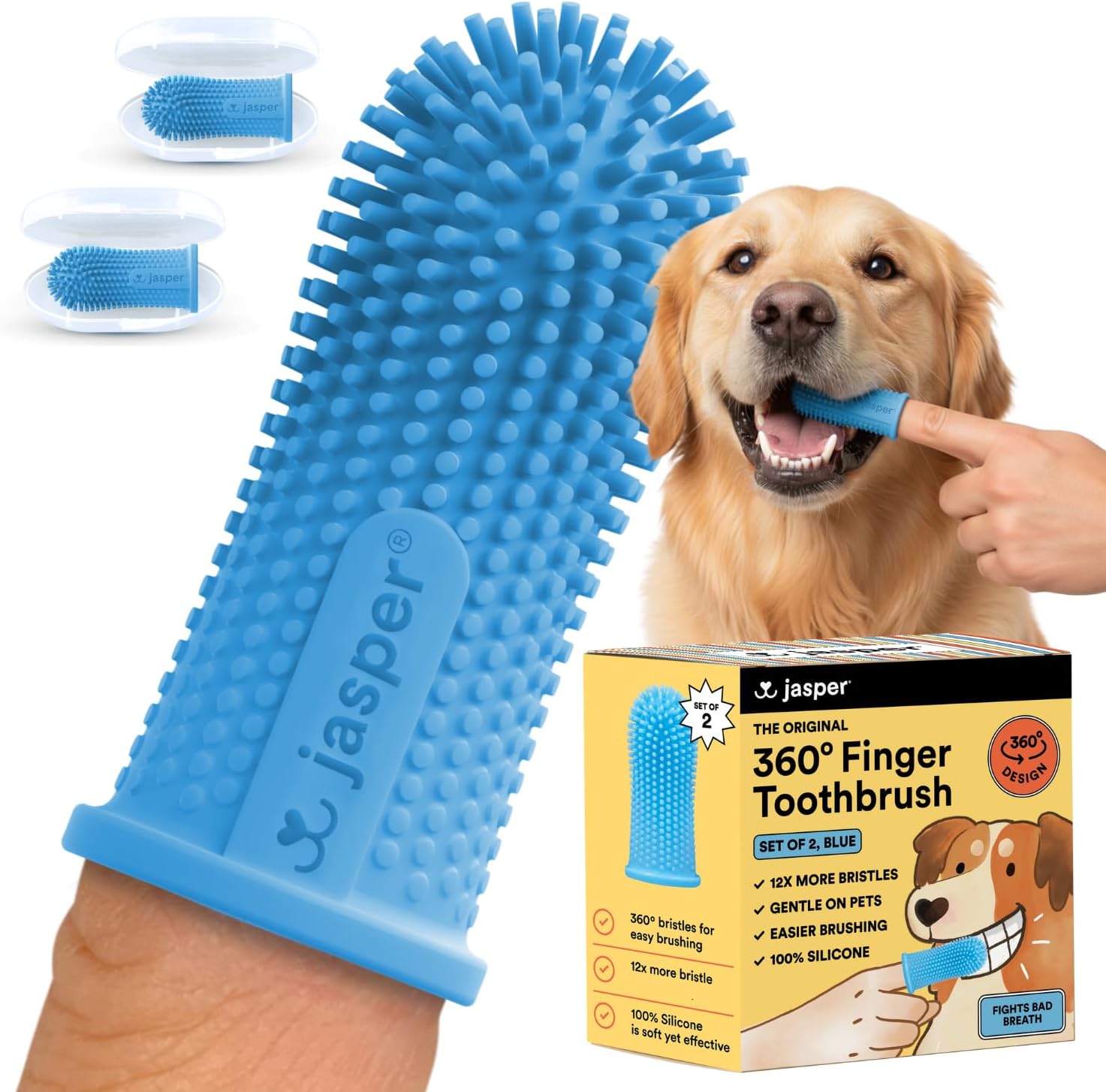
The finger brush is the bridge between doing nothing and brushing properly, and it is where most successful home routines start. It feels to the dog much more like being touched than like having a tool put in its mouth.
The 360 degree bristle layout is the useful part of this design. With bristles all the way around the tip, the angle of your finger stops mattering, which is exactly the problem when you are working blind against a moving target.
Reach is the trade. A finger only goes so far back, and the molars at the rear are both the hardest to reach and the ones that most need attention. A long handled brush wins there once the dog will tolerate one.
It also asks something of you that a long handle does not, which is putting a finger between a dog's teeth. With a calm dog that is a non event, and with a dog that has never had its mouth handled it is worth building up slowly rather than starting on day one.
Bottom line: the right place to start with a dog that has never been brushed, and a good second tool afterwards.
- Type: finger toothbrush, two per pack
- Bristles: 360 degree coverage around the tip
- Paste: not included, use any pet safe paste
- Species: dogs and cats
- Cleaning: rinse and air dry
- Best use: first brushing tool for a nervous animal
Let the dog lick paste from the brush before it goes anywhere near a tooth, so the object arrives as a reward. Work the outside surfaces first in sessions of a few seconds, since that is where deposit gathers and where dogs object least. Move to a long handled brush later if you want to reach the back molars properly.
Stop immediately if the dog snaps or shows real distress rather than mild objection, and build up over days instead of forcing a session. Rinse and air dry the brush after each use and replace it when the bristles flatten. Never use human toothpaste with it, since many contain xylitol which is dangerous to dogs.
How to Choose a Dog Dental Care Product
Six things separate one product from the next here, and the first one decides which shelf you should even be standing at. Read it before anything else.
Three Mechanisms, Not One Category

A dental chew works by abrasion. The dog bites through a shaped, slightly yielding texture, and the surface scrapes along the tooth as it goes, which is why the shape and the firmness of a chew are engineering decisions rather than styling. A chew that is swallowed in three bites has done nothing at all.
A brush and paste works the way yours does, by physically disturbing the film on the tooth surface. Pastes made for dogs are usually enzymatic and are formulated to be swallowed, so there is no rinsing step and no spitting, which is fortunate since neither is a skill dogs have. This is the mechanism veterinarians point to first, and it is also the one that asks the most of the owner.
Water additives and food powders are the passive group. An additive is dosed into the drinking bowl, a powder is measured onto the meal, and both work without any cooperation from the dog beyond eating and drinking as normal. That is their entire appeal, and it is a real one for a dog that will not tolerate hands near its mouth.
The One Independent Mark Worth Looking For
The Veterinary Oral Health Council operates a Seal of Acceptance for pet dental products. Manufacturers submit data against a defined protocol, and products that meet the standard for slowing plaque or tartar accumulation are listed and may display the seal. It is the closest thing this category has to an independent check.
Not every good product carries it, because submission is voluntary and costs the maker money, so absence of the seal is not evidence against a product. Presence of it, though, tells you the claim was assessed by somebody other than the marketing department, which is more than most of the packaging on the shelf can say.
Read the rest of the front of the pack more sceptically. Phrases about fresh breath describe a smell rather than a surface, and vet recommended is a marketing phrase with no defined threshold behind it. Where a listing states the seal, we note it on the product card below.
Whether Your Dog Will Actually Accept It
Compliance is the variable that decides everything, and it is the one no product page addresses. A brush and paste used twice in the first week and then abandoned in a drawer does less than an additive poured into a bowl every day without a thought. Be honest about which of these you will still be doing in a month.
Dogs differ enormously on this. Some will let you lift a lip and work along the outside of the teeth from the first attempt, and plenty will not tolerate a hand near the mouth at all. A finger brush is often the bridge, since it is far less intrusive than a long handled brush and lets you get the paste onto the gumline while the dog is being scratched rather than handled.
Taste matters just as much on the passive side. Water additives change the smell of the bowl, and a fussy drinker will simply stop drinking, which is a problem far more serious than plaque. Flavorless formulations exist for exactly this reason, and introducing any additive at a reduced dose over several days is the sensible way to find out where your dog stands.
Size, Dosing, and the Calories Nobody Counts
Dental chews are sized by the dog’s weight and the sizing is not a suggestion. A chew that is too small for a large dog can be swallowed whole, which removes the cleaning entirely and introduces a hazard, and a chew too large for a small dog is simply left uneaten. Check the weight band printed on the pack against your own dog rather than guessing by breed.
Additives and powders are dosed differently again. A water additive is measured per volume of water in the bowl, so a large bowl topped up through the day gradually dilutes below the intended concentration. A food powder is dosed by body weight with a small scoop, and it is easy to be generous without noticing.
Then there is the part that catches people out. A daily dental chew is a treat with calories in it, and for a small dog that daily chew can be a meaningful share of the day’s intake. The label states the figure, and the sensible move is to take that amount off the food bowl rather than adding it on top.
Texture and What a Chew Is Actually Doing

The useful chew is the one that lasts. Cleaning happens over the seconds the surface spends dragging along the tooth, so a texture firm enough to resist and soft enough to deform around the tooth is what the better designs are aiming at. Ridges, grooves and twists all exist to increase that contact time and to reach the gumline rather than only the crown.
Firmness has a limit, and it is worth taking seriously. Veterinarians widely caution against very hard chew objects such as antlers, hooves and cooked bones, because a tooth can fracture on something that will not give at all. Products formulated as dental chews are made to deform under pressure, which is precisely the difference.
Supervision is part of the instruction rather than a legal footnote. Chews should be given where you can see the dog, and the last small piece is worth taking away from an enthusiastic gulper. Ordinary chew toys are a separate purchase for a separate purpose, and those live over in toys and games.
Labels, Ingredients, and What Home Care Does Not Cover
One rule outranks everything else on this shelf: never use human toothpaste on a dog. Many contain xylitol, which is dangerous to dogs, and human formulations are made to be spat out rather than swallowed. Pet pastes are built for swallowing and are flavored to be tolerated, which is why the flavor list on a pet paste is a functional feature rather than a gimmick.
Beyond that, read the ingredient panel the way you would read one on your own shelf. Enzymatic pastes list their enzyme system, additives list their active ingredients and their dilution rate, and powders list the source material and the scoop size. Anything a label does not state is not a feature the product has.
The important limit is worth stating in plain words. Home care slows the accumulation of film and deposit between visits, and none of it removes hardened tartar or examines what is happening below the gumline. That is the work of a veterinarian, and a dog with bad breath that has changed suddenly, a broken tooth, bleeding or reluctance to eat needs an appointment rather than a new product. Our wider guides are collected in our article archive.
| Mechanism | Best at | Weak at |
|---|---|---|
| Daily dental chew | Daily compliance, gumline contact, dogs that love a routine | Adds calories, sizing must match the dog |
| Brush and enzymatic paste | Direct contact with the tooth surface, targeted areas | Needs a cooperative dog and a committed owner |
| Water additive | Zero effort, works on dogs that refuse handling | Fussy drinkers may reject a flavored bowl |
| Food powder | Measured onto the meal, nothing new for the dog to accept | Easy to over scoop, no mechanical action at all |
Why You Should Trust Us
We build these lists from published specification and from the pattern of what long term owners report, rather than from marketing copy. For every product here we recorded the mechanism it uses, the active ingredients or enzyme system named on the label, the dosing instructions by weight or by water volume, the size bands offered, and whether the listing states an independent Veterinary Oral Health Council acceptance.
We set aside near identical listings that differ only in count or size band, so each entry below is a genuinely different approach rather than another pack of the one above it. We describe what the labels state and how the products behave in a normal household, and we make no medical or veterinary claims, because diagnosis and treatment belong with a qualified veterinarian and not with a product page.
Final Thoughts
Best overall is Greenies Original Dental Dog Treats. It is the chew that most reliably gets used every single day, the texture is designed to deform around the tooth and reach the gumline rather than shatter, and it is sold in weight banded sizes so the fit can be matched to the dog. Take the treat calories off the food bowl and it slots into a routine without changing anything else.
Best value is the Vet’s Best Dog Toothpaste and Toothbrush Dental Care Kit. It supplies the enzymatic paste, a long handled brush and a finger brush in one box, which means you can find out which tool your dog tolerates without buying twice, and brushing is the mechanism with the most direct contact of anything here.
For specific needs, Virbac C.E.T. Enzymatic Toothpaste is the paste to pair with a brush you already own, Oxyfresh Premium Pet Dental Care Solution is the additive to reach for with a fussy drinker because the formula is designed to be unobtrusive in the bowl, and ProDen PlaqueOff Powder is the choice when a scoop on the food is the only routine that will survive contact with your week. Pedigree Dentastix suits large breeds that go through a chew quickly, Virbac C.E.T. Enzymatic Oral Hygiene Chews are the chew for a very small dog, Dental Fresh Advanced is the second additive option, and the Jasper 360 Degree Finger Toothbrush is the gentlest way to start with a dog that has never been brushed. Brand pages and current offers are gathered in our store directory.
Dog Dental Care Product FAQs
How often should I clean my dog’s teeth at home?
Daily is the target that veterinary guidance points to, because the film that products act on re-forms continuously rather than weekly. That does not mean brushing daily is realistic for every household, which is exactly why the passive options exist. A workable pattern for many people is a dental chew every day, an additive in the water bowl as a constant, and brushing whenever the dog is relaxed enough to allow it. Consistency beats intensity here: a modest routine kept up for a year does more than an ambitious one abandoned in February.
Can I use human toothpaste on my dog?
No, and this is the one hard rule in the category. Many human toothpastes contain xylitol, which is dangerous to dogs, and all of them are formulated on the assumption that you will spit rather than swallow, which no dog is going to do. Pet pastes are made to be swallowed safely and are flavored so that the dog cooperates. If you already own a soft brush, buy a pet paste on its own and use it with the brush you have. Browse the wider pet aisle through our category index.
Do water additives help if my dog will not let me brush?
They are the practical option in that situation, with a clear limit worth understanding. An additive works chemically on what is in the mouth and does nothing mechanically, so it is not doing the job a brush does, and no label claims it is. What it does offer is a routine that requires zero cooperation from the dog, which for a resistant animal is the difference between some home care and none. Introduce it at a reduced dose across several days and watch that your dog keeps drinking normally, since a bowl that smells wrong can put a fussy drinker off entirely.
What does the Veterinary Oral Health Council seal actually mean?
It means the manufacturer submitted trial data against a published protocol and the product met the standard for slowing plaque or tartar accumulation. It is awarded per product rather than per brand, so one item in a range can carry it while another does not. Submission is voluntary and it costs money, so plenty of reasonable products have never applied, and the absence of the seal is not evidence against them. Where it is present, it tells you somebody outside the company looked at the numbers, and that is the strongest signal available on this shelf.
Can home care replace a veterinary cleaning in 2026?
No. Everything in this list works on the soft film that forms daily, and the aim is to slow how quickly that film hardens into deposit. Once deposit has hardened onto the tooth or the problem sits below the gumline, no chew, paste or additive reaches it, and only a veterinarian can assess what is there and deal with it. Treat home care as the routine between appointments rather than as a substitute for them, and book a visit rather than a purchase if breath changes suddenly, a tooth looks broken, there is bleeding, or your dog becomes reluctant to eat.


Write Your Review
No reviews yet. Be the first to share your experience!