

Most people who go looking for a corded hammer drill are really asking one question without knowing it: do I need a drill that hammers, or a hammer that drills. Those are two different machines that share a name, and buying the wrong one is why a brand new tool can spend twenty minutes polishing a hole in concrete instead of making it. A cord settles the other half, giving unlimited run time and an output that does not sag as a battery drains. We looked at 8 corded machines from Bosch, SKIL, DEWALT and more, sorted by mechanism, chuck type, impact energy and how much of the vibration reaches your hands.
Our top pick is the Bosch 11255VSR Bulldog Xtreme for its SDS-plus piston mechanism paired with a compact D-handle body, which is the combination that turns concrete from a fight into an ordinary job without moving up to a tool you need both hands and a plan to operate. Below we split the field by mechanism first, since that decision governs everything after it. The rest of the workshop is covered in our tools and home improvement section.

Pros
- Piston driven SDS-plus mechanism sinks anchors in poured concrete
- Three modes including hammer only for chiseling
- D-handle puts your hand in line with the bit for straight pressure
- Compact and light enough to work overhead
- Variable speed trigger with reverse for backing out jammed bits
Cons
- Needs an adapter chuck to take ordinary round shank bits
- Vibration damping is basic compared with the premium tier
- Heavier than a plain percussion drill for simple wood and metal work
The Bulldog Xtreme is the tool that made compact SDS-plus rotary hammers a normal thing to own rather than a specialist purchase, and the reason it keeps appearing on lists like this is that it sits exactly where most people need a machine to sit.
The mechanism is the whole argument. A piston drives a flying weight against the back of the bit, so the force comes from the motor rather than from you pushing, and that is why an eight amp rotary hammer walks through slab concrete that defeats a much larger percussion drill.
The D-handle matters more than it looks on the listing photograph. Your hand sits directly behind the axis of the bit, so you push along the hole instead of at an angle to it, and combined with the side handle that alignment does more for drilling speed than an extra amp or two would.
Its limits are honest ones. Round shank bits need an adapter chuck and rotation only mode, the vibration damping is simple rather than sprung, and for drilling wood and steel all day a plain drill is a lighter companion.
Bottom line: the compact rotary hammer that covers the widest range of real jobs, and the default recommendation for anyone drilling concrete more than once.
- Type: SDS-plus rotary hammer, corded
- Motor: eight amp
- Capacity: one inch in concrete
- Modes: rotary hammer, rotation only, hammer only
- Chuck: SDS-plus collar
- Body: D-handle with auxiliary side handle
- Control: variable speed trigger with reverse
This suits anyone whose jobs include poured concrete: fixing into a slab, running anchors, chasing a small channel, or lifting tile with a chisel bit. It is equally sensible for a homeowner facing one such job a year and a tradesperson facing one a week. Skip it if your drilling is confined to brick, plasterboard and timber, where a percussion drill with an ordinary chuck is lighter and more convenient.
Smear the SDS shank of every bit with the supplied grease before it goes in, since a dry shank wears the spindle. Always fit the side handle: if the bit binds, the tool tries to spin around it and your wrist is the pivot. Start holes in rotation only mode so the tip seats before hammering begins, and clear dust from deep bores by withdrawing the bit rather than forcing it.

Pros
- Vibration control system takes real shock out of long sessions
- Three modes with chisel positioning
- Larger capacity than the compact class
- Supplied in a kit case with the side handle and depth rod
- Steady output for repeated masonry work
Cons
- Bigger and heavier than a one inch compact hammer
- More tool than a purely occasional user needs
- Round shank bits still need an adapter chuck
The D25263K is the pick for people whose problem is not whether the tool can drill the hole but whether their hands can last the afternoon. Its defining feature is a vibration control system that isolates the grip from the hammering mechanism, and the difference shows up in the second hour rather than the first minute.
Capacity sits a step above the compact class, which widens what the tool can do without pushing it into demolition territory. Larger anchors, deeper through holes and repeated fixing runs all sit comfortably inside its range.
Three modes cover drilling, hammer drilling and chiseling, so it handles channel chasing and tile lifting as well as holes. The kit case is the sort of detail that seems minor until you need the side handle and depth rod on site and they are still together in the box.
The trade is bulk. It is heavier than a one inch machine and correspondingly harder to hold up against a ceiling, and for someone drilling four holes a year it is more tool than the job asks for.
Bottom line: the rotary hammer to buy when session length rather than raw capability is your limiting factor.
- Type: SDS-plus rotary hammer, corded
- Motor: eight and a half amp
- Impact energy: around three joules
- Capacity: one and one eighth inch in concrete
- Modes: rotary hammer, rotation only, hammer only
- Vibration: sprung active control in the handle
- Supplied: kit case, side handle, depth rod
Let the tool do the pushing. Vibration control works by allowing a small amount of movement between the mechanism and the grip, and leaning hard on the tool defeats it by compressing that travel. Hold firmly but do not force. Start every hole in rotation only mode until the tip seats, then switch hammering on, and withdraw the bit periodically on deep holes to clear the flutes.
Buy this if you drill concrete in runs rather than one hole at a time, or if hand and arm fatigue has been the thing that ended previous sessions. It also suits anyone doing renovation work where chiseling and drilling alternate all day. It is more machine than needed for occasional household fixing, where a compact hammer or a percussion drill is easier to live with.

Pros
- Electronic kickback sensor cuts the motor when the tool starts to twist
- Strong impact energy for its size class
- Handles both drilling and demolition duties
- Vario style chisel positioning
- Bosch SDS-plus system with fast bit changes
Cons
- Heavier and longer than the one inch Bulldog
- Kickback sensor can trip on hard binding and needs a restart
- Overkill for brick and block only work
The GBH2-28L is the heavier sibling of the compact Bulldog and it earns the extra size with two things: more energy per blow and an electronic safety sensor watching for kickback.
That sensor is the reason to choose it for reinforced concrete. When a bit catches rebar, the tool tries to rotate around the bit faster than a human can react, and a sensor that cuts power on detecting that rotation acts before your wrist has to. A mechanical clutch does a similar job more slowly.
Impact energy in the 2.4 foot pound bracket puts it comfortably above the one inch class, which shows up on larger diameters and deeper holes rather than on small anchors. Chisel positioning makes it usable for breaking out and channel work as well.
The costs are length and weight, both of which you notice overhead, and an occasional nuisance where a hard bind trips the sensor and you have to release and restart the trigger.
Bottom line: the one to buy where rebar strikes are likely and where holes are bigger than an anchor bolt.
- Type: SDS-plus rotary hammer, corded
- Motor: eight and a half amp
- Impact energy: 2.4 foot pounds
- Capacity: one and one eighth inch in concrete
- Safety: electronic kickback control sensor
- Modes: rotary hammer, rotation only, hammer only with chisel positioning
Fit the side handle every time, and set it so your second hand is well out from the axis where it has leverage against a bind. Treat the kickback sensor as a backstop rather than a license to hold the tool loosely. Grease SDS shanks before insertion, and if the sensor trips repeatedly in one spot, stop and reconsider the hole rather than forcing through what is probably reinforcement.
Choose this over the compact Bulldog if your holes are larger, deeper, or in reinforced concrete. Choose the compact one instead if most work is overhead or in tight spaces, where its shorter body and lower weight matter more than energy per blow. Choose a percussion drill if concrete is not really on your list at all.

Pros
- Thirteen amp motor handles demolition as well as drilling
- Four modes including chisel angle adjustment
- Safety clutch protects the wrist when a bit binds
- Chisels, drill bits and grease supplied in the box
- Largest concrete capacity in this list
Cons
- Heavy to hold overhead for long
- Far more tool than household fixing requires
- Bulk makes it awkward in confined spaces
The ENEACRO is the heavy end of the SDS-plus class and it is aimed at people whose jobs include breaking things as well as drilling them. Thirteen amps and a one and a quarter inch capacity put it in a different bracket from the compact hammers above it.
Four modes is the practical headline. Beyond drilling, hammer drilling and chiseling, the fourth setting frees the chisel to rotate by hand so you can lock it at whatever angle the work needs, which is what makes channel chasing and tile lifting bearable rather than a fight with the tool.
The bundle is unusually complete for the class: chisels, drill bits and a tub of grease, all in a case. Since SDS shanks want greasing before every insertion, having some in the box means the habit starts on day one rather than after the spindle has already worn.
Weight is the obvious cost. This is a two handed tool that is tiring above shoulder height, and for hanging a shelf it is entirely the wrong choice.
Bottom line: the demolition capable option, and the one to pick if your list includes breaking out concrete rather than only making holes in it.
- Type: SDS-plus rotary hammer, corded
- Motor: thirteen amp
- Capacity: one and a quarter inch in concrete
- Modes: four, including chisel angle adjustment
- Safety: mechanical safety clutch
- Vibration: damped housing
- Supplied: chisels, drill bits, grease, carry case
This is for renovation work: lifting tile, chasing channels for cable and pipe, breaking small areas of concrete, and drilling larger diameters repeatedly. It suits someone with a defined heavy job ahead rather than a general household toolkit. Anyone whose drilling stops at brick and plasterboard will find it heavy, long and unnecessary.
Grease every SDS shank before it goes in. Use the chisel angle mode by switching to the free rotation setting, turning the chisel to the angle you want and locking it before starting, rather than trying to fight the tool into position under power. Work in short bursts when chiseling and let the weight of the machine supply the force. Keep the side handle fitted and both hands on the tool at all times.

Pros
- Enough motor for brick, block and mortar
- Half inch chuck takes ordinary round shank bits
- Variable speed for controlled hole starts
- Large accessory assortment included
- Doubles as a general purpose drill for wood and metal
Cons
- Percussion mechanism struggles in poured concrete
- Much of the bundled accessory count is screwdriver bits
- No impact energy figure, as with all percussion drills
The SKIL HD182002 is the sensible general purpose answer for a household that needs one drill rather than a specialist one. Seven and a half amps is a real motor for the class, and the half inch chuck takes whatever round shank bit the job calls for.
Percussion is the mechanism, which means the hammering is high frequency chatter with little force per strike, and the energy comes largely from you leaning on the tool. In brick, block and mortar that works fine. In poured concrete it does not, and no percussion drill at any amp rating changes that.
The bundled assortment is a genuine convenience for a first drill, though it pays to read what is in it: a headline piece count in the hundreds is usually mostly screwdriver bits, with a modest set of masonry and twist drills alongside.
Where it shines is versatility. Switch hammering off and it is an ordinary corded drill for timber and steel, which is exactly what a household toolbox wants from a single machine.
Bottom line: the best value pick for masonry that is not concrete, and a capable general drill the rest of the time.
- Type: percussion hammer drill, corded
- Motor: seven and a half amp
- Chuck: half inch
- Modes: drilling and hammer drilling
- Control: variable speed
- Supplied: side handle, depth control, large bit assortment
Choose this if your drilling is brick, block, mortar, timber and steel and you want one tool for all of it. Choose an SDS-plus rotary hammer instead if poured concrete or a slab floor is on the list, since the mechanisms are not interchangeable. Choose a smaller percussion drill if weight matters more to you than motor size.
Start every masonry hole with hammering switched off and the trigger barely pressed, until the bit has cut a seat, then switch hammering on. Fit the side handle and set the depth rod rather than judging depth by eye. Withdraw the bit every inch or so on deeper holes to clear dust, and let the drill cool between long runs, since percussion drills warm quickly under sustained load.

Pros
- Same motor size as pricier household drills
- Variable speed trigger for controlled starts
- Half inch chuck takes standard bits
- Compact for the amp rating
- Starter bits included
Cons
- Percussion mechanism is not a concrete solution
- Only a small bit set in the box
- Basic vibration handling for long sessions
The Hammerhead sits in the middle of the percussion group: the same motor size as the better known household drills, in a compact body, with a small set of bits rather than a large assortment.
For the work percussion drills are actually good at, that is a reasonable trade. Brick, block and mortar respond to motor size and a steady push, and seven and a half amps is enough that the drill is not the limiting factor.
Variable speed through the trigger is the feature to use rather than the top speed figure. Masonry holes start slowly so the bit stays in the mark, and a trigger with usable control across its travel makes that easy.
What it does not have is any of the vibration isolation of the rotary hammers, so long sessions are tiring, and the small bundled bit set means an accessory purchase fairly soon.
Bottom line: a solid mid range percussion drill for household masonry, with the usual caveat that concrete is not its job.
- Type: percussion hammer drill, corded
- Motor: seven and a half amp
- Chuck: half inch
- Control: variable speed trigger
- Modes: drilling and hammer drilling
- Supplied: side handle, depth gauge, six bits
This suits a household or a light workshop needing one corded drill for brick, block, timber and steel, especially where a compact body is welcome. It is a reasonable step up from a small entry drill. It is the wrong tool for concrete slabs, for repeated large diameter masonry holes, or for anyone who will hold it for hours at a stretch.
Always fit the side handle, since a bound bit in a half inch chuck twists the tool hard. Tighten a keyed chuck in all three key positions rather than one, otherwise the bit slips under hammering. Let the motor cool between long runs, and clear masonry dust out of the vents regularly, since blocked vents are the most common cause of a corded drill overheating.

Pros
- Light and easy to handle overhead
- Half inch chuck for common bit sizes
- Simple two mode operation
- Sensible for wall plugs and flat pack assembly
- Familiar, widely supported brand
Cons
- Smallest motor of the percussion group here
- Slow going in dense brick and useless in concrete
- Minimal vibration damping
The BEHD201 is the light duty entry to this list and is best understood as a general household drill that can also chatter its way into brick when needed.
Six and a half amps is modest, and that shows up as time rather than as failure: holes in dense brick take longer than they would with a seven or eight amp machine. For wall plugs, curtain rails and shelf brackets, longer is perfectly acceptable.
What you get back is weight. It is easy to hold up against a ceiling and easy to use one handed for ordinary drilling, which is not true of the rotary hammers here, and for most households that is the more common job by a wide margin.
Concrete is out of scope. The mechanism, not the motor, is the reason, so treat any listing that suggests otherwise with caution.
Bottom line: a light, familiar household drill with masonry ability attached, not a masonry tool with drilling attached.
- Type: percussion hammer drill, corded
- Motor: six and a half amp
- Chuck: half inch
- Modes: drilling and hammer drilling
- Control: variable speed
- Supplied: auxiliary side handle
Choose this if most of your drilling is timber, plasterboard and the occasional brick fixing, and if light weight matters. Step up to a seven and a half amp drill if dense brick or block is regular work. Move to an SDS-plus rotary hammer if concrete appears on the list at all, since no increase in percussion drill size solves that problem.
Use masonry bits with a carbide tip and let the drill run at moderate speed rather than flat out, since a small motor loses more to heat than it gains from speed. Press steadily and keep the drill square to the wall. For anything beyond a couple of inches deep in brick, withdraw regularly to clear dust, which is what stops the bit binding.

Pros
- Large accessory bundle covers most household fixings
- Side handle rotates a full circle for awkward angles
- Depth gauge included
- Light and easy to control
- Two modes cover drilling and light masonry
Cons
- Five amps is the smallest motor here and slows in dense material
- Accessory count is mostly screwdriver bits
- Not suitable for concrete or sustained masonry work
The GALAX PRO is the budget starter of this list, and the accessory set is a large part of what it offers: a beginner who owns no bits gets a working kit rather than a bare tool.
Five amps places it at the light end. In softwood and plasterboard that is irrelevant, in brick it means patience, and in concrete it means choosing a different tool entirely. Judged as a first drill for a new home, that is a fair position to occupy.
Two details lift it above the very cheapest options: a side handle that clamps anywhere through a full circle, which helps in corners and against ceilings, and a depth gauge, which stops the common beginner mistake of drilling straight through a wall.
As with every bundle, read the accessory list rather than the number. A count above a hundred is overwhelmingly screwdriver bits, with a small selection of masonry and twist drills.
Bottom line: a reasonable first corded drill with everything needed to start, provided the work stays light.
- Type: percussion hammer drill, corded
- Motor: five amp
- Chuck: half inch
- Speed: variable to 3000 rpm
- Modes: drilling and hammer drilling
- Supplied: rotating side handle, depth gauge, accessory set
This is for a first toolbox: hanging pictures and shelves, assembling furniture, occasional fixings into brick. It suits someone who owns no bits yet and wants everything in one purchase. It is not for renovation work, for concrete, or for anyone who already owns a drill and is looking for more capability.
Set the depth gauge before drilling into any wall you are not certain about, and check for cables and pipes above sockets and switches before starting. Fit the side handle even on a light drill, since a bound masonry bit twists harder than the motor size suggests. Keep the vents clear of dust and give a small motor a rest between holes rather than working it continuously.
How to Choose a Corded Hammer Drill
The first section is the one that matters. Everything else on this page is refinement once you have picked the right mechanism for the material you are drilling.
Percussion Hammer Drill or SDS-Plus Rotary Hammer
A percussion hammer drill makes its hammering by pressing two ridged steel plates together as the chuck turns. The ridges ride over each other and the whole spindle chatters forward and back at very high frequency but with almost no force behind each strike. The energy that actually reaches the wall comes mostly from you leaning on the tool, which is why these drills feel like hard work in dense material and why the numbers they quote are enormous.
An SDS-plus rotary hammer works nothing like that. A piston inside the tool drives a small flying weight down a cylinder on a cushion of air, and that weight strikes the back of the bit. The force comes from the motor rather than from your shoulder, and it is measured in joules or foot pounds because there is a real quantity of energy per blow. That is why a modest rotary hammer sinks anchors in slab concrete while a much larger percussion drill struggles.
The practical rule is about material and volume. Brick, block, mortar and the occasional wall plug are percussion drill work. Poured concrete, slab floors, structural lintels, rebar dodging, and anything you need to do more than a few times in a day are rotary hammer work. If your list contains both, the rotary hammers here run in drilling only mode as well, so they cover the whole range at the cost of size and a chuck adapter for round shank bits.
Chuck Type: SDS-Plus, Keyed, and Keyless

SDS-plus is a slotted shank system rather than a gripping chuck. The bit slides into the spindle and locks with a sprung collar, and crucially it is free to move a short distance forward and back inside that lock, which is what lets the piston strike it directly. Bits go in and out in a second with no tightening, and they cannot slip under load because nothing is clamping them in the first place.
A keyed chuck grips a round shank with three jaws tightened by a toothed key. It holds better under hammering than any keyless design, which is why budget percussion drills still use it, and the price is a key you will eventually lose. Keep it on the cord with the clip that comes in the box, because a keyed chuck without its key is an ornament.
A keyless chuck tightens by hand and is far more convenient if you swap between wood, metal and masonry all afternoon. Under sustained percussion it can work loose, so give it a firm second tighten after the first few seconds of hammering. Several rotary hammers also accept an adapter chuck in place of the SDS collar, which turns one tool into two at the cost of a little extra length.
Amps, Impact Energy, and What Blows Per Minute Really Says
Amp rating is the honest headline figure on a corded tool, because with mains voltage fixed it is a direct proxy for how much power the motor can draw before it gives up. Five to six and a half amps is light duty, seven to eight and a half covers most homeowner and trade work, and double digit machines are for demolition. More amps also means more weight, so buying above your workload is a cost rather than free headroom.
Impact energy is the number that separates the two mechanisms, and only rotary hammers quote it. Expressed in joules or foot pounds, it tells you how hard each individual blow lands. A tool in the two to three joule bracket handles anchors and through holes in concrete comfortably. Percussion hammer drills do not publish this figure at all, which is itself informative: there is no meaningful energy per blow to report.
Blows per minute is the most misread specification in the category. A percussion drill can claim tens of thousands because the count is simply rotation speed multiplied by the number of ridges on the clutch plate, while a rotary hammer claims a few thousand because each of those is a piston driven strike. Comparing the two figures across mechanisms tells you nothing. Compare them only between tools of the same type, and even then treat impact energy as the more useful number.
Vibration Control, Side Handle, and Safety Clutch

Vibration is the reason people stop before the job is done. Better machines isolate the motor housing from the grip with sprung or damped mounts, so a share of the shock never reaches your hands. The marketing names differ, the mechanism does not. On a tool you use for ten minutes a year this is a luxury; on anything you hold for an afternoon it decides whether you finish.
The side handle is not an accessory, it is a safety device. When a bit binds, the tool tries to spin around the bit and your wrist is the pivot, and a second hand out on an auxiliary grip is what stops that. Look for a handle that clamps at any angle around a full circle rather than one with fixed detents, and use the depth rod that clips into it instead of guessing depth by eye.
A safety clutch is the mechanical version of the same idea. If the bit jams, the clutch slips and the housing does not snap around. Every rotary hammer on this list has one, and the better ones add an electronic sensor that cuts the motor when it detects the sudden rotation of a kickback beginning. If you drill into reinforced concrete where hitting rebar is likely, treat that sensor as close to essential.
Modes, Variable Speed, and Reverse
Percussion drills have two modes, drilling and hammer drilling, selected with a collar or a switch. Rotary hammers usually have three or four: rotation only for wood and metal with an adapter chuck, hammer with rotation for masonry, hammer only for chiseling, and on several models a fourth setting that lets you rotate the chisel by hand to a chosen angle and lock it there. That chisel angle lock is what makes a rotary hammer useful for chasing channels and lifting tile.
Variable speed through the trigger matters more than the top figure. Every masonry hole starts slow to keep the bit in the mark, and a trigger with genuine control across its travel is what lets you do that. A tool that jumps to half speed the moment it engages will wander across the wall on every start, and no amount of top end speed compensates.
Reverse earns its place for two reasons that have nothing to do with driving screws: it backs a jammed bit out of a hole, and it clears dust from a deep bore. On a keyed chuck machine, check the chuck is properly retained for reverse running, since one that unthreads under reverse is a known annoyance on cheaper drills.
Weight, Balance, Cord Length, and What Comes in the Box
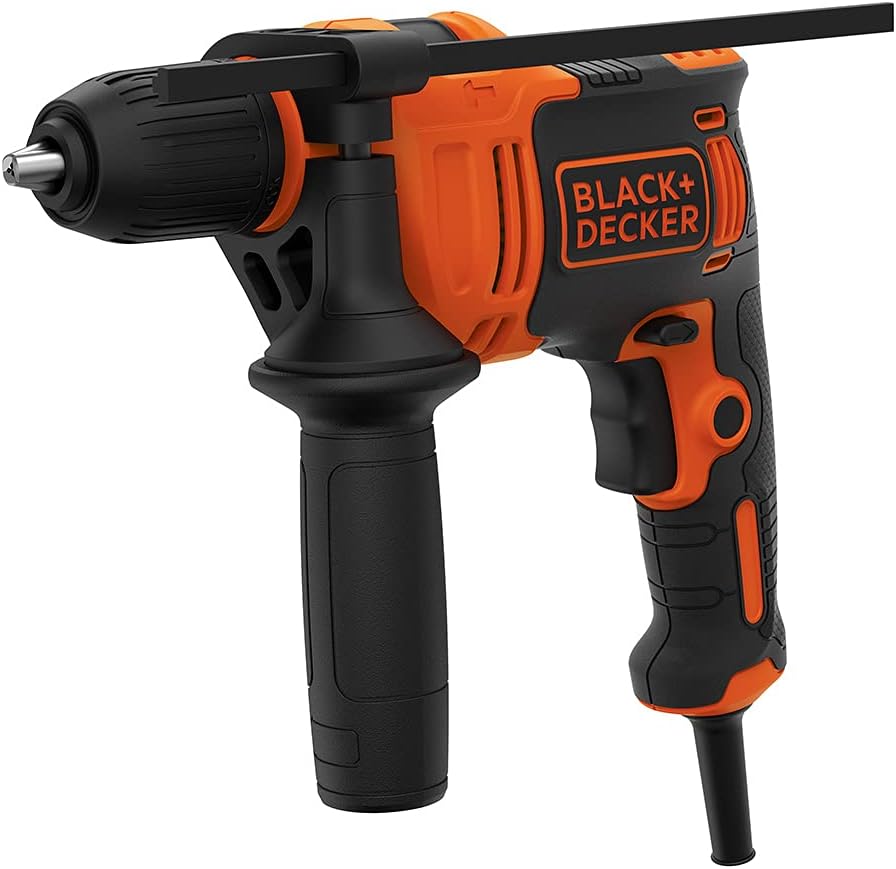
Two body shapes dominate. A pistol grip keeps the tool short and is easier overhead and in tight corners. A D-handle puts your hand directly behind the axis of the bit, which lets you push in line with the hole rather than at an angle, and that alignment does more for drilling speed than a modest difference in amps. Heavier tools are also easier to drill down into a floor with and harder to hold up against a ceiling.
Cord length is a genuine specification, not a detail. Anything under about eight feet means an extension lead on almost every job, and a thin extension on a high draw tool causes voltage drop that makes the motor run hot. Use a heavy gauge lead when you need one.
Bundled kits are worth reading carefully. A hundred piece accessory set is usually mostly screwdriver bits, while a rotary hammer kit with two or three SDS-plus bits, a point chisel and a flat chisel in a molded case is a genuinely useful start. Grease matters too: SDS shanks want a smear of the supplied grease before insertion, since dry shanks wear the spindle. There are more outdoor and workshop picks in our patio, lawn and garden section and across our article archive.
| Tool type | Best at | Weak at |
|---|---|---|
| Percussion hammer drill, half inch chuck | Brick, block, mortar, wood and metal with the same chuck | Poured concrete, volume work, operator fatigue |
| Compact SDS-plus rotary hammer | Anchors and through holes in concrete, chiseling small areas | Needs an adapter chuck for round shank bits |
| Heavy SDS-plus rotary hammer | Large diameter holes, repeated concrete work, breaking out | Weight overhead, overkill for occasional household jobs |
Why You Should Trust Us
We build these lists from published specification and from the pattern of what long term owners report once a tool has been through more than a weekend of use. For each machine here we looked at the hammering mechanism, the amp rating, quoted impact energy where the type publishes it, chuck system, number of operating modes, whether a chisel angle lock is included, the vibration control approach, the clutch or kickback protection, cord length and the actual contents of any bundled kit rather than the headline piece count.
We kept this list to corded machines only, so cordless models that appear alongside these in search results have been set aside even where they are excellent tools, because run time and constant output are the reason to choose a cord in the first place. We also set aside renewed listings and near identical siblings that differ only in amp rating or bundle contents, so every entry is a genuinely different machine.
Final Thoughts
Best overall is the Bosch 11255VSR Bulldog Xtreme. It is the compact SDS-plus rotary hammer that most people should own: enough impact energy for anchors and through holes in slab concrete, three modes including chiseling, a D-handle that lets you push straight down the axis of the bit, and a body small enough to work overhead without wrecking your shoulders. For a homeowner who has one concrete job a year and a tradesperson who has one a week, it is the same right answer.
Best value is the SKIL HD182002. It is a straightforward seven and a half amp percussion drill with a half inch chuck, a side handle and a large bit assortment in the box, and for brick, block, mortar and general household drilling it does everything asked of it. Buy it knowing what it is not: it will not make quick work of poured concrete, and no percussion drill at any amp rating will.
For specific needs, the DEWALT D25263K is the pick if vibration is your limiting factor on long sessions, the Bosch GBH2-28L Bulldog Xtreme Max is the one where hitting rebar is likely and kickback protection earns its place, and the ENEACRO 1-1/4 Inch SDS-Plus is the demolition capable option with a four mode selector and chisels included. For light household duty, the BLACK+DECKER BEHD201 and the GALAX PRO half inch drill cover wall plugs and flat pack work, with the Hammerhead HAHD075 between them. More categories are laid out in our category index, and the brands themselves appear in our store directory.
Corded Hammer Drill FAQs
Can a corded hammer drill drill into poured concrete?
A percussion hammer drill can, slowly and badly, and it is the single most common source of disappointment in this category. The mechanism produces high frequency chatter with very little force per strike, so it relies on you pressing hard, and in slab concrete that means minutes per hole and a bit that dulls fast. An SDS-plus rotary hammer drives a piston that strikes the bit directly, which is why a smaller rotary hammer outperforms a much bigger percussion drill in the same wall. If concrete is on your list at all, buy the rotary hammer.
Is a corded machine still worth buying in 2026?
For hammering work, yes. Cordless tools have closed the gap on drilling and driving, but sustained hammering is one of the highest draw jobs a hand tool does, and a battery empties quickly under that load while delivering gradually less as it drains. A corded machine gives constant output for as long as the job takes and weighs less than the equivalent tool plus a large battery. The trade is a lead and a socket, which in a garage is rarely the problem.
Do I need SDS-plus bits, or will my normal drill bits fit?
Rotary hammers take SDS-plus bits, whose slotted shank locks into the spindle while staying free to slide a short distance so the piston can strike them. Ordinary round shank bits do not fit that spindle at all. Most rotary hammers accept an adapter chuck that takes normal bits, but only in rotation only mode, since hammering through an adapter would destroy it. Percussion drills use standard round shank masonry bits in their keyed or keyless chuck.
What amp rating do I actually need?
For hanging shelves, fixing into brick and general household jobs, five to seven amps is plenty and the lighter body is a genuine advantage overhead. For renovation work, repeated masonry fixing, or drilling anything larger than about half an inch in diameter, seven to eight and a half amps is the sensible band and covers nearly every rotary hammer worth owning. Double digit amp machines are demolition tools: they are heavy, they are tiring to hold up, and they earn their keep only if you break out concrete regularly. More tool picks are in our tools and home improvement section.
How do I stop the bit wandering when I start a hole?
Start in rotation only mode with no hammering, at the slowest speed the trigger will give you, until the tip has cut a shallow seat. Then switch hammering on and bring the speed up. A center punch mark helps on tile and render, and masking tape over glazed surfaces stops the tip skating. Keep the tool square to the wall and let the machine push: leaning harder does not speed up a rotary hammer, it only pushes the bit off line before it has bitten.


Write Your Review
No reviews yet. Be the first to share your experience!