

A dining chair takes more abuse than almost any other seat in the house. It gets dragged across the floor several times a day, wiped down after spills, leaned back on, and asked to look presentable while it happens. Upholstered dining chairs answer the comfort half of that job well, but the padding and fabric that make them comfortable are also the parts that wear out first. We compared 10 upholstered dining chairs from Signature Design by Ashley, Roundhill Furniture, COLAMY and more to sort out which ones hold their shape and which ones simply look good on delivery day.
Our top pick is the Signature Design by Ashley Berringer for its solid wood frame and dense seat cushion, the combination that survives daily use rather than merely cushioning it. Below you will find the full 2026 ranking, followed by a buying guide that explains what the fabric labels and frame descriptions actually mean. If you are furnishing a whole room, our home and kitchen guides cover the tables and rugs that go with them.

Pros
- Solid wood frame resists racking under daily use
- Firm high density seat cushion holds its shape
- Woven fabric disguises crumbs and light marks
- Neutral styling suits both casual and formal rooms
- Highest volume of long term owner feedback in this group
Cons
- Sold only in pairs, so larger sets cost more to assemble
- Woven fabric needs a vacuum crevice tool rather than a wipe down
The Berringer is the most conventional chair in this comparison and that is precisely its strength. The frame is solid wood rather than engineered board, which means the joints carry load through timber instead of through fasteners sunk into compressed fibre. That single decision is what separates chairs that develop a wobble from chairs that do not.
The seat cushion is firm rather than plush. Sitting down, it feels less inviting than a soft foam seat, but firmness is what you want in a chair used upright at a table, and it is the reason owner feedback on this model does not carry the sagging complaints that follow softer competitors.
Fabric choice is sensible rather than fashionable. The woven upholstery is mid tone and textured, so crumbs and light marks disappear into the weave instead of sitting on top of it. That makes it forgiving in a household that eats at the table every day.
The main constraint is the pair format. Furnishing a six seat table means three purchases, and while the dye lot risk is low with a textured mid tone fabric, it is real. Order the full quantity at once if you can.
Bottom line: the chair to buy if you want one set of dining chairs and do not want to think about them again for a decade.
- Frame: solid wood
- Upholstery: woven fabric
- Configuration: set of two
- Back style: mid to high back, padded
- Assembly: legs attach to preassembled seat and back
- Cleaning: vacuum and spot clean
- Room fit: standard height dining tables
Households that use the dining table daily and want a chair that survives that use rather than one that photographs well. It suits both a formal dining room and an everyday kitchen table, which makes it the safe recommendation when you are furnishing a room you plan to keep.
Less suitable if you need to seat six or more in one purchase, or if you want a chair that wipes clean after every meal, in which case a faux leather seat is the better direction.
Vacuum the seat and the junction between seat and back weekly using a crevice tool, since that seam collects crumbs that grind into the fabric over time. Spot clean with a water based upholstery cleaner applied to a cloth rather than sprayed directly onto the fabric.
Check the leg bolts after the first month and then twice a year. Solid wood frames hold torque well, but any chair that gets dragged across a floor will eventually loosen a fastener, and retightening early prevents the joint from wearing oval.

Pros
- Nailhead trim gives a tailored, finished appearance
- Padded seat and back suit long meals
- Wooden legs pair naturally with wood tables
- Large body of long term owner feedback
- Straightforward leg only assembly
Cons
- Nailhead trim can catch on clothing at the seat edge
- Woven fabric marks more readily than faux leather
The Biony aims at the space between a plain kitchen chair and a formal dining chair, and it lands there convincingly. The nailhead trim is the detail doing most of the work, turning a simple padded silhouette into something that reads as considered rather than generic.
Construction is conventional: a padded seat and back on wooden legs, with assembly limited to attaching the legs. The back is mid height, which keeps the chair visually light and lets it tuck fully under most standard table aprons, a practical advantage in narrow rooms.
The fabric is woven rather than performance treated, so it needs the same care as any textile seat. That is the trade off for the softer look, and in a household with young children it is the reason to consider a wipe clean alternative instead.
Nailhead trim deserves one caution. On any chair at this level the individual nails are decorative rather than structural, and the ones along the front seat edge sit where legs brush past them. Check them occasionally and press any that stand proud back down.
Bottom line: the best balance of appearance and cost here, provided you are willing to vacuum rather than wipe.
- Upholstery: woven fabric
- Detailing: nailhead trim
- Legs: wood
- Configuration: set of two
- Back style: mid back, padded
- Assembly: attach legs only
- Cleaning: vacuum and spot clean
Anyone furnishing a dining room on a sensible budget who still wants the chairs to look intentional. The nailhead detail lifts the whole table setting, and the mid back profile keeps a small room feeling open.
Skip it if the table is used mainly by children, since woven fabric plus decorative trim is the least forgiving combination in this comparison.
Position these so the nailhead trim catches light from the side rather than head on, which is when the detail reads best. Because the back is mid height, the chairs sit below the sightline across an open plan room, so they work well in a dining area that shares space with seating.
Add screw in felt glides if your floors are hard. The supplied stick on pads work initially but tend to shear off once the chairs are pushed rather than lifted.

Pros
- Six chairs from one dye lot removes matching risk
- High back supports the shoulders during long meals
- Single purchase covers a full size dining table
- Padded back and seat throughout
- Consistent styling across the whole set
Cons
- High backs can make a compact dining nook feel enclosed
- Six chair delivery is bulky to unpack and assemble
Buying six chairs at once solves a problem that is easy to underestimate. Woven upholstery varies between production batches, and a chair bought six months after the first four can look subtly wrong under daylight even when the colour name is identical. A single six chair purchase removes that risk entirely.
The high back is the defining feature. It supports the shoulder blades rather than just the lumbar region, which makes a real difference at a table where people linger. In a formal dining room that proportion looks correct and gives the table presence.
The same height works against the chair in a small space. Six high backed chairs around a compact table create a visual wall, and in a dining nook the result can feel closed in. Measure the room, not just the table, before committing.
Assembly is the practical cost. Six chairs means six sets of legs and hardware, and it is worth setting aside an afternoon rather than trying to fit it around a meal. Tighten everything fully, then retighten after a week once the joints have settled.
Bottom line: the efficient answer when you need to seat six and want them to match.
- Configuration: set of six
- Back style: high back, padded
- Upholstery: fabric
- Seat: padded
- Intended fit: six and eight seat tables
- Assembly: required, per chair
- Cleaning: vacuum and spot clean
Households furnishing a full size dining table in one go, particularly in a dedicated dining room where the high back proportion suits the space. It is also the sensible route if you host regularly and want a consistent table setting.
Not the right choice for a small kitchen nook, where six high backs will dominate the room.
Before ordering a six chair set, measure the total run of table edge available and allow at least twenty four inches of width per seated person. Six chairs crammed around a table sized for four is a common and expensive mistake.
Check the seat height against your table apron with the cushion compressed rather than as delivered, since a high back chair that will not tuck under is awkward in a way a low back one is not.

Pros
- Set of four covers a standard table in one purchase
- Mid century silhouette reads as deliberate design
- Linen look fabric breathes well in warm rooms
- Tapered legs keep the visual footprint light
- Consistent fabric across all four chairs
Cons
- Linen look fabric absorbs liquid faster than performance textiles
- Tapered legs offer less contact area for floor glides
Mid century styling has become the default look for dining chairs, which makes execution the differentiator rather than the silhouette itself. The HNY set gets the proportions right: the back angle is relaxed without being loungey, and the taper on the legs is pronounced enough to read as intentional.
Linen look fabric is the right pairing for this style, since the texture suits the period reference and breathes better than a tight synthetic weave in a warm room. The cost is absorbency. Liquid soaks in rather than beading, so spills need attention immediately rather than after the meal.
Four chairs from one order solves the dye lot problem for a standard table, and with a textured light fabric that consistency is more visible than it would be with a dark solid colour.
Tapered legs look excellent and complicate floor protection. The contact patch is small, so stick on felt pads have less area to grip and tend to migrate. Screw in glides are the durable fix if your floors are hard.
Bottom line: the design led pick, best in a room where spills are occasional rather than routine.
- Configuration: set of four
- Style: mid century modern
- Upholstery: linen look fabric
- Legs: tapered wood
- Back style: mid back
- Assembly: attach legs
- Cleaning: prompt blotting, spot clean
Rooms where the dining chairs are part of the visual scheme rather than functional furniture. It suits adult households and occasional entertaining, where the linen look fabric will be appreciated rather than tested.
Avoid it as a daily family table in a house with young children, where a wipe clean seat will serve you far better.
Blot spills immediately, working from the outside inward, and resist rubbing since linen look weaves pill under abrasion. Use a water based cleaner sparingly and dry the area evenly to avoid a visible ring.
Fit screw in glides to the tapered legs rather than relying on adhesive pads, and check the leg fixings after the first few weeks.
Pros
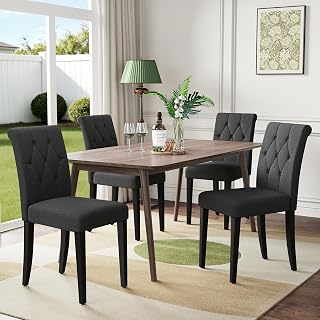
- Button tufting adds depth to an otherwise plain back
- Parsons profile tucks fully under standard aprons
- Set of four matched chairs in one purchase
- Padded seat suited to extended meals
- Straightforward assembly
Cons
- Tufted channels trap crumbs and need regular vacuuming
- Lower reported feedback volume than the longest established models here
Parsons chairs earn their place by being unobtrusive. The straight sided silhouette has no arms and no flare, so the chairs disappear under the table when not in use, which is exactly what you want in a room that has to serve more than one purpose.
Button tufting is what stops the design reading as plain. The indentations create shadow across the back panel and give the chair the appearance of a more expensive piece of furniture, which is a reasonable return on a purely decorative detail.
Those same tufted channels are the maintenance cost. Crumbs collect in them and stay there, and the only reliable remedy is a vacuum crevice tool used regularly. Skip that and the chair looks tired far sooner than the fabric warrants.
Feedback volume on this model is lower than on the longest established chairs in this group, which means less accumulated evidence about long term wear. The construction is conventional enough that this is a modest concern rather than a warning.
Bottom line: a formal look at a sensible level, on the condition that you own a vacuum crevice tool and use it.
- Configuration: set of four
- Style: Parsons, armless
- Back detail: button tufting
- Upholstery: fabric
- Seat: padded
- Assembly: attach legs
- Cleaning: vacuum tufting, spot clean
Dining rooms that need a formal appearance without armed chairs, and rooms where the chairs must tuck fully away between meals. The Parsons profile is the most space efficient shape in this comparison.
Less appropriate where nobody will keep up with vacuuming the tufted channels, since that is where this design shows neglect first.
Run a crevice tool along each tufted channel weekly rather than monthly. It takes under a minute per chair and is the difference between the detail looking crisp and looking grubby.
Because the silhouette is straight sided, these chairs sit well against a wall when not in use, which makes them a practical choice for a room that doubles as a workspace.

Pros
- Wooden frame pairs naturally with wood dining tables
- Set of four matched chairs in a single order
- Modern fabric styling without a strong period reference
- Padded seat and back
- Conventional assembly
Cons
- Styling is deliberately neutral and may read as plain
- Woven fabric requires vacuuming rather than wiping
This set is the middle option in COLAMY's range here, and it makes sense as the choice when the six chair high back set is more than you need. The wooden frame gives it a warmer feel than the metal legged chairs in this group and pairs more naturally with a wood table.
Styling is intentionally restrained. There is no tufting, no nailhead trim and no strong period reference, which makes the chairs easy to live with and easy to pair with an existing table. It also means they contribute little to a room visually, so they suit a space where the table or the lighting is the feature.
The seat and back are both padded, and the back sits at mid height, which keeps the chairs tuckable and stops a set of four dominating a small kitchen.
The upholstery is woven, so the same maintenance rules apply as elsewhere in this comparison. Vacuum regularly, blot rather than rub, and check the cleaning code before using any liquid cleaner.
Bottom line: the sensible neutral choice when you want the chairs to disappear into the room rather than define it.
- Configuration: set of four
- Frame: wood
- Upholstery: fabric
- Back style: mid back, padded
- Seat: padded
- Assembly: attach legs
- Cleaning: vacuum and spot clean
Rooms with an existing wooden table where the chairs should complement rather than compete. It is also the right pick when four chairs is the correct number and a six chair set would be wasteful.
Look elsewhere if you want the chairs to be a design statement, since restraint is the entire premise here.
Compare the wood tone of the frame against your table in daylight rather than under artificial light, since warm and cool undertones diverge most under a bulb. A close but imperfect match reads worse than a deliberate contrast.
If you are undecided between this and the six chair high back set, count your regular seating rather than your maximum, and buy for the regular number.

Pros
- Coloured fabric gives a room an accent without repainting
- Highest average rating in this comparison
- Modern silhouette suits contemporary tables
- Set of four matched chairs
- Padded seat and back
Cons
- Coloured upholstery limits future table pairings
- Smaller feedback base than the longest established models
Most dining chairs in this category are sold in beige, grey or cream, which makes a coloured set genuinely useful when a room needs an accent. The VKNOW set introduces colour at the table rather than on the walls, which is a considerably easier decision to reverse.
The silhouette is contemporary and clean, with no decorative detailing to compete with the colour. That is the correct call, since tufting or trim on a coloured seat quickly becomes busy.
Average rating on this set is the highest in the comparison, though the feedback base is smaller than on the long established models, so the figure carries less accumulated weight. The construction itself is conventional.
The obvious constraint is commitment. A coloured set locks the room into a palette, and if you replace the table later the chairs may no longer work. Neutral sets do not have that problem, and it is worth being honest with yourself about how often you rearrange.
Bottom line: the pick when you want the dining chairs to be the colour in the room.
- Configuration: set of four
- Style: modern
- Upholstery: coloured fabric
- Back style: mid back, padded
- Seat: padded
- Assembly: attach legs
- Cleaning: vacuum and spot clean
Rooms with neutral walls and a neutral table that need one confident element. It suits people who are comfortable committing to a palette and who are not planning to change the table soon.
Not the right choice if you expect to move the chairs between rooms or replace the table within a couple of years.
Repeat the chair colour once elsewhere in the room, in a runner or a piece of art, so the set reads as part of a scheme rather than an isolated decision. One repetition is enough; more starts to look matched.
Keep the rest of the table setting plain. Coloured chairs plus patterned placemats is a combination that fights itself.

Pros
- Metal frame is effectively permanent under normal use
- High average rating from owners
- Set of four matched chairs
- Slim frame profile keeps the room visually open
- Fabric seat softens an otherwise hard structure
Cons
- Metal legs transmit scraping noise on hard floors
- Frame offers no flex, so all comfort comes from the cushion
A metal frame changes the durability equation. There is no joint to loosen and no timber to split, so the frame will outlast the upholstery by a wide margin. If your previous dining chairs failed at a joint rather than at the fabric, this is the direct answer to that.
The slim leg profile is a secondary benefit. Metal is strong enough at small cross sections that the legs almost disappear, which keeps a small room feeling open in a way that thick wooden legs do not.
The trade offs are acoustic and tactile. Metal transmits sound, so a chair pushed across tile is audibly harsher than a wooden one, and the frame provides no flex at all. Everything you feel comes from the seat cushion, which makes cushion quality more important here than on a wood framed chair.
Floor protection is not optional with metal legs. Fit proper glides before the chairs are used, since a bare metal foot will mark hardwood almost immediately.
Bottom line: the most structurally durable choice here, provided you deal with the floor contact properly.
- Configuration: set of four
- Frame: welded metal
- Upholstery: fabric
- Seat: padded
- Leg profile: slim
- Assembly: attach legs to seat frame
- Cleaning: vacuum and spot clean
Households that have worn out wood framed chairs and want the frame question settled permanently. It also suits contemporary and industrial rooms where a slim metal leg is part of the intended look.
Less suitable for open plan spaces with hard floors unless you fit good glides, since noise is the main day to day compromise.
Fit screw in or high quality adhesive glides before first use and inspect them monthly. A metal leg running directly on tile or hardwood will leave marks that do not polish out.
Wipe the frame with a dry cloth rather than a wet one at the joints, since standing moisture at a weld seam is the only realistic corrosion risk on an indoor chair.

Pros
- Wooden construction suits traditional dining rooms
- Set of four in one purchase
- Upholstered seat and back for extended seating
- Conventional silhouette pairs with most tables
- Straightforward home assembly
Cons
- Smaller accumulated feedback base than established furniture brands
- Woven upholstery needs vacuuming rather than wiping
CHUN YI is better known for slipcovers than for chairs, which is an unusual background but not a disadvantage. A company that spends its time fitting fabric to furniture tends to understand upholstery tension, and the seat panels here sit taut rather than slack.
The design is deliberately conventional: wooden frame, padded seat, mid height back, no decorative detailing. That makes the set easy to pair with an existing table and easy to replace individually later if one chair takes damage.
Because the accumulated feedback base is smaller than for the long established names in this comparison, there is less evidence about how the chairs behave after several years. The construction is standard enough that this is a modest unknown rather than a red flag.
Assembly follows the usual pattern of attaching legs to a preassembled seat and back. Tighten in a cross pattern rather than fully tightening one bolt at a time, which seats the frame evenly.
Bottom line: a straightforward wooden set for a traditional room, with the caveat that its long term record is shorter than its rivals.
- Configuration: set of four
- Frame: wood
- Upholstery: fabric
- Back style: mid back
- Seat: padded
- Assembly: attach legs
- Cleaning: vacuum and spot clean
Traditional dining rooms where a wooden frame and a plain padded seat are exactly the brief. It works well as a replacement set for an older table that you intend to keep.
Buyers who want a long established track record before committing may prefer the Ashley or Roundhill sets.
Because this maker also produces chair covers, replacing the look later without replacing the chairs is a realistic option. That makes the set a reasonable choice if you expect your colour scheme to change.
Check the wood tone against your table in daylight before ordering, since a traditional silhouette makes a mismatch more obvious than a modern one would.

Pros
- Casters let chairs move without scraping the floor
- Suits a table that doubles as a workspace
- Set of four matched chairs
- Upholstered seat and back for long sessions
- Reduces noise in open plan rooms
Cons
- Casters can roll on hard floors when you do not want them to
- Smallest feedback base in this comparison
Casters are unusual on dining chairs and genuinely useful in one specific situation: when the dining table is also where someone works, studies or does craft projects. In that setting a chair gets repositioned constantly, and rolling it is quieter and kinder to the floor than dragging it.
The upholstery follows the rest of this category, with a padded seat and back in a light neutral. Cream beige is the least forgiving colour choice for a dining chair, so this set makes most sense in a room where meals are occasional and desk work is the main use.
The obvious caution is that casters roll in both directions. On a hard floor a chair can drift when you sit down, which is disconcerting until you are used to it and is a real consideration for elderly users. Locking casters or a rug under the table both address it.
The feedback base is the smallest in this comparison, so treat the long term durability of the caster mounts as an open question. Caster stems are a known wear point on any rolling chair.
Bottom line: the pick for a dining table that works for a living, and only for that.
- Configuration: set of four
- Mobility: casters on all legs
- Upholstery: fabric, cream beige
- Back style: mid back, padded
- Seat: padded
- Assembly: attach legs and casters
- Cleaning: vacuum and spot clean
Homes where the dining table is also the desk, the homework station or the craft bench. The rolling action is a daily convenience in that scenario and largely irrelevant in a dedicated dining room.
Not appropriate as a household's only dining chairs if any regular user is unsteady on their feet, since a chair that moves as you sit is a genuine hazard.
Check the caster stems monthly for play in the socket, since that is where rolling chairs fail first. Any wobble means the stem is wearing its seat and the caster should be replaced before it detaches.
Put a low pile rug under the table if the floor is hard. It stops unintended drift when someone sits down and it protects the floor from grit picked up in the caster wheels.
How to Choose Upholstered Dining Chairs
Upholstered dining chairs are sold on styling photographs, which is exactly why so many of them disappoint. The differences that matter are structural and material, and most of them are stated somewhere in the listing if you know which words to look for. Work through the six factors below before you commit to a set.
Frame Material and Joinery

The frame decides whether a chair lasts a decade or develops a wobble in a year. Solid wood frames, usually rubberwood or birch in this category, resist the racking forces that come from someone leaning back on two legs. Engineered wood and particleboard frames are lighter and cheaper to ship, but the fasteners that hold them together sit in material that crumbles once a screw works loose.
Metal frames behave differently again. A welded steel frame is effectively permanent, and the tubular metal legs on several chairs here will outlast their upholstery by a wide margin. The trade off is that metal transmits noise and cold, and it offers no give at all, so the seat cushion has to do all the comfort work on its own.
Pay attention to how the legs attach. Chairs where the legs bolt directly into a solid seat frame stay tight. Chairs where the legs thread into plastic inserts sunk in particleboard are the ones that start rocking. If a listing mentions corner blocks or a reinforced apron, that is a real structural detail rather than marketing language, and it is worth weighting heavily.
Seat Fill Density
Foam density is the single best predictor of how a dining chair will feel after a year. High density foam compresses under load and springs back; low density foam compresses and stays compressed, which is why an inexpensive chair can feel plush in week one and flat by month six. Density is rarely printed on dining chair listings, so the practical proxy is seat thickness combined with reported sag complaints.
Thickness alone is misleading. A four inch cushion of soft foam will bottom out faster than a three inch cushion of firm foam, and dining chairs are used sitting upright rather than lounging, so firmness matters more than softness. A seat that feels slightly too firm in a showroom is usually the one that still feels correct after two years of dinners.
Some chairs in this comparison use a sinuous spring base under the foam rather than a solid platform. That construction spreads load across the seat and takes strain off the foam itself. It adds weight and cost, and it is one of the clearest dividing lines between a chair built to furniture standards and one built to ship in a flat box.
Fabric Type and Cleanability
Dining chairs get food on them, so fabric choice is a maintenance decision more than an aesthetic one. Polyester and polyester blends dominate this category because they resist staining and dry quickly. Linen and linen look fabrics breathe better and read as more expensive, but they absorb liquid readily and show water rings if you blot them wrong.
Performance fabrics and faux leather sit at the easy end of the cleaning scale. Faux leather wipes clean with a damp cloth and shrugs off the sort of spill that would permanently mark woven fabric, which makes it the obvious choice in households with young children. Its weakness is cracking along stress lines over time, particularly at the front edge of the seat where legs slide across it.
Look for a cleaning code in the listing or on the tag. Code W means water based cleaners are safe, code S means solvent only, and code WS means either. That single letter tells you more about living with a chair than any photograph, and a code S chair in a busy kitchen is a decision you will regret the first time someone knocks over a glass.
Seat Height and Table Clearance
Standard dining tables sit around thirty inches tall, and a comfortable seat height for that is eighteen to nineteen inches from the floor. Upholstered chairs complicate this because the quoted seat height is usually measured uncompressed. A nineteen inch cushion that compresses two inches under an adult effectively becomes a seventeen inch seat, which leaves you reaching up to the table.
Thigh clearance is the other half of the calculation. You want roughly ten to twelve inches between the top of the compressed seat and the underside of the table apron. Less than that and the chair will not tuck in, which matters in narrow rooms where pushed out chairs block a walkway.
Arms make the tuck problem worse. Armed dining chairs need the arm height checked against the apron separately, and many upholstered designs with arms simply will not slide under a standard table. Measure your own table before ordering rather than trusting that a dining chair will fit a dining table by default.
Back Design and Support

High back chairs support the shoulder blades and suit long meals; low and mid back chairs feel airier and disappear visually in a small room. Neither is objectively better, but they suit different rooms, and a high back chair in a compact dining nook can make the space feel walled in.
Lumbar shaping matters more than height. A back panel with a slight forward curve at the base holds the pelvis upright and takes strain off the lower spine. A perfectly flat back panel, however well padded, encourages slouching because there is nothing to sit against.
Button tufting and nailhead trim are decorative, but they have practical consequences. Tufting creates channels that trap crumbs and require a vacuum crevice tool. Nailhead trim along the outer edge can catch on clothing and, on cheaper chairs, individual nails work loose. Both details look excellent and both add a maintenance step.
Assembly and Set Size

Almost every upholstered dining chair ships partly assembled, and the amount of work varies from attaching four legs to bolting a back panel to a seat frame. Chairs that arrive with the back already joined to the seat are meaningfully sturdier, because that joint is the one under most stress and a factory joint beats a home assembled one.
Set size affects both value and matching. Buying a set of four or six at once guarantees the fabric comes from the same dye lot, which matters with woven fabrics where batch variation is visible under daylight. Buying pairs lets you build up gradually but risks a mismatch if you return months later.
Check whether hardware is included and whether replacement parts are available. A chair with a proprietary bolt pattern and no spare parts channel becomes disposable the moment a fastener strips, while a chair using standard hex bolts can be repaired indefinitely from a hardware store.
Floor Protection and Noise
Dining chairs move constantly, and what sits between the leg and the floor decides whether that movement is silent or destructive. Bare metal or unfinished wood legs will mark hardwood within weeks and will scratch tile grout lines. Most chairs ship with stick on felt pads, and most of those pads fall off within a few months because the adhesive gives up under shear load.
Legs with a recessed nail hole in the base are the better design, because they accept screw in glides that stay put. If you have hard floors and expect the chairs to be pushed rather than lifted, that detail is worth checking in the product photographs before you order. Chairs with casters sidestep the issue entirely, provided the casters are rated for your floor type.
Noise follows the same logic. A hollow tubular metal leg amplifies every scrape into the room, while a solid wood leg with a felt glide is close to silent. In an open plan space where the dining area shares a room with seating, that difference is more noticeable day to day than any styling decision.
| Factor | Better choice for daily family use | Better choice for a formal room |
|---|---|---|
| Frame | Solid wood or welded metal | Solid wood with corner blocks |
| Fabric | Faux leather or performance polyester | Linen look woven fabric |
| Back height | Mid back, easy to tuck | High back with lumbar shaping |
| Detailing | Plain panels, no tufting | Button tufting or nailhead trim |
| Set size | Four or six, one dye lot | Pairs, matched to an existing table |
If you are still narrowing down a style direction, browsing our category guides alongside this list helps you see how chair silhouettes read next to different table shapes.
Why You Should Trust Us
We build these rankings from published manufacturer specifications and from patterns in verified owner feedback, not from sponsored placement. For each chair we recorded the stated frame material, seat construction, fabric type and cleaning code, overall and seat dimensions, weight capacity, and assembly requirements, then compared those figures across the group so that claims could be checked against one another rather than taken at face value.
Owner feedback is most useful when it is read for repetition rather than sentiment. A single report of a wobbly leg tells you nothing; the same complaint appearing across many months of feedback for the same model points at a design weakness. We weighted recurring structural observations, particularly around sagging cushions, loosening joints, and fabric wear at the seat edge, more heavily than one off comments about colour accuracy.
Final Thoughts
The Signature Design by Ashley Berringer earns best overall because it pairs a solid wood frame with a firm, deep cushion and a woven fabric that hides everyday marks. It is the chair in this group most likely to still be in service in ten years, and it reads well in both casual and formal rooms.
For best value, the Roundhill Furniture Biony delivers nailhead trim and a padded seat in a configuration that suits most standard tables without demanding much from your budget. If you need to seat a crowd, the COLAMY high back set covers six chairs from one dye lot, which solves the matching problem that comes with buying in pairs.
For specific situations, the KISLOT set with casters is the pick for a room that doubles as a home office, since rolling chairs move without scraping the floor. The VKNOW and UVV sets suit modern rooms where a metal leg profile is part of the look. Whichever direction you choose, measure your table apron first, then decide on fabric based on how the room actually gets used rather than how you would like it to be used. Our full article library covers the rest of the room.
Upholstered Dining Chair FAQs
How do I stop upholstered dining chair seats from flattening?
Rotate the chairs around the table every few months so the same two seats are not taking every meal. Flattening is cumulative compression of the foam, and spreading the load across all the chairs slows it down considerably. Chairs with a sinuous spring base under the cushion resist this better than chairs with foam sitting on a solid panel, so if flattening is your main concern, that construction detail is worth prioritising over cushion thickness.
Can upholstered dining chairs be cleaned at home?
Most can, but the method depends on the cleaning code. Code W fabrics tolerate water based upholstery cleaner applied to a cloth rather than sprayed directly onto the seat. Code S fabrics need a solvent cleaner and will water stain if you use anything wet. Faux leather wipes clean with a damp cloth and mild soap. In every case, blot rather than rub, and work from the outside of a spill inward so you do not spread it.
Are removable covers worth looking for?
They are if the household includes young children or pets. A washable cover turns a permanent stain into a laundry cycle, which materially extends the useful life of a chair. The trade off is fit: removable covers rarely sit as tightly as fixed upholstery and can look slack after washing. Some designs in this category use a slipcover over a fixed seat, which gives you both a tailored base layer and a washable outer layer.
What weight capacity should I look for?
Published capacities in this category commonly sit between two hundred and three hundred pounds per chair. Treat the number as a static rating rather than a dynamic one, because the forces involved in someone dropping into a seat or leaning back exceed their body weight. Choosing a chair rated well above the heaviest regular user gives you margin for that, and the chairs with higher ratings almost always achieve them through better frame construction rather than thicker padding.
Do upholstered chairs work with a wooden table?
Yes, and the combination is common because fabric softens the visual weight of a wood table. The pairing works best when you match undertones rather than exact colours, so a warm oak table sits well with cream or beige fabric while a cool grey table suits charcoal or blue. If the chairs have wooden legs, matching those legs to the table finish looks deliberate, while a deliberate contrast in a metal leg reads as modern. Our home and kitchen section has more on pairing dining room pieces.






Write Your Review
No reviews yet. Be the first to share your experience!