

A hair stopper is a small purchase that quietly prevents an expensive one. Hair binds with soap residue inside the trap and the horizontal run beyond it, and by the time a shower is standing in water the blockage is well past the point a plunger reaches. The catch is that these products come in two completely different shapes that fit two completely different drains, and buying the wrong shape is the single reason most of them end up in a drawer. We sorted 8 drain hair catchers from OXO, DrainWig, TubShroom and more by where they sit, what they are made of, and how well they stay put.
Our top pick is the TubShroom Bathtub Drain Hair Catcher for its in-drain design that collects hair around the outside of the body, out of sight and easy to wipe clean. Below we work through fit, materials, flow and cleaning, because the decisions that matter here are made before the product arrives. For related fixes around the house, our tools and home improvement section covers the rest of the job.

Pros
- Hair collects out of sight around the body rather than on the floor
- Flow stays good as it fills because the water path stays clear
- Sits below the tub floor so nothing gets trodden on
- Cleaning is a lift and a wipe rather than a scrape
Cons
- Only fits plain open drains within its stated diameter range
- Silicone can stain from hair dye over time
- Wiping the outside puts your hand close to the collected hair
This is the product that defined the in-drain approach, and the mechanism is the reason it sits at the top. The body drops into the drain opening and sits below the level of the tub floor, water flows over the rim and away through the middle, and hair wraps around the outside where it cannot block the water path.
That separation of hair and flow is the whole argument. A flat cover collects hair on the same holes the water uses, so it slows down as it fills. This shape keeps draining at the same rate whether it is clean or nearly full, which is why people report it staying effective between cleanings rather than needing constant attention.
It also disappears. Sitting below the tub floor means nothing to stand on, nothing to kick loose and nothing visible in the bath, which matters in a shower small enough that you cannot avoid the drain.
The limitation is fit, and it is absolute. It needs a plain open drain within the stated diameter range, so a tub with a pop-up plug or a lift and turn stopper rules it out unless you remove the mechanism. Measure the inside of the opening rather than the chrome flange before ordering.
Bottom line: the best mechanism in the category, provided your drain is the plain open type it needs.
- Type: in-drain strainer
- Fits: standard open tub drain openings within the stated range
- Material: flexible silicone body
- Hair collection: around the outside of the body
- Water path: open centre
- Cleaning: lift out and wipe
Buy this for a bathtub or shower with a plain open drain, especially in a household where long hair is the recurring problem and nobody wants to look at a mat of it on the floor of the tub. It suits small showers where a raised cover would be underfoot. Skip it if your drain has a pop-up plug, a lift and turn knob or a trip lever stopper, and skip it if the opening measures outside the stated range, since a loose fit lifts under running water and lets hair straight past.
Measure the inside diameter of the drain opening first, then push the body in until it seats firmly rather than resting loose. Check that it does not lift when the shower runs at full flow, and reseat it if it does. To clean, pull it out, wipe the hair off the outside into the bin, rinse it under hot water to shift soap film, and push it back. Weekly is right for most households, more often where several people share the shower.

Pros
- Fits drains that cannot take an in-drain insert
- Silicone edges grip and stay flat on a smooth surface
- Stainless steel element gives the body structure
- Hair is visible and peels off without lifting anything
Cons
- Passes water through the same holes hair sits on, so it slows as it fills
- Needs a smooth flat area around the grate to sit properly
This is the answer for every drain an in-drain catcher cannot use, which is a large share of bathrooms. Pop-up plugs, lift and turn knobs and trip lever assemblies all occupy the opening, and a cover that lies over the whole thing works around that without touching the plumbing.
The construction is the usual sensible pairing: silicone for grip and flexibility at the edges, a stainless element for structure so the cover does not curl or deform underfoot. On a smooth acrylic or enamel surface it stays where you put it.
Cleaning is the part people like. The hair collects on top where you can see it and peel it off in one piece, with no reaching into a drain and nothing to lift out. For a household that finds the in-drain routine unpleasant, that difference decides which product actually gets used.
The honest limitation is flow. Water passes through the same holes the hair sits on, so it drains normally when clear and slows once a mat builds up. That makes it a product to clear on a schedule rather than one to forget about, and it needs a smooth flat zone around the grate for the edges to seal against.
Bottom line: the most compatible design here, at the cost of needing more frequent clearing.
- Type: over-drain cover
- Materials: silicone with stainless steel element
- Fits: shower and tub drains including pop-up and lift and turn
- Profile: low, sits on top of the grate
- Hair collection: on the upper surface
- Cleaning: peel hair off, rinse
This is for drains with a stopper mechanism in the opening, for anyone renting who does not want to modify anything, and for households that would rather peel hair off a surface than pull a body out of a drain. It also suits tubs used for baths, since it does not interfere with the plug. Skip it if your shower floor is textured or tiled right up to the grate, where the edges cannot seal, and skip it if you want something you can leave for weeks between cleanings.
Clear the hair before it mats, since a wet mat left in soap becomes far harder to remove in one piece and is what causes standing water. Rinse the whole cover in hot water regularly to shift the soap and conditioner film that makes hair stick. Wipe the surface underneath it too, because trapped residue between the cover and the tub is where staining starts. Check the edges are lying flat after each clean so nobody catches a foot on a lifted corner.
Pros
- Stainless body holds its shape and will not go slack
- Does not stain from hair dye the way soft silicone can
- Same in-drain mechanism that keeps flow clear
- Looks like part of the fitting rather than an accessory
Cons
- A rigid body cannot conform to an out of round drain
- Still restricted to plain open drains within the size range
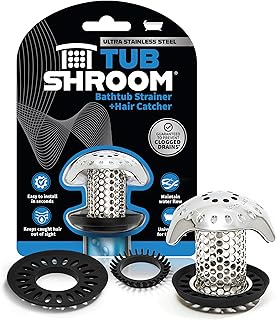
This takes the in-drain mechanism and rebuilds it in stainless steel, which fixes the two complaints people have about soft catchers: staining and slack. Hair dye and long term soap contact discolor silicone, and a body that softens loses the firm fit that keeps it seated.
Metal solves both. It holds its diameter, it wipes back to clean, and it looks like part of the drain fitting rather than something added on, which matters in a bathroom where the tub is on show.
The mechanism is unchanged and still the strongest argument for the format. Water leaves through the open middle, hair wraps around the outside, and the flow does not deteriorate as the hair collects. Cleaning is the same lift and wipe.
What you give up is conformity. A silicone body squeezes into an opening that is slightly out of round or has a rough lip, while a rigid metal body either fits or it does not. Measure the inside diameter carefully, and if your drain is old, chipped or an odd shape, the flexible version is the safer buy.
Bottom line: the in-drain design for anyone tired of stained silicone, provided the drain is a clean, regular opening.
- Type: in-drain strainer
- Material: stainless steel
- Fits: standard open tub drains within the stated range
- Hair collection: around the outside of the body
- Water path: open centre
- Cleaning: lift out and wipe
Check the drain opening is round and undamaged, then push the body in until it seats without rocking. Run the shower at full flow and watch for lift, since a metal body that is slightly loose will float in a way a silicone one might not. Clean by lifting it out, wiping the hair from the outside, and rinsing under hot water. If limescale builds up in a hard water area, a soak in a descaling solution restores the finish.
Choose steel over silicone if anyone in the house colors their hair, if the tub is visible and you want the fitting to look tidy, or if a previous soft catcher went slack. Choose silicone instead if your drain opening is chipped, out of round or at the edge of the size range, since flexibility is what makes those fit. Either way, confirm the drain is a plain open type with no stopper mechanism before ordering.

Pros
- Steel mesh catches fine hair without choking the flow
- Silicone base helps it sit flat and stay put
- Suited to wider shower drains rather than tub openings
- Simple shape that rinses clean quickly
Cons
- Sits on the floor of the shower so it can be trodden on
- Fine mesh needs clearing more often than an open in-drain body
Shower drains are frequently wider than tub drains, and this is aimed squarely at them. The combination of a stainless mesh with a silicone base is the standard solution for a floor drain: the mesh does the catching, the silicone keeps it flat and stops it sliding around under water.
Fine mesh is the notable part. Long strands are easy for any catcher to stop, but the shorter hair from shaving or from a pet wash slips through coarse holes and goes straight into the trap. A finer mesh holds those, which is the difference between a drain that stays clear for years and one that slowly silts up.
The trade-off arrives with the same feature. Finer holes mat over sooner, so this needs clearing more often than an open bodied in-drain unit. It rinses clean in seconds under a hot tap, so the routine is quick, but it is a routine rather than something to ignore.
Being a floor-sitting design, it also gets stood on. The low profile helps and the silicone base takes weight without cracking, but in a very small shower it is a thing underfoot in a way an in-drain body never is.
Bottom line: the pick for a wide shower drain, and the one that catches the fine hair others let through.
- Type: over-drain strainer
- Materials: stainless steel mesh with silicone base
- Fits: shower floor drains, wider than standard tub openings
- Catches: long and short hair
- Profile: low
- Cleaning: rinse under hot water
This suits walk-in showers with a wider floor drain, households where somebody shaves in the shower, and anyone who washes a dog in there and needs to stop short hair reaching the trap. It is also a good choice where the drain grate is set into tile and no insert will fit. Skip it if you want the longest possible interval between cleanings, since fine mesh mats sooner, and check the diameter against your grate before ordering.
Set it centrally over the grate on a clean dry surface so the base seats flat, then run the water and check it does not shift. Clear the hair as soon as it is visible: dry hair lifts off in one piece, soaked hair has to be picked apart. Rinse the mesh under hot water regularly to shift soap film, and lift it occasionally to wipe the grate underneath, where residue collects unseen.

Pros
- Very low profile so it is barely noticeable underfoot
- Simple one piece design with nothing to come apart
- Works over drains that cannot take an insert
- Easy to lift and rinse in seconds
Cons
- Collects hair on the visible surface of the tub
- Smooth surfaces only, it will not hold on textured floors
This is the plainest product on the list and that is its argument. There is no mesh insert to separate, no body to seat inside the plumbing and no fitting decision beyond checking the size: it lies over the drain, catches hair, and lifts off to be rinsed.
The low profile is the feature worth paying attention to. Anything sitting proud of a tub floor gets stood on, and a protector that sits nearly flush is one you stop noticing, which is exactly what you want in a tub used for both showers and baths.
Because it works over the existing drain, it is compatible with hardware that rules out in-drain designs. That makes it a straightforward answer in a rented bathroom or anywhere you would rather not touch the plumbing.
The limitations are the ones every over-drain design carries. Hair collects where you can see it, which some people dislike, and it needs a smooth flat surface to sit against, so a textured non-slip tub floor is a poor host. It also wants clearing on a schedule rather than being left.
Bottom line: the simplest, least intrusive over-drain option, and the easiest to live with day to day.
- Type: over-drain protector
- Fits: standard bathtub drains
- Profile: low, near flush with the tub floor
- Construction: one piece
- Hair collection: on the upper surface
- Cleaning: lift and rinse
Choose this when the tub is used for baths as well as showers and you want something that does not interfere with the plug or sit up under your feet. Check the flat area around your drain is smooth rather than textured. If your priority is the longest gap between cleanings, an in-drain body does better, and if the drain is a wide shower floor grate, a larger mesh strainer is the correct shape instead.
Lift and rinse it whenever hair is visible, and wipe the tub surface underneath at the same time, since soap residue trapped between the protector and the enamel is what leads to marking. Use hot water rather than abrasives on the protector itself. Make sure it is sitting flat before anyone showers, because a lifted edge in a wet tub is a trip point, particularly for older members of the household.

Pros
- Rigid steel construction holds its shape over time
- Sits over the drain so no insert is required
- Wipes clean and resists staining
- Suits both bathtub and shower drains
Cons
- Metal sitting on a tub floor is noticeable underfoot
- Needs a flat area around the drain to sit level
This is the metal counterpart to the silicone-based strainers, and it exists for households where soft catchers have not lasted. Steel keeps its shape indefinitely, does not go slack around the edges, and does not pick up the stains that hair dye leaves in silicone.
The strainer shape lifts the collecting surface slightly above the drain opening rather than lying flush on it, which keeps a little more of the water path clear as hair accumulates. It is a smaller version of the advantage the in-drain designs have, achieved without putting anything into the plumbing.
Cleaning is as simple as it gets: lift, tip the hair into the bin, rinse under hot water. There is nothing to disassemble and no soft surface for residue to cling to, which keeps the job to a few seconds.
What you notice is that it is metal on a tub floor. It is more obvious underfoot than a flat silicone cover and it needs a level area around the drain to sit properly, so a sloped or textured shower base is not the right host for it.
Bottom line: the durable over-drain option for households that keep wearing out softer catchers.
- Type: over-drain strainer
- Material: stainless steel
- Fits: bathtub and shower drains
- Design: patented strainer shape
- Hair collection: above the drain opening
- Cleaning: lift, empty, rinse
Buy this if silicone catchers in your bathroom have gone slack, stained or torn, and if the drain will not take an insert. It suits households with hard water or heavy conditioner use, where residue ruins soft surfaces quickly. It is also the tidier looking option in a bathroom where the fittings are chrome. Skip it if your shower base is textured or sloped right up to the grate, and skip it if you want something you genuinely cannot feel underfoot.
Place it centrally on a clean, dry area around the drain and check it sits level rather than rocking on a slope or a grout line. Clear hair as soon as it is visible, tipping it straight into the bin rather than rinsing it down the drain you are trying to protect. Rinse the strainer under hot water to shift soap film, and descale occasionally in a hard water area so the finish stays clean.

Pros
- Two covers per pack covers a second bathroom
- Flexible silicone takes a foot without deforming
- Suction cups hold well on smooth surfaces
- Hair peels straight off the top
Cons
- Suction cups do not hold on textured or tiled floors
- Slows noticeably once hair mats across the surface
- Light enough to shift under a strong flow if the cups let go
This is the straightforward version of the over-drain idea and the reason it is the value pick: a flexible square of silicone, suction cups underneath, hair on top, no fitting decisions to get wrong beyond checking the surface is smooth.
Arriving as a pair changes the calculation. Most households have more than one shower or tub that could use one, and buying a second bathroom's worth in the same pack is what makes this the sensible starting point for anyone who has not used a catcher before.
The silicone is soft enough to stand on without cracking or curling, which matters because a cover in the middle of a shower floor gets trodden on daily. Peeling the hair off the top is the easiest cleaning routine of any design here.
The weaknesses are honest and predictable. Suction cups need smooth acrylic or enamel, and they simply will not grip a textured non-slip base or a tiled floor with grout lines. Being a flat cover, it also slows once hair mats over the holes, so it wants clearing weekly rather than being left.
Bottom line: the easy, low-commitment way to protect two drains, as long as the surfaces are smooth.
- Type: over-drain cover
- Material: silicone
- Shape: square
- Fixing: suction cups
- Pack: two covers
- Cleaning: peel hair off, rinse
This is for a household trying a hair catcher for the first time, for anyone with two bathrooms to cover, and for renters who want nothing inserted into the plumbing. It suits smooth acrylic or enamel shower trays and tubs where the suction cups can do their job. Skip it if your shower floor is tiled or textured, where the cups will not hold, and skip it if you want a catcher that keeps draining freely for weeks between cleanings.
Clean and dry the area around the drain before fitting, then press the cover down firmly so every suction cup seats. Run the shower and check it does not creep. Lift and refit the cups every few weeks, since soap film gradually breaks the seal. Peel the hair off the top while it is dry if you can, because a soaked mat comes away in pieces rather than one, and rinse the underside when you lift it.

Pros
- You never touch or wipe collected hair
- Sits out of sight below the drain cover
- Nothing on the shower floor to stand on
- Installs in seconds with no tools
Cons
- A consumable, so there is an ongoing replacement cadence
- Needs a drain cover it can hang from
Every other product here asks you to handle wet hair sooner or later, and this one does not. It hangs below the drain cover, collects hair out of sight, and when it is full you pull the whole thing out and bin it with the hair still attached.
That is a genuinely different proposition, and in households where the job never gets done it is the deciding factor. A catcher that nobody empties stops working, so the design that removes the unpleasant step is often the one that actually keeps the drain clear.
It is also invisible in use. There is nothing sitting on the shower floor, nothing to trip on and nothing to look at, which suits a bathroom where you would rather not see a piece of hardware around the drain.
The cost is that it is a consumable rather than a one-off. There is a replacement rhythm to keep up with, and it needs a drain cover it can hang from, so check your fitting before ordering. For anyone who wants a single purchase and no repeat orders, an in-drain body is the better economics.
Bottom line: the pick for households where nobody will ever wipe hair off anything, at the price of ongoing replacements.
- Type: disposable in-drain hair trap
- Fitting: hangs below the existing drain cover
- Installation: no tools required
- Disposal: pull out and bin complete
- Visibility: nothing on the shower floor
- Format: consumable, replaced periodically
This is for households where the cleaning routine is the real obstacle: shared houses, families where nobody volunteers, or anyone who finds handling wet hair genuinely unpleasant. It also suits bathrooms where you want nothing visible around the drain. Skip it if you would rather make one purchase and be done, since this is a repeat buy, and check that your shower has a drain cover it can hang beneath before ordering.
Work out the replacement cadence for your household before committing, since a house of long-haired people gets through these faster than a single person will. Check the drain cover type first, because the design relies on hanging beneath it. If you want the same out-of-sight collection without the ongoing cost, an in-drain body gives you that in exchange for wiping hair off it yourself, which is the honest trade between the two approaches.
How to Choose a Drain Hair Catcher
Two shapes, two fits, and one measurement that decides everything. Read the first two sections before you look at anything else, because no material or brand preference survives a product that does not fit the drain.
In-Drain or Over-Drain

An in-drain catcher is a hollow body that drops into the drain opening itself and sits below the level of the tub floor. Water flows over the rim and down through the middle while hair wraps around the outside of the body, where it stays out of the way of your feet and out of sight. Lifting it out and wiping the collected hair off the outside is the whole maintenance routine.
An over-drain catcher is a flat or domed cover that sits on top of the grate, usually held down by suction cups or by its own weight. Hair collects on the surface where you can see it and pick it off, which some people prefer, and there is nothing inserted into the plumbing at all. It is also the only workable answer for drains you cannot put anything into.
The choice is mostly about the drain rather than about taste. A plain open tub drain or a simple shower grate can take either shape. A drain with a fitted stopper mechanism can usually only take an over-drain cover, and a large square shower drain in a tiled floor is nearly always an over-drain job. Work out which family fits before you compare products inside it.
Measure the Drain First

In-drain catchers are sold to fit a stated opening range, commonly around one and a half inches for a standard tub. Measure the inside diameter of the opening, not the visible chrome flange around it, since the flange is wider and measuring it is how people end up with something that will not seat. If the product states a range, being at the very edge of it usually means a loose fit that lifts when the water runs.
Over-drain covers are measured the other way. What matters is the width of the cover against the flat area of tub or shower floor around the grate, since the cover has to lie flat with its suction cups on smooth surface rather than half on a slope or a textured section. Measure the flat zone as well as the grate.
Check the grate style at the same time. Drains with a pop-up plug, a lift and turn knob or a trip lever have hardware sitting in the opening, which rules out most in-drain designs unless you remove the mechanism. Removing it is a real option in a shower you never plug, but it is a decision to make deliberately rather than discovering it with a product in your hand.
Silicone, Stainless Steel, or Both

Most of this category is silicone, stainless steel, or the two combined, and the combination is common because each material solves what the other cannot. Silicone flexes, so it seats into an irregular opening and grips a wet surface, and it does not corrode in a permanently damp environment. On its own it can be too soft, letting a cover deform under a foot or a body lift out of position.
Stainless steel gives structure, weight and a mesh fine enough to catch hair without slowing the flow. It stays flat, it does not sag over time, and it wipes clean rather than staining. The weakness is fit: a rigid steel part cannot conform to an out of round drain, and cheaper grades can spot or rust at a welded seam over time in hot, soapy water.
Combined designs put a steel mesh or ring inside a silicone body, which is the arrangement most of the best regarded products use. Look at where the two materials meet, because that seam is where hair and soap scum collect and where a poorly made unit starts to separate. A clean moulded joint rather than a glued one is worth looking for in the product photographs.
Flow Rate and Standing Water
Every catcher restricts the drain a little, and the question is whether you notice. In-drain designs generally handle flow well because water leaves through a large open middle and hair collects on the outside, so the collected hair never blocks the water path. That is the mechanical advantage of the shape and the reason it stays effective as it fills.
Flat over-drain covers work the opposite way: water passes through the same holes that the hair is sitting on. They drain fine when clean and slow noticeably once a mat of hair builds up, which means they need clearing more often rather than being worse designs. A domed cover manages this better than a flat one because the hair collects on the sides while the top stays clear.
Soap matters more than anyone expects. Bar soap and conditioner leave a film that hair sticks to, and a catcher clogged with soapy hair drains slowly regardless of its shape. If you notice a product slowing down within days rather than weeks, the cause is usually product residue rather than a design fault, and a rinse in hot water sorts it.
Cleaning Routine and Disposable Options
Be honest about how you will actually deal with the hair, because that determines which design you keep using. In-drain catchers require lifting the body out and wiping the outside, which is quick but does put your hand near the collected hair. Over-drain covers let you peel the mat off the top without lifting anything, which many people find easier to face.
Disposable inserts are a third route, sitting in the drain and collecting hair on a strand or a core that you pull out and bin whole, without touching anything. That is the cleanest routine available and the one that suits households where nobody will volunteer for the job. The trade-off is that it is a consumable, so there is a replacement cadence to keep up with rather than a one-off purchase.
Frequency depends entirely on the household. A single person with short hair may clear a catcher once a fortnight, while a house with several long-haired people will want it done weekly or more. Whatever the interval, doing it before the water starts pooling is what keeps the routine to a few seconds. More small household fixes are collected in our home and kitchen section.
Staying Put Under Water and Feet
A catcher that moves is a catcher that fails, and the two shapes fail differently. In-drain bodies rely on a snug fit against the drain wall, so a unit at the loose end of its stated range will float up when the water runs hard, then sit at an angle and let hair straight past. A firm push-in fit that needs a small effort to remove is what you want.
Over-drain covers rely on suction cups, and suction cups need a smooth, clean surface. They hold well on a smooth acrylic or enamel tub floor and poorly on textured non-slip surfaces or tiled shower floors with grout lines. If your shower floor has any texture at all, weight and a low profile do more than suction, and it is worth checking what a cover relies on before ordering.
Standing on it is the other test. Anything sitting proud of a shower floor gets trodden on, so a cover needs to be either low enough not to notice or flexible enough to take a foot without deforming. In-drain designs sidestep this entirely by sitting below the floor line, which is a genuine advantage in a small shower where you cannot avoid the drain.
| Type | Best at | Weak at |
|---|---|---|
| In-drain body | Flow stays good as hair collects, sits below foot level | Needs a plain open drain and a correct diameter |
| Over-drain cover | Fits almost any grate, hair is visible and easy to peel off | Slows once hair mats over the holes, suction fails on texture |
| Disposable insert | Cleanest routine, nothing to touch or wipe | Ongoing replacements rather than a single purchase |
Why You Should Trust Us
We build these lists from published specification and from the pattern of what long-term owners report, rather than from marketing copy. For each product here we looked at the stated drain size range, whether it is designed to sit in the drain or over it, the materials and how they are joined, the fixing method, and what the maker says about compatibility with pop-up and lift and turn drain hardware.
We set aside near-identical listings that differ only in color or pack size, so every entry is a genuinely different design. Where the same brand appears twice, the two entries differ in shape, size range or construction rather than being repeats of one product, and we say plainly which drains each one will not fit.
Final Thoughts
Best overall is the TubShroom Bathtub Drain Hair Catcher. The in-drain shape is the one that keeps draining freely as it fills, it sits below the floor of the tub where nobody stands on it, and clearing it is a matter of lifting it out and wiping the outside.
Best value is the Bovinde Hair Drain Catcher two-pack. It is a simple silicone over-drain cover with suction cups, it arrives as a pair so a second bathroom is covered, and for a smooth-floored tub or shower it does the job without any fitting decisions to get wrong.
For specific situations, the OXO Good Grips Silicone Shower and Tub Drain Protector is the pick for a drain you cannot insert anything into, the TubShroom Ultra is the choice if you want the in-drain design in stainless steel, the LEKEYE Shower Drain Hair Catcher suits a shower with a wider opening, the OXO Good Grips Bathtub Drain Protector is the low-profile option for a tub floor you stand on, and the DrainWig Shower Drain Hair Catcher is the one to buy if nobody in the house will ever wipe hair off anything. More picks for the rest of the home are indexed in our article archive and the category index.
Drain Hair Catcher FAQs
Will a drain hair catcher slow my shower down?
Barely, when it is clean and the right shape for the drain. In-drain designs keep draining well even as they fill, because the water leaves through an open middle while the hair collects on the outside of the body. Flat over-drain covers pass water through the same holes that the hair sits on, so they drain normally when clear and slow once a mat builds up. If any catcher slows down within days, the usual cause is soap and conditioner residue binding the hair into a film, which a rinse under hot water clears.
Which type works with a pop-up or lift and turn tub drain?
An over-drain cover, in almost every case. Pop-up, lift and turn and trip lever drains all have hardware occupying the opening, so there is nowhere for an in-drain body to seat. A silicone cover that lies over the whole assembly works around this without any modification. The alternative is removing the stopper mechanism, which is straightforward on many tubs and is a reasonable choice in a shower you never plug, but it is a change to the plumbing hardware rather than a simple fitting decision.
How do I measure my drain for a drain hair catcher?
For an in-drain unit, measure the inside diameter of the opening rather than the chrome flange around it, since the flange is always wider and measuring it leads to a part that will not seat. Standard tub drains commonly fall in a range around one and a half inches, and products state the range they fit. For an over-drain cover, measure the flat area of tub or shower floor around the grate as well as the grate itself, because the cover needs smooth surface to sit on and suction cups will not hold on a textured or tiled section.
Silicone or stainless steel: which lasts longer?
Both last well and they fail differently. Silicone stays flexible in permanent damp, grips a wet surface and conforms to a drain that is not perfectly round, but it can stain from hair dye and go slack if it is too soft to begin with. Stainless steel holds its shape, gives a fine mesh that catches hair without restricting flow, and wipes clean, though a low grade can spot at a welded seam over time. Combined designs use each material where it works, which is why they dominate the top of this category. Our tools and home improvement picks cover the rest of the bathroom maintenance kit.
How often should I clean a drain hair catcher in 2026?
Whenever hair is visible, which in most households means weekly, and more often where several people with long hair share one shower. The point of doing it early is that a small amount of dry hair lifts off in one piece, while a mat that has been sitting in soap for a month has to be scraped. Rinse the catcher in hot water at the same time to shift the soap film that makes hair stick in the first place, and check the seal or suction cups while it is out so it goes back in seated properly.



Write Your Review
No reviews yet. Be the first to share your experience!