

A woodworking vise is the one tool on the bench that does nothing on its own and makes everything else possible. Planing an edge, cutting a dovetail, chiselling a mortise or sanding a board all depend on the work being held still, and the vise is what holds it. The category splits cleanly into true woodworking vises, which mount under the bench top with wide jaws that you line with wood, and general bench vises, which bolt on top and grip with steel jaws that need care around finished stock. We looked at 9 vises from IRWIN, Pony Jorgensen, Olympia Tools and more, sorted by type, jaw width and opening, quick-release mechanisms and how they mount.
Our top pick is the IRWIN Tools 6 1/2 Inch Woodworker’s Vise for pairing a wide cast-iron front vise with a proper quick-release, at a size that suits nearly every home workbench and a track record long enough to trust. Below we sort the field so you can match a vise to your bench and your work. For the planes, chisels and clamps that live around it, our tools and home improvement section covers the rest of the shop.

Pros
- Quick-release that engages positively
- Bench dog and toe-in jaw for real woodworking
- Heavy casting resists racking
- Width suits nearly any home bench
Cons
- Needs an hour of fitting and wooden cheeks
- Handle end caps can loosen over time
The IRWIN 226361 is the front vise most home woodworkers end up with because it does everything a proper woodworking vise should at a size that fits an ordinary bench. The casting is heavy, the quick-release lever disengages cleanly so the jaw slides to the work, and a half turn locks it.
The front jaw carries a pop-up bench dog, which lets you pinch a wide board flat against a dog in the bench top for planing across its face. The jaw is cast with toe-in so it grips along its full height as you tighten.
Mounting is the usual front vise job: a spacer block, lag screws and hardwood cheeks on both jaws. Plan an hour.
Owners describe decades of use with the only recurring note being handle end caps that need re-seating.
Bottom line: the front vise to buy for a home bench, and the one that will still be there in twenty years.
- Type: front vise, under-bench mount
- Jaw width: 6.5 inch
- Opening: about 8 inch
- Quick-release: yes
- Bench dog: yes
- Material: cast iron, steel screw
Home woodworkers fitting a first proper vise to a bench of ordinary size, and anyone doing joinery and edge work who wants quick-release and a dog.
Mount with the rear jaw flush to the bench edge and slightly below the top. Screw hardwood cheeks to both jaws. Use a spacer when clamping off-centre.

Pros
- Smooth, reliable quick-release
- Seven inch jaw with dog and toe-in
- Heavy, well-finished casting
Cons
- Priced above the IRWIN
- Same fitting work as any front vise
The Eclipse EWWQR7 carries on the classic British quick-release front vise design, and it shows in the mechanism: the lever action is smooth and the half-nut engages fully every time, which is exactly what you want with a chisel in the other hand.
At seven inches it is a touch wider than the IRWIN, with the same dog and toe-in features and a heavy casting that resists racking.
Owners who compare it to the IRWIN generally call the quick-release the nicer of the two and the price the difference.
Bottom line: the refined choice among mid-size front vises.
- Type: front vise
- Jaw width: 7 inch
- Quick-release: yes
- Bench dog: yes
- Toe-in: yes
- Material: cast iron, steel screw
Woodworkers who use the quick-release constantly and want the smoothest mechanism in this size.
Keep the screw and guide bars lightly oiled. Replace the wooden cheeks when chewed. Check the lever pivot for play once a year.

Pros
- Twin guide bars resist racking
- Nine inch jaw for wider stock
- Quick-release and dog
- Solid steel main screw
Cons
- Needs a thick, sturdy bench
- Heavy to fit alone
The Yost F9WW steps up to a nine inch jaw and, more importantly, twin guide bars set wide apart that keep the front jaw parallel when you clamp off-centre. That is the feature that separates it from smaller vises on wide panels.
Quick-release and a bench dog are present, the casting is heavy and the screw is solid steel. It wants a thick bench top to carry it.
Owners with larger benches praise the rigidity.
Bottom line: the front vise for a big bench and wide work.
- Type: front vise
- Jaw width: 9 inch
- Guide bars: twin
- Quick-release: yes
- Bench dog: yes
- Material: cast iron, steel screw
Woodworkers with a large, thick bench who work wide panels and want minimal racking.
If your bench top is under two inches thick or the bench is small, choose the 6.5 or 7 inch vises instead.

Pros
- Ten inch jaw holds the widest stock
- Twin guide bars, minimal racking
- Quick-release and dog
- Very heavy casting
Cons
- Overkill for a small bench
- Heavy and demanding to mount
The F10WW is the F9WW's bigger sibling: a ten inch jaw, the same twin guide bars and quick-release, and a casting heavy enough that mounting is a two-person job. On a substantial bench it holds wide boards and panels with almost no racking.
On a light bench it is the wrong tool; the mass and width overhang and stress the top.
Owners with serious benches call it the last vise they will buy.
Bottom line: the pick for wide stock on a heavy bench.
- Type: front vise
- Jaw width: 10 inch
- Guide bars: twin
- Quick-release: yes
- Bench dog: yes
- Material: cast iron, solid steel screw
Furniture makers with a heavy bench who regularly clamp wide panels and door-sized stock.
Mount through a thick spacer into a substantial top. Line the jaws with hardwood. Use a spacer block for off-centre clamping despite the twin bars.

Pros
- Quick-release and bench dog
- Nine inch jaw at a medium-duty weight
- Trusted clamp maker, good handle
Cons
- Lighter casting than the Yost F9WW
- Single-bar layout racks more on wide work
Pony Jorgensen's 27091 gives you a nine inch jaw with quick-release and a dog at a medium-duty weight, which makes it easier to mount and gentler on a modest bench than the Yost nine inch. The handle is the sturdy Jorgensen type that people rarely replace.
The trade is rigidity: it racks a little more than the twin-bar Yost on wide, off-centre clamps, which a spacer block fixes.
Owners like the balance of size and manageability.
Bottom line: a nine inch front vise for a bench that is not built like a tank.
- Type: front vise
- Jaw width: 9 inch
- Quick-release: yes
- Bench dog: yes
- Duty: medium
- Material: cast iron
Woodworkers who want a wider jaw without the weight of the heavy-duty Yost vises.
Use a spacer for off-centre clamping. Oil the screw lightly. Replace cheeks as they wear.

Pros
- Small footprint for a small bench
- Light and easy to mount
- Trusted maker
Cons
- No quick-release
- Small jaw and opening limit the work
The Pony 26545 is a small front vise for a small bench, a hobby station or a secondary vise on a long bench. It mounts underneath like the bigger vises and takes wooden cheeks the same way.
There is no quick-release and the jaw is narrow, so it suits small parts and light work rather than panels.
Owners use it on portable benches and in apartments.
Bottom line: the compact front vise for tight spaces and small work.
- Type: light-duty front vise
- Jaw width: 4.5 inch
- Opening: about 6.5 inch
- Quick-release: no
- Material: cast iron
- Mount: under bench
Hobbyists with small benches, and anyone adding a secondary vise for small parts.
For general woodworking choose a 6.5 inch or larger vise; buy this for space-limited or small-parts work.

Pros
- Lowest cost front vise here
- Standard 6.5 inch jaw
- Mounts like any front vise
Cons
- No quick-release
- Lighter casting and rougher finish
- No bench dog
The Olympia 38-736 is the entry-level front vise: a 6.5 inch cast-iron jaw that mounts under the bench and takes wooden cheeks like the premium vises, at a fraction of the price.
What you give up is quick-release, a bench dog and casting weight. Winding the screw across the opening gets old if you change stock often, and the jaw racks more than the heavy vises.
Owners report it doing the job on hobby benches, with the usual advice to line the jaws and use a spacer.
Bottom line: the best value front vise for a bench where the stock stays much the same thickness.
- Type: front vise
- Jaw width: 6.5 inch
- Quick-release: no
- Bench dog: no
- Material: cast iron
- Mount: under bench
Budget hobbyists and secondary benches where a plain screw vise is enough.
Mount flush, add hardwood cheeks and a spacer for off-centre clamps. Oil the screw.

Pros
- Handles metal, pipe and wood with soft jaws
- Swivel base
- Small anvil
- Very large owner base
Cons
- Steel jaws dent wood without covers
- Stands above the bench, not for planing
- 3 inch opening is modest
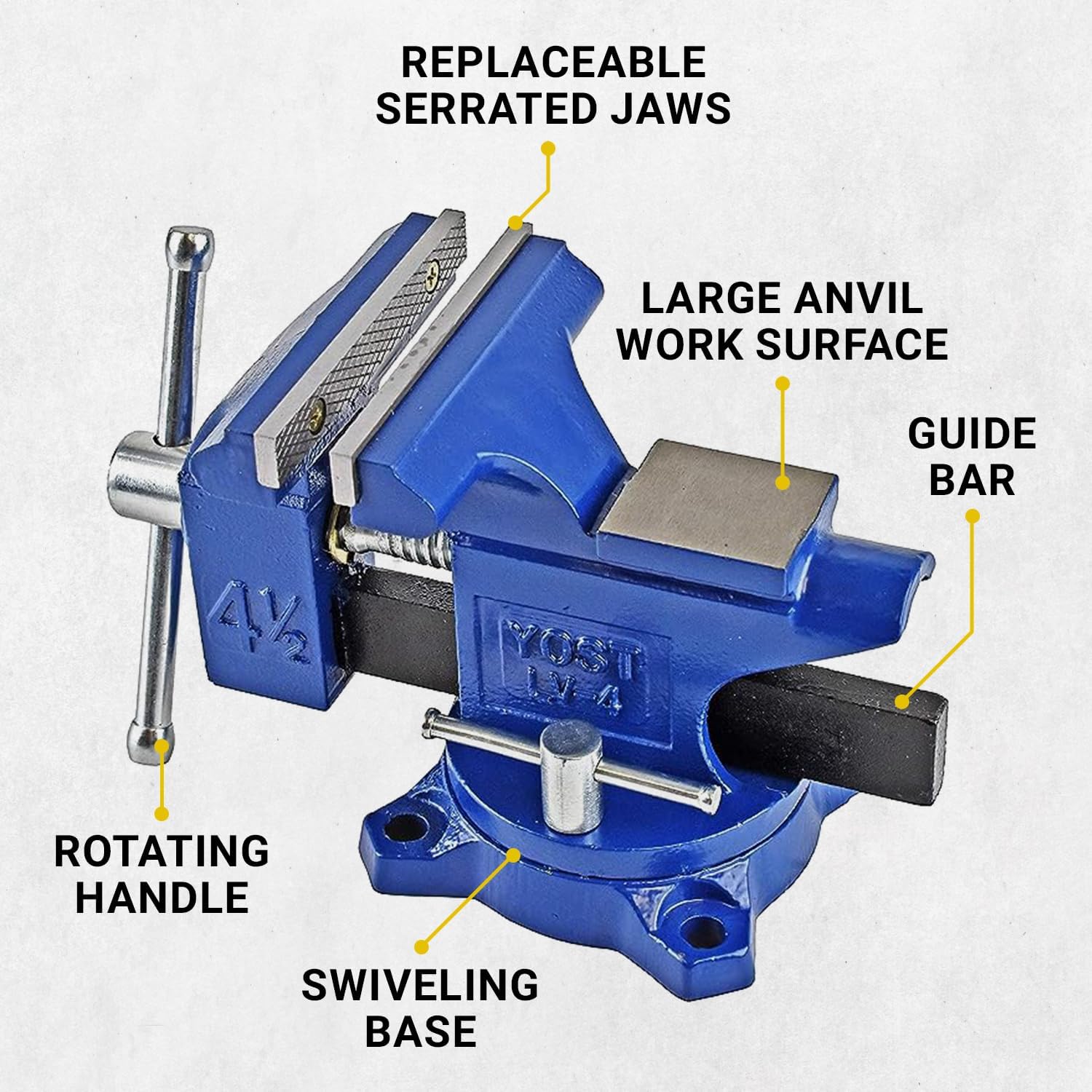
The Yost LV-4 is the general bench vise that ends up on countless home workbenches. It bolts on top, swivels, grips with serrated steel jaws and has a small anvil for tapping. For bike repair, pipe, sharpening and rough carpentry it is exactly right.
For fine woodworking it needs soft jaw covers to avoid denting stock, and its height above the bench keeps it out of planing work. That is the nature of a bench vise, not a fault of this one.
Owners rate it highly for the price and versatility.
Bottom line: the best general bench vise here for a bench that does more than wood.
- Type: bench vise, top mount
- Jaw width: 4.5 inch
- Opening: 3 inch
- Base: swivel
- Jaws: serrated steel
- Anvil: yes
Homeowners whose bench sees metal, pipe and bikes as well as wood, and anyone who wants one vise for everything.
Fit soft jaw covers for wood. Mount near a bench leg with four bolts. Lock the swivel before heavy work.

Pros
- Pipe jaws and anvil included
- Swivel base
- Low cost for a combination vise
Cons
- Lighter casting than the Yost
- Steel jaws need covers for wood
- Not a planing vise
WORKPRO's bench vise packs pipe jaws, a swivel base and an anvil into a low-cost package. It bolts on top of the bench and does the general-purpose gripping a home shop needs.
The casting is lighter than the Yost LV-4 and the finish rougher, and like any bench vise it needs soft covers for wood and sits above the bench.
Owners doing light work are satisfied for the money.
Bottom line: the budget combination vise for light general use.
- Type: bench vise, top mount
- Jaw width: 4.5 inch
- Pipe jaws: yes
- Base: swivel
- Anvil: yes
- Material: cast iron
Budget home shops that need a general vise for occasional pipe, metal and wood work.
For frequent use choose the Yost LV-4; for occasional jobs this does fine. Add soft jaw covers for wood.
How to Choose a Woodworking Vise
Two of the vises here are general bench vises, the rest are front vises that mount under the bench. They are held differently, they grip differently and they suit different work. Start with type, because it decides how the vise mounts and what it can safely hold.
Front Vise or Bench Vise: Two Different Tools
A woodworking front vise, like the IRWIN, the Eclipse, the Yost F9WW and F10WW, the Pony Jorgensen and the Olympia, bolts to the underside of the bench so its rear jaw sits flush with the front edge. You screw wooden cheeks to both jaws, and the work is clamped between wood, flush with the bench top, where you can plane and chisel it without the vise getting in the way. This is the vise for joinery, edge work and anything you would rather not dent.
A general bench vise, like the Yost LV-4 and the WORKPRO, bolts on top of the bench and grips with serrated steel jaws, often with a small anvil and pipe jaws. It is the vise for metal, pipe, sharpening and rough work, and it will hold wood if you use soft jaw covers. It stands proud of the bench, which is exactly what you do not want for planing.
Most home shops end up with one of each. If you are buying only one for woodworking, buy the front vise; if the bench does everything from bike repair to birdhouses, the bench vise is the more general tool.
Jaw Width and Opening: Size It to the Work
Jaw width is how wide a board the vise supports; opening is how thick a piece it can take. The six and a half inch IRWIN and Olympia and the seven inch Eclipse are the sweet spot for a home bench, wide enough to hold a drawer side flat and small enough to fit a bench that is not enormous. The Yost F9WW and F10WW at nine and ten inches are for bigger benches and wider stock, and the Pony Jorgensen at nine inches sits in between.
Opening matters for thicker work and for clamping with a wooden spacer. Most front vises here open eight to thirteen inches, which is generous. The light-duty Pony at four and a half inches wide is a small vise for a small bench or a secondary station.
Bigger is not automatically better. A ten inch vise on a thin bench top overhangs and racks, and a very wide vise needs a bench thick enough to carry it. Match the vise to the bench first and the work second.
Quick Release Is the Feature You Will Use Every Minute

A quick-release vise has a lever that disengages the screw so the front jaw slides freely; you push it to the work, flip the lever and turn the handle a half turn to clamp. Without it, every change in stock thickness means winding the screw across the whole opening. The IRWIN, the Eclipse, the Yost F9WW and F10WW and the Pony Jorgensen all have quick-release; the Olympia and the light-duty Pony do not.
Quick-release mechanisms are also where cheap vises fail. A half-nut that does not fully engage slips under load, which is dangerous with a chisel in hand. The established makers here have designs that have been refined for decades; the budget units are the ones owners complain about.
If you do repetitive work with varied stock, quick-release is worth almost any price difference. If the vise mostly holds one thickness for long sessions, a plain screw vise is fine and cheaper.
Casting, Screw and the Parts That Take the Load
Every front vise here is cast iron with a steel screw and guide bars, and the differences are in thickness and finish. Heavier castings resist racking when you clamp off-centre, and a screw with an acme thread runs smoother and lasts longer than a cheap cut thread. The IRWIN, Eclipse and Yost vises are noticeably heavier than the budget units, and owners describe that heft as the difference in how solid the clamp feels.
Guide bars keep the front jaw parallel as it moves. Two bars set wide apart, as on the Yost F-series, resist racking best. A single bar or closely spaced bars let the jaw twist when you clamp near one end, which is why a wooden spacer at the other end is standard practice on any vise.
Finish matters less than it looks. A painted casting hides nothing structural, and a rough machined face on the jaw is covered by the wooden cheek anyway. What you want smooth is the screw and the guide bars; run the jaw through its full travel before mounting, and if it binds anywhere, that is the vise to return.
Check the handle. A steel bar handle with end stops is the norm; a bent or thin handle is a sign of a light casting. The Pony Jorgensen and IRWIN handles are the ones people rarely replace.
The Dog and the Toe-In: Small Features That Change the Work
A bench dog on the front jaw, present on the IRWIN, Eclipse, Yost F-series and Pony Jorgensen, pops up to pinch a board against a dog in the bench top, which holds a wide panel flat for planing or sanding across its full face. It is the feature that turns a front vise into a clamping system for the whole bench, and it is the one people miss most on vises that lack it.
Toe-in means the front jaw is cast slightly angled so it meets the rear jaw at the top first. As you tighten, the jaw flexes and grips the work along its full height instead of only at the bottom. Good vises have it; cheap ones grip at the bottom and let the top of the work chatter.
Both features are quiet, and neither appears on a bench vise. They are the reason woodworkers pay for a proper front vise rather than bolting a general vise to the bench.
Mounting, Wooden Jaws and Getting It Right the First Time

A front vise mounts under the bench with lag screws or bolts through a spacer block so the rear jaw ends up flush with the bench edge and the top of the jaw sits just below the bench surface. Getting that flush is what lets you plane past the vise, and it usually means notching the apron or adding a block. Plan an hour for it.
Then line both jaws with hardwood cheeks screwed through the holes cast into the jaws. The cheeks protect the work, add grip and can be replaced when they are chewed up. Every front vise here ships bare and expects you to add them.
A bench vise bolts on top with four bolts through the bench, and a swivel base lets you rotate it. Mount it near a leg so the bench does not flex, and add soft jaw covers for wood. The category directory covers the benches and clamps that go with either.
| Vise | Type | Jaw width | Quick release |
|---|---|---|---|
| IRWIN 226361 | Front vise | 6.5 in | Yes |
| Eclipse EWWQR7 | Front vise | 7 in | Yes |
| Yost F9WW | Front vise | 9 in | Yes |
| Yost F10WW | Front vise | 10 in | Yes |
| Pony Jorgensen 27091 | Front vise | 9 in | Yes |
| Pony 26545 | Light-duty front vise | 4.5 in | No |
| Olympia 38-736 | Front vise | 6.5 in | No |
| Yost LV-4 | Bench vise, swivel | 4.5 in | No |
| WORKPRO 4.5 in | Bench vise, swivel | 4.5 in | No |
Our full article index lists every guide we publish.
Why You Should Trust Us
We assembled this list by comparing the published specifications for each vise, including type, jaw width and opening, quick-release mechanism, casting weight, guide bar layout, dog and toe-in features and mounting method, against the way owners describe using them over years on real benches. We looked for the patterns that repeat across thousands of owner reports: which quick-releases slip, which castings crack, which vises rack, and which ones are still the main vise on the bench a decade later.
We weighted holding security, build and the features that matter for actual woodworking above jaw size and price, and we were careful to separate true front vises from general bench vises that happen to be sold with woodworking in the title. Where a maker’s claims and owner experience diverged, we said so in the individual reviews.
Final Thoughts
The IRWIN Tools 6 1/2 Inch Woodworker’s Vise is our best overall because it is the front vise most home woodworkers end up with and keep: a heavy casting, a quick-release that engages positively, a bench dog, toe-in on the jaw and a width that suits nearly any bench. It mounts like every front vise, with an hour of fitting and a pair of wooden cheeks, and then it works for decades.
The Olympia Tools 6 1/2 Inch Woodworker’s Vise is the best value for a front vise without quick-release at a low cost, fine for a bench where the stock does not change thickness often. For a larger bench, the Yost F10WW is the best for wide stock, with twin guide bars and a ten inch jaw, and the Eclipse EWWQR7 is the pick for a refined quick-release at seven inches. If the bench does metal and pipe as well as wood, the Yost LV-4 is the best general bench vise here.
Whichever you choose, mount it flush, line the jaws with hardwood and use a spacer when clamping off-centre. The store list shows where each brand is currently discounted.
Woodworking Vise FAQs
What is the difference between a woodworking vise and a bench vise?
A woodworking front vise mounts under the bench with its jaw flush to the front edge, uses wide jaws lined with wood, and often has a bench dog and toe-in so it holds boards flat and undented for planing and joinery. A bench vise bolts on top of the bench with serrated steel jaws, a small anvil and often pipe jaws, and is built for metal, pipe and rough work. A bench vise can hold wood with soft covers, but it stands above the bench and gets in the way of planing.
What size woodworking vise do I need?
For most home benches, a six and a half to seven inch front vise like the IRWIN or Eclipse. It holds drawer sides and typical stock flat and fits a bench of ordinary size. Move to nine or ten inches, like the Yost F-series, only if the bench is large and thick and you work wide panels regularly. A very wide vise on a small bench overhangs and racks. Match the vise to the bench first.
Is a quick-release vise worth it?
If you change stock thickness often, yes. Quick-release lets you slide the jaw to the work and clamp with a half turn instead of winding the screw across the whole opening every time, and over a day of joinery that adds up to a lot of turning. If the vise holds similar stock for long sessions, a plain screw vise like the Olympia works fine and costs less. Buy quick-release from an established maker; a slipping half-nut is the failure to avoid.
How do I mount a front vise so it sits flush?
Position the rear jaw against the front edge of the bench with the top of the jaw slightly below the bench surface, add a hardwood spacer block between the vise and the underside of the top if needed to reach that height, and bolt or lag through the block into the top. Notch the apron if the bench has one. Then screw hardwood cheeks to both jaws and plane them flush with the bench top. Getting the rear jaw flush is what lets you plane an edge without hitting the vise.
Why does my vise twist when I clamp near one end?
That is racking: clamping off-centre pushes the front jaw out of parallel, and every vise does it to some degree. Vises with two widely spaced guide bars, like the Yost F-series, resist it best. The standard fix on any vise is a scrap of wood the same thickness as the work placed at the other end of the jaws so both ends bear evenly. The tools section covers the clamps that help with awkward pieces.

Write Your Review
No reviews yet. Be the first to share your experience!