

Shopping for a phono amplifier is confusing because the phrase covers two completely different boxes. One is a small phono preamp that lifts a turntable’s tiny signal up to line level and does nothing else, so it still needs an amplifier and speakers behind it. The other is a full stereo amplifier or receiver with a phono stage already inside, which drives your speakers directly. We compared 7 units from Pyle, Sony, Fluance and more across both types, so you can work out which one your setup is missing before you buy the wrong half.
Our top pick is the Sony STRDH190 for combining a proper phono input with enough power to run a pair of bookshelf speakers, which makes it a complete turntable system in one box. Below we start with that preamp versus amplifier question, since getting it wrong is the reason people end up with a silent record player. For the rest of the rack, our electronics section covers speakers and sources.

Pros
- Real phono input, so a turntable needs nothing in between
- Enough continuous power for a pair of bookshelf speakers
- Bluetooth handles every source that is not a record
- Four line inputs and a headphone socket cover a full system
Cons
- No digital inputs for a television or a streamer
- Phono stage is moving magnet only, as is normal at this level
The STRDH190 has been a default recommendation for turntable owners for years, and the reason is simple: it is the whole missing half of a vinyl system in one box. A phono input, a power stage that drives real speakers, and enough line inputs for everything else.
The phono stage is a conventional moving magnet circuit with a ground terminal, which covers the cartridge fitted to almost every turntable sold. Plug in, attach the earth lead, and there is nothing further to configure.
Power is honest rather than exaggerated, and it is comfortably enough for bookshelf speakers of ordinary sensitivity in a normal room. Bluetooth covers phones and tablets, so the receiver serves as the hub for the whole room rather than only for records.
What it lacks is digital connectivity. There is no optical or coaxial input, so a television or a dedicated streamer needs its own converter or an analogue output. For a system built around a turntable that is rarely a problem, and it is the main reason to look at the Denon instead.
Bottom line: the most complete answer for a turntable and a pair of passive speakers, and the one to buy if you want to stop reading here.
- Type: two channel stereo receiver
- Phono input: moving magnet, with ground terminal
- Wireless: Bluetooth
- Inputs: multiple line level analogue
- Outputs: speaker terminals and headphone socket
- Digital inputs: none
Buy this if you own a turntable and a pair of passive speakers and nothing to connect them. It also suits anyone consolidating a room around one amplifier, since the line inputs and Bluetooth cover most other sources. It is not the right pick if a television or a digital streamer needs to plug in directly, where an amplifier with a built-in converter saves a separate box.
Connect the turntable to the socket marked phono, not to a line input, and attach the thin separate earth wire to the ground terminal beside it. If your turntable has its own built-in preamp, switch it to line and use a line input instead, otherwise the signal is amplified twice. Keep the phono cable short and away from mains adapters, and check speaker polarity at both ends before powering up.

Pros
- Substantial continuous power for a range of passive speakers
- Built-in digital converter with optical and coaxial inputs
- Moving magnet phono stage in a properly engineered amplifier
- Bluetooth alongside the wired sources
Cons
- Larger and heavier than the compact options here
- More amplifier than a small room with efficient speakers needs
The PMA-600NE is the step up in this list, and it earns the position by being a serious integrated amplifier that happens to include a phono stage rather than a receiver with one bolted on.
Power is generous at seventy watts per channel, which means it stays composed with less sensitive speakers and in larger rooms where a smaller amplifier would be working hard. That headroom is audible on the dynamic peaks vinyl produces.
The digital side is the practical difference from the Sony. A built-in converter with optical and coaxial inputs means a television, a games console or a streamer connects directly, and the subwoofer output saves an awkward workaround if you want low end reinforcement later.
The phono stage is moving magnet, as expected, and is quiet enough that the noise floor is not the limiting factor in a normal system. The costs are size, weight and the fact that a small room with efficient bookshelf speakers simply does not need this much amplifier.
Bottom line: the pick when sound quality and digital inputs both matter, and the one to grow into rather than out of.
- Type: integrated stereo amplifier
- Power: 70 watts per channel
- Phono input: moving magnet
- Digital: built-in converter with optical and coaxial inputs
- Wireless: Bluetooth
- Extras: subwoofer output
This suits a listener building a system rather than solving a connection problem, particularly one with a television or streamer to integrate and speakers that are not especially efficient. It also suits larger rooms. It is more than a compact desk setup with powered speakers needs, and it is the wrong shape of purchase if all you require is a small box between a turntable and an existing amplifier.
Choose between this and the Sony on two questions. Do any digital sources need to connect directly, and are your speakers demanding enough to want the extra power. Two yes answers point here. Two no answers point to the Sony, which does the vinyl job just as directly for less complexity. Check your speaker impedance and sensitivity before deciding you need seventy watts, since an efficient speaker plays considerably louder on far less.

Pros
- Accurate RIAA equalization is the focus of the design
- Low noise floor keeps hiss out of quiet passages
- Compact case is easy to place away from power supplies
- Works with powered speakers or any line input
Cons
- Needs an amplifier or powered speakers behind it, since it drives neither
- Moving magnet only, with no adjustment for other cartridge types
The PA10 is the standalone preamp for people who care about the part that actually determines how a record sounds. Its design priorities are RIAA accuracy and a low noise floor, which are the two measurements that separate a good phono stage from a functional one.
RIAA accuracy matters because records are cut with an altered frequency balance and the preamp has to reverse it exactly. Get it wrong and everything sounds thin or dull in a way tone controls cannot properly repair. This is where the cheaper preamps in this list make their compromises.
The noise floor is the other half. A phono stage amplifies an extremely small signal by an enormous factor, so any hiss inside the circuit is amplified with it. A quiet design is the difference between silence and a background wash between tracks.
The limitation is definitional rather than a fault: this is a preamp, so it produces a line signal and nothing more. It needs powered speakers or an amplifier behind it. It is also moving magnet only, which suits nearly every stock cartridge but rules out low output moving coil.
Bottom line: the standalone preamp to buy when the small box is what you need and the sound matters.
- Type: standalone phono preamplifier
- Cartridge: moving magnet
- Equalization: RIAA
- Output: line level to any amplifier or powered speaker
- Ground: turntable earth terminal
- Drives speakers: no
This is for someone who already owns amplification, whether that is powered speakers, an existing integrated amplifier with only line inputs, or a desktop setup. It is the right pick when the phono stage is the only missing link and you would rather it were a good one. It is the wrong purchase if you have passive speakers and nothing to drive them, in which case you need an amplifier instead.
Turntable into the preamp input, preamp output into any line input, and the turntable's thin earth wire onto the ground terminal. Place the preamp away from mains adapters and power bricks, since a circuit with this much gain picks up radiated interference easily. Keep both interconnects short. If your turntable has its own preamp, switch it off or to phono so the signal is only amplified once.

Pros
- Simplest and cheapest route from a bare turntable to a line input
- Very small footprint, easy to hide behind a rack
- Standard RCA connections at both ends
- Low noise circuit adequate for most stock cartridges
Cons
- Basic circuit that does not chase RIAA accuracy the way better stages do
- Cannot drive speakers, so amplification is still required
The Pyle preamp is the plainest solution to the most common vinyl problem: a turntable with no built-in stage and an amplifier that only has line inputs. It converts one to the other and that is the entire product.
It is small enough to disappear behind a rack, uses standard RCA sockets at both ends, and has a ground terminal for the turntable earth wire, which is the part people forget and then blame for hum.
The circuit is basic. It applies the RIAA curve competently enough for a stock cartridge on a modest system, and it will not embarrass itself, but it does not chase the accuracy figures a dedicated high fidelity stage publishes. On a revealing system that difference is audible.
As with every preamp here, it produces a line signal and drives nothing. If you have passive speakers with no amplifier, this is not the box you need. Judged as the cheapest way to make a turntable talk to something that already amplifies, it does exactly what it says.
Bottom line: the value pick, and enough preamp for a stock cartridge on a modest setup.
- Type: compact phono preamplifier
- Cartridge: moving magnet
- Connections: RCA input and RCA output
- Ground: turntable earth terminal
- Output: line level
- Drives speakers: no
Take this if the system it is joining is modest and the goal is simply to get sound out of a turntable. Step up to the Fluance PA10 if your speakers or headphones are revealing enough to show up equalization errors, or if hiss between tracks would bother you. Step sideways to the PROZOR if you want a level control to match the record player against your other sources. All three need amplification behind them.
Keep it away from mains adapters and power supplies, which is the main cause of induced hum in a small preamp. Attach the turntable ground wire before listening rather than after. Do not stack it directly on top of an amplifier that runs warm. Use short RCA leads at both ends, since cable capacitance on a long run alters the treble response of a moving magnet cartridge.

Pros
- Level controls make it easy to match a turntable against other sources
- Both RCA and 3.5mm outputs suit desktop and hi-fi setups
- Low noise circuit with a ground terminal
- Compact enough for a crowded desk
Cons
- Still a preamp, so an amplifier or powered speakers are required
- Extra controls add another place for a setting to be wrong
The PROZOR takes the standard small preamp formula and adds front panel control, which sounds like a minor feature until you run a turntable alongside a streamer and find one is much louder than the other every time you switch.
Being able to trim the phono output solves that properly rather than by riding the volume control. It also helps when a cartridge sits at the quieter end of the moving magnet range and the system runs out of headroom before it runs out of loudness.
The output options are the other practical touch. RCA covers a conventional amplifier and powered speakers, while a 3.5mm output makes it straightforward to feed desktop speakers or an audio interface without an adapter in the chain.
The usual caveats apply. It is a preamp, not an amplifier, so passive speakers still need something to drive them. And an adjustable stage adds a setting that can be left wrong, so if the sound is distorted the first thing to check is that the level is not wound up too far.
Bottom line: the preamp for mixed systems where matching source levels is the real annoyance.
- Type: phono preamplifier with level control
- Cartridge: moving magnet
- Inputs: RCA
- Outputs: RCA and 3.5mm
- Controls: front panel level and volume
- Drives speakers: no
This suits desktop systems, mixed setups where a turntable shares an amplifier with digital sources, and anyone whose cartridge is quiet enough that a fixed gain stage leaves the volume control near the top. The 3.5mm output makes it a natural fit for computer speakers. It is unnecessary complexity if the turntable is the only source in the system.
Start with the level control low and raise it until the turntable sits at roughly the same loudness as your other sources at the same volume setting. If the sound is distorted or harsh, the level is too high and is clipping the following input rather than the preamp being at fault. Attach the turntable ground wire before listening, and use the RCA output for a hi-fi amplifier and the 3.5mm only for desktop gear.

Pros
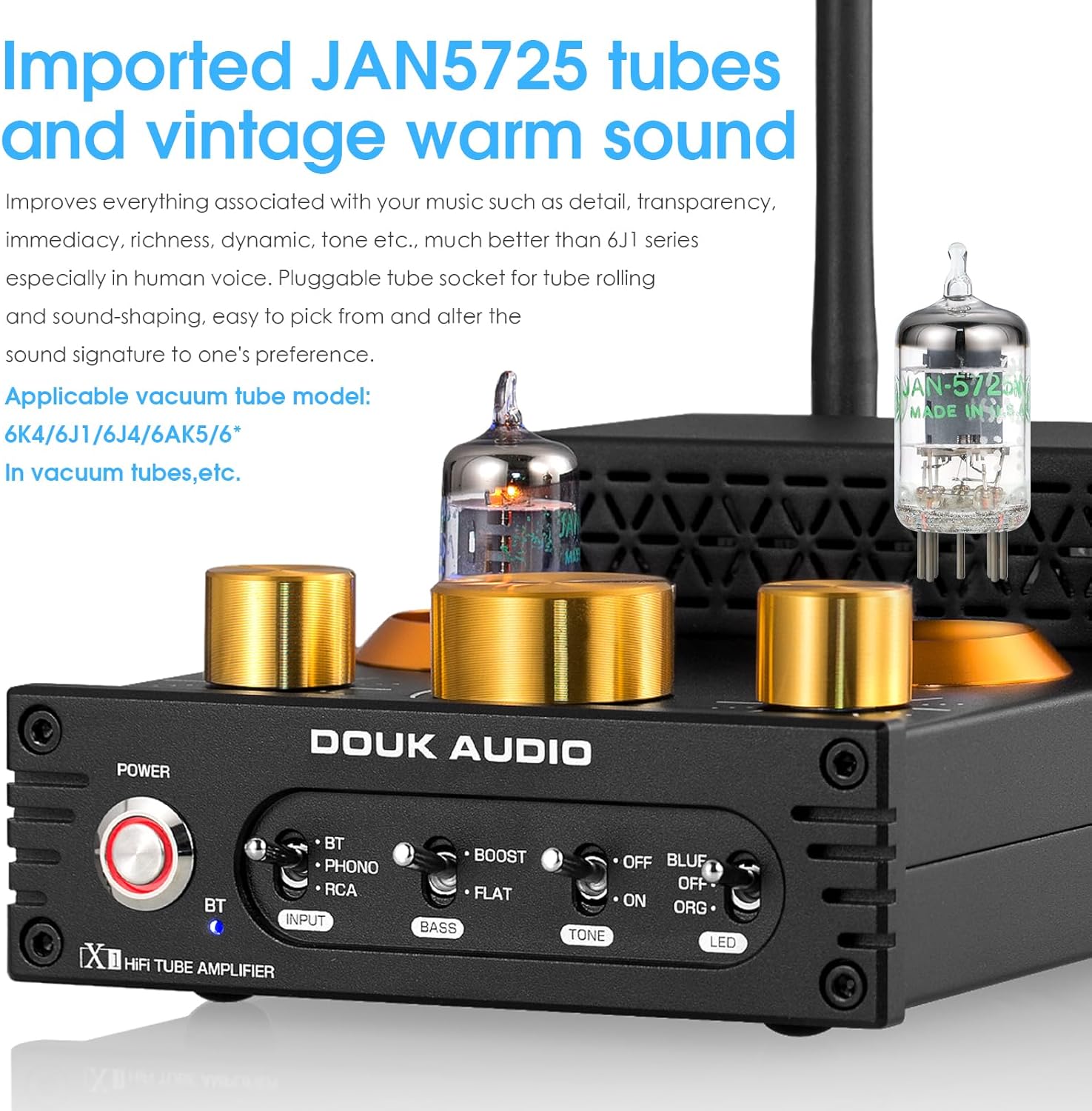
- Valve preamp stage adds the warmth listeners look for in tube gear
- Includes a phono input and drives speakers, so no second box is needed
- Tone controls allow correction for difficult rooms
- Bluetooth for non-vinyl sources
Cons
- Tube needs warm-up time, ventilation and eventual replacement
- Rated power figures are peak oriented rather than conservative continuous ratings
The Douk Audio unit is the character option here. A valve in the preamp stage feeding a solid state power section is a common and sensible arrangement: you get the even order harmonic colouration people describe as warmth without the heat and bulk of an all-valve amplifier.
Practically it is a complete solution, since it has a moving magnet phono input and drives passive speakers directly. Bluetooth covers phones, and the tone controls are genuinely useful in a bright or over-damped room, which is unfashionable but true.
The valve brings ownership requirements. It needs a few minutes to warm up before it sounds its best, it wants ventilation, it is microphonic enough that knocking the case can be audible, and it will need replacing at some point in the amplifier's life.
Treat the power rating with care. Numbers of this size in a case this small are peak figures rather than conservative continuous ratings, and the honest expectation is a competent desktop or small room amplifier rather than something that will drive demanding speakers hard.
Bottom line: the pick if you want valve flavour and a phono input in one compact box, with the maintenance that implies.
- Type: hybrid valve preamp with solid state power stage
- Phono input: moving magnet
- Wireless: Bluetooth
- Controls: bass and treble tone controls
- Output: speaker terminals for passive speakers
- Maintenance: valve requires eventual replacement
This is for a listener who actively wants tube character rather than neutrality, and who likes the idea of tone controls. It suits a desk or a small room. It is the wrong choice if you want an accurate, uncoloured presentation, if the amplifier will live in a closed cabinet with no ventilation, or if demanding floorstanding speakers are what it has to drive.
Give it several minutes to warm up before critical listening and leave clear space above and around it, since the valve runs hot. Do not place it in a closed cabinet. Avoid knocking the case while it is playing, because a microphonic valve turns physical taps into audible sound. Expect to replace the tube eventually, and switch the unit off at the wall rather than leaving it powered for weeks.

Pros
- The widest connection list here, including optical, coaxial and USB
- Phono input included alongside every digital source
- Bluetooth 5.3 for stable wireless streaming
- Microphone inputs suit karaoke and announcements
Cons
- Headline power is a peak figure rather than a continuous rating
- Breadth of features comes at the cost of specialist audio quality
The Donner receiver is the connectivity answer. If the problem you are solving is that a turntable, a television, a USB stick, a radio and a microphone all need somewhere to go in one small box, this covers more of that list than anything else here.
The phono input is present and works with a standard moving magnet cartridge, so a turntable connects directly. Bluetooth 5.3 is a newer implementation than most of the field, which in practice means more reliable pairing and better range.
The digital inputs are the genuine differentiator against the Sony. Optical and coaxial mean a television connects without a separate converter, and USB playback covers files on a stick without any other source device.
Two honest reservations. The headline power figure is a peak rating and should not be compared directly against the continuous ratings quoted by the Sony and the Denon. And a unit that does this many things is engineered around breadth rather than around the phono stage, so a listener chasing sound quality is better served elsewhere.
Bottom line: the most connected box here, and the pick when the socket count is the actual requirement.
- Type: two channel stereo receiver
- Phono input: moving magnet
- Wireless: Bluetooth 5.3
- Digital inputs: optical, coaxial, USB
- Tuner: FM radio
- Extras: two microphone inputs
Choose this when you are counting sockets rather than comparing phono stages. If a television, a USB drive, a radio and a microphone all need connecting alongside the turntable, nothing else here does the job in one box. Choose the Sony instead if vinyl is the main source and you want a conservative, well proven receiver, and the Denon if sound quality with digital inputs is the goal.
Connect the turntable to the phono socket and attach its earth wire to the ground terminal, then set the input selector to phono rather than a line input. For a television, use the optical output on the set rather than its headphone socket, which gives a cleaner signal. Set microphone levels low and raise them gradually, since feedback with speakers in the same room happens quickly.
How to Choose a Phono Amplifier
Work out which box you are missing first. Everything below is a refinement on top of that one decision, and no amount of specification rescues buying a preamp when you needed an amplifier.
Phono Preamp or Full Amplifier

A record cartridge puts out a signal thousands of times weaker than a phone or a streamer, and with a frequency response that has been deliberately altered during cutting. A phono preamp does two jobs: it amplifies that signal to line level and it applies the reverse of the recording curve. What comes out is a normal line signal that any amplifier can accept, but it cannot drive a speaker on its own. Three of the units here are this type: the Fluance PA10, the Pyle preamp and the PROZOR preamp.
An integrated amplifier or a stereo receiver with a phono input has that circuit built in, plus the power stage that actually drives speakers. Plug the turntable into the socket marked phono, connect the speakers, and the system is complete. The Sony STRDH190, the Denon PMA-600NE, the Douk Audio unit and the Donner receiver all work this way.
So the question is what you already own. Powered speakers or an existing amplifier with only line inputs, plus a turntable with no built-in preamp, means you need the small box. Passive speakers and nothing to drive them means you need the amplifier. And if your turntable already has a switchable built-in preamp, which many modern decks do, you may need neither: switch it to line out and feed any line input.
Moving Magnet or Moving Coil
Cartridges come in two families and they need very different amounts of gain. A moving magnet cartridge puts out a comparatively healthy signal and wants roughly forty decibels of gain. A moving coil cartridge puts out far less and needs something closer to sixty, which is a different circuit rather than a turned-up version of the same one.
Almost every phono input in this list is moving magnet only, which is normal at this level and perfectly sensible, because most turntables ship with a moving magnet cartridge. If a listing simply says phono input without specifying, assume moving magnet. Running a low output moving coil cartridge into a moving magnet stage gives you a thin, quiet sound with the volume control near maximum.
There is one further category worth knowing about. Some cartridges are described as high output moving coil, and these produce a signal close to moving magnet levels, so they work with a standard input. If you are still using the cartridge your turntable came with, this whole question almost certainly resolves to moving magnet and you can move on.
RIAA Accuracy and the Noise Floor
Records are cut with the bass reduced and the treble boosted, following a standard curve, because it lets the groove hold more music and less rumble. The phono stage has to apply the exact inverse. How accurately it does that is the single biggest determinant of whether a record sounds tonally right, and makers who take it seriously publish a deviation figure in fractions of a decibel.
The noise floor matters just as much, because you are amplifying a very small signal by a very large factor and any hiss in the circuit gets amplified with it. Signal to noise figures on a phono stage are worth comparing directly, and a difference of a few decibels is audible as background hiss between tracks on a quiet passage.
Hum is the other half of the noise story and it usually comes from wiring rather than the circuit. Every phono stage should have a ground terminal, and a turntable ground wire that is not connected is the most common cause of a loud buzz. Keep the phono cable short and away from mains leads and power supplies, which is easier with a compact preamp than with a receiver in a crowded rack. Our category index covers cabling and accessories alongside the components.
Gain, Loading and Level Controls
Fixed gain is the norm at this level and it is usually set for a typical moving magnet cartridge. Some preamps add a level or gain control on the front, which is genuinely useful when you are matching a record player against a streaming source so switching inputs does not produce a jump in volume. It also helps if your cartridge sits at the quieter end of the moving magnet range.
Loading is the more technical adjustment. A moving magnet cartridge expects to see a specific resistance and a certain amount of capacitance from the input it is connected to, and getting it wrong shifts the treble response. The standard resistance is universal enough that fixed inputs are fine, but capacitance varies with cable length, which is one more reason to keep the interconnect short.
A subsonic filter is worth looking for if you have a suspended turntable or a springy floor. Warped records and footfall produce very low frequency energy that you cannot hear but which makes woofers flap visibly and wastes amplifier power. A filter rolls that off below the audible band and costs you nothing musically.
Solid State or Tube
Most phono stages are solid state, which in this context means quiet, stable, accurate and indifferent to being left switched on. That is the right default, and a well-made solid state phono stage is neutral in a way that lets the cartridge and the record do the work.
Tube designs are chosen for the character they add rather than for accuracy. A valve stage typically produces a small amount of even order harmonic distortion, which many listeners describe as warmth or body. It is a deliberate colouration, not a technical improvement, and whether you want it is a matter of taste rather than of specification.
Tubes also come with ownership requirements. They take time to warm up, they wear out and need replacing eventually, they are microphonic enough that a knock on the case can be audible, and they run hot so they want ventilation. Many units marketed as tube designs use a valve in the preamp section with a solid state power stage, which is a reasonable way to get the flavour without the heat.
Power, Connections and Speaker Matching

If you are buying an amplifier rather than a preamp, output power decides which speakers it can drive and how loud. Bookshelf speakers of average sensitivity in a normal room are comfortable with a few tens of watts per channel of honest power. Treat peak power figures with suspicion: continuous power into a stated impedance is the number that means something, and peak ratings are marketing arithmetic.
Check impedance compatibility too. Most amplifiers here are happy with six or eight ohm speakers, and driving four ohm speakers hard from a budget amplifier is how protection circuits get triggered. Speaker terminals matter in practice: binding posts take banana plugs and thick cable, while spring clips limit you to thin bare wire.
Then count the sockets you actually need. Bluetooth is useful for a phone, a digital input matters if a television or a streamer is joining the system, and a subwoofer output saves an awkward workaround later. A phono input is the one non-negotiable here, but the difference between two of these amplifiers often comes down to whether the rest of your sources have somewhere to go. There is more on matching components in our electronics picks.
| What you already have | What to buy | Examples here |
|---|---|---|
| Turntable plus powered speakers | Standalone phono preamp | Fluance PA10, Pyle, PROZOR |
| Turntable plus an amplifier with only line inputs | Standalone phono preamp | Fluance PA10, Pyle, PROZOR |
| Turntable plus passive speakers, nothing else | Amplifier or receiver with a phono input | Sony STRDH190, Denon PMA-600NE |
| Turntable with a built-in preamp switch | Any line input, or an amplifier for passive speakers | Sony STRDH190, Donner, Douk Audio |
Why You Should Trust Us
We build these lists from published specification and from the pattern of what long-term owners report, not from marketing copy. For every unit here we checked whether it is a standalone preamp or a full amplifier, which cartridge type its phono input is designed for, what gain and signal to noise figures the maker publishes, whether a ground terminal and a subsonic filter are provided, and for the amplifiers, continuous power into a stated impedance rather than peak numbers.
We then read owner feedback for the things that only show up in a real room: hum that traces back to grounding or placement, gain that leaves a quiet cartridge short of volume, Bluetooth pairing that drops, and heat in compact cases. Where a listing uses the words amplifier and preamplifier interchangeably, we say plainly which one the box is, because that ambiguity causes more returns in this category than any performance shortfall.
Final Thoughts
Best overall is the Sony STRDH190. It has a real phono input, enough continuous power for a pair of bookshelf speakers, Bluetooth for everything that is not a record, and the kind of straightforward build that has kept it a default recommendation for years. For someone with a turntable and passive speakers and nothing in between, it completes the system on its own.
Best value is the Pyle Phono Turntable Preamp. It is a small box that does one job, which is turning a cartridge signal into a line signal you can plug into anything, and it is the cheapest route from a turntable with no preamp to powered speakers or an existing amplifier. It will not flatter anything, but it does the conversion.
For specific needs, the Denon PMA-600NE is the pick if sound quality is the priority and you want a built-in digital converter alongside the phono stage, the Fluance PA10 is the standalone preamp to buy when the small box is what you need but the Pyle is not enough, and the PROZOR preamp is the one with front panel level controls for matching sources. The Douk Audio tube unit is the choice for valve character with a phono input included, and the Donner receiver is the most connected option if a television, a streamer and a microphone all need a socket. More picks are indexed across our article archive.
Phono Amplifier FAQs
Do I need a phono amplifier if my turntable has a built-in preamp?
Not a separate phono preamp, no. A turntable with a built-in stage outputs a normal line signal, so it can go straight into any line input on an amplifier, a receiver or a pair of powered speakers. You still need something to drive passive speakers, which is where an integrated amplifier comes in. Running a turntable’s built-in preamp into a phono input is the mistake to avoid, since the signal gets amplified twice and comes out distorted and far too loud. Look for a switch on the back of the deck marked phono and line.
Why is there a hum when I connect my turntable?
The usual cause is the ground wire. Turntables have a thin separate earth lead that must be attached to the ground terminal on the phono stage, and leaving it unconnected produces a loud low frequency buzz. If the ground is connected and the hum persists, move the phono stage away from mains adapters and power supplies, since these circuits amplify by such a large factor that they pick up radiated interference. Short interconnects help, and so does keeping signal cables from running parallel to power leads.
What is RIAA equalization and why does it matter?
Records are cut with the bass level reduced and the treble raised, following an agreed standard curve, so that the groove can be narrower and surface noise is less obtrusive. The phono stage applies the exact opposite curve on playback to restore the original balance. If it does that inaccurately, the record sounds tonally wrong, typically thin or dull, and no tone control fixes it properly. Makers who care publish how closely their circuit tracks the standard, usually as a deviation in fractions of a decibel.
Can I use a phono preamp with powered speakers?
Yes, and it is one of the most common setups. Powered speakers contain their own amplification and accept a line level signal, so a turntable without a built-in preamp needs exactly one thing in between: a standalone phono preamp. Connect the turntable to the preamp, the preamp to the speakers’ line input, and attach the ground wire. In that configuration you do not need an integrated amplifier at all, and buying one would just add a redundant power stage.
How much power do I need from a phono amplifier in 2026?
For bookshelf speakers of average sensitivity in a normal sized room, a few tens of watts per channel of continuous power is comfortable, with headroom for the peaks that vinyl produces. Compare continuous ratings into a stated impedance rather than peak figures, which are calculated in ways that make small amplifiers look large. Speaker sensitivity changes the answer as much as the amplifier does: an efficient speaker plays considerably louder on the same power, so check that figure before assuming you need more watts.
Write Your Review
No reviews yet. Be the first to share your experience!