

Almost nothing sold for cats is marketed as trail gear, and that is the first thing to understand before you buy. What exists is a category of escape-proof walking harnesses, and the good ones happen to be exactly what a cat needs on a woodland path: a closure a cat cannot reverse out of, pressure spread across the chest rather than the throat, and mesh that breathes when the sun comes out. We looked at 8 harnesses from PetSafe, rabbitgoo, HEYWEAN and more, sorted by closure type, adjustment points and how honestly each one handles the escape problem.
Our top pick is the rabbitgoo Cat Harness and Leash Set for combining a full snap-buckle vest with two adjustment points, which is the design that leaves a determined cat nothing to back out of. Below we sort the field by closure, because that decision does more for security than any other feature on the label. Our pet supplies section covers the rest of the kit.

Pros
- Full snap buckles hold their setting exactly, unlike hook and loop
- Vest panel covers enough shoulder to remove the slack an escape needs
- Adjusts at both neck and chest for a proper two-point fit
- Reflective strips make a low cat visible at dusk
- Leash is included, so it works out of the box
Cons
- Some cats resist a harness that fastens over the head at first
- Mesh panel is warmer than an open H-style strap harness in full sun
This is the harness the rest of the category is measured against, and the reason is the closure. Snap buckles at the neck and the chest hold whatever setting you give them and do not gradually loosen, which is the single most important property in a harness whose whole job is to have no slack in it.
The vest panel is the other half of the design. A cat escapes by dropping its shoulders and reversing, and a panel that covers the shoulders broadly leaves nothing to reverse into, provided you have fitted it to the two-finger standard. Soft breathable mesh keeps that coverage from becoming a heat problem on a mild day.
It arrives as a set with a matching leash and a sturdy clip, so nothing else needs buying, and the reflective strips are genuinely useful rather than cosmetic. A cat low to the ground on a path at dusk is close to invisible, and reflective material on the sides as well as the back is what changes that.
The honest limitations are temperament and heat. A nervous cat may object to anything passing over its head, in which case a step-in design is the easier introduction, and a mesh panel is warmer in strong sun than a strap harness with no panel at all.
Bottom line: the most secure harness here and the right default for a cat you intend to walk on a trail.
- Type: escape-proof vest harness
- Closure: snap buckles at neck and chest
- Adjustment: two points
- Material: soft breathable mesh
- Visibility: reflective strips
- Leash: included, with sturdy clip
- Sizing: measure chest girth and consult the size chart
Buy this if security is the priority, if your cat has already escaped a lighter harness, or if you plan to walk anywhere unpredictable rather than around a garden. It suits small to average cats that will tolerate a harness going over the head. Skip it if your cat panics at anything passing over its face, where a step-in design gets you further, or if you need the coolest possible option for hot weather.
Check the fit at the neck and chest separately before every walk and again partway through, since a harness that has crept backward toward the waist has lost most of its grip. Wash the mesh by hand and let it dry fully, because a damp panel against the skin chills a small cat. Inspect the buckles and the stitching around the leash ring regularly, and never leave a harness on an unsupervised cat indoors.
Pros
- Step-in fit means nothing passes over the cat's head
- Air mesh is the most breathable construction in this group
- Fast-drying fabric handles dew, rain and wet grass well
- Reflective bands on the panel for low light visibility
Cons
- Sized tightly by chest girth, so measuring is essential
- Step-in panels give less shoulder coverage than a full buckle vest
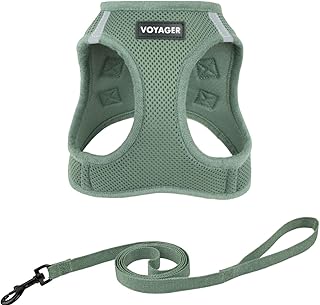
The Voyager Step-in Air is the harness to reach for when heat or a nervous cat is the problem. Air mesh is an open weave rather than a padded panel, so air moves through it instead of being trapped against the body, and that difference is obvious on a sunny afternoon.
The step-in format matters as much as the fabric. The cat places its front legs through two openings and the harness closes over the back, which means nothing goes over the head or the face. For a cat that has already decided it dislikes harnesses, that is often the difference between a walk and a standoff.
Fast drying is an underrated property outdoors. Dew-soaked grass, a shower or a puddle leaves a padded vest cold and heavy against the skin for a long time, and an open mesh sheds water and recovers in minutes. Reflective bands across the panel cover the visibility side.
Two things to watch. The sizing is genuinely tight and quoted by chest girth in inches, so measure the cat rather than guessing from a size name, and a step-in panel covers less of the shoulder than a full buckle vest, which makes exact adjustment more important rather than less.
Bottom line: the coolest and most weather-tolerant harness here, and the easiest introduction for a cat that will not accept anything over its head.
- Type: step-in cat harness
- Material: all-weather breathable air mesh
- Sizing: by chest girth, from around twelve inches
- Visibility: reflective bands
- Drying: fast-drying fabric
- Leash: included
Lay the harness flat on the floor with the openings visible, then place the front legs through one at a time rather than lifting the cat into it. Close it over the back and adjust until two fingers slide flat under the panel and no more. Take a moment to check the panel is sitting over the shoulders rather than back toward the ribs, because a step-in that has slid backward is the easiest of all these designs to reverse out of.
Rinse the mesh after walks through salt, mud or wet grass and let it air dry, which takes very little time with this construction. Check the closure and the leash ring before each outing. Because the panel is light, inspect the seams around the attachment point regularly for any sign of pulling. Do not size up in the hope of extra life from the harness, since a loose step-in is the least secure configuration in this list.
Pros
- Snap-buckle closure rather than hook and loop that weakens with fur
- Breathable vest panel with reflective strips
- Leash and clip included, so nothing else is needed
- Easy fit adjustment for small and average cats
Cons
- Panel is thinner than the premium vests, so fit matters even more
- Size range is narrow, and an extra small runs genuinely small
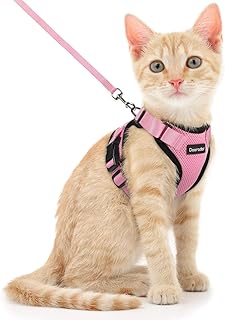
The Dooradar is the sensible economy version of the secure vest, and it keeps the features that matter rather than the ones that photograph well. Snap buckles rather than hook and loop, a breathable mesh panel across the shoulders, reflective strips and a leash in the box.
That specification is the important part. A great many cheaper harnesses save money by moving to a hook and loop closure, which grips well when new and progressively less well as it collects fur. Keeping buckles at this level is what makes this a genuine alternative to the more expensive vests rather than a compromise.
The panel itself is thinner than the premium sets, which cuts weight, a real advantage for a small cat, and slightly reduces how much shoulder is covered. That puts more of the security burden on adjustment, so fit it to the two-finger standard rather than to what looks comfortable.
Sizing runs small, particularly the extra small, so measure chest girth before ordering rather than choosing by the cat's weight. Within its range it fits easily and adjusts quickly, which matters when you are fitting a harness on a cat that will not stand still.
Bottom line: the best value here, and the harness to buy first if you are not yet sure your cat will accept one.
- Type: escape-proof vest harness
- Closure: snap buckles
- Adjustment: adjustable at neck and chest
- Material: soft breathable mesh vest
- Visibility: reflective strips
- Leash: included with sturdy clip
Compare this against the premium buckle vests on two points only: panel thickness and size range. If your cat is at the top of the size range or has escaped a harness before, the thicker panel and wider adjustment of the more expensive vests is worth the difference. If you are buying a first harness, or a second to leave in a bag, this covers the same fundamentals and the closure type is the same one that does the actual work.
Check the fit before every walk, since a thinner panel is less forgiving of slack than a heavily built vest. Hand wash and dry fully. Inspect the buckles for cracks and the stitching around the leash ring for any pulling, and retire the harness rather than repairing it if either shows wear. Never leave it on an unsupervised cat, and do not clip a leash to a collar as a backup, which risks the neck.

Pros
- Applies pressure to the shoulders instead of the throat
- Bungee leash absorbs the stop-and-bolt pattern cats actually walk in
- Strap construction is the coolest option in strong sun
- Two-point adjustment covers a wide chest girth range
Cons
- Least body coverage here, so adjustment has to be exact
- Straps can twist during fitting until you learn the layout
The Come with Me Kitty is the classic strap harness, and it solves a different problem from the vests. Rather than covering the body, it uses a figure-of-eight strap layout that directs any pulling force into the shoulders and away from the throat, which is where a plain collar does damage.
The bungee leash is the part owners come back for. Cats do not walk at a steady pace like dogs; they stop dead, consider something, then bolt. An elastic section takes those sudden loads out of the system instead of transmitting a jolt through the harness, and on uneven ground it lets a cat scramble over an obstacle without being checked mid-jump.
With no fabric panel at all, this is the coolest harness in the list and the least like wearing a jacket, which suits both hot weather and cats that object to the feeling of a vest. The two adjustment points cover a wide girth range, and the large size is aimed at bigger cats that many vests do not fit.
The trade-off is coverage. Straps hold less of the shoulder than a panel does, so an H-style harness depends entirely on being adjusted correctly and checked often. Fitting also takes practice, since the straps can twist before you learn the layout.
Bottom line: the coolest and gentlest option, best for cats that pull in bursts and for owners willing to fit it carefully.
- Type: H-style strap harness
- Adjustment: two-point fit
- Pressure: directed to shoulders, not neck
- Leash: bungee leash included
- Size example: large fits roughly thirteen to eighteen inch chest girth
- Construction: straps only, no fabric panel
Buy this if your cat is large for the vest sizing in this category, if hot weather is your main concern, or if the stop-and-bolt walking pattern makes a fixed leash feel harsh. It suits owners happy to spend a minute getting straps sitting correctly. Skip it if your cat is a proven escape artist, where a full panel vest gives you more to work with, or if you want the fastest possible fitting.
Lay the harness out flat first and identify the neck loop and the body loop before you approach the cat, which saves most of the fitting trouble people report. Fasten the neck loop, then the body loop, then adjust both until two fingers slide flat under each strap. Check that no strap has twisted along its length, since a twisted strap concentrates pressure on a narrow edge. Attach the bungee leash to the back ring only.

Pros
- Light construction that small cats accept more readily
- Adjustable across a usefully wide range of cat sizes
- Soft mesh is comfortable against the skin for longer walks
- Leash included in the set
Cons
- Lighter panel gives less to hold a determined escape than a thick vest
- Colour options vary more than the construction does between listings
The PetThem set sits in the middle of this field: an escape-proof adjustable harness in soft, light mesh with a leash included, aimed at owners who want a harness that is easy to put on and easy for a cat to accept.
Lightness is its main argument. A cat that flattens itself and refuses to walk is usually reacting to weight and stiffness rather than to the idea of a harness, and a light mesh panel that moves with the body is easier to accept than a heavily padded vest. That matters most in the acclimatisation stage.
Adjustment covers a wider range of cat sizes than several of the tightly sized harnesses here, which makes it a reasonable choice for a growing cat or for a household where one harness is shared between similar animals. The mesh is soft enough for longer wear without rubbing.
The honest limitation is the same one that comes with any light panel. Less material across the shoulders means the fit does more of the work, so this is a harness to check carefully rather than one to trust loose. For a proven escape artist, the thicker buckle vests give you more margin.
Bottom line: a comfortable, easy-going harness for a cooperative cat, and a good middle option between the light jackets and the heavy vests.
- Type: adjustable escape-proof harness
- Material: soft lightweight mesh
- Sizing: adjustable to suit small, medium and larger cats
- Use: walking, travel and outdoor time
- Leash: included
Buy this if your cat is at the acclimatisation stage and weight is what it objects to, or if you want one harness that adjusts across a wide size range. It suits calm cats on familiar ground. Skip it if your cat has already escaped a harness, where a thicker panel with full buckles is the safer purchase, or if you need the most breathable option for hot weather.
Fit to the two-finger standard and check again partway through any walk, because a light harness moves more easily out of position than a rigid one. Hand wash the mesh and dry it completely before reuse. Look over the leash ring seam regularly, since a lighter panel puts more stress into a smaller area of fabric. Take the harness off indoors rather than leaving it on between walks.

Pros
- Step-in fitting avoids anything passing over the head
- Hook and loop plus a buckle gives both a quick fit and a positive lock
- Light and easy on kittens and small cats
- Reflective detailing and an included leash
Cons
- Hook and loop grip weakens as the fastening collects fur
- Sized for kittens and small cats rather than large ones
This is rabbitgoo's answer for cats that will not accept the standard vest, and the change is entirely in how it goes on. The cat steps in rather than having anything lifted over its head, which removes the moment most nervous cats object to, and the panel then closes over the back.
The closure is a combination rather than a compromise. Hook and loop does the quick, broad job of holding the panel in place across the back, and a buckle backs it up so the whole harness does not depend on the hook and loop alone. That backup is worth having, because hook and loop loses grip as fur works into it.
It is a light harness aimed at kittens and small cats, and within that group it is easy to fit and easy to accept. Reflective detailing and a matching leash come in the set, so like the rest of the range it is complete out of the box.
Two honest limitations. Cleaning the hook and loop is a maintenance task rather than an optional one, since a fastening full of fur is a fastening that will let go, and the sizing genuinely is for smaller cats, so measure before ordering rather than assuming the range covers an adult of average build.
Bottom line: the easy-fitting rabbitgoo for kittens and nervous cats, provided you keep the closure clean.
- Type: step-in soft vest harness
- Closure: hook and loop secured with a buckle
- Weight: lightweight construction
- Visibility: reflective detailing
- Sizing: kittens and small cats, by chest girth
- Leash: included
Lay it out flat, guide the front legs through the openings one at a time and close the panel over the back, pressing the hook and loop down along its whole length rather than just at the ends. Fasten the buckle, then adjust until two fingers slide flat underneath. Before each use, run a finger along the hook side to lift out trapped fur, because that is what determines whether the closure still grips.
Clean the hook and loop regularly, with a stiff brush or a comb, since fur build-up is the failure mode of this closure type. Hand wash the panel with the fastening closed so it does not pick up lint, and dry it fully. Check the buckle every time, because on a step-in it is the part carrying the load if the hook and loop lets go. Do not use it on a cat that has already escaped a buckle vest.

Pros
- Among the lightest harnesses here, which matters for very small cats
- Cushioned construction is comfortable against the skin during running
- Soft fabric is easy for a hesitant cat to accept
- Also fits very small animals outside the average cat range
Cons
- Light panels give less material to hold a determined escape
- Cushioning is warmer than an open air mesh in strong sun
The HEYWEAN exists for a specific and common problem: a small cat wearing a harness that is too heavy simply stops. It flattens itself to the ground and will not move, and no amount of encouragement fixes it because the issue is weight and stiffness rather than willingness.
This jacket is built to be as light as a harness in this category gets, with a cushioned panel that stays comfortable while the cat is actually moving rather than only when standing still. For kittens and very small adults, that combination is often the difference between walking and refusing.
The cushioning is a considered choice rather than padding for its own sake. A running cat generates repeated contact between fabric and skin at the chest, and a soft cushioned face is kinder there than a thin unlined mesh, particularly on longer outings.
Where it gives ground is security and heat. There is less material here to resist a determined escape than in a full buckle vest, so this is a harness for a cooperative cat rather than for a proven escape artist, and cushioning traps more heat than an open air mesh does in strong sun.
Bottom line: the pick for kittens and very small cats that freeze under anything heavier.
- Type: ultra light walking jacket
- Construction: cushioned soft panel
- Sizing: kittens, small cats and other small pets
- Focus: low weight and comfort in motion
- Use: walking and supervised outdoor time
Buy this if your cat is a kitten or a very small adult, and especially if it has already refused to move in a heavier harness. It suits calm cats on familiar ground and short, supervised outings. Skip it if your cat has escaped a harness before, if you walk somewhere with dogs and sudden noise, or if hot weather is your main concern, where an open air mesh breathes better.
Weigh this against the buckle vests on one question: is your problem acceptance or escape. If the cat will not tolerate a harness, weight is usually the obstacle and the lightest option wins. If the cat tolerates a harness but gets out of it, weight is irrelevant and you want more coverage and positive buckles instead. Buying the light option for an escape artist solves the wrong problem.

Pros
- Step-in wear is quick and avoids fitting over the head
- Reflective trim across the panel for low light walks
- Listing is explicit about measuring chest girth before ordering
- Leash included in the set
Cons
- Hook and loop closure needs cleaning as it collects fur
- Sizing is tight, so an incorrect measurement is unforgiving
The FAYOGOO is a straightforward step-in walking vest, and the most useful thing about the listing is that it tells you plainly to measure the chest girth and check the size chart before ordering. That single instruction prevents most of the failures in this category, because sizing by weight is what puts a loose harness on a cat.
Fitting is quick. The cat steps in, the panel closes over the back with hook and loop, and there is nothing to lift over the head, which suits cats that dislike that moment. Reflective trim runs across the panel, covering the visibility question for early morning and dusk walks.
Hook and loop is the compromise here. It grips broadly and holds well when the fastening is clean, and it steadily loses grip as fur works into the hooks. That makes cleaning the closure a real maintenance task rather than an optional one, and it is why this format sits below the buckle vests for security.
Within its intended use, a calm cat on familiar ground or in a garden, it does the job and includes the leash. For unpredictable trail conditions, where a startled cat pulls with far more force than usual, a positive buckle closure gives you more margin.
Bottom line: a quick-fitting step-in for cooperative cats, provided the closure is kept clean and the size is measured.
- Type: escape-proof step-in vest
- Closure: hook and loop
- Sizing: measure chest girth against the published chart
- Visibility: reflective trim
- Leash: included
- Use: walking and supervised outdoor time
Measure the chest girth at the widest point behind the front legs and check it against the chart before ordering, not after. To fit, lay the harness flat, place the front legs through the openings and close the panel across the whole of its length rather than pressing only at the ends. Adjust until two fingers slide flat underneath, and confirm the panel sits over the shoulders instead of back toward the ribs.
Brush fur out of the hook side of the closure regularly, because that is what decides whether it still holds. Wash with the fastening closed so it does not collect lint, and dry fully before use. Check the grip by pulling gently apart before every walk, and replace the harness rather than persevering once the closure no longer resists that pull. Never leave it on an unsupervised cat.
How to Choose a Cat Harness for Hiking
Six things separate a harness a cat wears calmly on a trail from one that comes off in the first ten minutes. Read the fit section and the closure section even if you skip the rest, because escapes are almost always a fit failure rather than a product failure.
Escape Proof Is a Fit Problem, Not a Product Category
Every harness in this list carries the phrase escape proof somewhere on the label, and none of them is escape proof if it is loose. A cat escapes by backing up, dropping its shoulders and pulling its front legs through, and the only thing that stops that is a harness snug enough at the chest and neck that there is no slack to reverse into. Two fingers under the strap is the standard, and it is a tight standard.
Cats are also built differently from dogs in a way that matters here. A cat has no rigid collarbone and a spine that can compress its shoulders far narrower than they look, which is why a harness that would hold any dog of the same size will not hold a cat. Coverage across the shoulders is what compensates, and it is why vest designs dominate this category.
The second factor is where the harness sits on the body. A harness that has slipped backward toward the waist has almost no grip left, because the ribcage tapers behind the shoulders. Check the position at the start of a walk and again halfway through, since a harness that has crept back is the moment before an escape rather than a minor untidiness.
Vest, Step-In, or H-Style: Three Closures Compared

A buckle vest, like the main rabbitgoo set and the Dooradar harness, goes over the head or wraps around and closes with snap buckles at the neck and chest. It gives the broadest coverage across the shoulders and the buckles hold their setting exactly, which is why this is the most secure format here. The cost is that some cats resist having anything fastened over them at first.
A step-in design, used by the Voyager Air harness, the rabbitgoo step-in vest and the FAYOGOO set, has the cat place its front legs through two openings before the harness closes over the back. It is far less confronting for a nervous cat because nothing passes over the head, and it is the easiest format to fit on a cat that will not stand still. Several step-in models close with hook and loop, which holds well when the fastening is clean and loses grip once it collects fur.
The H-style harness, which is what the PetSafe Come with Me Kitty is, uses straps rather than fabric panels, with an adjustable fit at two points and a figure-of-eight layout that applies pressure to the shoulders instead of the neck. It is the lightest and coolest option and the least like wearing a jacket, but it also has the least coverage, so it depends more on precise adjustment than the vests do.
Getting the Measurement Right Before You Order
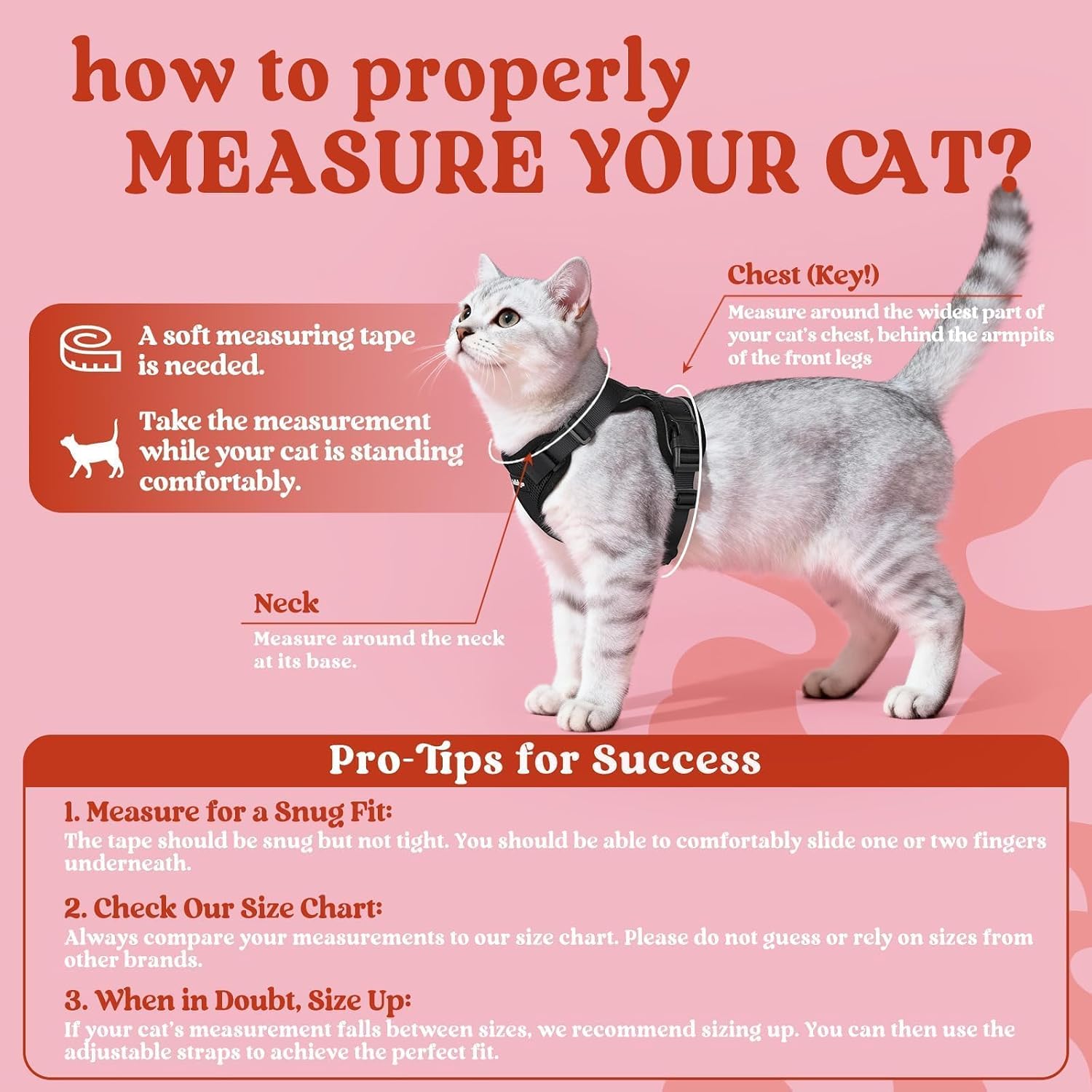
Measure the chest girth at the widest point just behind the front legs, and measure the neck separately, because most sizing failures come from ordering on the cat’s weight instead. Two cats at the same weight can differ by a good deal around the chest, and the FAYOGOO listing is not the only one in this group that tells you plainly to measure and consult the chart before ordering.
Watch the size range as much as the size name. The Voyager step-in listed here is an extra extra small built for a chest of roughly twelve to thirteen and a half inches, while the PetSafe large is aimed at a girth of thirteen to eighteen inches. Those are different animals, and the label on the packet tells you far less than the inches do.
Buy for the cat you have rather than the one you expect. A kitten will outgrow a harness within months, and buying large with the intention of tightening it later gives you a loose harness now, which is exactly the condition an escape needs. Two adjustment points, which most of this group offers, give you a working range but not a whole size.
Mesh, Breathability, and Heat on the Trail
A cat outdoors in sun is carrying a fur coat already, and a padded vest across the chest and back adds a layer exactly where heat is hardest to shed. Air mesh construction, which the Voyager and the HEYWEAN harnesses both emphasise, is the direct answer: an open weave that lets air through the panel rather than trapping it against the body.
Fast-drying fabric belongs in the same conversation and is worth more than it sounds on any walk near water or in dew-wet grass. A soaked padded vest stays cold against the skin for a long time and adds weight a small cat notices. Mesh that sheds water and dries quickly is the difference between a damp cat and a miserable one.
Weight matters more here than in any dog harness. An ultra light jacket like the HEYWEAN design exists because a small cat wearing a heavy harness simply stops moving and flattens itself to the ground. If your cat is under about ten pounds, prioritise the lightest thing that still fits securely. More outdoor gear thinking lives in our sports and outdoors section.
Reflective Trim, Leash Attachment and the Bungee Question

Reflective strips appear on most of this group and they are not decoration. A cat low to the ground on a path at dusk is close to invisible, and reflective trim across the back and sides is what makes it visible to a cyclist or a driver. Look for reflective material on more than one face of the harness rather than a single strip along the top.
The leash ring should sit between the shoulder blades on a sturdy metal fitting, not on a plastic loop or on the fabric itself. A back attachment turns any pulling into a straight line along the spine, which a cat handles far better than the sideways pressure a side ring creates. Check that the ring is stitched into a reinforced panel rather than hanging off a single seam.
A bungee leash, which comes with the PetSafe set, is worth understanding because cats do not walk like dogs. They stop dead, then bolt, and an elastic section absorbs those sudden loads instead of transmitting a jolt through the harness to the cat’s chest. On uneven ground it also lets a cat scramble over an obstacle without being checked mid-jump.
Acclimatising a Cat, and What a Trail Actually Demands
A harness that fits perfectly is still refused by a cat that has never worn one. The routine that works is slow: the harness on the floor for a few days, then fastened indoors for a few minutes at a time with something good happening, then a leash attached and left to trail indoors, then a garden, then anywhere further. Rushing this stage is the most common reason a harness ends up in a drawer.
What a trail adds beyond a garden is unpredictability. Dogs, other walkers, sudden noise and cover to bolt into all appear at once, and a startled cat pulls with far more force than its size suggests. This is the moment that finds slack in a harness, which is why the secure buckle vests suit trail use better than the lightest step-in designs, useful as those are for a nervous cat at home.
Carry a plan for the walk back. Most cats will walk out and then want carrying home, and a soft carrier or a backpack is standard equipment for anyone doing this regularly. Keep the harness on for the return leg rather than removing it, so a cat that jumps out is still attached to something.
| Closure | Best at | Watch out for |
|---|---|---|
| Buckle vest | Maximum security, broad shoulder coverage, holds its setting | Some cats resist a fastening over the head at first |
| Step-in with hook and loop | Nervous cats, quick fitting, nothing over the head | Grip weakens once the fastening collects fur |
| H-style strap harness | Lightest and coolest, no fabric panel against the body | Least coverage, so adjustment has to be exact |
| Ultra light mesh jacket | Small cats and kittens that freeze under weight | Thin panels give less to hold a determined escape |
Why You Should Trust Us
We build these lists from published specification and from the pattern of what long-term owners report, rather than from marketing copy. For each harness here we compared closure type and how many points it adjusts at, stated chest girth ranges rather than size letters, panel construction and breathability, where the leash ring sits and what it is made of, reflective coverage, and whether a leash is included in the set.
We also set aside near-identical listings that differ only in colour or in size, so every entry below is a genuinely different design rather than the same harness in another shade. Owner feedback is read for repeating patterns, because a single escape tells you about one cat and a recurring one tells you where a design gives out. We note plainly that no harness in this category is sold as dedicated hiking equipment, and we assess these as escape-proof walking harnesses that suit a trail.
Final Thoughts
Best overall is the rabbitgoo Cat Harness and Leash Set in the escape-proof vest form. Full snap buckles at the neck and chest hold their setting exactly, the soft breathable mesh covers enough of the shoulders to remove the slack a cat reverses into, and reflective strips plus an included leash make it a complete kit rather than a component. It is the one to buy if trail use is the plan.
Best value is the Dooradar Cat Harness and Leash Set. It follows the same secure blueprint, a snap-buckle breathable vest with two adjustment points, reflective strips and a sturdy clip, and includes the leash, which makes it the sensible choice for a first harness or for a second one to keep in a bag.
For specific needs, the Voyager Step-in Air harness is the pick for hot weather and for a cat that will not tolerate anything over its head, the PetSafe Come with Me Kitty is the one to choose if you want an H-style strap harness with a bungee leash for a cat that stops and bolts, and the HEYWEAN ultra light jacket suits kittens and very small cats that freeze under a heavier vest. The PetThem, FAYOGOO and rabbitgoo step-in sets round out the field for owners who want a lighter, easier fitting option. More picks are indexed across our article archive and the category index.
Cat Harness for Hiking FAQs
Is any of these actually made for hiking?
None of them is sold as dedicated hiking equipment, and it is worth saying so plainly. What this category offers is escape-proof walking harnesses, and the features that make one good on a suburban pavement are the same ones that matter on a trail: a closure a cat cannot reverse out of, coverage across the shoulders, breathable mesh and reflective trim. Choose on those specifications rather than on any product that claims a trail on the box.
How tight should a cat harness for hiking be?
Snug enough that you can slide two fingers flat under the strap and no more. Anything looser leaves slack for a cat to drop its shoulders and reverse out of, which is how nearly every escape happens. Check the fit at the neck and at the chest separately, since most harnesses here adjust at two points, and check again partway through a walk because a harness that has crept backward toward the waist has lost most of its grip.
Which is more secure, a vest or a step-in harness?
A buckle vest, in most cases. Snap buckles hold their exact setting and a fabric panel covers more of the shoulders, which is what removes the slack an escape needs. Step-in designs are easier to fit and far kinder to a nervous cat because nothing goes over the head, but the ones closing with hook and loop lose grip as the fastening collects fur, so they need checking and cleaning more often. For unpredictable ground, the buckle vest is the safer default.
How do I get my cat used to wearing one?
Slowly, over days rather than an afternoon. Leave the harness out to be investigated, then fasten it indoors for a couple of minutes at a time while something good is happening, and build up from there. Add the leash indoors and let it trail before you ever hold it. Then a garden, then somewhere quiet outdoors. A cat that flattens itself and refuses to move is telling you the harness is too heavy, too tight or too soon. Our pet supplies section covers the rest of the setup.
Do I still need a carrier if my cat walks on a leash in 2026?
For anything longer than a short loop, yes. Most cats will walk out happily and then decide they are finished, and a soft carrier or a backpack is standard equipment for owners who do this regularly. Keep the harness on and the leash attached inside the carrier rather than taking it off, so a cat that pushes out at the wrong moment is still connected to you. It also means you are not refitting a harness on an unsettled cat by the side of a path.





Write Your Review
No reviews yet. Be the first to share your experience!