

A cervical neck pillow is one of the few purchases where the shape everyone photographs matters less than a single number nobody prints on the box: how tall the pillow is under your neck once your body weight is on it. Get that height wrong and the contour that was supposed to help pushes your head into a worse angle than the flat pillow you replaced. We compared 7 pillows from UTTU, Tempur-Pedic, Royal Therapy and more on loft, adjustability, foam behaviour and how the cover handles a warm night.
Our top pick is the UTTU Sandwich Pillow for letting you remove a middle layer and change the height, which is the feature that turns a guess into a fit. Below we start with loft and sleeping position, because that pairing decides whether any of these will suit you. For the rest of the bedroom, our home and kitchen section covers bedding and sleep accessories.

Pros
- Removable middle layer changes the loft without buying a second pillow
- Dual-height contour covers both side and back sleeping
- Washable removable cover
- Adjustment survives a change of mattress later on
Cons
- Only two loft settings rather than fine adjustment
- Slow response foam does not keep up with restless position changes
The UTTU is built around the only feature that reliably fixes the biggest problem in this category. Its core is layered, and the middle layer lifts out, which drops the pillow to a lower loft. That turns the height question from a one-shot guess into something you can settle over a week.
The contour itself is a conventional wave with two ridge heights, which is the shape that suits the widest range of people. Flip it end to end and you get a further coarse adjustment, so between the layer and the flip there are several usable configurations.
The foam is standard slow response memory foam. It moulds well to a still head and holds the contour, and like all memory foam it insulates, so a warm sleeper will notice it. The cover comes off and washes, which is the whole cleaning strategy for a pillow whose core cannot get wet.
The honest limits are that the adjustment is stepped rather than continuous, and that a sleeper who turns repeatedly through the night may find the foam always fitting the position they just left. Neither is unusual, and neither undoes the value of being able to change the height at all.
Bottom line: the pillow to buy if you do not already know what loft suits you, which is most first-time buyers.
- Construction: layered memory foam with removable middle insert
- Contour: dual-height wave
- Adjustment: two loft settings plus end to end flip
- Cover: removable and machine washable
- Best for: side and back sleepers
- Care: foam core must not be washed
Buy this if it is your first contour pillow, if you are between sleeping positions, or if you have recently changed mattress and no longer know what height you need. It also suits couples who want one model that can be set differently on each side. It is less compelling if you already know your loft precisely, in which case a fixed pillow at that height gives you the same result more simply.
Unpack it and let it expand for several days before judging the height. Start with all layers in and the taller ridge at the bottom edge, closest to your shoulders. If you wake with your chin tucked toward your chest, the pillow is too high, so remove the middle layer. If your head tips down toward the mattress on your side, it is too low, so put the layer back and use the taller ridge. Give each setting several nights.

Pros
- Height is adjustable, so loft can be tuned after purchase
- Wider winged shape keeps restless sleepers on the contour
- Removable machine washable cover
- Ergonomic profile works for both side and back sleeping
Cons
- Wider footprint takes up more of a shared bed
- Standard pillowcases do not fit the shape neatly
The ZAMAT takes the same adjustable approach as the UTTU and pairs it with a broader shape. The extra width at the sides matters more than it looks: a contour only helps while you are actually on it, and a wide pillow gives a restless sleeper more room to move without rolling off the shaped area.
Adjustability means the loft can be tuned after the pillow arrives, which remains the single most useful property a cervical pillow can have. Combined with the wide profile, it makes this a good choice for someone who changes position through the night rather than settling in one.
The cover is removable and washable, which is the only realistic way to keep a memory foam pillow clean, since the core cannot be immersed. The foam behaves like standard memory foam: good at holding a moulded shape, insulating enough that warm sleepers will notice.
The cost of the wide shape is bed real estate and bedding. On a shared bed it takes noticeably more space than a standard pillow, and an ordinary pillowcase will bunch over the extensions rather than sit flat, so plan on using the supplied cover.
Bottom line: the adjustable pick for people who move in their sleep, at the cost of a larger footprint.
- Construction: adjustable memory foam
- Contour: ergonomic with side extensions
- Adjustment: loft can be changed after purchase
- Cover: removable and machine washable
- Best for: side and back sleepers who change position
- Care: foam core must not be washed
Choose between this and the UTTU on shape rather than on adjustability, since both adjust. Take the ZAMAT if you move a lot at night, sleep with an arm tucked under the pillow, or have found yourself sliding off narrower contours. Take the UTTU if bed space is tight, if you share a bed, or if you would rather keep using ordinary pillowcases. Both are better first purchases than any fixed loft pillow.
Air the pillow in a ventilated room for a day or two before first use, since compressed foam has a distinct smell when unwrapped. Wash the cover on a cool cycle and air dry rather than tumble drying, which shrinks knitted fabric onto a contour it no longer fits. Spot clean the foam with a barely damp cloth only, and never immerse it.

Pros
- Hollow centre relieves ear pressure that solid contours create
- Cooling case sleeps noticeably less warm than a jersey cover
- Adjustable orthopaedic profile suits more than one position
- Odourless foam formulation shortens the airing period
Cons
- The recess only helps if your head stays in it
- Contour shape does not fit standard pillowcases well
The Osteo pillow solves a specific complaint that loft alone does not touch. Side sleepers on a solid contour end up with the full weight of their head pressing an ear into firm foam, and after a few hours that becomes the reason they wake. A recessed hollow in the centre gives the ear somewhere to sit.
The same recess also stops the head rolling out of position, which helps sleepers who drift between side and back. It is a small design change with a disproportionate effect for the people it suits, and it is worth nothing at all to those who do not have that problem.
The cooling case is the other real feature. Memory foam insulates and a moulded pocket has almost no airflow, so the cover fabric does more for temperature than anything inside the pillow. This one is meaningfully cooler to the touch than a plush knit.
The caveats are shape-related. The recess only works while your head is in it, so a very restless sleeper may not benefit, and the moulded profile does not take an ordinary pillowcase without bunching. Airing is still worth a day even with a low odour foam.
Bottom line: the pick for side sleepers whose real complaint is a sore ear rather than a sore neck.
- Contour: hollow centre with raised neck support
- Core: memory foam
- Cover: cooling case, removable
- Profile: adjustable orthopaedic shape
- Best for: side sleepers, ear pressure relief
- Care: cover washable, foam core is not
This is the pillow for anyone who has tried a contour and found the problem moved from their neck to their ear, and for people who wear hearing aids or sleep with earplugs. It also suits warm sleepers who want the cooler cover. It is less relevant if you sleep mainly on your back, where ear pressure is not a factor and a conventional wave shape works fine.
Unwrap and air the pillow for a day before use, and allow several days for it to reach full loft after being vacuum packed. Wash the cooling case on a cool cycle and air dry it, since heat damages the treated fibres that make it feel cool. Keep the foam core dry at all times and spot clean marks with a barely damp cloth.

Pros
- Two ridge heights in one pillow, selected by flipping it
- Simple design with nothing to lose or reassemble
- Ergonomic contour supports side, back and mixed sleepers
- Neutral grey cover suits most bedrooms
Cons
- Coarse two-step adjustment rather than fine tuning
- Fixed foam height cannot be reduced further for stomach sleeping
The VYLEE is the straightforward version of the idea: a moulded memory foam wave with one tall ridge and one short one, and the adjustment is simply which way round you lie on it. There is nothing to unzip, remove or refill.
For a lot of people that is enough. The tall side is intended for side sleeping, where the pillow has to bridge a shoulder, and the short side for back sleeping, where far less height is needed. If one of those two settings matches you, the pillow does its job with no fuss.
The contour is a conventional ergonomic profile and the foam is standard slow response memory foam, so it moulds well to a still head and insulates like all memory foam does. The cover is removable, which is the only practical way to keep a foam pillow clean.
The limitation is granularity. Two heights is a coarse adjustment, and if your ideal loft sits between them there is no way to get there. Stomach sleepers in particular will find even the short side taller than they want, and are better served by a thin pillow or none.
Bottom line: the simplest flip-to-fit contour here, and a good pick when one of its two heights matches you.
- Contour: dual-height ergonomic wave
- Core: memory foam
- Adjustment: flip end to end for two loft settings
- Cover: removable
- Best for: side and back sleepers
- Care: cover washable, foam core is not
Take this if you already have a rough idea of the height you need and it sits near one of two common settings. Take an adjustable pillow instead if you are guessing, if your shoulders are unusually broad or narrow, or if you have just changed mattress. Measure the gap between your mattress and the side of your head while lying down if you want a starting number rather than a guess.
Let it expand fully for several days after unpacking before judging the height. Put the taller ridge at the bottom edge, nearest your shoulders, and lie on your side first. If your head tips down toward the mattress, you need the taller setting. If your neck feels pushed up and your chin drops toward your chest, flip to the shorter side. Give each orientation several nights before changing again.

Pros
- Queen sizing means ordinary pillowcases fit properly
- Dual-height contour for side and back sleeping
- Odourless foam formulation reduces the airing period
- Broad surface suits sleepers who shift position
Cons
- Larger footprint than a compact contour pillow
- No mechanism to fine tune the loft between its two heights
The DONAMA answers a practical annoyance most contour pillows ignore: bedding. It is built to queen dimensions, so a pillowcase you already own fits over it without bunching across the ridges and flattening the shape.
Beyond that it is a competent dual-height contour. The taller edge suits side sleeping and the shorter edge back sleeping, and the extra surface area of a queen sized pillow gives a mover more room to stay on the shaped area rather than sliding off it.
The foam is described as odourless, which in practice means a formulation and a factory airing that shorten the initial smell rather than eliminate it. Give it a day in a ventilated room regardless, and several days to reach full loft after unpacking.
What it does not have is any way to adjust the height beyond flipping it. If neither of its two settings matches your shoulder width and mattress, there is no remedy, which is the same trade every fixed contour makes in exchange for simplicity.
Bottom line: the pick if using your existing pillowcases matters to you and one of its two heights suits.
- Size: queen
- Contour: dual-height ergonomic
- Core: odourless memory foam
- Cover: removable
- Bedding: fits standard queen pillowcases
- Care: cover washable, foam core is not
This suits anyone who does not want to buy special pillowcases, and households where the bedding is already standardised on queen sizing. The broad surface also helps sleepers who change position. It is not the right pick for a narrow bed or a tight bedside, and not for someone who needs a loft that falls between its two ridge heights.
Air it for a day or two after unwrapping and allow several days for the foam to reach full height. Wash the cover cool and air dry it. Never immerse the foam core, since memory foam breaks down when soaked and holds moisture for days. If you use your own pillowcase over the top, wash that on your normal bedding cycle and keep the maker cover as the barrier layer.
Pros
- Conventional contour shape that suits a broad range of sleepers
- Queen sizing works with standard pillowcases
- Removable washable cover
- Simple construction with nothing to go wrong
Cons
- No height adjustment, so the loft has to be right first time
- Standard foam density softens over time faster than premium cores
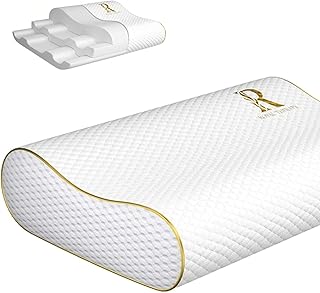
The Royal Therapy pillow is the plain option here, and that is its argument. A queen sized memory foam contour with a washable cover, no adjustment layers and no extra features to evaluate.
The shape is the conventional cervical wave, which is the profile that suits the largest number of people, and the queen sizing means it works with pillowcases you already own. For a second pillow, a spare room or a replacement for a contour you already know fits you, that is the whole requirement.
What you give up is the ability to tune the loft. If the height is not right for your shoulder width and mattress, there is no adjustment to make, which is exactly the gamble the adjustable pillows above remove. Buying this as a first contour is more of a bet than it looks.
The foam is a standard density rather than a premium core, which means it will soften and lose effective height sooner than a denser pillow. That is a reasonable trade at this position in the list, provided you expect it and treat the pillow as a two to three year item.
Bottom line: the value pick, sensible once you already know your loft and a gamble before you do.
- Size: queen
- Contour: conventional cervical wave
- Core: memory foam, fixed loft
- Cover: removable and washable
- Best for: side and back sleepers
- Care: cover washable, foam core is not
Choose this when you are replacing a contour pillow of a known height, furnishing a guest room, or buying a second pillow for a bed where one adjustable pillow has already told you what loft works. Choose an adjustable model instead for a first purchase. Compare it against the DONAMA on shape and against the VYLEE on whether you want two ridge heights or one.
Air the pillow before first use and let it expand fully for several days. Wash the cover on a cool cycle and air dry it. Keep the foam dry, spot cleaning only. Watch for the pillow failing to recover its shape in the morning, which is the sign the foam has softened past the point of supporting you and the pillow is due for replacement.

Pros
- Dense proprietary foam holds its shape far longer than budget cores
- Precisely defined medium profile contour
- Backed by a maker with a long track record in this material
- Firm support that does not compress away under a heavy head
Cons
- Fixed medium profile with no adjustment at all
- Firm dense foam feels unforgiving during the adjustment period
The Tempur-Pedic entry is the one where the material rather than the design is the reason to consider it. The brand's viscoelastic foam is denser than most of what else is here, and density is what determines whether a contour still holds its height after a year of nightly load.
That matters because the common failure in this category is not a broken pillow but a slow one: foam softens, the head sinks further, effective loft drops, and the support quietly disappears. A denser core delays that considerably.
The shape is a conventional ergonomic contour in a single medium profile. The maker has picked a height and committed to it, which works well for people that height suits and offers nothing to those it does not.
Two honest caveats. Dense foam feels firm and unyielding at first, so the adjustment period tends to be longer than with a softer pillow. And there is no adjustment whatsoever, which makes this a pillow to buy when you already know a medium profile is what you need rather than one to experiment with.
Bottom line: the longest lasting core here, in a fixed height that has to suit you from the start.
- Profile: medium, fixed
- Core: TEMPUR viscoelastic foam
- Contour: ergonomic neck support
- Cover: removable
- Best for: back sleepers and side sleepers suited to a medium loft
- Care: cover washable, foam core is not
This is for someone who already knows a medium profile suits them and wants a core that will still be doing its job in a few years. It suits back sleepers particularly well. It is the wrong pillow for a first contour purchase, for broad shouldered side sleepers who need real height, and for anyone who dislikes firm foam, since dense viscoelastic is unforgiving before it warms to body temperature.
Allow a full airing after unpacking and several days for the foam to reach its shape. Wash the cover according to its own label, cool and air dried, and keep the core dry at all times. Dense foam is firmer in a cold room and softens as it warms to body heat, so judge the feel after a full night rather than in the first few minutes.
How to Choose a Cervical Neck Pillow
Read the first two criteria carefully. Almost every one-star review in this category is a loft mismatch wearing the costume of a design complaint.
Loft, Sleeping Position and Shoulder Width

The job of a contour pillow is to fill the gap between your mattress and your head so the neck stays roughly in line with the spine. How big that gap is depends on how you sleep. A side sleeper has to bridge the whole width of their shoulder, which is the largest gap of the three positions, and broad shoulders need more height still. A back sleeper needs far less, just enough to support the natural curve at the base of the skull.
Stomach sleepers are the awkward case. Any meaningful loft forces the neck into extension, so a stomach sleeper generally needs the lowest pillow available or none at all. Pillows advertised for all three positions are usually telling you they have a taller side and a shorter side rather than that one height suits everyone.
Mattress firmness changes the answer too, and this catches people out. A soft mattress lets your shoulder sink in, closing part of the gap, so the same person needs a lower pillow on a plush bed than on a firm one. If you have recently changed mattress and your old pillow stopped working, this is usually why.
Adjustable Height or Fixed Contour
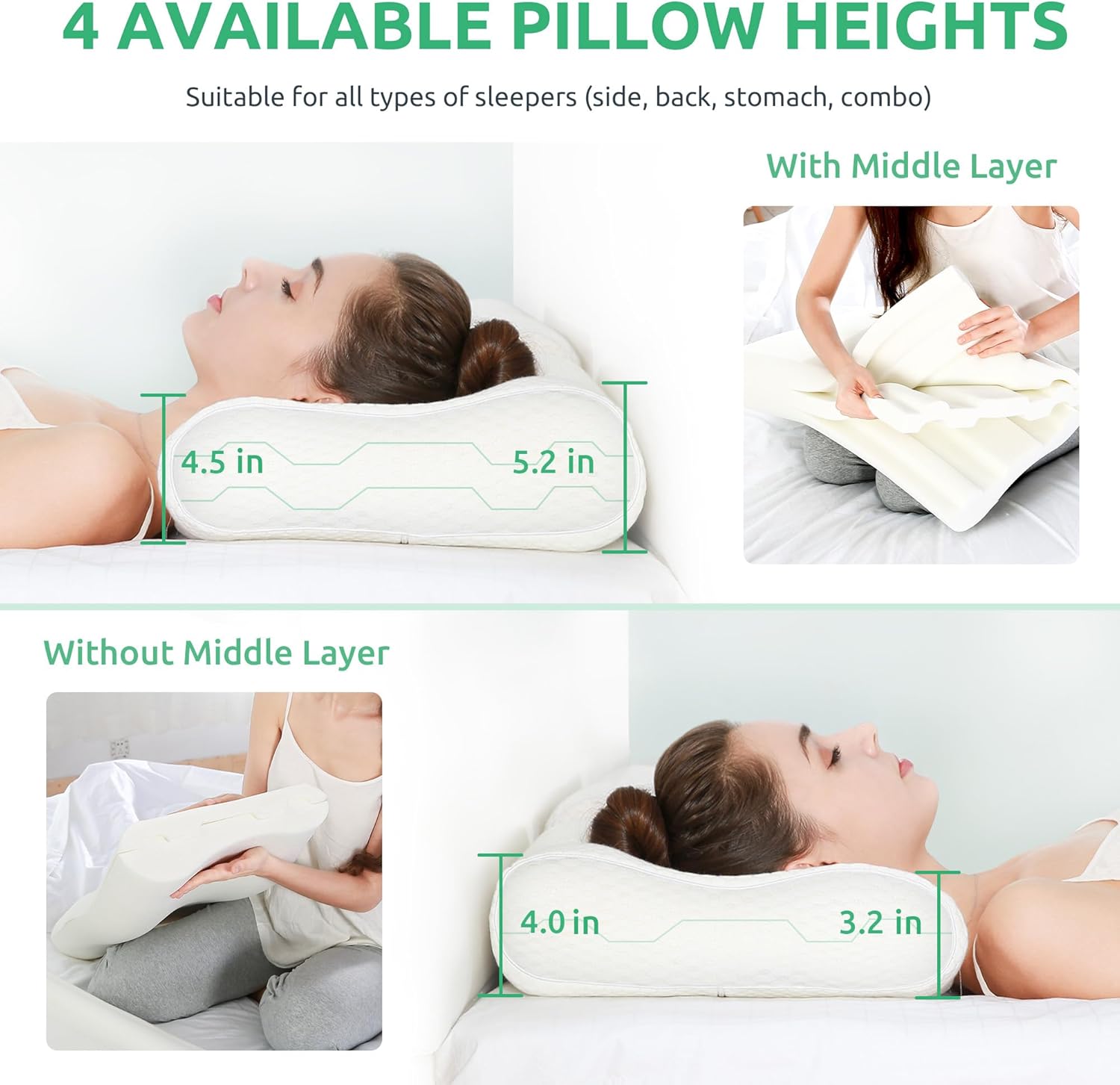
Adjustable pillows solve the loft problem by letting you change it. The common approach is a layered construction where a foam insert can be removed from the middle, dropping the height by a fixed amount. Some designs instead use a zipped chamber of shredded foam that you add to or take from, which gives finer control but a less defined contour.
A fixed contour is a bet that the maker chose your height correctly. Many use a dual-height design, with a taller ridge along one long edge and a shorter one along the other, so flipping the pillow end to end gives you two options. That is a coarse adjustment rather than a fine one, but it covers a lot of people.
If you are buying your first contour pillow, adjustability is worth prioritising over almost every other feature. It converts an unknown into something you can tune over a week, and it means a change of mattress later does not send the pillow to a cupboard. Once you know the height that suits you, a fixed pillow at that loft is perfectly reasonable.
Contour Shape: Wave, Hollow Centre or Wings

The classic cervical shape is a wave: two raised ridges with a dip between them. You sleep on your back with the neck over a ridge and the head cradled in the dip, and the higher ridge is meant to be at the bottom edge. A surprising number of people use these upside down, which puts the tall ridge under the skull and pushes the chin toward the chest.
Hollow centre designs cut a recess into the middle so the head sits lower than the surrounding foam. The idea is to reduce pressure on the ear when side sleeping and to stop the head rolling, which is genuinely useful for people who wake with a sore ear or who wear hearing aids. It also traps a little less heat around the head than solid foam.
Butterfly or winged shapes add extensions at the sides, intended to support the arm a side sleeper tucks under the pillow or to stop you rolling onto your front. They take up more of the bed and they suit people who move a lot in the night. Whichever shape you pick, note that a contour only works if you actually stay on it, so restless sleepers usually do better with a wider pillow.
Foam Density, Firmness and Heat
Memory foam is the standard material here because it holds a moulded contour and responds slowly to pressure. Density is what determines how much it sinks under load. Low density foam feels comfortable in the shop and compresses too far under a heavy head, which quietly reduces the effective loft and undoes the contour. Higher density holds its shape for years but feels firmer at first.
Slow response is the trademark of memory foam and it cuts both ways. It moulds beautifully to a still head, but it does not keep up with a sleeper who changes position several times a night, so you can end up lying against a shape that fits where you were rather than where you are. Latex and firmer foams recover faster if that describes you.
Heat is the other constant complaint. Dense foam insulates, and a head resting in a moulded pocket has very little airflow around it. Gel infusions and perforated ventilation channels help at the margins rather than transforming the pillow, and the cover fabric usually makes more difference than anything inside. Sleep temperature is worth a look across our health and household picks if it is your main problem.
Cover Fabric and Washing
The foam core in these pillows cannot be washed. Soaking memory foam breaks it down and it takes days to dry, so the cover is your entire cleaning strategy. A removable, machine washable cover with a full length zip is close to non-negotiable, and a second cover in the box is a genuine convenience rather than a bundle filler.
Fabric choice affects how warm the pillow sleeps. A knitted polyester jersey feels soft and holds heat. Bamboo derived viscose and similar cellulose blends move moisture better and feel cooler to the touch. Some covers are printed as cooling on one side and plush on the other, which is a practical way to handle a house that swings between seasons.
Check whether a standard pillowcase will fit. Contour pillows are often narrower and taller than a standard pillow, so a normal case bunches over the ridges and flattens the shape you paid for. Some makers size their pillows to standard or queen dimensions specifically so that ordinary bedding works, and that is worth knowing before you order new cases.
Off-Gassing and the Adjustment Period
New memory foam arrives compressed and gives off a distinct smell for the first few days. It fades, and unwrapping the pillow and leaving it in a ventilated room for a day or two handles most of it. Makers who describe their foam as odourless are usually referring to a formulation and a longer airing at the factory rather than a guarantee, so plan for at least one night of airing regardless.
The pillow also needs time to reach full loft after being vacuum packed, often several days. Judging the height on the first night is a mistake, since it may still be short of its final shape. Give it the time the instructions ask for before deciding whether the loft is right.
Your neck needs an adjustment period too. Moving from a soft flat pillow to a firm contour changes the angle your neck has held for years, and a few nights of unfamiliarity is normal. What is not normal is waking with more pain than you went to bed with, which points to a loft mismatch rather than an adjustment. Browse the full category index for adjacent sleep gear.
| How you sleep | Loft to look for | Shape that suits |
|---|---|---|
| Side, broad shoulders | Highest available, adjustable preferred | Tall ridge or winged design with ear relief |
| Side, narrow shoulders | Medium, or a tall pillow with a removable layer | Dual-height contour, flipped to the taller edge |
| Back | Low to medium under the head, higher under the neck | Classic wave with the tall ridge at the bottom edge |
| Stomach or mixed | Lowest available | Thin contour or a flat pillow instead |
Why You Should Trust Us
We build these lists from published specification and from the pattern of what long-term owners report, not from marketing copy. For each pillow here we compared stated loft at both ends of the contour, overall dimensions against standard bedding sizes, whether the height is adjustable and by how much, foam type and any cooling treatment, and what the cover is made of and how it washes. We then read owner feedback for the complaints that only surface after weeks: foam that softens and loses height, covers that pill, and smells that outlast the airing period.
We set aside listings that were the same pillow in a different colour or a two pack, so each entry is a genuinely different product. We also want to be plain about scope: these are consumer bedding products, not medical devices, and nothing here is a treatment for a diagnosed condition. If you have persistent neck pain, numbness or symptoms that wake you, a clinician is the right first stop and a pillow is a comfort decision to make afterwards.
Final Thoughts
Best overall is the UTTU Sandwich Pillow. Its removable middle layer is the most useful feature in this whole category, because it turns the loft question from a gamble into something you adjust over a week. The contour itself is a conventional dual-height wave, which is the shape that suits the widest range of people, and the cover washes.
Best value is the Royal Therapy Memory Foam Contour Pillow. It is a straightforward queen sized contour with a washable cover and no adjustment mechanism, which is fine once you already know the loft that works for you. For a spare room or a second pillow, it does the job without complicating it.
For specific needs, the ZAMAT Adjustable Cervical Pillow is the pick if you want adjustability with a broader, winged shape, the Osteo Hollow Design Cervical Pillow is the one for side sleepers who wake with a sore ear, and the VYLEE Dual-Height Contour Pillow is the simplest flip-to-fit option. The DONAMA Contour Pillow is the queen sized dual-height choice for a standard pillowcase, and the Tempur-Pedic TEMPUR-Ergo Neck Pillow is the fixed medium profile pick from the brand that defined the material. More picks are indexed across our article archive.
Cervical Neck Pillow FAQs
Which way round does a cervical neck pillow go?
On a classic wave pillow, the taller ridge goes at the bottom edge, closest to your shoulders, so it fills the gap under your neck while your head rests in the dip behind it. Using it the other way puts the tall ridge under the back of your skull and tips your chin toward your chest, which is the opposite of what the shape is for. If the pillow has two different ridge heights, the taller edge is generally intended for side sleeping and the shorter for back sleeping.
How long does it take to get used to a contour pillow?
Most people need somewhere between a few nights and two weeks. You are changing an angle your neck has held for years, and a firm moulded surface feels very different from a soft flat pillow, so mild unfamiliarity early on is expected. Give the pillow itself several days to reach full loft after unpacking before you judge it. If you are waking with more discomfort than before rather than less, that is a loft mismatch rather than an adjustment period, and the fix is a different height rather than more patience.
Can you wash a memory foam neck pillow?
Not the foam core. Water breaks memory foam down and it holds moisture for days, so submerging it ruins the pillow. Clean the removable cover on a cool machine cycle and air dry it rather than tumbling it, since heat shrinks knitted covers onto a contour they no longer fit. For the foam itself, spot clean marks with a barely damp cloth and mild soap, then let it dry completely in a ventilated room. A second cover makes this far less disruptive.
Are these pillows good for side sleepers?
Side sleeping needs the most loft of any position, because the pillow has to bridge the full width of your shoulder. Contour pillows suit side sleepers well provided you choose a tall enough version, which usually means the higher ridge of a dual-height design or an adjustable pillow set to its maximum. Broad shoulders and a firm mattress both push you toward more height. A hollow centre or a winged shape adds ear comfort, which is a common side sleeping complaint that loft alone does not fix.
How often should a cervical pillow be replaced in 2026?
Two to three years of nightly use is a reasonable expectation for a decent density foam core. The failure is gradual rather than sudden: the foam softens, the contour compresses further under load, and the effective loft drops until the support you bought is no longer there. The tell is that the pillow stops recovering its shape in the morning, or that you start waking the way you did before you bought it. Covers wear out sooner and are easily replaced on their own.










Write Your Review
No reviews yet. Be the first to share your experience!