

A carbon steel wok is the rare piece of cookware that gets better with use and worse with care, which is why so many of them end up in a cupboard after one sticky, smoking evening. The metal is cheap, the shape is ancient and the performance is genuinely different from anything nonstick can do, but only if the wok matches your burner and you get through the first few cooks. We sorted 9 woks from Joyce Chen, Craft Wok, Souped Up Recipes and more by bottom shape, steel gauge, handle layout and whether they arrive seasoned or bare.
Our top pick is the Craft Wok Flat Bottom Hand Hammered Pow Wok for pairing a genuinely hand-hammered carbon steel body with a flat base that sits properly on a home range. Below we start with burner compatibility, because that single decision rules out half the field before anything else matters. For the pans and boards that live alongside it, our home and kitchen section covers the rest of the kit.

Pros
- Genuinely hand-hammered interior parks food on the sloped wall
- Flat base sits properly on domestic gas and flat electric elements
- Stick handle with helper loop suits tossing rather than stirring
- Bare steel takes a durable seasoning that keeps improving
Cons
- Arrives bare and needs an hour of seasoning before first use
- Wooden handle cannot go in an oven or sit over the flame
The flat bottom Craft Wok is the version of a traditional pow wok made to work on the stove most people actually own. The body is hand hammered, so the interior carries the irregular dimpled texture that gives food something to sit against when you push it up the wall.
That texture is the practical difference between this and a smooth machine-spun pan. Cooking in a wok depends on being able to park cooked ingredients on the cool shoulder while the next handful sears in the centre, and on a polished interior they slide straight back down.
The stick handle is the other half of the design. It is long enough for leverage and stays cool, so tossing becomes possible rather than theoretical, and the small steel helper loop opposite lets you lift a full pan with two hands.
The catch is the bare steel. It ships with a protective coating that must be scrubbed off, and then it needs seasoning from scratch, which takes an hour and turns the metal blue and blotchy before it turns black. That is normal, and the surface you end up with is more durable than any factory layer.
Bottom line: the most complete wok here for a home kitchen, provided you are willing to season it yourself.
- Diameter: 14 inches
- Bottom: flat
- Material: carbon steel, hand hammered
- Handles: wooden stick handle with steel helper handle
- Finish: bare steel, requires seasoning
- Suitable for: gas, electric coil, glass ceramic
Heat the empty wok until it just starts to smoke before any oil goes in, then add oil and swirl it up the walls. Cook in small batches so the pan never loses its heat, and push each finished batch up the sloped side rather than removing it. Use the stick handle to toss with a forward and upward flick of the wrist rather than a shake. Keep the wooden handle clear of the flame at all times.
Rinse with hot water and a bamboo brush while the pan is still warm, then dry it back on the burner until no moisture remains and wipe on a trace of oil. Avoid steel scourers, long soaks and the dishwasher entirely. Ventilate the kitchen well during the initial seasoning, which produces a lot of smoke. Never lift a full wok by the stick handle alone.

Pros
- Continuous curve gives the classic hot centre and cool shoulder
- Hand hammered interior holds food on the sloped wall
- Wooden stick handle plus helper handle for real tossing
- Bare carbon steel builds a hard-wearing seasoning
Cons
- Needs a wok ring or a burner that wraps the curve to work properly
- Will not sit safely on a glass ceramic or induction surface
This is the traditional shape, and on the right heat source it is the better cooking surface of the two Craft Wok entries. The uninterrupted curve creates a genuine temperature gradient from the searing centre to the cooler rim, which is the mechanism stir frying is built around.
The hammering does the same job here as on the flat bottom version, giving the interior a texture that holds food where you put it. Combined with the depth, it makes cooking in batches straightforward and gives enough volume to deep fry in a modest amount of oil.
The stick handle and helper loop are the traditional pow wok arrangement, and with a round base the tossing motion is far easier than it is on a flat pan, because the curve returns food to the centre on its own.
Everything depends on the burner. Balanced on a ring over an ordinary domestic gas hob, this wok heats slowly at a small point and disappoints. Over an outdoor propane ring or a dedicated wok burner it does exactly what it is supposed to. It cannot be used on induction or glass ceramic at all.
Bottom line: the best cooking surface here, and only worth buying if you have the flame it needs.
- Diameter: 14 inches
- Bottom: round
- Material: carbon steel, hand hammered
- Handles: wooden stick handle with steel helper handle
- Finish: bare steel, requires seasoning
- Requires: wok ring or high output gas burner
Buy this if you cook on an outdoor propane wok burner, a dedicated indoor wok ring, or a gas hob with enough output that a support ring still gets the base properly hot. It is the right answer for anyone chasing restaurant results. It is the wrong answer for a glass ceramic top, an induction hob, an electric coil, or a modest four-burner gas hob, where the flat bottom version cooks better.
Use a stable, properly sized wok ring, since a round wok on an unstable support is the main safety risk in this category. Season from bare metal before the first cook. Clean while warm with hot water and a bamboo brush, dry on the heat, and oil lightly. Store it on a hook rather than resting it on its curve, where it will rock and can be knocked off a counter.
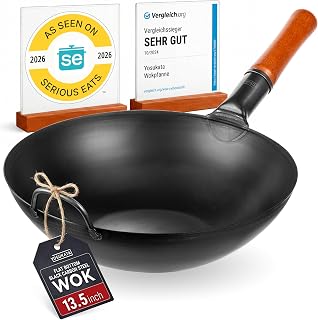
Pros
- Arrives pre-seasoned so it can be cooked in immediately
- Flat base works across gas, electric, glass ceramic and induction
- 13.5 inch size fits a domestic hob better than a full 14 inch
- Wooden handle stays cool and gives leverage for tossing
Cons
- Factory seasoning is thin and looks patchy for the first weeks
- Machine formed interior lacks the texture of a hammered wok
The YOSUKATA black steel wok is the easiest entry point to carbon steel in this list, because it removes the one step that puts people off. The factory has already laid a base seasoning, so the first meal can happen on the day it arrives.
The flat bottom is wide enough to work across every common cooktop, induction included, and the 13.5 inch diameter is a sensible compromise: enough sloped wall to cook properly, small enough that it does not overhang the neighbouring burner on a compact hob.
The body is machine formed rather than hammered, which gives a smooth interior. It is easier to wipe clean and slightly less good at holding food on the shoulder, and for most home cooking that is an acceptable trade.
Set expectations on the finish. A factory seasoning is a thin base layer, not a finished nonstick surface, and it will look mottled and uneven for several weeks while your own layers build over it. Owners who read that as a defect and scour it back are the ones who end up disappointed.
Bottom line: the pre-seasoned flat bottom pick, and the least intimidating way into carbon steel.
- Diameter: 13.5 inches
- Bottom: flat
- Material: black carbon steel
- Finish: pre-seasoned
- Handle: wooden
- Suitable for: gas, electric, glass ceramic, induction
Choose between the three YOSUKATA woks on two questions. First, flat or round: flat for any hob that heats by contact, round only for a wok ring or a strong open flame. Second, black steel or blue steel: black is the standard pre-seasoned finish and the safer default, while blue steel has a heat-treated surface that resists rust better before seasoning. If neither distinction matters to you, this is the one to take.
Cook fatty food in it for the first few sessions to build on the factory layer, and resist scrubbing the patchy areas. Wash with hot water and a soft brush, dry on the burner, and wipe with a thin film of oil. Do not put it in the dishwasher, and do not leave it wet in a sink. If rust appears, scour that patch back to metal and season it again rather than replacing the pan.

Pros
- Compact 12.5 inch size suits small hobs and single cooks
- Lid and spatula included, so nothing else is needed to start
- Flat base designed to work with induction and electric elements
- Lighter than the 14 inch woks and easier to handle one-handed
Cons
- Smaller cooking area limits batch size for family portions
- Shallower wall gives less room when adding sauces
The Souped Up Recipes wok is aimed squarely at the modern domestic kitchen: a flat base sized for an induction ring, a diameter that fits between burners on a compact hob, and a weight that one hand can manage.
Including a lid changes what the pan can do. A wok with a lid steams, braises and finishes dishes with a splash of liquid, and buying a separate domed lid that fits a sloped pan afterwards is more awkward than it sounds. The spatula in the bundle is the correct curved shape for the wall of a wok.
At 12.5 inches the cooking area is noticeably smaller than a 14 inch pan. For one or two portions that is fine and arguably better, since a small burner keeps a small pan hotter. For four portions you will be cooking in two batches.
The wall is a little shallower than the traditional pans here, which shows up when you add a saucy element and the contents come close to the rim. It is a compromise that comes with the compact footprint rather than a fault.
Bottom line: the practical choice for induction and small kitchens, and the most complete out of the box.
- Diameter: 12.5 inches
- Bottom: flat
- Material: carbon steel
- Included: lid and spatula
- Suitable for: induction, electric, gas
- Care: hand wash, dry on heat, oil lightly
This suits a one or two person household, a small hob, or anyone cooking on induction who wants the pan and the lid settled in one purchase. It is also the easiest of these woks to lift and move when full. Look elsewhere if you regularly cook for four or more at once, where the smaller cooking area forces batching, or if you want the deep traditional curve.
On induction, remember that only the base is heated: keep food moving through the centre rather than expecting the walls to cook anything. Preheat the empty pan on medium rather than maximum, since induction can create a hot spot that warps thin steel. Use the lid to finish dense vegetables with a splash of water after searing, which is the technique a lidless wok cannot do.

Pros
- Pre-seasoned and ready to cook on arrival
- Set includes a lid and the utensils a wok needs
- Compact 12.8 inch size fits a domestic hob comfortably
- No chemical nonstick coating to wear away
Cons
- Accessories are basic and some will be replaced over time
- Machine formed body without the texture of a hammered interior
The Leidawn set answers a specific question: what is the least complicated way to start cooking in carbon steel. It arrives pre-seasoned, it comes with a lid, and it includes the utensils, so there is no second order and no seasoning evening.
The pan itself is a straightforward machine-formed carbon steel body at 12.8 inches, which is a friendly size for a normal hob. It heats and behaves like carbon steel should, and there is no coating to scratch or wear off, which is the entire reason to choose this material.
The accessories are what you would expect from a bundle. They work, and some of them will be quietly replaced within a year as you develop preferences. Judged as a way to get a working wok kit in one go, that is not a criticism.
What you are not getting is a hammered interior or a documented steel gauge. Food slides back down the smooth wall more readily, and the pan gives away some of the character that makes the Craft Wok entries interesting. For a first carbon steel pan, most people will not notice.
Bottom line: the value pick, and the least friction between ordering and cooking.
- Diameter: 12.8 inches
- Material: carbon steel, pre-seasoned
- Included: lid and accessory set
- Coating: none
- Suitable for: gas and electric cooktops
- Care: hand wash, dry on heat, oil lightly
Take this if you have never owned carbon steel and want to find out whether you like it before committing to a hammered pan. Compare it against the pre-seasoned YOSUKATA on one point: whether you need the lid and utensils now. If you already own a domed lid that fits a sloped pan and a wok spatula, the standalone pans are the better metal for the money.
Treat the factory seasoning as a starting layer and build on it by cooking fatty food early on. Wash in hot water with a soft brush, never in the dishwasher, and dry the pan on the burner rather than in a rack. A thin wipe of oil after drying prevents surface rust. If a patch rusts, scour that area and re-season it locally rather than stripping the whole pan.

Pros
- Full 14 inch traditional curve with a proper cooking gradient
- Pre-seasoned, so no seasoning session before the first cook
- Deep body suits batch cooking and shallow frying
- Wooden handle stays cool over an open flame
Cons
- Requires a wok ring or an open gas flame, ruling out flat cooktops
- Round base makes it unstable on any surface without a ring
This is the same steel and finish as the flat bottom YOSUKATA in a traditional round shape and a larger 14 inch diameter. The reason to choose it is the curve, which produces the searing centre and cooler shoulder that flat pans only approximate.
Being pre-seasoned makes it unusual among round bottom woks, most of which arrive bare. It removes the hour of preparation and lets the pan start building a surface from the first cook, which is a real convenience given the size.
The depth is generous, so it handles a large batch of stir fry without spilling and holds enough oil for shallow frying. The wooden handle stays cool over a flame, though it needs keeping clear of the fire.
The requirement is unavoidable: this needs a stable wok ring over a gas flame, or an outdoor burner. It cannot sit on induction or glass ceramic, and on a small domestic burner the heat reaches too little of the base to do the shape justice.
Bottom line: the pre-seasoned option for anyone who already cooks over an open flame.
- Diameter: 14 inches
- Bottom: round
- Material: black carbon steel
- Finish: pre-seasoned
- Handle: wooden
- Requires: wok ring or open gas flame
Buy this if you have an outdoor wok burner or a gas hob with a stable ring and enough output to heat a 14 inch base. It suits cooks who want the traditional shape without the seasoning ritual. It is not for flat cooktops of any kind, and it is not the pan to buy first if you are still deciding whether carbon steel suits you.
Set the wok ring so the pan sits low and steady, then preheat until a drop of water skitters and vanishes. Add oil, swirl it up the wall, and cook in batches, pushing finished food onto the shoulder. Keep the handle away from the flame and use a cloth on the metal helper loop. Take the pan off the ring before stirring vigorously, since a round base moves easily.

Pros
- Blue steel surface resists rust better than plain carbon steel
- Flat base works on gas, electric, glass ceramic and induction
- Pre-seasoned and usable straight away
- Same practical 13.5 inch size as the black steel version
Cons
- Blue finish is cosmetic once your own seasoning builds over it
- Machine formed interior without hammered texture
The blue steel YOSUKATA is the same pan as the black 13.5 inch flat bottom model with a different surface treatment. Blue steel has been heat treated to form a protective oxide layer, which makes it noticeably more resistant to rust in the period before your own seasoning takes hold.
In use the difference is smaller than the marketing suggests. Once you have cooked in it for a few weeks, both pans are carrying your seasoning rather than their factory surface, and they behave identically.
Everything else is the same and the same things are good about it. The flat base covers every common cooktop including induction, the 13.5 inch diameter fits a domestic hob without overhanging, and the wooden handle stays cool.
The choice between the two comes down to circumstance. In a humid kitchen, or if the wok will sit unused for stretches, the blue steel is the safer surface. Otherwise there is no reason to prefer one over the other beyond appearance.
Bottom line: worth the pick if rust between uses is a real concern, otherwise interchangeable with the black steel model.
- Diameter: 13.5 inches
- Bottom: flat
- Material: blue carbon steel, heat treated
- Finish: pre-seasoned
- Handle: wooden
- Suitable for: gas, electric, glass ceramic, induction
Pick blue over black if the pan will live in a humid kitchen, go weeks between uses, or be stored somewhere that is not reliably dry. Pick black if it will be in weekly rotation, since your own seasoning will cover the difference within a month. Do not choose between them on cooking performance, because at that level they are the same wok.
The heat treated surface is more forgiving but not rustproof: still dry the pan on the burner and wipe on a trace of oil after washing. Avoid steel wool, which will cut through both the blue layer and the seasoning. Keep it out of the dishwasher. If the pan is going into storage for a season, oil it more heavily and wrap it rather than leaving it exposed.
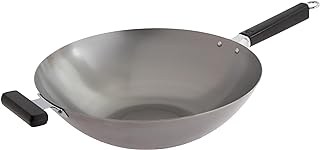
Pros
- Phenolic handles stay cool and will not char like wood
- Full 14 inch capacity for family sized batches
- Simple, durable construction with a long track record
- Handles tolerate moderate oven heat
Cons
- Handle layout suits stirring rather than tossing
- Bare steel needs seasoning before the first use
The Joyce Chen Professional Series is a plain, competent 14 inch carbon steel wok whose distinguishing feature is the handle material. Phenolic resin stays cool, does not char if it strays near the flame, and tolerates a moderate oven, which wood cannot.
That makes it a different kind of tool to the pow woks in this list. You will stir rather than toss, and you can move the pan straight from the hob into the oven to finish a braise, which broadens what it can do.
The body is a full size 14 inch carbon steel pan with the capacity for cooking for a family in one go, and the material behaves as carbon steel always does: responsive, seasonable, repairable, and better after a year than it was on day one.
It arrives bare, so the first job is stripping the factory coating and seasoning it. The handles also mean this is not the pan for anyone who wants to learn the tossing motion, since there is no long stick to lever against.
Bottom line: a durable family sized workhorse for stirring rather than tossing, with handles that outlast wooden ones.
- Diameter: 14 inches
- Material: carbon steel
- Handles: phenolic, heat resistant
- Finish: bare steel, requires seasoning
- Oven use: moderate temperatures
- Care: hand wash, dry on heat, oil lightly
This suits a household cooking for three or four at a time, and anyone who wants to move a wok into the oven. It is a sensible pick for cooks who stir with a spatula and have no interest in tossing. It is the wrong pan for someone who wants the traditional pow wok technique, and it asks for the same seasoning work as the bare Craft Wok models.
Strip the factory coating and season from bare metal before first use. Phenolic handles tolerate oven heat but not a direct flame, so keep them clear of a burner that reaches past the base. Wash by hand while warm, dry on the heat, and oil lightly. Use a cloth when moving the pan after oven use, since the handles do get warm even though they will not burn you on the hob.
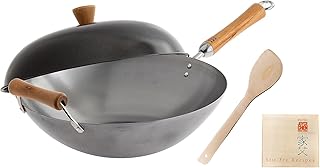
Pros
- Lid included, so the pan can steam and braise as well as fry
- Uncoated steel with nothing to wear off or scratch
- Birch handles feel warm and stay cool on the hob
- Full 14 inch capacity for larger batches
Cons
- Birch handles cannot go in an oven or take a direct flame
- Bare steel needs full seasoning before the first cook
The Classic Series is the traditional counterpart to the Professional model, built around wooden handles and supplied with a lid. Together those two choices make it a more versatile pan than the specification suggests.
A lid is the difference between a wok that stir fries and a wok that also steams, braises and finishes greens with a splash of water. Domed lids that fit a sloped 14 inch pan are awkward to buy separately, so having one in the box is worth more than the piece count implies.
Birch handles are pleasant to hold and stay cool on the hob. They are also the limiting factor: no oven, no direct flame, and no dishwasher, so they need the same care as any wooden handled pan.
The steel is uncoated and arrives bare, which means seasoning it before the first meal. As with every wok here that ships that way, the surface you build yourself is more durable than a factory layer, and the pan will keep improving for as long as you use it.
Bottom line: the pick if you want two loop-free wooden handles and a lid in one purchase, and are happy to season it.
- Diameter: 14 inches
- Material: uncoated carbon steel
- Handles: birch wood
- Included: lid, four piece set
- Finish: bare steel, requires seasoning
- Care: hand wash only, no dishwasher
Season from bare metal first, in thin coats, with plenty of ventilation. Use the lid in two ways: cover after searing to steam dense vegetables through with a splash of water, and cover during a braise to keep the liquid in. Keep the birch handles away from the flame front and off a hot oven shelf. Stir with a curved wok spatula that matches the wall rather than a flat one.
Wash by hand while the pan is warm, dry it on the burner, and wipe with a trace of oil. Never put the wok or the lid in the dishwasher, since the wooden handles will dry out, grey and loosen. Oil the birch occasionally with a food safe mineral oil. Keep the lid stored separately rather than clamped on the pan, so any residual moisture can escape.
How to Choose a Carbon Steel Wok
Start with the burner. Every other criterion here is a refinement, but a wok that cannot sit on your stove is not a compromise, it is a returned parcel.
Round Bottom or Flat Bottom

A round bottom wok is the traditional shape and the better cooking surface. The continuous curve gives you a searing hot pool at the centre and a cooler shoulder to push finished food up onto, which is the whole technique of stir frying. It needs a flame that wraps around the curve, which in practice means a gas ring with a wok support, a dedicated wok burner or an outdoor propane ring.
A flat bottom wok trades some of that curve for a disc of metal that sits directly on a flat element. On an electric coil, a glass ceramic top or an induction hob it is the only version that works at all, because those surfaces heat by contact and a round wok touches them at a single point. The flat area is usually four to six inches across, and a larger flat is more stable but reduces the sloped area you actually cook against.
Be honest about the stove you have rather than the one you want. A round bottom wok balanced on a ring over a standard domestic gas burner heats slowly and unevenly, and the results disappoint people who expected restaurant heat. If your gas ring is a normal four-burner hob output, the flat bottom version of the same wok will cook better in your kitchen.
Steel Gauge and How Fast the Metal Responds
Carbon steel woks are typically made in gauges from around fourteen down to twenty on the standard scale, where a lower number means thicker metal. Thin steel, in the eighteen to twenty range, heats almost instantly and responds the moment you turn the flame down, which is what makes a professional wok feel alive. It also dents if handled roughly and can warp under an unevenly hot element.
Thicker steel around fourteen or fifteen gauge holds heat rather than reacting to it. On a domestic burner that stored heat is genuinely useful, because a home flame cannot recover quickly when a cold handful of vegetables hits the pan. The cost is weight and slow response, and a heavy wok is not one you will toss food in.
Match gauge to burner power rather than to price. Weak burner and thicker steel is the pairing that gets a decent sear from a domestic hob. Strong burner and thinner steel is the pairing that gives you control. Getting it backwards produces either a wok that never gets hot enough or one that scorches the moment you look away.
Hand Hammered or Machine Spun

A hand-hammered wok is formed by beating a steel disc over a form, which leaves the characteristic dimpled surface. Those dimples are not decoration: they give food something to catch on when you push it up the wall, so ingredients stay parked on the shoulder instead of sliding back into the hot centre. The hammering also work-hardens the metal slightly.
Machine-spun woks are pressed and spun to shape, giving a smooth, perfectly symmetrical interior. They are cheaper to make, more consistent between units and slightly easier to clean because there is no texture to hold residue. What you lose is the parking shelf effect, which matters more than it sounds once you are cooking in batches.
Look for evidence rather than the word. Genuine hammering shows as slightly irregular, overlapping dimples that vary across the surface, and it usually comes with a maker who says where the wok was formed. A uniform machine-embossed pattern is a different thing sold under similar language. Our category index covers the broader cookware picks if you are furnishing a kitchen from scratch.
Handle Type and Cooking Style
Three handle layouts dominate. A long wooden stick handle, sometimes with a small helper loop opposite, is the pow wok arrangement built for tossing. Wood stays cool, the length gives leverage, and you can flip the contents without a utensil once you learn the motion. The drawback is that a wooden handle will char if it sits over the flame and cannot go into an oven.
Two loop handles are the cantonese arrangement, used for larger woks where tossing is not realistic. They store flat, they take oven heat, and a full wok of soup is far safer to move with two hands. They also mean you will be stirring with a spatula rather than flipping, which suits home cooking more than restaurant technique.
Phenolic and other moulded handles sit between the two. They stay cool, they will not char, they usually tolerate a moderate oven, and they lack the warm feel of wood. Check how the handle attaches: riveted or welded through the body is durable, while a screw into a bracket is the joint that works loose after a year of heat cycles.
Pre-Seasoned or Bare Steel

Bare carbon steel arrives coated in a factory oil or lacquer that has to be scrubbed off, then seasoned from scratch by heating thin layers of oil until they polymerise. It is not difficult, but it takes an hour of attention, a well-ventilated kitchen and a willingness to see the metal turn blue and blotchy before it turns black. Done properly it gives the most durable surface.
Pre-seasoned woks skip the worst of that. The factory has already put down a base layer, so you can cook on the first day, and the surface builds from there. The layer is usually thin and patchy, and it will look uneven for the first few weeks regardless of what the product photos show, which is normal rather than a defect.
Either way the seasoning is a working surface, not a finish. It darkens, it flakes in places, and it recovers if you keep cooking fatty food in it and stop scrubbing it with detergent. The single biggest cause of a ruined wok is treating a patchy season as damage and attacking it with a scourer.
Diameter, Depth and What Fits Your Stove
Fourteen inches is the traditional size and the one that gives a proper cooking curve, but it needs a hob with clearance around the burner and a cupboard tall enough to store it. Twelve to thirteen inches is easier to live with in a domestic kitchen and still cooks two or three portions comfortably. Below twelve inches the sloped wall gets too short for food to sit on.
Depth matters for the technique. A deep wok keeps oil and steam contained when you add sauce, and it is what lets you deep fry in a small volume of oil. A shallow one is closer to a frying pan with sloped sides, which is easier for beginners but gives away the thing that makes a wok different.
Measure the burner spacing before ordering the largest option. A fourteen inch wok on a compact four-burner hob will overhang the neighbouring burners and, on a glass ceramic top, can sit on the frame rather than the element. Check the flat base diameter against your induction ring too, since a base smaller than the ring will not trigger some hobs at all. Our appliances section is the place to check what your cooktop expects.
| Your burner | Wok to buy | Why |
|---|---|---|
| Outdoor ring or high output gas | Round bottom, thinner gauge | Flame wraps the curve and the metal responds instantly |
| Standard domestic gas hob | Flat bottom, medium to thick gauge | Stored heat compensates for a burner that cannot recover |
| Electric coil or glass ceramic | Flat bottom with a wide base | Contact area is the only path for heat into the pan |
| Induction | Flat bottom sized to the ring | Base must cover the coil or the hob may not detect it |
Why You Should Trust Us
We build these lists from published specification and from the pattern of what long-term owners report, not from marketing copy. For every wok here we compared bottom shape and flat base diameter, stated steel gauge and weight, forming method, handle material and attachment, and whether the piece ships bare or pre-seasoned, then read owner feedback for the problems that only appear later: warping on electric elements, handles loosening at the bracket, and seasoning that flakes because the first coat was applied too thick.
We also separated genuinely different models from listings that share a shape and differ only in colour or bundle. Three of the woks below come from one maker and they are three distinct pans, not a colour choice, so each entry says plainly what changes between them. Where a bundle counts a lid, a spatula and a set of accessories toward its headline, we describe the pan rather than the piece count.
Final Thoughts
Best overall is the Craft Wok Flat Bottom Hand Hammered Pow Wok. It is a properly hand-hammered carbon steel body with the dimpled interior that actually parks food on the shoulder, built with a stick handle for tossing and a flat base that works on the stove most people have. It asks you to season it yourself, and that is the only real barrier.
Best value is the Leidawn 12.8 Inch Carbon Steel Wok, which arrives pre-seasoned with a lid and a set of tools, so nothing else needs buying to get started. The pan is machine formed rather than hammered and the accessories are ordinary, but as a way into carbon steel cooking without a shopping list attached, it does the job.
For specific needs, the Craft Wok Traditional Hand Hammered round bottom model is the one to buy if you have an outdoor burner or a wok ring over real heat, the YOSUKATA 13.5 Inch Flat Bottom Black Carbon Steel Wok is the pre-seasoned flat bottom pick, and the Souped Up Recipes 12.5 Inch wok is the most induction-friendly size with a lid and spatula included. The Joyce Chen Classic 14 Inch set is the choice for two loop handles and oven work. More kitchen picks are indexed across our article archive.
Carbon Steel Wok FAQs
Do I need a round bottom carbon steel wok?
Only if you have a flame that can wrap around the curve, which means a wok ring over a powerful gas burner or an outdoor propane ring. On a standard domestic gas hob, an electric coil, a glass ceramic top or induction, a flat bottom wok cooks better because those heat sources work by contact or by a narrow flame. Buying the traditional shape for a stove that cannot support it is the most common regret in this category, and no amount of technique fixes it.
How do I season a new carbon steel wok?
Scrub off the factory coating with hot water and a little detergent, dry it fully, then heat the empty wok until the steel changes colour and starts to blue. Wipe on the thinnest possible film of a high smoke point oil, heat until it stops smoking, and repeat a few times. Thin is the whole trick: a thick coat polymerises unevenly and flakes off within a week. Expect a blotchy result for the first month, which fills in as you cook.
Can I use soap on a carbon steel wok?
A little dish soap on a well-seasoned wok will not strip it, and the old rule against it dates from a time when detergents contained lye. What does real damage is abrasion and soaking: a steel scourer, a long stay in the sink, or a trip through the dishwasher, which combines heat, salt and hours of water and will take a wok back to bare metal and rust. Rinse hot, scrub with a bamboo brush, dry on the burner, wipe with a trace of oil.
Will a carbon steel wok work on induction?
Yes, since carbon steel is magnetic, but the flat base has to be large enough for the hob to detect it and to spread the heat. A base of around five inches or more is the safe target, and a smaller one may either fail to trigger the ring or create a scorching hot spot in the centre while the sloped walls stay cold. Induction also cannot heat the walls at all, so cook by stirring through the centre rather than expecting the shoulder to do anything.
How long should a carbon steel wok last in 2026?
Decades, and that is the point of the material. There is no coating to wear off, so the surface is repairable at any stage: if it rusts, scour it back and season it again, and it is as good as new. The parts that actually fail are handles, either charring at a wooden joint or working loose at a screwed bracket, which is why handle attachment is worth more attention than the steel itself. Warping is the other risk, and it comes from heating an empty wok too hard on a small element.

Write Your Review
No reviews yet. Be the first to share your experience!