
Argan oil earned its reputation honestly. It is high in oleic and linoleic acid and in vitamin E, and on dry or chemically treated hair it does measurably reduce the rough feel that comes from a lifted cuticle. What it cannot do is survive being listed twelfth on an ingredient panel behind a harsh sulfate. That gap between the marketing and the formula is why 9 bottles from OGX, Moroccanoil, HASK and more can all say the same three words on the front and behave completely differently in the shower.
Our top pick is Moroccanoil Hydrating Shampoo for putting argan oil high enough in the formula to matter and pairing it with a gentle cleansing base, which is the combination almost every cheaper bottle gets wrong in one direction or the other. Below we sort the field by cleansing agent, where the oil actually sits in the panel, and whether the bottle is a shampoo alone or a set. For the rest of a routine, our beauty and personal care section covers adjacent categories.

Pros
- Argan oil sits high enough in the formula to change how hair feels
- Gentle base that does not strip the oil it just delivered
- Concentrated, so a smaller dose does the same job
- Sold as a shampoo alone rather than forced into a set
Cons
- The most expensive bottle in this group
- Too rich for fine straight hair used at full dosing
Moroccanoil Hydrating Shampoo is the product in this roundup that most obviously earns the argan oil on its label. The oil is present at a level that changes the feel of hair rather than at a level that justifies a claim, and the cleansing base is gentle enough that it does not immediately strip what it delivers. That pairing is the whole game in this category, and most bottles get one half of it right at best.
It is a concentrated salon formula, which has a practical consequence people often miss. Used at the dose you would take from a drugstore bottle it is wasteful and can leave residue. Used at about a third of that it lathers properly and rinses clean, and the cost per wash lands much closer to the cheaper options than the shelf price suggests.
Because it is sold as a shampoo alone rather than bundled, you can pair it with whatever conditioner you already use and buy each at the rate you actually finish them. On long hair, where conditioner runs out well before shampoo, that is a real advantage over the sets in this list.
The limit is hair type. On fine straight hair this is heavier than you want at full strength, and roots will feel greasy by the second day. Fine haired readers who like the brand should use noticeably less and keep it away from the scalp.
Bottom line: the most complete formula here, and the one to buy if argan oil is the reason you are shopping rather than a nice extra.
- Type: shampoo, sold individually
- Key ingredient: argania spinosa kernel oil, high in panel
- Cleansing base: gentle, suited to dry and treated hair
- Concentration: salon strength, low dose per wash
- Best for: dry, coarse, colored and chemically treated hair
- Format: standard bottle with flip cap
Buy this for dry, coarse, curly or color treated hair, and especially if a cheaper argan shampoo has left your hair feeling clean but rough. Skip it if your hair is fine and straight, if your scalp runs oily, or if you want a matched set rather than a single bottle to pair yourself.
Start with about a third of the amount you would use from a drugstore bottle and add only if lather does not develop. Work it at the scalp and let the rinse carry it through the lengths rather than scrubbing the ends, which is where mechanical damage accumulates. Follow with a conditioner concentrated from the mid-lengths down.

Pros
- Sold as a matched pair so the two products are designed together
- Stocked almost everywhere, easy to replace
- Pleasant scent that holds through the day
- Good slip and detangling for the price
Cons
- Argan oil sits lower in the panel than the salon options
- Heavy fragrance load is a problem for sensitive scalps
Herbal Essences Argan Oil Repair is the practical choice rather than the technically best one. The argan oil sits lower in the panel than it does in the salon formulas here, and the conditioning work is shared with other agents. What you get in return is a set that is genuinely available: if you run out on a Wednesday you can replace it that evening from almost any shop.
As a pair it works well. The conditioner carries more of the conditioning load than the shampoo does, which is the correct division of labour, and detangling on medium length hair is noticeably better than with an unmatched combination. For anyone who has been pairing products at random, moving to a matched set is usually a bigger improvement than switching to a more expensive shampoo.
The scent is the brand signature and it is a large part of why people repurchase. It is also the main reason to avoid this set if you have a reactive scalp, because the fragrance load here is on the heavier side of the category.
Treat this as a good everyday shampoo that contains argan oil rather than as an argan treatment. On moderately dry hair that distinction will not matter. On badly damaged hair it will.
Bottom line: the easiest set to live with, and the right first purchase if you are not sure this category is for you.
- Type: shampoo and conditioner set
- Key ingredient: argan oil with added moisturisers
- Availability: very widely stocked
- Fragrance: strong signature scent
- Best for: normal to moderately dry hair
- Format: matched pair, standard bottles
Buy the set rather than the shampoo alone. The conditioner does most of the conditioning here, and using this shampoo with an unmatched conditioner gives up much of the benefit. If you have a sensitive scalp, patch test on the hairline before committing, because the fragrance load is the highest hurdle in this formula.
Keep the conditioner off the scalp and concentrate it from the mid-lengths down. If flaking or itching appears within a week of switching, fragrance is the most likely cause rather than the argan oil, and the fix is a formula where fragrance sits at the end of the ingredient panel.

Pros
- Immediate slip and shine from the first wash
- Cheapest route into a workable argan formula
- Light enough that fine hair tolerates it
- Sold as a single bottle rather than a forced set
Cons
- Argan oil is present at a modest level, not a treatment dose
- Silicone-led smoothness can build up on a sulfate-free routine
OGX is the value pick and it is honest about what it is once you read the panel. The smoothness you feel after the first wash comes largely from light conditioning agents rather than from a treatment level of argan oil, and that is not a criticism: those agents do real work, and the result on frizz-prone hair is immediate.
Because the conditioning is light rather than rich, this is one of the few bottles here that fine haired readers can use at full strength without their roots collapsing by day two. That breadth of hair type is a genuine advantage over the richer salon formulas.
The thing to watch is buildup. Silicone-led smoothness accumulates on hair over weeks, and if the rest of your routine is sulfate free that residue is not being removed. Hair that felt wonderful for three weeks and then went flat is almost always this pattern. A clarifying wash every few weeks resets it.
For the money there is very little to complain about. It is not a repair treatment and it does not pretend to compete with a salon concentrate, but as an everyday shampoo that leaves hair smooth it is hard to beat.
Bottom line: the best value here by a wide margin, provided you understand it as a good daily shampoo rather than an argan treatment.
- Type: shampoo, sold individually
- Key ingredient: argan oil with light conditioning agents
- Best for: normal, fine and frizz-prone hair
- Availability: very widely stocked
- Format: standard bottle with pump or flip cap depending on size
- Pairs with: the matching conditioner or any light conditioner
This is the pick for anyone who wants smoother, shinier hair without spending much, and the only bottle here that fine straight hair can use at full dosing. It is not the pick for badly damaged or heavily processed hair, which needs a formula carrying more argan oil and added protein.
If you also use a sulfate-free conditioner or heavy leave-in, plan a clarifying wash every three to four weeks to clear silicone buildup. Without it, hair gradually goes flat and dull and people wrongly blame the shampoo for stopping working.

Pros
- Sulfate free base is kind to colored hair
- Sold as a matched pair formulated together
- Gentle enough for frequent washing
- Reasonable argan placement for the price bracket
Cons
- Low lather takes adjustment if you are used to sulfates
- Will not clear heavy styling product without a clarifying wash
This set is built for one job: washing colored hair without accelerating the fade. The sulfate-free base is the reason to buy it, and on dyed hair the difference between a harsh and a gentle cleanser can amount to several weeks of color life. That is worth more than any other single decision in this category if you pay for color.
The trade is lather. Sulfate-free surfactants foam far less, and the instinct when a shampoo does not lather is to use more of it, which wastes product without cleaning better. Work it into wet hair at the scalp and give it a moment rather than adding a second handful.
Sold as a pair, the conditioner does the heavier conditioning and the shampoo stays light. That is the right split and it means the set behaves consistently rather than leaving hair coated.
The limitation is the flip side of gentleness. If you use dry shampoo, heavy leave-ins or styling wax, this will not remove them, and residue accumulates until hair feels dull. Keep a stronger shampoo for an occasional reset wash.
Bottom line: the sensible sulfate-free set for colored hair, provided you accept low lather and keep a clarifying option in reserve.
- Type: shampoo and conditioner set
- Base: sulfate free, paraben free
- Best for: color treated and chemically processed hair
- Lather: low, typical of sulfate-free formulas
- Size: sixteen ounce bottles
- Format: matched pair
Buy this if your hair is colored and fade is your main complaint. Do not buy it as your only shampoo if you use heavy styling products, because it will not clear them. The most reliable routine is this set for most washes plus a stronger clarifying shampoo once every few weeks.
Wet hair thoroughly first, which matters far more with a low-lather formula than with a sulfate one. Apply at the scalp, work it in for a slow count of twenty, then rinse. Resist adding more product when the foam looks thin: sulfate-free formulas clean without visible lather.
Pros
- Rich enough to make a visible difference on coarse hair
- Sulfate free and color safe
- Sold as a matched pair
- Widely stocked in drugstores
Cons
- Far too heavy for fine or oily hair
- Strong scent that lingers on hair
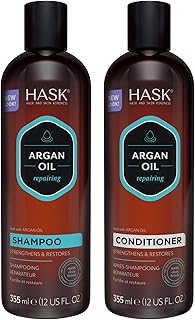
HASK Argan Oil Repairing is the richest drugstore option here and it knows exactly who it is for. On coarse, thick, curly or chemically damaged hair the weight of the formula is the point, and the change in manageability shows up within one or two washes rather than after a month.
The base is sulfate free and color safe, which means the richness is not immediately undone by an aggressive cleanser. That combination of gentle base and heavy conditioning is unusual at this price and is the main reason this set is worth attention.
The scent is strong and it lingers on hair rather than rinsing away, which people either love or find overwhelming. If you are sensitive to fragrance this is not the set for you, and neither is most of the drugstore end of this category.
The clearest failure mode is hair type. Used on fine or oily hair this will produce limp, greasy roots within a day. There is no dosing adjustment that fixes it: the formula is simply built for a different head of hair.
Bottom line: the best value for coarse and damaged hair specifically, and a poor choice for anything fine.
- Type: shampoo and conditioner set
- Base: sulfate free, color safe
- Best for: coarse, curly, thick and damaged hair
- Weight: rich, on the heavy side of the category
- Fragrance: strong and long lasting
- Size: sixteen ounce bottles
Buy this if your hair is thick, coarse, curly or heavily processed and your complaint is roughness rather than flatness. Avoid it entirely if your hair is fine, if your scalp runs oily, or if you are sensitive to fragrance.
Keep the conditioner off the scalp: on this formula, scalp application is the fastest route to greasy roots even on thick hair. If hair starts feeling coated after several weeks, alternate with a lighter shampoo rather than washing more often, which strips the ends while doing nothing for the buildup.

Pros
- Middle weight formula suits a wide range of hair types
- Sulfate free base
- Matched pair sold together
- Milder fragrance than most of the drugstore field
Cons
- Does not excel at any single hair type
- Low lather requires adjusting how much you use
ArtNaturals occupies the useful middle of this category. It is sulfate free like the sets aimed at colored hair, but it is not as rich as the repairing formulas, which makes it one of the few options here that works across normal, wavy and moderately dry hair without being obviously wrong for any of them.
The fragrance is noticeably lighter than the drugstore norm, which matters more than it sounds. Fragrance is the most common cause of scalp irritation after a product switch, and a milder scent profile makes this a safer trial for anyone who has reacted before.
As with every sulfate-free formula here, lather is low and the temptation is to use more. That wastes product without improving cleaning. Wet hair thoroughly, use a modest amount at the scalp, and give it time.
The honest criticism is that it does not win any category outright. If your hair is very damaged, HASK does more. If your hair is fine, OGX is lighter. If you want the best argan formula regardless of price, Moroccanoil is clearly ahead. ArtNaturals is what you buy when none of those extremes describe you.
Bottom line: the safe middle choice, and the best pick for a household where several people with different hair share one shower.
- Type: shampoo and conditioner set
- Base: sulfate free
- Weight: moderate, between light and rich
- Fragrance: milder than the drugstore average
- Best for: normal to moderately dry hair
- Size: sixteen ounce bottles
Choose this when you need one set that several people will use, or when you have reacted to fragrance in the past but still want a sulfate-free argan formula. If you know your hair sits at an extreme, fine and flat or coarse and damaged, buy the formula built for that extreme instead.
Because the formula is middle weight, dosing is where you tune it. On finer hair use less and keep the conditioner to the last few inches. On drier hair use the conditioner from the ears down and leave it a minute before rinsing.

Pros
- Generous bottle size, good value per ounce
- Formulated for dry and damaged hair
- Matched pair sold together
- Sulfate free base
Cons
- Large bottles are the wrong first purchase if you are unsure
- Rich formula weighs down fine hair
Luseta competes mainly on volume. The bottles are larger than the category standard, which makes the cost per wash attractive if you have long or thick hair and go through product quickly. For anyone finishing a standard bottle in six weeks, that is a genuine saving rather than a marketing point.
The formula is aimed at dry and damaged hair and behaves accordingly: rich, good slip, strong detangling on long hair. It is closer to the HASK end of this list than to the OGX end, and it should be bought with that in mind.
The size that makes it good value also makes it the wrong first purchase. Shampoo has a defined shelf life after opening, and a large bottle that takes you more than a year to finish can separate or lose its scent toward the end. Buy big only after you know a formula suits you.
Detangling is where it earns its keep day to day. On long hair the matched conditioner cuts brushing time noticeably, which is the practical difference most people actually feel.
Bottom line: buy this second, not first, and only if you have enough hair to finish it in good time.
- Type: shampoo and conditioner set
- Base: sulfate free
- Best for: dry, damaged, long or thick hair
- Size: larger than category standard
- Weight: rich
- Format: matched pair
This is for people with long or thick dry hair who already know an argan formula works for them and want to stop rebuying every six weeks. It is a poor first purchase, and a poor choice for fine hair at any volume.
Check the open-jar symbol on the bottle for the period after opening and be realistic about whether you will finish it in that window. Store the bottles out of direct sunlight and away from a hot shower rail, since heat and light shorten the useful life of an oil-rich formula.

Pros
- Added keratin fills a lifted cuticle and reduces porosity
- Sulfate free and safe for colored hair
- Matched pair formulated together
- Popular set with a long track record
Cons
- Protein-heavy formulas can leave hair stiff if used every wash
- Fragrance is on the stronger side
Botanic Hearth is the protein option in this group. Alongside argan oil it carries hydrolyzed keratin, which is small enough to sit in the gaps of a lifted cuticle and temporarily reduce porosity. On hair that feels rough and catches on a comb rather than merely feeling dry, that combination does more than oil alone.
The base is sulfate free, so the protein and oil are not stripped immediately by the cleanser. For bleached or heavily heat styled hair this is a sensible pairing and the improvement in how hair holds together is noticeable within a couple of washes.
Protein has a ceiling and this is where people get caught. Used at every wash on hair that is not badly damaged, keratin formulas make hair feel stiff and brittle rather than strong. If your hair feels rougher after two weeks, that is protein overload and the answer is alternating with a plain moisturising shampoo rather than using more.
The fragrance is stronger than the ArtNaturals set and comparable to the rest of the drugstore field, so sensitive scalps should approach with the same caution.
Bottom line: the right pick for porous, bleached or heat damaged hair, used two or three washes out of four rather than every time.
- Type: shampoo and conditioner set
- Base: sulfate free, paraben free
- Key additions: argan oil plus hydrolyzed keratin
- Best for: porous, bleached or heat damaged hair
- Fragrance: strong
- Size: sixteen ounce bottles
Buy this if your complaint is that hair catches, snags and feels rough rather than simply dry, which is the signature of high porosity. Do not use it as your only shampoo: alternate with a plain moisturising formula so the protein does not accumulate and stiffen the hair.
Watch for the stiffness that signals protein overload, most obvious as hair that feels strong but snaps rather than stretches. If that appears, stop the keratin formula for two weeks and use a moisturising shampoo and deep conditioner instead. Resume at a lower frequency afterwards.

Pros
- Simple formula without a long list of additions
- Matched pair sold together
- Reasonable price for a full set
- Suits normal to dry hair without being heavy
Cons
- Nothing in the formula stands out against stronger competition
- Argan oil sits mid panel rather than near the top
Majestic Pure is the plainest set here and there is a case for that. It does not load up on protein, it does not carry an unusual botanical list, and it does not try to be a repair treatment. It washes hair, it leaves a modest amount of conditioning behind, and it does so at a fair price for two full bottles.
Argan oil sits in the middle of the panel rather than near the top, which puts this closer to the everyday shampoo end of the category than the treatment end. For normal to moderately dry hair that is entirely appropriate and the lighter touch is an advantage.
The problem is competition. In this group OGX is lighter and cheaper, HASK is richer for damaged hair, and ArtNaturals occupies the middle with a milder scent. Majestic Pure does nothing wrong and nothing that clearly beats those three.
Where it makes sense is as a simple set for someone who wants argan oil without protein, without a heavy formula, and without paying salon prices. That is a real buyer, just not a large one.
Bottom line: competent and unexceptional, worth choosing if the simplicity of the formula is what you are after.
- Type: shampoo and conditioner set
- Base: sulfate free
- Key ingredient: argan oil, mid panel
- Best for: normal to moderately dry hair
- Additions: minimal, no heavy protein loading
- Size: sixteen ounce bottles
Choose this if you want a simple argan set with no protein and no heavy conditioning, particularly if keratin formulas have left your hair feeling stiff before. Look elsewhere if you want the strongest performer for damaged hair or the lightest option for fine hair.
Because the formula is light on additions, it responds well to being paired with a separate weekly treatment rather than doing everything itself. Use the set for routine washing and add a deep conditioning mask once a week if your ends need more than the conditioner provides.
How to Choose Shampoo With Argan Oil
Almost every buying mistake in this category comes from reading the front of the bottle instead of the back. The decisions below are ordered roughly by how much difference they make to what your hair feels like a week after you switch.
Where Argan Oil Sits on the Ingredient Panel

Ingredient lists are ordered by concentration down to one percent, after which a manufacturer can arrange things freely. Argania spinosa kernel oil appearing in the last third of a long panel means it is present at a trace level, which is enough to make the claim on the label and not enough to change how your hair behaves. Argan oil appearing in the first six or seven ingredients means the formula is genuinely built around it.
There is a legitimate middle ground. Some well formulated shampoos put argan oil in the middle of the panel and pair it with other conditioning agents that do overlapping work, and the result on hair is good even though the argan content is modest. The problem is that you cannot distinguish that from a token addition without reading what surrounds it, which is why the next few criteria matter as much as this one.
A practical shortcut: if the panel lists argan oil after the fragrance and the preservative, it is decoration. Fragrance is almost always used below one percent, so anything after it is present in a smaller amount than the perfume.
The Cleansing Agent Decides Everything Else
The surfactant is the first or second ingredient after water and it does the actual work. Sodium lauryl sulfate is the most aggressive of the common options and strips oil efficiently, which is why an argan shampoo built on it is working against itself. Sodium laureth sulfate is milder. Sulfate-free formulas typically use sodium cocoyl isethionate, cocamidopropyl betaine, decyl glucoside or a blend, and they clean more gently at the cost of less lather and slower removal of heavy silicone buildup.
Sulfate free is not automatically better. If you use heavy styling products, a gentle formula will leave residue that builds up over weeks until your hair feels coated and limp. The honest answer is that most people benefit from a gentle daily shampoo plus an occasional stronger wash rather than from choosing one extreme.
For color treated hair the calculus shifts firmly toward sulfate free. Sulfates accelerate dye loss, and the difference between a harsh and a gentle cleanser can be several weeks of color life. If you pay for color, this single decision is worth more than every other item on this list combined.
Silicones, and Why They Are Not the Enemy
Dimethicone and its relatives get blamed for a lot. What they actually do is coat the hair shaft and reduce friction, which makes hair feel smooth immediately and look shinier under light. That is a real benefit, not a trick, and for coarse or frizz-prone hair it is often the difference between manageable and not.
The complication is that heavier non-water-soluble silicones build up, and a sulfate-free shampoo may not remove them. That is how people end up with hair that felt wonderful for three weeks and then went flat and dull. If your shampoo is sulfate free and your conditioner is silicone heavy, you need a clarifying wash every few weeks to reset.
Look for lighter silicones ending in -conol or those prefixed with PEG, which are water dispersible and rinse out more readily. A formula pairing argan oil with a light silicone gives you both the conditioning and the immediate slip without the buildup problem.
Shampoo Alone or a Matched Set

Most of this category is sold as a shampoo and conditioner pair, and there is a real argument for that. The two products are formulated to work together, the conditioner usually carries a higher argan concentration than the shampoo does, and buying the set removes the guesswork of pairing a gentle cleanser with an appropriate conditioner.
The argument against is that most people use conditioner faster than shampoo, particularly on long hair, so a matched pair leaves you with a half-full shampoo bottle and no conditioner. Buying separately lets you buy each at the rate you actually use it.
If you are switching brands entirely, the set is the safer first purchase because it isolates the variable. If a set does not work you know the brand is wrong for your hair rather than wondering whether you paired it badly.
Match the Formula to Your Hair Type, Not to Your Hair Problem

Argan oil is a moderately heavy oil. On coarse, thick, curly or chemically damaged hair that weight is the point, and a rich argan formula makes hair feel dramatically better within one or two washes. On fine straight hair the same formula weighs the hair down, and the result is limp roots and a greasy feel by the second day.
Fine haired people are not excluded from this category, but they should look for a formula where argan oil is present in the middle of the panel rather than at the top, and where the conditioning agents are light. A shampoo marketed for volume or for daily use that also contains argan oil is usually the right shape of formula.
Scalp condition is a separate axis from hair condition and people routinely conflate them. An oily scalp with dry ends is extremely common, and the fix is a gentle shampoo used at the roots with the conditioning product concentrated from the mid-lengths down. No single bottle solves both ends of that problem at once.
Keratin, Biotin and the Other Additions
Hydrolyzed keratin, hydrolyzed wheat protein and similar additions are genuinely useful on damaged hair. They are small enough to sit in the gaps of a lifted cuticle and temporarily fill them, which reduces porosity and makes hair feel stronger. The effect is real and it is temporary, lasting until the next few washes remove it.
Biotin in a shampoo is a different story. Biotin deficiency can cause hair loss and oral biotin corrects it, but there is no good evidence that biotin applied to the outside of the hair shaft and rinsed off does anything. It is on the label because it is a word people recognise. Do not pay extra for it.
Protein has a ceiling. Used too often on hair that is not damaged, protein-heavy formulas make hair feel stiff and brittle rather than strong, which is usually described as protein overload. If your hair feels rougher after two weeks on a new keratin shampoo, that is what happened, and the fix is alternating with a plain moisturising wash.
Fragrance Load and Sensitive Scalps
Shampoo carries some of the heaviest fragrance loads in personal care because scent drives repeat purchase more reliably than performance does. For most people that is harmless. For anyone with a reactive scalp, seborrheic dermatitis or a fragrance allergy, it is the most likely single cause of itching and flaking after a product switch.
Fragrance-free and unscented are not the same claim. Unscented often means a masking fragrance was added to cover the raw smell of the base. Fragrance free means no fragrance ingredients at all. In this category truly fragrance-free options are rare, so if you are sensitive, look for formulas where fragrance sits at the very end of the panel.
Essential oils are fragrance. A formula scented with lavender or rosemary oil rather than synthetic fragrance is not automatically gentler, and several common essential oils are more sensitising than the synthetics they replace.
Bottle Size and What You Actually Use
Sixteen fluid ounces is the standard size in this category and it is genuinely a lot of shampoo. Someone with short hair washing three times a week will take the better part of a year to finish it. Someone with long thick hair washing daily will finish it in six to eight weeks.
That matters because shampoo does not last forever once opened. Preservative systems are designed for a defined shelf life, typically printed as a small open-jar symbol with a number of months. A bottle that takes you fourteen months to finish may separate or lose its scent toward the end, which is cosmetic rather than dangerous but is not what you paid for.
Salon sized bottles are the best value per ounce and the worst choice for trying something new. Buy the standard size first and scale up only after a couple of months of using it happily.
How to Judge It in the First Two Weeks
A new shampoo needs about three washes before the verdict is fair. The first wash often feels unusually good or unusually bad because it is removing or leaving residue from the previous product, and that transition is not representative of anything.
The signal to watch is how your hair feels on day two, not on the day you wash it. Almost everything feels acceptable straight out of the shower. If roots are greasy by the second morning on a formula that was fine before, the new shampoo is too rich for your hair. If ends feel straw-like by day two, it is too stripping.
Keep one variable fixed while you test. Changing shampoo, conditioner and a leave-in product in the same week tells you nothing about which one is responsible for whatever happens next.
Value Across a Long Bottle
Salon formulas are more concentrated than drugstore ones as a rule, which means a smaller dose does the same job. A bottle that costs three times as much but needs a third of the amount per wash is not actually three times more expensive to use, and people routinely misjudge this by comparing bottle prices rather than cost per wash.
The counterweight is that a concentrated formula used at drugstore dosing is wasteful and can leave residue. If you switch up in concentration, use less than feels right and add only if the lather does not develop.
Sets skew the math too. A shampoo and conditioner pair sold together is usually better value than either bought alone, but only if you use them at roughly the same rate. On long hair you rarely do.
| Hair situation | What to look for | What to avoid |
|---|---|---|
| Color treated | Sulfate free base, argan high in the panel | Sodium lauryl sulfate |
| Fine and straight | Light conditioning agents, argan mid panel | Rich oil-forward formulas |
| Coarse, curly or damaged | Argan in the top ingredients, added keratin | Clarifying and volumising formulas |
| Oily scalp, dry ends | Gentle shampoo, conditioner from mid-length down | One rich product used everywhere |
| Sensitive scalp | Fragrance at the end of the panel | Heavy essential oil scenting |
Why You Should Trust Us
We build these lists from published formulation detail and from the pattern of what long-term users report, not from brand claims. For each product here we looked at the primary cleansing agent, where argania spinosa kernel oil falls in the ingredient order, what conditioning agents and proteins sit alongside it, and whether the product is sold alone or as a matched pair.
We set aside duplicate listings that differ only in bottle size or pack count, so every entry below is a genuinely different formula. Where a product is well reviewed but the panel shows argan oil at a trace level, we say so plainly rather than letting the label speak for it.
Final Thoughts
Best overall is Moroccanoil Hydrating Shampoo. It is the formula in this group that most clearly builds around argan oil rather than adding it, and it pairs that with a gentle base that will not undo the conditioning it delivers. It is sold as a shampoo alone, which suits anyone who works through conditioner faster than shampoo.
Best value is OGX Renewing Argan Oil of Morocco Shampoo. It is widely available, it delivers noticeable slip and shine on the first wash, and it costs a fraction of the salon options. It leans on lighter conditioning agents rather than a high argan load, so treat it as a good everyday shampoo with argan in it rather than as a treatment.
For specific cases, Herbal Essences Argan Oil Repair is the easiest set to find on a shelf when you run out mid-week, HASK Argan Oil Repairing is the pick for coarse and chemically treated hair that wants weight, and Botanic Hearth is the one to choose if you specifically want a sulfate-free set with keratin alongside the argan. Fine haired readers should start at the lighter end of this list rather than the richest. More picks are indexed in our article archive and across the category index.
Shampoo With Argan Oil FAQs
Does shampoo with argan oil actually repair damaged hair?
Not in the structural sense. Hair is not living tissue and split ends cannot be rejoined by anything you rinse out. What argan oil and the hydrolyzed proteins alongside it do is temporarily fill gaps in a lifted cuticle, which reduces porosity, cuts friction and makes hair feel and look considerably better. The effect is genuine and it washes out, which is why the improvement holds only while you keep using it.
Should I choose sulfate free?
If your hair is colored, yes: sulfates strip dye and sulfate-free formulas can add weeks of color life. If you use a lot of styling product or heavy silicone conditioner, a fully sulfate-free routine will let residue build up, and you will want a stronger clarifying wash every few weeks. For most other people either works, and the gentler option is the safer default.
Will argan oil make fine hair greasy?
A rich argan-forward formula often will. Argan is a moderately heavy oil, and on fine straight hair the weight shows as limp roots by the second day. Fine haired readers should look for formulas where argan sits in the middle of the ingredient panel alongside light conditioning agents, and should keep conditioner well away from the roots.
How long before I can tell if it works?
Give it three washes. The first wash is distorted by whatever the previous product left behind, so it tells you very little. Judge by how your hair feels on the second day after washing rather than straight out of the shower, and change only one product at a time or you will not know what caused the result.
Is a shampoo and conditioner set better value in 2026?
Usually yes per ounce, and a matched pair removes the guesswork of combining a gentle cleanser with a suitable conditioner. The catch is consumption rate: most people with long hair finish conditioner well before shampoo, so a set leaves a half-used bottle behind. If that is you, buy the shampoo alone and pick a conditioner in the size you actually get through.






Write Your Review
No reviews yet. Be the first to share your experience!