

The difference between a wire cutter and a heavy duty wire cutter is not the word on the handle, it is what happens when the jaws meet a piece of hardened steel wire, a stranded copper cable or a nail. A light craft cutter chips its edge or simply stops. A properly built pair, with induction-hardened cutting edges, a high-leverage pivot and handles long enough to use your whole hand, goes through and comes back for more. Shopping for heavy duty wire cutters therefore means matching the jaw style and the leverage to the material you cut most: diagonal pliers for electrical and general work, compound-action or bolt-cutter jaws for hard wire, and dedicated cable shears for thick copper and aluminum. For October 2026 we gathered 8 of the highest rated options on Amazon from Klein Tools, IRWIN, Crescent and more, then sorted them by what they are built to cut.
Our top pick is the Klein Tools D248-9ST Ironworker’s Diagonal Cutting Pliers for its high-leverage design, its hardened edges made to cut hard wire and rebar tie wire, and the fact that it is a full-size tool built in the USA for daily trade use. Below it sit a compact bolt cutter for hard wire, IRWIN and Crescent diagonal pliers, Klein’s dedicated cable cutter and linesman pliers, and a budget WORKPRO pair that covers general household jobs. Every pick is rated at least 4.0 stars by real Amazon customers, and our tools and home improvement guides cover the rest of the bag.

Pros
- High-leverage design multiplies hand force on hard wire
- Hardened cutting edges built for ironwork and rebar tie wire
- Full 9 inch trade length
- Made in USA with Klein's hand tool warranty
Cons
- Too long for tight boxes
- Heavier than a 6 inch pair
- Overkill for occasional household use
The Klein Tools D248-9ST is the diagonal plier built for people who cut hard wire all day. The high-leverage design places the pivot to multiply hand force, so rebar tie wire, hard steel wire and nails that stall a standard plier go through with the same squeeze, and the hardened edges are made to keep doing it.
At 9 inches it is a trade-length tool for the belt rather than the pocket, with cushioned grips for repeated cutting, and it is made in the USA and covered by Klein's hand tool warranty. It doubles as a general cutter for copper, aluminum and screws.
The costs are size and weight in a tight box, and more tool than a household needs for the odd cable tie. For daily heavy work, that is the point.
Bottom line: the heavy duty diagonal plier to buy once and use for years.
- Type: high-leverage diagonal cutting pliers
- Length: 9 inches
- Cuts: hard wire, rebar tie wire, copper, aluminum, screws
- Edges: hardened cutting edges
- Origin: made in USA
- Model: D248-9ST
Ironworkers, electricians and serious DIYers who cut hard wire regularly. Not for someone who mostly trims leads in a small enclosure.
Wear eye protection when cutting hard wire, since cut ends fly. Keep the jaws closed in storage, oil the pivot occasionally, and do not use the grips as electrical insulation unless a tool is rated for it.

Pros
- Compound leverage cuts hard wire a diagonal plier cannot
- Spring return opens the jaws for one-handed work
- Compact 8 inch size for a toolbox
- Soft anti-slip handles
Cons
- Not for fine electrical trimming
- Short jaws limit reach
- Not a full-size bolt cutter for large padlocks
The WORKPRO Mini Bolt Cutter is the tool for the material that blunts diagonal pliers: hard wire, chain link, small chain and similar. Compound leverage in an 8 inch tool gives cutting force well beyond a plier of the same length, and the spring return opens the jaws after each cut so it works one-handed.
It is compact enough for a toolbox and comfortable to grip, and it is not a substitute for a diagonal plier on fine wire, where its short thick jaws are clumsy, or for a full-size bolt cutter on large shackles.
Bottom line: the compact answer for hard wire and chain, and a sensible second cutter next to a diagonal plier.
- Type: mini bolt cutter
- Length: 8 inches
- Cuts: hard wire, cable, chain link, small chain
- Handles: soft anti-slip, spring loaded
Fencing, garden and shop users who meet hard wire and chain. Not for electricians trimming conductors.
Cut hardened material only within the rated capacity, wear eye protection, and keep the jaws closed and lightly oiled between uses.

Pros
- 8 inch length gives real leverage for wire and nails
- Nickel chromium steel with hardened edges
- Comfortable ProTouch grips
- Trusted trade brand and warranty
Cons
- Not a bolt cutter for hardened wire
- Bulkier than the 6 inch version
- No spring return
The IRWIN VISE-GRIP 8 inch Diagonal Cutting Pliers is the all-round shop pair: enough length for leverage on wire and nails, nickel chromium steel with hardened edges that stay sharp, and grips comfortable enough for a full day. It is the size to own if you own one diagonal plier.
It will not do a bolt cutter's job on hardened wire, and it is bulkier than the 6 inch pair in a tight box, but for the wide middle of cutting work it is hard to fault.
Bottom line: the dependable 8 inch diagonal for shop and site.
- Type: diagonal cutting pliers
- Length: 8 inches
- Steel: nickel chromium, hardened cutting edges
- Grips: ProTouch cushion
- Model: 2078308
Anyone wanting one heavy duty diagonal plier for general work. Pair it with a 6 inch for reach if you work in panels.
Keep within the tool's wire capacity, protect the edges in storage, and wear eye protection when cutting.

Pros
- Compound action cuts hard wire with less hand force
- Dual-material grips for long sessions
- 8 inch general size
- Trade brand backing
Cons
- Compound linkage adds a little bulk
- Slightly slower jaw travel than a simple plier
- Overkill for light wire
The Crescent 8 inch Pro Series Compound Action Diagonal Cutting Pliers add a second pivot to the classic diagonal, multiplying leverage so hard wire and nails cut with noticeably less hand force than a standard plier of the same length. That makes it the choice for anyone with hand fatigue or a lot of hard cutting.
The linkage adds a little bulk and the jaws travel a touch slower, and it is more tool than light wire needs, but the dual-material grips and the extra force pay for themselves on hard material.
Bottom line: the diagonal plier for hard wire when you want leverage without going to a bolt cutter.
- Type: compound-action diagonal cutting pliers
- Length: 8 inches
- Grips: dual material
- Model: PS5429C
People who cut hard wire often or want less effort per cut. Not needed for occasional soft wire.
Keep the compound linkage clean and lightly oiled, wear eye protection, and stay within the rated wire capacity.

Pros
- Shear jaws leave a clean round end for lugs and terminations
- Rated for aluminum, copper and communications cable
- One-handed cutting of thick cable
- Made in USA
Cons
- Not for steel wire, nails or hard wire
- Single-purpose tool
- Larger than a diagonal plier
The Klein Tools 63050 Cable Cutter is the tool for the cut a diagonal plier ruins: thick stranded copper or aluminum cable that a pinching jaw crushes and splays. Its curved shear jaws slice cleanly, leaving a round end that seats properly in a lug, and it does it one-handed.
It is rated for aluminum, copper and communications cable and it is not for steel wire, nails or hard wire, which would damage the shear edge. That single-purpose design is exactly why electricians own one alongside their diagonals.
Bottom line: the right tool for thick conductor cable, and the wrong one for everything else.
- Type: shear-jaw cable cutter
- Cuts: aluminum, copper, communications cable
- Not for: steel wire, nails, hard wire
- Origin: made in USA
- Model: 63050
Electricians and anyone terminating thick cable. Not a general wire cutter.
Cut only conductor cable within the rated size, keep the shear edges clean, and never use it on steel or hard wire.

Pros
- Grips, twists and cuts in one tool
- High-leverage side cutter behind the jaws
- Trade-standard 9 inch length
- Made in USA
Cons
- Heavier and bulkier than a diagonal plier
- Cannot reach into tight boxes
- More tool than a pure cutter needs
The Klein Tools D213-9NE is the linesman plier that electricians reach for more than any other tool: flat gripping jaws at the tip, a knurled section for pulling and twisting conductors, and a high-leverage side cutter behind them for copper, aluminum and screws. For panel and rough-in work it replaces a diagonal plier and a pair of pliers at once.
It is heavier and bulkier than a diagonal, and it cannot get into a small box the way a 6 inch cutter can, so it suits people who grip and twist as well as cut.
Bottom line: the heavy duty cutter for anyone who does electrical work rather than only cutting.
- Type: linesman pliers with side cutters
- Length: 9 inches
- Cuts: copper, aluminum, screws and similar
- Origin: made in USA
- Model: D213-9NE
Electricians and DIYers doing wiring work. Not for someone who only needs to cut.
Not insulated unless marked; do not work live. Keep the pivot oiled and the cutting edges closed in storage.

Pros
- CRV steel at a budget price
- Compact 6 inch size for tight spots
- Comfort grip handle
- Covers household and craft cutting
Cons
- Not a trade tool for hard wire all day
- Less leverage than 8 inch tools
- Edges not rated like the trade brands
The WORKPRO 6 inch Wire Cutters are the value pick because they cover the cutting most households actually do, wiring repairs, cable ties, picture wire and craft, in chrome vanadium steel with a comfortable grip, at a price that makes owning a proper cutter easy.
They are a general-purpose tool rather than a trade cutter: less leverage than an 8 inch pair and edges that are not rated the way Klein or IRWIN rate theirs, so hard wire is not their job. For everything else in a home toolbox they are fine.
Bottom line: the sensible cheap pair for the kitchen drawer or the first toolbox.
- Type: diagonal wire cutters
- Length: 6 inches
- Steel: CRV
- Handle: comfort grip
Households and hobbyists. Not for daily hard-wire work.
Keep to household wire and soft materials, store closed, and wear eye protection when cutting springy wire.

Pros
- Compact enough for boxes and panels
- Hardened edges from a trade brand
- Comfortable ProTouch grips
- Large owner base
Cons
- Less leverage than the 8 inch version
- Not for hard wire or nails
- Small for large hands
The IRWIN Vise-Grip 6 inch Diagonal Cutting Pliers are the trade-quality compact pair: hardened edges and comfortable grips in a size that reaches into boxes and panels and trims leads precisely. It is the tool many electricians keep in a pocket next to a bigger cutter.
The size costs leverage, so it is not the pair for hard wire or nails, and it is small in a large hand. Used for what it is, reach and precision, it is excellent.
Bottom line: the compact half of a two-cutter setup.
- Type: diagonal cutting pliers
- Length: 6 inches
- Edges: hardened
- Grips: ProTouch
- Model: 2078306
People working in tight enclosures who already own a larger cutter. Not a first pair for heavy work.
Keep to soft and medium wire, protect the edges in storage, and oil the pivot occasionally.
How to Choose the Right Heavy Duty Wire Cutters
Diagonal Pliers, Bolt Cutters and Cable Shears Are Three Different Tools
Most of what gets sold as heavy duty wire cutters is a diagonal cutting plier: two angled jaws that pinch and shear the wire, in a 6 to 9 inch tool you use one-handed. The IRWIN Vise-Grip diagonals, the Klein D248-9ST, the Crescent Pro Series and the WORKPRO 6 inch pair are all this type, and it is the right default for electrical wire, cable ties, nails and general fastening.
A mini bolt cutter, like the WORKPRO 8 inch, uses compound leverage and short, thick jaws to cut hard wire, chain link and small padlock shackles that would blunt a diagonal plier. A cable cutter, like the Klein 63050, has curved shear-style jaws that slice cleanly through thick stranded copper and aluminum cable without crushing it, which matters when the cut end has to go into a lug. Buy the type that matches your most common cut; owning two of the three is normal for anyone who works with wire.
Leverage: Why Handle Length and Pivot Position Beat Muscle

Cutting force at the jaws is your grip multiplied by the leverage ratio, and that ratio is set by how far the pivot sits from the handle ends and how close the cutting edge is to the pivot. High-leverage diagonals like the Klein D248-9ST place the pivot to multiply hand force, so a hard wire that stalls a standard plier goes through with the same squeeze. Compound-action tools like the Crescent Pro Series add a second pivot to multiply again.
Longer handles help for the same reason: an 8 or 9 inch tool gives more leverage than a 6 inch one and lets you use the whole hand instead of the fingers. The trade-off is reach into tight spaces, where a 6 inch pair wins. If you cut hard material regularly, choose leverage over compactness; if you mostly trim wire in boxes and panels, the 6 inch tool earns its place.
Steel and Hardened Edges: The Detail That Decides Longevity
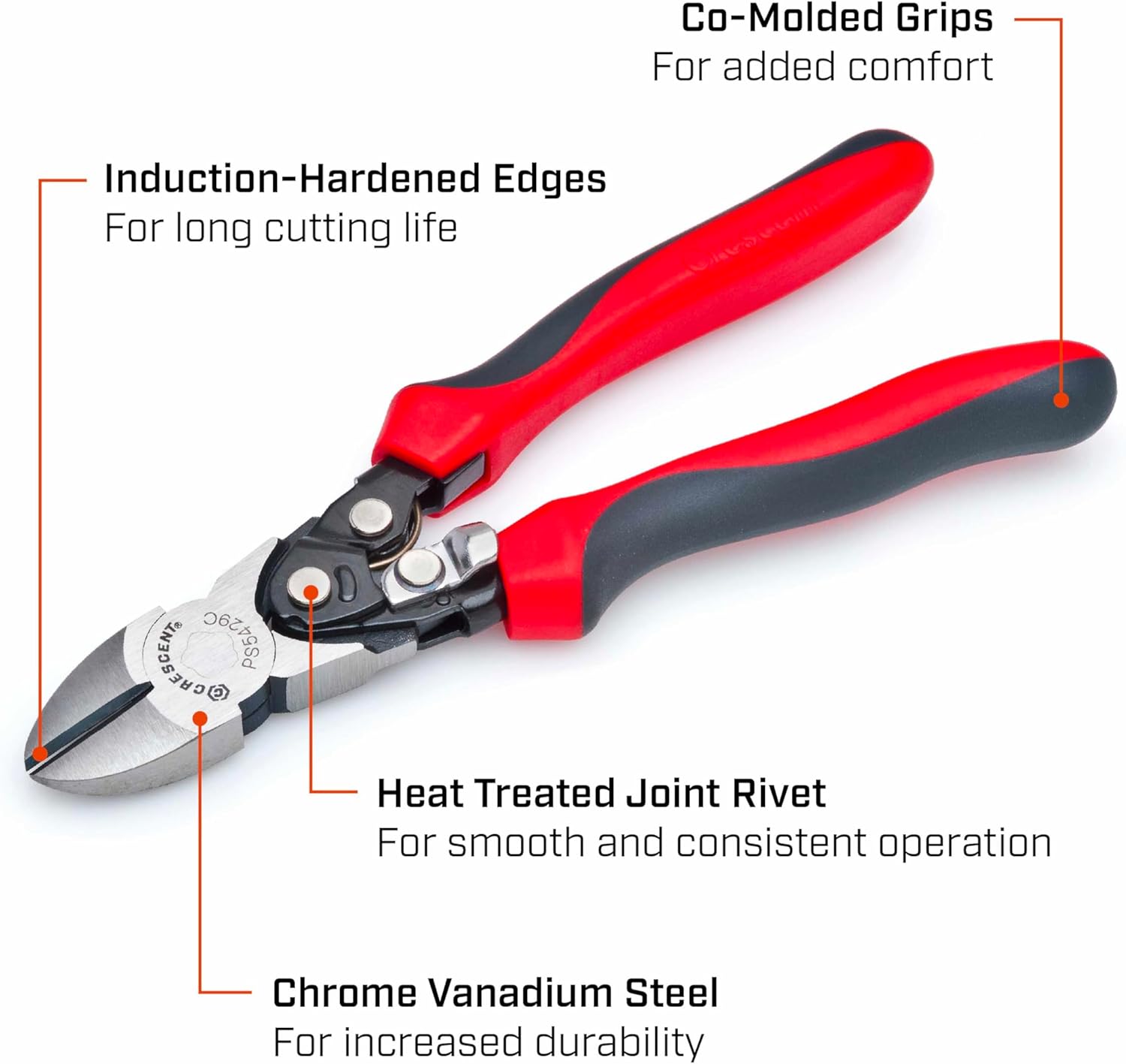
The blade edge on a serious cutter is induction hardened, a process that heat-treats just the cutting edge to a higher hardness than the body, so it stays sharp through hard wire while the rest of the tool keeps some toughness against shock. Klein, IRWIN and Crescent all specify hardened cutting edges on their trade tools; the IRWIN diagonals list nickel chromium steel, and WORKPRO lists CRV, chrome vanadium, for its 6 inch pair.
What that means in practice: a hardened-edge diagonal plier will cut soft steel nails and hard wire without chipping, while a bargain tool with unhardened edges develops a notch the first time it meets a staple. If a listing does not mention hardened or induction-hardened edges, assume it is a light-duty tool regardless of what the title says.
Match the Jaw to the Material: Copper, Aluminum, Steel and Hard Wire
Soft copper and aluminum conductors cut cleanly with any decent diagonal plier, but thick stranded cable crushes and splays under diagonal jaws. That is where the Klein 63050 cable cutter earns its place, shearing aluminum, copper and communications cable to a clean round end. Steel wire, nails and screws want the high-leverage diagonals from Klein, IRWIN and Crescent, whose hardened edges are rated for it.
Hard wire, piano wire, chain link and small chain are the bolt cutter’s job, and the WORKPRO mini bolt cutter is built for exactly that at 8 inches. Trying to cut hardened wire with a diagonal plier is how edges get notched, and trying to cut fine electrical wire with a bolt cutter is how insulation gets mangled. The article’s picks are arranged so there is a right tool for each.
| Tool | Type and size | Built to cut | Notable feature |
|---|---|---|---|
| Klein Tools D248-9ST | High-leverage diagonal, 9 in | Hard wire, rebar tie wire, general | Ironworker design, made in USA |
| WORKPRO Mini Bolt Cutter | Compact bolt cutter, 8 in | Hard wire, chain link, small chain | Spring loaded, soft grip |
| IRWIN Vise-Grip Diagonal, 8 in | Diagonal pliers, 8 in | Wire, nails, general | Nickel chromium steel |
| Crescent Pro Series Compound, 8 in | Compound-action diagonal, 8 in | Hard wire with less effort | Dual-material grips |
| Klein Tools 63050 Cable Cutter | Shear-jaw cable cutter | Aluminum, copper, comms cable | Clean round cuts, made in USA |
| Klein Tools D213-9NE Linesman | Linesman pliers, 9 in | Copper, aluminum, screws | Grips, twists and cuts |
| WORKPRO 6 in Wire Cutters | Diagonal pliers, 6 in | Household wire and craft | CRV steel, comfort grip |
| IRWIN Vise-Grip Diagonal, 6 in | Diagonal pliers, 6 in | Wire in tight spaces | Compact trade tool |
Linesman Pliers: The Cutter That Also Grips and Twists
The Klein D213-9NE is a linesman plier: a 9 inch tool with flat gripping jaws at the tip, a knurled section for pulling and twisting, and a high-leverage side cutter behind them. Electricians reach for it more than any other tool because it twists conductors, pulls fish tape and cuts screws and wire without switching tools.
It is heavier and bulkier than a diagonal plier and cannot reach into a tight box the way a 6 inch pair can, but for anyone doing panel or rough-in work, it replaces two tools. If you only ever cut, buy the diagonal; if you also grip and twist, the linesman is the more useful heavy duty cutter.
Handles, Grip and Working All Day

Dipped or molded handles matter more on a cutter than on most hand tools, because you squeeze hard and often. Cushion grips like those on the Klein, IRWIN and Crescent tools spread the load; the WORKPRO 6 inch and mini bolt cutter add comfort grips and, on the bolt cutter, a spring return that opens the jaws for you.
Do not treat a dipped grip as electrical insulation unless the tool is explicitly rated and marked for it; the grips here are for comfort. If you work on live circuits, buy insulated tools rated for that. And check for a spring or lock if you use the cutter one-handed all day, since it saves the hand that opens the jaws a thousand times.
Size: 6, 8 or 9 Inches and What Each Is For
The 6 inch tools, the IRWIN Vise-Grip 6 inch and the WORKPRO 6 inch, are the reach-into-the-box size, light enough for a pocket and precise enough for trimming leads. The 8 inch tools, the IRWIN 8 inch and the Crescent 8 inch compound, add leverage for hard wire and nails and are the general shop size. The 9 inch Klein diagonals and linesman are trade-length tools built for the belt and the daily grind.
If you own one pair, an 8 inch diagonal is the compromise. If you own two, a 6 inch for reach and a 9 inch or compound for force covers almost everything, with a bolt cutter or cable shear added when the work demands it.
Flush Cut, Bevel Cut and Why Craft Cutters Are Not in This List
Craft and jewelry cutters advertise flush cutting, an edge ground on one side so it leaves a flat end on soft wire and cable ties. They are precise and pleasant, and they are not heavy duty; the same geometry that gives a flush cut leaves the edge thin, and it chips on hard steel. Several high-volume listings for wire cutters are this type, and we left them out on purpose.
Heavy duty diagonals use a beveled edge that supports the cutting tip, which is why they survive nails and hard wire. If you need a perfectly flush end on soft wire, own a small flush cutter for that job and keep the heavy duty pair for everything else. Trying to make one tool do both is how both jobs end up done badly.
Made in USA, Warranty and What Trade Brands Promise
Klein’s D248-9ST, 63050 and D213-9NE are made in the USA, and Klein, IRWIN and Crescent all stand behind their hand tools with long warranties for defects. That matters on a cutter more than on many tools because the failure mode, a chipped edge, is obvious and cheap for a brand to replace, and reputable brands do.
WORKPRO tools are the value tier here: well reviewed, comfortable, and honest about being general-purpose rather than trade tools. That is a fair place to start for household use. For daily work, the trade brands cost more once and last for years.
Care: Keep the Edges Sharp and the Pivot Free
A cutter lives or dies at the edge and the pivot. Keep the jaws closed when stored so the edges are protected, wipe them after cutting anything corrosive, and put a drop of light oil on the pivot now and then so the tool opens freely. Do not use a diagonal plier as a hammer or pry bar, which is how pivots loosen.
When an edge finally chips, retire the tool from hard wire; it will still cut soft copper for years. And keep the right cutter for the right material, which is the whole theme of this guide. For the tools that sit next to these in the bag, our guides to the best digital multimeters and the best drywall utility knives are the natural next reads.
Why You Should Trust Us
We built this shortlist from the highest rated heavy duty wire cutters, diagonal pliers, bolt cutters and cable cutters on Amazon, then read the specifications and the pattern of owner feedback for each, focusing on jaw type, leverage design, steel and hardening claims, size and warranty. We do not claim to have cut wire with every tool; the comparisons come from published specifications and real owner reports.
Ratings shown on the cards are pulled from Amazon and update over time. We do not print prices because they change, and we do not accept payment for placement.
Final Thoughts
The best overall pick is the Klein Tools D248-9ST Ironworker’s Diagonal Cutting Pliers. High leverage, hardened edges rated for hard wire, a full 9 inch trade length and USA manufacture make it the diagonal plier that does the heavy work a lighter tool cannot.
The best value is the WORKPRO 6 inch Wire Cutters in CRV steel, a comfortable general-purpose pair for household wiring and craft that costs little and cuts cleanly. Around those two, choose by material: the WORKPRO mini bolt cutter for hard wire and chain, the Klein 63050 for thick cable, the Klein linesman if you also grip and twist, and the IRWIN and Crescent diagonals as excellent 8 inch all-rounders. For the other half of most wiring jobs, our guide to the best computer repair tool kits covers the small end of the toolbox.
Frequently Asked Questions About Heavy Duty Wire Cutters
What are the best heavy duty wire cutters in 2026?
For general heavy work, a high-leverage diagonal plier with hardened edges like the Klein Tools D248-9ST. For hard wire and chain, a compact bolt cutter; for thick stranded cable, a dedicated cable cutter like the Klein 63050.
Can heavy duty wire cutters cut steel wire?
Diagonal pliers with induction-hardened edges are rated for soft steel wire and nails, and high-leverage designs handle harder wire. Hardened or piano wire and chain link belong to a bolt cutter, which uses compound leverage and thick jaws for exactly that.
What is the difference between diagonal cutters and linesman pliers?
Diagonal cutters only cut. Linesman pliers like the Klein D213-9NE add flat gripping jaws and a knurled section for pulling and twisting conductors, with a side cutter behind them, so they replace two tools for electrical work.
Should I buy 6 inch or 8 inch heavy duty wire cutters?
Six inch tools reach into boxes and panels and suit trimming; eight and nine inch tools give the leverage for hard wire and nails. If you own one pair, 8 inches is the compromise; many people keep a 6 inch for reach and a larger pair for force.
Are the dipped handles on wire cutters insulated?
Not unless the tool is explicitly rated and marked as insulated. The cushion grips on the tools here are for comfort. For live electrical work, buy insulated-rated tools, and see our guide to the best split ring pliers if the job is fishing tackle rather than wiring.
Write Your Review
No reviews yet. Be the first to share your experience!