

A sprayer is the cheapest tool in the shed that decides whether a herbicide works, a fungicide sticks, or a liquid fertilizer burns a stripe across the lawn. Choosing one sounds trivial until you realize the tank is only half the decision: seals, nozzle, wand length and how the pressure behaves at the bottom of the tank matter more than the number printed on the side. For this shortlist of 6 lawn and garden sprayer picks we pulled models from CHAPIN, Roundup, PetraTools and more that are still selling in volume in October 2026, then sorted them by the job they actually do rather than by price.
Our top pick is the Chapin 2-Gallon Pump Sprayer for its chemical-resistant seals, wide-mouth tank that rinses clean, and the fact that it ships as a pair so you can keep one tank for weed killer and one for everything else. If you are working a bigger property, skip ahead to the battery backpack section. If you have never bought a sprayer before, the buying guide below explains the one rule that saves more plants than any other: never mix jobs in the same tank. You can browse the rest of our outdoor gear coverage in the Patio, Lawn and Garden section.

Pros
- Ships as two identical tanks, which solves cross-contamination without extra cost
- One nozzle twists from a stream to a fine mist, so there is nothing to swap
- 12 inch wand on a 34 inch hose reaches under shrubs without bending
- Wide funnel top and see-through poly tank make filling and rinsing easy
- Wand clips to the pump handle for storage
Cons
- Pressure falls as the tank empties, so you re-pump several times per fill
- Plastic nozzle scores over time and eventually sprays unevenly
This is the plain, unglamorous tank sprayer that most homeowners should own, and the reason it leads this list has nothing to do with features. It is sold as a matched pair. The single most damaging mistake in home spraying is running fertilizer through a wand that previously carried glyphosate, and no amount of rinsing fully removes that risk. Two tanks removes it structurally.
The details Chapin publishes are the right ones. A 12 inch wand on a 34 inch hose is enough reach to stand upright over a bed, a wide funnel top makes filling and rinsing straightforward, the poly tank is see-through so you can read the level, and one nozzle twists from a stream to a fine mist rather than asking you to carry spares. Chapin lists it for weed killers, pesticides, fertilizers and household cleaners, with the usual instruction to follow each chemical manufacturer's guidelines.
The weaknesses are the weaknesses of every manual pump sprayer. Pressure comes from air compressed above the liquid, so the spray pattern narrows as the tank drains and you stop to re-pump three or four times per fill. The stock plastic nozzle is fine at first and gradually loses its clean fan as grit scores the orifice; a brass replacement fixes that for very little money.
Bottom line: if you only buy one sprayer for a suburban yard, buy this two-pack, label one tank WEEDS in permanent marker, and never let them swap jobs.
- Type: manual pump tank sprayer, model 20024
- Capacity: 2 gallons (7.6 litres) per tank
- Quantity: 2 sprayers per purchase
- Wand: 12 inches
- Hose: 34 inches
- Nozzle: single twist nozzle, stream to mist
- Fill: wide-mouth funnel top, see-through poly tank
- Listed uses: weed killers, pesticides, fertilizers, household cleaners
Rinse the tank and run clean water through the wand until it comes out clear after every use. Release pressure before opening the lid; a pressurized tank can spit concentrate upward when the cap breaks its seal.
Store with the lid loose so the gasket is not permanently compressed, and drain the pump cylinder fully before freezing weather. Water trapped in the cylinder is the most common cause of a dead pump after winter.
Homeowners with a lot up to about a quarter acre who apply weed control and liquid feed a handful of times per season. The two-tank format is most valuable to anyone growing vegetables or ornamentals near an area that gets treated with herbicide.
Less suitable for anyone spraying for hours at a stretch; the shoulder strap and repeated pumping become tiring well before a battery backpack does.

Pros
- Designed around herbicide and insecticide use from the start
- Pressure-relief valve makes opening the tank safer
- Adjustable nozzle covers stream and fan patterns
- Comfortable pump stroke for a 2-gallon tank
- Also handles deck and siding cleaning solutions
Cons
- Single tank, so cross-contamination is on you to manage
- In-line filter clogs if you skip straining homemade mixes
Where the Chapin two-pack is a general-purpose tank, this one is aimed squarely at the job most people buy a sprayer for: killing weeds along a fence line, in driveway cracks and around beds. The nozzle adjusts from a narrow stream that throws a useful distance to a fan for even coverage, which is the range you want for spot work.
The pressure-relief valve is the detail worth calling out. It lets you vent the tank before unscrewing the lid, which prevents the small eruption of concentrate that happens when you open a pressurized tank in a hurry. It sounds minor until it happens to you once.
The limitation is that this is a single tank. If you also want to apply liquid fertilizer, you are either buying a second sprayer or accepting real risk to your plants. Treat this one as your dedicated herbicide tank and the decision gets easy.
Bottom line: the right pick if you already own a general sprayer and want a second unit reserved for weed control.
- Type: manual pump tank sprayer
- Capacity: 2 gallons
- Nozzle: adjustable, stream to fan
- Safety: pressure-relief valve
- Intended use: weed control, insect control, deck and siding cleaning
- Carry: shoulder strap
Mix concentrate at the label rate in a separate container, then pour through the tank opening rather than mixing in the tank; you get a more even solution and you can strain out lumps.
Spray on a still day. A fan pattern at low wind lands where you point it; the same pattern in a breeze drifts onto whatever is downwind, which for herbicide means damage you will not see for a week.
Vent the pressure using the relief valve before opening. Rinse three times with clean water, running some through the wand each time, and dispose of rinse water on the same area you treated rather than down a storm drain.
Mark this tank clearly. A sprayer that has held glyphosate should never be used for anything else, regardless of how well it was rinsed.

Pros
- Constant pressure without pumping, carried on a padded shoulder sling
- Published spray range beyond 20 feet means far less bending
- Ships with a flat fan and an adjustable brass nozzle
- Two-hour published runtime is ample for a suburban session
- Lighter to carry than any backpack option here
Cons
- Two gallons means refills on larger properties
- A sling puts the load on one shoulder rather than across both
This is the sprayer for people who want the pressure consistency of a battery unit without carrying four gallons on their back. It is a sling sprayer rather than a backpack: a padded strap over one shoulder, an easy-carry handle, and a body light enough to move around a bed without planning the route.
The feature that earns its keep is reach. PetraTools publishes a spray range beyond 20 feet, which is the practical answer to the same problem a long wand solves, and it means a driveway edge or a fence line gets treated from where you are standing. The two included nozzles cover the useful range: a flat fan for even bands and an adjustable brass nozzle, brass being the material that resists clogging and can be stripped and cleaned.
The published 2-hour runtime is shorter than the 4-gallon backpack units, which is expected given the smaller battery, but two hours of intermittent spraying is more than most homeowners do in a session. The real constraint is tank size, not charge, and a sling loads one shoulder rather than two.
Bottom line: the most comfortable option here for typical suburban work, provided you accept a refill on anything larger than a quarter acre.
- Type: battery powered sling sprayer
- Capacity: 2 gallons
- Runtime: 2 hours per charge as published by the manufacturer
- Spray range: beyond 20 feet as published
- Nozzles: flat fan plus adjustable brass, both included
- Carry: padded shoulder sling and carry handle
- Listed uses: lawn and garden, weed killers and herbicides, pest control, fertilizer application
Anyone with wrist, shoulder or grip limitations who still wants to do their own spraying. Removing the pumping motion removes the part of the job that causes most of the strain, and the sling carries the weight rather than your arm.
Also a strong pick for frequent small applications, such as weekly foliar feeding of container plants, where getting a manual tank up to pressure each time is disproportionate to the amount actually sprayed.
Run clean water through the pump, hose and both nozzles after each use. The brass nozzle can be unscrewed and cleaned properly, which is the main reason to use it for anything that leaves residue.
Do not store the battery fully discharged over winter. Top it up before putting the unit away and check it once mid-season.

Pros
- Four gallons of capacity with no battery to manage
- Lever pump can usually be switched to either side
- Simple mechanism with replaceable seals
- Costs less than comparable battery backpacks
- Works after months of storage without charging
Cons
- You pump continuously with one hand while spraying with the other
- Pressure still varies with how hard and often you pump
Battery backpacks get the attention, but a manual backpack still makes sense in two situations: when the sprayer will sit unused for long stretches, and when you want a tool that can be repaired with a seal kit rather than replaced. This one covers both.
The working rhythm takes some getting used to. You pump with one hand on the lever while spraying with the other, and the pressure you get is the pressure you generate. Once you settle into a cadence the output is reasonably even, but it is never as flat as a diaphragm pump.
Four gallons on your back is the same 35 pounds it is on any other unit, so the harness matters. Check strap adjustment before you fill it rather than after, because rebalancing a full pack is awkward.
Bottom line: the sensible choice for large-area spraying on a budget, or for anyone who does not want another device to charge.
- Type: manual backpack sprayer
- Capacity: 4 gallons
- Pump: side lever, manually operated
- Intended use: fertilizers, herbicides, weed killers, insecticides
- Harness: shoulder straps
Build pressure before you start walking, then maintain it with short strokes rather than letting it fall and pumping hard to recover. Consistent cadence is what makes a manual backpack apply evenly.
Set the lever on your non-dominant side so your dominant hand controls the wand. Most units allow the swap; do it before your first fill.
Rinse the tank, the lever pump chamber and the wand separately. Residue that stays in the pump chamber is what degrades the seals.
Never carry a full pack down a slope without both straps fastened. A shifting 35-pound load is a fall risk, and a fall while carrying concentrate is a chemical exposure risk.

Pros
- Right size for spot-treating without mixing a large batch
- Anti-clog nozzle holds a continuous spray pattern
- Wide-mouth translucent tank fills and rinses easily
- Stores on a shelf rather than taking floor space
- Inexpensive enough to dedicate to one chemical
Cons
- Forty-eight ounces empties fast on anything but small jobs
- Short wand means bending over low weeds
Most spraying jobs around a house are small: a patch of weeds in a driveway crack, a wasp nest, a few aphid-covered rose stems. Mixing two gallons for any of those is wasteful, and leftover mixed chemical should not be stored. A 48-ounce bottle is the correct answer to that problem.
The anti-clog nozzle is the part that separates this from a generic spray bottle. Cheap trigger bottles lose their pattern the moment a grain of grit reaches the orifice; this design keeps a continuous spray and can be cleared without tools.
The obvious limitation is capacity. Forty-eight ounces is roughly a third of a gallon, so it is a spot tool and nothing more. The short wand also means you are bending over anything at ground level, which is fine for five weeds and tiring for fifty.
Bottom line: not a replacement for a tank sprayer, but the cheapest way to stop wasting concentrate on small jobs, and cheap enough to buy two and dedicate one to herbicide.
- Type: handheld pump bottle sprayer
- Capacity: 48 ounces
- Nozzle: anti-clog, continuous spray
- Tank: wide-mouth translucent
- Operation: single hand pump and trigger
Apartment balconies, small patios, container gardens and anyone who sprays a handful of times a year. Also useful as a second unit alongside a tank sprayer, reserved for a chemical you only use in tiny amounts.
Not the right tool for lawn-wide applications; you will refill it a dozen times and still apply unevenly.
Rinse after every use and leave the cap loose while it dries. Because the bottle is small it is easy to forget it still holds chemical, so label the outside.
Keep it out of reach of children. A 48-ounce bottle looks like an ordinary household sprayer, which is precisely why it needs clear labeling.
Pros
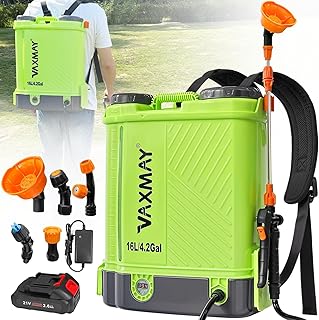
- Adjustable pressure dial up to a published 100 PSI, so you can turn it down for drift
- Runs on Makita 18V packs and ships with a 21V 2.6Ah battery and charger
- Five named nozzles including windproof, cone, fan and stream
- Retractable wand, trigger lock and a distinct tank scale
- Harness has breathable adjustable straps and lumbar support
Cons
- A full 16 litre tank is a genuinely heavy carry on slopes
- Battery platform lock-in matters less if you own no Makita tools
The interesting specification here is not simply 100 PSI, it is that the pressure is set on a dial. Most homeowner backpack sprayers operate at a fixed output, and the extra pressure at the top of this unit's range buys reach and better atomisation, while the ability to turn it down is what stops that same pressure creating drift near plants you value.
The nozzle set is unusually complete for the price: windproof, dual, cone, fan and stream, which covers every pattern you would otherwise buy separately. A retractable wand, a trigger lock and a tank with a visible scale are the small details that make a session less annoying.
Battery compatibility is the other genuine differentiator. It runs on Makita 18V packs, so if you already own that platform spare batteries mean it never stops mid-job, and it still ships with its own 21V 2.6Ah battery and charger so it works out of the box either way. The harness has breathable adjustable straps and lumbar support, which matters because 16 litres of water is around 35 pounds.
Bottom line: the pick for Makita owners and for anyone who needs reach, and the pressure dial is what makes that reach safe to use.
- Type: battery powered backpack sprayer
- Capacity: 16 litres, 4.2 gallons
- Pressure: adjustable dial to a published maximum of 100 PSI
- Battery: works with Makita 18V packs; 21V 2.6Ah battery and charger included
- Wand: retractable, with trigger lock
- Nozzles: 5 included, windproof, dual, cone, fan and stream
- Harness: breathable adjustable straps with lumbar support
- Extras: filter screen, tank scale, onboard storage area
The combination of a retractable wand and adjustable pressure is what lets you treat the top of a hedge and then a seedling bed without changing tools. Dial the pressure down before you go near anything delicate.
Retract the wand for low work. A fully extended wand at ground level puts your wrist in an awkward position and makes it harder to hold a steady band.
Flush with clean water through every nozzle you used, then run the pump dry for a few seconds to clear the diaphragm. Check the filter screen at the same time, since that is where grit collects.
Wear eye protection and a long-sleeve shirt. At the top of the pressure range the spray carries further than you expect, including back toward you when it hits a hard surface.
How to Choose a Lawn And Garden Sprayer
Sprayers look interchangeable on a product page. They are not. The five criteria below are the ones that show up as regret three months later, when a wand starts dripping on your shoes or a tank of glyphosate residue kills the tomatoes you were trying to feed.
Tank Size and What It Actually Covers
Most homeowners buy too much tank. Liquid weed killers and lawn fertilizers are typically mixed to cover somewhere between 300 and 500 square feet per gallon of finished spray, which means a full 2-gallon tank handles roughly 600 to 1,000 square feet of dense coverage, or considerably more if you are spot-treating rather than blanket-spraying. A quarter-acre lot with scattered weeds rarely needs more than one 2-gallon fill.
The reason to go bigger is not coverage, it is refills. Every refill means walking back to the hose, remixing concentrate and re-pressurizing. A 4-gallon backpack cuts a two-hour fence line job down to one trip. The cost is weight: water alone runs about 8.3 pounds per gallon, so a full 4-gallon backpack sits around 35 pounds on your shoulders before you add the sprayer itself. That is a real load on uneven ground.
The honest middle ground for most yards is a 2-gallon handheld tank with a shoulder strap. It is light enough to carry one-handed, big enough to finish a bed or a driveway edge without stopping, and small enough that you are not tempted to store leftover mixed chemical, which you should never do anyway.
Manual Pump Versus Battery Power
A manual pump sprayer builds pressure in the headspace above the liquid. As you spray, that air expands and pressure drops, so the spray pattern that was a tight fan at the start of the tank becomes a sloppy dribble by the end unless you stop and pump again. On a 2-gallon tank you will typically re-pump three or four times to empty it. That is not a defect, it is how the design works, but it does mean your application rate is not constant across the tank.
Battery sprayers replace the air chamber with a small diaphragm pump that holds pressure steady from the first squeeze to the last. For anything where dose consistency matters, such as selective herbicide on a lawn, that steadiness is worth more than the convenience of not pumping. The PetraTools HD2000-S publishes a 2-hour runtime per charge on a 2-gallon sling-carried tank; the VAXMAY backpack holds 4.2 gallons, publishes a maximum of 100 PSI and carries an adjustable pressure dial, which matters because it lets you turn the pressure down for drift-sensitive work rather than only up.
The trade-off is failure mode. A manual sprayer that stops working can usually be fixed with a new o-ring and a rinse. A battery sprayer that stops working needs a pump, a switch or a cell, and those parts are rarely sold separately. If the sprayer will sit unused for six months at a time, the manual pump is the safer long-term buy.
Seals, Gaskets and Chemical Compatibility

This is the criterion nobody reads and everybody eventually learns. Sprayer seals are made from different elastomers, and each one tolerates a different set of chemicals. Standard seals handle water-based herbicides and fertilizers fine. Bleach, oil-based products and some strong acids swell or dissolve those same seals, which is why manufacturers sell dedicated bleach sprayers with different gasket material rather than telling you the standard model is fine.
The practical rule is one tank per chemical family. Herbicide residue clinging to a wand at parts-per-million levels is enough to damage sensitive ornamentals when that same wand later sprays fertilizer. Labeling tanks with a paint pen costs nothing. Buying a second sprayer costs less than replacing a hedge. That is the single reason the Chapin two-pack leads this list.
Nozzles, Wand Length and Spray Pattern

An adjustable cone nozzle covers most homeowner jobs, but it is a compromise. A fan nozzle lays down an even band and is what you want for broadcast work on turf. A stream or jet setting throws further and is what you want for reaching wasp nests or the far side of a hedge. A fine mist is right for foliar feeding and wrong for anything windy, because mist is what drifts onto plants you did not intend to treat.
Wand length decides your posture. A short wand on a handheld bottle means bending over every weed in a gravel driveway. The Chapin 2-gallon tank publishes a 12 inch wand on a 34 inch hose, which is enough to stand upright over a bed; the PetraTools sling sprayer publishes a spray range beyond 20 feet, which is a different solution to the same problem of not wanting to bend. Brass nozzles resist clogging better than plastic and can be disassembled and cleaned, and the PetraTools unit includes an adjustable brass nozzle alongside a flat fan; plastic nozzles are lighter and cheaper and will eventually get scored by grit.
Carrying, Straps and Where the Weight Sits
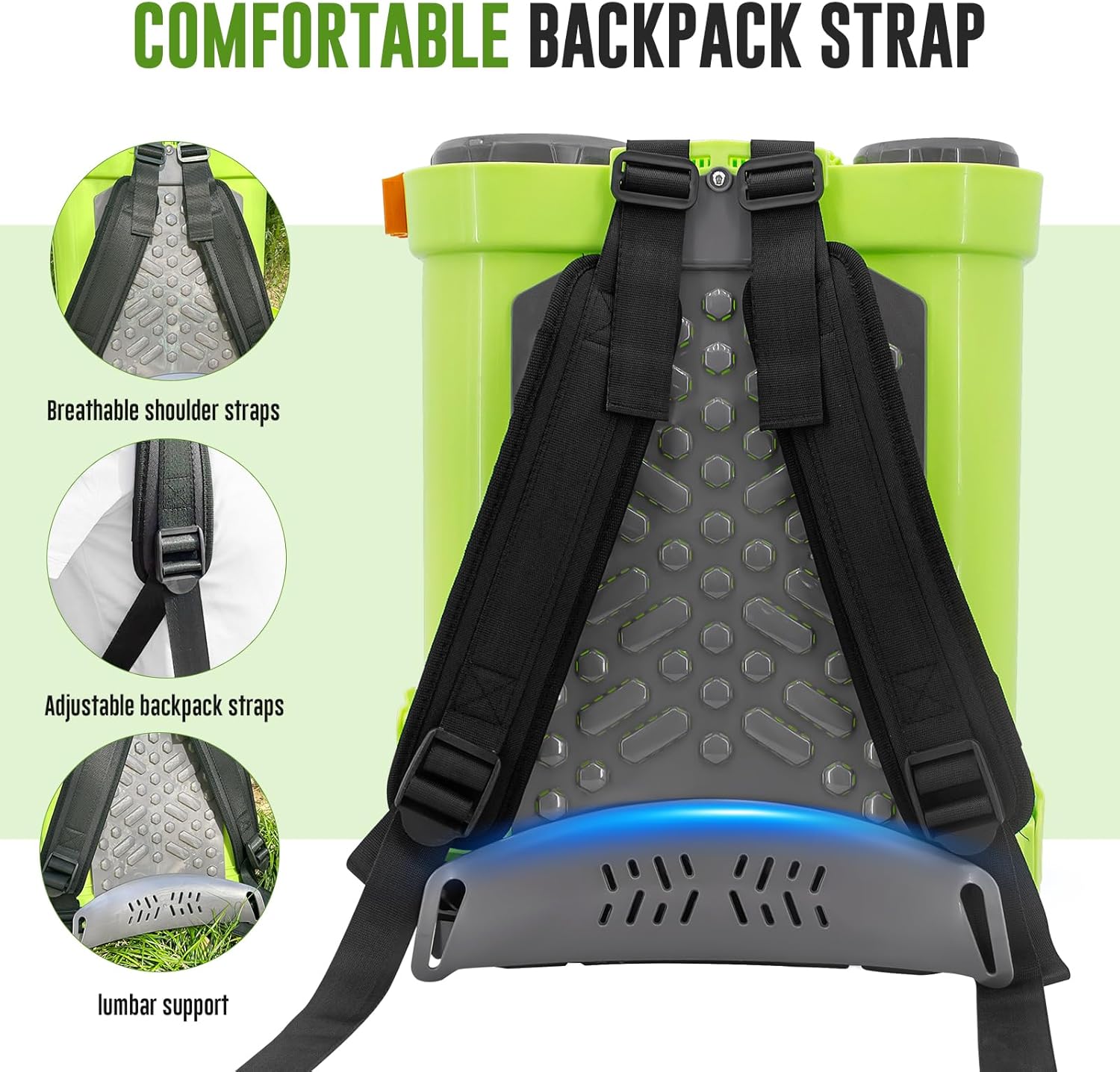
Handheld tank sprayers hang from one shoulder, which is fine for fifteen minutes and unpleasant for an hour. Backpack sprayers distribute the load across both shoulders and, on better models, a waist belt. Look for padded straps and a rigid back panel; a soft-sided pack full of liquid will roll against your spine on slopes.
Pump handle position matters on manual backpacks. Most units let you swap the lever from left to right so you can pump with your non-dominant hand while spraying with the other. If you are buying a manual backpack and cannot confirm the handle is reversible, assume it is not.
Reading a Concentrate Label Before You Buy the Tank
The sprayer you need is decided by the label of the product you plan to put in it, not the other way round. Concentrate labels give a mix rate in ounces per gallon and a coverage figure in square feet per gallon of finished spray. Those two numbers tell you how many tank fills the job takes before you have spent a cent.
Labels also state which equipment is appropriate. Some products specifically say not to apply through a hose-end sprayer, because a hose-end unit dilutes at a rate set by water pressure rather than by measurement, and pressure varies house to house. Others warn against fine mist settings for drift reasons. Reading that section once is faster than replacing a shrub.
One more label habit worth building: check whether the product is a contact killer or a systemic. Contact products need thorough wetting, which favors a fan nozzle and a slow walk. Systemics move within the plant, so a lighter, even application works and drenching just wastes concentrate. The nozzle you choose is the difference between those two behaviours.
| Model | Type | Capacity | Best for |
|---|---|---|---|
| Chapin 2-Gallon (2-pack) | Manual tank | 2 gal each | Keeping herbicide and fertilizer in separate tanks |
| Roundup 190260 | Manual tank | 2 gal | Weed and insect control around beds and decks |
| PetraTools HD2000-S | Battery tank | 2 gal | Standing upright while spot-spraying |
| Roundup 190314 | Manual backpack | 4 gal | Large areas without batteries to charge |
| Chapin 48oz Handheld | Handheld bottle | 48 oz | Small spot jobs and indoor-adjacent work |
| VAXMAY 16L Backpack | Battery backpack | 4.2 gal | Owners of Makita 18V batteries |
If your yard work leans toward soil rather than spray, our guide to compost for vegetable gardens covers the other half of feeding a bed. For pest work that needs volume rather than precision, a backpack mosquito fogger is a different tool entirely and worth understanding before you try to make a sprayer do that job.
Why You Should Trust Us
We build these shortlists from what is actually selling and what buyers actually report, not from press releases. Every model here was checked against its current listing for capacity, pump type, nozzle count and published specifications, and we discard anything where the manufacturer cannot be identified. Sprayers are a category full of unbranded listings with copied photos, and a sprayer with no manufacturer behind it is a sprayer with no replacement seals.
We also read the negative reviews before the positive ones. For sprayers the complaints cluster in three places: seals that fail after a season, wands that drip at the trigger, and pumps that lose prime. Where a model has a known weakness in one of those areas we say so in its cons rather than leaving it out, because a sprayer with a replaceable o-ring kit is a better buy than one with no known failures and no spare parts.
Final Thoughts
Best overall goes to the Chapin 2-Gallon Pump Sprayer two-pack. It is not the most advanced sprayer here, and that is the point: it is a proven tank design with chemical-resistant seals, a wide fill opening that lets you actually rinse the inside, and two of them for the price most brands charge for one. Owning two tanks solves the cross-contamination problem permanently instead of asking you to remember to rinse.
Best value is the Chapin 48oz Handheld Sprayer. For spot-treating cracks in a driveway, misting seedlings or handling a job too small to justify mixing two gallons, a small bottle with an anti-clog nozzle is the right tool, and it stores on a shelf instead of taking up floor space.
For large properties, the VAXMAY 16 litre battery backpack is the pick. It publishes a 100 PSI maximum on an adjustable dial, which is high for this class and buys real reach, and its retractable wand lets you treat the top of a hedge without walking into the bed. If you already run Makita 18V tools, spare packs mean it never stops mid-job. Just respect what that pressure does to drift: use the coarse nozzles near anything you value. Browse more outdoor picks in Patio, Lawn and Garden or see everything new in our latest articles.
Lawn And Garden Sprayer FAQs
How many gallons do I need for an average yard in 2026?
For spot-treating weeds on a quarter-acre lot, a 2-gallon tank is usually more than enough for a single session. For blanket applications such as a liquid fertilizer across an entire lawn, work backwards from the concentrate label: most homeowner products cover 300 to 500 square feet per finished gallon, so a 5,000 square foot lawn needs roughly 10 to 16 gallons of finished spray and you should plan on a backpack and several refills.
Can I use the same sprayer for weed killer and fertilizer?
You should not. Herbicide residue in the hose, wand and nozzle is difficult to remove completely, and the trace amounts left behind are enough to damage ornamentals and vegetables when the same equipment is later used to feed them. Dedicate one sprayer to herbicides and a second to everything else, and label both. This is the main reason a two-pack of identical tanks is a better buy than one premium tank.
Why does my lawn and garden sprayer lose pressure halfway through the tank?
On a manual pump sprayer that is normal. Pressure comes from compressed air above the liquid, and as liquid leaves the tank that air expands and its pressure falls. Stop and re-pump every few minutes to keep the pattern consistent. If pressure drops immediately after pumping, the problem is a seal: check the pump cylinder o-ring, the tank lid gasket and the hose fitting in that order.
Is a battery sprayer worth the extra cost?
It is if you spray for more than about twenty minutes at a time or if consistent application rate matters to you. Battery models hold steady pressure across the whole tank, which manual pumps cannot do, and they remove the fatigue of pumping while carrying weight. For occasional spot work on a small yard, a manual tank is simpler, cheaper and has fewer parts that can fail.
How should I store a sprayer between uses?
Empty it, rinse the tank and run clean water through the wand and nozzle until it comes out clear, then release all pressure and store the tank with the lid loose so the gasket is not compressed. Never store mixed chemical in the tank; it degrades seals and you will not remember what is in it. In freezing climates, drain the pump completely, because trapped water expanding in the cylinder is the most common way these tools die over winter. More seasonal gear picks are in our pump sprayer distance guide.



Write Your Review
No reviews yet. Be the first to share your experience!