

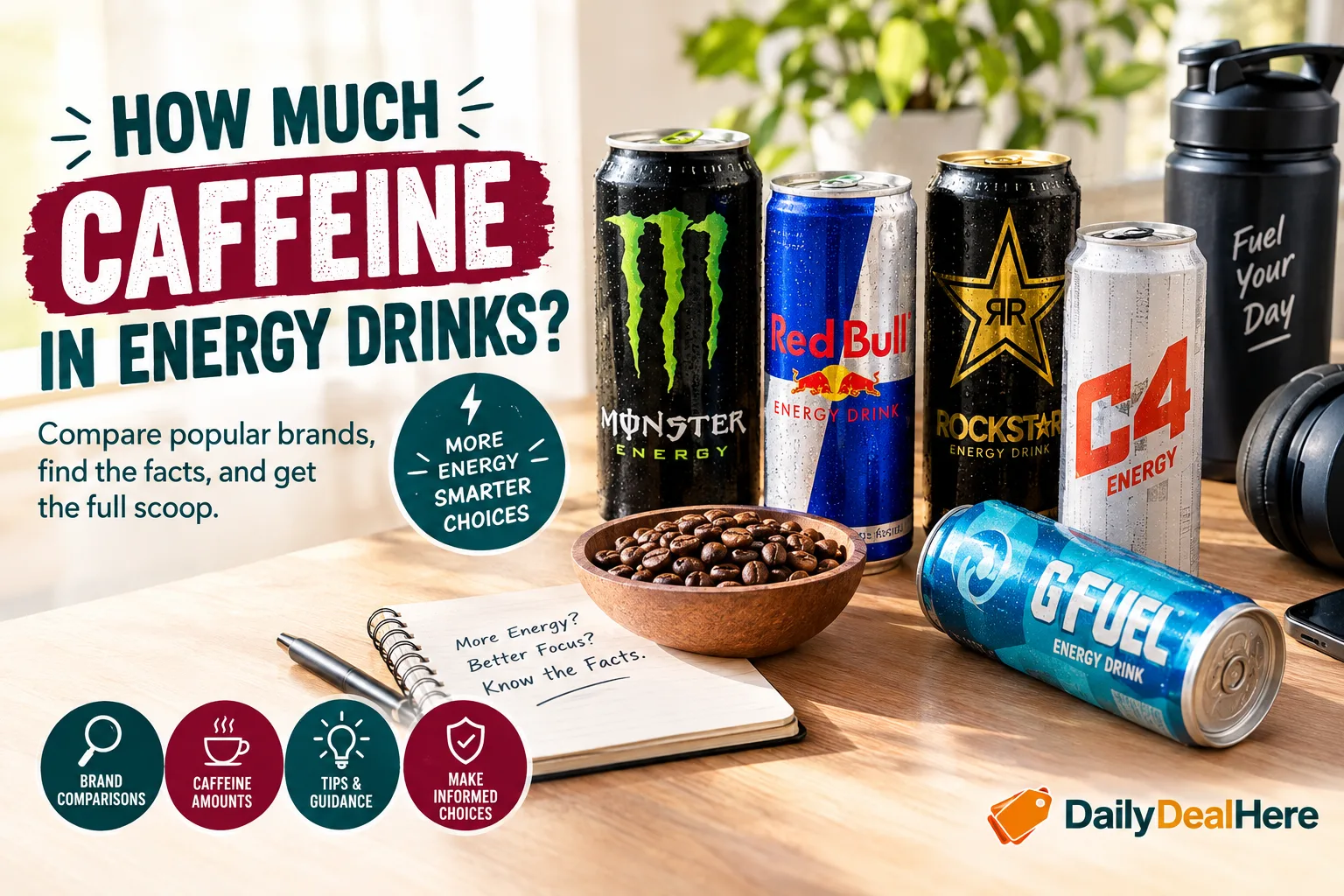
Most energy drinks sold in the United States contain between 80mg and 300mg of caffeine per can. A standard 8.4 ounce Red Bull has 80mg, a 16 ounce Monster has 160mg, a 12 ounce Celsius has 200mg, and the strongest mainstream cans, Bang and Reign, hold 300mg. The Food and Drug Administration puts the category range at 54 to 328mg per 16 fluid ounces, which is why two cans sitting side by side in the same cooler can differ by a factor of four. The chart below lists what is actually in each one.
Caffeine in popular energy drinks, compared
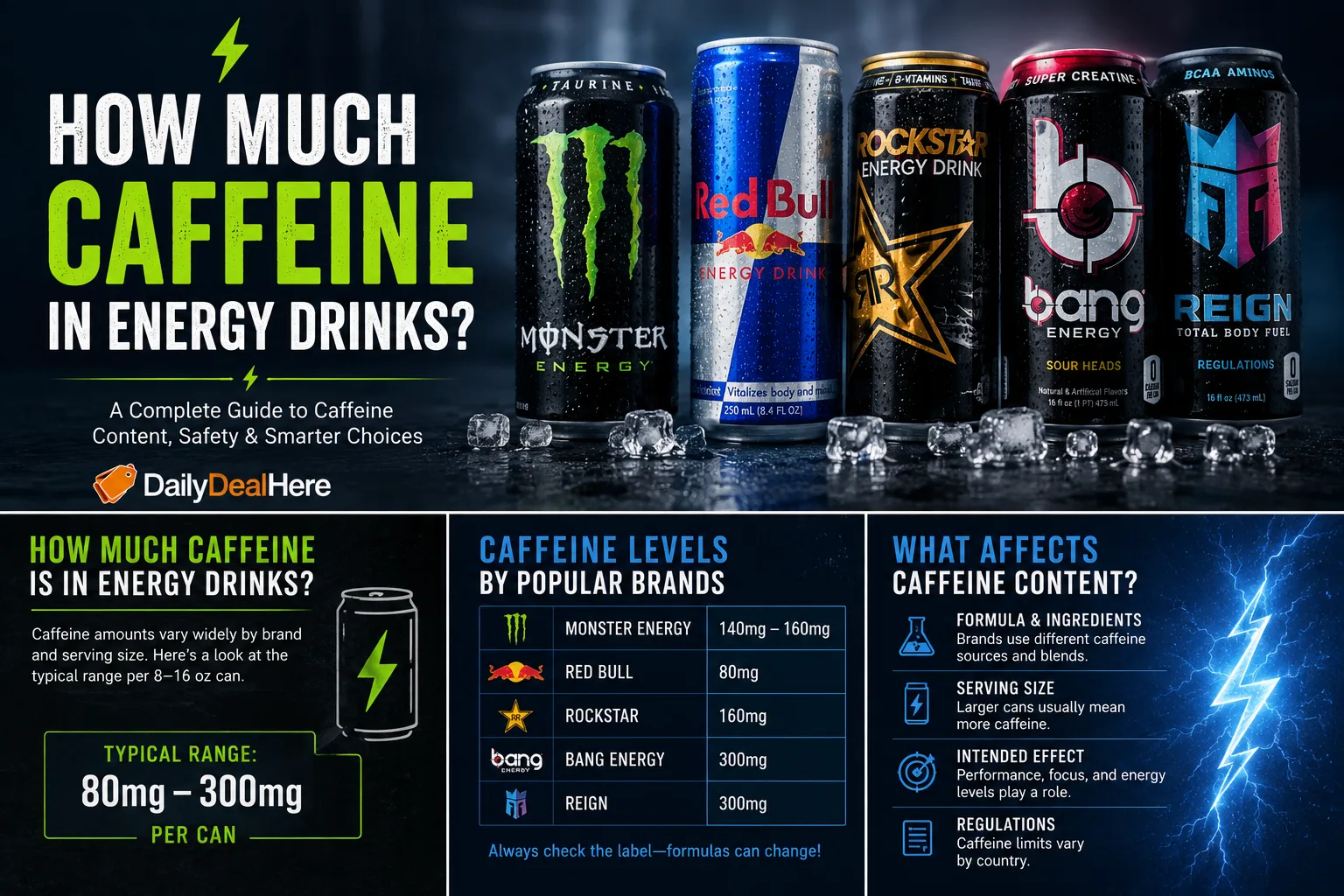
Caffeine is the number people are really asking about, and the gap between brands is wider than the shelf suggests. The table below lists the caffeine in the energy drinks most widely sold in the United States, taken from brand statements and printed can labels, sorted from mildest to strongest. The last column is the one worth reading twice.
| Energy drink | Can size | Caffeine | Per fl oz |
|---|---|---|---|
| Mtn Dew Kickstart | 16 oz | 90 mg | 5.6 mg |
| Red Bull | 8.4 oz | 80 mg | 9.5 mg |
| Red Bull | 12 oz | 114 mg | 9.5 mg |
| Monster Energy | 12 oz | 120 mg | 10.0 mg |
| Monster Energy Zero Sugar | 16 oz | 140 mg | 8.8 mg |
| Guayaki Yerba Mate | 15.5 oz | 150 mg | 9.7 mg |
| Red Bull | 16 oz | 151 mg | 9.4 mg |
| Monster Ultra (varies by flavor) | 16 oz | 150 to 155 mg | 9.4 to 9.7 mg |
| Monster Energy (original) | 16 oz | 160 mg | 10.0 mg |
| Rockstar Original | 16 oz | 160 mg | 10.0 mg |
| ZOA Energy | 12 oz | 160 mg | 13.3 mg |
| Starbucks Baya | 12 oz | 160 mg | 13.3 mg |
| Mtn Dew Rise | 16 oz | 180 mg | 11.3 mg |
| Celsius | 12 oz | 200 mg | 16.7 mg |
| Alani Nu | 12 oz | 200 mg | 16.7 mg |
| Ghost Energy | 16 oz | 200 mg | 12.5 mg |
| C4 Performance Energy | 16 oz | 200 mg | 12.5 mg |
| Prime Energy | 16 oz | 200 mg | 12.5 mg |
| NOS High Performance | 16 oz | 200 mg | 12.5 mg |
| ZOA Energy | 16 oz | 210 mg | 13.1 mg |
| Starbucks Doubleshot Energy | 15 oz | 225 mg | 15.0 mg |
| Celsius Essentials | 16 oz | 270 mg | 16.9 mg |
| Bang Energy | 16 oz | 300 mg | 18.8 mg |
| Reign Total Body Fuel | 16 oz | 300 mg | 18.8 mg |
| C4 Ultimate Energy | 16 oz | 300 mg | 18.8 mg |
| 5-hour Energy Regular | 1.93 oz shot | 200 mg | 104 mg |
| 5-hour Energy Extra Strength | 1.93 oz shot | 230 mg | 119 mg |
Two entries in that list deserve a flag. Monster Ultra changes with the flavor, running from about 150mg to 155mg per 16 ounce can, so there is no single Ultra number. And Celsius Essentials carries 270mg in one can, with a label instruction not to exceed one serving a day, which is a different product from the 12 ounce Celsius most people picture. If you are comparing specific cans rather than categories, our roundup of the best energy drink brands lines the popular options up side by side.
Energy drinks versus coffee, tea, soda and shots
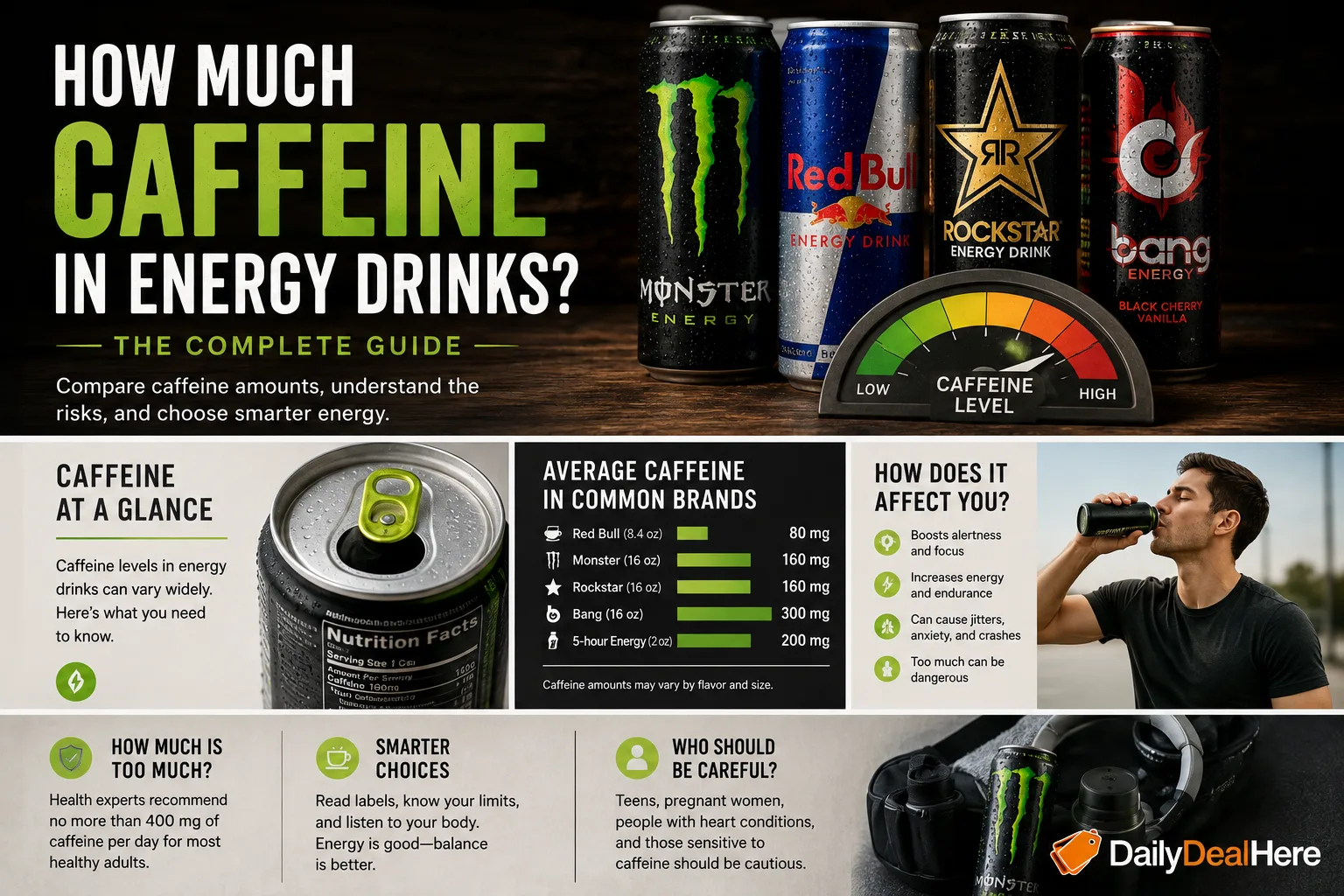
The assumption that energy drinks are in a different league from coffee does not survive the numbers. A 16 ounce Monster and a large drip coffee are close. A 300mg can is stronger than almost any single cup of coffee you can buy. And a two ounce energy shot beats both, from a bottle that fits in a pocket.
| Drink | Serving | Caffeine |
|---|---|---|
| Decaf coffee | 8 oz | 2 to 15 mg |
| Brewed green tea | 8 oz | 28 mg |
| Coca-Cola Classic | 12 oz | 34 mg |
| Pepsi | 12 oz | 38 mg |
| Dr Pepper | 12 oz | 41 mg |
| Diet Coke | 12 oz | 46 mg |
| Brewed black tea | 8 oz | 47 mg |
| Mountain Dew | 12 oz | 54 mg |
| Instant coffee | 8 oz | 62 mg |
| Espresso | 1 oz shot | 64 mg |
| Brewed coffee | 8 oz | 96 mg |
| Energy drink | 12 oz | 41 to 246 mg |
| Caffeine tablet (NoDoz, Vivarin) | 1 tablet | 200 mg |
| Energy shot | 2 oz | 215 mg |
Read down that column and the real picture appears. Soda is a rounding error next to an energy drink. Tea sits below a single espresso shot. A cup of coffee lands in the same territory as a mild energy drink, which means the honest comparison is not energy drink versus coffee but this can versus that cup. If your habit is really about the drink rather than the dose, the coffee side of the aisle gets you to the same 100mg with more control over the size.
Restaurant coffee is the wild card. Large chain coffees can run well past 200mg, and the FDA notes plainly that restaurants and retail food establishments are not required by law to tell you how much caffeine they serve. A grande from a coffee shop is often the largest single dose in someone’s day, and it is the one dose with no number attached to it.
Why the per ounce number matters more than the number on the can
Monster looks like double Red Bull: 160mg against 80mg. Per ounce they are nearly identical, at 10.0mg and 9.5mg. The entire difference is that the Monster can is twice the size. Celsius tells the opposite story: 200mg sounds like a middling number until you notice it comes in a 12 ounce can, which makes it 16.7mg per ounce, far denser than any Monster or Red Bull on the shelf.
This matters for a practical reason. A big can is something you can put down half finished. A small dense can is usually drunk in one go, and a 1.93 ounce shot at roughly 104mg per ounce is finished in seconds. The same 200mg arrives very differently depending on the format it comes in, and the format is exactly what the headline number hides.
How much caffeine is too much?
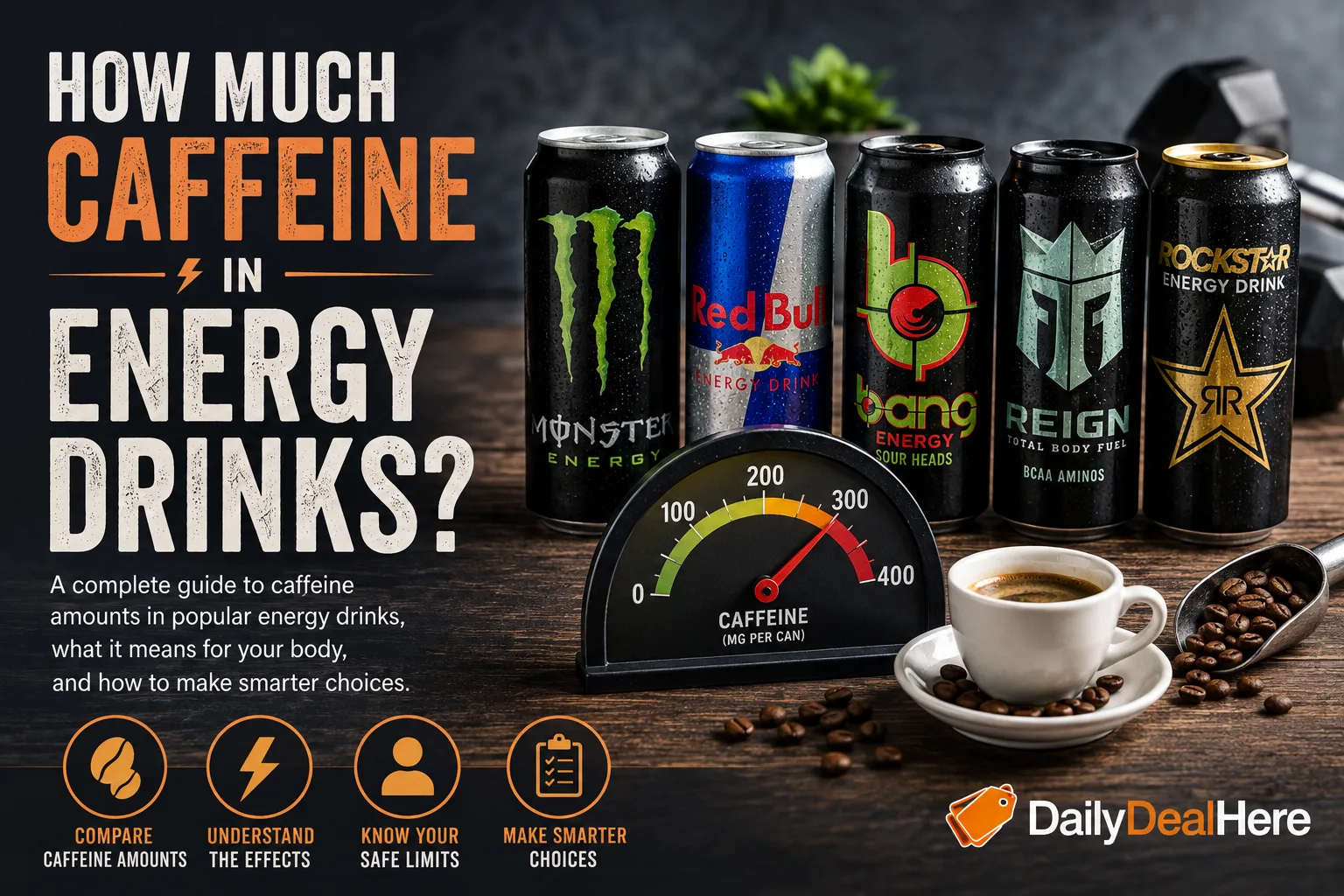
The figure everyone quotes is 400mg a day. It is worth knowing exactly what the FDA does and does not say about it. The agency states that for most adults it “has cited 400 milligrams a day, that’s about two to three 12-fluid-ounce cups of coffee, as an amount not generally associated with negative effects,” and in the same breath notes there is wide variation in how sensitive people are and how fast they clear it. That is a reference point, not a legal limit and not a line that turns dangerous the moment you cross it.
Used properly it is still the most useful number available, because it is a daily total from every source. Coffee at breakfast, a can in the afternoon and a soda with dinner all draw from the same 400mg. One 300mg can spends three quarters of it before lunch.
The FDA also names a far higher figure that is often quoted out of context: toxic effects such as seizures can be seen with the rapid consumption of around 1,200mg. That figure attaches to pure and highly concentrated caffeine, the powders and liquid concentrates where, as the agency puts it, the difference between a safe amount and a life threatening amount is very small. One teaspoon of pure powdered caffeine can hold as much as 28 cups of coffee. It is not a description of what happens when someone drinks a fourth can.
The symptoms the FDA lists for too much caffeine are worth recognizing in yourself: a faster heart rate, palpitations, raised blood pressure, insomnia, anxiety, jitters, an upset stomach, nausea and headache. This article is general information rather than medical advice, and if those show up regularly, the number that matters is the one your doctor gives you.
Pregnancy, teenagers and kids: where the numbers change
During pregnancy, the figure repeated everywhere is 200mg a day, and it comes from the American College of Obstetricians and Gynecologists. Their actual position is more careful than the shorthand: moderate consumption, which they define as less than 200mg a day, “does not appear to be a major contributing factor in miscarriage or preterm birth,” and they say plainly that a recommendation about higher intakes cannot be made from the available evidence. So 200mg is the level with reassuring data behind it rather than a ceiling somebody set. One 12 ounce Celsius or Alani Nu reaches it exactly, with nothing left over for coffee.
For children and teenagers, the guidance is not a smaller number, it is avoidance. The FDA states that medical experts advise against energy drinks for children and teens because of the caffeine and sugar levels, citing the American Academy of Pediatrics. Where a number is given for adolescents, it comes from the American Academy of Child and Adolescent Psychiatry, which suggests limiting 12 to 18 year olds to at most 100mg a day, roughly two cans of cola, while advising against energy drinks entirely for that age group and against routine caffeine for under 12s. Every drink in the first table clears that 100mg mark except the smallest Red Bull and a Kickstart.
This is no longer only a guideline question. Connecticut has prohibited the sale of energy drinks to anyone under 16 since the start of 2025, and similar bills have been filed in other states. The direction of travel is toward treating these as age restricted products.
What the label does not tell you
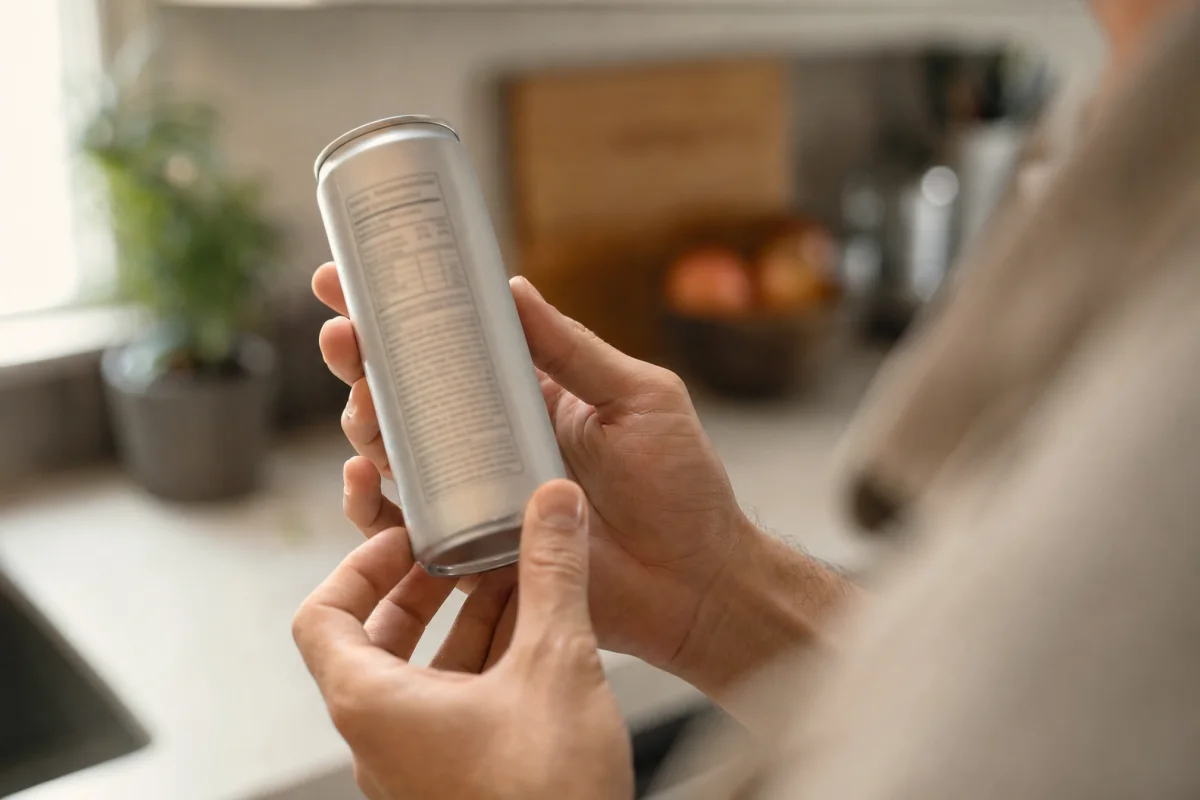
Here is the part that surprises most people: in the United States, printing the caffeine amount on a drink is voluntary. The FDA requires caffeine to appear in the ingredient list when it is added as a standalone ingredient, but the milligram figure on the can is something brands choose to provide. Most large energy drink brands do provide it, and many go further by printing “caffeine from all sources,” which folds in the caffeine that arrives through guarana or green tea extract rather than as a separate line item.
Three things follow from that, and they are the ones worth carrying to the store.
- A drink with no number is not a drink with no caffeine. If the label lists guarana, yerba mate, kola nut, green tea extract or green coffee bean extract, there is caffeine in the can whether or not anyone quantified it.
- Beverage and supplement are two different labels. Monster, Red Bull, Celsius, Rockstar and Ghost are sold as beverages and carry a Nutrition Facts panel. 5-hour Energy is sold as a dietary supplement and carries a Supplement Facts panel instead, along with the standard disclaimer that its statements have not been evaluated by the FDA.
- A proprietary blend can legally hide the split. Under the supplement labeling rules, the ingredients inside a blend must be named and ranked by weight, but only the blend’s total weight has to be quantified. Caffeine’s individual share inside that blend does not have to be broken out.
This may not stay the case. The FDA has a draft guidance on labeling caffeine content in foods and beverages sitting on its list of guidance under development. Draft guidance is neither a rule nor binding, and no proposed wording or deadline has been published, so treat it as a signal about where the agency’s attention is rather than a change you can shop by today.
Sugar and the other ingredients that add up
Caffeine gets the attention, but it is rarely the only thing in the can worth checking. A full sugar energy drink can carry a large share of a day’s added sugar in one serving, which is a big part of why the zero sugar versions now outsell the originals in several lines. Taurine, B vitamins and amino acids round out most formulas, and their effects are far more modest than the marketing suggests.
The trade worth understanding is this: going sugar free changes the calories, not the stimulant. Monster Zero Sugar sits at 140mg against the original’s 160mg, and in most other lines the zero sugar can carries exactly the same caffeine as its full sugar twin. If sugar is your concern rather than caffeine, our roundup of the best sugar-free energy drinks covers the options that keep the kick and drop the sweetener load.
Caffeine before a workout: how much and when
Pre workout is the most common reason people reach for a can, and it is where the biggest number is least useful. Caffeine needs time to move from your stomach into your bloodstream, so a drink swallowed in the parking lot is still arriving during your warm up. Timing the can to land before the hard part of the session does more for you than adding another 100mg to it.
There is also a tolerance trap. People who take caffeine every single day get less of a lift from it than people who save it for sessions that matter, which is an argument for treating a 300mg can as a tool rather than a habit. Worth noting too: a typical pre workout powder scoop lands in the same 150mg to 300mg range as the strongest cans, so stacking a scoop and a can is how people quietly reach 500mg. If training is the reason you are buying, our guide to the best sports energy drinks looks at the formulas built for that use, including the ones that pair caffeine with electrolytes instead of sugar.
Caffeine and sleep: the cutoff that actually matters
Caffeine leaves the body slowly, and how slowly varies enormously between people. The Sleep Foundation puts the half-life anywhere from 2 to 12 hours, which is why two people can share the same can and only one of them lies awake at midnight.
The finding worth changing your habits over comes from a controlled trial published in the Journal of Clinical Sleep Medicine, in which a 400mg dose was given at three different times before bed. Taken six hours before bedtime, it cut measured total sleep time by more than an hour, and the participants did not report noticing. That last detail is the important one: feeling fine at bedtime is not evidence that the caffeine has worn off. Consumer guidance from the Sleep Foundation goes further and suggests stopping at least eight hours before bed, so if you go to sleep at 10pm, that means nothing after 2pm.
A practical rule that fits both numbers: the bigger the dose, the earlier the cutoff. An 80mg drink at 4pm is a different decision from a 300mg drink at 4pm, even though both feel like one can.
Who should skip energy drinks entirely
For most of us the question is how much. For some groups it is whether at all.
- Children and teenagers. The clearest line in the guidance, and it is avoidance rather than a lower dose.
- Anyone pregnant or breastfeeding. A single 12 ounce Celsius or Alani Nu hits the 200mg mark on its own.
- People with heart rhythm problems or high blood pressure. Caffeine raises heart rate and blood pressure temporarily, and a cold can goes down far faster than a hot drink.
- Anyone mixing caffeine with alcohol. A stimulant can mask how impaired you feel without making you any less impaired.
- People who already sleep badly. Caffeine does not create energy, it postpones the feeling of tiredness, and that is a loan repaid the same night.
How to pick the caffeine level that fits you
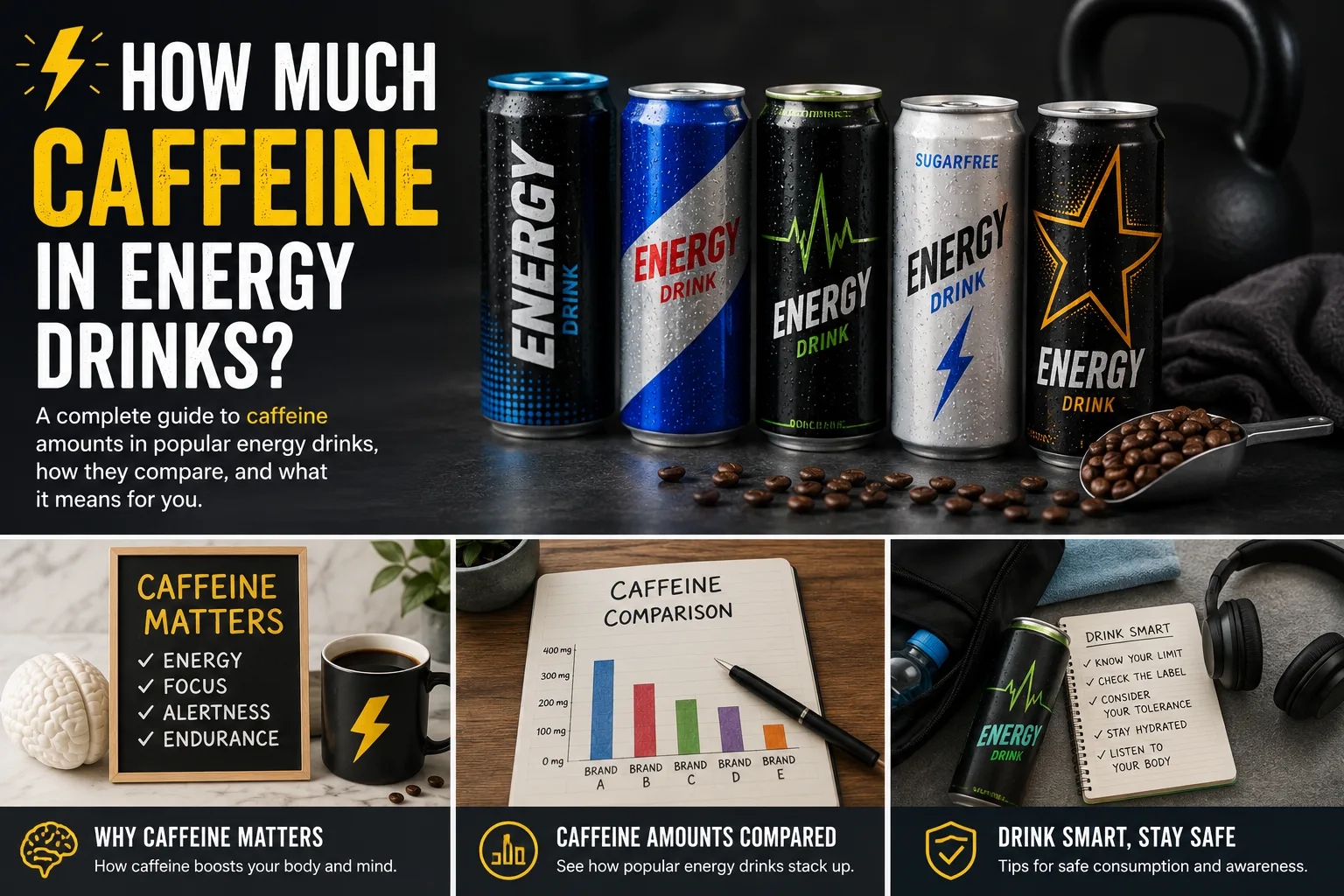
Rather than asking which drink is strongest, work backwards from your own day. Three questions settle it.
- What else are you drinking today? Two cups of coffee at breakfast already spend roughly half of the 400mg reference point.
- How fast will you drink it? A hot mug takes twenty minutes, a cold can takes three, and a shot takes seconds. Same caffeine, very different curve.
- What time is it? The later it is, the smaller the number should be.
Matched to those answers, the table at the top stops being a ranking and turns into a menu. Around 80 to 120mg is a coffee equivalent for an ordinary afternoon. Around 160mg is the standard big can. From 200mg up you are making a deliberate choice that should come with an earlier cutoff, and 300mg is most of a day’s reference point in a single sitting. If what you actually want is the ritual rather than the dose, a low caffeine option like mushroom coffee does that job better than any can.
The bottom line
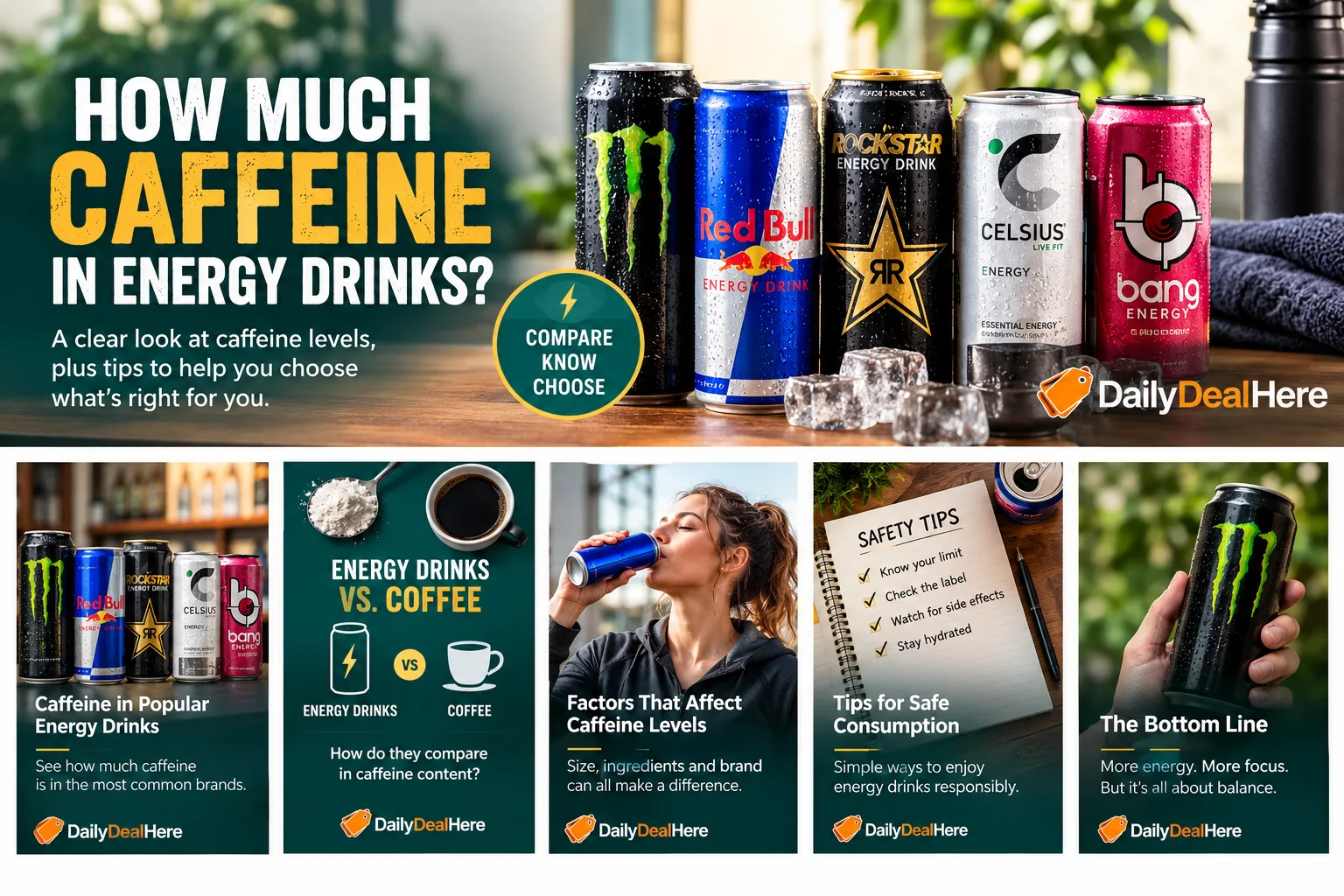
Energy drinks run from 80mg in a small Red Bull to 300mg in a Bang, Reign or C4 Ultimate, with Monster and Rockstar at 160mg and the 12 ounce Celsius and Alani Nu cans packing 200mg into a smaller format. Compare cans by the per ounce column rather than the headline, keep your daily total from every source in view rather than counting drinks, and remember that the milligram figure on the label is there voluntarily. When you have settled on the caffeine level you want, our guide to the best energy drink brands is the fastest way to find a specific can that fits it.
Frequently asked questions
Which energy drink has the most caffeine?
Among mainstream cans sold in the United States, Bang, Reign and C4 Ultimate share the ceiling at 300mg per 16 ounce can. Celsius Essentials is just behind at 270mg per 16 ounces and carries a label instruction not to exceed one can a day. Energy shots beat all of them by concentration rather than total: a 5-hour Energy Extra Strength holds 230mg in under two ounces.
How much caffeine is in Red Bull compared to Monster?
A standard 8.4 ounce Red Bull has 80mg and a 16 ounce Monster has 160mg, so Monster looks like double. Measured per ounce they are almost the same, at 9.5mg for Red Bull and 10.0mg for Monster. The difference is can size, not strength. Red Bull also sells 12 ounce and 16 ounce cans at 114mg and 151mg, which land in Monster territory.
Is 200mg of caffeine a lot?
200mg is half of the 400mg a day the FDA describes as not generally associated with negative effects in healthy adults, so on its own it is a moderate dose for an adult. It stops being moderate if you add coffee earlier in the day, drink it late, or fall into a group advised to stay lower. In pregnancy, 200mg is the whole day’s reference point rather than one drink’s worth.
Is an energy drink stronger than a cup of coffee?
It depends entirely on which can and which cup. An 8 ounce brewed coffee is about 96mg, which is stronger than a small Red Bull and weaker than a Monster. A 300mg can is stronger than nearly any single cup you can buy, while a large coffee from a chain can pass 200mg and beat most cans. Compare the specific drinks rather than the categories.
Does sugar-free mean caffeine-free?
No. Sugar free changes the sweetener and the calories, not the stimulant. Monster Zero Sugar carries 140mg against the original’s 160mg, and in most other lines the zero sugar can has exactly the same caffeine as its full sugar twin. Compare the caffeine line separately from the sugar line.
Do I have to be told how much caffeine is in a drink?
Not in the United States. Caffeine must appear in the ingredient list when it is added as a standalone ingredient, but printing the milligram amount is voluntary. Most big energy drink brands print it anyway, often as caffeine from all sources so it includes guarana and green tea extract. Restaurants are not required to disclose caffeine at all, which is why chain coffee is the least transparent drink in most people’s day.
How long before bed should I stop drinking energy drinks?
Caffeine’s half-life runs anywhere from 2 to 12 hours depending on the person, so a late afternoon can can still be working at midnight. In a controlled trial, a 400mg dose taken six hours before bed cut measured sleep by more than an hour and the sleepers did not notice it happening. Consumer guidance from the Sleep Foundation suggests stopping at least eight hours before bed, and the bigger the dose, the earlier that cutoff should be.
Can teenagers drink energy drinks?
Guidance says no. The FDA states that medical experts advise against energy drinks for children and teens, citing the American Academy of Pediatrics. Where a number is offered for ages 12 to 18, it comes from the American Academy of Child and Adolescent Psychiatry, which suggests a cap of 100mg a day while still advising against energy drinks for that age group. Connecticut has banned selling them to under 16s since 2025.










Write Your Review
No reviews yet. Be the first to share your experience!