

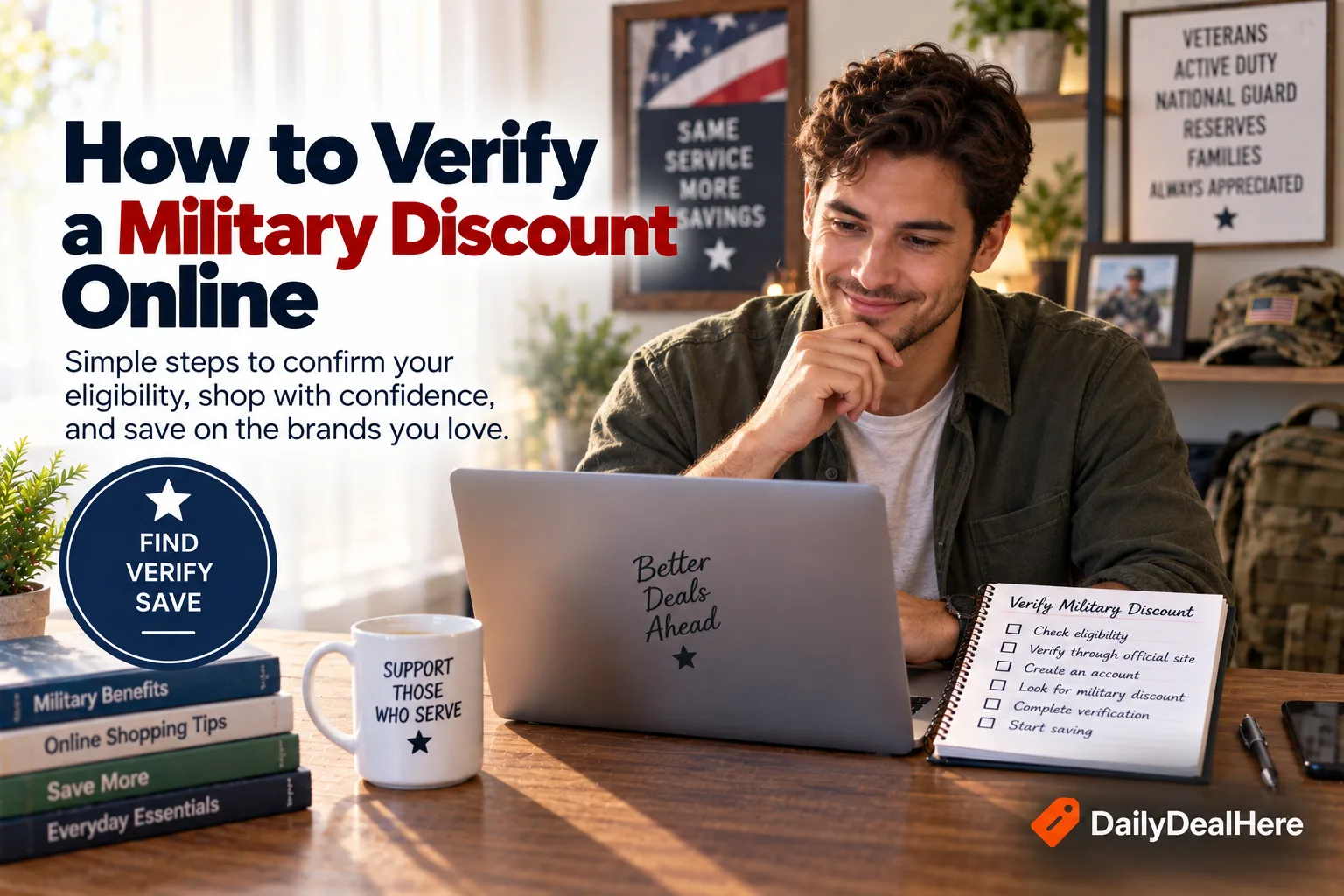
Most online military discounts are verified by a third party service rather than by the retailer itself. You click the military offer at checkout or on the retailer’s dedicated page, a window from a verification provider opens, you enter your name, branch and service dates, and in most cases you are approved in seconds against government records. When automatic matching fails, you upload a document such as a discharge certificate, a military identification card or a veteran health identification card, and a person reviews it, usually within a day or two.
Two services handle the majority of this work across American retail, and once you have an account with either one, most sites you use afterwards recognise you in a couple of clicks. Below is how the process works step by step, who normally qualifies, what to do when verification fails, how to tell a legitimate verification screen from a scam, and where the discount is worth using rather than simply available.
Who normally qualifies
Eligibility varies by retailer and is the single most common source of confusion, because the phrase military discount covers several different groups and few retailers cover all of them.
| Group | How often covered | Usual proof |
|---|---|---|
| Active duty | Almost always | Military identification, matched electronically |
| Reserve and National Guard | Usually | Military identification or service records |
| Veterans | Commonly, sometimes only on specific days | Discharge certificate or veteran health identification card |
| Retirees | Usually | Retiree identification |
| Military spouses | Sometimes | Dependent identification, or linked to the member’s record |
| Dependents and family | Less often | Dependent identification |
| Gold Star families | Occasionally, on a case by case basis | Documentation reviewed manually |
Read the retailer’s own eligibility line rather than assuming, because a policy that says military often means active duty only, and a policy that says military and veterans usually means what it says. Where the offer is limited to a single day, that day is almost always Veterans Day or Memorial Day.
The two verification services you will meet
Retailers do not want to store military records, and they are not equipped to judge documents. So they hand the question to a specialist and receive back a simple yes or no.
In practice you will encounter one of two providers across most of American retail. Both work the same way from your side: you create an account once, they match your details against authoritative records, and thereafter they confirm your status to any participating retailer without you re entering anything. One of them also handles identity verification for various government services, which is why many people already have an account without realising it applies here.
The practical consequence is that the first verification is the slow one. Set it up once, ideally before you need it, and every later retailer is a two click process.
The process, step by step
- Find the offer on the retailer’s own site. It is usually on a military or first responder page, or presented at checkout as a discount option.
- Click through to the verification window. It should open from within the retailer’s page and clearly show the provider’s name.
- Enter your details. Full legal name, date of birth, branch, and service start and end dates. Accuracy matters more than speed here, because the match is made against official records.
- Wait for the automatic match. Most approvals happen in seconds.
- Upload a document if asked. This is normal rather than a warning sign, and it happens most often for veterans whose service predates full digital records.
- Apply the code. Verification usually produces a single use code, sometimes with a short expiry, which you enter at checkout.
The step people miss is the last one. Verification and discount application are separate actions on many sites, and an approved status with no code entered produces a full price order.
Which documents actually work
When manual review is required, some documents are accepted almost everywhere and others cause delays.
The discharge certificate is the most widely accepted proof for veterans, and a legible copy of the relevant page is usually enough. A veteran health identification card works at many retailers and is easier to carry. A current military identification card is the simplest proof for active duty, reserve and retiree status. A state driver licence with a veteran designation is accepted by some retailers and not others, since not every state issues one and the designation criteria differ.
Keep a clear digital copy of whichever document you rely on, stored somewhere private rather than in a photo library that syncs widely. Verification is far less painful when the file is already to hand and readable.
When verification fails
Failure is common and usually mundane. Four causes account for most of it.
A name mismatch is the leading one, typically a married name against a service record in a maiden name, or a middle initial recorded differently. Service dates entered from memory are the second, and being a month out is enough to prevent a match. Older service records that were never fully digitised are the third, which is why manual upload exists. And a browser blocking the verification window is the fourth, which looks like a system failure and is not.
The fix for the first three is the same: switch to manual document upload rather than retrying the automatic match. For the fourth, allow the window, disable a blocker for that page or try a different browser, since the verification frame is often loaded from a different domain than the store.
How to tell a legitimate verification from a scam
Military status is attractive information to collect, and the season around Veterans Day brings a rise in fake offers built to harvest it. A few checks settle it quickly.
- Start from the retailer, never from a link. Type the store’s address yourself and find the military page there, rather than following an offer from an email or a social post.
- The verification window should be named. A legitimate flow shows the provider clearly and is loaded from that provider’s domain.
- Nobody needs a full social security number for a store discount. Verification providers may use partial identifiers, but a plain form asking for the whole number on a retail site is a stop sign.
- Never email a photograph of an identification document. Legitimate verification uses an upload inside the secure flow.
- No legitimate discount requires a payment to unlock. Any request for a fee, a deposit or a gift card is fraud.
- Be wary of offers that are far larger than normal. Genuine military discounts are typically modest and stack poorly with other promotions.
Online and in store are different systems
A retailer that gives a discount at a register with a glance at an identification card may handle the online version completely differently, and the two are frequently not interchangeable.
In store, verification is often visual and immediate. Online, it has to be documented, which is why the third party service exists. Some retailers run the discount only in one channel, some apply different percentages in each, and some require the online verification even for an in store purchase, delivering a code to your phone.
If a discount matters to a purchase, check the channel specific terms before deciding where to buy. The difference is occasionally large enough to change the decision.
What the discount usually excludes
Military discounts are real and narrower than they appear. The exclusions follow a consistent pattern across retail.
Items already on promotion are commonly excluded, which matters enormously in November, because it means the military discount and the seasonal deal usually cannot be combined. Gift cards are almost universally excluded. Major appliances, electronics and other low margin categories are frequently excluded or discounted at a lower rate. Marketplace items sold by third parties on a retailer’s site are outside the policy entirely. And there is often a cap on the discount per transaction or per year.
Read the exclusions before planning around the discount, because a percentage that does not apply to the category you are buying is not a discount at all.
Stacking, and why it rarely works
The natural instinct is to combine the military discount with a seasonal sale, a coupon and a card offer. In practice most systems allow one discount code per order.
What does usually stack is anything that is not a code: cashback through a card or portal, store loyalty points, and any offer applied automatically at the account level rather than at checkout. Those run on different mechanisms and are generally unaffected by the code you enter.
The practical approach when both are available is to price the order twice, once with the seasonal promotion and once with the military discount, and take the larger. During November the seasonal price wins more often than not, which is worth knowing before spending time on verification for a specific purchase.
Where the discount is worth the effort
Not every verification is worth the minutes it takes. The categories where it reliably pays are the ones with steady prices and few promotions.
Home improvement and hardware are the standard example, since several chains run a permanent military discount and the categories rarely go on deep promotion otherwise. Apparel and outdoor brands are the second group, where the discount often applies year round and the seasonal alternative is a broad percentage rather than a specific deal. Services, memberships and mobile plans are the third, and they are frequently overlooked despite being recurring costs where a small percentage compounds.
Where it rarely pays is electronics during a seasonal event, precisely because promotional pricing is excluded from most military offers. The comparison of which categories genuinely bottom out in November is covered in the guide on whether early November deals match Black Friday.
Veterans and online exchange shopping
Separate from retail discounts, honourably discharged veterans have online shopping privileges at the military exchanges. It is a different mechanism with a different benefit, and it is widely underused.
The advantage is not primarily a discount rate, it is that exchange purchases are not subject to sales tax, which on a large purchase can exceed any percentage a retailer offers. Verification is handled once through the exchange’s own process rather than through a retail verification provider.
The trade off is a narrower catalogue and different delivery arrangements, so it is worth checking rather than assuming, particularly for larger items where the tax difference is meaningful.
Protecting the information you hand over
Verification requires genuinely sensitive details, which is a good reason to do it deliberately rather than repeatedly.
Use one verification account rather than creating a new one at every retailer, since that limits how many places hold your service details. Use a strong unique password and enable two step verification on that account, because it is now a key that unlocks status at dozens of sites. Keep document copies in encrypted storage rather than a general photo library. And review which retailers have connected access occasionally, in the same way you would review app permissions.
Be especially careful in the weeks around Veterans Day, when fraudulent offers targeting the military community rise sharply and the pretext is usually a limited time discount that requires immediate action.
A five minute setup that pays all year
Once. Create an account with a verification provider before you need it, ideally in a quiet week rather than during a sale. Have your service dates in front of you rather than recalled.
Once. Save a clear copy of your discharge certificate or veteran health identification card in private storage, so a manual review takes a minute instead of an afternoon.
Each purchase. Start from the retailer’s own site, verify, then check that a code has actually been applied to the order total before paying. Compare the discounted price against the current seasonal promotion and take whichever is lower.
Whether the Veterans Day event itself is worth planning purchases around, as opposed to using the discount whenever you happen to buy, is a separate question covered in the guide on whether Veterans Day sales are worth shopping.
The same system covers other groups
The verification providers that handle military status also handle several other categories, and the flow is identical. If you qualify for more than one, it is worth knowing which gives the better rate at a given retailer, because you can normally only use one.
| Group | Typical proof | Where it tends to be strongest |
|---|---|---|
| Military and veterans | Service records or discharge document | Home improvement, outdoor and apparel brands |
| First responders | Employer or department records | Similar retailers, often the same offer |
| Teachers and school staff | School email or employment records | Stationery, technology, bookshops |
| Students | School email and enrolment records | Software, streaming, technology |
| Healthcare workers | Licence or employer records | Footwear, apparel, wellness brands |
| Government employees | Employer records | Travel, hotels, car rental |
Households frequently qualify under more than one heading between them, and the discount usually applies to the account holder rather than the household. Checking who in the family qualifies where takes a few minutes once and occasionally changes who places an order.
Large purchases are where it matters
A percentage is a percentage, so the discount is worth the most on the largest purchases, and those are exactly the ones where people forget to check before ordering.
Furniture and mattresses are the clearest case, since they are high value, rarely excluded, and sold by retailers that commonly run military programmes. Travel is the second, where hotels, car rental and some airlines operate their own verified rates that never appear in a general search. Appliances and home improvement projects are the third, and on a whole project the saving is meaningful rather than symbolic.
The habit that captures it is simply to ask before buying anything substantial rather than after. On a mattress, for instance, the discount and the seasonal event pricing usually cannot be combined, so the right move is to price both and take the lower, using the category comparison in the guide to mattresses and the timing notes in the piece on holiday weekend mattress pricing to judge whether the seasonal number is genuinely good.
Keep a short list of where you are verified
After a year or two the discount becomes invisible, which is the main reason it goes unused. People verify at a retailer once, then forget the programme exists the next time they shop there.
A short note listing the retailers where you are already verified, and the rough discount each one gives, solves it. Keep it wherever you keep the rest of your shopping notes, and glance at it before any purchase over a certain size. It takes seconds and it catches the case where a store you use regularly has a programme you signed up for eighteen months ago.
The same note is the right place to record which retailers exclude promotional items, since that is the detail that decides whether to bother during a seasonal event. Folding it into the wider planning described in the guide on building a holiday shopping budget keeps it in front of you at the moment it is useful.
If the retailer has no programme at all
Plenty of retailers offer nothing, and asking is still worth a minute in person. Store level discretion exists in independent shops, local service businesses and smaller chains, where the decision sits with whoever is standing in front of you rather than with a corporate policy page.
Online, the equivalent move is to check the retailer’s help pages rather than searching, since programmes are frequently live without being advertised. Where nothing exists, the ordinary levers are the ones that matter: buying in the right window, comparing the full cost including delivery, and knowing whether the retailer will adjust a price after purchase.
Frequently asked questions
How do I verify a military discount online?
Find the offer on the retailer’s own site, click through to the verification window, enter your name, branch and service dates, and most approvals happen automatically in seconds. If the automatic match fails you upload a document for manual review, then apply the code that verification produces at checkout.
Who qualifies for a military discount?
It varies by retailer. Active duty, reserve, National Guard and retirees are covered almost everywhere, veterans are covered commonly and sometimes only on specific days, and spouses and dependents less often. Read the retailer’s own eligibility wording rather than assuming.
What documents are accepted?
A discharge certificate is the most widely accepted proof for veterans, a veteran health identification card works at many retailers, and a current military identification card covers active duty, reserve and retiree status. Some retailers accept a driver licence with a veteran designation and others do not.
Why did my military verification fail?
Most often a name mismatch, service dates entered from memory being slightly off, older records that were never fully digitised, or a browser blocking the verification window. For the first three, switch to manual document upload rather than retrying the automatic match.
How do I know a military discount offer is legitimate?
Start from the retailer’s own site rather than a link, confirm the verification window names the provider, and stop if you are asked for a full social security number on a store form, asked to email a photo of an identification document, or asked to pay anything to unlock the offer.
Can I combine a military discount with a sale price?
Usually not. Items already on promotion are commonly excluded, and most checkouts accept one discount code per order. Cashback, loyalty points and card level offers generally still apply, since they run on separate mechanisms.
Is the military discount better than the Black Friday price?
Rarely in electronics, because promotional items are usually excluded from military offers. It is more valuable in categories with steady prices such as home improvement, apparel, outdoor gear, memberships and mobile plans.
Do veterans get online exchange shopping privileges?
Honourably discharged veterans have online exchange shopping privileges, verified through the exchange’s own process. The main benefit is that purchases are not subject to sales tax, which on a large item can be worth more than a retail percentage discount.
Set the verification account up once in a quiet week, keep a clear document copy ready, and check the code has landed on the order total before paying. After the first time, most retailers take two clicks.









Write Your Review
No reviews yet. Be the first to share your experience!