

A simple alarm clock sounds like the easiest thing in the world to buy, right up until you read the listings. The word “simple” gets stuck on a smart display that answers questions, on a radio with twenty presets, and on a plastic box with two buttons, and all three claim to be the uncomplicated choice. What actually separates them is not the feature count printed on the box. It is what you have to do at three in the morning, in the dark, half awake, when the thing goes off and you want it to stop.
Our top pick is the Travelwey-style No Bells No Whistles Digital Travel Alarm Clock for its dedicated physical buttons and a display you can dim to almost nothing without digging through a menu. Below we walk through 9 clocks from Amazon Basics, DreamSky, Peakeep and more, sorted by how they behave in a dark bedroom rather than by spec sheet. If you want the wider picture on bedroom gear, our home and kitchen guides cover the rest of the room, and this list is current for October 2026.

Pros
- Controls are physical and few, so it can be operated in the dark
- Battery power means no cable and no dependence on an outlet
- Small and light enough to move between nightstand and suitcase
- On and off switch makes the alarm state visible at a glance
Cons
- Small digits are not meant to be read from across a room
- No mains option, so cells need replacing eventually
This is the clock that takes the category name literally. There is no radio, no projection, no temperature readout and no app. You get the time, an alarm, a snooze and an on and off switch, and every one of them has its own control on the body of the clock.
That restraint is the reason it tops this list. The functions people actually use at three in the morning are the ones you can reach without thinking, and a device with four controls teaches your hand where they are within a few nights. Clocks that hide the same functions behind held buttons and modes never quite get there.
Battery power is the second reason. Without a cable it can sit anywhere in the room, travel in hand luggage, and keep running through a power cut, which is more than most mains clocks with a backup cell can claim. The trade off is that the display is sized for a bedside table rather than a far wall.
Bottom line: if your complaint about modern alarm clocks is that they do too much, this answers it directly and it packs.
- Power: battery operated, no mains cable
- Display: compact digital, sized for bedside viewing
- Alarm: loud single alarm with snooze
- Controls: dedicated physical buttons and an on and off switch
- Extras: none, by design
- Intended use: travel, guest rooms, bedside
Best for anyone who has replaced a clock because it was too complicated, and for travellers who want the same alarm in every hotel room rather than trusting an unfamiliar bedside unit.
Also a sensible pick for a guest bedroom, where a visitor should not need instructions to set an alarm, and for a nightstand with no free outlet.
Set the alarm before you set the brightness, so you can see what you are doing while the display is at full strength.
Confirm the alarm switch is in the armed position by touch as well as by sight, since that is the check you will be repeating in the dark. Keep a spare set of cells in the drawer rather than in the clock, and swap them on a schedule instead of waiting for the display to fade.

Pros
- Small oval footprint leaves room on a crowded nightstand
- Nightlight covers the walk to the door without a lamp
- Battery backup keeps settings through an outage
- Straightforward layout with nothing to learn
Cons
- Backup cell holds settings rather than sounding the alarm
- Digits are too small to read from across a room
This is the default answer for a second bedroom, a guest room or anyone who wants a clock to disappear into the furniture. The oval shell is smaller than most digital clocks and it does not demand the front of the table.
What you get is the short list of functions people genuinely use: a lit display you can dim, an alarm with snooze, and a nightlight that saves you switching on a lamp. The nightlight is the feature that earns its place, because it changes the clock from something you read into something that helps you move around the room.
The backup battery is worth understanding correctly. On this design, as on most mains clocks, it exists to hold the time and the alarm setting through a power cut rather than to sound the alarm while the power is out. If you need an alarm that fires during an outage, a fully battery powered model is the right choice.
Bottom line: the sensible low cost pick when the clock does not need to be the centrepiece of the room.
- Power: mains with battery backup for settings
- Display: small LED with dimming
- Alarm: single alarm with snooze
- Extras: integrated nightlight
- Shape: compact oval
- Colour: black
Best for guest rooms, children's rooms and any nightstand already carrying a lamp, a phone and a book. Also a good pick as a first clock for someone moving away from waking up on a phone.
Less suited to anyone who needs to read the time from a doorway or without glasses, where a large digit model is the better match.
Compare it against the large display clocks in this list on one question: how far away will you be when you look at it. Under an arm's length, this size is right and a bigger display becomes a light source pointed at your face.
If you want the nightlight but need bigger numbers, look at the large format models and plan to add a separate low level light instead.
Pros
- Large numbers in a body that still suits a small table
- Display dims for night time use
- Simple button layout with snooze
- Backup cell preserves time and alarm settings
Cons
- Needs an outlet for the display to stay lit
- Fewer extras than clocks at a similar size
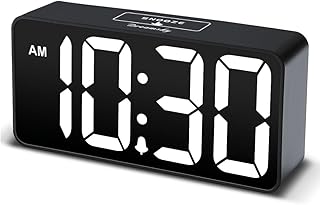
The DreamSky occupies a useful middle ground. Most clocks make you choose between digits you can read from the doorway and a body small enough for a cluttered nightstand. This one narrows that gap by giving the numbers most of the front panel.
Brightness control is the part that matters at night. A large digit clock without a proper dimmer is a lamp, and the ability to bring the display down is what makes a bigger display liveable in a dark bedroom.
Everything else is deliberately ordinary. There is an alarm, a snooze, and a backup cell that holds your settings when the power drops. Nothing here needs a manual, which is the point of the category.
Bottom line: the pick when you want readable numbers but do not have space for a large format clock.
- Power: mains with battery backup for settings
- Display: large digits in a compact housing, dimmable
- Alarm: alarm with snooze
- Placement: bedroom, living room, desk
- Controls: physical buttons on the housing
Best for people who find standard bedside clocks hard to read but do not want a large slab on the table. Works equally well on a living room shelf where it needs to be legible from a sofa.
Not the pick if you want a nightlight or a temperature readout, both of which other clocks in this list include.
Set the dimmer at night rather than during the day. A brightness level that looks reasonable in an afternoon room is usually far too high once the lights are off.
If the clock sits low relative to your pillow, angle it slightly away so the digits are readable without the display pointing directly at your eyes.

Pros
- Adjustable volume suits both light and heavy sleepers
- Dual alarms cover two schedules or a backup alarm
- Numbers stay legible from across a room
- Display brightness can be lowered for night
Cons
- Large footprint dominates a small nightstand
- Bright at close range even when dimmed
The feature that sets this clock apart is not the display size, it is the volume control. Most alarm clocks are fixed at a level the manufacturer chose, and clocks marketed for heavy sleepers are calibrated for the worst case, which makes them punishing for anyone else in the room.
Being able to set the volume turns one clock into something that works for a teenager who sleeps through everything and an adult who wakes at a whisper. Paired with two independent alarms, it also covers a household where two people get up at different times.
The large display is the trade off. Numbers this size are excellent from a doorway and overwhelming at arm's length, so this is a clock to place across the room or on a dresser rather than beside a pillow. Even with the brightness lowered, a 7.5 inch display puts out real light.
Bottom line: the most adaptable clock here if the alarm has to suit more than one person.
- Display: 7.5 inch with large LED numbers
- Alarms: two independent alarms
- Volume: adjustable alarm volume
- Brightness: adjustable display dimming
- Power: mains with settings backup
Best for shared bedrooms with two different wake times, for households where one person needs a much louder alarm than the other, and for anyone who reads the clock from across the room.
Skip it for a small nightstand at arm's length, where the display size works against you.
Place this one at least a couple of paces from the pillow. Large digit clocks are designed for distance viewing and the brightness that makes them readable at range is the same brightness that keeps you awake up close.
Use the second alarm as a backup rather than a second schedule if you have ever silenced an alarm in your sleep with no memory of it.

Pros
- Tall digits readable without glasses
- Dimmable across a usable range
- Loud alarm intended for deep sleepers
- Clear front panel controls
Cons
- Large numbers throw light at close range
- Louder than some people will want in a shared room
This clock exists for a specific and common problem: reading the time at night without reaching for glasses. The digits are tall enough to solve it, and unlike some large format clocks the brightness comes down far enough to be tolerable in a dark room.
The alarm is pitched at deep sleepers, which is a genuine strength and a caveat at the same time. It will get someone out of bed, and it will also wake the other person in the room. In a shared bedroom, a model with an adjustable volume is the safer choice.
Controls sit on the front where you can find them rather than underneath, which matters more than it sounds. A dimmer or snooze hidden on the base means feeling around the clock in the dark and often knocking it over.
Bottom line: the pick when legibility is the deciding factor and the room is yours alone.
- Display: large dimmable LED digits
- Alarm: loud alarm with snooze
- Controls: front mounted buttons
- Power: mains powered bedside clock
- Target use: bedrooms, seniors, heavy sleepers
Best for anyone who checks the time at night without glasses, for older users, and for deep sleepers who need volume rather than a gentle start.
Less suitable for a shared room where a fixed loud alarm will wake both people every morning.
Keep the clock out of direct sunlight, which makes LED digits harder to read during the day and can wash out the display entirely.
If the clock is for an older relative, set the alarm and the brightness before handing it over, and write the snooze and off buttons on a small label. The setting almost nobody gets right on the first try is the twelve or twenty four hour format.

Pros
- Ascending sound wakes light sleepers before full volume
- Red LED is gentler on night vision than blue or white
- Weekday and weekend scheduling avoids resetting alarms
- Two alarms for shared rooms
Cons
- Ascending start may be too slow for the deepest sleepers
- Mains powered, so the backup cell only holds settings
The ascending alarm is the reason to choose this one. A conventional alarm starts at full volume and is effective in the way a fire drill is effective. This one begins quietly and builds, so a light sleeper is often awake before it reaches full strength, and a deep sleeper still gets the volume in the end.
The weekday and weekend scheduling is the other useful piece. Clocks without it force you to switch the alarm off on Friday and remember to switch it back on Sunday night, which is exactly the kind of small task that gets forgotten.
Red digits are a deliberate choice rather than a styling decision. Red light is the least disruptive to night vision and tends to read as less harsh than blue or white at the same measured brightness, which is why it has been the bedroom standard for decades.
Bottom line: the best pick for anyone who hates being jolted awake but still needs the alarm to escalate.
- Display: red LED
- Alarms: dual alarm with weekday and weekend scheduling
- Wake sound: ascending volume
- Power: mains with settings backup
- Extras: snooze
Best for people who wake easily but hate the shock of a full volume alarm, and for households with different weekday and weekend routines.
Deep sleepers who have slept through ascending alarms before should look at the fixed loud models or the version with a volume control instead.
Set the weekend schedule at the same time as the weekday one, while the manual is still in front of you. It is the setting most people intend to configure later and never do.
Give the ascending alarm a longer lead than a conventional one. Since it starts quiet, the effective wake time is a minute or two after the set time rather than at it.

Pros
- One key per function removes guesswork in the dark
- Large snooze bar is easy to find half asleep
- Red LED display suits a bedroom
- Labelled controls make setup obvious
Cons
- Keyboard layout takes more front panel space
- Mains powered, so a cable is required
Most clocks in this price range stack functions onto two or three buttons and separate them by how long you hold each one. This Sharp does the opposite: it spreads the functions out as individual labelled keys, so setting the alarm is reading and pressing rather than remembering a sequence.
That design pays off twice. It makes the initial setup something you do once without a manual, and it makes the clock safe to operate in the dark, because each key is in a fixed place and does one thing.
The large snooze is the second half of the idea. A wide bar means a sleepy hand landing anywhere in the area does the right thing, instead of finding a small off button of the same size and shape and cancelling the alarm entirely.
Bottom line: the best choice for anyone who has ever turned an alarm off by accident while trying to snooze it.
- Controls: keyboard style individual keys
- Snooze: large easy access control
- Display: red LED
- Power: mains with settings retention
- Alarm: standard alarm with snooze
Best for people who struggle with modern control layouts, for older users, and for anyone who wants to change an alarm time quickly without relearning a button sequence.
Also a strong choice for a guest room, since a visitor can work it out at a glance.
If you compare this against the travel clock at the top of the list, the difference is philosophy. The travel model simplifies by removing functions. This one simplifies by giving every function its own key. Both are easy in the dark for different reasons.
Choose this if you actually use dual settings and want them accessible. Choose the travel model if you want the fewest possible controls and no cable.

Pros
- Runs on batteries so it works with no outlet nearby
- Keeps working through a power cut, alarm included
- Night light helps with getting up in the dark
- Indoor temperature readout on the same display
Cons
- Cells need replacing rather than plugging in
- Display cannot stay at full brightness continuously
The reason to buy this clock is the absence of a cable. A nightstand with no outlet behind it, a shelf across the room, a bedside table that is really just a chair: these are the situations where every mains clock fails and this one does not.
It also solves a problem most mains clocks quietly do not. A backup cell in a plug in clock holds the settings during a power cut but usually will not sound the alarm. A fully battery powered clock has no such gap, which makes it the honest answer for anyone in an area with unreliable power.
The night light and the temperature readout are useful additions rather than headline features. The night light matters more of the two, since it covers the walk to the door without switching on a lamp and waking everyone.
Bottom line: the pick when there is no outlet, or when you want an alarm that still fires when the power is out.
- Power: battery operated, cordless
- Display: digital with night light
- Extras: indoor temperature readout
- Alarm: alarm with snooze
- Placement: any table or shelf, no outlet required
Best for bedrooms where the nearest outlet is across the room, for dorm rooms and rentals where you cannot rearrange the wiring, and for anyone who wants an alarm that survives a blackout.
Less suitable if you want a permanently bright display, which battery power cannot sustain.
Replace the cells on a schedule rather than waiting for the display to fade, since a weakening battery affects alarm volume before it affects the display.
Treat the temperature readout as a rough guide. A clock measures the air immediately around itself, so a position near a radiator, a window or a lamp will read several degrees away from the rest of the room.

Pros
- Full brightness range covers bright rooms and dark bedrooms
- Colour display options rather than a single red or blue
- Compact enough for a nightstand
- Snooze on a clear control
Cons
- Colour displays read as busier than plain red at night
- Mains powered, so a cable is needed
Most bedroom clocks assume you want the display to disappear. This one assumes the opposite: that a clock can be part of how the room looks, and gives you colour options plus a brightness range wide enough to go from a lit room down to night time levels.
The wide brightness range is what makes that workable. A colour display stuck at one level is a nuisance in a dark bedroom, whereas one that can be taken right down gives you the look during the evening and something liveable overnight.
Size wise it stays compact, so it fits a nightstand without taking it over. It is worth knowing that colour digits generally read as busier than plain red at night, so if your priority is the least visually intrusive clock possible, the red LED models are the more disciplined choice.
Bottom line: the pick for a bedroom or desk where you want the clock to be seen rather than hidden.
- Display: colour LED with full range brightness control
- Size: compact bedside format
- Alarm: alarm with snooze
- Power: mains powered
- Placement: bedroom, desk, shelf
Best for desks, teenagers' rooms and bedrooms where the clock is meant to be visible, and for anyone who finds plain red displays dated.
Not the pick for the most light sensitive sleepers, who are better served by a red display dimmed to a faint glow.
Choose the colour first and the brightness second, in a dark room. Colours differ in perceived brightness at the same setting, so a level that suits one shade can be too much in another.
Keep the clock off the same surface as a phone charger if you can. Two light sources on one nightstand is usually what makes a bedroom feel bright at night, not the clock alone.
How to Choose a Simple Alarm Clock
Almost every buying guide for this category ranks clocks by how many functions they pack in. That is backwards. A clock is a single-purpose object that has to work while you are at your least capable, so the useful questions are about friction, not features. The five criteria below are the ones that actually change how a clock feels after a month on the nightstand.
Controls You Can Find Without Looking

This is the criterion that decides whether a clock feels simple, and it has nothing to do with the number of features. What matters is whether each function has its own physical control. A clock with a separate snooze bar, a separate alarm switch and a separate dimmer can be operated blind within a week of owning it, because your hand learns three distinct shapes. A clock that puts alarm setting, time setting and volume behind the same two buttons, distinguished only by how long you hold them, has to be re-learned every time you change it.
Look at how the snooze is implemented in particular. The best designs give you a large bar or the entire top surface, so a sleepy hand landing anywhere in the neighbourhood does the right thing. The Sharp model with keyboard-style controls goes furthest here, laying the functions out as separate labelled keys rather than stacking them into modes. The worst designs put snooze next to a small off button of the same size and shape, which is how people end up switching the alarm off entirely and oversleeping.
A related detail: check whether the alarm on-off is a physical switch or a soft button. A switch shows its state visually, so you can confirm the alarm is armed with a glance before you fall asleep. A soft button relies on a small icon on the display, which is easy to miss and easy to knock off while feeling for the snooze.
How Far the Display Actually Dims

Nearly every clock in this category advertises a dimmer, and the range is enormous. Some have two levels, high and slightly less high, and the low setting still throws enough light to read by. Others use a wheel or a multi-step control that takes the digits down to a faint glow. If you are sensitive to light while sleeping, this single specification will matter more than everything else on the box.
Colour plays into it as well. Red LEDs, used on both Sharp models here, are the traditional choice for bedrooms because red light is the least disruptive to night vision and tends to read as less harsh at the same measured brightness. Blue and white displays look cleaner in a photograph and more aggressive at two in the morning. The REACHER clock takes a different route and offers colour options with a full brightness range, which suits people who want the display visible from across the room rather than invisible from the pillow.
One practical check before you commit: find out whether the dimmer control is on the front or hidden underneath. A dimmer wheel on the side or back is fine because you set it once. A dimmer that shares a button with something else means you will change brightness by accident while reaching for snooze.
Power Source: Outlet, Battery, or Both
There are three power arrangements in this list and they suit three different situations. Mains-powered clocks with a battery backup, such as the Amazon Basics oval and both Sharp units, keep the display lit continuously and fall back to the battery only to preserve the time and alarm settings through a power cut. The backup battery in these models is usually not enough to sound the alarm, which is worth knowing before you rely on one during storm season.
Fully battery-operated clocks, like the Peakeep night light model, cut the cord entirely. That is the right answer for a nightstand with no nearby outlet, for a shelf across the room, or for anyone who dislikes a visible cable. The trade-off is that the display cannot stay lit permanently without draining cells, so these designs either use a very dim always-on display or light up on a tap.
Travel clocks are the third case. The No Bells No Whistles model runs on a battery and is built small and light enough to throw in a bag, which also makes it the least disruptive option for a guest room. If a clock is going to move around, a mains cable is a liability rather than a feature.
Alarm Volume and How the Sound Begins
Two clocks can both be described as loud and wake you in completely different ways. A conventional alarm starts at full volume immediately, which is effective and unpleasant. An ascending alarm, which the Sharp heavy sleeper model uses, starts quiet and builds, so a light sleeper is often up before it reaches full strength and a deep sleeper still gets the volume eventually. Which one you want depends less on how deeply you sleep and more on whether you share the room.
Adjustable volume is the feature most often missing and most often missed. The large-display dual alarm model in this list includes a volume control, which turns one clock into something that works for both a teenager who sleeps through anything and an adult who wakes at a whisper. Without it you are stuck with whatever level the manufacturer chose, and clocks marketed at heavy sleepers are calibrated for the worst case.
Dual alarms are worth having even in a single-occupant bedroom. The second alarm covers the weekend schedule, or acts as a backup ten minutes after the first for anyone who has ever silenced an alarm in their sleep and has no memory of doing it.
Digit Size and Reading It Without Glasses
Display size is the specification most people get wrong in both directions. The 7.5-inch large-display model and the Peakeep unit aimed at seniors use tall digits that stay legible from across a room and without corrective lenses. That is genuinely useful if you check the time from a doorway or if your eyesight is not what it was. It is a poor choice on a small nightstand at arm’s length, where the same digits become a light source pointed at your face.
Small-format clocks like the DreamSky and the Amazon Basics oval put the numbers at a size that suits a bedside table and leave the footprint small enough to share space with a lamp, a book and a glass of water. Measure the space you actually have before you buy the biggest display you can find.
A few models add a second line of information such as indoor temperature. It is a small convenience rather than a reason to choose a clock, and on a crowded display it can make the time itself harder to pick out at a glance.
Snooze Behaviour: Interval, Repeats, and Auto Shut-Off

Snooze is the function people use most and research least. Three things vary between models and none of them appear in the headline specifications. The first is the interval. Most clocks in this category use a fixed period of around nine minutes, inherited from mechanical designs where the gear spacing decided the number. A few allow you to change it, which matters if your routine needs a longer buffer than the factory setting.
The second is how many times snooze will repeat before the clock gives up. Some models keep going indefinitely until you switch the alarm off, which is what you want if snoozing is part of your routine. Others stop after a set number of cycles or after roughly an hour, on the theory that an alarm nobody has silenced is an alarm nobody is hearing. Neither behaviour is wrong, but discovering which one you own on a morning that matters is unpleasant.
The third is what the display does while snoozing. A clock that shows a small indicator to confirm the alarm is merely paused, rather than cancelled, removes the doubt that sends people reaching for their phone to double-check. It is a tiny design decision that has an outsized effect on whether you fall back asleep.
| Clock | Power | Display size | Stands out for |
|---|---|---|---|
| No Bells No Whistles Travel | Battery | Small | Fewest controls, packs easily |
| Amazon Basics Oval | Mains, battery backup | Small | Nightlight and compact footprint |
| DreamSky Small Digital | Mains, battery backup | Small to medium | Big numbers in a small body |
| 7.5-Inch Dual Alarm | Mains, battery backup | Large | Adjustable volume, dual alarms |
| Peakeep Loud Digital | Mains, battery backup | Large | Legibility for older eyes |
| Sharp Heavy Sleeper | Mains, battery backup | Medium | Ascending wake sound, red LED |
| Sharp Keyboard Controls | Mains, battery backup | Medium | One key per function |
| Peakeep Night Light | Battery only | Small | No cable, indoor temperature |
| REACHER Colorful LED | Mains, battery backup | Small to medium | Colour choice, wide brightness range |
If your nightstand is also home to a phone charger and a lamp, the compact models are the safer buy. If the clock has to be readable from the other side of the room, jump straight to the large-display group. Our buying guides follow the same approach for other rooms.
Why You Should Trust Us
We build these shortlists from what manufacturers publish and what verified buyers report, then we throw out anything that does not match the category. That matters here more than usual, because a search for a simple alarm clock returns smart displays, radios with twenty presets and voice assistants, all of which are the opposite of simple. Every clock on this page is a dedicated timepiece with physical controls.
We also separate claims that can be checked from claims that cannot. Digit height, power arrangement, the presence of a volume control and whether the alarm ramps up are all stated by the manufacturer and easy to confirm. Vague promises about being gentle or intuitive are not, so we ignore them and describe the mechanism instead. Where a model is aimed at a specific person, such as a heavy sleeper or someone with weaker eyesight, we say so rather than pretending one clock suits everyone.
Final Thoughts
The No Bells No Whistles Digital Travel Alarm Clock is our best overall because it commits to the brief. It does one job, its controls are physical and few, it runs on a battery so it works anywhere, and it is small enough to move between a nightstand and a suitcase. If your complaint about modern clocks is that they do too much, this is the direct answer.
The Amazon Basics Small Digital Oval Alarm Clock is the best value pick. It covers the essentials that most people actually use, a dimmable LED display, a snooze function, a nightlight and a battery backup to hold settings through an outage, in a footprint that does not take over the table. For a guest room or a second bedroom it is usually enough.
For specific situations, pick by the problem. Sleep through everything? The Sharp heavy sleeper model with its ascending wake sound, or the 7.5-inch dual alarm clock with adjustable volume. Reading the time without glasses? The Peakeep large-digit model. No outlet near the bed? The battery-only Peakeep with the night light. And if you want the display to be part of the room rather than hidden, the REACHER colour LED covers that. More comparisons like this one are collected in our home and kitchen section.
Frequently Asked Questions
What makes a simple alarm clock different from a smart clock?
A simple alarm clock has no network connection, no account and no app. You set the time and the alarm with buttons on the device, and it keeps working during an internet outage or after a company stops supporting a product. Smart displays do more, but they also update themselves, sometimes change their interface, and need setup before they can tell you the time.
Will the battery backup sound the alarm during a power cut?
Usually not. On most mains-powered clocks the backup cell exists to preserve the time and alarm settings so you are not resetting the clock after every outage. If you need an alarm that definitely sounds when the power is out, choose a fully battery-operated model instead, such as the Peakeep night light clock in this list.
Are large-display clocks better for bedrooms in 2026?
Only if you need to read the time from a distance or without glasses. A large display at arm’s length becomes a light source in a dark room, and even a good dimmer cannot fully undo the effect of tall bright digits half a metre from your face. Match the digit size to the viewing distance, not to the biggest number on the listing.
How do I stop hitting the wrong button when the alarm goes off?
Choose a clock where snooze is physically different from everything else, ideally a wide bar or the whole top panel, and where the alarm on-off is a switch rather than a button. Clocks that separate functions onto distinct keys, like the Sharp keyboard-control model, are much harder to get wrong while half asleep.
Does the colour of the display matter for sleep?
Red is the traditional bedroom choice because it is the least disruptive to night vision and generally reads as gentler than blue or white at the same brightness. That said, a display you can dim far enough matters more than the colour. If you want more guidance on setting up a comfortable bedroom, browse our article archive.









Write Your Review
No reviews yet. Be the first to share your experience!