

Roofs almost never leak through the middle of a field of shingles. They leak where the roof meets something else: a chimney, a vent pipe, a skylight, a wall. Those junctions are covered by flashing, and when flashing fails, the sealant around it is usually what gave up first. Our shortlist covers 8 roof sealant for flashing products from Dicor, Liquid Rubber, Flex Seal and more, grouped by the four quite different forms they come in.
Our top pick is the Dicor 501LSW self-leveling lap sealant for doing the specific job this search is usually about, sealing horizontal seams and flashing edges with a compound that flows into the joint rather than sitting on top of it. One caution that runs through this whole guide: sealant patches a flashing problem, it does not fix flashing that has corroded or lifted. This list is current for October 2026.

Pros
- Self-levels into horizontal seams without tooling
- Stated EPDM compatibility rather than left to guesswork
- UV stabilised, non-staining and HAPS free
- Very high rating average across a large sample
Cons
- Runs downhill on any sloped or vertical surface
- Single tube covers a limited run
This is the product most people searching for flashing sealant actually need. A self-leveling compound flows out under its own weight and fills a horizontal seam completely, which means no tooling, no voids underneath, and a finished joint that sheds water rather than holding it in a tooled hollow.
It also states EPDM compatibility outright. Petroleum-based sealants can degrade EPDM rubber, and on RV roofs and flat roofing that is a real failure mode rather than a theoretical one, so a product that names its substrate is worth more than one that lists none.
White is the right colour for anything horizontal in sun, since it reflects rather than absorbs the energy that ages sealant fastest. The one hard limit is geometry: on a slope or a vertical face this will run, and you need a non-sag product instead.
Bottom line: the specialist for horizontal seams, and the default choice for flashing on flat and RV roofs.
- Model: 501LSW-1
- Type: self-leveling lap sealant
- Volume: 10.3 fl oz tube
- Colour: white, range includes black, grey, ivory, almond, tan
- Substrate: EPDM compatible
- Properties: UV stabilised, no stain, HAPS free
- Role: secondary seal on horizontal surfaces
Clean back to a sound surface and let the joint dry fully; sealant applied over trapped moisture bubbles and lifts.
Use on horizontal seams only. On slopes and vertical faces choose a non-sag sealant, a brushed coating or a tape.
Check the minimum application temperature before working in cold weather; cold surfaces prevent both curing and adhesion.
Inspect repairs each autumn and re-coat before cracks appear rather than after a leak starts.

Pros
- Reaches complex shapes a brush cannot
- Two cans avoid running out mid-job
- Fast to apply for emergency repairs
- Largest rating history in this category
Cons
- Very thin film per coat, so many passes are needed
- Black absorbs heat and ages faster in sun
A spray earns its place in a roof repair kit for one reason: it gets rubber onto shapes a brush cannot reach. Around a vent boot, into the angle where flashing meets a wall, along a corrugated edge, a can gets coverage where a brush leaves gaps.
The two pack is a practical touch rather than an upsell. Sprays lay down a very thin film per pass, and building enough thickness to actually resist water takes several coats, which is exactly when a single can runs dry.
Be realistic about what it is. Spray sealant is excellent for stopping an active leak today and for coating complicated shapes; it is a poor way to waterproof any significant flat area, where a brushed coating puts down far more material for the money. Black also runs hotter and ages faster than white in full sun.
Bottom line: the value pick and the emergency answer, best kept for shapes rather than areas.
- Type: rubberised sealant spray
- Volume: 17 oz per can, 2 cans
- Colour: black
- Application: aerosol spray, multiple coats
- Use: leaks, flashing edges, irregular shapes
Apply several light coats rather than one heavy one, allowing each to set; a single thick pass runs and cures unevenly.
Mask surrounding areas. Overspray travels much further than expected on a breezy roof.
Work upwind and wear a respirator; aerosol solvents on a still, hot roof are unpleasant and hazardous.
Never spray near an open flame or a running flue.

Pros
- Flexible rubberised film
- Convenient single can size for small jobs
- Established brand support
- Fast to apply
Cons
- Thin film per coat
- Black finish ages faster in direct sun
This is the single can version of the same idea as the Flex Seal spray, and the sensible reason to choose it is scale: one modest repair around a vent or a short length of flashing edge does not need two large cans.
The film is flexible once cured, which matters on a roof where thermal movement is constant and a brittle sealant cracks at the first cold snap. As with any spray, thickness comes from repeated light coats rather than one heavy pass.
Gorilla's distribution is the quiet advantage: it is stocked everywhere, so a mid-repair top-up is a trip to a local shop rather than a wait for delivery.
Bottom line: the small-job spray, for touch-ups rather than campaigns.
- Type: waterproofing spray
- Volume: 16 oz
- Colour: black
- Finish: flexible rubberised
- Use: cracks, seams, flashing edges
Choose this for a single small repair; choose the two-pack if you are working along any length of seam.
For flat areas, a brushed coating gives far more material per pound spent.
Shake thoroughly and test the spray pattern off the roof before committing.
Wear a respirator and keep away from ignition sources.

Pros
- Builds real thickness per coat
- Brush application gives control at edges
- Flexible once cured
- Covers more area per pound than spray
Cons
- Slower to apply than a spray
- Needs a dry spell for full cure
Where a spray struggles is thickness, and that is exactly what a brushed liquid rubber delivers. One coat of this puts down substantially more material than several passes with an aerosol, which is what you want at the base of flashing or across a small flat area where the coating is doing waterproofing rather than cosmetic sealing.
Brushing also gives control. You can work material deliberately into a seam and feather it out at the edges, rather than relying on where the aerosol lands, and that edge detail is usually where a repair eventually fails.
The costs are time and weather. Brushing is slower, and the film needs a dry spell to cure properly, so this is a planned repair rather than an emergency one in the rain.
Bottom line: the brush option, and the right choice when thickness matters more than speed.
- Type: brush-on liquid rubber coating
- Properties: waterproof, flexible, breathable
- Application: brush or roller
- Use: flashing bases, seams, small flat areas
Work the first coat into the seam with a stiff brush rather than laying it on; the bond happens in that first thin layer.
Build subsequent coats after each has set, and feather edges rather than leaving a hard line where water can lift it.
Check the forecast for a clear dry window before starting; a shower during cure ruins the film.
Clean brushes immediately; cured rubber coating does not come off.
Pros
- Gallon coverage suits real roof areas
- White reflects solar energy and ages slower
- Elastomeric film accommodates movement
- Designed for flat and metal roofs
Cons
- Overkill for a single flashing joint
- Needs a settled dry spell to apply and cure
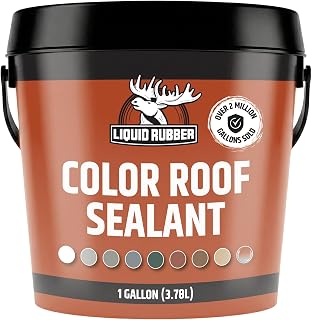
This is the product for when the flashing repair turns into a roof section repair. A gallon covers a real area, and an elastomeric coating stretches with the thermal movement that opens seams in the first place rather than cracking alongside it.
White is the significant specification. On a flat roof in full sun a black coating reaches temperatures that age it quickly and push heat into the building below; a reflective white coating stays substantially cooler and lasts longer for the same chemistry.
It is not the product for a single joint around a vent, where a tube of self-leveling sealant does the job for a fraction of the cost. Buy this when the area rather than the joint is the problem.
Bottom line: the roof-area answer, and the coolest-running product here.
- Volume: 1 gallon
- Colour: white
- Type: elastomeric roof coating
- Surfaces: flat and metal roofs
- Application: brush or roller
Whole flat roof sections, metal roof panels and large areas around multiple flashing details.
Not economical for a single seam.
Apply in a settled dry spell with several dry days behind and ahead; elastomeric coatings need time to cure.
Prime or clean per the instructions; adhesion on chalky old coatings is poor without preparation.

Pros
- Useful middle size between spray and gallon
- Brushable for controlled application
- Flexible waterproof film
- Widely stocked brand
Cons
- Black ages faster in direct sun
- Less economical per litre than a gallon
Most roof repairs are neither a single joint nor a whole roof, and this is the size for the middle. Thirty-two ounces covers several flashing details or a modest patch without committing to a gallon that will skin over in the tin before you use it again.
Being brushable it builds proper thickness and lets you work material into a seam, which is the part of a repair that determines whether it survives a winter.
Black is the only real reservation. On a sunlit horizontal surface it runs hotter and ages faster than a white coating, so where the repair is exposed and flat, the white gallon is the more durable choice even at a higher price.
Bottom line: the sensible middle size, for a handful of details rather than one joint or a whole roof.
- Volume: 32 oz
- Type: brush-on liquid rubber sealant
- Colour: black
- Properties: waterproof, flexible
- Use: patches, seams, flashing details
Choose this over a spray when you need thickness, and over a gallon when you have only a few details to seal.
Prefer a white coating for exposed horizontal repairs in full sun.
Reseal the container carefully; part-used liquid rubber skins over quickly once air reaches it.
Apply within the stated temperature range and allow a dry cure window.

Pros
- Bonds without primer to wood, OSB, concrete and PVC
- Installs from 0 to 120 degrees Fahrenheit
- 180 day exposure guarantee
- Slip-resistant top layer for safer installation
Cons
- Demands a clean, dry surface
- Straight seams only, awkward on complex shapes
For a straight seam, a tape is frequently a better answer than any liquid. It bridges the joint with a continuous membrane, it is the same thickness everywhere, and there is no cure time to plan around: rolled down properly, it is working immediately.
The acrylic adhesive here bonds without primer to wood, OSB, concrete and PVC, and installs anywhere from 0 to 120 degrees Fahrenheit, which is a far wider working window than butyl allows. A 180 day exposure guarantee means it can also sit uncovered while the rest of a job progresses, and the top layer is slip resistant, which matters when you are standing on it.
Two conditions decide whether it lasts. The surface must be genuinely clean and dry, because an adhesive cannot bond through dust or moisture, and the tape must be rolled down firmly with a hand roller. Finger pressure along a long seam produces edges that lift within a season and then channel water underneath, which is worse than no repair at all.
Bottom line: the best answer for straight seams, provided you prepare the surface and own a roller.
- Type: acrylic flashing tape
- Adhesive: advanced acrylic, no primer required
- Installation range: 0 to 120 degrees Fahrenheit
- Exposure guarantee: 180 days
- Substrates: wood, OSB, concrete, PVC
- Top layer: slip resistant
Clean and dry the surface, then roll the tape down with a hand roller rather than pressing by hand; adhesive bonds under pressure.
Start at the lowest point and overlap upward so water runs over joins rather than into them.
Straight seams, sheathing joints and flashing details on new or exposed construction.
Not for irregular shapes or damp, dirty surfaces where a liquid coating copes better.

Pros
- Butyl conforms to irregular surfaces
- 50 foot roll covers long runs
- Multi-surface adhesion
- Can be overcoated with liquid rubber
Cons
- Butyl is temperature sensitive during application
- Messy to handle in heat
Butyl behaves differently from acrylic tape, and the difference is conformability. Where an acrylic tape wants a flat, clean plane, butyl squashes into texture and around slight irregularities, which suits older roofing and repairs on surfaces that are not perfectly true.
Fifty feet is a generous run, enough to treat every seam on a small flat roof, and it can be overcoated with liquid rubber from the same brand to build a continuous system rather than a series of patches.
Its weakness is temperature. Butyl goes stiff in cold and becomes soft and sticky in heat, so the comfortable working window is narrower than for acrylic. In hot weather chill the roll before use and cut lengths as you go.
Bottom line: the conformable tape, for irregular surfaces where acrylic will not sit flat.
- Size: 2 in x 50 ft
- Adhesive: butyl
- Surfaces: multi-surface
- Compatibility: overcoatable with liquid rubber
- Use: seams, flashing edges, irregular surfaces
Work in moderate temperatures where possible; chill the roll in hot weather and warm the surface in cold.
Roll firmly and overlap ends by a couple of inches, always working uphill.
Wear gloves; butyl adhesive on skin is difficult to remove and picks up grit that then contaminates the seam.
Store the roll flat and out of direct sun so the adhesive does not migrate.
How to Choose a Roof Sealant for Flashing
Four formats compete under one search term and they are not interchangeable. Tube sealants fill joints. Sprays coat quickly and thinly. Brushed liquid coatings build a thick membrane. Tapes bridge a gap mechanically. Pick the format that matches the shape of the problem before comparing brands.
Self-Leveling Versus Non-Sag: The Mistake That Ruins a Repair

This distinction matters more than any brand choice and catches people constantly. Self-leveling sealant, such as the Dicor 501LSW, is formulated to flow out and settle into a joint under its own weight, which produces a smooth, fully filled seam with no tooling required. It is designed for horizontal surfaces: flat roofs, RV roofs, the tops of flashing where it meets a wall.
Apply it to a sloped or vertical surface and it does exactly what the name promises, which is run downhill and leave the joint you were sealing exposed. For vertical work you need a non-sag or non-leveling sealant, which holds its shape after tooling.
The practical rule is simple: if water would pool there, use self-leveling. If water would run off, use non-sag, a brushed coating or a tape. Getting this wrong wastes both the material and the afternoon.
Sprays, Brushed Coatings and Where Each Belongs
Spray sealants such as Flex Seal MAX and the Gorilla waterproofing spray are the quickest way to cover an awkward shape, and their strength is exactly that: getting rubber onto a rough surface with lots of angles that a brush cannot easily reach. Their weakness is film thickness. A spray puts down a very thin layer per pass, and building the millimetre or so that actually resists water means many coats and patience.
Brushed liquid coatings such as the Liquid Rubber gallons and the Gorilla Patch and Seal liquid put down a far thicker film per coat, which is what you want on a flat roof area or around the base of flashing where the coating is doing structural waterproofing rather than cosmetic sealing. They take longer to apply and cover much more area per pot than a can of spray.
A useful way to decide: sprays for complicated shapes and small areas, brushed coatings for flat expanses and anywhere you need real thickness. Using a spray to waterproof a flat roof is an expensive way to achieve very little.
Tapes: The Format Most People Overlook

Butyl and acrylic flashing tapes bridge a joint mechanically rather than filling it chemically, and for a straight seam they are often both faster and more durable than any liquid. The ZIP System flashing tape uses an advanced acrylic adhesive that bonds without primer to wood, OSB, concrete and PVC, installs anywhere from 0 to 120 degrees Fahrenheit, and carries a 180 day exposure guarantee, which is a far wider working window than most adhesives manage. The Liquid Rubber butyl seam tape is the more conformable option for irregular surfaces, at the cost of a narrower comfortable temperature range.
Tapes are unforgiving about surface preparation and temperature, since an adhesive needs a clean, dry, warm surface to bond. Applied correctly they last for years; applied to a dusty or damp surface they lift at the edge within a season and then channel water underneath, which is worse than not having applied anything.
Roll the tape down firmly with a hand roller rather than pressing it with your fingers. Adhesive bonds under pressure, and finger pressure is not enough across a long seam.
Surface Preparation Decides Everything

Almost every failed roof sealant repair failed at preparation rather than in the tube. The surface must be clean, dry and free of loose material, and on an old roof that means removing failed sealant entirely rather than applying fresh material on top of it. New sealant bonds to the old layer, the old layer is still failing, and the whole assembly lifts together.
Dry matters more than it sounds. A roof that looks dry after morning dew is not dry in the joints, and a sealant applied over trapped moisture will bubble or fail to adhere. Work in the middle of a dry day, with at least a couple of dry days behind you if the repair follows heavy rain.
Check the minimum application temperature on the container. Most of these products want a surface temperature well above freezing, and a cold surface prevents both curing and adhesion. Emergency repairs in winter are exactly the ones that fail by spring.
Material Compatibility
Roofing materials are not chemically neutral toward each other. EPDM rubber, TPO, modified bitumen, galvanised steel, aluminium and asphalt shingle all have different requirements, and some sealants attack some substrates. Petroleum-based products in particular can degrade EPDM, which is why the Dicor product specifies EPDM compatibility explicitly rather than leaving buyers to guess. Dicor also describes its lap sealant as a secondary seal, which is an unusually honest piece of labelling: it is there to protect and supplement the primary waterproofing detail, not to replace it.
Read the substrate list before buying, and where an old repair is present, identify what it was before adding to it. If you cannot determine the existing material, removing it entirely and starting from the deck is safer than layering an unknown chemistry on top.
Colour, UV and Service Life
Sunlight is what eventually destroys every product here. Black sealants absorb heat and reach much higher temperatures on a summer roof than white ones, which accelerates ageing and, on a flat roof, adds to the cooling load of the building underneath.
White or light coloured sealants, such as the Dicor white lap sealant and the Liquid Rubber white roof coating, reflect a substantial part of that energy. On any horizontal surface exposed to full sun, that is the more durable choice as well as the cooler one. Black remains the sensible pick where the repair is hidden, on a vertical face, or where matching a dark roof matters.
Whatever you use, treat sealant as maintenance rather than a permanent fix. Inspect repairs annually, ideally in autumn before the weather turns, and re-coat before a crack appears rather than after water has found it.
When Sealant Is the Wrong Answer
The honest limit of this whole category: sealant seals joints, it does not replace flashing. If the metal has corroded through, lifted from the wall, or was never installed correctly, no amount of rubber will hold for more than a season or two, because the water is being directed into the building by the geometry rather than merely seeping through a gap.
Signs that you are past the sealant stage include repairs that fail repeatedly in the same spot, staining on the interior ceiling away from the visible leak, and flashing that moves when pressed. All three mean the flashing itself needs replacing by someone who can lift the surrounding roofing to do it properly.
Used within its limits, though, sealant is genuinely valuable. It buys years on a sound flashing detail that has simply weathered, and it stops an active leak today while you arrange a proper repair for the summer.
Working Safely on the Roof Itself
The sealant is the cheap part of this job; the fall is not. Roof work causes a large share of serious DIY injuries every year, and flashing repairs are particularly risky because the details that leak sit at the edges, at chimneys and around skylights, which is exactly where people lean out to reach.
Three rules cover most of it. Never work on a wet, mossy or frosty roof, since all three are far more slippery than they look from the ladder. Extend the ladder three rungs above the gutter line and tie it off rather than relying on friction. And never work alone on a roof, because the point of a second person is not to hand you tools but to call an ambulance.
If the flashing in question is on a steep pitch, above a second storey, or around a chimney you cannot reach from a stable position, this is the point to stop and hire someone. A roofer with proper anchors will do the same repair in an hour, and no sealant is worth a fall.
| Pick | Format | Colour | Best for |
|---|---|---|---|
| Dicor 501LSW | Self-leveling lap sealant, tube | White | Horizontal seams, EPDM roofs |
| Flex Seal MAX | Spray, 17 oz, 2-pack | Black | Awkward shapes, quick coverage |
| Gorilla Waterproofing Spray | Spray, 16 oz | Black | Small repairs and touch-ups |
| Flex Seal Liquid | Brushed rubber coating | Various | Building thickness by brush |
| Liquid Rubber Roof Sealant | Brushed coating, 1 gallon | White | Flat and metal roofs, reflective |
| Gorilla Patch & Seal Liquid | Brushed coating, 32 oz | Black | Medium repairs |
| ZIP System Flashing Tape | Acrylic adhesive tape | Manufacturer colour | Sheathing seams, flashing details |
| Liquid Rubber Seam Tape | Butyl tape, 2 in x 50 ft | Manufacturer colour | Irregular surfaces, multi-surface |
If corrosion rather than water ingress is the underlying problem, our guide to rust prevention paint covers the other half of that job.
Why You Should Trust Us
Every product here was checked against its live listing for format, colour, stated substrate compatibility and the application method it is designed for. Format is the specification that decides whether a product works at all in a given repair, and because all four formats appear under the same search term, we have labelled each one plainly rather than treating them as alternatives to one another.
We have not exposed these sealants to a season on a roof, and we do not claim to have. What we can do is explain the self-leveling and non-sag distinction that ruins more repairs than any product defect, set out the preparation that determines whether any of them bond, and say plainly where sealant stops being the right answer. More home repair guides are in our tools and home improvement section.
Final Thoughts
The Dicor 501LSW self-leveling lap sealant is our best overall pick for flashing work. It is formulated for exactly the job this search usually describes, flowing into a horizontal seam and filling it completely without tooling, it states EPDM compatibility explicitly, and it comes in white, which survives sun better than black. Its rating average is among the highest here across a very large sample.
For best value, the Flex Seal MAX two-pack covers the widest range of emergency jobs for the least money. A spray reaches shapes a brush cannot, and having a second can matters when the first runs out halfway along a seam in failing light.
After that, match the format to the repair. The Liquid Rubber white gallon for a flat or metal roof where reflectivity and thickness both count, the Gorilla spray or Patch and Seal liquid for medium repairs, the Flex Seal Liquid where you want to build a film by brush, and either tape for a straight seam that would be better bridged than filled. And if the same spot has failed twice, stop buying sealant and replace the flashing.
Frequently Asked Questions
Can I use self-leveling sealant on a sloped roof?
No. Self-leveling compounds are designed to flow out under their own weight on horizontal surfaces, so on a slope they run downhill and leave the joint exposed. Use a non-sag sealant, a brushed coating or a flashing tape on anything sloped or vertical.
Can I apply roof sealant for flashing over an old repair?
Only if the old material is sound and compatible. New sealant bonds to whatever it touches, so applying it over failing sealant means the new layer lifts along with the old one. Remove failed material back to a solid surface, and if you cannot identify what is already there, remove it entirely.
Will roof sealant stick to a damp surface?
Poorly, and that is the most common reason repairs fail. Joints hold moisture long after the surface looks dry, so work in the middle of a dry day with a couple of dry days behind you, and check the minimum application temperature on the container before starting in cold weather.
Is black or white sealant better?
On any horizontal surface in full sun, white. It reflects a substantial part of the solar energy that would otherwise heat the sealant and accelerate its ageing, and on a flat roof it reduces cooling load as well. Black is fine for hidden repairs, vertical faces, or where matching a dark roof matters.
How long does a sealant repair last in 2026?
Treat it as maintenance measured in years rather than a permanent fix, with sunlight the main limit. Inspect repairs each autumn and re-coat before cracks appear rather than after water has found them. If the same detail fails repeatedly, the flashing itself needs replacing rather than resealing. More repair guides are in our category index.

Write Your Review
No reviews yet. Be the first to share your experience!