

Radon gas enters residential structures through microscopic foundation cracks, unsealed crawlspaces, sump pump basins, and structural joints, silently accumulating in basements and ground-level living quarters. Because this hazardous radioactive byproduct of decaying uranium in natural soil possesses neither color, odor, nor taste, selecting a dependable radon testing method represents an urgent safety priority for every homeowner. Prolonged residential exposure remains the primary contributor to lung cancer among non-smokers, claiming thousands of lives annually. Evaluating indoor air quality requires specialized hardware designed to track real-world fluctuations caused by barometric changes, heating ventilation systems, and seasonal weather patterns. To assist homeowners, home inspectors, and buyers in identifying optimal screening solutions, we evaluated 8 radon testing method options from AccuStar, Ecosense, Airthings and more for September 2026.
Our top pick is the Airthings 2950 Wave Radon for its seamless smartphone connectivity and clear visual air quality indicators. Sustaining safe indoor air aligns directly with regular home maintenance regimens, much like having reliable workshop essentials highlighted across our tools and home improvement guides. Continuous digital tracking empowers occupants with real-time feedback, seasonal data logging, and immediate warnings whenever gas levels surpass standard safe thresholds. Understanding the performance profiles of various monitoring devices allows you to select the right tool for short-term real estate assessments or permanent basement monitoring.

Pros
- Continuous long-term and short-term radon tracking
- Touch-free color-coded glow ring for quick visual checks
- No lab fees or disposable sampling kits required
- Measures ambient temperature and humidity alongside radon
Cons
- Requires proximity for Bluetooth sync unless paired with a separate hub
- Lacks a digital numerical display directly on the device face
The Airthings Wave Radon is a smart indoor air monitor designed for homeowners who want reliable, ongoing surveillance of radon gas concentrations. Unlike traditional charcoal canisters, this device remains active year-round, capturing shifting radon trends alongside indoor humidity and temperature levels.
A major strength is its touchless interface. Waving your hand in front of the unit activates a color-coded glow ring that immediately indicates whether levels are safe, warning-level, or hazardous. Detailed historical data syncs via Bluetooth to the Airthings smartphone app, where you can generate shareable analytical reports without paying any lab fees.
A notable limitation is the absence of an integrated numerical screen on the device itself, meaning you must open the app to see specific picocurie counts. Users who want constant off-site cloud access without manual Bluetooth syncing will also need to invest in a separate Airthings Hub.
Bottom line: The Airthings Wave Radon delivers effortless long-term indoor monitoring with intuitive visual alerts and dependable smartphone reporting, making it a standout selection for proactive home safety.
- Monitored metrics: Radon gas, humidity, temperature
- Power source: Battery operated
- Wireless connectivity: Bluetooth and Smartlink
- Indicator type: Color-coded glow ring (Green, Yellow, Red)
- Data tracking: Daily, weekly, monthly, and yearly averages
- Software platform: Airthings mobile app and online dashboard
- Lab fees: None required
Position the battery-powered unit on a wall or flat tabletop in your lowest lived-in level, keeping it away from drafty windows, exterior doors, and direct ventilation vents.
Download the free Airthings companion app to your smartphone and pair the device via Bluetooth to begin continuous background measurements.
Wave your hand across the front sensor at any time for an immediate green, yellow, or red air quality check, or open the app to review historical trend charts.
Because the unit operates on battery power, installation requires zero electrical wiring or nearby wall outlets. It can be mounted to standard drywall with a single screw or set upright on a shelf.
The detector pairs via Bluetooth directly with iOS and Android smartphones running the Airthings app. For remote monitoring outside Bluetooth range, it connects seamlessly with the optional Airthings Hub via Smartlink.
Pros
- Fast initial reading within 10 minutes
- High counting efficiency with pulsed ion chamber
- Clear on-device OLED display
- Visual trend charts via smartphone app
Cons
- Requires continuous power cable connection rather than battery operation
- Relies on local Bluetooth range rather than built-in Wi-Fi sync
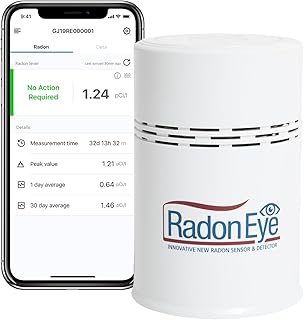
The Ecosense RadonEye RD200 is a continuous radon monitor engineered for residential spaces. Built for homeowners and property managers, it replaces slow traditional charcoal kits with real-time digital monitoring to track changing gas levels across days and months.
A primary strength is the patented pulsed ion chamber design, which produces 30 counts per hour per pCi/L. This sensitivity allows the device to present an initial measurement in just 10 minutes, while the crisp OLED display keeps critical readings visible without opening a smartphone.
Because it requires an active power cable connection, placement is limited to areas near electrical outlets. In addition, data syncing relies on short-range Bluetooth rather than Wi-Fi, meaning users who want remote monitoring while away from home may find it restrictive.
Bottom line: The Ecosense RD200 delivers rapid, sensitive radon detection and informative trend graphs, making it a dependable pick for proactive indoor air quality tracking.
- Brand: Ecosense
- Model: RD200 (RadonEye)
- Sensor Type: Patented pulsed ion chamber
- Counting Efficiency: 30 counts per hour per pCi/L
- Display: Built-in OLED screen
- Connectivity: Bluetooth
- Measurement Interval: Hourly averages with first reading in 10 minutes
- Power Source: Included AC power cable
- Warranty: 12 months limited warranty
- Ecosense RadonEye RD200 continuous radon detector
- AC power cable adapter
- Comprehensive user guide
- Access to the free mobile companion app
- Email customer support contact information
Setting up the device requires plugging the included power cable into a standard wall outlet in the lowest lived-in level of your home. Place it on an elevated surface away from drafty windows, exterior doors, or heating and cooling vents for the most reliable results.
Download the free Ecosense companion application onto a compatible iOS or Android mobile device. Enable Bluetooth on your smartphone to establish a connection, view hourly trend charts, and export historical radon records.

Pros
- Continuous real-time and average readouts
- Audible and visual alarm modes
- Clear backlit digital screen
- Automatic daily sensor self-checks
- Manufactured in the USA
Cons
- Requires a constant wall outlet connection without battery backup
- Lacks smart app connectivity and remote phone notifications
- Bulky plug-in housing can block adjacent electrical sockets
The Safety Siren Pro Series 4 is an electronic radon gas monitor engineered for persistent household screening. Designed for homeowners, landlords, and property managers, it continuously evaluates indoor air quality to track fluctuating gas levels in basements and living areas.
Its primary strength lies in its dual averaging capability, which displays real-time levels alongside short-term and long-term averages. An easy-to-read backlit digital display ensures simple monitoring in dark spaces, while customizable sound and visual alarms provide prompt alerts when readings surpass safe thresholds.
Because it relies entirely on AC wall power, this unit lacks a secondary battery backup during electrical outages. Shoppers looking for wireless smartphone logging, graph exports, or automated smart home integration may want to explore battery-operated smart monitors instead.
Bottom line: The Safety Siren Pro Series 4 offers dependable, straightforward radon screening with clear visual warnings and continuous tracking for any household.
- Brand: SafetySiren
- Model: Pro Series 4 (4th Generation)
- Device Type: Plug-in electronic radon gas monitor
- Display: Backlit digital LCD screen
- Alert System: Three audible alarm modes and visual alert
- Data Tracking: Real-time, short-term, and long-term averages
- Diagnostic System: Automatic 24-hour self-check
- Country of Origin: Made in USA
Position the detector in the lowest regularly occupied level of your home, such as a basement, recreation room, or ground-floor bedroom. Plug the device directly into an unswitched standard 120-volt wall outlet away from exterior doors, drafts, windows, and high-humidity areas like laundry facilities.
Once plugged in, the unit begins sampling ambient air immediately and calculates rolling averages over time. It operates entirely as a standalone plug-in appliance, requiring no Wi-Fi networks, Bluetooth pairing, or specialized smartphone software to deliver reliable alerts.
To ensure proper performance, keep the sensor vents clear of household dust and pet hair by gently wiping the exterior casing with a clean, dry cloth. Never spray liquid cleaners or aerosol sprays directly near the intake openings.
The unit runs an automated self-check cycle every 24 hours to monitor internal electronics and sensor responsiveness. If the audible warning triggers or levels rise persistently above recommended safety limits, consult a certified radon mitigation professional to assess your home ventilation.

Pros
- Weighted, tip-resistant charcoal canister design
- Rapid 48 to 96-hour exposure window
- Certified laboratory analysis
- Effective for checking radon mitigation systems
Cons
- Requires keeping home doors and windows closed throughout screening
- Must be mailed to an external laboratory for result processing
- Single-use screening device cannot provide continuous real-time readouts
The AccuStar Charcoal Screening Kit is a short-duration radon detector designed for property owners seeking fast, certified indoor air quality data. Built around an activated carbon medium, this passive device measures radon concentration levels over an exposure timeframe spanning two to four days.
A major design advantage is the weighted canister with a low center of gravity. This physical stability minimizes accidental displacement from household pets or draft currents while maintaining closed-building protocol. It also serves as an effective diagnostic device to confirm that an existing radon mitigation fan is operating properly.
Because this is a passive snapshot screening method, it requires keeping windows and non-entry doors shut before and during exposure. Homeowners who want ongoing digital graphs or immediate on-device readings should look toward electronic monitors instead.
Bottom line: The AccuStar charcoal screening kit offers dependable, certified air quality analysis with minimal fuss, making it a solid pick for quick real estate inspections and mitigation system checks.
- Brand: AccuStar
- Detection Type: Activated Charcoal Adsorption
- Deployment Duration: 48 to 96 Hours (2 to 4 Days)
- Target Gas: Radon Gas (Rn-222)
- Analysis Type: Certified Laboratory Processing
- Design: Weighted, Low Center of Gravity Canister
- Operating Conditions: Closed Building Environment
Deploy the canister in the lowest lived-in level of the home, placing it roughly two to three feet off the ground and away from drafts, exterior doors, and direct sunlight.
Maintain closed-house conditions by keeping all exterior doors and windows shut for 12 hours prior to start and throughout the 48 to 96-hour monitoring period.
Once the screening window closes, seal the container securely, complete the included information sheet, and dispatch the package promptly to the designated analysis laboratory.
This charcoal device is tailored for prospective home buyers and sellers who must complete rapid radon assessments under strict closing deadlines.
It also suits homeowners who recently installed or serviced a radon mitigation exhaust system and want to verify that ambient gas concentrations dropped to safe levels.
Households with curious cats, dogs, or small children will appreciate the stable, tip-resistant weighted base that stays upright during measurement.

Pros
- Built-in rechargeable battery for portable room-to-room checks
- No recurring lab analysis fees
- Clear LCD screen showing short and long term averages
- Rapid initial results within 24 hours
Cons
- Brand lacks widespread name recognition in home safety
- No smartphone app or wireless smart home integration
- Requires periodic recharging rather than standard replaceable batteries
The Funny Kitchen Portable Radon Detector offers an accessible way to monitor indoor air quality for radioactive gas accumulation. Designed for homeowners, parents, and property managers, it provides real-time digital feedback rather than requiring disposable charcoal canisters.
One notable feature is the dual display mode, which tracks short-term daily and weekly fluctuations alongside long-term averages. Powered by a rechargeable battery, the unit moves easily between basements, living spaces, and bedrooms without relying on fixed wall outlets.
Those seeking modern smart home connectivity or companion app integration will need to look elsewhere, as this device functions strictly offline with an on-board screen. Buyers who prefer standardized single-use lab mailers for official real estate transactions may also find digital monitors less conventional.
Bottom line: This portable digital detector delivers reliable daily peace of mind with rapid on-screen tracking and zero recurring lab fees for ongoing home observation.
- Sampling Method: Passive radon diffusion chamber
- Detection Method: Alpha spectrometry
- Power Source: Rechargeable battery
- Measurement Range: 0 to 9999 pCi/L
- Measurement Accuracy: 5% plus or minus 0.14 pCi/L
- Operating Temperature: 32 to 104 degrees Fahrenheit
- Operating Relative Humidity: Less than 85%
- Display: Digital LCD with daily, weekly, and long-term concentrations
Charge the device completely before initial placement, and power it on in the lowest livable area of your home, such as a finished basement or ground-floor bedroom.
Position the monitor on a flat surface away from drafts, exterior doors, windows, and high-heat sources to maintain steady airflow into the diffusion chamber.
Allow the monitor to sample the air for at least 24 hours to generate the first short-term reading, and keep it in place longer for accurate seasonal averages.
This digital detector is tailored for homeowners and renters who want continuous visibility into their indoor air quality without paying recurring mail-in lab fees.
It is especially suitable for families with infants, elderly relatives, or sensitive individuals living in areas known for elevated radon concentrations.
Anyone managing multiple rooms or properties will appreciate the rechargeable battery, making room-to-room relocations quick and convenient.

Pros
- Crisp 300 DPI tempered glass display
- Switchable between pCi/L and Bq/m3 units
- Blinking visual alert for elevated levels
- Versatile tabletop and wall mount holder
- Convenient battery-operated portability
Cons
- Lacks smart app connectivity or Wi-Fi data logging
- Requires periodic replacement of AAA batteries
- Visual alert only with no audible sound option mentioned
The CRADTEC Digital Radon Detector III provides continuous radon tracking for homeowners and property managers who want clear indoor air quality metrics. Powered by three standard AAA batteries, this compact monitor can be deployed anywhere in a living space without being tethered to a wall outlet.
Standout qualities include a sharp 300 DPI tempered glass screen that resists scratches and delivers crisp visibility across standard indoor lighting. Its updated internal sensor and refined algorithm calculate both short-term variations and long-term averages, while allowing users to toggle between standard US pCi/L readings and metric Bq/m3 values. A blinking alert triggers whenever readings jump, signaling the need for increased ventilation.
However, the device does not provide wireless synchronization, smart home tie-ins, or historical data graphs via a mobile app. Those who want remote smartphone notifications or automated ventilation triggers through smart home ecosystems may prefer an internet-connected monitor.
Bottom line: For property owners seeking a simple, standalone device that provides dependable continuous readings without digital bloat, this battery-powered monitor offers clean visuals and great portability.
- Brand: CRADTEC
- Model: Digital Radon Detector III
- Display: 300 DPI high-clarity screen with tempered glass
- Power Source: 3 AAA batteries
- Measurement Units: Switchable between pCi/L and Bq/m3
- Monitoring Modes: Short-term and long-term level detection
- Mounting Options: Freestanding tabletop stand or wall mount
- Alert System: Visual blinking indicator
- Color: White
Place the device in the lowest routinely occupied level of your home, such as a basement or first-floor living room, kept away from direct drafts, exterior windows, and air vents.
Insert three fresh AAA batteries to power on the unit, then select your preferred measurement units between pCi/L and Bq/m3 using the rear controls.
Use the multi-position bracket to either set the monitor on an elevated table or mount it securely to an interior wall at typical breathing height.
Allow the monitor to operate undisturbed to establish an accurate short-term reading, and keep an eye out for the flashing alert if readings surge.
Homeowners and renters who want an easy, self-contained way to track indoor radon concentrations over several seasons without dealing with disposable lab kits or recurring fees.
Basement dwellers and home office workers who spend significant hours in subterranean spaces where soil gas tends to gather in higher amounts.
Anyone who prefers a straightforward hardware unit with an easy-to-read screen over devices requiring smartphone apps, Bluetooth syncing, or continuous Wi-Fi signals.

Pros
- Fast initial readout in six hours
- Long-term tracking capacity up to 504 days
- Rechargeable battery for wireless portability
- Clear LCD showing multiple time intervals
Cons
- Requires six hours before displaying initial data
- Long-term data requires manual navigation through menu screens
- Sleep mode required to achieve the full 45-day battery duration
The AEGTEST HOUND-1011 is a portable digital radon monitor designed for residential basements, living areas, and travel. It serves homeowners and property managers who want continuous indoor air quality data without relying on disposable charcoal canisters or mailing samples to laboratories.
A built-in semiconductor sensor records radon concentrations between 0.09 and 1000 pCi/L, providing an initial assessment within six hours and hourly refreshes afterward. Users can toggle between standard pCi/L and metric Bq/m³ units, track multi-day averages directly on the LCD screen, and run the device wirelessly for up to 45 days in sleep mode.
While convenient and responsive, the unit needs several hours before generating its first reading, making it unsuitable for instant spot-checks. Buyers looking for smart home ecosystem integration or remote smartphone notifications via Wi-Fi should look elsewhere, as this model relies strictly on its local display.
Bottom line: The AEGTEST HOUND-1011 provides reliable continuous tracking, clear interval screens, and portable battery operation for anyone monitoring basement radon levels.
- Sensor Type: High-precision semiconductor sensor
- Measurement Range: 0.09 to 1000 pCi/L
- Measurement Units: pCi/L and Bq/m³
- Initial Reading Time: 6 hours
- Update Frequency: Hourly
- Monitoring Range: 6 hours to 504 days
- Battery Life: Up to 45 days in sleep mode
- Power Interface: Type-C charging port
- Included Accessories: Stand, lanyard, and Type-C cable
- 1 AEGTEST HOUND-1011 Portable Radon Detector
- 1 Tabletop Support Stand
- 1 USB Type-C Charging Cable
- 1 Carrying Lanyard
- 1 User Operation Manual
This detector is ideal for homeowners, buyers, and tenants who want to keep ongoing tabs on radon levels in basements, crawlspaces, or ground-floor rooms. Its portable footprint makes it simple to move from room to room to isolate problem zones.
Frequent travelers and property managers will also appreciate the 45-day battery reserve and lanyard attachment. It delivers clear on-device metrics without requiring internet pairing, subscriptions, or laboratory processing fees.

Pros
- Fast 10-minute continuous updates
- Exceptional 7-year battery life on 2 AA batteries
- Easy-to-read E-Ink screen with color status alerts
- Tracks humidity, temperature, and atmospheric pressure
- Supports dual units for US and international standards
Cons
- E-Ink screen lacks a built-in backlight for low-light viewing
- Full data history and tracking features require the smartphone app
- Does not include audio alarms for elevated gas levels
The Aranet Radon Plus is an advanced digital monitor engineered for continuous indoor air observation. Built for homeowners and renters who want vigilant tracking in basements or living spaces, this compact device records radon concentrations alongside ambient temperature, relative humidity, and air pressure.
Its standout capability is a rapid 10-minute measurement cycle, allowing users to spot rising concentration levels much faster than traditional daily monitors. The ultra-low-power architecture delivers an exceptional battery life of up to seven years on two AA batteries, while the clear E-Ink screen provides instant color-coded visual feedback.
While the E-Ink display offers sharp contrast in daylight, it does not include a backlight for viewing in unlit basements without an external light source. Additionally, those seeking an audible high-radon alert may find the visual-only display notification limiting unless paired with the companion mobile application.
Bottom line: The Aranet Radon Plus delivers exceptional convenience with its rapid 10-minute intervals and multi-year battery life, making it a premier continuous monitoring choice for modern homes.
- Measurement Interval: Every 10 minutes
- Power Source: 2 AA batteries (up to 7-year lifespan)
- Display: E-Ink screen with color-coded status indicator (Green, Yellow, Red)
- Sensors: Radon, temperature, relative humidity, atmospheric pressure
- Radon Units: Dual measurement support (pCi/L and Bq/m³)
- Temperature Units: Fahrenheit (°F) and Celsius (°C)
- Average Calculations: Real-time, 24-hour, 7-day, and 30-day averages
- Operation Modes: Standalone display or companion app connectivity
Getting started with the device is straightforward since it operates completely wire-free out of the box with two AA batteries. Homeowners can set it on a shelf or mount it in a basement, ground-floor living room, or bedroom where continuous tracking is needed.
The unit works in two distinct configurations. Users can operate it as a standalone monitor using the high-contrast E-Ink display, or pair it with the free mobile app to access detailed historical graphs, customize alert thresholds, and switch between regional measurement units such as pCi/L and Bq/m³.
How fast does the detector report new readings?
The device measures radon concentrations continuously, updating the on-screen reading every 10 minutes to deliver swift notification of rising gas levels.
Do I need to plug the unit into a wall outlet?
No. The detector is fully battery-powered using standard AA batteries, which last up to seven years due to its ultra-low-power internal hardware.
What other environmental factors does it track?
In addition to radon, the monitor records relative humidity, ambient temperature, and atmospheric barometric pressure.
How to Choose the Best Radon Testing Methods: Buying Guide
Sensor Response Time and Measurement Cadence

Indoor radon gas concentrations never remain static. Instead, levels rise and fall across hours and days in response to changing barometric pressures, subterranean moisture shifts, and residential ventilation habits. When selecting an effective radon testing method, understanding how rapidly a detector responds to these atmospheric swings is paramount. Devices engineered with high-efficiency counting chambers register fluctuations quickly, allowing homeowners to see how daily activities such as running kitchen range hoods or opening basement windows influence indoor air quality.
Modern digital monitors display considerable variation in their initial reading speeds and continuous measurement intervals. For instance, the Ecosense Continuous Home Radon Detector delivers its first reading in just 10 minutes, utilizing patented ion chamber sensor technology that achieves a counting efficiency of 30 counts per hour per picocurie per liter. Similarly, the Radon Plus Radon Detector for Home with 10-Minute updates continuous measurements every 10 minutes through its ultra-low-power architecture, providing immediate insight into shifting gas concentrations.
Other portable devices adopt a more deliberate cadence to calculate stable rolling averages. The HOUND-1011 Portable Radon Detector for Home displays initial readings within 6 hours before shifting to hourly updates, utilizing a high-precision semiconductor sensor designed for long-term stability. Meanwhile, monitors like the Funny Kitchen Home Radon Detector,Portable Radon generate an initial indication within 24 hours, making it suitable for general residential checks. Selecting the proper cadence depends on whether you require immediate feedback following home adjustments or prefer steady multi-day baseline tracking.
Continuous Digital Monitoring Versus Charcoal Adsorption
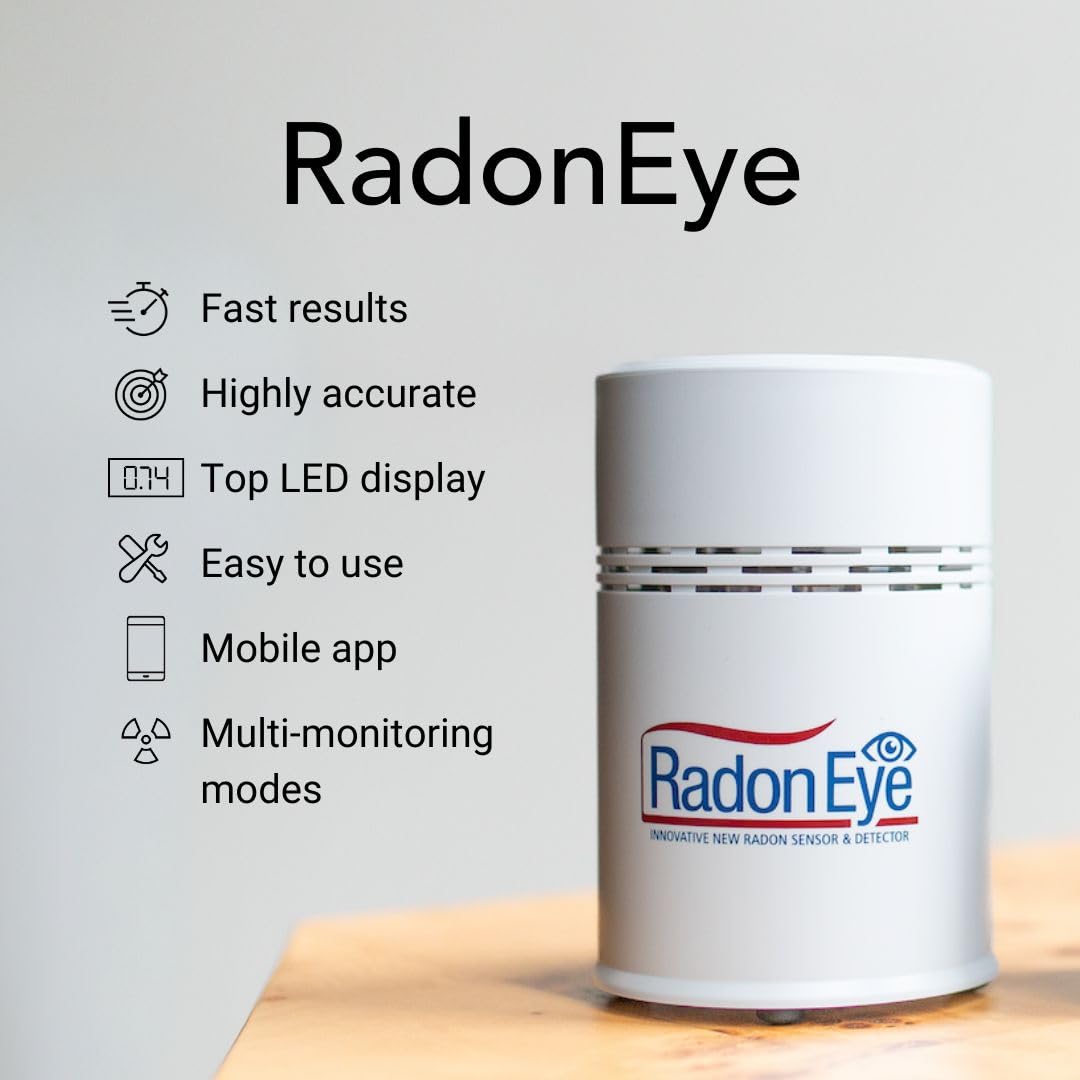
A primary consideration when choosing a radon testing method is deciding between a single-use passive canister and an active electronic monitoring device. Passive screening tools, such as the Radon Gas Test Kit AccuStar Charcoal Short Term, rely on activated charcoal adsorption. This method requires the container to remain undisturbed for 48 to 96 hours under strictly controlled closed-building conditions. Its weighted design and low center of gravity prevent accidental tipping, making it a reliable option for quick real estate transactions or assessing whether an active mitigation system is functioning properly.
However, charcoal devices represent a temporary snapshot rather than a long-term safety shield. Once the exposure window concludes, the canister must be mailed away for certified processing, incurring turnaround delays and one-time fees. In contrast, digital instruments like the Airthings 2950 Wave Radon eliminate recurring analysis costs completely. Digital hardware provides ongoing tracking across daily, weekly, monthly, and yearly intervals, letting you view real-time fluctuations straight from a smartphone dashboard.
Continuous electronic devices also provide added peace of mind through automated self-diagnostics and continuous tracking. The Safety Siren Pro Series 4 Plug-in Radon Detector runs an automatic daily self-check every 24 hours to ensure sensor integrity while displaying short-term and long-term averages. Setting up a screening unit requires thoughtful placement in the lowest living zone: much like checking structural alignment with accurate builders levels during home renovations, positioning your monitor undisturbed away from drafts ensures your readings reflect true residential exposure.
Power Delivery and Long-Term Placement Flexibility

The architectural layout of your basement or ground floor dictates which power configuration suits your living space. Radon enters homes from subterranean soil, meaning detectors must reside on the lowest finished level where family members spend time. If your basement includes readily accessible electrical outlets, a direct corded or plug-in device offers seamless continuous operation. The Safety Siren Pro Series 4 Plug-in Radon Detector plugs directly into standard wall outlets, eliminating worries about battery depletion during critical winter heating seasons. Similarly, the Ecosense Continuous Home Radon Detector includes a dedicated power cable to maintain uninterrupted ion chamber operation.
On the other hand, battery-powered monitors provide unlimited placement freedom, allowing homeowners to position devices away from drafty doorways, sump pits, and exterior walls without running extension cords across living spaces. The Digital Radon Detector III, White, Radon Monitor operates on 3 AAA batteries, pairing with a selectable holder that enables either freestanding tabletop placement or neat wall mounting. Taking battery longevity to the extreme, the Radon Plus Radon Detector for Home with 10-Minute achieves up to a 7-year operating lifetime using just 2 AA batteries, making it an exceptional set-and-forget safeguard.
Rechargeable internal cells provide a versatile middle ground for property managers who inspect multiple rooms or properties. The Funny Kitchen Home Radon Detector,Portable Radon features a low-consumption rechargeable battery, allowing you to easily carry the instrument from the basement to upper bedrooms to verify air quality across different floors. Meanwhile, the HOUND-1011 Portable Radon Detector for Home combines a continuous Type-C charging cable connection with an internal battery lasting up to 45 days in sleep mode, ensuring ongoing protection whether placed permanently on a basement shelf or taken along during property travel.
Display Clarity, On-Device Interfaces, and Alert Systems
When hazardous radioactive gas gathers in indoor air, clear and immediate communication from your screening hardware is essential. Different devices take distinct approaches to reporting data, ranging from minimalist visual indicators to elaborate digital screens and audible sirens. The Airthings 2950 Wave Radon incorporates an intuitive touch-free sensor: by simply waving your hand in front of the unit, a color-coded light illuminates green, yellow, or red to convey current air quality status, while detailed numeric graphs stream wirelessly via Bluetooth to the companion mobile application.
For homeowners who want instant on-device figures without opening a smartphone app, high-clarity digital displays are invaluable. The Digital Radon Detector III, White, Radon Monitor features a crisp screen boasting 300 DPI resolution beneath protective tempered glass with high light transmission, paired with a blinking alarm to notify occupants when gas levels surge unexpectedly. Navigating dark basement corners or utility rooms during installation often requires handy illumination from tools like rechargeable pen flashlights, and once positioned, the Safety Siren Pro Series 4 Plug-in Radon Detector ensures effortless monitoring through its clear backlit screen alongside three selectable audible alarm modes and visual alerts for hearing-impaired residents.
Advanced display technology also appears in modern monitors like the Radon Plus Radon Detector for Home with 10-Minute, which uses an E-Ink display that provides color-coded visual indications of gas levels in green, yellow, and red. E-Ink screens offer wide viewing angles in varied ambient lighting conditions while drawing virtually zero power between screen refreshes. Whether you prefer an audible buzzer, an illuminated screen, or an app notification, selecting an interface that matches your lifestyle guarantees that elevated gas levels never go unnoticed.
Extended Data Logging, Timeframes, and Measurement Units
Because radon levels fluctuate across days, seasons, and varying weather patterns, long-term data logging is necessary to understand your true annual exposure risk. A single day of heavy rain or high winds can create a temporary spike that does not necessarily reflect year-round conditions. The HOUND-1011 Portable Radon Detector for Home excels at contextual tracking, displaying historical averages spanning 6 hours, 24 hours, 48 hours, 72 hours, 96 hours, and up to 504 days directly on its LCD screen, giving you comprehensive insight into both immediate shifts and multi-season patterns.
Tracking both short-term and long-term averages is equally valuable when verifying whether remediation efforts or improved basement ventilation have effectively lowered gas concentrations. The Funny Kitchen Home Radon Detector,Portable Radon displays average daily, weekly, and long-term concentrations on screen, helping you confirm whether corrective modifications have succeeded. Similarly, the Ecosense Continuous Home Radon Detector logs hourly average data to generate a smart view radon trend chart in its mobile app, allowing you to examine granular patterns over weeks and months.
Measurement unit versatility also plays an important role, particularly for users navigating international standards or relocating between regions. The Digital Radon Detector III, White, Radon Monitor and the Radon Plus Radon Detector for Home with 10-Minute both support switchable units between picocuries per liter (pCi/L), the United States standard, and becquerels per cubic meter (Bq/m³), the metric standard used in Canada and Europe. Furthermore, devices like the Airthings 2950 Wave Radon and Radon Plus broaden your indoor air assessment by incorporating ambient temperature and humidity sensors, providing a complete picture of your home’s subterranean environment.
| Product | Power Source | Display or Visual Indicator | Measurement Tracking |
|---|---|---|---|
| Airthings 2950 Wave Radon | Battery-powered | Color-coded visual indication (Green, Yellow, Red) | Daily, weekly, monthly and yearly measurements |
| Ecosense Continuous Home Radon Detector | Power cable | OLED Display | Hourly basis average data |
| Safety Siren Pro Series 4 Plug-in Radon Detector | Plug-in | Backlit display | Short-term and long-term averages |
| Digital Radon Detector III, White, Radon Monitor | 3 AAA Batteries | Tempered glass | Switchable Between Bq/M3 and pCi/L |
| Radon Plus Radon Detector for Home with 10-Minute | 2 AA batteries | E-Ink display | Real-time, 24h, 7d, or 30d average readings |
Why You Should Trust Us
At Daily Deal Here, our editorial team brings decades of combined experience evaluating residential wellness equipment, safety hardware, and indoor environmental monitors. To identify the most dependable radon testing method options, we conduct extensive examinations of verified marketplace listings, manufacturer technical documentation, and public health guidelines. Rather than relying on superficial marketing claims, we analyze thousands of verified homeowner feedback themes, cataloging recurring user impressions regarding long-term reliability, sensor stability across shifting seasons, and companion software functionality.
Our selection methodology emphasizes hardware durability, counting efficiency, and day-to-day usability for both residential owners and professional property inspectors. We systematically compare technical architecture, such as ionization sensor mechanisms, power consumption profiles, and display legibility, ensuring each featured unit meets rigorous performance standards. We never claim proprietary physical evaluations or specialized scientific chamber trials. Instead, our objective recommendations stem from exhaustive data synthesis, real-world customer insights, and strict editorial curation designed to help you safeguard your household with total confidence.
Final Thoughts
Selecting an effective radon testing method is one of the most consequential decisions you can make to preserve indoor environmental health and protect your household from long-term radioactive gas hazards. Because soil gas infiltration shifts with changing weather conditions, barometric drops, and household ventilation patterns, relying on continuous digital detection provides far superior insight compared to brief one-off screenings. For most homeowners seeking effortless operation alongside comprehensive environmental data, our best overall recommendation is the Airthings 2950 Wave Radon. Its touch-free visual wave sensor, seamless Bluetooth connectivity, and integrated humidity and temperature tracking deliver complete peace of mind without ongoing processing fees.
Budget-conscious homeowners who want dependable digital tracking without excessive investment will appreciate the Funny Kitchen Home Radon Detector,Portable Radon as our top value selection. With its built-in rechargeable battery, clear LCD interface, and 24-hour initial feedback, it provides flexible room-to-room portability for checking basements, bedrooms, and family living spaces. For property owners and home inspectors who require rapid verification and high counting efficiency, the Ecosense Continuous Home Radon Detector serves as the premier pick for rapid detection, delivering its first reading in just 10 minutes through its professional-grade ion chamber sensor.
Whether you choose a permanently installed AC monitor, a battery-powered E-Ink display, or a multi-room portable sensor, maintaining a proactive monitoring routine is the key to preventing hazardous gas accumulation. Complementing your indoor air strategy with dependable home improvement gear, such as the recommendations found across our curated buying guides, helps ensure your entire property remains safe, efficient, and well maintained. Investing in an accurate radon testing method removes the guesswork from indoor air quality, giving your family the reliable data needed to take swift, effective mitigation action whenever levels rise.
Frequently Asked Questions About Radon Testing Methods
What is the most reliable radon testing method for an unfinished basement?
For unfinished basements, an active digital continuous monitor represents the most reliable radon testing method. Continuous units track gas fluctuations caused by barometric shifts and seasonal heating cycles, unlike brief single-use options that only capture a short window. A digital detector equipped with an illuminated display or smartphone connectivity allows you to observe ongoing short-term and long-term averages. Placing the detector at least twenty inches above the floor, away from exterior walls, sump pits, and drafty windows, ensures the sensor records representative air samples from the lowest level of your home.
How long does a typical radon testing method take to provide actionable readings?
The timeframe depends heavily on whether you utilize a rapid digital sensor or an activated charcoal collector. Certain fast-response digital devices deliver initial readings within ten minutes, while others require six to twenty-four hours to calculate an accurate starting baseline. However, because gas levels vary significantly day to day, establishing true actionable data requires monitoring over several weeks or months. For passive charcoal collectors, the device remains in place between forty-eight and ninety-six hours before being sent away for professional analysis to yield certified short-term results.
Why do indoor gas readings fluctuate when using a radon testing method in 2026?
Radon concentrations fluctuate constantly due to changing weather dynamics, soil moisture, and household airflow mechanics. During winter or windy periods, the stack effect pulls subterranean soil gases upward through foundation cracks as warm air rises inside the building. Operating central heating, exhaust fans, or air conditioning systems also alters indoor air pressure balances, causing significant swings across daily and weekly intervals. Modern digital devices capture these ongoing shifts, helping you identify whether brief spikes represent temporary atmospheric anomalies or persistent indoor air contamination requiring professional remediation.
Can a single radon testing method monitor an entire multi-story residence?
A single device cannot adequately assess an entire multi-story house because gas concentrations vary dramatically between different levels and zones. Radon typically enters through the foundation, resulting in higher readings in basements and ground floors than in upper bedrooms. To gain an accurate picture, place your primary monitor in the lowest occupied living space, then move portable units or install secondary devices in upper living areas. Exploring diverse home maintenance categories helps property owners develop a comprehensive strategy for monitoring air quality across every floor.
When should homeowners contact mitigation professionals based on a radon testing method?
Homeowners should take corrective action whenever long-term averages reach or exceed 4.0 picocuries per liter, the standard action level established by environmental protection authorities. Even at levels between 2.0 and 4.0 picocuries per liter, reducing indoor exposure is strongly advised, especially for households with children or sensitive individuals. If your digital monitor consistently displays elevated numbers across varying seasons, or if a short-term charcoal screening confirms elevated levels, consulting a certified remediation contractor to install a sub-slab depressurization system is the safest course of action.



Write Your Review
No reviews yet. Be the first to share your experience!