

DEET works, and that is exactly why it owns most of the shelf space in the bug spray aisle. It is also why so many shoppers go looking for something else: the smell that clings to a shirt for two days, the way it softens plastic sunglass arms and watch straps, the slick film it leaves on a forearm. A non-DEET insect repellent has to earn its place on a different set of terms, and the honest way to judge one is to read the active ingredient panel instead of trusting the word “natural” printed on the front of the bottle. That single habit separates a registered picaridin formula with a published protection window from a scented oil blend that asks you to reapply every hour. This roundup covers 10 picks from Sawyer Products, Badger Bug, Avon and more, grouped by what is actually inside the bottle and by what the listing is willing to promise about how long it lasts.
Our top pick is the Sawyer Products SP564 Premium Insect Repellent for its 20 percent picaridin formula in a lotion base that stays where you rub it instead of drifting onto food, gear and eyewear. From there the list splits into three honest tiers: registered synthetics such as picaridin and IR3535, plant-derived oil of lemon eucalyptus sprays that publish a protection window, and lighter essential oil blends that trade duration for a gentler scent. One product on the list is not a skin repellent at all, and we flag it clearly, because treating clothing is a different job with different rules. If your real problem is the yard rather than your forearms, our guide to the best bug sprays for outside your house is the better place to start. Stock and packaging change constantly on Amazon, so treat this as a shortlist for September 2026 rather than a permanent ranking.

Pros
- Full strength 20 percent picaridin, with up to fourteen hours printed on the bottle
- Lotion format goes only where you rub it, with no overspray onto food, tackle or camera gear
- Picaridin does not attack plastics and synthetic fabrics the way DEET can
- No aerosol propellant, so the bottle packs easily for travel
- One of the largest customer rating bases of any DEET-free repellent on Amazon
Cons
- Covering both arms and both legs by hand takes noticeably longer than spraying
- The fourteen hour figure is printed on the bottle rather than in the listing title, so it is easy to miss
- A lotion film can feel heavy on skin in high humidity
The Sawyer Products SP564 is a 4 ounce squeeze bottle of insect repellent lotion built around 20 percent picaridin, the concentration that anchors the top end of the DEET-free market. It is aimed at anyone who wants the strongest widely available non-DEET active without the smell, the fabric damage or the greasy residue that sends people looking for DEET alternatives in the first place.
The real argument for this bottle is the format. A lotion lands only where your hand puts it, which matters far more than it sounds when you are applying repellent next to a cooler, a fly rod, a lens or a small child. Nothing drifts, nothing coats the picnic table, and you use a fraction of the product an aerosol would burn through covering the same skin. Picaridin also avoids the plastic softening problem that makes DEET a poor neighbour for sunglasses, watch straps and technical fabrics.
The weakness is effort rather than substance. Application is slower than a spray, and on a humid afternoon the lotion film reads heavier on skin than a quick drying aerosol would. Disclosure is also oddly split: the listing title publishes the 20 percent figure and no duration at all, while the bottle in the listing photographs prints up to fourteen hours against mosquitoes and ticks. The number exists, it is simply not where a shopper looks first.
Bottom line: if you are buying one non-DEET repellent and it has to work around food, kids and gear, this is the bottle. The concentration is at the ceiling for the category and the format wastes nothing, which is exactly why it takes the top slot here.
- Active ingredient: picaridin
- Concentration stated on listing: 20 percent
- Format: lotion in a squeeze bottle
- Size: 4 ounces
- Protection window: up to 14 hours printed on the bottle, not stated in the listing title
- EPA registration number printed in listing title: no
- Model reference: SP564
- Propellant: none, non-aerosol
Best suited to anglers, photographers, campers and parents, in short anyone applying repellent in close quarters with equipment or food. The lotion format is also the sensible choice for anyone who has to apply repellent indoors before heading out, where an aerosol would coat the room.
It is less suited to groups in a hurry. If four people need covering at a trailhead in two minutes, an aerosol will beat it every time.
Dispense a coin sized amount and spread it in a thin even layer over exposed skin, working outward from the centre of each limb so you do not miss the back of the arm. Apply to your own hands last, then use those hands to work a small amount carefully around the jaw and neck, keeping it clear of eyes and lips.
The bottle prints up to fourteen hours against mosquitoes and ticks, but sweating and swimming shorten any repellent window, so treat the physical label as the authority on reapplication. Wash hands before eating.

Pros
- Publishes a clear six hour protection figure, which many rivals omit
- Oil of lemon eucalyptus is the one plant-derived active regulators treat on the same footing as synthetics
- Ships as a two-pack, so one bottle can live in the car and one in the pack
- Strong citrus scent that most people find far more tolerable than DEET
- The largest customer rating base of any product in this roundup
Cons
- The 30 percent concentration appears only in the product images, never in the listing title
- Public health guidance advises against use on children under three years old
- Six hours is short next to the twelve hour figure on the strongest picaridin picks
Repel Plant-Based Lemon Eucalyptus is the volume seller of the botanical repellent world, and this listing packages two 4 ounce bottles together. The active is oil of lemon eucalyptus, the plant extract whose working component is PMD, and it sits in a different tier from citronella and lemongrass blends because regulators treat it as a reviewed repellent rather than an exempt one.
What makes it the value pick is the combination of a published figure and a two-pack. The listing states six hours of protection against mosquitoes, which is a real commitment rather than a vague promise, and getting two bottles at once means you can keep one in the car without rationing. The scent is unmistakably citrus and eucalyptus, and for most households that is the entire reason they left DEET behind.
Two things are worth naming. The listing title does not print the concentration, which makes direct comparison awkward until you notice the 30 percent OLE figure sitting in the product images. More importantly, the Centers for Disease Control and Prevention advises against using oil of lemon eucalyptus or PMD on children under three, and that applies here regardless of how gentle the plant-based framing sounds.
Bottom line: for adults and older children who want a botanical active with a stated protection window and no fuss, this is the most sensible money on the list. Households with toddlers should look at the picaridin and IR3535 options instead.
- Active ingredient: oil of lemon eucalyptus
- Concentration: 30 percent shown in product images, not in the listing title
- Format: pump spray
- Size: 4 ounces per bottle, two bottles per pack
- Protection window stated on listing: 6 hours against mosquitoes
- EPA registration number printed in listing title: no
- Scent: citrus and eucalyptus
- Marketed as: DEET-free, plant-based
The Centers for Disease Control and Prevention advises that oil of lemon eucalyptus and its synthesized form PMD should not be used on children under three years of age. That guidance is the single most important thing to know about this bottle and it is not always obvious from the front label.
Keep the spray away from eyes and lips, apply it outdoors or in a ventilated space, and store the bottle out of direct sun. Follow the reapplication interval printed on the physical label rather than the figure in any listing.
A strong fit for adults and school age children who want a plant-derived active, and for households that go through repellent quickly enough to justify a two-pack. It suits backyard evenings, campsites and short trail days where six hours covers the whole outing.
It is the wrong choice for families with toddlers, and it is not the pick for a full day in heavy cover where a longer stated window would save you a reapplication.

Pros
- Full 20 percent picaridin in the fastest format to apply
- Fragrance free, which avoids the sweet floral note of many botanical sprays
- Dries to a light finish rather than the greasy film associated with DEET
- Largest can size among the sprays here, useful for covering a group
- Backed by one of the highest customer ratings in this roundup
Cons
- Aerosol overspray is hard to control near food, pets or camera gear
- The eight hour figure is printed on the can rather than in the listing title
- Pressurised cans are restricted in carry-on luggage
OFF! Clean Feel is the mainstream brand answer to picaridin, and this 5 ounce can pairs the full 20 percent concentration with a fragrance-free formulation. It exists for people who want the strongest common non-DEET active without either the smell of DEET or the sweet botanical scent that comes with lemon eucalyptus sprays.
Speed is the selling point. An aerosol covers two arms, two legs and a neck in well under a minute, which is why this is the can to reach for when a group is standing at a trailhead losing daylight. The finish lives up to the product name, drying to a light touch rather than the tacky layer that pushes people away from older repellents, and the fragrance-free formula means it will not fight with sunscreen or perfume.
The tradeoffs come with the format. Aerosol overspray is genuinely difficult to contain, so this is the wrong can to use next to an open cooler or a dog. The listing title also leans on the phrase long lasting without putting a number to it, even though the can in the product photographs plainly prints up to eight hours.
Bottom line: the best choice when you need to cover several people fast and nobody wants to smell like repellent afterwards. If control matters more than speed, the Sawyer lotion is the better buy.
- Active ingredient: picaridin
- Concentration stated on listing: 20 percent
- Format: aerosol, continuous spray
- Size: 5 ounces
- Protection window: up to 8 hours printed on the can, described only as long lasting in the listing title
- Fragrance: none, fragrance free
- EPA registration number printed in listing title: no
- Target pests named on listing: mosquitoes, ticks, flies
Hold the can roughly the length of your forearm from the skin and sweep steadily rather than holding in one place. Spray outdoors and downwind of other people, food and pets, then spread the product with your hand so the coverage is even instead of patchy.
Never spray directly at the face. Apply to your hands first, then transfer carefully to the neck and jawline while keeping well clear of eyes and mouth.
Choose this can if you value speed and a neutral scent, and if your repellent stays in the car or the garage rather than in a carry-on bag. Aerosols are restricted on flights, so frequent travellers are better served by a pump bottle.
If you want the same active with a published protection window, the Natrapel pump spray states twelve hours. If you want the same active without any propellant at all, the Ranger Ready pump is the closer match.

Pros
- States 30 percent oil of lemon eucalyptus, the highest botanical concentration here
- The only listing in this roundup that states its EPA-registered status outright
- Publishes a clear up to six hours protection figure
- Listing states it protects skin and gear, not skin alone
- Two-pack of pump bottles with no aerosol propellant
Cons
- Public health guidance advises against use on children under three years old
- Six hours falls short of the longest picaridin claims on this list
- The strong eucalyptus scent is polarising in enclosed spaces
Murphy's Naturals sits at the documented end of the botanical category. The product name itself carries three facts that most rivals bury or omit: 30 percent oil of lemon eucalyptus, EPA-registered status, and protection of up to six hours. In a category where labelling is famously vague, that transparency is the whole pitch.
The 30 percent figure matters because concentration is what buys duration with oil of lemon eucalyptus, exactly as it does with picaridin. Stating registered status matters even more, because it is the line between a duration claim submitted with supporting data and a duration claim written by a marketing team. The listing also notes that the spray covers gear as well as skin, which makes a two-pack easy to justify for a household that camps.
The limits are the ones built into the active itself. Six hours is honest but it is not twelve, so a full day outdoors means carrying the bottle. And the guidance from the Centers for Disease Control and Prevention against using oil of lemon eucalyptus or PMD on children under three applies here in full, no matter how natural the branding reads.
Bottom line: the pick for anyone who wants the plant-derived route with the paperwork attached. If you have been burned by vague botanical labels, this is the bottle that answers the questions before you ask them.
- Active ingredient: oil of lemon eucalyptus
- Concentration stated on listing: 30 percent
- Format: pump spray
- Size: 4 fluid ounces per bottle, two bottles per pack
- Protection window stated on listing: up to 6 hours
- Registration status stated on listing: EPA-registered
- Listing states use on: skin and gear
- Target pests named on listing: mosquitoes, ticks
The Centers for Disease Control and Prevention advises that oil of lemon eucalyptus and its synthesized form PMD should not be used on children under three years of age. At 30 percent this is the most concentrated botanical formula in the roundup, so that guidance deserves particular attention here.
Apply outdoors, avoid eyes and lips, and when treating gear let the fabric dry before packing it. Check the physical label for the registration number and for the reapplication interval.
Built for campers, hikers and gardeners who want a plant-derived active but refuse to buy on vague wording. The two-pack and the gear approval suit households that keep one bottle at home and one in the kit bag.
Not the right pick for families with toddlers, and not the pick for anyone who dislikes a strong eucalyptus scent in a car or a tent.
Pros
- Full 20 percent picaridin with the concentration printed in the product name
- Scent Zero formulation carries no added fragrance at all
- Two 3.4 ounce bottles, a size that suits carry-on liquid rules
- Pump spray rather than aerosol, so there is no propellant to declare
- Listing describes the formula as family friendly
Cons
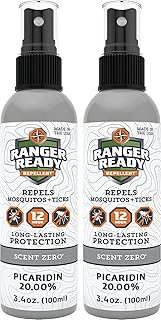
- The twelve hour figure and the EPA registered badge sit in the product images rather than in the listing title
- 3.4 ounce bottles run out faster than a full size can
- A pump spray needs spreading by hand for even coverage
Ranger Ready built its name on picaridin done properly, and the Scent Zero line strips out fragrance entirely. This listing pairs two 3.4 ounce pump bottles with the full 20 percent concentration printed directly in the product name, which is more than several bigger brands manage.
The appeal is precision without perfume. A pump spray gives you a coarser, more controllable pattern than an aerosol, so less product ends up on the ground or on the person standing next to you, and the absence of added fragrance means the bottle will not clash with sunscreen or leave a scent trail. The 3.4 ounce size is not an accident either; it is the standard carry-on liquid limit, which makes this a natural pack-and-fly option.
The gap is where the information lives. Ranger Ready states the concentration clearly in the title and then says nothing about hours there, even though the bottle prints twelve hours and the product images carry an EPA registered badge. The smaller bottles also empty faster than a 5 ounce can if several people are sharing.
Bottom line: the best fragrance-free pump option here, and the natural pick for travellers who want full strength picaridin without a pressurised can.
- Active ingredient: picaridin
- Concentration stated on listing: 20 percent
- Format: pump spray
- Size: 3.4 ounces per bottle, two bottles per pack
- Protection window: 12 hours printed on the bottle, not stated in the listing title
- Fragrance: none, described as Scent Zero
- EPA registration number printed in listing title: no
- Target pests named on listing: mosquitoes, ticks
Suits travellers, commuters and anyone who reacts badly to fragranced products. The carry-on friendly bottle size makes it the easiest full strength picaridin option to take on a plane, and the two-pack means one bottle can stay in a bag permanently.
Less suitable if you are covering a large group regularly, where a bigger can costs less effort per person.
Spray onto exposed skin from a short distance and then spread it evenly with your hand, since a pump pattern is coarser than an aerosol mist and can leave gaps. Do the ankles and the back of the neck deliberately, as those are the spots most people miss.
Because the listing publishes no duration, read the reapplication interval on the bottle itself and reapply after swimming or heavy sweating.

Pros
- States up to twelve hours of protection, the longest published figure here
- Full 20 percent picaridin concentration stated on the listing
- 1 ounce bottles are described as TSA-approved for carry-on use
- Four bottles per pack, enough to stock a car, a pack, a desk and a jacket
- Listing states the formula protects the whole family
Cons
- 1 ounce bottles empty quickly if you are covering arms and legs daily
- Four small bottles cost more packaging than one large one
- No EPA registration number appears in the listing title
Natrapel is the outdoor retail staple of the picaridin world, and this listing is the travel configuration: four 1 ounce pump bottles, each carrying 20 percent picaridin, with a stated protection window of up to twelve hours against mosquitoes and ticks.
That twelve hour figure is the standout number in this roundup. Several picaridin products state the same concentration and then decline to say how long it lasts, so a listing that publishes both is doing something useful. The one ounce format is the second half of the pitch: it clears carry-on liquid limits without argument, and four bottles means you can leave one in a glovebox, one in a daypack, one in a tackle box and one at a desk instead of hunting for the single bottle you own.
The catch is capacity. One ounce does not cover an adult many times over, so if you are treating arms and legs every evening this pack disappears quickly and you are paying for four sets of packaging. There is also no registration number in the listing title, so verify it on the bottle if that documentation matters to you.
Bottom line: the best travel repellent on the list and the longest published protection window here. Buy it as the bottle that lives in your bag, not as the household supply.
- Active ingredient: picaridin
- Concentration stated on listing: 20 percent
- Format: pump spray
- Size: 1 ounce per bottle, four bottles per pack
- Protection window stated on listing: up to 12 hours
- Travel status stated on listing: TSA-approved
- EPA registration number printed in listing title: no
- Target pests named on listing: mosquitoes, ticks
The 1 ounce bottle is the reason this pack exists. It sits inside standard carry-on liquid allowances, so it goes through security in the same bag as your toothpaste rather than into checked luggage or the bin. Aerosol repellents cannot make that claim.
Four bottles also means you can pre-position repellent rather than remembering to pack it. One in the car, one in the daypack and one in the suitcase covers most trips without a single decision.
Pump onto exposed skin and spread by hand, paying attention to ankles, wrists and the back of the neck. For tick pressure specifically, cover the lower legs thoroughly and consider pairing the spray with treated trousers rather than relying on skin alone.
The listing states up to twelve hours, but sweating and swimming shorten any repellent window, so reapply after either.

Pros
- One of the few widely stocked repellents built on IR3535 rather than picaridin or DEET
- Combines repellent and SPF 30 sunscreen in a single bottle
- Pump spray with no propellant, so it packs without restrictions
- Two-pack covers a household without a repeat order mid-season
- Sold and marketed as a family bug spray on the listing
Cons
- Neither the IR3535 concentration nor a protection window appears on the listing
- Sunscreen normally needs reapplying more often than repellent, which the combined bottle forces
- IR3535 is less familiar than picaridin, so comparison data is harder to find
The Avon Skin So Soft Bug Guard Plus range is the main route to IR3535 on the US market, and the Expedition version pairs that active with SPF 30 sunscreen in a pump spray. IR3535 is a synthetic derived from an amino acid, and it belongs in the same reviewed tier as picaridin rather than with exempt oil blends.
The two-in-one design is the appeal. Anyone who has tried to layer repellent and sunscreen correctly knows the ordering is fiddly and the coverage often ends up uneven, and a single bottle removes that problem for a beach day or a long paddle. The pump format packs without aerosol restrictions and the two-pack means one bottle can live permanently in a beach bag.
The frustration is disclosure. The listing names IR3535 and SPF 30 and then stops, publishing neither the repellent concentration nor a protection window. There is also a structural issue with combination products: sunscreen usually wants reapplying on a shorter cycle than repellent, so a single bottle nudges you toward over-applying the repellent or under-applying the sun protection.
Bottom line: a genuinely useful bottle for sunny open water and beach days where both products are needed anyway. For heavy sun exposure, separate bottles give you cleaner control over reapplication.
- Active ingredient: IR3535
- Concentration stated on listing: not stated
- Sun protection: SPF 30
- Format: pump spray
- Pack size: 2 bottles
- Protection window stated on listing: not stated
- EPA registration number printed in listing title: no
- Target pests named on listing: mosquitoes, ticks
Combination repellent and sunscreen products need a little thought. Sunscreen protection degrades with sweat, water and time faster than most repellent actives do, so follow the sunscreen reapplication guidance on the label rather than the repellent interval, and accept that you will be applying repellent more often than strictly necessary.
Apply outdoors, keep the spray away from eyes and lips, and check the age wording printed on the bottle before using it on young children.
Best for beach days, lake trips, paddling and open water fishing, where sun and insects arrive together and carrying two bottles is a nuisance. It also suits anyone who has reacted poorly to picaridin or lemon eucalyptus and wants a third option.
Less suitable for shaded woodland walks, where the sunscreen half of the bottle does nothing and you would rather have a stated protection window instead.

Pros
- States a three hour window rather than leaving duration unspoken
- Built on citronella and certified organic essential oils
- Aluminium bottle instead of plastic, which suits low waste households
- Vegan formulation stated on the listing
- Light plant scent rather than a chemical note
Cons
- Three hours is the shortest stated window in this roundup
- No concentration figure appears anywhere on the listing
- Essential oil blends are generally exempt from registration review rather than assessed
Badger makes the case for the honest short duration repellent. The formula is citronella plus a blend of certified organic essential oils, packaged in a 4 fluid ounce aluminium bottle, and the listing states three hours of protection rather than implying more.
That candour is the reason it earns a slot. Plenty of essential oil sprays avoid naming a duration entirely, and a brand that prints three hours on the front is telling you exactly what the product is for: a barbecue, a dog walk at dusk, an hour weeding the beds. The aluminium bottle and the vegan formulation appeal to the same buyer, and the scent is mild enough to use indoors before heading out.
The limits are structural rather than a fault of this bottle. Essential oil blends are generally exempt from the registration review that picaridin and oil of lemon eucalyptus products undergo, so the three hour figure has not been assessed to the same standard. No concentration appears anywhere either, which makes cross comparison impossible.
Bottom line: the right bottle for short evening exposure when scent and ingredients matter more than duration. Do not ask it to cover a full day in heavy mosquito pressure, because it does not claim to.
- Active ingredients: citronella and organic essential oils
- Concentration stated on listing: not stated
- Format: pump spray
- Size: 4 fluid ounces
- Container: aluminium bottle
- Protection window stated on listing: 3 hours
- Formulation notes stated on listing: vegan, family friendly
- EPA registration number printed in listing title: no
Essential oil concentrations can irritate sensitive skin, so apply a small amount to the inside of the forearm first if you have reacted to botanical products before. Keep the spray clear of eyes and lips and away from broken skin.
Because the stated window is short, set an expectation of reapplying rather than assuming an evening is covered by one application. Store the aluminium bottle out of direct sun.
Buy this if your outings are measured in an hour or two and you want the simplest possible ingredient list. It is the honest choice for a porch, a garden or a school sports field at dusk.
If you need a longer window from a plant-derived active, step up to an oil of lemon eucalyptus spray with a stated concentration. If you need all day coverage, a 20 percent picaridin product is the only sensible answer.

Pros
- One of the few repellents marketed specifically at gnats and no-see-ums
- Large 8 ounce bottles sold as a two-pack, so volume is generous
- Light vanilla and citrus scent that most people find pleasant
- Made in the USA according to the listing
- Very large customer rating base for a plant-based repellent
Cons
- The listing names no active ingredient and no concentration at all
- No protection window is published anywhere in the listing
- Lowest customer rating of the ten products in this roundup
Bug Soother has built a large following on a narrow promise: gnats and no-see-ums, the small biting flies that most mosquito focused repellents ignore. This listing pairs two 8 ounce bottles, which is a lot of product for the money, and the scent is a light vanilla and citrus rather than anything medicinal.
The niche is real. Anyone who has spent an evening near water in gnat season knows that a mosquito spray does not always solve the problem, and Bug Soother is one of the few widely available options that names those insects directly. The bottle size suits how people actually use it, sitting on a porch table or in a camper rather than in a pocket.
The disclosure is the weakest of any product here. The listing describes the spray as plant based and never names a single active ingredient, never states a concentration and never publishes a protection window. It also carries the lowest customer rating in this roundup, which fits the pattern of a light formulation that needs frequent reapplication.
Bottom line: worth buying for gnat and no-see-um pressure specifically, where its reputation is genuinely earned. Do not buy it as your only repellent for a long day of heavy mosquito activity.
- Active ingredient: not named on listing, described as plant based
- Concentration stated on listing: not stated
- Format: pump spray
- Size: 8 ounces per bottle, two bottles per pack
- Protection window stated on listing: not stated
- Target pests named on listing: mosquitoes, gnats, no-see-ums
- Origin stated on listing: made in the USA
- EPA registration number printed in listing title: no
Aimed at people whose problem is gnats and no-see-ums rather than mosquitoes alone, which usually means anyone spending evenings near lakes, rivers or coastal marsh. The large bottles suit porches, campers and boats where the spray lives in one place.
Not the pick for a full day in mosquito heavy woodland, and not the pick if you want to know exactly what you are applying.
Treat this as a specialist rather than a workhorse. It earns its place when small biting flies are the issue and a pleasant scent matters, and it makes sense as a second bottle alongside a stronger repellent rather than as the only one you own.
If the absence of a named active ingredient bothers you, and it reasonably might, choose a product that publishes both an active and a concentration instead.

Pros
- Treats the surfaces ticks reach first, letting a lighter skin repellent do less work
- Bonds to fabric and survives repeated washing, unlike a skin product
- Works on boots, socks, trousers, packs and tent panels alike
- Contains no DEET, so it does not attack synthetic technical fabrics
- One of the largest customer rating bases of any product in this roundup
Cons
- Must never be applied to skin, which makes it a supplement rather than a substitute
- Garments need to dry completely before wearing, so treatment needs planning
- Neither the concentration nor the treatment lifespan appears in the listing title
This is the one product on the list that never touches skin, and that needs saying before anything else. Sawyer Products Premium Permethrin is a fabric treatment for clothing, gear and tents. You spray it onto garments, let them dry fully, and then wear them. It is not a skin repellent and using it as one would be a misuse of the label.
Understood as a layer rather than a substitute, it is one of the most useful things a DEET-avoiding household can own. Treated socks, trouser cuffs and boots cover the exact route ticks take, which means the repellent on your arms and neck is doing less work over a smaller area. Hikers and anglers who want to stay off DEET entirely almost always end up running this two layer approach, and the treatment survives multiple washes rather than needing reapplication every outing.
The drawbacks are practical. Treatment requires a ventilated space and enough lead time for garments to dry completely, so it is not something you do at a trailhead. The listing title also publishes neither the permethrin concentration nor the number of washes the treatment survives, so the physical label is the reference for both.
Bottom line: the smartest addition to a non-DEET kit if ticks are your real concern, provided you treat it as gear care rather than as something you put on yourself.
- Active ingredient: permethrin
- Concentration stated on listing title: not stated
- Applied to: clothing, gear and tents
- Applied to skin: no, never
- Format: spray applied to fabric
- Protection window stated on listing title: not stated
- Treatment durability: survives washing, see label for wash count
- EPA registration number printed in listing title: no
Permethrin is applied to clothing, boots, packs and tents and is never applied to skin. Treat garments outdoors or in a well ventilated space, on a hanger rather than while worn, and allow them to dry completely before putting them on.
Keep pets away from treated fabric while it is still wet, as permethrin is hazardous to cats in its wet state. Store the bottle away from children and follow the reapplication interval printed on the label.
Hang the garment outdoors, spray until the fabric is lightly damp rather than soaked, and pay particular attention to socks, trouser cuffs, boot uppers and the lower half of a pack. Turn the item and repeat on the other side.
Let the item dry fully, which usually takes a couple of hours in moving air, before wearing or packing it. Pair the treated clothing with a skin repellent on exposed arms, hands and neck.
How to Choose a Non-DEET Insect Repellent
Skipping DEET does not mean skipping chemistry. It means choosing a different active ingredient, and the gap between the strongest and the weakest non-DEET option is far wider than the gap between two DEET products. The criteria below are the ones that actually change your afternoon, ordered roughly by how much difference each one makes.
Start With the Active Ingredient, Not the Word Natural

Four active ingredients account for nearly every serious non-DEET repellent sold today. Picaridin, also written as icaridin, is a synthetic modeled on a compound found in pepper plants. IR3535 is a synthetic derived from an amino acid and is the active behind the Avon Skin So Soft Bug Guard Plus line. Oil of lemon eucalyptus, usually shortened to OLE, is a plant extract whose working component is PMD, and it is the only plant-derived active that regulators treat on the same footing as the synthetics. Citronella and blends of lemongrass, cedarwood or geraniol sit in a fourth group that is generally exempt from registration rather than reviewed for efficacy.
That last distinction matters more than the marketing does. A bottle can be entirely plant-based, entirely honest about its ingredients, and still offer a much shorter window than a picaridin spray. Bug Soother and Badger both belong in this roundup because plenty of people genuinely prefer a light citrus or citronella scent on a short evening walk, but neither is asking to be judged against a 20 percent picaridin formula, and neither should be.
Read the panel on the back rather than the headline on the front. A listing that leads with “DEET-free” and never names an active ingredient is telling you what it left out instead of what it put in. Every product on this list names its active family, and where the listing also names a concentration, we have quoted it verbatim.
Concentration Sets the Clock, Within Limits

For picaridin and OLE, concentration is the closest thing to a duration dial. Picaridin formulas on the US market cluster at 5 percent, 10 percent and 20 percent, and the 20 percent versions are the ones that carry the long protection claims. Every picaridin pick here is a 20 percent formula: the Sawyer Products lotion, the OFF! Clean Feel aerosol, the Ranger Ready Scent Zero spray and the Natrapel travel pump all state that figure on the listing. Oil of lemon eucalyptus works the same way, which is why the Murphy’s Naturals spray prints “30% oil of lemon eucalyptus” right in the product name.
The limit is that concentration only buys time, not intensity. A 20 percent picaridin lotion does not repel harder than a 10 percent one at minute five; it simply keeps working further into the afternoon. If you are going out for ninety minutes, a lower concentration is a reasonable choice. If you are on a trail all day and would rather not carry a bottle, the higher figure is the one you want.
Be equally alert to what is missing. The Repel Plant-Based spray names oil of lemon eucalyptus in its title but leaves the percentage to its product images, where it appears as thirty percent OLE, and Bug Soother describes itself as plant based without naming a single active or a percentage anywhere at all. The first case is an inconvenience. The second means you are buying on reputation and on the review record rather than on a stated number.
An EPA Registration Separates a Claim From a Reviewed Claim
Skin repellents in the United States fall into two buckets. Products that make a repellency claim and are reviewed by the Environmental Protection Agency carry an EPA registration number on the label, and their duration claims have been submitted with supporting data. Products built entirely from oils on the minimum risk list are exempt from that review, which is why they can go to market quickly and why their claims are worded loosely.
Among the picks here, Murphy’s Naturals is the only one that states its registered status in the product title itself, describing the spray as “EPA-registered and DEET-free” alongside its 30 percent OLE figure, and Ranger Ready carries an EPA registered badge in its own product images. None of the ten listings prints an actual registration number in the title, so if that number matters to you, look for it on the back label of the bottle before you rely on the timing claim. Picaridin and IR3535 products are registered as a class, but a specific registration number should still be visible on the physical label.
None of this makes an exempt product useless. It does mean that a three hour claim from a registered formula and a three hour claim from an exempt one were not held to the same evidentiary standard, and pricing your expectations accordingly will save you a frustrating evening.
Lotion, Pump Spray or Aerosol Changes More Than Convenience

Format is usually treated as a footnote, and it should not be. A lotion goes exactly where your hand puts it, wastes nothing, and cannot drift onto a sandwich, a dog or a camp stove. That is why the Sawyer Products lotion earns the top slot for anyone applying repellent around food, kids or gear. The tradeoff is that covering two arms and two legs takes real effort, and you will feel it on a hot day.
A pump spray such as the Ranger Ready Scent Zero or the Natrapel travel bottle splits the difference. It covers faster than a lotion, produces a coarser and more controllable spray than an aerosol, and it travels without pressure restrictions. The Natrapel four-pack in particular is built around one ounce bottles that clear carry-on liquid limits, which is the whole point of buying it.
An aerosol such as the OFF! Clean Feel is the fastest way to cover a group of people before a hike, and its fragrance-free formulation avoids the sweet floral smell that puts some people off botanical sprays. The cost is overspray, and aerosols are the format most likely to end up on a picnic table you did not intend to treat. Match the format to the setting, not to the shelf price.
Clothing Treatment Is a Separate Layer and It Never Goes on Skin
Permethrin is the odd entry on this list and it needs stating plainly: permethrin is applied to clothing, boots, packs and tents, and it is not applied to skin. The Sawyer Products permethrin treatment on this list is a fabric treatment, you spray it on garments, let them dry fully before wearing, and the treatment survives multiple washes. It is not a substitute for a skin repellent and it should never be used as one.
The reason it belongs in a non-DEET roundup is that it lets a lighter skin product do less work. Treated trousers, socks and boots cover the surfaces that ticks reach first, which means the repellent on your arms and neck is covering a smaller area for a shorter time. Hikers and anglers who want to avoid DEET entirely usually end up running exactly this two layer setup, and it is a far more sensible approach than reaching for a stronger formula on bare skin.
Treat the garments in a ventilated space, keep pets away from the fabric while it is still wet, and follow the reapplication interval on the bottle. If those extra steps sound like more effort than you want, skip this category and stay with a skin repellent, which is a completely reasonable decision.
Age Limits Are Printed for a Reason
Non-DEET does not automatically mean suitable for everyone in the family. The Centers for Disease Control and Prevention advises that oil of lemon eucalyptus and its synthesized component PMD should not be used on children under three years of age. That guidance applies to the Repel Plant-Based, Murphy’s Naturals and any other OLE spray, regardless of how the front label is worded, and it is the single most commonly missed detail in this category.
Picaridin and IR3535 products are the ones most often marketed for family use, and several here say so directly on the listing: Ranger Ready describes its spray as family friendly, Natrapel says its formula protects the whole family, and the Avon Skin So Soft Bug Guard Plus IR3535 Expedition spray is sold as a family bug spray. Read the age wording on the specific bottle you buy rather than relying on the category, because manufacturers word these limits differently.
One more format note for households: the Avon Expedition spray combines IR3535 with SPF 30 sunscreen. Combination products are convenient, but sunscreen normally wants reapplication on a shorter cycle than repellent, so a combined bottle pushes you toward reapplying both more often than you strictly need to. If sun exposure is heavy, separate bottles give you cleaner control. Browsing more warm weather gear in our sports and outdoors section is a reasonable next step once the repellent question is settled.
What the Listings Actually State
Because the labelling in this category is uneven, the table below records only what the product listing title publishes. The title is the one field we could check the same way across all ten products, so it is the fair basis for comparison. Where a cell reads “not stated”, that figure is absent from the title, and the note under the table explains where several of these brands do publish it instead.
| Product | Active ingredient | Concentration in listing title | Protection window in listing title |
|---|---|---|---|
| Sawyer Products SP564 lotion | Picaridin | 20 percent | Not stated |
| Repel Plant-Based spray | Oil of lemon eucalyptus | Not stated | 6 hours |
| OFF! Clean Feel aerosol | Picaridin | 20 percent | Not stated, described as long lasting |
| Murphy’s Naturals spray | Oil of lemon eucalyptus | 30 percent | Up to 6 hours |
| Ranger Ready Scent Zero | Picaridin | 20 percent | Not stated |
| Natrapel travel pump | Picaridin | 20 percent | Up to 12 hours |
| Avon Bug Guard Plus Expedition | IR3535 with SPF 30 | Not stated | Not stated |
| Badger Bug Spray | Citronella and organic essential oils | Not stated | 3 hours |
| Bug Soother spray | Plant based, active not named | Not stated | Not stated |
| Sawyer Products permethrin | Permethrin, clothing and gear only | Not stated | Not stated |
Two patterns fall out of that table. The picaridin group is consistent on concentration and vague on duration, while the botanical group is the reverse, publishing a clear hour figure but staying quiet about how much active is in the bottle. Neither habit is dishonest, but knowing which half of the picture you are being shown is the difference between an informed purchase and a hopeful one. You will find the same uneven labelling across the wider health and household category, where duration claims and concentration figures rarely appear together.
A title is not the whole label, though, and several of these brands put the missing number on the bottle instead. Reading the product photography on the same listings fills four of the gaps above: the Sawyer Products picaridin lotion prints up to fourteen hours against mosquitoes and ticks on its bottle, the OFF! Clean Feel can prints up to eight hours, the Ranger Ready bottle prints twelve hours alongside its twenty percent figure, and Repel shows thirty percent OLE in its own product images. That is the practical lesson of this category: if a number matters to your day, read the bottle rather than the headline, because the strongest claims are often the ones the seller never typed into the title.
Why You Should Trust Us
We build these shortlists from the public record rather than from press samples. For this category that meant pulling current Amazon listings for DEET-free skin repellents, discarding anything that turned out to contain DEET despite a natural sounding product name, and discarding wristbands, clip-on patches and plug-in devices that carry no reviewed active ingredient at all. What survived was then read line by line so that every concentration and every hour figure quoted above traces back to text the seller actually published.
Ranking came from the combination of customer rating and review volume, which is why long established formulas from Sawyer Products, Repel and OFF! sit near the top: a high rating across a very large review base is a stronger signal than a perfect rating across a handful. We do not claim to have run field trials, and where a listing declines to publish a protection window we have said so rather than filling the gap with a number from somewhere else. Where guidance from a public health authority applies, such as the age limit on oil of lemon eucalyptus, we have reported the guidance as written and left the judgement to you. You can see how the same method plays out across other categories in our full article archive.
Final Thoughts
The best overall non-DEET insect repellent here is the Sawyer Products SP564 Premium Insect Repellent lotion. It pairs the strongest concentration commonly sold, 20 percent picaridin, with the format that gives you the most control over where the product lands, and it carries one of the largest rating bases of any DEET-free repellent on Amazon. If you only want to own one bottle and you expect to use it around food, children, fishing tackle or camera gear, this is the one to buy.
For value, the Repel Plant-Based Lemon Eucalyptus spray is the easy call. It ships as a two-pack, it publishes a straightforward six hour figure, and oil of lemon eucalyptus is the one plant-derived active that regulators treat seriously. Keep the age guidance in mind and it covers most backyard and campsite use without asking much of your wallet. If you want that same active with the paperwork stated up front, Murphy’s Naturals prints both 30 percent OLE and its EPA-registered status in the listing title itself, which makes it the pick for anyone who wants the botanical route documented rather than implied.
For specific jobs, the picks are clean. Best for travel is the Natrapel four-pack, whose one ounce TSA-friendly bottles carry the same 20 percent picaridin and state up to twelve hours of protection in the listing itself rather than burying it on the label. Best for fragrance sensitivity is a tie between the OFF! Clean Feel aerosol and the Ranger Ready Scent Zero pump, both of which drop the perfume entirely. Best for a short evening on the porch is the Badger three hour citronella spray or Bug Soother, if a gentle scent matters more to you than duration. And if ticks are the real concern, add the Sawyer Products permethrin treatment for your clothing and boots, remembering that it goes on fabric and never on skin. When the biting pressure is coming from the yard itself rather than from your skin, pair any of these with a perimeter product from our guide to backpack mosquito foggers, or browse the rest of our buying guides by category.
Frequently Asked Questions
Is a non-DEET insect repellent as effective as DEET in 2026?
The honest answer depends entirely on which non-DEET active you pick. A 20 percent picaridin formula is the closest comparison, and it is the reason picaridin dominates four of the ten slots above. Oil of lemon eucalyptus at a stated concentration is the next tier and publishes shorter windows, typically around six hours. Lightly scented essential oil blends sit further down and generally ask for reapplication on a much shorter cycle. Comparing a picaridin spray to DEET is a fair comparison; comparing a citronella spray to DEET is not.
Which non-DEET active ingredient lasts the longest?
On published figures, picaridin at 20 percent goes furthest. The longest claim in this roundup belongs to the Sawyer Products lotion, whose bottle prints up to fourteen hours against mosquitoes and ticks, followed by the Natrapel pump spray at up to twelve hours and the Ranger Ready bottle at twelve. The oil of lemon eucalyptus sprays from Repel and Murphy’s Naturals both state six hours, the OFF! Clean Feel can prints eight, and the Badger citronella spray states three. Note that several of those figures appear on the packaging rather than in the listing title, so check the bottle if the exact window matters for your day.
Can I use a non-DEET insect repellent on a toddler?
Read the specific bottle, because the answer varies by active ingredient rather than by the DEET-free label. The Centers for Disease Control and Prevention advises against using oil of lemon eucalyptus or PMD on children under three years old, which rules out the Repel and Murphy’s sprays for that age group. Picaridin and IR3535 products are the ones most commonly marketed for family use, and Ranger Ready, Natrapel and the Avon Bug Guard Plus Expedition spray all describe themselves in family terms on the listing. Follow the age wording printed on the packaging you actually buy.
Does permethrin count as a non-DEET repellent?
It contains no DEET, so technically yes, but it belongs in a different column. Permethrin is a fabric treatment for clothing, boots, packs and tents, it is sprayed on the garment and allowed to dry completely before wear, and it is never applied to skin. Used alongside a skin repellent it reduces how much bare surface you need to cover, which is why it is popular with hikers who want to avoid DEET. Used on its own as a skin product it would be a misuse of the label.
Why do some DEET-free sprays not list an active ingredient at all?
Repellents built entirely from oils on the minimum risk list are exempt from federal registration, so their labels are not required to carry a registration number and their marketing tends to describe the product as plant based rather than naming a percentage. Bug Soother is the clearest example in this roundup. That does not make the product bad, and its rating base is large, but it does mean you are buying on reputation instead of on a reviewed claim. If you want the documentation, look for a product that prints both an active ingredient and a concentration, and check the rest of our sports and outdoors guides for gear that pairs with it.



Write Your Review
No reviews yet. Be the first to share your experience!