

Every food container claims to seal. Far fewer will survive being carried sideways in a tote bag with chili inside. The gap between those two things is where most kitchen frustration lives, and it comes down to three details that product photos rarely show clearly: how the lid clamps, what the gasket is made of, and whether the rim was designed to hold liquid or just to keep crackers crisp. This shortlist of 6 leak proof food containers picks pulls from DuraHome, Rubbermaid, Freshware and more and is organised around that distinction rather than around set size.
Our top pick is the Rubbermaid Brilliance 14-Piece set for its four-latch lids with a built-in silicone gasket, the design that actually holds liquid in any orientation. If you mostly move soup and dressing rather than dry leftovers, read the section on latching lids first. If you want the cheapest reliable option, skip to the deli containers. For pantry and dry-goods storage the priorities are different, and our guide to airtight food containers covers that side.

Pros
- Latches plus a moulded gasket give a genuine liquid-tight seal
- Vent in the lid opens for splatter-resistant microwaving and closes flush
- Crystal-clear plastic resists clouding better than most sets
- Lids and bases both stack rather than sliding around a drawer
- Made in the USA, with sizes from dressing portions to lunch portions
Cons
- Latches crack if you pry one corner instead of opposite pairs
- Tomato-based sauces still stain the plastic over time
Brilliance is the set most people mean when they say a container is leak proof, and the reason is mechanical rather than marketing. The lid carries a moulded silicone seal and latches press it flat against a wide rim, so clamping force comes from the latch rather than from the plastic gripping the lip, and the seal does not weaken with age the way friction-fit lids do.
The vent is worth understanding rather than fearing. Rubbermaid advertises an airtight leak-proof seal and vents for splatter-resistant microwaving on the same set, which sounds contradictory until you see that the vent is a flap in the latch. Open it in the microwave so steam escapes, close it and the lid seals. That is the design you want, as opposed to a permanent hole moulded into the lid.
Two honest weaknesses. The latches are the failure point, and they break from being pried at one corner rather than from ordinary use; open opposite pairs and they last. And no clear plastic is immune to tomato and turmeric staining, so if half your leftovers are sauce-based, a glass set will look better in two years.
Bottom line: the default answer for anyone who carries food in a bag, and the set to buy if you only want to buy one.
- Pieces: 14 total, 7 containers and 7 lids
- Material: BPA-free clear plastic
- Lid: latching with moulded silicone gasket
- Vent: closable, for splatter-resistant microwaving
- Seal: stated airtight and leak-proof
- Dishwasher: top rack
- Stacking: lids and bases both stack
- Origin: made in the USA
Close the vent before the container goes anywhere except the microwave. An open vent is the one state in which this lid is not leak proof, and it is easy to forget after reheating.
Wash lids on the top rack only. Bottom-rack heat is what warps a lid, and a warped lid never seals again regardless of how good the gasket is. Dry lids gasket-side down so water does not sit in the seal channel.
Anyone packing lunches that include liquid: soup, chili, dressed salads, yoghurt with fruit. This is the set that survives a bike commute or a bag left on its side under a desk.
Less compelling if your containers never leave the fridge, in which case a cheaper snap-lid set or a glass set will serve just as well for less.

Pros
- Same four-latch gasketed lid as the plastic Brilliance line
- Glass does not stain from tomato or turmeric
- No odour transfer after reheating oily food
- Bases handle oven use within the stated limits
- Clear glass shows contents without opening
Cons
- Heavier than plastic, noticeably so once full
- Glass breaks; the plastic version survives a dropped bag
This is the Brilliance lid on a glass body, and that combination answers the main complaint about the plastic set. The seal is identical, because it is the same lid design with the same moulded gasket and the same four latches. What changes is the container underneath.
Glass earns its place in exactly two situations: sauce-based food that stains, and food you reheat regularly. Plastic picks up both colour and smell from repeated microwave cycles with oil and tomato; glass does not. If your leftovers are mostly curry, ragu or anything with turmeric, this is the version to buy.
The 3.2 cup size is a single generous portion, which is the size most people actually reach for. It is not a batch-cooking container, and four of them will not cover a week of meal prep on their own.
Bottom line: buy this instead of the plastic set if your food stains, and alongside it if you want to keep plastic for anything that travels.
- Pieces: 4 containers with 4 lids
- Capacity: 3.2 cups each
- Base material: glass
- Lid: latching with moulded gasket
- Microwave: safe
- Dishwasher: safe
Thermal shock is the real risk with any glass container. Do not move a container straight from the fridge into a hot oven, and do not set a hot dish on a cold stone counter. Let it stand a few minutes at room temperature in between.
Never put the lid in the oven. Oven ratings apply to the glass base only, and a latching plastic lid will deform well below normal baking temperatures.
Households that reheat sauce-heavy leftovers and are tired of orange-tinted plastic. Also good for anyone sensitive to plastic smells in reheated food.
Poor fit for children's lunchboxes or bike commutes, where the weight and breakability outweigh the staining advantage.

Pros
- Eight different sizes rather than eight of the same, from 0.6 to 4.4 cups
- Removable silicone seals can be pulled out and cleaned properly
- Four snap locks per lid with a stated 100 percent leakproof seal
- Published temperature range of minus 4 to 752 degrees Fahrenheit
- Freezer, microwave, oven and dishwasher rated, lids excluded from heat
Cons
- Eight glass containers is a heavy and bulky cupboard commitment
- Mixed sizes stack less neatly than a set of matching containers
Where the Rubbermaid glass set is four matching portion-sized units, this is a graduated kit. The eight containers are eight different capacities, from a 0.6 cup square for dressings up to a 4.4 cup rectangle for a family portion, which is more useful than eight identical boxes if your leftovers vary in size.
Two specifications separate it from cheaper glass sets. The silicone seals pull out for cleaning, which matters because the seal groove is where smells start, and the lids use four snap locks against a stated 100 percent leakproof seal. Vtopmart also publishes an unusually explicit temperature range, minus 4 to 752 degrees Fahrenheit, alongside a clear statement that microwave and oven use excludes the lids.
The trade-offs are physical. Eight glass containers is genuinely heavy to store and to carry, so this is a fridge-and-oven set rather than a commuting set, and mixed sizes nest rather than stack squarely. Square internal corners also hold food more stubbornly than round ones.
Bottom line: the strongest pick here for weekly batch cooking and oven reheating, provided the containers mostly stay at home.
- Pieces: 8 containers with 8 lids
- Sizes: eight capacities from 0.6 cup (150ml) to 4.4 cup (1040ml)
- Base material: glass
- Lid: four snap locks with removable silicone seal, stated 100 percent leakproof
- Temperature range: minus 4 to 752 degrees Fahrenheit as published
- Freezer, microwave and oven safe; lids excluded from microwave and oven
- Dishwasher: safe
Cool food to room temperature before sealing. Sealing hot food creates a vacuum as it cools, which makes the lid extremely hard to open and pulls condensation onto everything inside.
Take the lids off before anything goes in the oven or microwave. Vtopmart states this explicitly, and a snap-lock lid deforms well below the temperature the glass tolerates.
Pull the silicone seals out monthly, wash both parts and dry them before reassembling. Check the seal seats flat in its groove before latching; a seal pushed out of position is the usual cause of a sudden leak in a set that used to be fine.
Inspect glass for chips at the rim. A chipped rim will not seal and is a cut risk when washing.

Pros
- Every lid fits every base, so you never hunt for a match
- Fifty units cover batch cooking and freezing without shortages
- Rated for hot or cold use from minus 4 to 250 degrees Fahrenheit
- Tapered walls nest for storage and release a frozen block cleanly
- Round rim seals evenly all the way around
Cons
- Press-fit lids do not survive being pried with a knife
- Thin walls are less durable across repeated freeze and thaw cycles
Deli containers are the answer restaurants reached long before home cooks did, and the reason is standardisation. The 16 ounce diameter is an industry norm, so every lid in this set fits every base, and it will also fit the 32 ounce version of the same format. Nobody who has hunted a cupboard for a matching lid needs that explained twice.
The seal is better than it looks. A round rim distributes press-fit force evenly around the whole circumference, with no corners for the lid to lift away from, and Freshware demonstrates it by photographing a filled container upside down. The published range runs from minus 4 to 250 degrees Fahrenheit, which covers the freezer at one end and reheating at the other.
The walls are tapered so the containers nest, which is what makes fifty of them storable, and it also helps a frozen block release. They are thin, which is the trade for the price, and a lid removed with a knife edge will crack the rim. Treat them as semi-disposable and the value is unmatched.
Bottom line: the cheapest genuinely useful storage in this list, and the right choice for freezing stock, soup and portioned batches.
- Pieces: 50 containers with 50 lids
- Capacity: 16 ounces each
- Dimensions: 4.6 inches diameter by 3 inches tall
- Temperature: rated for hot or cold use, minus 4 to 250 degrees Fahrenheit
- Lid: press-fit, standard deli diameter, stated leak-proof and airtight
- Microwave, dishwasher and freezer safe
- Tapered walls for nesting and stacking
Leave about an inch of headspace when freezing liquids. Water expands as it freezes and a container filled to the rim will push its own lid off or split at the seam.
Label with masking tape on the lid rather than writing on the container. Tape comes off cleanly and the lid is what you see first in a stacked freezer.
Anyone who batch cooks, freezes stock, or portions lunches at volume. Also the practical choice for sending leftovers home with people, since you are not waiting to get the container back.
Not the right pick for carrying soup on public transport; that job needs a latching lid.
Pros
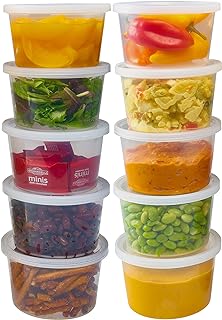
- Thicker walls survive more freeze and thaw cycles than thin deli tubs
- Lids described as leakproof and grip firmly on the rim
- Standard deli diameter keeps lids interchangeable
- Clear body makes contents identifiable while stacked
- Microwaveable for direct reheating
Cons
- Forty pieces is a large cupboard commitment
- Firm lids take real effort to remove one-handed
This is the deli container format with more plastic in the walls, and that single change is what separates a container you use for a season from one you use for years. Thin deli tubs craze after several freeze cycles; heavier walls tolerate the expansion and contraction much better.
The lids grip firmly enough that the manufacturer describes them as leakproof, and in practice they hold liquid on a flat shelf reliably. The cost of that grip is that removing one with cold hands takes a proper effort, and prying with a knife will crack the rim eventually.
Forty pieces is a lot of cupboard. If you do not batch cook, half this set will sit unused. If you do, the interchangeable lids mean you can stack a freezer densely and still open any container without searching.
Bottom line: the pick if your deli containers live in the freezer rather than the recycling bin, and worth the step up over thinner sets for that reason alone.
- Pieces: 40 containers with 40 lids
- Material: BPA-free plastic
- Lid: press-fit, described as leakproof
- Microwave: safe
- Dishwasher: safe
- Freezer: capable
Open by lifting a lid tab with a thumb rather than levering with cutlery. Rim damage is permanent and a damaged rim leaks.
Do not reheat oily food repeatedly in the same container if you care about clarity; plastic clouds and holds odour with heat, and these are cheap enough to rotate out.
Serious batch cooks, people who freeze stock and sauces regularly, and anyone running a home kitchen at something close to commercial volume.
Overkill for a single person who reheats twice a week; a smaller deli set or a latching lunch set is a better fit.

Pros
- Oven safe bases let you cook and store in the same dish
- Four latches per lid with a silicone gasket rated leak proof
- Mixed square, rectangular and round shapes cover different jobs
- Stain resistant and easy to clean
- Seven pieces is a realistic cupboard footprint
Cons
- Heavier than any plastic set here
- Mixed shapes stack less efficiently than a matching set
The useful thing about this set is that the bases go in the oven, which turns storage containers into small bakeware. Roast a portion of vegetables, let it cool, latch the lid and put it in the fridge without moving food between dishes. That saves a washing-up item every time.
Seven pieces is a sensible number. Large glass sets look good in a photo and then occupy an entire cupboard shelf; this one covers the common sizes without demanding that commitment. The lids latch with a gasket, which is the design that actually holds liquid.
Weight is the honest downside, and it is not marginal. A glass container of soup is meaningfully heavier than the plastic equivalent, which matters if it goes into a bag. Glass also has one failure mode plastic does not, and a chipped rim will not seal.
Bottom line: the tidiest glass option here for a normal household, and the one to pick if oven-to-fridge is part of how you cook.
- Pieces: 7 containers with lids
- Base material: glass
- Lid: latching, described as leak proof
- Oven: bases are oven safe within stated limits
- Dishwasher: safe
- Stain resistance: stated by the manufacturer
Remove the lid before the container goes anywhere near an oven. Oven ratings cover the glass only.
Let a hot dish cool on a wooden board or a folded towel rather than a cold stone counter, and avoid pouring cold liquid into a hot dish. Both are thermal shock, and both break glass that was fine a moment earlier.
Check the rim for chips each time you wash. A chip means the container can no longer seal and should be retired from anything liquid.
Wash lids on the top rack and dry the gasket channel before storing. Store lids separately from bases so trapped moisture cannot turn stale.
How to Choose Leak Proof Food Containers
The six criteria below are what separates a container that holds broth from one that merely holds a lid. None of them are visible in a stack photo, which is why so many sets disappoint.
What Leak Proof Actually Means on a Lid

There is no regulated definition, so manufacturers use the phrase loosely. In practice there are three tiers. A lid that is merely airtight keeps air out when the container sits flat; tip it and liquid finds the seam. A splash-resistant lid holds up to gentle movement. A genuinely leak proof lid uses mechanical pressure, usually latches, to compress a soft gasket against a flat rim, and that is the only design that reliably survives being carried on its side.
The tell is the rim. Look at the container edge in the product photos. If it is a simple lip with a snap-on lid, the seal depends entirely on how tightly that plastic grips, and plastic relaxes with heat and age. If the rim is flat and wide and the lid carries a visible silicone or rubber ring, there is a real gasket doing the work.
Vents are where this gets misread, including by us at first. There are two kinds. A fixed open vent is a permanent hole and a lid with one cannot hold liquid on its side, whatever the listing says. A closable vent is a small flap or button built into the latch that you flip open for microwaving and closed the rest of the time, and it does not compromise the seal at all. Rubbermaid Brilliance uses the second kind, advertising an airtight leak-proof seal alongside vents for splatter-resistant microwaving, and both claims are true because the vent shuts.
So the check is not whether a vent exists, it is whether it closes. Look for a moving part in the product photos. If the vent is simply a moulded hole in the lid, that set belongs in the pantry, not in a bag.
Latching Lids Versus Snap Lids Versus Deli Lids

Latching lids, the kind with four flip tabs, deliver the strongest seal and the most reliable one over time, because the clamping force comes from the latch rather than from the plastic memory of the lid. The cost is bulk, more parts to break, and latches that eventually crack if you pry them roughly.
Snap lids with an integrated gasket sit in the middle. Rubbermaid Brilliance uses this approach, combining latches with a moulded seal, which is why the line has a reputation for surviving a bag. Pure friction-fit lids with no gasket are the weakest, and they are what most bargain sets ship with.
Deli containers are their own category and deserve more respect than they get. The 16-ounce and 32-ounce sizes use an industry-standard diameter, which means every lid in the set fits every base regardless of height. For soups and meal prep that interchangeability is worth more than a fancy latch, and a screw-free press lid on a round rim seals surprisingly well because the force is even all the way around.
Glass or Plastic for Liquids
Glass wins on staining, odour and reheating. Tomato sauce and turmeric permanently discolour most plastics, and reheated oil pulls a faint smell into the walls that no dishwasher cycle removes. Glass also tolerates the oven, which plastic never does, so a glass set doubles as bakeware.
Plastic wins on weight and on survival. A glass container full of soup is heavy in a bag and unforgiving on a tile floor. If the container spends its life commuting, plastic is the sensible material and staining is the price. A useful compromise is a mixed cupboard: glass for anything reheated or sauce-based, plastic for lunches that travel.
Note that the leak proof claim on a glass set applies to the lid, not to the glass. Most glass sets use the same plastic latching lid you find on plastic bases, so the seal quality is identical and the difference is entirely about the container body.
Gaskets Are the Part That Fails First

Two designs exist. A removable gasket sits in a groove and can be pulled out for cleaning, which matters because that groove is where mould grows. A moulded-in gasket cannot be removed, which means it cannot be lost and cannot be cleaned behind.
The Vtopmart glass set is a clear example of the removable kind, pairing a pull-out silicone seal with four snap locks, while Rubbermaid Brilliance moulds its gasket in. Both are defensible. Removable seals are the better hygiene choice if you will actually take them out monthly; moulded seals are better if you will not, because a gasket put back crooked seals worse than one left alone. Whichever you choose, dry lids upside down. Water trapped in a seal channel is the single most common source of that stale smell in a cupboard of clean containers.
Sizes That Match Real Portions
Large sets pad their piece counts with sizes nobody uses. Count lids, not pieces: a 14-piece set is 7 containers and 7 lids. Then check the distribution. The sizes that get used daily are roughly 1 to 2 cups for sides and dressings, 3 to 4 cups for a single lunch portion, and 6 to 8 cups for batch cooking or a family portion of soup.
Deep and narrow beats wide and shallow for liquids, because the lid area is smaller and there is less rim for a seal to fail along. Wide and shallow is better for reheating evenly and for anything you want to eat straight from the container without it going cold at the edges.
Microwave, Dishwasher and Oven Ratings
Read these as three separate permissions, because manufacturers rate them separately. A container can be microwave safe and top-rack dishwasher only. Lids almost always have a lower heat tolerance than bases, and putting lids on the bottom rack next to a heating element is how they warp, after which nothing seals again.
Oven safe applies to glass bases only, and never to the lid. Manufacturers say this plainly when you look: Vtopmart publishes a temperature range of minus 4 to 752 degrees Fahrenheit and then states microwave and oven safe with the lids excluded, in those words. Check the maximum temperature and whether the glass is tempered soda-lime or borosilicate; both work, but thermal shock rules still apply and a cold glass dish into a hot oven is a broken dish.
Lid Availability Is What Decides How Long a Set Lasts
Containers rarely die from a broken base. They die because a lid goes missing, warps in the dishwasher, or has its gasket torn, and at that point the base is landfill even though nothing is wrong with it. How replaceable the lid is therefore decides the real lifespan of a set, and almost nobody checks this before buying.
There are two models. Proprietary lids are matched to one specific base profile from one brand, and if the brand discontinues that shape you are done. The upside is a better engineered seal, since the designer controls both halves. Standard lids, which is what deli containers use, are interchangeable across brands and sizes within the same rim diameter, so a lost lid is a two-second problem rather than a lost container.
The practical guidance is to match the model to the use. For a set you expect to own for years, favour a brand large enough that replacement lids stay in stock, and check that they are actually sold separately rather than only bundled. For anything high-turnover, such as freezer portions or food you give away, buy the standard deli format specifically so lids never become the constraint.
One more habit that extends any set: stop washing lids in the bottom rack. Heat from the element below is what deforms a rim by a fraction of a millimetre, which is invisible and is enough to break the seal. A set that seemed to fail all at once has usually just had every lid warped in the same cycle.
| Set | Material | Lid style | Best for |
|---|---|---|---|
| Rubbermaid Brilliance 14-Piece | Plastic | Latch and gasket | Carrying liquids in a bag |
| Rubbermaid Brilliance Glass 3.2 Cup | Glass | Latch and gasket | Reheating sauce-based leftovers |
| Vtopmart Glass 8-Pack | Glass | Latch and gasket | Meal prep with oven reheating |
| Freshware 16oz, 50 Set | Plastic | Press-fit deli lid | Batch portions and freezing |
| DuraHome Deli 40-Pack | Plastic | Press-fit deli lid | Soup and stock in the freezer |
| Amazon Basics Glass 7-Set | Glass | Latch and gasket | Oven to table without transferring |
If the container is going into a bag rather than a fridge, insulation matters as much as the seal, and our guide to thermal lunch boxes covers that pairing. You can browse the rest of our kitchen coverage in the Home and Kitchen section.
Why You Should Trust Us
We build these lists from what is selling and what buyers report, and we read the one-star reviews before the five-star ones. In this category the complaints are unusually consistent and unusually useful: lids that warp in the dishwasher, latches that snap after a year, gaskets that hold a smell, and sets whose piece count is inflated by lids counted as pieces. Where a model has one of those weaknesses we put it in the cons.
One thing we corrected while checking rather than after publishing: we had assumed that any vent disqualifies a lid from being leak proof. Reading the manufacturer material showed that is only true of fixed open vents. A closable vent, of the kind built into the Rubbermaid Brilliance latch, shuts flush and the seal is unaffected. What we did exclude is the genuinely disqualified group, sets whose lids carry a permanent moulded hole and are still marketed as leak proof. Every set here uses either a gasketed latching lid or a standard deli press lid, both of which can hold liquid.
Final Thoughts
Best overall is the Rubbermaid Brilliance 14-Piece set. The combination of four latches, a moulded gasket and crystal-clear plastic that resists staining better than most is the closest thing to a default answer in this category, and the lids stack rather than sliding off each other in a drawer.
Best value is the Freshware 16-ounce 50-set. Deli containers are what commercial kitchens use for exactly this job, the lids are interchangeable across the whole set, and at that quantity you can freeze a month of stock without ever running short of a matching lid. The DuraHome 40-pack does the same job in a slightly heavier-walled container if you want something that survives more freezer cycles.
If you reheat sauce-heavy food, buy glass instead. The Vtopmart 8-pack is the most versatile of the glass options here because the bases handle the oven, and the Amazon Basics 7-set covers the same ground with fewer pieces. The Rubbermaid Brilliance glass containers are the pick if you want the same latch system as the plastic set in a body that will not stain. More kitchen picks are in the Home and Kitchen section, and everything new is in our latest articles.
Leak Proof Food Containers FAQs
How can I test whether a container is really leak proof?
Fill it two-thirds with water, seal it, and lay it on its side on a paper towel for ten minutes, then repeat upside down. Most failures show within the first minute along one edge of the rim. Do this before you trust it with soup in a work bag, and do it again after a year, because gaskets harden and latches loosen.
Are glass containers actually better than plastic in 2026?
Better at resisting stains, odours and oven heat; worse at weight and at surviving drops. The seal quality is usually identical because most glass sets use the same plastic latching lid as their plastic counterparts. Choose glass for reheating and for anything tomato-based, and plastic for anything that commutes.
Why do my container lids smell even after washing?
Water and food residue trapped in the gasket channel. If the seal is removable, pull it out, wash both parts and dry them separately before reassembling. If it is moulded in, run the lid through a hot cycle and then dry it upside down so the channel drains. Storing lids sealed onto bases traps moisture and makes the problem worse.
Can I put leak proof food containers in the freezer?
Plastic deli containers are the best freezer option here because they tolerate the cold without becoming brittle and the straight sides let a frozen block slide out. Leave headspace, since liquids expand as they freeze and a full sealed container can pop its lid or crack. Glass can be frozen if the manufacturer says so, but never move it straight from freezer to hot oven.
Do latching lids wear out faster than snap lids?
The latches themselves are the wear point, and they fail from being pried open at an angle rather than from use. Open opposite latches in pairs rather than one corner at a time. Snap lids do not have that failure mode but they lose grip gradually as the plastic relaxes, which is harder to notice until something spills. More kitchen storage comparisons are in our airtight container guide.







Write Your Review
No reviews yet. Be the first to share your experience!