

Measuring a room with a limp steel tape is a two person job on a good day and a guessing game on a bad one. A laser unit turns the same chore into one button press from the doorway, which is why flooring installers, painters and anyone about to order carpet keep one clipped in a pocket. Our top pick is the Bosch GLM165-40 Blaze Pro for its large backlit screen and steady readings across a full 165 foot span, which covers almost any interior wall you will ever point it at. Below are 8 models from Leica Geosystems, Bosch, MILESEEY and more that hold up to real indoor work rather than showroom demos.
Choosing a laser measure for rooms is less about raw range than most shoppers assume. Almost every unit here reaches farther than the longest wall in a typical house, so the real separators are how fast the display refreshes, whether the beam is visible on a bright white wall, and how many calculations the tool does for you before you reach for a calculator. We weighed those practical details alongside verified customer ratings, and you can browse more picks like these in our tools and home improvement section.

Pros
- Range comfortably covers any interior wall in a house
- Large backlit display shows the current and previous readings together
- Indirect measurement handles ceiling heights without a ladder
- Bosch service network makes long term support straightforward
- Simple three button layout stays readable with gloves on
Cons
- Costs more than the budget units with similar headline specifications
- No Bluetooth link, so readings have to be written down
- Body is bulkier than pocket sized alternatives
The GLM165-40 Blaze Pro is Bosch's answer to the question most homeowners actually have, which is how to size a room quickly without a helper holding the other end of a tape. It reaches 165 feet, far beyond any wall you will find indoors, and it does the arithmetic for area and volume on the tool so you are not converting decimal feet in your head at a flooring counter.
What separates it from the crowded budget field is the display. The backlit panel carries several lines at once, so the reading you just took sits above the two before it. That sounds minor until you are walking a floor plan and want to confirm a wall length against the opposite side without starting over. Combined with the real time length mode, which streams a live figure as you move, it makes locating the centre of a wall for a fixture or a TV mount a one person job.
Indirect measurement is the other standout. By combining angled shots the tool works out a dimension it cannot reach directly, which is how you get a stairwell ceiling height while standing on the floor. The implementation is forgiving and the prompts on screen tell you which shot to take next, so it is usable without reading the manual twice.
The trade offs are honest ones. It is larger than a keyring unit, it has no Bluetooth so nothing lands on your phone, and cheaper meters quote the same 165 foot number on the box. What you are paying for is the display, the build and the fact that Bosch measuring tools stay supported for years.
Bottom line: if you want one laser measure that handles every room in the house and never makes you squint at the screen, this is the safest choice in the group.
- Maximum range: 165 ft
- Display: backlit multi line LCD
- Modes: distance, area, volume, indirect measurement, real time length
- Reference points: front and back edge
- Power: AAA batteries
- Connectivity: none
- Typical use: interior room and whole house measuring
This is the pick for homeowners tackling a full renovation, for anyone ordering flooring or paint across several rooms, and for tradespeople who need a reliable daily tool rather than a gadget. If you measure a few times a year and want the simplest possible purchase, a budget unit will serve you. If the tool is going to live in a bag and get used weekly, the display and build here pay for themselves.
Stand with the back of the tool flat against one wall and shoot the opposite wall for a clean length. Repeat for the width, then switch to area mode and take the two shots in sequence to get square footage directly. For ceiling height in a stairwell, use indirect measurement and follow the on screen prompts for the angled shots. Keep the beam square to the target surface, because a tilted shot reports a diagonal rather than a true wall length.

Pros
- Full 165 foot range at an entry level price
- Two bubble levels help keep shots square to the wall
- Backlit LCD stays readable in dark closets and basements
- Switches between metres, inches and feet without menu digging
- Area, volume and Pythagorean modes all included
Cons
- Plastic housing feels less solid than the Bosch units
- Single line focus on the display means less reading history
- Beam can struggle on dark walls in bright daylight
The RockSeed is the unit that most people should look at first, because it delivers the specification list that matters for room work at a fraction of what the name brands ask. You get 165 feet of range, which is more than any interior wall demands, plus area, volume and Pythagorean calculation on the tool itself.
The two bubble levels are the detail that makes it punch above its price. A laser travels straight, so a meter held slightly off square reports a diagonal instead of a wall length, and over 20 feet that small tilt becomes a real error. Lining up the bubbles before you press the button removes that problem without any electronics. The backlit LCD handles the other half of the job, because closets and unfinished basements are where you need a reading and where there is never enough light.
Where it gives ground is in feel and refinement. The housing is light plastic, the button action is softer than the Bosch, and on a dark wall in a sunlit room the sensor takes longer to lock on. None of that changes the number it reports, but it is the difference between a tool you enjoy using daily and one you are happy to own for occasional jobs.
This model has attracted an unusually deep body of owner feedback, and the recurring theme is that it simply keeps working. Complaints cluster around the manual rather than the hardware, which is a good sign in this category.
Bottom line: the smart buy if a laser measure is a once or twice a year tool, and a genuinely capable one even if it gets more use than that.
- Maximum range: 165 ft (50 m)
- Display: backlit LCD
- Levels: two integrated bubble levels
- Modes: distance, area, volume, Pythagorean
- Units: metres, inches, feet
- Power: AAA batteries
- Typical use: room sizing, flooring and paint estimates
Choose this model if your priority is getting accurate room dimensions without spending on features you will rarely touch. Skip it if you need Bluetooth export, if you work outdoors at long range where a target plate and stronger optics matter, or if you want the sturdier housing of a professional grade unit. For estimating flooring, paint and furniture clearance across a house, it covers the job completely.
Keep the lens clean with a soft dry cloth, since dust on the aperture scatters the beam and slows the lock on. Remove the batteries if the tool will sit unused for months, because leakage is the most common way meters in this price bracket die. The laser is a low power class 2 unit, the same category as a supermarket scanner, but never aim it at anyone's eyes and switch it off between readings rather than leaving the dot streaming.

Pros
- Angle sensor makes indirect and tilted shots more reliable
- Two inch screen is easy to read at arm's length
- 229 foot range covers indoor work and long outdoor runs
- Stated accuracy of two millimetres suits precise layout work
- Battery supplied so it works out of the box
Cons
- More modes than a casual user will ever need
- Menu navigation takes a session to learn
- Larger body than the pocket sized options
The MILESEEY is the technical pick of this group, and the angle sensor is the reason. Most laser meters expect you to hold the tool perfectly level and trust yourself, which works on a clear wall and falls apart when you are shooting from a ladder or over furniture. This unit knows its own tilt, reports it on screen and factors it into indirect calculations.
That matters most in Pythagorean mode. Working out a wall height above an obstruction, or a ceiling height in a stairwell, means combining two or three angled shots, and the accuracy of the answer depends entirely on the geometry being right. With an angle sensor doing the work, the result is repeatable rather than a figure you take twice and average.
The two inch backlit screen is the other everyday win. It carries several lines and large characters, so you can read the current shot and the two before it without bringing the tool up to your face. Combined with unit switching that includes feet plus inches, the format flooring and lumber are actually ordered in, it removes a lot of small friction.
The cost is complexity. There are more modes here than a homeowner measuring a bedroom will ever use, and the menu structure takes a session to internalise. If you want to point and read, this is more tool than you need.
Bottom line: the one to buy if you do layout work, angled shots or anything where the geometry has to be right rather than close.
- Maximum range: 229 ft (70 m)
- Stated accuracy: 2 mm
- Sensor: built in angle sensor
- Display: 2 inch backlit LCD
- Modes: distance, area, volume, Pythagorean, angle
- Units: ft, in, ft plus in, m
- Power: battery included
Indirect measurement solves for a dimension the beam cannot reach. Point at the top of the target, then at a second reference, and the tool applies Pythagoras to return the height. On this unit the angle sensor supplies the tilt figure rather than assuming you held it square, which is why the answers hold up. Use it for stairwell ceilings, wall heights above cabinets and any span blocked by furniture you would rather not move.
Made for people who measure regularly and care about the number: renovators laying out framing, installers fitting cabinets or blinds, and anyone drawing up a floor plan where errors compound. A homeowner sizing a rug once a year will find it capable but overspecified, and a simpler unit will be quicker to pick up.

Pros
- 100 foot range is ample for any room in a house
- Very simple operation with almost no learning curve
- Bosch build quality in an entry level body
- Batteries supplied so it works immediately
- Compact enough to keep in a tool pouch
Cons
- Smallest range in this group, so outdoor use is limited
- Fewer calculation modes than the Blaze Pro
- Display is smaller than the two inch panels here
The GLM100-23 is Bosch stripping its own formula back to what a homeowner actually presses. There is a button, a beam and a number, and the 100 foot range still swallows every interior dimension in an average house, where the longest run is rarely past 40 feet.
That restraint is the appeal. Plenty of buyers in this category end up with a meter that offers eight modes and use two of them, then hunt through a menu each time because the default is not the one they want. This unit gets out of the way. Point it at the far wall, read the figure, move on.
You do give things up. The display is smaller than the two inch panels on the MILESEEY and DTAPE, the calculation set is narrower than the Blaze Pro, and 100 feet is the least reach here so outdoor lot work is off the table. For indoor measuring none of those limits bite.
What you keep is the Bosch housing and the reassurance that goes with a brand that has made measuring tools for decades. Owners consistently describe it as the meter that just works, and the AA cells mean a flat battery is fixed from a kitchen drawer rather than a charging cable.
Bottom line: the right pick if you want a dependable name brand tool for indoor work and have no interest in modes you will never open.
- Maximum range: 100 ft
- Display: backlit LCD
- Modes: distance measurement with area and volume calculation
- Power: 2 AA batteries, supplied
- Connectivity: none
- Body: compact handheld housing
- Typical use: interior rooms and short runs
This is the meter to grab when the question is small: does the sofa clear the doorway, how wide is the alcove, how far is the socket from the corner. It powers up fast, needs no mode selection for a plain distance reading, and gives an answer before a tape would be fully extended. For a whole house survey with area totals, one of the fuller featured units will save you more time.
Place the flat back of the tool against the starting wall, aim the dot at the opposite surface and press to read. For an accurate figure keep the body square to the wall, since a tilt returns a diagonal. In bright rooms, hold a sheet of white paper against the target to give the beam a better surface to bounce off. Note readings as you go, because there is no phone link to catch them.

Pros
- Bluetooth sends every reading straight to a phone app
- 330 foot range handles interiors and long exterior runs
- Leica precision suited to trim and layout tolerances
- Slim body slips into a shirt pocket
- Folding end piece makes corner and sill readings simple
Cons
- Priced well above the general purpose units here
- The app is where much of the value sits, so phone dependency grows
- Feature set is narrower than some cheaper meters that pile on modes
The DISTO D2 is the only unit in this guide that solves the problem of what happens after the reading. Every other meter expects you to write the number on a scrap of paper or hold it in your head until you reach a notebook. This one pushes each measurement over Bluetooth into a companion app, where you can drop dimensions onto a sketched floor plan and export the result.
For anyone documenting a whole property, that changes the workflow completely. Walking a house and capturing thirty readings without touching a pen removes the single biggest source of error in the job, which is transcription rather than measurement. The plan you leave with is already in a shareable form.
The hardware underneath earns the Leica name. The tolerance is at the tight end of this group, which matters if you are working to trim rather than material estimates, and the folding end piece lets you hook the tool into an inside corner or over a window sill with the reference point adjusting automatically. That one detail removes a category of mental arithmetic from renovation work.
It asks a lot in return. This is the most expensive way to measure a bedroom, and if you never open the app you are paying for a link you do not use. Some cheaper meters also offer more calculation modes on the tool itself, since Leica keeps the onboard menu deliberately lean.
Bottom line: buy it if you are building floor plans or working to fine tolerances, and skip it if you only need square footage for a flooring order.
- Maximum range: 330 ft (100 m)
- Connectivity: Bluetooth 4.0
- Companion app: floor plan sketching and reading transfer
- End piece: folding, with automatic reference adjustment
- Body: slim pocket sized housing, roughly 4.6 by 1.7 by 1 inches
- Colour: black and red
- Typical use: layout work, surveys and floor plans
Pair the meter to your phone once, then each reading you take appears in the app automatically. From there you can attach dimensions to a room sketch, build a simple floor plan and export it to share with an installer or contractor. Treat the app as a convenience layer rather than the reason to buy, because all the measuring still happens on the tool and it works perfectly well with the phone left in your pocket.
Aimed at estate agents, designers, surveyors and serious renovators who capture a lot of dimensions and need them in a document afterwards. Also a strong choice for anyone fitting cabinetry or trim, where the tighter tolerance is genuinely useful. A homeowner measuring one room for carpet does not need this and will be equally well served by a unit at a fraction of the outlay.

Pros
- 330 foot range covers long hallways and open plan spaces
- Two inch backlit LCD is easy to read across a room
- Fine stated accuracy of one sixteenth of an inch
- Full mode set including indirect range finding
- Feet, inches, feet plus inches and metre switching
Cons
- Long range is surplus for most single room work
- Housing is larger than the compact meters here
- Brand support is thinner than the established names
The DTAPE is built for people whose idea of a room includes a warehouse floor. At 330 feet it has more than triple the reach any bedroom demands, which is surplus for a bungalow and exactly right for open plan lofts, long corridors, commercial units and the odd outdoor run down a driveway.
Its practical strength indoors is the screen. The two inch backlit panel carries large characters over several lines, so a reading taken at the far end of a hallway is legible while you are still standing there. Anyone who has squinted at a single line display in a dim basement will recognise the value immediately.
The stated accuracy of one sixteenth of an inch puts it in serious company, and the mode set is complete: distance, area, volume and indirect measurement using angled shots for dimensions the beam cannot reach directly. Unit switching includes feet plus inches, which is how flooring and lumber are ordered in the United States and the format where conversion errors usually creep in.
What you weigh against that is size and support. The body is bigger than the compact meters in this guide, and DTAPE does not carry the service network of a Bosch or a Leica if something goes wrong in year three.
Bottom line: the pick when your spaces are large or your eyesight wants a bigger screen, and overkill if you only measure ordinary rooms.
- Maximum range: 330 ft
- Stated accuracy: 1/16 inch
- Display: 2 inch backlit LCD
- Modes: distance, area, volume, indirect range finding
- Units: ft, in, ft plus in, m
- Format: handheld electronic tape measure
- Typical use: large rooms, hallways, open plan and light commercial
Pick this one if your measuring includes spaces beyond a standard room: an open plan ground floor, a long hallway, a garage or a workshop. The extra range and the bigger screen both earn their place there. If every job is a single bedroom or bathroom, a 100 to 165 foot unit does the same work in a smaller body, and the money is better spent on display quality or build.
Wipe the lens with a soft dry cloth and keep grit away from the aperture, because a scratched window scatters the beam and shortens usable range. Store the tool out of direct sun in a vehicle, since heat is hard on both the display and the cells. The laser is low power class 2 and safe in normal use, but never aim it at eyes and switch it off between readings so the dot is not left streaming around pets or children.

Pros
- 165 foot range is plenty for whole house measuring
- Two bubble levels help keep readings square
- Backlit LCD readable in poorly lit rooms
- Straightforward controls suit a first laser measure
- Metre, inch and foot switching built in
Cons
- Very close in specification to other budget meters here
- No connectivity, so readings must be noted by hand
- Plastic housing is not built for heavy site abuse
The Ogeto is the definition of a sensible first laser measure. It gives you 165 feet of range, area and volume calculation, a Pythagorean mode for heights you cannot shoot directly, and two bubble levels to keep the beam square, which is the whole practical toolkit for measuring a house.
The bubble levels deserve more credit than they usually get. Electronics on pricier meters compensate for tilt automatically, but a pair of bubbles achieves most of the same result for nothing, and they give you a visible confirmation before you press rather than a correction afterwards. Over a 20 foot span, that is the difference between a wall length and a diagonal.
The backlit screen handles the other reality of room measuring, which is that the places you most need a number are the darkest. Closets, under stairs and unfinished basements all defeat an unlit display.
It sits in a crowded part of the market and does not stand out on any single specification. That is not a criticism so much as a description: budget meters have converged on the same feature list, and choosing between them comes down to fit in the hand and how the buttons feel. Owners report it doing its job without drama, which is what this category should deliver.
Bottom line: a clean, capable entry point if you want laser convenience for household jobs without weighing up features you will not use.
- Maximum range: 165 ft (50 m)
- Display: backlit LCD
- Levels: two integrated bubble levels
- Modes: distance, area, volume, Pythagorean
- Units: metres, inches, feet
- Body: lightweight handheld housing
- Typical use: household room measuring and DIY projects
Suited to homeowners buying their first laser measure, renters sizing furniture before a move, and anyone who wants an accurate room figure without learning a menu system. If you measure professionally, or you need Bluetooth export or an angle sensor, look further up this list.
Rest the flat back of the tool against your starting wall, level the bubbles, then shoot the opposite surface. Take the width the same way, switch to area mode and repeat the pair of shots to read square footage directly. For an L shaped room, split it into rectangles, measure each and add the totals. For a ceiling height you cannot reach, use Pythagorean mode and follow the prompts for the angled shots.

Pros
- Small enough to carry on a keyring every day
- USB-C charging removes disposable batteries
- Crisp OLED display rather than a basic LCD
- Two millimetre stated accuracy despite the size
- Feet, metre and inch conversion on the tool
Cons
- 98 foot range is the smallest in this guide
- Tiny screen shows less information at a glance
- Needs a cable rather than a spare cell when flat
The HOTO answers a different question from everything else here. Instead of asking how far a meter can reach, it asks whether you have one with you at the moment you need it. The body is small enough to sit on a keyring, which means the answer is yes when you are standing in a furniture shop wondering whether an armchair clears your hallway.
The 98 foot range is the smallest in this guide and it does not matter for that use. An average room is under 25 feet across and the longest interior run in a typical house is around 40, so the reach is comfortable for anything indoors. The two millimetre stated accuracy is genuinely competitive with meters several times its size.
Build choices reflect the brief. The OLED display is crisp and legible for its size, USB-C charging means no battery drawer to raid, and the whole thing feels closer to a piece of consumer electronics than a site tool. That also makes it the most giftable item in this roundup, which is exactly how a lot of them are bought.
The compromises are the obvious ones. A small screen shows one figure clearly rather than a run of readings, there is no bubble level to square the shot, and when the charge runs out you need a cable rather than a spare cell. For a survey of a whole house, one of the larger meters will be less work.
Bottom line: the laser measure you actually have on you, and the right second tool alongside a full sized meter.
- Maximum range: 98 ft (30 m)
- Stated accuracy: plus or minus 2 mm
- Display: OLED
- Power: USB-C rechargeable battery
- Units: ft, m, in
- Carry: keychain ready compact body
- Typical use: everyday carry, furniture and quick room checks
The whole point of this unit is the form factor. It rides on a keyring or in a coat pocket without weight or bulk, so the meter is present for the unplanned measurement: checking a shelf gap in a shop, confirming a doorway width at a viewing, sizing a rug on the spot. Larger meters get left in a toolbox and are never there when the question comes up.
Charge it over USB-C every few months even if you have not used it, because a fully drained lithium cell ages faster. Keep the lens away from keys in a pocket, since scratches on the aperture scatter the beam. The class 2 laser is safe for normal use but should never be aimed at eyes, and it is worth switching off between readings around pets that chase the dot.
How to Choose a Laser Measure for Rooms
Laser measures look interchangeable on a product page. They are small plastic bricks with a screen and three or four rubber buttons, and the marketing copy on nearly all of them repeats the same four words: distance, area, volume, Pythagorean. The differences that matter show up on the second day of use, when you are crouched in a closet trying to read a number in the dark or trying to work out a ceiling height without a ladder. Here are the criteria we weighted most heavily.
Measuring Range for Indoor Work
The longest interior dimension in an average single family home is rarely more than 40 feet, and most individual rooms fall under 25 feet. That means a 100 foot unit like the Bosch GLM100-23 already has enormous headroom for house work, and the 330 foot models earn their range only in warehouses, open plan lofts, long corridors and outdoor lot work.
There is a catch worth knowing. Stated maximum range assumes a matte, light coloured target in dim conditions. Point a budget laser at a dark wood panel across a sunlit room and the usable distance can fall by half, because the sensor needs enough reflected light to lock on. If your house has dark walls, bright windows or glossy surfaces, buying more range than you strictly need is cheap insurance rather than a wasted upgrade.
For pure room work, anything from 100 feet upward is comfortable. Reach for the 229 foot MILESEEY or the 330 foot DTAPE only if you also measure driveways, fences or commercial spaces.
Accuracy and What the Tolerance Figure Means
Manufacturers quote accuracy as a plus or minus figure, commonly around two millimetres or one sixteenth of an inch. That tolerance applies to a single clean shot under favourable conditions, and it stacks. Measure four walls of a room individually and small errors accumulate into a total that will not close neatly, which is why cabinet makers still confirm critical cuts with a physical rule.
For the jobs most homeowners care about, ordering flooring, estimating paint coverage, checking that a sofa clears a doorway, a two millimetre tolerance is far tighter than the job requires. The Leica Geosystems DISTO D2 sits at the precise end of this group and is the one to pick if you are working to trim tolerances rather than material estimates.
Accuracy also depends on where the tool measures from. Better units let you switch the reference point between the back edge, the front edge and a folding end piece, so you can butt the tool into a corner without doing arithmetic afterwards. Cheaper units usually offer back and front only.
Area, Volume and Pythagorean Modes

Area mode is the single feature that saves the most time indoors. You shoot the length, shoot the width, and the tool returns the square footage you need for flooring, tile or paint without a second device. Volume mode adds height and gives you cubic feet, which matters when you are sizing an air conditioner, a dehumidifier or an air purifier for a specific space.
Pythagorean mode, sometimes labelled indirect measurement, is the one people ignore until they need it. It works out a dimension you cannot shoot directly, most often a ceiling height in a stairwell or the height of a wall above an obstruction, by combining two or three angled shots. Every model on this list offers it, but the implementation quality varies. Units with a built in angle sensor, like the MILESEEY, handle indirect shots more reliably because the tool knows its own tilt instead of relying on you to hold it perfectly.
Continuous measurement mode deserves a mention too. It streams a live reading as you walk, which is how you find the exact centre of a wall or position a fixture without marking and remarking. If you are also hunting for framing behind drywall while you plan a layout, pair the laser with a scanner from our guide to the best stud finders for plaster walls.
Display, Backlight and Reading the Number in a Dark Room
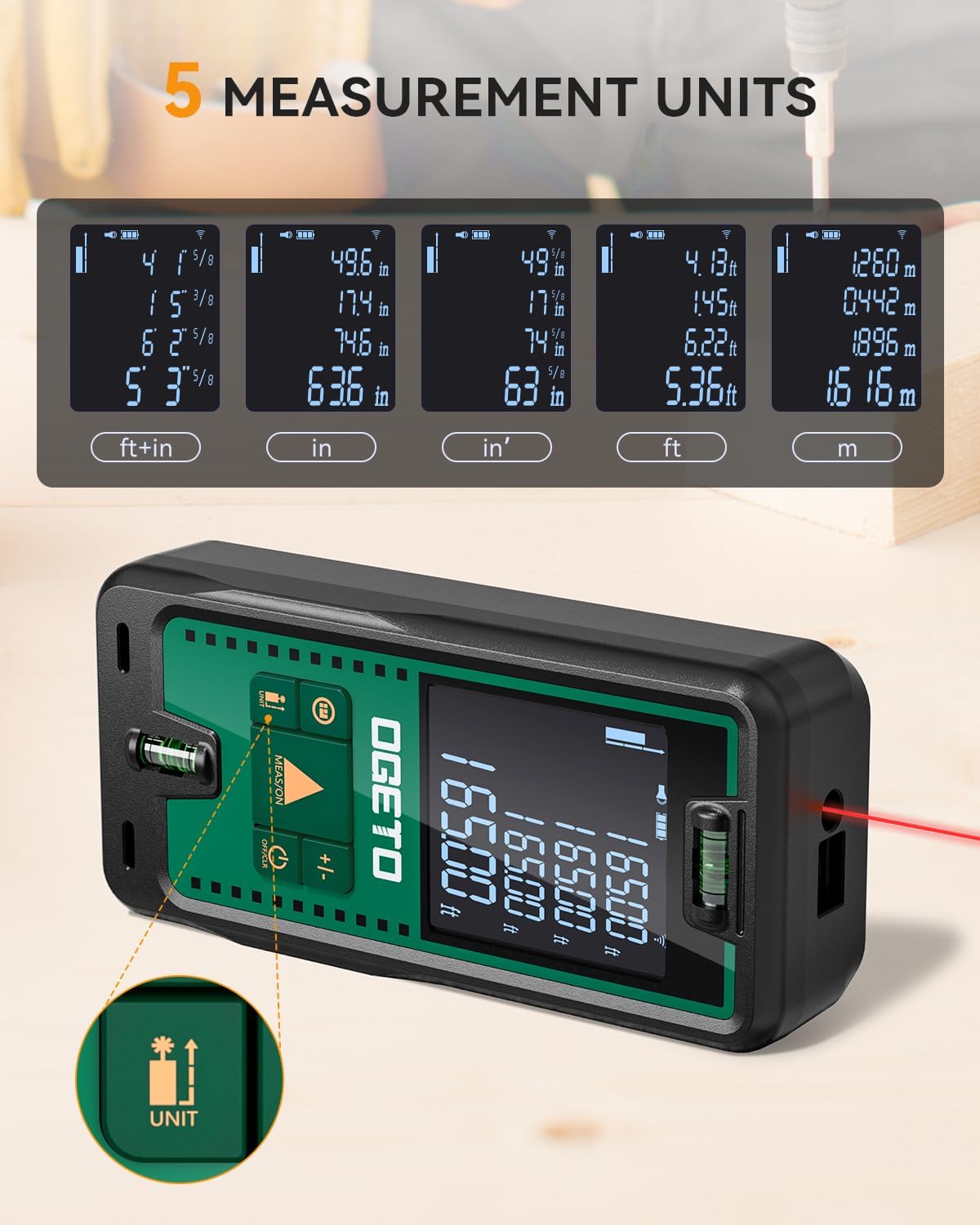
Closets, basements, crawl spaces and unfinished rooms have one thing in common: bad light. A backlit LCD is not a luxury on a laser measure for rooms, it is the difference between reading a figure and carrying the tool back to a window. Every model here has a backlight, but the useful ones also show multiple lines at once so you can see the current shot alongside the previous two.
Screen size and character height matter more than pixel count. The two inch panels on the MILESEEY and DTAPE units are noticeably easier to read at arm’s length than a compact single line display. The HOTO pocket unit takes the opposite approach with a small OLED screen, trading readability for a body that genuinely fits on a keyring.
Unit switching is the other display detail worth checking. Look for a tool that toggles between feet, inches, feet plus inches and metres, because feet plus inches is how flooring and lumber are actually ordered in the United States, and converting decimal feet in your head is where mistakes creep in.
Bubble Levels, Reference Points and Holding It Straight
A laser travels in a straight line, so a tool held slightly off square reports a diagonal rather than a wall length. Over 20 feet, a small tilt turns into a genuine error. Two bubble levels, one for horizontal and one for vertical, are the cheapest fix and appear on the RockSeed and Ogeto units in this group.
Higher end units solve the same problem electronically. An angle sensor reports tilt on screen and lets the tool compensate, which is why the MILESEEY and the Bosch Blaze Pro feel more forgiving when you are shooting from an awkward position. If you frequently measure from ladders or over furniture, that electronic assistance is worth paying for.
Also look at the tail end of the housing. A folding end piece lets you hook the tool over a window sill or into an inside corner and have the reference point adjust automatically, which removes an entire category of mental arithmetic from renovation work.
Power, Batteries and Getting Numbers Off the Tool

Most units in this group run on two AAA or AA cells, which is genuinely convenient because a dead tool is revived from any kitchen drawer. Rechargeable units such as the HOTO use USB-C and hold a charge for months of light use, but they need planning if the tool lives in a truck.
Getting the numbers off the tool is the feature gap that separates the Leica Geosystems DISTO D2 from everything else here. Its Bluetooth link pushes each reading into a companion app on your phone, where you can drop dimensions onto a floor plan sketch and export the result. Treat that app as a convenience layer on the hardware rather than the reason to buy, since the measuring itself still happens on the tool. If you are gathering readings before a repaint, our roundup of the best handheld HVLP paint sprayers covers the next step.
Everyone else expects you to write numbers down. Onboard memory helps here. Storing the last 20 or 30 readings means you can walk a whole floor, then sit down and transcribe once instead of juggling a notepad in one hand.
| Model | Stated Max Range | Best For |
|---|---|---|
| Bosch GLM165-40 Blaze Pro | 165 ft | Whole house walkthroughs |
| RockSeed Digital Laser Distance Meter | 165 ft | Budget friendly room sizing |
| MILESEEY Laser Measure with Angle Sensor | 229 ft | Angled and indirect shots |
| Bosch GLM100-23 Blaze | 100 ft | Simple point and read jobs |
| Leica Geosystems DISTO D2 | 330 ft | Sending readings to a phone |
| DTAPE Laser Measuring Tool | 330 ft | Long hallways and open plans |
| Ogeto Laser Distance Meter | 165 ft | A first laser measure |
| HOTO Pocket-Size Laser Measuring Tool | 98 ft | Carrying one every day |
Why You Should Trust Us
We build these guides by starting from what verified buyers report over months of ownership rather than from spec sheets alone. For this roundup we gathered the laser measures with the deepest bodies of customer feedback on Amazon, filtered out anything that failed to hold a strong average rating, and then read through the recurring complaints. Patterns matter more than individual reviews: a single report of a flaky button is noise, while dozens of owners describing the same drift in cold weather is a real characteristic of the tool.
From there we cut hard. Duplicate listings of the same hardware under different model codes were merged, and outdoor rangefinders built around a zoom viewfinder were removed even though they measure distance perfectly well, because a tool designed for shooting fence lines at 300 feet is the wrong shape for a bedroom. Every specification quoted above comes from the manufacturer listing, and we say plainly when a figure is a stated maximum rather than a guaranteed result. Our editorial picks are ours alone, and purchases made through links on this page may earn us a commission at no extra cost to you.
Final Thoughts
The Bosch GLM165-40 Blaze Pro is our best overall choice. It pairs a range that comfortably swallows any interior wall with the large backlit readout and indirect measurement modes that make room work quick, and Bosch has enough of a track record in measuring tools that support and accessories are easy to find years later. If you want one tool for every room in the house and no compromises you will notice, this is it.
For best value, the RockSeed Digital Laser Distance Meter is remarkable. It gives you the same 165 foot reach, the same area, volume and Pythagorean calculations, plus two bubble levels for keeping shots square, and it has attracted a body of owner feedback larger than everything else in this guide combined. It is the unit to buy if a laser measure is a once a year tool for you.
Two picks cover the edges. The Leica Geosystems DISTO D2 is the choice for anyone building floor plans, because the Bluetooth link means readings land in an app instead of on the back of an envelope. At the other extreme, the HOTO Pocket-Size Laser Measuring Tool is the one you actually have with you, small enough to live on a keyring for the moments when you spot a piece of furniture and need to know whether it fits. Once the dimensions are on paper, our guide to the best smart water shut off valves is a good next stop for anyone planning a bathroom or laundry renovation, and you can find more comparisons in the articles archive.
Frequently Asked Questions
How accurate is a laser measure for rooms compared with a steel tape?
For distances beyond about six feet a laser is usually more accurate, because it removes tape sag, the guesswork of hooking the end and the parallax of reading a mark at an angle. Typical tolerances of around two millimetres over a full room are tighter than most people manage with a tape held solo. Under a couple of feet the advantage flips, since many lasers have a minimum working distance and a rigid rule is simply easier at close quarters.
Can a laser measure work out square footage on its own?
Yes. Every model in this guide has an area mode: you take a length reading, take a width reading, and the tool displays the square footage. For an L shaped or irregular room, split the space into rectangles, measure each one, and add the results. Some units have a running total function that does the addition for you, which is worth looking for if you regularly quote flooring.
Do I need an app to use one of these tools in 2026?
No. Every unit here is fully usable standalone, with all calculation modes running on the tool itself. A companion app, offered on Bluetooth models such as the Leica DISTO D2, adds convenience by logging readings and letting you sketch a plan on your phone, but it is an extra layer rather than a requirement. If an app is central to how you want to work, confirm the specific model supports Bluetooth before buying, because most of the units in this price bracket do not.
Why does my laser measure struggle in a bright room?
The sensor reads reflected laser light, and strong daylight washes out that return signal. Dark, glossy or mirrored surfaces make it worse by scattering the beam. Two fixes work well indoors: hold a plain white card or a sheet of paper against the target wall to give the beam something to bounce off, or close blinds on the sunlit side of the room. Outdoors the same problem is solved with a target plate, which is why long range models often ship with one.
Is a laser measure for rooms safe to use around children and pets?
The units in this guide use low power class 2 lasers, the same category as a supermarket scanner, and they are safe for normal use. The standard precaution still applies: never point the beam at anyone’s eyes and do not look into the aperture. Because the beam is visible and pets sometimes chase the dot, it is worth switching the tool off between readings rather than leaving it streaming. You can browse more home tool guides in our digital multimeter roundup.

Write Your Review
No reviews yet. Be the first to share your experience!