

Waiting on the tap to run warm is one of the small daily frustrations a home never has to have. An instant hot water heater closes that gap, whether it is a compact tank under the kitchen sink, a dedicated dispenser for tea and coffee, a full tankless unit that replaces the storage tank in the utility closet, or a portable propane heater for a campsite shower. Our top pick is the Bosch Tronic 3000 T 4-Gallon Mini-Tank Water Heater for how easily it plugs into a standard outlet and delivers instant hot water at a single sink without any electrical rewiring. We compared 8 instant hot water heater picks by real customer ratings, from Bosch, Camplux, InSinkErator and more, covering everything from a single bathroom sink to a whole house. Some of these products barely resemble each other beyond the marketing label: a 4-gallon under-sink tank, an 18kW hardwired whole-home unit, and a propane camp shower all get sold as “instant hot water heaters,” so this guide groups them by what they actually do rather than by price or brand alone. If your home’s plumbing needs a broader fix first, our guide to automatic water shut off valves is a useful companion read.

Pros
- Plugs into a standard 120V outlet, no electrician or dedicated circuit needed
- Glass-lined 4-gallon tank keeps hot water on standby between uses
- Mounts on a wall, floor, or shelf to fit tight cabinet spaces
- UL listed with a magnesium anode rod for added tank protection
- Comes from a well-established water heater brand with wide parts availability
Cons
- 4 gallons of stored hot water can run out during back-to-back use at a busy sink
- Recovery time between refills is slower than a true tankless unit
- Best suited for one fixture, not a whole bathroom or kitchen
The Bosch Tronic 3000 T ES4 is a point-of-use mini-tank water heater meant to sit directly under a sink or in a nearby cabinet, so hot water reaches the faucet in seconds instead of after a long wait for water to travel from a heater on the other side of the house.
The 4-gallon glass-lined tank holds a small reserve of hot water at all times, and because the unit plugs into a standard 120V household outlet, installation is mostly a matter of tapping into the cold water line rather than opening up the electrical panel. That makes it one of the more approachable upgrades on this list for a renter or a homeowner who wants to avoid hiring an electrician.
The tradeoff for that simplicity is capacity. Four gallons is enough for a bathroom sink, a wet bar, or a single kitchen faucet, but it is not a substitute for a full water heater and will run out of hot water faster than a tankless unit under sustained use.
Bottom line: this is a smart, low-friction way to get instant hot water at one specific fixture, especially in a kitchen, guest bathroom, or basement bar where running a new hot water line from the main heater is impractical.
- Tank capacity: 4 gallons
- Power: 120V, 1440W, approximately 12.5 amps
- Mounting: wall, floor, or shelf
- Tank lining: glass-lined steel with magnesium anode rod
- Certification: UL listed
- Power cord included, no hardwiring required
Best for anyone who wants hot water at one sink, wet bar, or bathroom without running a new line from the main water heater. It also works well as a supplemental source in a room that is far from the primary heater and always runs cold before hot water arrives.
It is a poor fit for a shower, a laundry room, or any fixture that needs sustained hot water for more than a few minutes at a time.
Like any tank-style heater, the ES4 has a magnesium anode rod that gradually corrodes to protect the tank itself; checking it periodically extends the tank's working life. Keep the surrounding cabinet ventilated and free of stored chemicals, and confirm the outlet used is not on a shared circuit that regularly trips under load.

Pros
- Self-modulating power output adjusts to the flow you actually need
- Compact wall-mounted design frees up floor space a storage tank would use
- Digital temperature control for consistent output at the tap
- No storage tank means no standby heat loss between uses
- Can serve as a full water heater replacement in moderate climates
Cons
- Requires two dedicated 240V circuits with 40-amp double-pole breakers, a job for a licensed electrician
- Output flow rate drops in colder climates where incoming water is colder
- Higher upfront installation cost than a simple tank swap
The Rheem 18kW is built to do the job a traditional 40 or 50-gallon storage tank does, just without the tank. Cold water passes through the unit's heating element on its way to the faucet or shower, so there is no standby tank of water losing heat in the background all day.
At 18kW and 240V, this is the larger end of what a residential electric tankless heater offers, and it is genuinely capable of supplying a full house in a moderate climate where incoming groundwater is not extremely cold. In colder regions, expect the maximum simultaneous flow rate to drop, since the unit has to work harder to raise the temperature of colder incoming water.
The installation is the real commitment here. This model calls for two dedicated 240V circuits with 40-amp double-pole breakers on 8 AWG wire, which almost always means hiring a licensed electrician and confirming the home's electrical panel has the capacity to spare.
Bottom line: for a household ready to make the switch away from a storage tank and willing to pay for proper electrical work, this delivers essentially endless hot water and reclaims the floor space a tank used to occupy.
- Power: 18kW at 240V, up to 75A maximum draw
- Wiring: two 240V circuits, 40-amp double-pole breakers each, 8 AWG wire
- Mounting: wall-mounted, hardwired (no plug)
- Control: digital temperature display
- Design: self-modulating power output
Whether an 18kW unit can truly cover a whole house depends on climate and how many fixtures run at once. In warmer regions with milder groundwater temperatures, it can comfortably supply a shower and a kitchen faucet simultaneously. In colder northern climates, running two hot water fixtures at the same time may require throttling one back.
Always confirm your home's electrical panel has room for the added double-pole breakers before purchasing, since a panel upgrade adds meaningfully to the total installation cost.
Because this is a hardwired 240V appliance, installation and any future service should be handled by a licensed electrician and, where required, permitted and inspected. Periodic descaling may be needed in areas with hard water to keep the heating element working efficiently.

Pros
- True tankless design, no storage tank losing heat between uses
- Digital thermostatic control adjustable in 1 degree Fahrenheit increments
- Smaller footprint and lower amperage draw than a whole-home tankless unit
- Good fit for a single point-of-use sink where a mini-tank isn't quite enough
Cons
- Still requires a dedicated 240V circuit and hardwired installation
- Not sized to supply more than one fixture at a time
- 27A draw is significant for a single sink, confirm panel capacity first
This smaller Rheem model sits between the mini-tank heaters on this list and the full 18kW whole-home unit. It is still a true tankless design, meaning it heats water on demand rather than storing a reserve, but it is sized and wired for a single point-of-use fixture like a bathroom sink or handwashing station.
The digital thermostatic control lets you dial in an exact output temperature in 1 degree Fahrenheit increments, which is more precise than the fixed or dial-based controls found on most mini-tank heaters. That precision is useful in a commercial-style handwashing setup or anywhere consistent water temperature matters more than raw capacity.
Installation still means a dedicated 240V circuit and hardwiring, so this is not a plug-and-go option like the mini-tank units, but the amperage and wiring requirements are lighter than the whole-home tankless model above.
Bottom line: a good middle-ground choice for a single sink that needs genuinely on-demand hot water rather than a limited tank reserve, without taking on the electrical work a whole-home tankless unit requires.
- Power: 6.5kW at 240V, approximately 27A
- Wiring: dedicated 240V circuit, hardwired connection
- Control: digital thermostatic, 1 degree Fahrenheit increments, 80 to 140 degrees
- Design: true tankless, on-demand heating
Suited to a single bathroom or utility sink, a handwashing station, or a workshop faucet that needs reliable hot water without the standby loss of a tank. Not intended to feed a shower or multiple fixtures simultaneously.
As a hardwired 240V appliance, installation should go through a licensed electrician, and the dedicated circuit should be confirmed before purchase. Because there is no storage tank, there is no standing water to maintain or flush.

Pros
- Runs entirely on propane and battery ignition, no electrical hookup needed
- Portable with a folding handle, easy to pack for camping or RV trips
- Overheat protection and low pressure startup for safer outdoor use
- CSA certified with a flame failure safety device
Cons
- Outdoor use only, it is a combustion appliance and must never run indoors
- 1.32 GPM flow rate is modest compared to a home tankless unit
- Requires a propane tank and periodic battery changes for ignition
The Camplux AY132 is a different category of instant hot water heater from the rest of this list: it runs on propane rather than electricity, and it is designed to travel. At 10 pounds with a folding handle, it is meant to be strapped to an RV, packed for a camping trip, or set up next to an off-grid cabin.
Ignition is handled by two D batteries rather than a wall outlet, so the whole system works with nothing but a propane tank and a water source, which is the entire point for campers and off-grid users. The 1.32 GPM flow rate and 34,000 BTU output are enough for a camp shower or dishwashing station, though it is far below what a home tankless unit delivers.
Because this is a combustion appliance that burns propane, it is built and certified strictly for outdoor use. Running any propane water heater indoors creates a real carbon monoxide risk, and this unit is not an exception.
Bottom line: this is a purpose-built camping and RV accessory, not a home water heater, and it earns its spot here for anyone whose instant hot water need is actually happening at a campsite.
- Power source: propane, battery ignition (2 D batteries)
- Flow rate: 1.32 GPM, up to 34,000 BTU/hour
- Water pressure range: 3 to 130 PSI
- Dimensions: 14.8 x 11.4 x 4.3 inches, approximately 10 lbs
- Certification: CSA certified, for outdoor use only
- Safety: flame failure device, overheat protection, anti-freezing protection
This unit is designed and certified for outdoor use exclusively. Never operate a propane water heater inside a tent, camper interior, cabin, or any enclosed space, since combustion appliances consume oxygen and produce carbon monoxide. Set it up outside with adequate ventilation and keep the propane tank connection away from any flame source.
Check the battery ignition before every trip and keep spares on hand, since a dead battery is the most common reason a portable propane heater fails to light. Inspect the propane hose and connections for wear before each use and store the unit somewhere dry between trips.

Pros
- Delivers near-boiling water instantly from its own dedicated faucet
- Stainless steel tank and satin nickel faucet finish
- Plugs into a standard 120V outlet under the sink
- Well known brand with wide service and parts availability
Cons
- Only supplies a small, near-boiling stream, not general hot water for washing dishes
- Adds a second faucet hole if your sink doesn't already have one
- Tank needs periodic descaling in hard water areas
This is a different kind of instant hot water heater than the tank and tankless units above: it is a small, insulated tank paired with a dedicated faucet that keeps a supply of near-boiling water ready at the kitchen sink, mainly for tea, coffee, oatmeal, or quick cooking prep rather than washing dishes or hands.
The stainless steel tank sits under the sink and plugs into a standard 120V outlet, so installation is closer to the Bosch mini-tank on this list than to the hardwired tankless units, though it also needs a dedicated faucet hole, either an existing one on the sink or a new hole drilled into the counter.
Because the output is small and near-boiling rather than a full flow of warm water, this product solves a specific kitchen convenience problem instead of replacing a home's main water heater or even a point-of-use mini-tank.
Bottom line: a strong pick for anyone who wants an instant cup of tea or a head start on cooking water without a kettle, but not the right choice if the goal is more everyday hot water at the sink.
- Tank material: stainless steel
- Faucet finish: satin nickel
- Power: standard 120V outlet
- Output: near-boiling water on demand from a dedicated faucet
- Installation: under-sink tank plus separate faucet
Best for a kitchen where instant tea, coffee, or cooking water matters more than general hot water access. It complements a regular hot water tap rather than replacing it, since the dispenser's small tank isn't meant for handwashing or dish rinsing volumes.
Because the dispensed water is near boiling, keep the dedicated faucet out of reach of young children and use the child-safety lock feature if the model includes one. In hard water areas, periodic descaling keeps the tank and heating element working efficiently.

Pros
- Lower price than the Bosch equivalent while covering the same basic job
- Compact 1.32-gallon tank fits in tight under-sink cabinets
- Runs on standard 110-120V power, no dedicated circuit needed
- UL listed and rated for wall or floor mounting
Cons
- Smaller reserve than the 4-gallon Bosch unit, runs out of hot water faster
- Brand has less of a service track record than Bosch or Rheem
- Best for light, single-fixture use only
The ThermoMate ES150 covers the same basic job as the Bosch mini-tank above at a lower price: a small tank of hot water kept ready under the sink so a single fixture gets instant hot water instead of waiting for it to travel from the main heater.
At 1.32 gallons, the reserve is smaller than the 4-gallon Bosch, so it recovers and depletes faster under repeated use, but for a single bathroom sink or a light-duty wet bar faucet that is rarely a problem in practice.
It runs on standard 110-120V power and is UL listed, with the same wall or floor mounting flexibility as the pricier mini-tank options, which makes it a straightforward swap for anyone tight on cabinet space or budget.
Bottom line: the value pick on this list for a single-fixture instant hot water upgrade, especially when the full 4-gallon capacity of a pricier mini-tank isn't necessary.
- Tank capacity: 1.32 gallons
- Power: 110-120V
- Mounting: wall or floor mounted
- Certification: UL listed
- Model: ES150
A good fit for a single bathroom sink, small wet bar, or workshop faucet where instant hot water matters but volume needs are light. Anyone wanting a shared bathroom sink or a busier kitchen faucet should look at the larger 4 or 8-gallon options on this list instead.
Keep the mounting area ventilated and avoid installing in a cabinet packed with flammable cleaning supplies. As with any small tank heater, periodic flushing helps if the local water supply is hard.

Pros
- 8-gallon capacity handles more sustained use than a compact mini-tank
- Plugs into a standard 120V outlet, no dedicated circuit needed
- UL listed and rated for wall or floor mounting
- Useful as a supplemental heater for a room far from the main water heater
Cons
- Larger tank takes up more cabinet or utility space than the smaller mini-tanks
- Still a storage tank, so it can run out of hot water under heavy demand
- Brand has less of a track record than Bosch or Rheem
This larger ThermoMate model steps up from the compact 1.32-gallon unit to an 8-gallon tank, which gives it enough reserve to cover a small bathroom sink and shower combination, or a fixture that sees more sustained use than a single kitchen tap.
Like the smaller ThermoMate and the Bosch mini-tank, it plugs into a standard 120V outlet at 1440W, so installation stays in electrician-free territory even though the tank itself is noticeably larger and will need more room in the cabinet or utility closet.
It is a good option for a detached space, like a garage bathroom, guest suite, or basement half-bath, that sits far enough from the main water heater that hot water normally takes a long time to arrive.
Bottom line: the pick on this list for anyone who needs more standby hot water than a single-sink mini-tank provides but still wants to avoid a 240V hardwired installation.
- Tank capacity: 8.0 gallons
- Power: 120V, 1440W
- Mounting: wall or floor mounted, plug-in
- Certification: UL listed
- Model: ES800
Best for a small bathroom, guest suite, or detached space that needs more hot water reserve than a compact mini-tank but doesn't justify a full 240V tankless installation. Not a replacement for a whole-home water heater serving multiple bathrooms.
Give the unit clearance for its larger footprint and confirm the mounting surface can support the added weight of a full 8-gallon tank. As with any storage-tank heater, periodic flushing helps in hard water areas.

Pros
- Lowest price point on this list for a plug-in tank water heater
- Compact 2.5-gallon size fits RV, trailer, or food truck installations
- Includes a stainless steel hose kit for installation
- Standard 110-120V power, no special wiring
Cons
- No established brand behind it, so support and parts availability are uncertain
- Build quality and long-term reliability are less proven than Bosch, Rheem, or ThermoMate
- Best treated as a budget or backup option rather than a primary installation
This 2.5-gallon tank water heater is a budget, largely unbranded option aimed at RVs, trailers, food trucks, and other compact kitchens where a full-size mini-tank from an established brand either doesn't fit or costs more than the project justifies.
It runs on standard 110-120V power like the Bosch and ThermoMate mini-tanks above, and it ships with a stainless steel hose kit to simplify a tight installation, which is a genuinely useful inclusion for an RV or trailer retrofit.
The tradeoff for the low price is the absence of a recognizable brand behind the product, which means less certainty around long-term parts availability or support if something goes wrong down the line.
Bottom line: a reasonable budget or backup pick for a compact installation like an RV or trailer, but shoppers who want a name-brand track record should look to the Bosch or ThermoMate mini-tanks instead.
- Tank capacity: 2.5 gallons
- Power: 110-120V, 1440-1500W
- Includes: 16 inch stainless steel hose, 1/2 inch FIP fittings
- Typical use: RV, trailer, food truck, compact kitchen
Best suited to an RV, travel trailer, food truck, or other compact setup where space and budget matter more than brand reputation. A homeowner installing a permanent fixture in a house will generally be better served by the Bosch or ThermoMate mini-tanks on this list.
Inspect the included hose and fittings for a secure fit before first use, and check connections periodically in a mobile installation like an RV or trailer where vibration during travel can loosen fittings over time.
How to Choose an Instant Hot Water Heater
Not every product sold as an “instant hot water heater” solves the same problem. Before comparing specific models, it helps to understand the handful of factors that actually separate a good fit from a frustrating one.
Tank-Style Mini Heaters vs. True Tankless Units
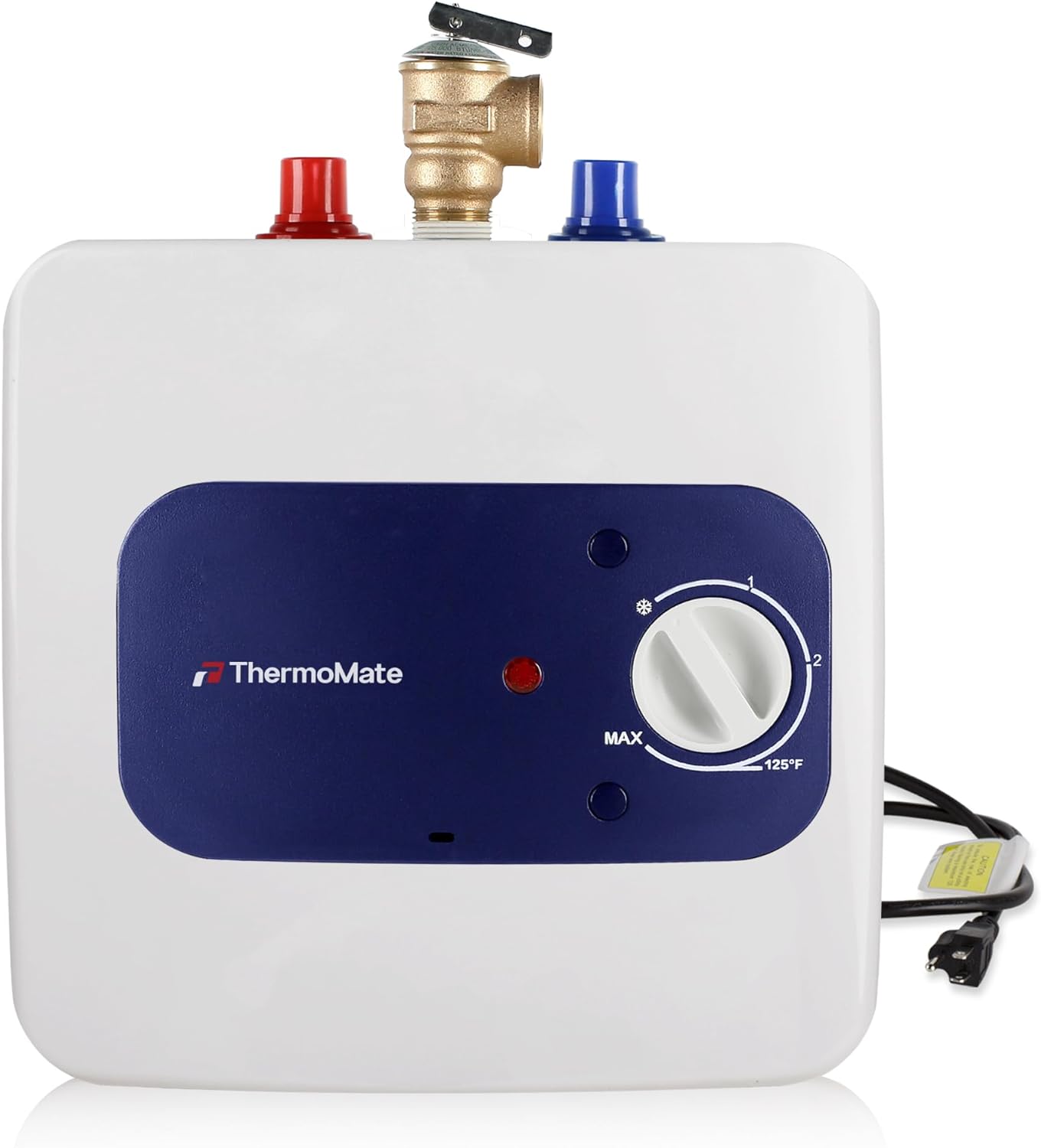
Two very different designs both get marketed as instant hot water heaters. A mini-tank heater, like the Bosch and ThermoMate units in this guide, keeps a small reserve of hot water (often 1 to 8 gallons) heated and ready at all times, so opening the tap delivers instant hot water until that reserve runs out. A true tankless unit, like the Rheem models here, has no reserve at all and instead heats water as it passes through, giving essentially unlimited hot water as long as the flow rate stays within what the unit can handle.
Mini-tanks are simpler and cheaper to install, but they can run dry during sustained use. True tankless units solve that problem but come with a bigger installation job and a higher price tag. Neither design is universally better; the right choice depends on whether you need instant hot water at one sink occasionally or sustained hot water across a whole home.
Electric vs. Propane Power Source

Every fixed installation on this list runs on electricity, either a standard 120V household outlet for the mini-tanks and the InSinkErator dispenser, or a hardwired 240V circuit for the Rheem tankless models. The Camplux is the outlier: it burns propane and uses battery ignition, which makes it useful off-grid but restricts it strictly to outdoor use.
If a purchase is for a fixed home installation, stick with an electric model and plan the wiring around it. If the need is a campsite, an RV, or an off-grid cabin, a propane unit like the Camplux is the only option here that does not depend on a working electrical hookup, but it must always be set up outdoors.
Voltage, Amperage, and Breaker Requirements

This is where the products on this list differ the most, and it is worth checking carefully before buying. The Bosch and ThermoMate mini-tanks, along with the InSinkErator dispenser, plug into a standard 110-120V outlet at roughly 1440W, so most homes can install them without any electrical work beyond confirming a nearby outlet.
The Rheem tankless units are a different story. The 6.5kW point-of-use model needs a dedicated 240V circuit drawing about 27A, while the 18kW whole-home model needs two separate 240V circuits with 40-amp double-pole breakers on 8 AWG wire, capable of up to 75A combined. Both require hardwiring by a licensed electrician, and the 18kW unit in particular means confirming the home’s electrical panel has spare capacity before buying. Do not treat these amperage figures as optional; they come straight from the manufacturer’s published specifications and matter for both safety and code compliance.
Flow Rate and Sizing for Your Home
Flow rate, measured in gallons per minute (GPM), determines how much hot water a tankless unit can deliver at once. The 18kW Rheem tops out around 7 GPM in mild climates, enough to run a shower and a sink together in many regions, though colder incoming water reduces that ceiling. The smaller point-of-use tankless and the propane Camplux both deliver a modest flow rate suited to a single fixture rather than multiple simultaneous uses.
Mini-tank heaters do not have a flow rate in the same sense; instead, their limit is the stored gallon capacity. A 1.32-gallon tank empties faster under continuous use than an 8-gallon one, so match the tank size to how demanding the fixture actually is, whether that’s an occasional bathroom sink or a small shower.
Safety Certifications and Overheat Protection
Look for UL listing on any electric unit, which the Bosch, ThermoMate, and InSinkErator products in this guide all carry, and CSA certification on the Camplux propane heater. Overheat protection and, for propane models, a flame failure device are worth checking for specifically, since these features are what keep a malfunction from becoming a real hazard rather than an inconvenience.
Installation Cost and Long-Term Value
The purchase price on this list ranges from a budget under-sink tank up to a full 240V tankless unit, but the purchase price is rarely the full cost of ownership. A plug-in mini-tank or the InSinkErator dispenser adds little beyond the unit itself, since most installs are a DIY plumbing job. A hardwired tankless unit adds the cost of a licensed electrician, possibly a new dedicated circuit or two, and in some cases a panel capacity check, all of which can add up to more than the appliance itself.
Where a tankless unit tends to win back some of that cost over time is standby efficiency: a storage tank heats and reheats water all day whether anyone uses it or not, while a true tankless unit only heats water when a tap is open. For a fixture used constantly, that efficiency gap matters more than it does for an occasional single sink, which is where a simple mini-tank remains the more practical and lower-cost choice.
| Product | Type | Power Source | Best For |
|---|---|---|---|
| Bosch Tronic 3000 T ES4 | Mini-tank, 4 gallons | 120V plug-in | Single sink, easy install |
| Rheem 18kW Tankless | True tankless | 240V hardwired | Whole-home use |
| Rheem 6.5kW Point-of-Use | True tankless | 240V hardwired | Single fixture, on-demand |
| Camplux 5L Portable | Portable tankless | Propane, battery ignition | Camping, RV, off-grid (outdoors only) |
| InSinkErator H-HOT150 | Dispenser tank | 120V plug-in | Near-boiling water for tea and cooking |
| ThermoMate ES150 | Mini-tank, 1.32 gallons | 120V plug-in | Budget single-sink upgrade |
| ThermoMate ES800 | Mini-tank, 8 gallons | 120V plug-in | Small bathroom, detached space |
| Budget 2.5-Gallon Tank | Mini-tank, 2.5 gallons | 110-120V plug-in | RV, trailer, compact kitchen |
For more plumbing and water fixture comparisons, browse our full Tools & Home Improvement category, or if the kitchen sink is getting a full upgrade, our guide to garbage disposals covers the other appliance that typically shares that cabinet space.
Why You Should Trust Us
We built this list by starting from real Amazon customer ratings and review counts rather than manufacturer marketing claims, then filtering for products with a meaningful number of verified purchases and consistently strong ratings. Our editorial team cross-checked voltage, amperage, and installation requirements against each manufacturer’s published specifications so the electrical details in this guide reflect what installers and buyers can expect, not rounded-off marketing copy.
We also grouped products by how they actually function, tank-style mini heaters, true tankless units, a dedicated dispenser, and a portable propane heater, rather than lumping every “instant hot water” product into one bucket, because the right pick depends heavily on which of those categories actually solves your problem.
Where a product’s brand could not be confirmed, such as the budget 2.5-gallon tank on this list, we labeled it clearly rather than guessing, and we left it out of any brand comparison in this guide’s summary numbers. We also avoid publishing prices or exact review counts in the writeups themselves, since those figures change constantly; the product cards above always reflect current information straight from the source.
Final Thoughts
For most homeowners who just want instant hot water at one sink without an electrician, the Bosch Tronic 3000 T 4-Gallon Mini-Tank Water Heater is our best overall pick. It plugs into a standard outlet, mounts almost anywhere in a cabinet, and comes from a brand with a long track record in this exact product category.
Anyone working with a tighter budget should look at the ThermoMate 1.32-Gallon Mini Tank, our best value pick. It does the same basic job as the Bosch unit at a lower price, with a smaller reserve that is still plenty for a single lightly used sink.
For a household ready to replace its main water heater entirely, the Rheem 18kW Tankless Electric Water Heater is the pick worth the electrical work, and for campers or RV owners, the Camplux 5L Portable Propane Water Heater is the only option here that works fully off-grid. Anyone heading out on the road might also want to check our guide to RV water filters to pair with it, and our full articles library covers plenty of other home upgrade comparisons.
Two more picks round out this list for narrower needs: the Rheem 6.5kW Point-of-Use Tankless Water Heater is the better choice over a mini-tank when a single fixture needs genuinely on-demand hot water instead of a limited reserve, and the InSinkErator H-HOT150 Instant Hot Water Dispenser is not a water heater replacement at all but a smart addition for anyone who wants near-boiling water on tap for tea, coffee, or cooking. The ThermoMate 8-Gallon Point-of-Use Tank is worth a look for a detached bathroom that needs more reserve than a compact mini-tank offers, without the electrical work of a hardwired tankless unit.
FAQs
How does an instant hot water heater work?
It depends on the design. A tank-style unit keeps a small reserve of water heated and ready at all times, so opening the tap delivers hot water immediately until that reserve is used up. A true tankless unit has no reserve; it heats cold water as it flows through the unit, so hot water is available continuously as long as the flow stays within the unit’s rated capacity.
Do I need a plumber or electrician to install one in 2026?
A plug-in mini-tank unit that runs on a standard 120V outlet usually only needs plumbing work to tap into the cold water line, which many DIY-comfortable homeowners can handle. A 240V tankless unit needs a dedicated circuit and hardwiring, which should always go through a licensed electrician, and often a plumber as well for the water connections.
Can an instant hot water heater supply a whole house?
A large enough true tankless unit, like the 18kW Rheem in this guide, can supply a full home in a moderate climate, though the maximum simultaneous flow rate depends on how cold the incoming water is. Mini-tank heaters and dispensers are sized for a single fixture and are not built to cover a whole house.
How long do instant hot water heaters last?
Electric mini-tank and tankless units from established brands are generally built for many years of regular use, though actual lifespan depends on water hardness, usage patterns, and basic maintenance like checking the anode rod on a tank-style unit or descaling in hard water areas. Following the manufacturer’s care guidance is the biggest factor in how long any of these units last.
Is an instant hot water heater worth it in 2026?
For a sink or fixture that is far from the main water heater, or a home considering a switch away from a bulky storage tank, yes: the convenience of instant hot water and, for tankless units, the elimination of standby heat loss can be a real everyday improvement. If your plumbing setup is due for other checks, our guide to shower filters covers another common bathroom upgrade worth considering at the same time.
What’s the difference between a mini-tank heater and a hot water dispenser?
A mini-tank water heater, like the Bosch or ThermoMate units in this guide, delivers regular hot water at normal tap temperature from the sink’s existing faucet, suitable for washing hands or dishes. A hot water dispenser, like the InSinkErator model here, delivers a smaller stream of near-boiling water from its own dedicated faucet, meant for tea, coffee, or cooking rather than everyday washing. Some households end up wanting both for different reasons.


Write Your Review
No reviews yet. Be the first to share your experience!