

A thorough residential property evaluation requires seeing what remains concealed behind finished drywall, inside crowded breaker panels, and under attic floorboards. Missing fiberglass batts, thermal bridging across structural framing, slow plumbing leaks inside ceilings, and overheated electrical connections can easily escape visual inspection until they trigger extensive structural damage. Equipping yourself with a reliable infrared camera for home inspectors transforms hidden temperature differences into clear visual evidence, helping you deliver comprehensive diagnostic reports that protect property buyers and homeowners alike.
To help you select the most capable thermal imager for your toolkit, we compared 12 infrared camera for home inspectors options from FLIR, VEVOR, TOPDON and more for October 2026. Our research evaluated sensor resolution, thermal sensitivity, visual fusion capabilities, battery endurance, and software workflows across the leading devices in the industry. Whether you are conducting routine energy audits, inspecting commercial HVAC equipment, or exploring specialized industrial and scientific inspection equipment, selecting the right device ensures accurate findings every time.
Our top pick is the TOPDON TC004 3.5″ Thermal Imaging Camera for its large display, robust 512 by 384 enhanced resolution, and seamless wireless reporting tools.

Pros
- Long 15-hour battery runtime with auto shut-off options
- Smooth 25Hz frame rate prevents image lag
- Durable 2-meter drop resistance and IP54 rating
- Automatic image capture during high-temperature alerts
- 512MB internal storage holds up to 8,000 images
Cons
- Native sensor resolution is 128x128 before software enhancement
- Wall adapter plug is not included with the charging cable
- Physical printed user manual is omitted from the packaging
The TOPDON TC004 Mini is a compact handheld thermal imaging camera built for home inspectors, HVAC technicians, and maintenance professionals. It delivers enhanced 240x240 thermal resolution through proprietary TISR technology, paired with a wide 40-degree by 30-degree field of view to help evaluate building insulation, pipe leaks, and circuit breakers.
Its standout feature is an exceptional 15-hour runtime on a single charge, preventing midday power loss during consecutive audits. The 25Hz refresh rate keeps the image smooth while scanning walls or ductwork, and the automated threshold alert captures a photo the moment surface temperatures exceed preset safety limits.
Prospective buyers seeking ultra-high native sensor resolution should note that this unit relies on digital enhancement from a 128x128 core sensor. Additionally, while a USB charging cable is supplied, you will need to provide your own AC charging block, and the manual must be downloaded online.
Bottom line: The TC004 Mini offers a durable, long-lasting thermal scanning solution that provides reliable heat tracking and smart image logging for residential diagnostics.
- Thermal Resolution: 128x128 (Enhanced to 240x240 with TISR)
- Refresh Rate: 25Hz
- Field of View: 40° x 30°
- Temperature Range: -4°F to 842°F (-20°C to 450°C)
- Measurement Accuracy: ±3.6°F or ±2%
- Battery Runtime: Up to 15 hours
- Internal Storage: 512MB eMMC (up to 8,000 photos)
- Durability Rating: IP54 water resistance and 2-meter drop protection
- Dimensions and Weight: 4 x 3.5 x 9 inches, 1.03 pounds
Home inspectors evaluating building envelopes, missing attic insulation, air drafts, and radiant floor heating will benefit from the wide field of view and automatic spot tracking.
HVAC contractors and electricians troubleshooting overheated circuit breakers, duct leaks, and overloaded wiring can rely on the real-time thermal alerts and wide temperature range.
Facility managers and automotive specialists needing a durable, pocket-sized diagnostic tool will appreciate the IP54 ruggedness and all-day 15-hour battery performance.
Does this camera include a printed user guide?
No, the package does not include a paper manual. TOPDON provides an electronic manual that you can download by scanning the QR code printed on the product packaging.
How many thermal images can the internal memory save?
The device comes with 512MB of built-in eMMC storage, which allows you to store up to 8,000 thermal photos directly on the unit without purchasing an external memory card.
What happens when a temperature exceeds the set limit?
The camera triggers an instant on-screen alert and automatically takes a photo, capturing the diagnostic evidence immediately without requiring manual shutter input.

Pros
- Smooth 25Hz refresh rate for fluid real-time scanning
- Automated hot, cold, and center spot tracking
- Built-in laser pointer and standard tripod mount
- Long 11-hour battery life on a single charge
- Windows PC software included for detailed analysis
Cons
- AI scene detection does not measure actual moisture levels
- Analysis software is limited to Windows PC operating systems
- Requires a firmware update to unlock full IntellFault features
The HSFTOOLS HF96 is an infrared inspection camera engineered for home inspectors, energy auditors, and maintenance technicians. It combines spot thermometry with thermal imaging to help users scan electrical panels, HVAC ductwork, and structural envelopes efficiently.
A notable strength is the 25Hz refresh rate paired with live super resolution, which upscales thermal views to 240x240 clarity without lag. Automatic tracking highlights hot, cold, and center spots across a wide 50-degree field of view, while manual level and span controls allow inspectors to isolate subtle temperature variations as small as 0.05°C.
Inspectors should note that while the AI IntellFault system flags thermal patterns common to plumbing issues, the device does not measure moisture content directly. Additionally, the desktop reporting suite is built specifically for Windows computers, meaning Mac users must find alternative workflows for in-depth data review.
Bottom line: With a dependable 11-hour battery life, IP54 dust and splash resistance, and fluid 25Hz thermal imaging, the HF96 offers reliable daily diagnostic capability for residential inspections.
- Model: HF96
- Dimensions: 3.8 x 6.3 x 10.4 inches
- Weight: 1.46 pounds
- Temperature Range: -4°F to 1022°F
- Accuracy: ±3.6°F
- Thermal Sensitivity: Below 50mK (0.05°C)
- Frame Rate: 25Hz
- Battery: 3350 mAh Lithium Ion (rechargeable)
- Internal Storage: 4 GB
- HSFTOOLS HF96 Handheld Thermal Camera
- 2-in-1 USB-C to USB-A and USB-C Cable
- Adjustable Wrist Lanyard
- User Manual
The HF96 connects to Windows computers using the included USB cable to interface directly with HSF Studio software. This program allows users to organize inspection data, conduct detailed post-scan analysis, manage screen projections, and generate 3D thermal distribution models.
To access the AI IntellFault scene detection functions, install the latest firmware available on the manufacturer website and activate the scene mode in the system settings. The camera also features a standard threaded tripod socket for hands-free positioning during extended monitoring sessions.

Pros
- High 256x192 thermal resolution with 512x384 enhancement
- Large, easy-to-read 3.5-inch screen
- Expansive 64GB internal storage capacity
- Quick wireless file transfer via Wi-Fi and mobile app
- Rugged IP54 rating with 2-meter drop defense
Cons
- Noticeably heavier than pocket-sized units at 2.11 pounds
- Laser indicator can be difficult to see in direct sunlight
- Requires app setup for remote file synchronization
The TOPDON TC004 is a handheld thermal imager engineered for residential inspectors, HVAC technicians, and facility maintenance teams. Its broad measurement capability, ranging from -4°F to 1022°F, provides the flexibility necessary to evaluate building envelopes, locate hidden plumbing leaks, and monitor electrical breaker panels.
Clear image quality is essential during diagnostic scans, and the TC004 delivers through its 256x192 resolution sensor, which scales up to 512x384 using built-in TISR technology. Combined with a bright 3.5-inch display, 64GB of internal memory, and Wi-Fi synchronization to the TopInfrared app, the camera makes gathering documentation and generating reports fast and straightforward.
At 2.11 pounds, the device is bulkier than compact smartphone dongles, which might cause fatigue during extended inspections across multiple properties. Professionals who prefer ultra-compact equipment that fits inside a shirt pocket may want to consider smaller pocket-style alternatives.
Bottom line: The TOPDON TC004 delivers sharp thermal imaging, extensive onboard memory, and field-ready durability, making it a dependable diagnostic asset for any home inspection toolkit.
- Model: TC004
- Manufacturer: TOPDON
- Display Size: 3.5 inches
- Thermal Resolution: 256 x 192 (enhanced to 512 x 384 via TISR)
- Temperature Range: -4°F to 1022°F
- Storage Capacity: 64GB built-in memory
- Durability Rating: IP54 water and dust resistance, 2-meter drop resistance
- Power: 1 A battery required (included)
- Item Weight: 2.11 pounds
Getting started with the TOPDON TC004 is straightforward out of the box. The unit operates on its included battery and powers on quickly, allowing inspectors to start scanning walls, ceilings, and mechanical equipment right away.
For professional reporting, the camera features integrated Wi-Fi that pairs directly with the TopInfrared mobile application. Inspectors can wirelessly download photos and thermal videos to a smartphone or tablet to compile detailed client summaries before leaving the jobsite.
The TOPDON TC004 is well suited for residential home inspectors, energy auditors, and weatherization contractors who need sharp imagery to identify missing insulation, thermal bridging, and drafty window seals.
It is also a great fit for commercial facility managers, electricians, and HVAC professionals who require an expanded temperature threshold up to 1022°F to monitor high-voltage equipment and boiler systems.
Users looking for an all-in-one tool with onboard storage, drop protection, and a built-in work light will appreciate its durability compared to fragile phone attachments.

Pros
- Fluid 25Hz refresh rate for lag-free scanning
- Super resolution algorithm boosts clarity to 240x240
- Rugged IP54-rated housing with 6.6-foot drop resistance
- Large 3.5-inch touchscreen with smartphone-style UI
- Integrated voice and video recording capabilities
Cons
- Base sensor resolution is limited to 96x96 pixels
- Does not measure direct moisture percentages
- Battery runtime tops out at roughly 4 hours
The HSFTOOLS HP96 is an entry-level infrared imager tailored for residential home inspections, electrical audits, and HVAC assessments. Built with a compact form factor, it gives inspectors an accessible way to spot thermal anomalies across ceilings, exterior walls, and electrical panels.
A standout attribute is the responsive 3.5-inch touchscreen paired with a 25Hz frame rate, ensuring fluid navigation and smooth panning without visual stutter. While the physical sensor captures at 96x96 resolution, the onboard Super Resolution processing reconstructs images up to 240x240, delivering crisp image blending alongside the 640x480 visible light lens.
Despite these strengths, the base sensor resolution may feel limited for inspectors tasked with expansive commercial jobs or long-range evaluations. Additionally, while the automated IntellFault system spots thermal patterns indicative of leaks, it does not record actual moisture content, requiring a dedicated moisture meter to confirm findings.
Bottom line: The HP96 is a practical, user-friendly thermal camera that offers residential inspectors reliable anomaly detection and clean visual blending at an approachable tier.
- Sensor Resolution: 96 x 96 (Live Super Resolution up to 240 x 240)
- Visible Light Camera: 640 x 480
- Refresh Rate: 25Hz
- Field of View: 50° x 50°
- Thermal Sensitivity: Below 50mK (0.05°C)
- Battery: Built-in rechargeable Lithium-Ion (up to 4 hours runtime)
- Dimensions: 2.76 x 4.72 x 7.48 inches
- Weight: 1.48 pounds
- Durability: IP54 rating, 6.6-foot drop resistance
Residential home inspectors will appreciate the HP96 for assessing insulation coverage, finding missing fiberglass batts, and tracking down air drafts around window frames and doors.
It is also a practical companion for HVAC contractors checking ductwork integrity and electricians scanning breaker boxes for overloaded circuits or hot terminals.
Professionals who manage heavy industrial facilities or require high-resolution engineering thermography should opt for higher native resolution platforms.
The imager features built-in eMMC memory that holds roughly 30,000 standard thermal photos or up to 20 hours of video with voice annotations captured through the integrated microphone.
Files transfer smoothly to a computer for in-depth analysis, client reporting, and image organization using the HSF Studio PC software.
Users can install firmware updates via the HSFTOOLS website to access feature improvements and activate automated IntellFault scene recognition modes.
A standard threaded mounting hole on the base allows inspectors to attach the unit to any standard tripod for continuous stationary monitoring.

Pros
- Smooth 25Hz refresh rate for real-time panning
- Broad temperature range up to 1022°F
- Rugged 6.6-foot drop-resistant housing
- Six distinct thermal color palettes
- Built-in visual temperature alarms
Cons
- Audible clicking sound during automatic recalibration may surprise new users
- Manufacturer designates usage primarily for indoor inspection scenarios
- Bulky handheld frame measures roughly 30 centimeters in length
The Flagfront YXI96 is a handheld thermal imaging camera engineered to help home inspectors, HVAC technicians, and facility managers detect hidden building flaws. By combining a 240x240 super-resolution enhancement with a 50-degree field of view, it allows users to scan wide wall cavities, breaker panels, and plumbing runs quickly.
Key performance strengths include its fluid 25Hz refresh rate, which eliminates the motion stutter common on slower imagers during live walk-throughs. The broad temperature range from -4°F to 1022°F, paired with adjustable emissivity and on-screen spot tracking for maximum, minimum, and center points, provides dependable thermal profiling across insulation, ductwork, and electrical circuits.
On the downside, the camera makes an audible clicking noise while periodically auto-calibrating, which can feel jarring before you realize it is standard operation. In addition, the manufacturer rates the unit for indoor usage, so technicians requiring specialized outdoor or extreme-weather equipment may want a dedicated exterior survey tool.
Bottom line: The Flagfront YXI96 provides an effective combination of high-refresh imaging, rugged drop resistance, and customizable palette modes for interior home inspections and trade diagnostics.
- Model Name: Flagfront YXI96
- Display Type: Digital Large Display
- Resolution: 240 x 240 Super Resolution
- Refresh Rate: 25Hz
- Field of View: 50 degrees
- Upper Temperature Range: 1022°F (spans -4°F to 1022°F)
- Durability: 6.6-foot drop resistance, IP54 weather rating
- Power Source: Battery powered (1 Lithium Ion battery included)
- Item Length: 30 centimeters
Home inspectors and energy auditors will benefit most from this device when tracking thermal bypasses, missing fiberglass batts, and air leaks around windows or baseboards. The 25Hz frame rate ensures smooth visual feedback while walking room to room.
Electricians and HVAC technicians can utilize the high-temperature ceiling of 1022°F to pinpoint overloaded breakers, faulty wiring splices, and blocked heating coils before components fail.
Property managers and DIY homeowners will also appreciate the intuitive color palettes and temperature alarms for locating subfloor plumbing leaks, roof moisture, or pet stains without invasive wall cuts.
Why does the camera make a clicking noise?
The clicking sound occurs when the internal shutter activates to recalibrate the thermal sensor. This automatic process ensures ongoing image clarity and temperature precision throughout your inspection.
Which color palettes are available?
The imager includes six selectable color palettes: White Heat, Rainbow, Red Heat, Black Heat, and Iron, allowing you to optimize contrast based on surface reflectivity and ambient lighting.
Can I adjust emissivity settings?
Yes, the camera allows you to customize both emissivity and distance values to match specific building materials, improving thermal accuracy on reflective or textured surfaces.

Pros
- High 512 x 384 enhanced resolution with 40mK thermal sensitivity
- Generous 10.5-hour battery life with 18W fast charging
- Sturdy IP54 housing with 2-meter drop protection
- Tracks six simultaneous temperature spots on screen
- Wi-Fi and USB real-time streaming capabilities
Cons
- Heavier than average handheld profile at 3.12 pounds
- Higher resolution relies on software upscaling from a 256 x 192 sensor
- Bulky dimensions can cause hand strain during extended inspections
The Thermal Master Thor002 is a professional handheld infrared imager tailored for home inspectors, energy auditors, and HVAC specialists. Designed to uncover air leaks, missing insulation, and overloaded circuits, it combines a 2MP visible light camera with an infrared sensor enhanced to 512 x 384 resolution.
Diagnostics benefit from 40mK thermal sensitivity and a 25Hz refresh rate, allowing smooth scanning across surfaces without motion blur. The 3.5-inch IPS display clearly shows six temperature measurement points at once. Inspectors can record voice notes and transmit files wirelessly to phones or via USB to a PC for client reporting.
Weighing 3.12 pounds, the unit is noticeably heavier than compact pocket imagers, which may cause wrist strain during long walkthroughs. Professionals seeking true native ultra-high resolution should also note that its 512 x 384 clarity is achieved through software enhancement of an underlying 256 x 192 detector.
Bottom line: The Thermal Master Thor002 offers an outstanding blend of battery endurance, rugged durability, and crisp visual diagnostics, making it a dependable inspection tool for residential and light commercial audits.
- Display: 3.5-inch IPS screen (640 x 480 resolution)
- Thermal Resolution: 512 x 384 (X3 enhanced from 256 x 192)
- Visible Light Camera: 2MP
- Refresh Rate: 25Hz
- Thermal Sensitivity: 40mK (NETD)
- Temperature Range: -4°F to 1022°F (Accuracy: ±3.6°F)
- Battery and Runtime: 5000mAh Lithium-Ion, up to 10.5 hours (18W fast charging)
- Storage and Memory: 8GB RAM, 32GB internal storage
- Dimensions and Weight: 10.24 x 4.33 x 4.13 inches; 3.12 pounds
Home inspectors will find this camera ideal for locating hidden insulation gaps, tracking moisture intrusion behind drywall, and assessing radiant heating loops. The integrated laser pointer and voice recording feature help inspectors quickly document findings inside dark attics or crawlspaces.
Electricians and facility managers can also make great use of its high-temperature alerts and multi-point tracking. Monitoring six spots simultaneously makes it simple to identify overloaded breakers and failing mechanical bearings before they present safety hazards.
The device connects directly to computers using USB to stream real-time thermal video for detailed analysis. Inspectors can review imagery and generate professional diagnostic reports using downloadable PC software.
On-site wireless pairing with iOS and Android smartphones or tablets allows inspectors to share findings directly with clients in real time. The imager also features QR code file indexing to keep photo and video documentation organized across its 32GB onboard storage.

Pros
- Fluid 25Hz refresh rate for quick sweeps
- Broad measurement span from -4°F to 1022°F
- Generous 8GB internal storage for video and stills
- Durable 6.6-foot drop-rated IP54 housing
Cons
- Analysis software is not compatible with macOS
- Native sensor resolution is 120x90 prior to enhancement
The FOXWELL RT280 is an ergonomic handheld infrared camera designed to help home inspectors, electricians, and HVAC contractors detect hidden building defects. By visualizing subtle heat signatures behind drywall, around electrical panels, and along ductwork, it enables professionals to pinpoint air drafts, plumbing leaks, and overloaded circuits without intrusive demolition.
Thermal clarity is driven by an enhanced 240x180 TISR resolution paired with a 25Hz refresh rate, delivering smooth motion during rapid sweeps. The camera provides nine selectable color palettes, an integrated laser pointer, and an LED work light for dark crawl spaces. With an expansive measurement range from -4°F to 1022°F and automated high or low temperature alarms, identifying critical anomalies is fast and straightforward.
While the hardware is protected by an IP54-rated shell and 6.6-foot drop resistance, its reporting software is strictly designed for Windows computers. Inspectors who rely exclusively on Apple Mac systems will face workflow hurdles when exporting thermal data. Additionally, users who require ultra-high native sensor resolution without algorithmic enhancement may prefer higher-tier industrial equipment.
Bottom line: The FOXWELL RT280 delivers an excellent balance of rugged job-site durability, fluid imaging, and useful diagnostic tools for home inspectors who work within a Windows PC environment.
- Thermal Resolution: 240 x 180 (TISR enhanced from 120 x 90)
- Display: 2.8-inch LCD (320 x 240)
- Frame Rate: 25Hz
- Temperature Range: -4°F to 1022°F
- Accuracy: ±3.6°F or ±2%
- Internal Storage: 8GB eMMC
- File Formats: JPEG (stills), MP4 (video)
- Durability: IP54 water resistance, 6.6-foot drop protection
- Hardware Interface: USB Type-C
The RT280 connects to your computer via a standard USB Type-C interface, allowing rapid file transfers of stored JPEG images and MP4 video recordings. The included analysis software lets inspectors perform point, line, and area temperature evaluations, view 2D and 3D models, and compile professional client reports.
Please note that the thermal analysis suite is compatible solely with Windows PC operating systems. Mac users can still access standard image files as storage media, but advanced reporting software features require a Windows environment.
Home inspectors seeking to locate insulation voids, missing thermal breaks, moisture intrusion, and air leaks around windows or doors will find the RT280 well suited for residential assessments.
HVAC professionals, plumbers, and automotive technicians can also utilize the broad -4°F to 1022°F range to isolate overheating motors, examine ductwork, and detect hidden pipe blockages in dark mechanical rooms.

Pros
- Fluid 25Hz imaging speed
- Long-lasting 14-hour battery run time
- Broad 50-degree by 50-degree viewing area
- Lightweight 240-gram handheld profile
- High and low temperature alert alarms
Cons
- Modest 96x96 resolution limits extreme fine-detail clarity
- Fixed focus lens is not suited for micro electrical inspection
The AccuMEMS GT14S is an ultra-compact handheld infrared camera engineered for home energy audits, HVAC diagnostics, and building inspections. At just 240 grams, it combines portable convenience with practical utility, serving inspectors who need rapid, dependable thermal scanning without bulky hardware.
Its main strength lies in its smooth 25Hz refresh rate paired with a broad 50-degree field of view. While lower-tier imagers often suffer from noticeable lag, this camera moves fluidly across broad surfaces to pinpoint missing insulation or underfloor heating lines. The sensor detects subtle temperature shifts down to 0.05°C, supported by an internal 2500mAh battery that delivers up to 14 hours of continuous operation.
The 96x96 IR sensor provides sufficient detail for general home diagnostics, such as checking drafty window seals or overheated circuit breakers. However, inspectors seeking ultra-sharp images for detailed commercial reporting or minute component diagnostics may want a higher sensor pixel density.
Bottom line: The AccuMEMS GT14S is a lightweight, capable thermal scanner that provides fluid visual feedback, broad room coverage, and outstanding battery life for everyday residential inspections.
- IR Resolution: 96 x 96 pixels
- Thermal Sensitivity: NETD < 50mK (0.05°C)
- Frame Rate: 25 Hz
- Field of View: 50° x 50°
- Battery: Built-in 2500 mAh rechargeable lithium-ion
- Battery Life: Up to 14 hours
- Device Weight: 240 grams (Package Weight: 14.9 ounces)
- Package Dimensions: 9.45 x 4.49 x 3.9 inches
- Warranty: 1-year limited warranty
Residential home inspectors will benefit from the generous 50-degree field of view, which allows swift scanning across entire ceilings, crawl spaces, and baseboards to uncover insulation gaps and water intrusion.
HVAC technicians and facilities maintenance specialists can rely on the dual-mode thermal imaging and spot thermometer to quickly check registers, balance ductwork, and identify overheated mechanical bearings.
Property managers and energy consultants will appreciate the lightweight form factor and simple button navigation, making long facility walk-throughs easy to handle without hand fatigue.
What is the benefit of the 25Hz refresh rate?
A 25Hz refresh rate ensures the screen updates smoothly as you walk through rooms, eliminating the image stutter and motion blur common in standard 9Hz entry-level cameras.
How does dual mode operation work?
Dual mode allows you to toggle between standard thermal imaging with automatic hot and cold spot tracking, and a dedicated digital thermometer mode for focused numerical spot measurements.
Can this camera find hydronic radiant floor heating pipes?
Yes, the high thermal sensitivity of 0.05°C clearly visualizes warm fluid tubing or electric heating cables embedded beneath standard tile and wood flooring surfaces.

Pros
- Pocket-sized and lightweight at only 190 grams
- Direct Wi-Fi cloud data synchronization
- Built-in 5 MP visual camera with LED light
- Standard tripod mounting hole for stability
Cons
- Lacks water resistance for outdoor wet weather
- Requires manual focus adjustment
The FLIR C3-X is a compact thermal imaging camera built for home inspectors, HVAC technicians, and building maintenance specialists. It pairs a 10,800-pixel infrared detector with a 5 MP visual camera, making it simple to detect thermal anomalies and correlate them with visible surfaces.
Portability and workflow efficiency are the core strengths of this model. Weighing only 190 grams, the unit fits into a pocket and features Wi-Fi connectivity for instant cloud uploads. The integrated LED work light and tripod screw mount add valuable versatility when scanning dim crawl spaces or setting up fixed monitoring positions.
Because the unit is not water resistant, technicians need to exercise caution during rainy exterior audits or around wet plumbing leaks. Users must also manage manual focus settings, which requires a quick manual adjustment to get clear readings at varying distances.
Bottom line: For home inspectors seeking a pocket-ready thermal imager with dependable heat detection and immediate cloud backup, the FLIR C3-X provides a capable diagnostic solution.
- Brand: FLIR
- Model Series: C3-X (Part Number: 90501-0201)
- Thermal Resolution: 10,800 pixels
- Photo Sensor Resolution: 5 MP
- Weight: 190 g
- Viewfinder Type: LCD screen
- Video Capture Resolution: 1080p MP4
- File Formats: JPEG, RAW
- Water Resistance Level: Not Water Resistant
Home inspectors will find this camera useful for quickly locating insulation deficiencies, cold air drafts, and hidden pipe leaks without carrying bulky equipment.
HVAC professionals and electrical technicians can use it on routine service calls to identify hot circuit breakers, faulty duct connections, and overheating motors.
Facility managers and contractors will appreciate the rapid image capture and cloud sync, which allow for quick visual documentation and reporting before leaving the jobsite.
Built-in Wi-Fi connectivity links the camera directly to cloud storage, enabling real-time backup and faster client reporting from any jobsite with wireless access.
The camera stores visual and thermal information in standard JPEG and RAW file formats, ensuring seamless transfer and viewing on mobile devices and desktop computers.
The base includes a standard tripod screw hole, allowing inspectors to mount the camera to tripods or extension poles for continuous monitoring or hard-to-reach scans.
Pros
- Sharp 240x180 infrared resolution with 20Hz refresh rate
- Dual-lens fusion blends optical contours with thermal maps
- Long 11-hour battery life for all-day property assessments
- Durable IP54 housing with 6.6-foot drop resistance
Cons
- Larger physical profile than compact smartphone plugin imagers
- Focus distance is fixed and optimized between 1.6 and 13.1 feet
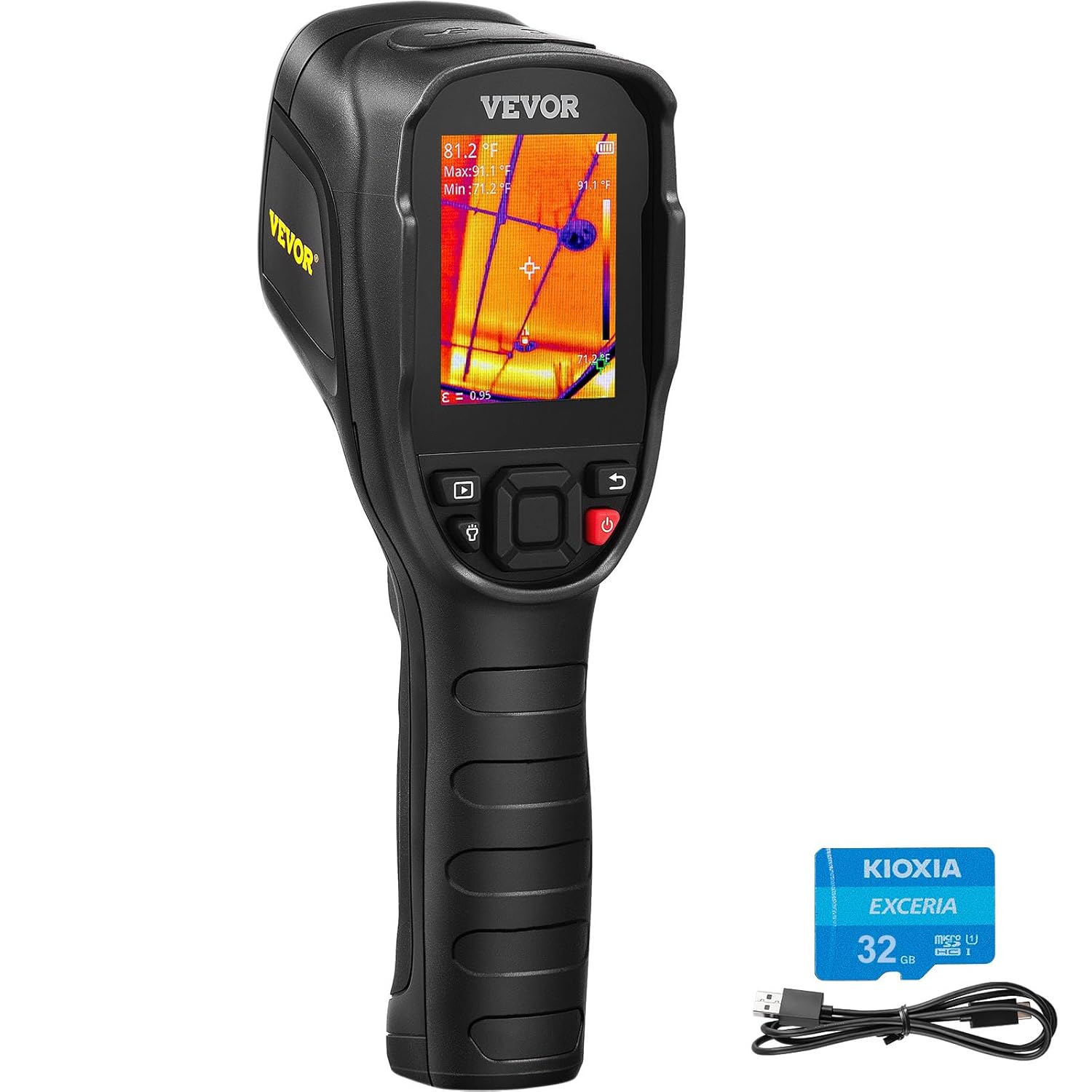
The VEVOR SC240M is a handheld infrared camera designed for home inspectors, energy auditors, and HVAC contractors who require precise thermal diagnostics. Combining a 240x180 infrared detector with a 2-megapixel visual camera, it captures surface temperatures spanning from -4 to 1022 degrees Fahrenheit.
Its standout capability is image fusion, which overlays visible light outlines onto thermal maps to clarify structural details. A 20Hz refresh rate keeps scanning smooth while checking electrical breaker boxes or ceiling drywall, and seven selectable color palettes make it simple to distinguish subtle temperature anomalies.
Because the optical distance is tuned between 1.6 and 13.1 feet, it is not engineered for long-distance exterior roof surveys or extreme close-up circuit board inspections. Technicians seeking an ultra-compact tool that plugs into a phone might also find the rugged pistol-grip body comparatively bulky.
Bottom line: The VEVOR SC240M delivers crisp dual-camera imagery, generous battery endurance, and jobsite-ready durability, making it an excellent standalone choice for residential and commercial building assessments.
- Infrared Resolution: 240 x 180 pixels
- Visible Light Resolution: 2 megapixels
- Refresh Rate: 20Hz
- Thermal Sensitivity: 40 mK
- Temperature Range: -4 to 1022 degrees Fahrenheit (-20 to 550 degrees Celsius)
- Field of View: 52.5 degrees x 39.5 degrees
- Battery: 1 Lithium Ion battery required (included), up to 11 hours runtime
- Storage: 64GB SD card included
- Durability: IP54 water and dust resistance, 6.6-foot drop rated
- Dimensions: 11.8 x 7.9 x 7.3 inches; Weight: 1.15 pounds
- 1 x VEVOR SC240M Thermal Imager
- 1 x 64GB SD Card
- 1 x USB Cable for data transfer and charging
- 1 x Protective Carry Bag
- 1 x User Guide
This thermal camera is tailored for residential home inspectors looking to spot hidden moisture pockets, insulation gaps, and overheating circuit breakers. Image blending makes reports easier for homebuyers to interpret by keeping visible room contours sharp.
It is equally useful for HVAC technicians, plumbers, and facility engineers diagnosing duct leaks, radiant floor issues, and mechanical friction. The rugged enclosure and 11-hour battery life handle full days in attics, crawlspaces, and mechanical rooms.

Pros
- Enhanced 512 x 384 TISR thermal resolution
- Smooth 25Hz real-time frame rate
- Dual-lens blending with 2MP visual sensor
- Durable 6.6-foot drop rating and IP54 housing
- Detailed 2D and 3D PC analysis software
Cons
- Desktop analysis software is not compatible with macOS
- Compact 2.8-inch display may feel small for complex reads
The FOXWELL RT280 PRO is a handheld thermal imager designed for residential building inspectors, HVAC contractors, and facility maintenance technicians who need reliable heat mapping on demanding job sites. It serves as a practical diagnostic tool for detecting hidden thermal leaks, missing insulation, and overloaded breakers without cumbersome gear.
A major strength during structural scans is the pairing of a 2MP visual camera with TISR enhancement, which scales thermal image details up to 512 by 384 pixels. Working alongside a smooth 25Hz refresh rate and a broad 56 by 42 degree field of view, the camera allows inspectors to survey entire walls or ceilings quickly without dealing with frame lag.
While the hardware is built tough with an IP54 rating and 6.6-foot drop resistance, the included analysis program is limited exclusively to Windows PCs. Inspectors who operate entirely within the Apple Mac ecosystem will have to use workarounds or rely on on-device visual analysis when preparing their client reports.
Bottom line: The FOXWELL RT280 PRO gives home inspectors an exceptionally durable, high-clarity infrared imager with fast real-time tracking, making it a dependable choice for finding building envelope defects.
- Screen Size: 2.8-inch LCD screen
- Thermal Image Resolution: 512 x 384 (TISR enhanced)
- Visible Light Camera: 2MP resolution
- Refresh Rate: 25 frames per second
- Temperature Range: -4°F to 1022°F
- Measurement Accuracy: ±3.6°F or ±2%
- Field of View: 56° x 42°
- Durability: IP54 water resistant and 6.6-foot drop resistant
- Interface and Storage: USB Type-C with internal eMMC media
Connecting the imager to a computer is handled directly through the onboard USB Type-C port, allowing users to transfer JPEG thermal stills and MP4 or AVI video recordings stored on the internal eMMC memory.
The included thermal reporting software runs on Windows laptops and desktops, providing point, line, and regional temperature calculations alongside 2D and 3D profile modeling for formal inspection documentation.
Apple macOS is not supported by the analysis utility. While Mac computers can access standard image files over USB, radiometric data adjustments require a Windows workstation.
Home inspectors will appreciate the wide 56-degree field of view when sweeping large ceiling spans, subfloors, and exterior walls to track air leaks and missing insulation.
HVAC technicians and electricians benefit from the broad -4°F to 1022°F temperature limits and high/low alarms, which pinpoint overheating breakers and ductwork leakage on contact.
Professionals who manage their reporting exclusively on Mac computers or who need wireless smartphone streaming will want to look at alternate units designed around those workflows.

Pros
- Up to 14 hours of continuous battery life
- High thermal sensitivity under 50mK for subtle leaks
- 50-degree wide field of view covers large surfaces quickly
- Lightweight 240-gram design for comfortable one-handed use
Cons
- Compact screen size limits viewing fine details from a distance
- No wireless data transfer or instant mobile app sync
The AccuMEMS GT14S is a handheld thermal imager designed for quick diagnostic sweeps and point-and-shoot temperature checks. Built for residential home inspectors, maintenance technicians, and energy auditors, it delivers real-time thermal scanning to detect insulation voids, moisture intrusion, and overloaded circuits.
Its standout capability rests in the combination of a high-sensitivity sensor with an NETD under 50mK and a broad 50-degree field of view. These features allow inspectors to scan expansive walls and ceilings quickly while capturing subtle temperature shifts down to 0.05°C. With seven color palettes and up to 14 hours of continuous runtime from its 2500mAh battery, it easily manages full-day site evaluations.
While the compact form factor ensures easy handling at just 240 grams, the smaller display may feel limiting for inspectors who prefer presenting visuals directly to clients on-site. Professionals needing cloud report syncing or integrated Wi-Fi may also find the standalone workflow restrictive.
Bottom line: The AccuMEMS GT14S provides home inspectors with an enduring battery, dependable thermal sensitivity, and wide coverage in a portable package that simplifies daily building assessments.
- Model: GT14S-US
- Temperature Range: -4°F to 1022°F
- Thermal Sensitivity: NETD < 50mK (0.05°C)
- Field of View: 50 degrees
- Battery: Built-in 2500mAh rechargeable lithium-ion
- Battery Life: Up to 14 hours continuous operation
- Color Modes: 7 selectable palettes
- Weight: 240 grams (15.2 ounces package weight)
- Warranty: 1-year manufacturer warranty
Residential home inspectors will appreciate the expansive 50-degree field of view and extended 14-hour battery life. It simplifies rapid assessments of attic insulation, HVAC registers, plumbing runs, and electrical service panels during lengthy property walk-throughs.
HVAC technicians and facility maintenance professionals benefit from the wide measurement range of -4°F to 1022°F. It allows quick identification of duct leakage, overheating motors, and hot spots in electrical breaker boxes.
Property managers and DIY energy auditors looking to track down air drafts and wall heat loss will find the point-and-shoot operation straightforward without needing specialized thermography experience.
Power on the device using the physical controls and select your preferred color palette based on the inspection environment. Iron and rainbow palettes work well for detecting insulation gaps, while high-contrast monochrome modes excel at electrical panel checks.
Adjust the emissivity and distance settings to match the target material, such as drywall, wood, or metal surfaces. Use the Center, Hot, and Cold spot indicators to monitor moving targets and instantly pinpoint temperature extremes across the scene.
Set custom high and low temperature alarms before scanning large rooms. When an anomaly triggers an alert, utilize the level and span manual adjustment functions to isolate the issue with clear thermal contrast.
How to Choose the Best Infrared Cameras for Home Inspectors: Buying Guide
Detector Resolution and Image Enhancement Technologies

In infrared thermography, resolution dictates how sharply you can distinguish distinct thermal patterns across a building component. Native sensor resolution measures the physical array of microbolometer detectors capturing thermal radiation. A low-resolution sensor produces coarse thermal maps where slight temperature gradients blend together, making it difficult to separate air infiltration from normal structural framing cooling. Image enhancement technologies, such as super-resolution algorithms, take base radiometric data and interpolate adjacent pixels to reconstruct finer thermal edges, allowing inspectors to interpret thermal patterns with significantly higher clarity.
High thermal clarity is demonstrated in tools like the TOPDON TC004 3.5″ Thermal Imaging Camera, which utilizes a 256 by 192 native sensor boosted by Thermal Image Super Resolution (TISR) technology to produce a 512 by 384 effective image. Similarly, the Thermal Master Thor002 Handheld Thermal Camera upgrades its 256 by 192 infrared sensor to 512 by 384 resolution with its proprietary X-cubed algorithm. For compact inspection workflows, the FOXWELL RT280 PRO Thermal Imaging Camera also provides 512 by 384 enhanced resolution, while the HP96 Thermal Imaging Camera,3.5″ Touch Screen elevates a 96 by 96 base core to 240 by 240 super-resolution during live viewing and photo capture. Dedicated pocket units like the FLIR C3-X 10,800 Pixels, Infrared Thermography deliver 10,800 thermal measurement pixels for swift spot assessments.
The U.S. Department of Energy’s Building America Solution Center notes that an infrared camera can help you detect missing insulation in walls or ceilings as well as air leakage, and that the best time to perform thermal imaging is when there is a significant temperature difference between inside and outside the home. When you scan high cathedral ceilings, exterior cladding, or large electrical distributions, enhanced resolution allows you to diagnose thermal leaks from safe floor-level vantage points without missing pinpoint anomalies.
Thermal Sensitivity (NETD) and Measurement Accuracy

Thermal sensitivity, expressed as Noise Equivalent Temperature Difference (NETD) in millikelvins (mK), represents the smallest temperature change an infrared detector can distinguish from electronic background noise. A lower millikelvin number indicates a more sensitive imager. In residential inspections, moisture intrusion and minor insulation gaps do not create extreme temperature spikes. Instead, damp insulation or slow sub-surface pipe leaks produce minute evaporative cooling effects that differ from surrounding dry drywall by less than a single degree.
Devices like the Thermal Master Thor002 Handheld Thermal Camera and the VEVOR Thermal Imaging Camera feature an ultra-sensitive 40mK rating, capable of registering temperature variations as subtle as 0.04 degrees Celsius. The HF96 Thermal Camera with AI Scene Detection, the GT14S Thermal Imaging Camera, Thermometer Mode, and the GT14S Thermal Imaging Camera with Edge all provide sensitivity ratings under 50mK, picking up discrepancies down to 0.05 degrees Celsius. These cameras support an extensive thermal span from minus 4 degrees Fahrenheit up to 1022 degrees Fahrenheit, maintaining tight measurement accuracy within plus or minus 2 percent or 3.6 degrees Fahrenheit across diverse residential and mechanical surfaces.
Emissivity settings matter as much as sensitivity: the Wikipedia overview of thermography explains that an object of low emissivity could have its temperature underestimated by the detector, and that surrounding infrared radiation can be reflected in the object. Because building components span diverse materials like plaster, brick, concrete, and copper piping, choosing an imager with customizable emissivity and distance settings prevents inaccurate readings and ensures your diagnostic conclusions remain completely reliable.
Visual Light Fusion and Optical Display Systems

Thermal heatmaps alone can be bewildering to home buyers who lack background training in thermography. A standalone thermal image showing a purple and blue anomaly rarely conveys where the defect resides inside a room. Optical fusion blends a standard digital photograph with the thermal heatmap, outlining structural edges like ceiling corners, door trims, and breaker switches directly over the thermal gradient. This visual alignment makes inspection findings instantly understandable to clients, contractors, and real estate professionals.
Multiple cameras in our comparison excel at optical alignment. The FOXWELL RT280 PRO Thermal Imaging Camera combines an infrared sensor with a 2-megapixel visible-light camera, offering five inspection modes including thermal, visible, outline fusion, picture-in-picture, and overlay fusion. The HP96 Thermal Imaging Camera,3.5″ Touch Screen integrates a 640 by 480 visible camera with an intuitive 3.5-inch touchscreen interface, supporting four distinct fusion modes. For larger workspaces, the VEVOR Thermal Imaging Camera combines a 2-megapixel visual camera with thermal imagery across four presentation modes, while the FLIR C3-X 10,800 Pixels, Infrared Thermography features a built-in 5-megapixel visual camera to document crisp context photos.
Pinpointing the wet area matters because, as the U.S. Environmental Protection Agency puts it, the best way to control mold growth is to control moisture. By superimposing thermal contours over visual elements, you can unequivocally demonstrate whether a cold spot originates from a faulty window flashing, a missing wall insulation batt, or an active plumbing junction.
Field of View and Refresh Rate Dynamics
The optical Field of View (FOV) determines how much surface area an infrared camera captures from a given working distance. When conducting residential inspections, you frequently work in confined areas such as crawl spaces, half-baths, and mechanical closets where moving backward to widen your shot is physically impossible. A broad field of view captures entire walls, subfloors, and ceiling joists in a single image, accelerating your survey speed and preventing fragmented documentation.
The FOXWELL RT280 PRO Thermal Imaging Camera provides an expansive 56-degree by 42-degree field of view, while the VEVOR Thermal Imaging Camera delivers a wide 52.5-degree by 39.5-degree viewing angle. Devices such as the HF96 Thermal Camera with AI Scene Detection, the Thermal Camera, 240 x 240 TISR Resolution for Home, and the GT14S Thermal Imaging Camera, Thermometer Mode all offer generous 50-degree horizontal fields. Complementing optical breadth, a fast 25Hz refresh rate, found on the TOPDON TC004 Mini Thermal Imaging Camera and FOXWELL RT280 Thermal Imaging Camera, guarantees smooth, blur-free panning compared to slower 9Hz or 20Hz sensors that smear when sweeping across expansive surfaces.
Continuous, even coverage during a walkthrough helps you catch thermal bypasses. An imager combining a wide angle of view with a 25Hz frame rate ensures inspectors can swiftly pan across exterior wall elevations, eaves, and foundation lines without experiencing motion lag or missing subtle heat leaks.
Software Integration, Wi-Fi Connectivity, and Report Generation
Capturing thermal data is only the first phase of a successful building diagnostic survey. Transforming raw heatmaps into polished, professional reports with spot measurements, temperature profiles, and visual comparisons is what justifies an inspector’s professional fee. High-quality diagnostic cameras provide dedicated analysis software and wireless syncing, allowing you to fine-tune level and span settings, switch color palettes, and place measurement markers after leaving the site.
Robust connectivity is central to the TOPDON TC004 3.5″ Thermal Imaging Camera, which features integrated Wi-Fi for cable-free file synchronization to the TopInfrared mobile application alongside 64GB of onboard memory. The Thermal Master Thor002 Handheld Thermal Camera provides 32GB of internal storage, pairs wirelessly with mobile devices, and integrates a noise-reducing microphone to record voice notes directly alongside thermal captures. For desktop analysis, the FOXWELL RT280 Thermal Imaging Camera includes 8GB of eMMC memory storing over 20,000 files, connecting to Windows software for advanced 2D and 3D thermal analysis. You can browse our detailed collection of buying guides and reviews to see how smart diagnostic equipment streamlines professional contractor workflows.
Saved radiometric data is also useful when you scan electrical panels for hot spots such as loose connections. Utilizing cameras that store raw radiometric information ensures you can present clear, auditable evidence to insurance adjusters and property owners.
Jobsite Ruggedness, Battery Endurance, and Portability
Home inspectors operate in demanding physical conditions, squeezing into unconditioned attics during summer heat, crawling across damp dirt basements, and inspecting outdoor service panels in freezing weather. Diagnostic tools must endure rough handling without losing optical alignment or sensor calibration. Look for equipment with verified Ingress Protection (IP) ratings against dust and water, reinforced exterior housings, and long-lasting lithium batteries that eliminate midday charging interruptions.
The TOPDON TC004 Mini Thermal Imaging Camera sets a high standard with up to 15 hours of battery runtime, an IP54 waterproof rating, and drop resistance up to 2 meters while weighing just 1.03 pounds. The ultra-portable GT14S Thermal Imaging Camera, Thermometer Mode weighs a mere 240 grams (14.9 ounces) and delivers up to 14 hours of continuous operation from its 2500mAh battery. For heavy field workloads, the HF96 Thermal Camera with AI Scene Detection withstands drops from 6.6 feet, carries an IP54 rating, and provides 11 hours of runtime, while the Thermal Master Thor002 Handheld Thermal Camera features a 5000mAh battery providing up to 10.5 hours of operation with 18W fast-charging capability.
A rugged enclosure protects the sensitive microbolometer sensor from drops and dust. Choosing cameras engineered to withstand multi-meter drops and sealed against particulate intrusion ensures reliable daily performance across seasons of demanding residential diagnostics.
| Product | Temperature Measurement Range | Drop and Ingress Protection | Built-in Storage |
|---|---|---|---|
| TOPDON TC004 Mini Thermal Imaging Camera | -4°F to 842°F (-20°C to 450°C) | 2 meters drop, IP54 waterproof rating | 512MB eMMC (up to 8,000 photos) |
| HF96 Thermal Camera with AI Scene Detection | -4°F to 1022°F | 6.6-foot drop, IP54 protection rating | 4 GB (over 30,000 images, 14 hours video) |
| Thermal Master Thor002 Handheld Thermal Camera | -4℉ to 1022℉ | Up to 2 meters drop, IP54 protection standards | 32GB storage (and 8GB RAM) |
| FOXWELL RT280 Thermal Imaging Camera | -4°F to 1022°F | 6.6-foot drop, IP54 rating | 8GB eMMC (over 20,000 images and videos) |
| VEVOR Thermal Imaging Camera | -4 to 1022°F (-20 to 550℃) | 6.6 ft drop, IP54 rated | 64GB SD card (up to 360,000 photos) |
Why You Should Trust Us
At Daily Deal Here, our editorial mission is centered on providing clear, unbiased, and technically rigorous consumer guidance across automotive, outdoor, and professional diagnostic gear. As a senior editor focusing on technical inspection tools, I work alongside our research team to cut through marketing hype and identify equipment that delivers dependable results in the field. We evaluate verified customer reviews, analyze recurring feedback themes from certified home inspectors and building auditors, and scrutinize manufacturer specifications to understand how these devices perform across varied residential environments.
Our comparative methodology avoids superficial overviews. Instead, we dissect technical hardware data, microbolometer sensor specifications, Noise Equivalent Temperature Difference (NETD) ratings, optical lens configurations, and companion desktop reporting software. We study how each camera handles real-world challenges, from high-contrast roof surveys to subtle moisture mapping behind plastered walls. We never accept sponsored product placements or manufacturer incentives, ensuring our recommendations remain transparent, practical, and focused entirely on helping you choose the right diagnostic equipment for your inspection business.
Final Thoughts
Selecting the right thermal imaging hardware can elevate a routine home inspection into an indispensable property evaluation. For building professionals seeking the optimal balance of viewing comfort, enhanced thermal definition, and streamlined reporting, our top recommendation is the TOPDON TC004 3.5″ Thermal Imaging Camera. Its large 3.5-inch display makes pinpointing temperature differentials straightforward, while the 256 by 192 sensor enhanced to 512 by 384 resolution via TISR provides the fine-grained clarity needed to uncover thermal bypasses, hidden duct leaks, and insulation voids. With 64GB of internal memory and seamless Wi-Fi connectivity to the mobile application, documenting client findings on site is faster and more organized than ever.
If you are seeking professional-grade thermal diagnostics on a streamlined budget, the GT14S Thermal Imaging Camera, Thermometer Mode represents exceptional value. Weighing only 240 grams, this compact unit delivers high thermal sensitivity under 50mK, detecting temperature variations down to 0.05 degrees Celsius across an expansive range from minus 4 degrees Fahrenheit to 1022 degrees Fahrenheit. Its 14-hour battery life ensures uninterrupted daily operation, making it an ideal companion for new inspectors building out their primary diagnostic gear.
For inspectors and energy auditors who require maximum diagnostic versatility with voice annotations and high thermal sensitivity, the Thermal Master Thor002 Handheld Thermal Camera is our pick for complex building forensics. With its ultra-fine 40mK sensitivity, dual-lens visual integration, 10.5 hours of battery endurance, and onboard noise-reducing microphone for field notes, it delivers comprehensive diagnostic capability for demanding commercial and residential walkthroughs. Feel free to explore our comprehensive product categories to discover more professional tools that enhance your business productivity.
Frequently Asked Questions About Infrared Cameras for Home Inspectors
What thermal resolution is recommended for an infrared camera for home inspectors?
When selecting an infrared camera for home inspectors, a minimum thermal resolution of 160 by 120 pixels is generally recommended for identifying basic thermal bridging and large insulation voids across ceilings and walls. However, cameras offering native or enhanced resolutions of 240 by 240 pixels or 512 by 384 pixels provide significantly sharper detail. Higher resolution allows you to safely survey electrical service panels from several feet away and clearly identify individual circuit breakers that are overheating without experiencing pixelated distortion or confusing thermal bleed across adjacent terminals.
Can an infrared camera for home inspectors detect moisture behind drywall?
An infrared camera does not directly detect water molecules behind walls. Instead, it identifies the subtle evaporative cooling effect and thermal mass differences created by damp building materials. Moisture cools the drywall surface through natural evaporation, creating a distinct cool thermal footprint that contrasts with surrounding dry construction. Home inspectors use these distinct thermal signatures to track water intrusion from roof valleys, plumbing joints, and foundation cracks, but they always confirm the anomaly using a physical pin or pinless moisture meter before finalizing inspection reports.
How does thermal sensitivity affect residential building diagnostics in 2026?
Thermal sensitivity, measured as Noise Equivalent Temperature Difference in millikelvins, determines an infrared camera’s ability to discern subtle temperature differences across building surfaces. In residential diagnostics during 2026, a camera featuring a sensitivity rating below 50mK or 40mK is essential for spotting faint draft patterns, underfloor heating leaks, and early-stage moisture intrusion. Highly sensitive detectors visualize temperature differentials as small as 0.04 degrees Celsius, uncovering hidden structural and insulation issues that lower-grade sensors blend into general background noise during routine walkthroughs.
Why is visual light blending important in an infrared camera for home inspectors?
Visual light blending superimposes visible-light photography over infrared heatmaps, adding sharp outlines of architectural elements, breaker labels, and plumbing fixtures directly onto the thermal image. Pure thermal gradients can be confusing to home buyers who lack diagnostic training and cannot pinpoint where an anomaly is located. Adding visible context makes your reports instantly understandable, credible, and actionable for clients and repair contractors. You can review seasonal savings on inspection tools through our store coupons and seasonal promotions to find capable dual-camera options.
What temperature range is required for a residential infrared camera for home inspectors?
For standard residential building surveys, an operating temperature measurement range extending from minus 4 degrees Fahrenheit to roughly 750 degrees Fahrenheit easily covers heating systems, air conditioning diagnostics, insulation checks, and electrical breaker panels. Many advanced cameras provide broader coverage from minus 4 degrees Fahrenheit up to 1022 degrees Fahrenheit. This expanded temperature span gives home inspectors extra headroom when examining high-heat mechanical equipment, commercial boiler flues, industrial flue pipes, and chimney flues safely without saturating or damaging the microbolometer sensor during intensive audits.




Write Your Review
No reviews yet. Be the first to share your experience!