

Wattage is the number printed largest on the box and it explains less about blending than the shape of the metal bell at the bottom of the shaft. That bell decides whether soup circulates or whether the blender welds itself to the base of the pot and spins uselessly in a pocket of its own making. We compared 8 immersion blender from Mueller, OVENTE, Cuisinart and more on bell design, shaft length, speed control and what the attachments actually get used for.
Our top pick is the KitchenAid Variable Speed Corded Hand Blender for its speed control, which is what prevents a hot pot of soup redecorating the kitchen. For related equipment, our guide to the best blenders covers the countertop alternative.

Pros
- Variable speed prevents splattering at the start of a blend
- Stainless blending arm handles hot contents
- Detachable arm makes cleaning quick
- Comfortable grip for extended one handed use
Cons
- Costs more than fixed speed alternatives
- Fewer accessories than large multi piece sets
Variable speed sounds like a specification and behaves like a safety feature. Dropping a blender into a full pot and hitting a fixed high speed throws hot liquid up the shaft, and starting slow lets the contents circulate before the blade reaches pace.
Everything else follows from getting that right. A stainless arm deals with heat without concern, the detachable shaft means rinsing one component rather than manoeuvring a motor around a tap, and the grip is shaped for holding the appliance out over a pot rather than for sitting on a shelf.
What you give up is accessories. Multi piece sets bundle choppers, whisks and beakers, and this is a blending arm. For a cook who mainly makes soups and sauces that is the right trade, and for someone wanting one appliance to cover chopping and whisking it is not.
Bottom line: the best control here, and the one whose main feature you notice on every single use.
- Type: corded immersion blender
- Speed: continuously variable
- Arm: stainless steel, detachable
- Attachments: blending arm
- Cleaning: arm detaches for washing
- Best use: hot soups and sauces
Take the pot off the heat, leave headroom for the volume the blender displaces, and start at the lowest speed until the contents begin circulating.
Hold the head just off the base and tilt slightly so liquid can enter from one side, then move around the pot rather than holding one spot.
Keep the join between shaft and motor body above the liquid. Getting liquid into that join is the most common way these appliances fail.
Rinse the head in warm soapy water immediately after use, before residue dries under the bell where a sponge cannot reach.

Pros
- Ample power for soups, sauces and smoothies
- Very large body of buyer feedback
- Multi speed control
- Low cost entry to the category
Cons
- Less refined speed control than variable models
- Build finish is functional rather than premium
This is the volume seller in the category and the practical default for a first immersion blender. Five hundred watts is comfortably enough for the work these appliances actually do, which is soft cooked vegetables, soup, sauces and smoothies rather than anything frozen solid.
The very large pool of buyer feedback is worth something in itself, since it makes behaviour predictable in a category where listings say little about bell design or shaft length.
Where it trails the pricier options is control. Stepped speeds are less forgiving than a continuous ramp when starting a blend in a full pot, so the technique of starting low and lifting the head slightly matters more here. The finish is functional rather than premium, which is a reasonable trade at this price.
Bottom line: the sensible value pick, with a little more care needed at the start of each blend.
- Type: corded immersion blender
- Power: 500 watts
- Speed: multiple settings
- Attachments: included set
- Use: soups, sauces, smoothies
- Cleaning: rinse head after use
First time buyers and households wanting capable everyday blending without paying for continuous speed control.
Less suited to someone blending very large volumes regularly.
Start on the lowest setting with the head fully submerged but off the base, then step up once the contents move.
Blend in a deep pot or jug rather than a shallow pan to keep splashing down.

Pros
- Variable speed control for gentle starts
- Whisk attachment replaces a stand mixer for small jobs
- Chopper bowl handles herbs and small quantities
- Stainless blending shaft
Cons
- Accessory set needs cupboard space
- More parts to wash than a blending arm alone
This covers the same control ground as the top pick and adds the attachments, which makes it the better buy for a cook who genuinely uses a whisk.
The whisk is the accessory worth having. Whipping cream or a couple of egg whites without dragging out a stand mixer is a real convenience, and it is the attachment most likely to stay in rotation rather than migrating to the back of a cupboard.
The chopper bowl divides opinion. It is useful for herbs, nuts and small quantities of onion, and it is another item to wash and store for a task many cooks do with a knife. Judge it against your own prep habits rather than the feature list, and be honest about cupboard space before choosing a larger set.
Bottom line: the right version of the variable speed idea if the whisk will be used.
- Type: corded immersion blender
- Speed: variable
- Shaft: stainless steel
- Attachments: whisk and chopper
- Cleaning: detachable components
- Use: blending, whisking, small chopping
Cooks who whisk regularly and want one appliance covering blending and light prep.
Less appealing where cupboard space is tight and only blending is needed.
Never immerse the motor housing, and keep the shaft join above the liquid line.
Wash attachments promptly, since dried residue in a whisk is considerably harder to remove than fresh.
Pros
- Four speeds give reasonable control
- Blending cup suits single portions
- Whisk included for light tasks
- Compact for drawer storage
Cons
- Stepped speeds rather than continuous control
- Small cup limits batch size
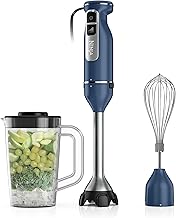
This one leans toward the smoothie and single portion end of the category rather than the stockpot end, and the included cup makes that intention clear.
Four speeds is enough control for most work. It is not the continuous ramp of a variable speed model, but the lowest setting is usable as a starting speed, which is the main thing that matters when blending hot contents.
The cup is convenient for one serving and limiting for anything more, so a household making soup for four will be working in the pot rather than the cup. The whisk is a genuine addition for light tasks.
Bottom line: a good fit for smoothies and small batches, less so for large volume soup work.
- Type: corded immersion blender
- Speeds: four settings
- Attachments: whisk and blending cup
- Cup: small, single portion scale
- Storage: compact
- Use: smoothies, small batches, light whisking
Households making single portion smoothies and small quantities rather than large pots of soup.
Less suitable as the main tool for volume cooking.
Fill the cup no more than two thirds to leave room for the volume the blender displaces.
For hot contents, work in the pot rather than the cup and start on the lowest speed.

Pros
- High power suits sustained blending of large volumes
- Full accessory set covers several jobs
- Multiple speed settings
- One purchase rather than several
Cons
- Accessory set takes real cupboard space
- High wattage is more than everyday cooking needs
The case for high wattage is sustained work rather than raw capability. Blending a large stockpot asks the motor to run for minutes, and that is where weaker units heat up, slow down and occasionally trip a thermal protector. If you cook in volume, the extra power is doing something real.
The five piece set is the other half of the proposition, covering blending, whisking and chopping in a single purchase rather than three.
Both come with the same caveat: space. An immersion blender partly earns its keep by living in a drawer, and a set with several accessories and a bowl starts occupying the cupboard room that made you skip a countertop machine. For everyday small batch cooking the power also goes largely unused.
Bottom line: the right choice for volume cooking and multi task prep, oversized for a small kitchen.
- Type: corded immersion blender set
- Power: 1100 watts
- Pieces: five including attachments
- Speeds: multiple settings
- Attachments: whisk, chopper, beaker
- Use: large batches and varied prep
Cooks working in volume and households wanting one purchase to cover blending, whisking and chopping.
Not the right fit for a small kitchen with limited cupboard space.
Keep the motor housing and shaft join clear of liquid at all times.
Let the motor rest between long blends rather than running it continuously beyond the stated duty guidance.

Pros
- Strong motor for larger volumes
- Anti scratch head suits non stick cookware
- Three pieces rather than an oversized set
- Multiple speed settings
Cons
- Stepped speeds rather than continuous control
- Power exceeds what light everyday use requires
The anti scratch head is the detail worth noticing here. Blending directly in a non stick pan is common and a metal bell dragged across a coated surface damages it, so a head designed to be gentler on coatings solves a real problem.
Power sits at the higher end, which suits sustained blending of larger pots where a smaller motor would heat up and slow.
Three pieces keeps the storage burden reasonable compared with a five piece set, while still covering more than a blending arm alone. Speed control is stepped rather than continuous, so the low setting matters and the start of a blend needs the usual care.
Bottom line: the pick if you blend in non stick cookware and want power without a large accessory set.
- Type: corded immersion blender
- Power: 1000 watts
- Head: anti scratch design
- Pieces: three
- Speeds: multiple settings
- Use: larger batches, non stick cookware
Cooks who blend directly in non stick pans and want more sustained power without a large accessory set.
Less relevant if all your cookware is stainless or enamelled.
Even with an anti scratch head, keep the blender just off the pan surface rather than pressed against it.
Start on the lowest speed and move the head around the pot rather than holding it in one place.

Pros
- Very simple with little to go wrong
- Light and easy to handle
- Inexpensive
- Compact for drawer storage
Cons
- 300 watts limits sustained work on large pots
- Two speeds give limited control
Not every kitchen needs a powerful appliance. For blending a small pot of soup occasionally or mixing a batter, a basic two speed unit does the job and takes up almost no room.
Its lightness is a genuine advantage in use, since you hold this appliance out over a pot with one hand and weight becomes tiring quickly.
The limits are honest ones. Three hundred watts is fine for light work and will struggle with a large stockpot blended in one long pass, and two speeds give less control at the start of a hot blend. Neither matters much if the work is small and occasional.
Bottom line: the minimal option, appropriate for light and infrequent use.
- Type: corded immersion blender
- Power: 300 watts
- Speeds: two settings
- Weight: light
- Attachments: minimal
- Use: small batches and light blending
Households blending occasionally in small quantities who want something light and inexpensive.
Not the right tool for regular large pot soup making.
Check the shaft length against your usual saucepan, since a shorter unit suits smaller pans better than deep stockpots.
Blend in stages with pauses rather than one long continuous run to avoid overheating a smaller motor.

Pros
- Simple and dependable in daily use
- Stainless blending shaft
- Established brand with consistent build
- Compact with few parts to store
Cons
- Two speeds rather than variable control
- Few attachments included
This is the pared back version of the brand's stick blender, keeping the stainless shaft and the build consistency while dropping the variable speed control and most of the accessories.
For a cook whose main use is blending soup in a pot, that is a reasonable set of choices. The low speed is usable as a starting speed, the shaft handles hot contents, and there is very little to store.
What you notice against a variable speed model is the step between settings at the beginning of a blend, where a continuous ramp is gentler on a full pot. It is a difference in refinement rather than capability.
Bottom line: a dependable simple choice, one step below the variable speed models in control.
- Type: corded immersion blender
- Speeds: two settings
- Shaft: stainless steel
- Attachments: beaker
- Storage: compact
- Use: everyday soup and sauce blending
Cooks who mainly blend soup and want a dependable simple appliance without accessories to store.
Less suitable for anyone who wants fine control at the start of a hot blend.
Take the pot off the heat before blending and leave headroom for displaced volume.
Rinse the head immediately after use and keep the shaft join above the liquid line.
How to Choose an Immersion Blender
Wattage Is Not the Number That Matters
Motor power in this category runs from around three hundred watts to over a thousand, and the spread tells you less than it appears to. An immersion blender is working on soft cooked vegetables, soup, sauces and smoothies, not on frozen blocks, and a modest motor handles all of that comfortably.
Where higher power genuinely helps is sustained work. Blending a large stockpot in one session asks the motor to run for minutes rather than seconds, and a weaker unit heats up, slows down and sometimes cuts out on a thermal protector. If you cook in volume, that is the case for more power.
For everyday cooking, blade geometry and bell design do more for the result than another two hundred watts. A well shaped head at moderate power outperforms a poorly shaped one at high power, which is why the wattage race on the packaging is mostly noise.
The Bell Shape and Why It Sticks to the Pot
The metal dome around the blade is doing two jobs: containing splashes and controlling how liquid moves through the blade. Press a bell flat against the bottom of a pot and it forms a seal, the blade churns the same small volume of liquid over and over, and blending effectively stops even though the motor is running.
Bells with vents or a stepped edge break that seal deliberately, allowing liquid to keep flowing through even when the head is near the base. It is a small design detail that decides whether a pot of soup takes one minute or five, and it is rarely mentioned in the listing.
Technique covers most of the gap on any model. Hold the head just off the bottom rather than pressed down, tilt it slightly so liquid can enter from one side, and move it around the pot rather than holding it in one place. Suction is the most common complaint in this category and it is largely a usage problem.
Shaft Length Against Your Deepest Pot
Measure the pot you actually use before buying. A shaft that cannot reach the bottom of a tall stockpot without submerging the motor housing is a shaft that limits what you can cook, and no amount of power compensates for not reaching.
The opposite problem is real too. A long shaft in a small saucepan or a narrow jug means the blade sits too high to engage the contents, so you end up tipping the pan and chasing the liquid around. If most of your blending happens in a modest saucepan, a shorter unit is easier to control.
There is a hard limit on how deep you can go. The join between shaft and motor body must stay above the liquid, and getting liquid into that join is the most common way these appliances die.
Variable Speed Versus Two Speeds

Speed control matters more than it sounds because of what happens at the start. Plunging a blender into a full pot and hitting a fixed high speed throws hot liquid up the shaft and out of the pot. Starting slow lets the contents begin circulating before the blade reaches full pace.
Variable speed gives you that ramp. A two speed unit gives you a low setting, which is usually enough if the low speed is genuinely low rather than a slightly slower version of fast. Trigger style controls that respond to finger pressure are the most intuitive of all, since you can modulate continuously while watching the pot.
For a household blending soups regularly, this is the feature worth paying for. For occasional smoothies in a jug, two speeds is plenty and the extra control goes unused.
Hot Liquid, Splashing and Plastic
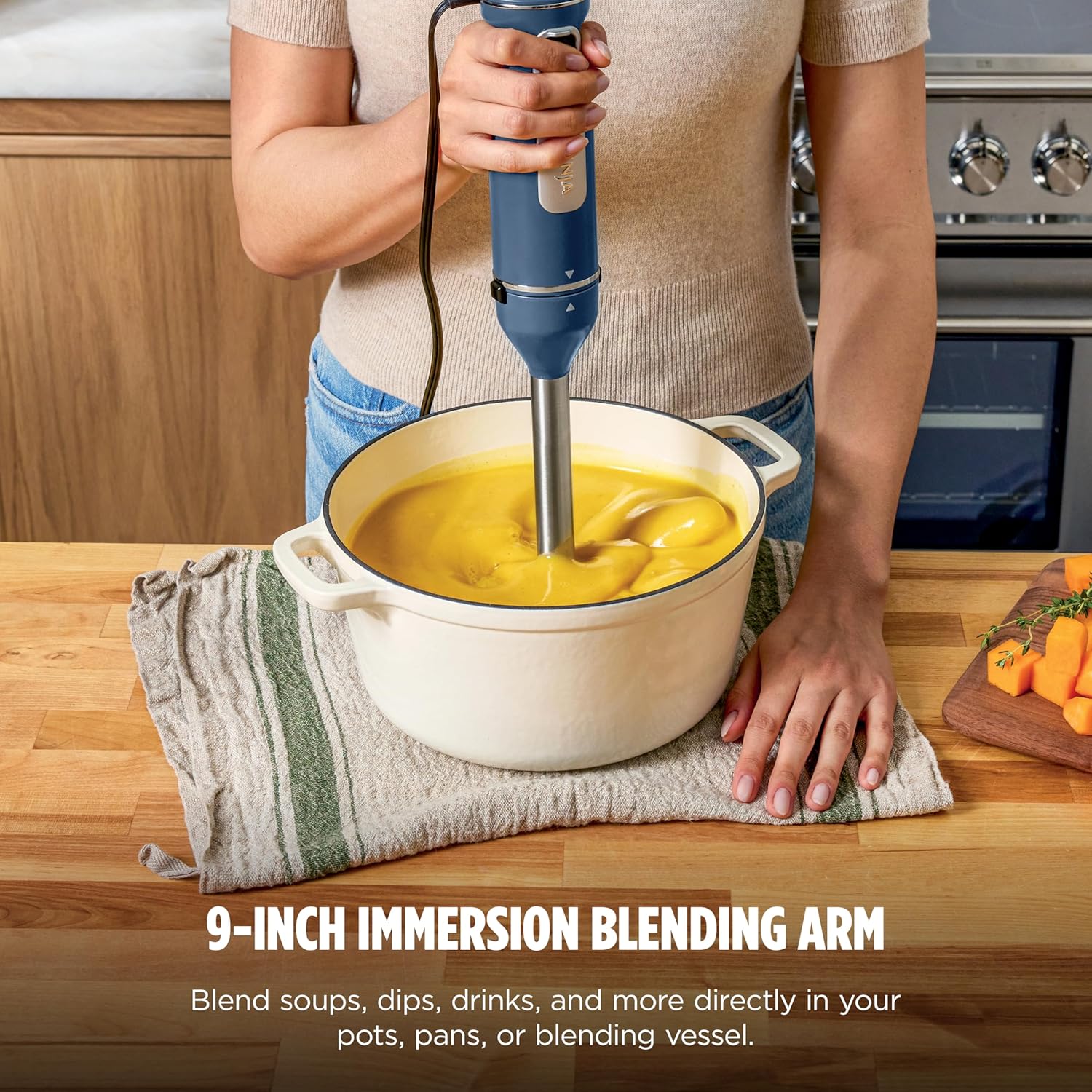
Blending hot soup is the job most of these are bought for and the one with the most ways to go wrong. Beyond splash burns, a full pot leaves no room for the volume displaced by the blender itself, so blending a pot filled to the brim guarantees an overflow.
Take the pot off the heat first. Blending over a live burner adds steam to the mix and puts your hand over a heat source for the duration, and nothing about the process needs the pot to still be cooking.
Material choice matters at temperature. A stainless bell and shaft handle hot contents without concern, while some budget units use plastic in the lower shaft, which is worth checking if you blend hot soup often. It is also the part most likely to stain from turmeric or tomato.
Attachments: Whisk, Chopper and Reality

Sets described as five in one usually count a whisk, a small chopper bowl, a beaker and sometimes a masher alongside the blender itself. The whisk is the one people genuinely use, since it handles cream and egg whites without dragging out a stand mixer.
Chopper bowls are more divisive. They work for herbs, nuts and small quantities of onion, and they are another item to wash and store for a job many cooks would do with a knife. Whether that trade is worth it depends on how much prep you do rather than on the quality of the attachment.
Be honest about storage before buying a large set. An immersion blender earns its place partly by living in a drawer, and a set with four accessories and a bowl occupies the cupboard space that made you skip the countertop machine in the first place.
Cleaning and Whether the Shaft Detaches
The fastest clean is done at the sink immediately: run the head in a jug of warm soapy water for a few seconds, then rinse. Left to dry, soup residue sets under the bell where a sponge cannot easily reach.
A detachable shaft makes the difference between rinsing one component and manoeuvring a whole appliance with a motor in it around a tap. It also decides what can go in the dishwasher, since the motor housing never can.
Check how the shaft locks on. A twist lock with a positive stop is reassuring in use; a loose fitting connection allows the shaft to wobble under load, which is both noisy and hard on the coupling over time.
Cord, Grip and Using It One Handed
Corded units dominate this category because a motor that runs for minutes at a time drains a battery quickly. A cord is rarely a limitation in a kitchen, though cord length decides how far from a socket you can work, which matters on a large island.
Grip is more important than it appears. You are holding the appliance out over a pot, often at arm’s length, with one hand steadying the pan, and a heavy body with a slick handle becomes tiring within a minute. Weight distribution matters more than total weight.
Button placement completes the picture. A power control you can hold comfortably for the length of a blend, without cramping your grip, is the difference between an appliance that gets used and one that stays in the drawer.
When a Countertop Blender Is the Better Tool
An immersion blender is not a smaller version of a countertop machine. They fail at different things, and knowing which job you have saves buying the wrong appliance twice.
The immersion blender wins whenever the food is already in a container you do not want to empty. Soup in a stockpot, sauce in a pan, batter in a bowl. Nothing gets decanted, nothing gets poured back, and the cleanup is one shaft rather than a jug, a lid and a base. That advantage grows with the size of the pot, because pouring three litres of hot soup into a jug in batches is both tedious and the most likely moment for a burn.
The countertop machine wins on texture and on hard ingredients. A sealed jug forces everything through the blade repeatedly, which is how you get a genuinely smooth result rather than a mostly smooth one with fibres in it. Frozen fruit, ice and nut butters need that enclosure and the higher sustained speed. An immersion blender working on fibrous ingredients like celery, kale stems or ginger will usually leave threads behind no matter how long you run it, because there is nothing forcing the contents back through the blade.
Most kitchens that cook regularly end up with both, using them for entirely different tasks. If you can only have one and you mainly make soup, the immersion blender is the more used appliance by a wide margin. If you mainly make smoothies with frozen fruit, it is the wrong tool and our guide to blenders covers the right one.
| Blender | Speed Control | Attachments | Best For |
|---|---|---|---|
| KitchenAid Variable Speed | Variable | Blending arm | Hot soups and controlled starts |
| MuellerLiving Ultra-Stick | Multi speed | Included set | Everyday blending at low cost |
| Cuisinart CSB-179 Smart Stick | Variable | Whisk and chopper | Cooks who use the whisk regularly |
| Ninja Immersion Blender and Whisk | Four speeds | Whisk and cup | Smoothies and small batches |
| Turelar 5-in-1 | Multi speed | Full accessory set | One purchase covering several jobs |
| KOIOS 3-in-1 | Multi speed | Whisk and beaker | Higher power at a moderate price |
| OVENTE Corded Hand Blender | Two speeds | Minimal | Occasional simple blending |
| Cuisinart Smart Stick Two Speed | Two speeds | Beaker | Straightforward soup blending |
For the rest of the kitchen, our home and kitchen guides cover related appliances, and the full library sits at our article index.
Why You Should Trust Us
We organised this list around the features that change the result in a pot rather than the specifications printed largest on the box, because wattage is the least informative figure in the category and the one most heavily marketed. Bell design, shaft length and speed control decide more.
We then weighted real customer ratings while paying attention to complaints that repeat across many buyers, since reports of suction against the pot base usually describe technique or bell design rather than a defect. Where a brand sells the same model in several colours, we treated it as one product rather than counting each finish separately.
Final Thoughts
For most kitchens the KitchenAid Variable Speed Corded Hand Blender is the easiest recommendation. Variable speed is the feature that stops a pot of hot soup from splattering, and it is the one you notice on every single use rather than occasionally.
The MuellerLiving Ultra-Stick Immersion Hand Blender is the best value pick, with enough power and a familiar accessory set for everyday cooking. Cooks who whisk regularly should look at the Cuisinart CSB-179 Smart Stick, and anyone blending large stockpots repeatedly will appreciate the sustained power of the higher wattage units like the Turelar and KOIOS models.
Whichever you choose, measure your deepest pot first, take it off the heat before blending, and hold the head just off the base rather than pressed against it. Browse more of our category guides for the rest of the kitchen.
Frequently Asked Questions
What is the best immersion blender in 2026?
The KitchenAid Variable Speed Corded Hand Blender is our overall pick for 2026 because speed control prevents the splattering that makes blending hot soup unpleasant. For a lower cost option with similar everyday capability, the MuellerLiving Ultra-Stick covers most kitchens.
How many watts do I need in an immersion blender?
Fewer than the packaging suggests. Soft cooked vegetables, soups and smoothies do not demand high power, and bell design and blade geometry affect the result more. Higher wattage helps mainly with sustained blending of large volumes, where a weaker motor heats up and slows.
Why does my immersion blender stick to the bottom of the pot?
The bell forms a seal against the base and the blade then churns the same trapped liquid. Lift the head slightly off the bottom, tilt it so liquid can enter from one side, and move it around the pot. Bells with vents or a stepped edge reduce the effect by design.
Can I blend soup directly in a hot pot?
Yes, and take the pot off the heat first. Leave headroom, since the blender displaces volume and a full pot will overflow, and start on the lowest speed so the contents begin circulating before the blade reaches full pace. Our kitchen guides cover related equipment.
Are the extra attachments worth it?
The whisk usually is, since it handles cream and egg whites without a stand mixer. Chopper bowls divide opinion, being genuinely useful for herbs and small quantities but adding items to wash and store. Consider your cupboard space before choosing a large set.





Write Your Review
No reviews yet. Be the first to share your experience!