

A tray that fights you every morning is a tray you stop using. That is the real problem with ice cube trays: almost every one of them freezes water, but only some of them give the ice back without a wrestling match, a cracked corner, or a puddle across the freezer shelf. We built this shortlist of 9 ice cube trays around that single test, then sorted the rest by what you actually want to drink. Our top pick is the DOQAUS 4-Pack Silicone Ice Cube Tray with Lids for its flexible silicone base that pops cubes free with a light twist while the snap-on lid keeps freezer odors out.
The 9 trays below come from Kitch, Glacio, DOQAUS and more, and they cover more ground than a simple “best of” list usually does. Some make the standard one inch cube for water and soda. One makes a two inch block for whiskey that melts slowly enough to finish a drink. One makes pebble ice small enough to drop through the neck of a sports bottle. Choosing well is mostly a matter of matching cube size to the glass you drink from, which is exactly what the buying guide below walks through. If you like silicone in the kitchen, our roundup of silicone popsicle molds uses the same release-first logic.

Pros
- Flexible silicone base releases cubes with a light twist
- Lids seal against spills and freezer odor
- Four trays stack flat for real capacity
- Listed as BPA free and LFGB certified
Cons
- Silicone can hold odors if the tray is used for food and drinks alike
- Soft base needs support when carrying a full tray
The DOQAUS set answers the two complaints that make people abandon ice trays. The base is flexible silicone, so a cube pops free under thumb pressure instead of requiring you to crack the whole tray against the counter. The lid snaps down over the top, which stops water sloshing onto the freezer shelf on the walk from the sink and, more importantly, keeps the frozen surface of each cube away from freezer air.
Capacity is where this set separates from single tray products. Four trays with flat lids stack into a column, so a full rotation gives you a genuine supply rather than sixteen cubes and a wait. The lids are the structural element that makes stacking work, so this is a set where the lid is not an accessory.
The weakness is inherent to the material. Food-grade silicone is mildly porous, so a tray that has spent a month next to strong-smelling leftovers will eventually pass a faint taste into the water. The lid slows this considerably but does not eliminate it, and washing in hot soapy water rather than rinsing matters more here than with rigid plastic.
Bottom line: if you want one set to cover everyday ice for a household and you are willing to wash the trays properly, this is the most complete option on the list.
- Material: food-grade silicone base with plastic lid
- Quantity: 4 trays with individual lids
- Cube size: roughly 1.3 inch
- Certification: BPA free, LFGB listed, odor free
- Temperature range: -20 C to 80 C
- Design: stackable flat lids, dishwasher safe
Households that empty a tray a day rather than a tray a week, and anyone whose freezer holds strong-smelling food that makes a lid non-negotiable. Also a sensible pick for an RV or a second fridge where the freezer compartment is small and vertical stacking is the only way to get capacity.
Less suited to someone who only wants a single tray for occasional use, where a one or two tray set costs less and takes less shelf space.
Wash with hot water and dish soap before first use and whenever the ice starts tasting of anything at all. A quick cold rinse is not enough for silicone, which holds residue in the surface. Air dry fully before refilling, since trapped water freezes cubes together.
If a tray has picked up a smell, a soak in a solution of warm water and white vinegar usually resets it. Keep one tray dedicated to food portions and the others to drinking water to avoid the problem entirely.

Pros
- Twist action drops ice into the bin without touching it
- Bin turns a two tray set into a running supply
- Round cubes suit cocktails and iced coffee
- Includes tong for serving
Cons
- Round ice does not stack in a glass the way cubes do
- Bin takes more freezer footprint than trays alone
This is a system rather than a tray. You fill two trays, twist them over the bin, and the round cubes drop out without your fingers ever touching the ice. Refill, freeze, repeat, and within a day the bin holds far more ice than the trays themselves could ever hold at once.
The round shape is doing real work. A sphere has less surface area for its volume than a cube of the same width, so it melts a little more slowly, and it looks deliberate in a glass of iced coffee or a cocktail in a way a rectangular cube does not.
The trade-off is footprint. A tray plus bin arrangement occupies more freezer space than a flat stack of trays, and round ice rolls rather than settling, so a tall glass filled with spheres holds less ice than the same glass filled with cubes.
Bottom line: the right pick if you want ice ready on demand and you like the look of round ice, provided your freezer has room for the bin.
- Cube shape: 1 inch round
- Included: 2 trays, storage bin, tong
- Release: easy twist
- Lid: spill resistant, odor blocking
- Design: stackable
- Colour: blue
Fill through the lid opening until water levels itself across the wells, then freeze flat for roughly four hours. Twist the tray in both hands over the open bin and the spheres release together. Refill immediately and stack the tray back on top of the bin so the cycle continues without thinking about it.
For clearer round ice, use water that has been boiled and cooled, which drives off dissolved air before freezing.
Iced coffee drinkers and anyone who entertains, where having a bin of ice ready beats waiting on a tray. Also useful for households where several people take ice through the day, since the bin absorbs the demand that would otherwise empty a tray by noon.

Pros
- Twist frees all sixteen cubes at once
- Rigid plastic does not absorb freezer odors
- Sixty four cubes across four trays
- Simple design with nothing to break
Cons
- No lid, so water spills in transit and ice sits exposed
- Rigid plastic can crack if twisted hard when very cold
This is the tray most people picture when they think of an ice tray, and it survives because the design works. Twist the rigid frame and all sixteen cubes crack loose at once, which is faster than pushing cubes out one at a time when you are filling a pitcher.
Rigid plastic has one clear advantage over silicone that rarely gets mentioned: it is not porous, so it does not take on the smell of the freezer the way soft silicone does. For a household that goes through ice quickly and keeps a clean freezer, that removes the main reason to pay for lids.
The absence of a lid is the real trade-off. Water sloshes on the way to the freezer, ice sits exposed to freezer air, and the trays cannot stack with anything on top without crushing the cubes. Cold plastic also becomes brittle, so a hard twist on a tray straight from a deep freeze can crack the frame.
Bottom line: the best value here by a wide margin, as long as you accept an open tray.
- Material: rigid plastic
- Capacity: 16 cubes per tray, 64 total
- Quantity: 4 trays
- Release: full tray twist
- Lid: none
- Care: dishwasher safe, top rack
Choose this style if your freezer is clean and odor free, if you use ice fast enough that it never sits for weeks, and if you want maximum cubes for minimum money. Choose silicone with lids instead if your freezer holds fish, onions, or anything else aromatic, or if you need to stack trays vertically to fit.
A practical middle path many households land on: this set for volume, plus one lidded silicone tray for the ice that goes into water rather than into a cooler.
Wash on the top rack of a dishwasher or by hand. Let the tray warm for a minute before twisting if it has been in a deep freezer, since very cold plastic is brittle and more likely to crack. Store the trays nested when not in use to save space.

Pros
- Removable lids wash properly, unlike hinged designs
- Flexible silicone releases cubes individually
- Stacks flat to save freezer space
- LFGB certified and BPA free
Cons
- Fourteen cubes per tray is slightly below the usual sixteen
- Removable lids can be misplaced
Airabc builds this set around a removable lid rather than a hinged one, and that choice matters more than it sounds. A lid that comes off entirely can be washed into its corners and dried properly. A hinged lid is quicker in daily use but collects residue where the hinge meets the tray.
The silicone base behaves as expected: push from underneath and a single cube releases without disturbing the rest, which is the advantage flexible trays hold over rigid ones. Flat lids let four trays stack into a column, so the set fits a narrow freezer shelf better than four trays laid side by side.
Fourteen cubes per tray is a slightly unusual count, two below the classic sixteen. Across four trays that is a difference of eight cubes against a standard set, which matters only if you are running the freezer at full tilt.
Bottom line: a well judged everyday set, and the removable lid is the detail that earns its place over similar silicone trays.
- Material: silicone with removable plastic lid
- Capacity: 14 cubes per tray, 4 trays
- Cube size: 3.8 x 2.8 x 2.2 cm
- Tray size: 25.4 x 9.8 cm
- Certification: LFGB certified, BPA free, rated -20 C to 80 C
- Design: stackable, dishwasher safe
Anyone with a crowded freezer who still wants lids. The flat stack is the point here: four trays occupy roughly the footprint of one. Also a good fit for households that care about certification, since LFGB is the stricter European food-contact standard rather than the more commonly cited baseline.
Fill to just below the rim, seat the lid, and freeze on a flat shelf. To release, remove the lid, flex the tray gently, then push individual cubes up from below. Twisting a filled silicone tray the way you would twist rigid plastic is unnecessary and shortens the life of the base.
Pros
- Pillar plate in the lid presses every cube out in about a second
- Bin holds a large running supply of cubes
- Scoop keeps hands out of the ice
- Rigid PP and ABS resists odor better than silicone
Cons
- Small 0.8 inch cubes melt faster than a full size cube
- Bin adds height that does not fit every freezer shelf
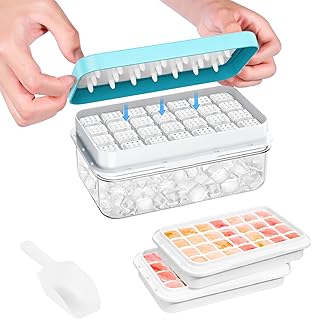
PHINOX does not twist and it does not flex. The lid carries a plate of pillars, and pressing that lid down flat pushes every cube through the tray into the bin underneath in about a second. It is the least physical release on this list, which matters if grip strength is a consideration, and it means the ice never touches your hands.
Fifty six cubes comes from two tiers of twenty eight rather than one large tray, and the cubes themselves are 0.8 inch rather than the usual inch. That is a deliberate choice: smaller cubes chill a glass faster and fit more shapes of tumbler, at the cost of melting sooner. The manufacturer rates the plastic from -150 F to 140 F, so it tolerates a deep freezer and a dishwasher alike.
Rigid PP and ABS rather than silicone means the set does not pick up freezer smells, so ice that sits in the bin for a week still tastes like water. The scoop matters more than it looks: reaching in by hand warms the top layer and fuses it into a block, and the scoop avoids that entirely.
Bottom line: the pick for people who want volume, a genuinely effortless release, and rigid plastic rather than silicone, provided the bin fits the shelf.
- Material: food-grade PP and ABS, BPA free
- Cube size: 0.8 inch, roughly 0.51 cu in per cube
- Capacity: 56 cubes, 28 per tier across 2 tiers
- Temperature range: -150 F to 140 F
- Included: tray, pillar-plate lid, storage bin, scoop
- Release: press the lid, cubes drop into the bin
Fill the tray to the moulded water line rather than by eye, seat the lid, and freeze flat. To release, press the lid down evenly with both palms and the pillars push the whole tier into the bin at once. Refill immediately and repeat, since two or three cycles are what fill the bin. Use the scoop rather than your hand so the cubes at the surface do not partially melt and refreeze into a block.
Measure the height of your freezer shelf before buying any tray and bin set. The bin is what makes this system work and it is also the part most likely not to fit. If clearance is tight, a flat stack of lidded trays gives similar capacity in a shorter package, though without the loose-ice convenience.

Pros
- Rigid rim stops the sag that plagues soft silicone trays
- Spill-proof lid seals for transit and stacking
- Established brand with consistent build quality
- Dishwasher safe
Cons
- Two trays give less capacity than four tray sets
- Costs more per cube than budget multi-packs
OXO solves the structural problem with flexible trays by combining a silicone base with a rigid frame. A full soft-silicone tray sags in the middle when you lift it, which is how water ends up on the freezer shelf. The frame here keeps the tray flat while the base still flexes enough to release cubes cleanly.
The lid seals well enough to carry a filled tray across a kitchen without spilling, and it doubles as the stacking surface for the second tray. Two trays is modest capacity, which is the honest limitation of this set against four tray alternatives.
What you are paying for is consistency. This is a kitchen brand with a long track record, and the build quality on the frame and lid is noticeably better than generic equivalents, which matters on a part that gets twisted several times a week for years.
Bottom line: the pick when you want one dependable tray design rather than the largest possible stack.
- Material: flexible silicone base with rigid frame
- Quantity: 2 trays, blue and white
- Lid: spill-proof, stackable
- Release: twist
- Care: dishwasher safe
- Use: freezer storage, kitchen accessory
Smaller households and anyone who has already been through a cheap silicone tray that sagged and spilled. This is the buy-once option rather than the highest capacity one, and the rigid frame is the specific feature worth paying for.
Dishwasher safe, though hand washing in hot soapy water keeps the silicone surface neutral longer. Dry the lid seal fully before closing it, since trapped moisture freezes the lid to the tray and makes the first opening harder than it should be.
Pros
- Fifty six cubes across four lidded trays
- Silicone and plastic hybrid resists sagging
- Lids allow a flat vertical stack
- Suits cocktails, coffee and everyday drinks
Cons
- Lid fit is tighter than some, needing a firm press
- Mixed materials need more careful drying
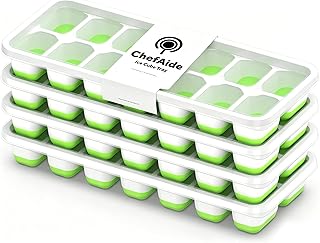
ChefAide takes the same hybrid approach as the OXO tray but scales it to four trays. Silicone wells sit inside a plastic frame, so cubes release under thumb pressure while the tray itself stays flat when carried full.
Fifty six cubes across four trays puts this between the sixteen-cube classics and the bin-based systems. You get real capacity without the vertical clearance a bin demands, which is the practical reason to choose it.
The lids seat firmly, firmly enough that the first few uses take a deliberate press to close. That is preferable to the opposite problem, since a loose lid defeats the purpose, but it is worth knowing before you assume something is wrong.
Bottom line: a sensible middle option, and the strongest choice if you want lids and volume but cannot fit a storage bin.
- Material: silicone wells with plastic frame
- Capacity: 56 cubes total
- Quantity: 4 trays with lids
- Design: stackable
- Release: easy release molds
- Use: cocktails, coffee, drinks
Compare this against bin-based sets on one axis: freezer geometry. If you have shelf area but little height, a flat four tray stack like this wins. If you have height and want loose ice on demand, a tray and bin set serves better. Capacity between the two is roughly comparable.
Fill each tray to just under the rim, press the lid down until it seats all the way around, and freeze on a level shelf. Release by flexing the silicone from below rather than twisting the frame, which is what the hybrid construction is designed for.

Pros
- Two inch blocks melt slowly and protect a drink
- Flexible silicone releases large cubes without cracking
- Eight blocks across two molds is enough for a gathering
- Also works for stock, coffee and juice portions
Cons
- Large cubes take six hours or more to freeze solid
- Blocks do not fit narrow glasses or bottles
This mold exists for one reason and does it well. A two inch block has far less surface area relative to its volume than a standard cube, so it absorbs heat more slowly and dilutes a drink far less. For bourbon or an old fashioned, that is the whole game.
Silicone is the right material at this size. A rigid mold makes a two inch block almost impossible to remove without running it under water, which defeats the purpose by melting the surface. The flexible walls here peel away from the block instead.
The cost is time. A two inch cube freezes from the outside in and the center is the last part to solidify, so plan on six hours or more rather than the three or four a standard tray needs. Pulling a block early gives you a shell with liquid inside, which cracks in a glass.
Bottom line: not an everyday tray, and not meant to be. As a dedicated spirits mold it is the correct tool.
- Cube size: 2 inch square blocks
- Capacity: 8 cubes across 2 molds
- Material: flexible silicone
- Release: peel and push
- Freeze time: roughly 6 hours or more
- Use: whiskey, cocktails, coffee
Fill with water that has been boiled and cooled for a clearer block, then freeze on a level shelf overnight rather than for an afternoon. To release, peel one wall of the mold away from the block first, then push from underneath. Store finished blocks in a sealed bag or bin so they do not pick up freezer odor before you use them.
Anyone who drinks spirits neat or in a short cocktail and has watched a drink thin out over twenty minutes. Also useful for anyone freezing stock or coffee in large portions, where a two inch block equals a much larger measure than a standard cube.

Pros
- Half inch pebbles fit narrow bottles and tumblers
- Chills a drink faster than any full size cube
- Soft enough to chew, the appeal of nugget ice
- Bin and scoop included for a running supply
Cons
- Melts quickly, so drinks dilute sooner
- Small pieces fuse together if the bin is left open
Pebble ice is the closest a home freezer gets to the nugget ice from a commercial machine, and the reason to want it is not only that it is chewable. Half inch pieces pour through the neck of a sports bottle or a reusable tumbler, where a one inch cube simply will not go.
Surface area works in both directions. All those small pieces chill a drink almost immediately, which is the appeal, and they also melt faster than any full size cube, which is the cost. For iced coffee poured over the top and drunk within twenty minutes, that trade is worth making.
The bin matters more here than with larger cubes. Left loose in an open container, pebble ice partially melts at the surface and refreezes into a single lump. A closed bin and the included scoop keep the pieces separate for far longer.
Bottom line: a specialist tray that solves a specific problem, and the only option here for a narrow-mouth bottle.
- Ice size: 0.55 inch pebbles
- Included: 2 trays, bin, scoop
- Release: easy twist
- Lid: sealed, odor blocking
- Design: stackable
- Use: iced coffee, bottles, juice
Pour water in through the lid until it levels itself across the wells rather than filling each well individually, which is the design intent and much faster. Freeze for roughly ninety minutes, then twist over the bin. Keep the bin closed between uses so the pebbles stay loose.
Iced coffee drinkers, anyone who fills a narrow sports bottle daily, and people who genuinely like chewing ice and would otherwise buy bagged nugget ice. Not the right pick as a household's only tray, since pebble ice melts too quickly for a glass of water left on a desk.
How to Choose the Right Ice Cube Trays
Ice trays look interchangeable in a product photo. They are not. The differences that matter show up on day three, when the tray has absorbed the smell of last night’s leftovers or when you need ice in a hurry and half the cubes stay stuck. These are the five things worth checking before you buy.
Silicone Versus Rigid Plastic

Silicone flexes, so you can push a single cube out from underneath without disturbing the other fifteen. That is the main reason it dominates this category. The trade-off is that flexible silicone needs a rigid frame or a flat freezer shelf underneath it, otherwise the tray sags on the way from the tap to the freezer and you lose half the water. Trays like the OXO and the ChefAide address this by pairing a silicone base with a stiff plastic rim.
Rigid plastic trays, the kind Kitch still makes in classic white, work on a different principle. You twist the whole tray and every cube breaks loose at once. That is faster when you want to dump sixteen cubes into a pitcher, and rigid plastic does not pick up freezer smells the way soft silicone can. It is also the cheapest way to add capacity: four trays of sixteen cubes give you sixty four cubes for less than most single silicone sets cost.
One caveat on silicone worth knowing: food-grade silicone is porous at a microscopic level, which is why a tray that has lived next to an open container of onions can leave a faint taste in your water. A lid solves most of it. Washing the tray in hot soapy water rather than only rinsing solves the rest.
Cube Size Decides Almost Everything

Cube size is not a style choice, it is a physics choice. A large cube has less surface area relative to its volume, so it melts more slowly and dilutes a drink less. That is why the Glacio tray makes two inch blocks: one of them chills a glass of bourbon for as long as you want to sit with it. A standard one inch cube, by contrast, is a compromise built for volume. It chills a glass of water quickly and it fits any tumbler.
At the other end, pebble ice of the kind the WIBIMEN mini tray produces at roughly half an inch behaves in the opposite way. All that surface area chills a drink almost immediately and the small pieces are soft enough to chew, which is the entire appeal of nugget ice. The practical advantage nobody mentions is bottle geometry: pebble ice drops through the narrow neck of a sports bottle or a reusable tumbler, where a one inch cube simply will not fit.
| Cube size | Melt speed | Best for | Fits narrow bottles |
|---|---|---|---|
| Roughly 0.5 in pebble | Fast | Iced coffee, sports bottles, chewable ice | Yes |
| 1 in standard cube | Moderate | Water, soda, everyday tumblers | No |
| 1 in sphere | Moderate to slow | Cocktails, iced coffee, presentation | No |
| 2 in block | Slow | Whiskey, old fashioned, spirits neat | No |
Lids Do Two Jobs, and One Is Invisible
The obvious job of a lid is to stop water sloshing out while you carry a full tray to the freezer. The invisible job matters more over time: a sealed lid keeps the frozen surface of each cube from absorbing the smell of whatever else is in the freezer. Anyone who has poured a glass of water that tasted faintly of fish knows exactly what an unlidded tray does after a few weeks.
Lids also make trays stackable, which is the difference between one tray of ice and four. Airabc and DOQAUS both build their lids as flat platforms so a second tray sits square on top of the first. Check whether the lid on a given tray is removable. A removable lid washes properly. A hinged lid that stays attached is more convenient day to day but harder to clean into the corners.
Storage Bins Change How Much Ice You Actually Have
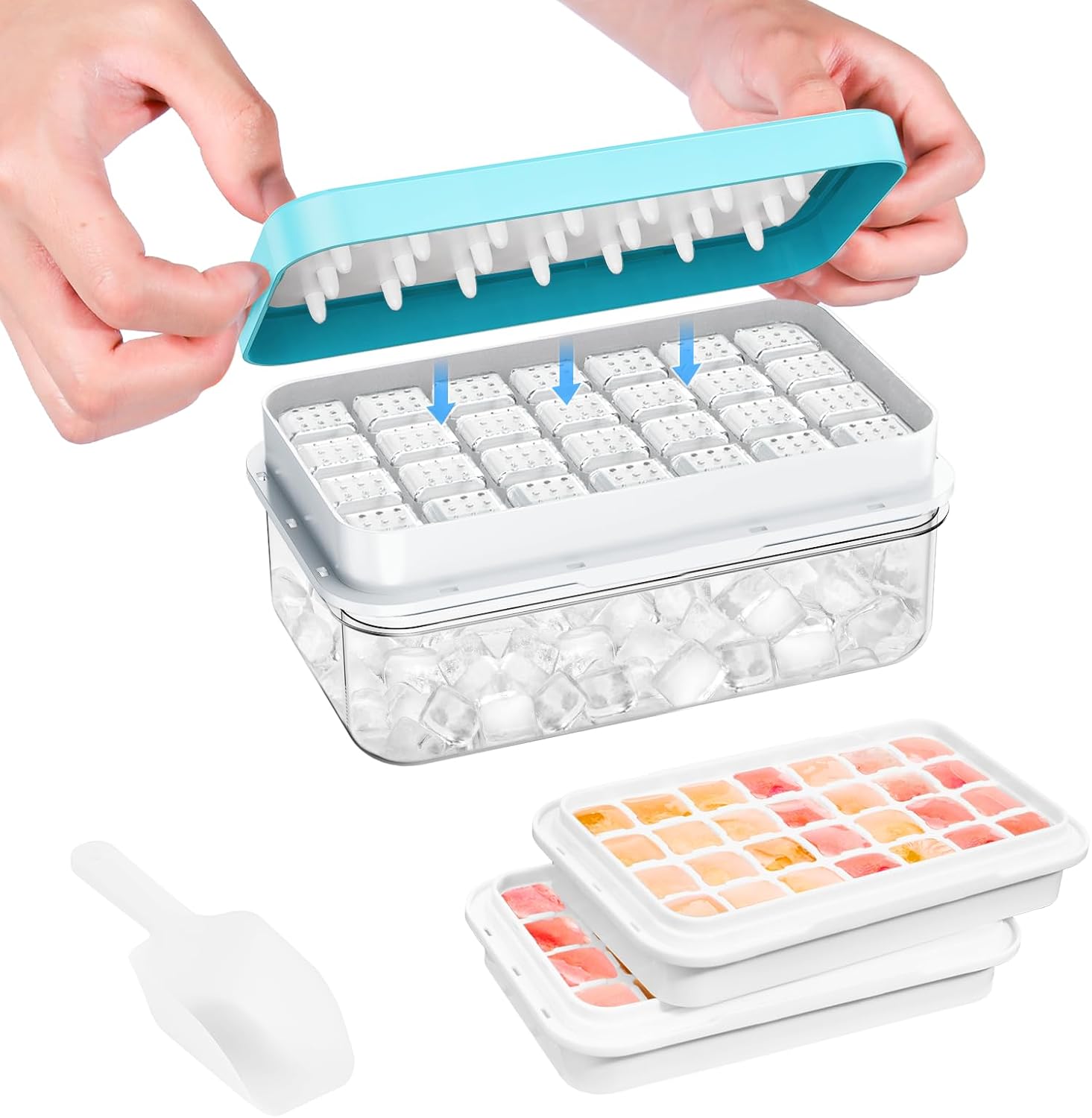
A tray holds one batch. A tray with a bin holds a running supply. Freeze a batch, empty it into the bin, refill the tray, repeat, and within a day you have a few hundred cubes sitting loose in a container instead of two trays of sixteen and a wait. The two systems here get the ice out in different ways, and it is worth knowing which you prefer: WIBIMEN uses a twist, where you turn the tray over the bin and the cubes drop together, while PHINOX presses. Its lid carries a plate of pillars that push every cube through into the bin below when you push the lid down flat, which takes about a second and no grip strength at all.
The detail that separates a good bin from a bad one is whether it seals and whether it comes with a scoop. An open bin lets cubes fuse into a single block as they slowly sublimate and refreeze. A sealed bin slows that down considerably. If you are storing other things in the freezer alongside the ice, the same principle applies to the rest of your kitchen storage, which our guide to airtight food containers covers in more detail.
What Else Belongs in an Ice Tray
An ice tray is a portion-control mold, and water is only its most obvious use. Once you start thinking of it that way, a second tray earns its shelf space quickly. Leftover stock or broth freezes into cubes that drop straight into a pan without defrosting a whole container. Coffee frozen into cubes keeps an iced coffee from turning into brown water as it melts, which is the single cheapest upgrade to a home iced coffee habit. Wine that would otherwise be thrown out freezes into cubes ready for the next pan sauce.
Herbs are the use worth planning for. Chop parsley, thyme, or basil, pack it into the wells, top with olive oil rather than water, and freeze. The oil protects the herb from freezer burn and the resulting cube goes straight into a hot pan. The same trick works for tomato paste, which otherwise dies half used in the back of a fridge, and for lemon and lime juice squeezed while the fruit is cheap.
Two cautions come with all of this. First, anything with fat or strong aromatics will scent a silicone tray semi-permanently, so dedicate one tray to food and keep another for drinking water. This is the strongest practical argument for buying a multi-pack rather than a single tray. Second, cube volume varies more than people expect: a standard one inch well holds roughly one fluid ounce, so two cubes is about a quarter cup. Measure once with your own tray and write the number down, because recipes that call for frozen portions assume you know it.
Release Mechanism and the Freezer Shelf Test
There are three release designs in circulation. Flex-and-push, where you press each cube out from below, gives you one cube at a time without melting the rest. Twist, the classic plastic tray action, frees everything at once. Twist-and-drop, used by the round and pebble trays here, spins the tray so cubes fall straight into the bin below without your fingers touching them.
Before you buy any of them, measure your freezer shelf. This sounds obvious and it is the single most common reason a tray gets returned. Deep chest freezers and the narrow shelf above a fridge compartment have very different footprints, and a four-tray stack that fits one will not fit the other. Trays that stack vertically save far more space than trays laid side by side, so if your freezer is crowded, prioritize a flat-lidded stackable set over a wider single tray.
Why You Should Trust Us
Every tray on this list was selected from current Amazon listings using verified customer ratings and review volume as the first filter, then narrowed by hand. We read the listings closely, compared stated cube dimensions and materials, and cross-checked manufacturer claims against what buyers report over months of use rather than in the first week. Products with no identifiable brand behind them were left off, even when their review counts were high, because a tray with no manufacturer to stand behind it is a tray with no replacement path when the silicone tears.
We also deliberately kept trays that do very different jobs rather than filling the list with nine versions of the same one inch cube. Our editorial picks are independent, and we update this guide as listings change. You can see the rest of our kitchen coverage in the home and kitchen section.
Final Thoughts
The DOQAUS 4-Pack Silicone Ice Cube Tray with Lids earns best overall because it solves the two problems that make people give up on trays at once: the silicone base releases cubes without cracking, and the sealed lid keeps freezer odor out of the ice. Four trays in a stack is also enough capacity for a household rather than a single drink.
For the best value, the Kitch Easy Release White Ice Cube Tray set is hard to argue with. Four rigid trays, sixteen cubes each, a twist action that has not needed redesigning in decades, and no lid to lose. If your freezer is clean and you use ice fast enough that odor never becomes an issue, this is all the tray you need.
Beyond those two, pick by glass. The Glacio 2-Inch Large Square Ice Cube Molds are the right answer for whiskey and nothing else. The WIBIMEN Mini Pebble Ice Cube Trays are the right answer for a sports bottle or an iced coffee habit. The OXO Good Grips Flexible Ice Cube Tray is the one to buy if you want a single reliable tray rather than a stack. And if ice is mostly headed for smoothies, our list of blenders pairs naturally with the pebble trays here.
Frequently Asked Questions
How long do ice cube trays take to freeze?
A standard one inch cube in a home freezer set to 0 F takes roughly three to four hours. Larger two inch blocks can take six hours or longer because the center freezes last. Pebble ice at around half an inch is often ready in ninety minutes. Silicone insulates slightly more than thin plastic, so a silicone tray may run half an hour behind a rigid tray of the same cube size.
Why does my ice taste like the freezer?
Ice absorbs volatile compounds from the air around it, and silicone is mildly porous, so an uncovered tray sitting next to strong-smelling food will pick up that smell within days. A sealed lid is the fix. Washing the tray with hot soapy water rather than a quick rinse removes residue that has already settled into the surface, and storing finished cubes in a closed bin rather than the open tray keeps them neutral longer.
How do I make clear ice in a regular tray?
Cloudiness comes from dissolved air and minerals trapped as water freezes inward from all sides. Two things help in a normal tray. Boil the water and let it cool before filling, which drives off dissolved gas. Then slow the freeze by placing the tray inside a small insulated container with the top left open, so the ice forms from the top down and pushes impurities toward the bottom. It will not match commercial clear ice, but it is a visible improvement.
Are silicone ice trays safe?
Food-grade silicone is stable across freezer and dishwasher temperatures and does not leach at those ranges. Look for BPA-free labeling and, better, an LFGB mark, which is the European food-contact standard and is stricter than the common FDA reference. Several trays in this list carry LFGB certification. If a silicone tray has a strong chemical smell out of the box, wash it and air it before first use.
What size cube should I buy in 2026?
Match the cube to the glass rather than to the trend. One inch cubes suit everyday water and soda in a standard tumbler. Two inch blocks suit spirits served neat or in an old fashioned, where slow melt protects the drink. Pebble ice suits narrow bottles, iced coffee, and anyone who likes to chew ice. Many households end up with two trays for two purposes, which is cheaper than compromising with one. Browse our full buying guides for related kitchen picks.







Write Your Review
No reviews yet. Be the first to share your experience!