

A hard pistol case has one job at the range and a completely different job at an airline counter, and most buyers only discover the difference when a check-in agent turns them away. Our shortlist of 8 hard pistol cases is built around that second job, because a case that satisfies airline rules will always cover range and storage use, while the reverse is not true. Our top pick is the Eylar Tactical Hard Gun Case for pairing a water and shock resistant shell with padlock lugs and pluck foam at a sensible size for one or two handguns.
The 8 cases below come from Plano, Case Club, Cedar Mill Fine Firearms and more, and they range from a basic single pistol box to a five pistol chest. Before you pick by capacity, read the section on what federal rules actually require, because the single most common mistake in this category is buying a lock that is legal for luggage and not legal for a firearm. Anyone building out the rest of a range bag may also want our guide to sports and outdoors gear.

Pros
- Padlock lugs at both ends satisfy airline lock rules
- Water and shock resistant shell with sealing gasket
- Pluck foam adapts to any pistol and optic
- Pressure equalisation handles altitude changes
Cons
- Heavier than a basic moulded range box
- Pluck foam shows wear where cubes have been removed
The Eylar sits at the point where a range box becomes a travel case. The shell is sealed against water and dust, the lid closes onto a gasket, and the lugs accept a proper padlock rather than a token luggage lock, which is what airline rules actually require.
Pluck foam is the right choice at this size. A handgun with a red dot sight or a weapon light has an outline no factory cut foam anticipates, and shaping the cavity by hand takes ten minutes and solves it permanently.
The cost of all this is weight and bulk. Against a simple moulded box this is a noticeably heavier object, and for someone who only drives to a local range that is capacity they will never use.
Bottom line: the case to buy if there is any chance the firearm will fly, and still perfectly good if it never does.
- External size: 11.6 x 8.3 x 3.8 in
- Construction: sealed polymer shell
- Protection: water and shock resistant
- Locking: padlock lugs, padlocks not included
- Foam: pick and pluck, plus convoluted lid foam
- Capacity: one to two handguns
Anyone who flies with a handgun, hunts or travels in bad weather, or wants one case that covers every situation. Less necessary for a firearm that only travels in a car boot to a nearby range, where a moulded box does the same job for less money and less weight.
Check the gasket for grit before closing, since a trapped particle is how a seal starts leaking. Leave a full cube of foam between the pistol cavity and the shell so the foam can absorb an impact. Store unloaded, and keep the padlock key or combination with you rather than in the case pocket.

Pros
- Depth accommodates a scoped or optic equipped pistol
- Rigid moulded shell at a low price
- Padlockable latch points
- Long standing design with wide availability
Cons
- Not sealed against water ingress
- Moulded interior is less adaptable than pluck foam
The Gun Guard SE has been in production long enough that most ranges have several in the parking lot on any given weekend. It is a rigid moulded box with padlockable latch points and interior depth chosen for a pistol wearing a scope, which is a specification a surprising number of cheaper cases miss.
What it does not do is seal. There is no gasket and no pressure valve, so this is a case for a car and a range bag rather than a boat or a checked hold in bad weather.
For the money that is a fair trade. Most handguns spend their lives between a safe and a range twenty minutes away, and this covers that whole cycle while remaining lockable enough to satisfy transport rules in most states.
Bottom line: the best value here, and the right amount of case for a firearm that does not fly.
- Capacity: single scoped pistol
- Construction: moulded rigid shell
- Locking: padlockable latch points
- Sealing: not sealed
- Interior: moulded with foam lining
- Use: range and storage
Owners of a scoped or optic equipped pistol who need a lockable case for car transport and home storage. Also a sensible second case for someone who already owns a sealed travel case and does not want to carry it every week.
Choose this if the firearm travels by car. Choose a sealed case with padlock lugs instead if it will ever be checked onto a flight or exposed to weather, since an unsealed case has no defence against water running into a baggage cart.

Pros
- Dual latch design with reinforced locking lugs
- Pluck foam included and replaceable
- Compact footprint suits carry-on sized bags
- Splash proof, dust proof and UV resistant shell
Cons
- Fits firearms under roughly six inch barrel length
- Compact size limits it to a single handgun
Cedar Mill built this case around one use: getting a single handgun through an airline check-in without an argument. The external footprint of 12.3 by 10.5 inches fits inside a checked bag, the shell is polymer rather than a padded fabric panel, and the twin latches carry reinforced lugs for padlocks.
The interior takes pick and pluck foam, which is replaceable rather than bonded in, so a case that has been shaped for one pistol can be reset later for another. That is a real advantage over bonded custom foam at this size.
Capacity is the limit. This holds one handgun with a barrel under roughly six inches, so a long slide competition pistol or a scoped revolver needs something larger. It is splash and dust proof rather than fully submersible.
Bottom line: the compact airline option, and the right pick if you fly with exactly one handgun.
- External size: roughly 12.3 x 10.5 in
- Fits: handguns and revolvers up to 6 in barrel
- Ingress rating: IP64 water and dust resistant
- Shell: DS3TeK impact resistant polymer, UV proof
- Locking: dual latch with reinforced lugs
- Foam: replaceable pick and pluck, interlocking case design
The traveller with one carry pistol who wants the smallest case that still satisfies the rules. Not the choice for a collection, a long slide competition gun, or anyone who needs magazine storage in the same case.
Fit two padlocks rather than one so the lid cannot be levered open at a corner. Declare the firearm at the counter and keep the keys on your person, never inside the checked bag. Reset the pluck foam if you change firearms rather than forcing a pistol into a cavity cut for a different outline.

Pros
- Foam comes in peelable layers rather than one fixed cut
- 19 double-layer magazine pockets alongside pistol slots
- Removable insert for accessory storage
- Press and pull latches with padlock lugs
Cons
- Costs considerably more than generic equivalents
- Large footprint for a single handgun
Pelican is the name other manufacturers describe themselves against, and the Vault line is the company's more affordable range rather than its professional series. For a multi pistol case that will be handled by strangers repeatedly, that pedigree is what you are paying for.
The foam is more flexible than a custom cut description suggests. It arrives in layers you peel back one at a time, so the same case can hold slim pistols in a shallow cavity or a taller optic equipped gun once the second layer comes out. Alongside the pistol slots sit 19 double-layer magazine pockets and a removable insert for accessories, which is what turns this from a transport case into a full range kit.
The latches are a press and pull design that stays shut under impact, and the lugs take padlocks, so security is whatever you thread through them rather than a moulded combination dial.
Bottom line: the buy-once option, and considerably more adaptable inside than the price tag alone suggests.
- Capacity: multiple pistols
- Magazine storage: 19 double-layer pockets
- Foam: layered, peel back to set depth
- Extras: removable accessory insert
- Latches: press and pull
- Locking: padlock lugs
Frequent flyers, competitive shooters moving several pistols, and anyone who has already replaced a cheaper case after a cracked latch. Overspecified for a single handgun that visits a local range by car.
Compare the Vault line against the professional Pelican series only if you need certified ingress protection. For firearm transport the Vault specification is generally sufficient, and the money saved is better spent on two good padlocks. Peel only the foam layers you need, since removed foam cannot be put back.

Pros
- Customisable foam interior
- Lockable for transport compliance
- Compact enough for a range bag
- Lighter than heavy duty sealed cases
Cons
- Lighter shell than premium protective cases
- Not intended for full submersion
CASEMATIX occupies the middle of this market. The shell is a genuine hard case rather than a padded bag, the interior foam can be shaped to the firearm, and it locks, which together cover the requirements most owners actually face.
Compared with the sealed cases here it is lighter and less rugged, which is a fair trade for someone whose case rides in a car and occasionally in luggage rather than on a boat. Compared with a basic moulded box it offers a far better interior.
Judge it on the padlock lugs rather than the shell. Check that the holes accept the padlock you intend to use before travelling, since that is the specification that decides whether the case is airline legal in practice.
Bottom line: a reasonable middle option when a sealed case is more than you need and a moulded box is less.
- Construction: hard shell with foam interior
- Foam: customisable
- Locking: lockable design
- Capacity: pistol focused
- Weight: lighter than sealed heavy duty cases
- Use: transport and storage
Owners who want a shaped interior and a lock without paying for full ingress sealing. A sensible upgrade path from a moulded range box, and a sensible saving against a premium protective case.
Shape the foam with a sharp blade rather than tearing it, and keep offcuts to pack around an optic later. Store the case out of direct sunlight, since lighter polymer shells discolour and become brittle faster than heavy duty equivalents.

Pros
- Holds multiple pistols plus magazines
- Low cost for the capacity offered
- Foam interior with defined locations
- Lockable latch points
Cons
- Build quality below premium protective cases
- Sealing is basic rather than gasket rated
VEVOR sells this on capacity per unit of money, and on that measure it succeeds. It carries several handguns and their magazines in a foam interior, and it locks, which covers a range day and car transport without a second bag.
The shell is where the savings appear. It is thinner and less rigid than the premium cases here, and the closure is not built to gasket standards, so this is not the case for checked baggage in weather or for a boat.
Used within its intended range, none of that matters much. A case that lives in a car boot and holds three pistols and their magazines for a Saturday morning is doing exactly what it was designed for.
Bottom line: capacity on a budget, provided you accept it is a range case rather than a travel case.
- Capacity: multiple pistols and magazines
- Interior: foam with defined locations
- Locking: lockable latch points
- Construction: moulded shell
- Sealing: basic
- Use: range and vehicle transport
Shooters who take several handguns to a range regularly and do not fly with them. Also useful as a dedicated magazine and accessory case alongside a smaller sealed travel case.
Check the padlock lug dimensions before assuming this case will satisfy an airline. Budget cases often mould a loop that only accepts a small luggage padlock, which is not the type of lock a firearm requires.

Pros
- Foam cut for eighteen magazines as well as two pistols
- Removes the need for a second range bag
- Accessory pocket for tools and ammunition
- Solid latches and lockable design
Cons
- Fixed foam layout suits its intended load only
- Heavy when fully loaded
This is the case that solves the second bag problem. Competition and practice days need magazines in quantity, and most pistol cases treat them as an afterthought. Case Club cuts foam locations for eighteen alongside two pistols and adds a pocket for tools and ammunition.
The fixed layout is a genuine trade-off. Foam cut for two pistols and eighteen magazines is excellent when that is what you carry and wasteful when it is not, and there is no plucking your way to a different arrangement.
Fully loaded it is heavy, which is worth considering if the walk from car park to firing line is long. A single centre handle on a case this size makes that walk feel longer.
Bottom line: purpose built for competition and practice, and the most efficient case here for anyone who shoots a lot in one session.
- Capacity: 2 pistols, 18 magazines
- Extras: accessory compartment
- Foam: custom cut layout
- Locking: lockable latches
- Construction: rigid shell
- Use: competition and range practice
Competitive shooters and anyone who runs long practice sessions with several magazines. Not the right pick for a single carry pistol, where the extra volume is dead weight.
Load magazines into the cut foam empty rather than loaded if the case will be stored for long periods, since prolonged compression is harder on springs than repeated cycling. Keep ammunition in the accessory pocket rather than loose in the main cavity so it cannot shift against the firearms.

Pros
- Carries up to five pistols in pre-cut foam
- Padlock lugs for transport compliance
- Large enough to double as accessory storage
- Rugged shell for the capacity offered
Cons
- Heavy and awkward when fully loaded
- Pre-cut foam assumes a standard pistol outline
The Model 801 exists for the owner moving several handguns at once, whether to a range, a gunsmith, or a new house. Pre-cut foam gives five defined locations, so nothing shifts against anything else in transit.
Pre-cut foam is a compromise at this capacity. The cut outlines assume conventional pistol shapes, and a firearm with an optic or a compensator may not sit flush, so measure before assuming a fit.
Weight is the other consideration. Five pistols in an eighteen inch case is a two hand carry, and if the contents will be moved regularly rather than occasionally, a wheeled case is worth considering instead.
Bottom line: the capacity option, and the most sensible way here to move a collection in one trip.
- Capacity: up to 5 pistols
- Case length: 18 in
- Foam: pre-cut locations
- Locking: padlock lugs
- Model: 801
- Use: collection and multi firearm transport
Collectors, instructors, and anyone who transports several handguns together. Excessive for a single firearm, where a compact case is safer to handle and easier to secure in a vehicle.
Fit padlocks to both lugs on a case this wide, since a single lock at one end lets the opposite corner flex. Check that each pistol sits below the level of the foam so the lid does not press on an optic, and store the case flat rather than on edge.
How to Choose a Hard Pistol Case
Cases in this category look similar and behave very differently under the two conditions that matter: a locked lid in the hands of a baggage handler, and a dropped case on a concrete range floor. These are the factors worth checking before capacity or colour.
What Airline Rules Actually Require
Federal rules for flying with a handgun in checked baggage come down to four conditions. The firearm must be unloaded. It must be in a hard-sided container. That container must be locked. And only the passenger may retain the key or combination. That last clause is where most people go wrong.
A lock marked TSA approved is designed so that screeners can open it with a master key. That is exactly what the firearm rule prohibits, because the passenger would no longer be the only person able to open the container. For a pistol case you want an ordinary padlock or a built-in combination lock that nobody else can open, which is the opposite of what you want on a suitcase. Both types of lock exist in this list, so check which one a case is built for before you buy.
One point of confusion is worth clearing up, because several products in this category use the phrase in their names. A case advertised as TSA approved or TSA compliant, as the Cedar Mill case is, means the container itself satisfies the hard-sided and lockable requirement. That is a claim about the box, not about the lock, and it is a legitimate one. A lock advertised as TSA approved is a different product making a different claim, and that is the one to avoid here. Buying a compliant case and then securing it with a master-keyed luggage padlock puts you back outside the rules.
The practical consequence for case design is that lockable padlock lugs matter more than latches. Look for two lugs rather than one, positioned at opposite ends of the lid, and check that the holes are large enough for the shackle of a real padlock rather than a token luggage lock. Airline staff also want the case to be rigid enough that squeezing the sides does not open a gap, which is the difference between a hard case and a padded soft case with a stiff panel.
Locks, Latches, and Lugs Are Three Separate Things

Latches hold the lid closed. Lugs are the reinforced holes that accept a padlock. A built-in lock is a mechanism integrated into the case body. A case can have excellent latches and no way to lock at all, which makes it a storage box rather than a travel case.
Built-in combination locks remove the risk of losing a key, which is the most common failure mode when a case only travels twice a year. The trade-off is that a moulded combination mechanism is generally easier to defeat than a hardened padlock, so cases aimed at serious security tend to use lugs instead and leave the choice of padlock to you. Pelican takes that approach on the Vault series, where the latches are press and pull and the security comes from what you thread through the lugs.
Foam Type Decides Whether the Case Fits Your Pistol
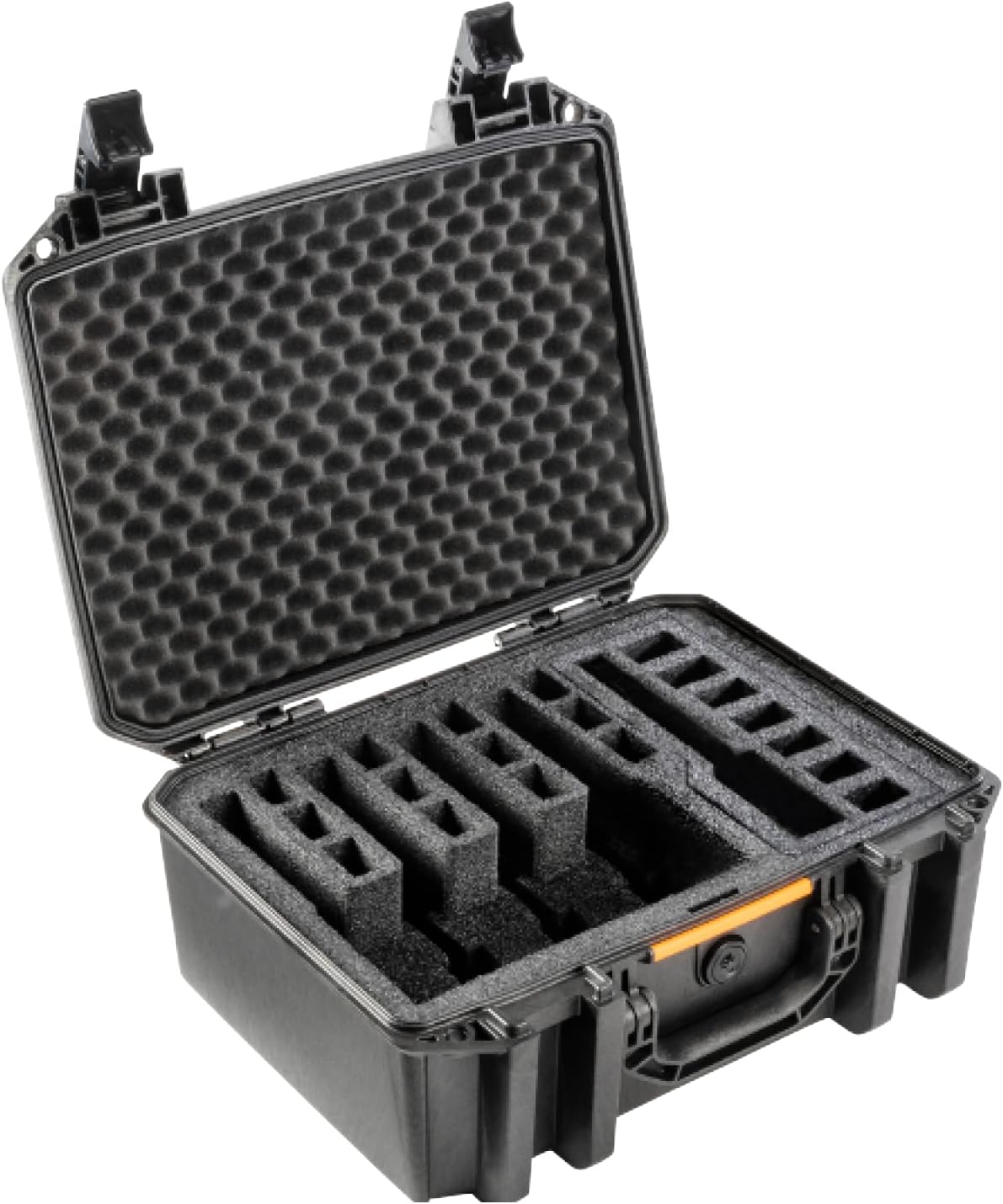
Three foam styles cover almost every case sold. Pluck foam, sometimes called pick and pluck, arrives as a grid of small perforated cubes that you pull out by hand to shape a cavity around your specific firearm. It is the most flexible option and the one to choose if you expect to change what the case carries.
Custom cut foam arrives already shaped for a specific pistol or for a generic outline, which looks tidier and holds the firearm more securely, but it locks you into that layout. Egg crate foam, the convoluted sheet usually found in the lid, is there to press down on the contents and stop them shifting rather than to locate them.
The mistake worth avoiding is plucking too aggressively. Leave at least one full cube of foam between the cavity and the case wall, and leave the cubes under the muzzle intact. A cavity cut right to the edge lets the pistol move sideways under impact, which is the exact load the foam exists to absorb.
| Case | Capacity | Lock style | Foam | Best use |
|---|---|---|---|---|
| Eylar Tactical | 1 to 2 pistols | Padlock lugs | Pluck | Air travel and range |
| Plano Gun Guard SE | 1 scoped pistol | Padlockable | Moulded | Range and storage |
| Cedar Mill | 1 handgun | Dual latch, lockable | Pluck | Carry on flights |
| Pelican Vault | Multiple pistols | Padlock lugs | Custom cut | Heavy duty travel |
| Case Club | 2 pistols, 18 magazines | Padlockable | Custom cut | Range days and competition |
| Condition 1 Model 801 | Up to 5 pistols | Padlock lugs | Pre-cut | Collection transport |
Water, Dust, and the Valve Nobody Explains
Sealed cases advertise an O-ring gasket in the lid and, on better models, a small pressure relief valve on the side. The gasket keeps water and dust out. The valve exists because a sealed case that travels in an aircraft hold experiences a pressure difference between the cabin altitude and the sea level air trapped inside, which can make the lid difficult to open on arrival or stress the seal.
A manual valve is a button you press to equalise. An automatic valve breathes continuously through a membrane that blocks liquid water. Neither is essential for a case that only rides in a car boot to the range, and both are worth having on a case that flies regularly.
Water resistance claims deserve a closer read than they usually get. Splash proof and dust proof describe a case that survives rain on a range. A fully sealed case with an O-ring and a rated ingress protection figure is a different thing, and it is the specification to look for if the case will ever sit in a boat, a truck bed, or checked baggage in bad weather.
Capacity Means Magazines Too

Capacity ratings quote pistols, but a range day needs magazines, and a case that holds two pistols and nothing else forces you to carry a second bag. This is the quiet advantage of purpose built competition cases like the Case Club design, which allocates cut foam for eighteen magazines alongside two pistols.
Think about weight distribution as well as count. A five pistol case is heavy when full, and a single centre handle on a wide case makes it awkward to carry any distance. Larger cases benefit from either a double handle arrangement or wheels, and a case that is comfortable empty in a shop can be genuinely unpleasant loaded.
What the Counter Process Looks Like
Knowing the sequence in advance removes most of the friction, and it also explains several case design choices that otherwise look arbitrary. You declare the firearm at the airline check-in desk rather than at security. The agent gives you a declaration card to sign, which states the firearm is unloaded. That card goes inside the case, not on the outside of the bag, and the case is then locked by you and placed inside your checked luggage or checked as its own piece depending on the airline.
From there the bag usually travels to a screening area where an officer may need it opened. This is precisely why the rules insist that you keep the only key: if screening needs access, they page you rather than opening it themselves, and passengers are commonly asked to remain near the desk for a short period until the bag clears. Leaving the counter immediately after check-in is the most frequent cause of a missed page and an offloaded bag.
Two design consequences follow. First, a case with an external pocket is useful for holding the declaration paperwork on the return journey, but the signed card itself belongs inside with the firearm. Second, a case that is quick to unlock and relock matters more than it sounds when you are doing it at a counter with a queue behind you. Combination locks avoid the fumbling for keys that makes this slower. Ammunition, incidentally, must be in the manufacturer’s packaging or a purpose made ammunition box rather than loose in the case, and airlines set their own weight limits on how much you may carry.
Measure the Inside, Not the Outside
External dimensions are what manufacturers advertise and internal dimensions are what determine whether your pistol fits. The difference is not trivial: wall thickness, the lid gasket channel, and the foam layers together consume an inch or more in each direction on many designs. A case advertised at twelve inches long can present a usable cavity closer to ten.
Measure your firearm with everything attached that will travel with it. A red dot sight, a weapon light, or a threaded barrel with a compensator each add length or height that a bare pistol measurement misses, and a scoped pistol needs a case built for that height, which is precisely the niche the Plano Gun Guard SE fills. Then add half an inch in each direction for foam. If a listing does not publish internal dimensions at all, treat that as a reason to look at a different case rather than an oversight.
Why You Should Trust Us
Every case here was chosen from current Amazon listings, filtered first on verified customer ratings and review volume, then narrowed against the criteria above: lockability that satisfies airline rules, foam type, sealing, and published internal capacity. We read manufacturer specifications closely and compared them against what owners report after repeated flights rather than after a first inspection.
We left out cases that market themselves as airline ready while providing only a single lug or a moulded loop too small for a real padlock, since that is a specification failure rather than a matter of taste. Our editorial picks are independent and we update this guide as listings change.
Final Thoughts
The Eylar Tactical Hard Gun Case is our best overall because it covers the widest range of situations without asking you to pay for features you may never use. Water and shock resistance, padlock lugs at both ends, and pluck foam make it equally valid in checked baggage, a truck bed, and a range bag.
For best value, the Plano Gun Guard SE Series case remains hard to beat. It is a rigid moulded box sized for a scoped pistol, it locks, and it costs a fraction of a sealed travel case. If the firearm lives at home and visits a range by car, this is the sensible amount of case to own.
Above those two, pick by mission. The Pelican Vault Multi-Pistol case is the one to buy if the case will be handled by other people repeatedly and the contents are worth protecting properly. The Case Club two pistol and eighteen magazine case is built for competition days. The Condition 1 Model 801 carries five pistols for anyone moving a collection. And the Cedar Mill case is the compact option sized specifically for airline carry. More of our gear guides are collected in the buying guides section.
Frequently Asked Questions
Can I use a TSA approved lock on a hard pistol cases?
No, and this is the most important detail in the category. Federal rules require that the passenger be the only person able to open a container holding a firearm. A TSA approved lock is specifically designed to be opened by screeners with a master key, which breaks that requirement. Use a standard keyed or combination padlock through the case lugs instead, and keep the key or combination yourself.
Does a hard case need to be locked for range use?
Range rules vary and state storage laws vary more, so check both rather than assuming. As a practical matter, a locked case is useful any time the firearm is out of your direct control, including in a vehicle. Many ranges require firearms to arrive cased and unloaded, and a hard case with a lock satisfies the strictest version of that rule without needing to ask.
How much foam clearance should I leave around the pistol?
Leave at least one full cube of pluck foam between the cavity and the case wall, and do not remove the layer beneath the firearm. The foam is absorbing impact energy, and a cavity cut to the edge lets the pistol strike the shell directly. If the fit feels loose after plucking, add the lid egg crate foam back rather than cutting a tighter cavity.
Are polymer cases strong enough compared with aluminium?
For handgun sized cases, a quality polymer shell handles drops better than thin aluminium because it flexes and returns rather than denting permanently. Aluminium wins on rigidity for very large cases and on appearance. Polymer also insulates against temperature swings slightly better, which matters if a case lives in a vehicle. Weight is usually comparable at this size.
What size case should I buy in 2026?
Measure your firearm with optics, lights, and any muzzle device attached, then add roughly half an inch in each direction for foam and compare that figure against published internal dimensions rather than external ones. If you own more than one handgun or shoot competitively, jump to a case that also holds magazines, because carrying a second bag defeats the purpose of a purpose built case.





Write Your Review
No reviews yet. Be the first to share your experience!