

A cooler with wheels solves a problem that only appears when the cooler is full. Seventy quarts of ice and drinks weighs somewhere between eighty and a hundred pounds, which is past the point where two people can carry it comfortably across a car park, let alone a beach. The catch is that most wheels are sized for a driveway rather than for sand, and that single detail separates a cooler you will actually take places from one that lives in the garage. Our top pick is the YETI Tundra Haul for pairing genuine multi-day ice retention with a single strong tow handle and wheels large enough to roll over rough ground.
This shortlist of 9 hard coolers with wheels spans Igloo, Coleman, RTIC and more and runs from a thirty two quart weekender to a hundred and ten quart hauler. The buying guide below covers the three things that decide whether a wheeled cooler earns its keep: how the insulation is made, what the wheels can cross, and how much of the interior your ice actually needs to occupy. If you want something you carry rather than tow, our guide to soft coolers with hard liners covers the lighter end.

Pros
- Rotomolded body holds ice for days rather than hours
- Wheels large enough for gravel, grass and trail
- Rigid tow handle gives control on uneven ground
- Gasketed lid with heavy duty latches
Cons
- Very heavy before it is loaded
- Costs several times an injection molded equivalent
The Tundra Haul is the wheeled version of the cooler that made rotomolded construction mainstream. The body is formed as one thick walled piece and pressure filled with foam, which is why it holds ice across a weekend rather than across an afternoon.
The wheel and handle arrangement is what earns it a place at the top of this list rather than the insulation alone. The wheels are large and impact resistant rather than small moulded castors, and the handle is a rigid bar rather than a telescoping tube, so you steer the cooler over rough ground instead of dragging it behind you.
The costs are weight and price. Empty, this is a heavy object, and loading it into a high truck bed is a two person job. It also costs several times what a perfectly serviceable day-trip cooler costs.
Bottom line: the right buy for multi-day trips over rough ground, and considerable overkill for a park picnic.
- Capacity: 13.8 gallons, holds 45 twelve ounce cans with 55 lb of ice at a 2:1 ratio
- Construction: rotomolded with up to 2 in of insulation in the walls
- Wheels: solid single-piece puncture resistant tires
- Handle: welded aluminium tow arm
- Lid: freezer quality gasket with heavy duty latches
- Extras: tie-down slots, threaded drain
Campers, hunters and anglers whose trips run past a single day, and anyone who has bought ice mid-trip and resented it. Not the right purchase for someone whose cooler only travels from car to picnic table.
Pre-chill with sacrificial ice for a few hours before loading, since a warm rotomolded body will consume a surprising amount of your ice budget cooling itself. Load block ice low, contents in the middle, cubes filling every air gap, at roughly two parts ice to one part contents. Keep the drain closed until you need the space.

Pros
- Weighs only 12.9 lb empty, so one person can load it
- Lid rated to 250 lb and doubles as a seat
- Double-wall insulation rated up to 5 days in lab conditions
- Holds 84 cans at 50 quart capacity
Cons
- The 5 day figure is a laboratory number, expect less in real heat
- Wheels are far smaller than dedicated all-terrain designs
The Xtreme line is what most people picture when they think of a rolling cooler, and it endures because it is priced and sized for the way coolers are actually used. Coleman rates it at up to five days of ice retention on double-wall insulation, and that figure deserves context: it comes from controlled laboratory testing, so a cooler opened repeatedly in a hot car park will do considerably less. Treat it as a comfortable two day cooler in real use and a pleasant surprise beyond that.
Two numbers make it easy to live with. It weighs 12.9 pounds empty, so one person loads it into a boot without thinking, and the lid is rated to 250 pounds, which means it works as a seat at a campsite. At 50 quarts it holds 84 cans.
The wheels are the honest limitation. Coleman describes them as all-terrain and they handle grass and gravel, but they are a fraction of the diameter of the oversized wheels on a dedicated beach cooler, and deep soft sand will still defeat them.
Bottom line: the value pick, and the correct amount of cooler for anything that finishes the same day.
- Capacity: 50 quarts, up to 84 cans
- Dimensions: 22.7 W x 17.5 D x 18.3 H in
- Empty weight: 12.9 lb
- Lid: hinged, rated to 250 lb, cup holders moulded in
- Insulation: double-wall, rated up to 5 days in lab testing
- Mobility: telescoping handle with all-terrain wheels
Tailgaters, park picnics, day fishing and anyone who wants capacity without a heavy lift. If your trips end before nightfall, the extra ice retention of a rotomolded cooler is capability you will never use.
Choose this over a rotomolded cooler if the cooler will spend more time being lifted than being relied on. Choose against it if you regularly cross sand or gravel, since the wheel size is the one specification here that cannot be worked around.

Pros
- Layout designed for serving drinks at gatherings
- Familiar Igloo build with wide parts availability
- Good capacity for the price
- Straightforward drain and lid
Cons
- Serving focused layout wastes space on a camping trip
- Injection molded retention rather than multi-day
Igloo's party bar concept treats the cooler as furniture at an event rather than as a storage box. The layout puts drinks within reach at a comfortable height, which is a different priority from packing food for a weekend.
Insulation is conventional injection molded construction, so this holds ice for a day rather than for four. At a party, where the lid opens constantly, that distinction matters much less than it would on a camping trip, since frequent opening dominates ice loss anyway.
Igloo's other advantage is unglamorous but real: parts availability. Drain plugs, latches and wheels for common Igloo models are easy to find, which extends the usable life of a cooler that lives outdoors.
Bottom line: the right cooler for hosting, and the wrong one for a four day trip.
- Series: Polar and Party Bar
- Construction: insulated injection molded body
- Layout: serving oriented
- Mobility: wheeled
- Ice retention: day use
- Parts: widely available
Anyone who hosts outdoors regularly, from barbecues to sports days. Less suitable as a household's only cooler if camping is also on the agenda, where a conventional chest layout uses space better.
Rinse and dry with the lid propped open after every use, since a closed damp cooler grows mould in the gasket channel within days. Wash the interior with warm soapy water and, for lingering smells, a solution of baking soda and water left overnight.

Pros
- Around 30 percent lighter than conventional rotomolded coolers
- 2.5 in closed cell foam holds cold up to 5 days
- 78 can capacity at 30 lb empty weight
- Built-in cargo net and bottle opener
Cons
- Lighter walls give up some retention against the heaviest rotomolded coolers
- Still heavier than injection molded equivalents
RTIC built its reputation selling rotomolded performance for less money, and the Ultra-Light line addresses the other complaint about that construction: sheer weight. Material is trimmed where the thermal penalty is smallest, cutting a meaningful amount of empty weight while keeping the thick walled character.
At 52 quarts this is sized for a weekend for a small group, which is the trip length where ice retention starts to matter but a hundred quart cooler would be absurd. The wheels and handle make it towable when loaded, and the reduced weight makes it liftable when it is not.
Against the very heaviest rotomolded coolers it will give up some retention, which is the direct consequence of thinner walls. For most users that is a trade worth making.
Bottom line: the sensible middle of this list, and the pick if the cooler has to be lifted as often as it is rolled.
- Capacity: 52 quarts, 78 cans, 53 lb of ice
- Empty weight: 30 lb
- Insulation: 2.5 in closed cell foam
- Dimensions: 26.5 x 17.8 x 17.4 in
- Extras: silicone cargo net, built-in bottle opener
- Retention: up to 5 days per manufacturer
Weekend campers and anglers who load a cooler into a vehicle without help. The weight saving is most valuable to anyone lifting into a truck bed or a boat rather than sliding into a car boot.
Pre-chill, then use the two to one ice ratio as with any rotomolded cooler. Because the walls are thinner than a conventional rotomolded body, keeping the cooler out of direct sun makes a proportionally larger difference here. A light coloured cover or simply parking it in shade extends retention noticeably.

Pros
- Sealed dry drawer keeps food out of meltwater entirely
- Cold transfers into the drawer, holding it under 40 F
- 65 quart capacity suits family trips
- Puncture resistant all-terrain wheels
Cons
- Dry compartment takes volume from the main chamber
- Newer design with a shorter track record than legacy brands
Every cooler eventually fills with meltwater, and every cooler owner has lost a sandwich to it. The FrostVault addresses that with a sealed drawer that sits apart from the ice chamber rather than a basket that floats above the water line until the cooler fills up.
The clever part is that the drawer is not simply dry storage. Cold transfers through into the compartment, and Ninja rates it to hold under 40 F for days, which is the food-safe threshold. So sandwiches, cheese and fruit stay both dry and properly chilled rather than merely dry.
The trade-off is arithmetic. The drawer occupies volume that would otherwise hold ice and drinks, so a 65 quart cooler with a dry drawer holds less cold capacity than a 65 quart chest. If you carry mostly cans, that is a poor trade. If you carry food for a family, it is an excellent one.
Bottom line: the pick for anyone who packs food rather than only drinks.
- Capacity: 65 quarts total
- Dry Zone: sealed drawer held under 40 F
- Wheels: puncture resistant all-terrain
- Handle: integrated heavy duty pull handle
- Construction: insulated hard body
- Use: family trips and picnics
Families and anyone who packs sandwiches, cheese, or anything in a paper wrapper. Less compelling for a drinks-only cooler, where the dry drawer is volume spent on a problem you do not have.
Use the Dry Zone for anything that must not get wet: sandwiches, cheese, fruit, anything in paper. Because cold transfers into the compartment and it holds under 40 F, it is genuine chilled storage rather than a warm cubby. Pack the main chamber normally at two parts ice to one part contents.
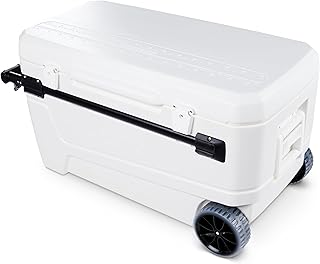
Pros
- 110 quarts covers a large group in one cooler
- Wheels and handle for moving a heavy load
- Maxcold insulation for the class
- Lower cost per quart than any rotomolded option
Cons
- Extremely heavy and awkward when full
- Injection molded retention rather than multi-day
At 110 quarts this is a different category of object. It is the cooler you buy when the alternative is three smaller coolers and three trips to the car, and its value is measured in logistics rather than in ice retention.
Insulation is Igloo's Maxcold specification, which is a step above basic injection molding and well short of rotomolded. In practice it holds a full day comfortably and the second day depends on how often the lid opens.
Loaded, this cooler is close to immovable by one person even on wheels, and it cannot be tipped to drain. A bottom drain that accepts a hose is worth using rather than fighting the weight.
Bottom line: the volume pick for events, provided you accept it is a one location cooler once it is full.
- Capacity: 110 quarts
- Insulation: Maxcold injection molded
- Mobility: wheeled with pull handle
- Drain: bottom drain plug
- Terrain: pavement and firm ground
- Use: large groups and events
Team sports days, family reunions, catering and anyone feeding a crowd from one place. A poor choice as a general purpose cooler, since the size makes it impractical for anything smaller than the occasion it was bought for.
Before buying a cooler this large, consider two 50 quart coolers instead. Two coolers can go to two locations, can be lifted by one person each, and let you keep drinks separate from food so the food chamber stays shut. The single large chest wins only when everything stays in one place.

Pros
- 10 inch oversized wheels genuinely work on sand and mud
- Holds up to 112 cans at 70 quarts
- Suspended basket and butler tray built in
- Stainless steel telescoping handle
Cons
- Large wheels add bulk in a car boot
- Injection molded retention rather than multi-day
The Trailmate exists because of the specific failure described throughout this guide: small wheels sinking into sand. Its oversized all-terrain wheels have a wide contact patch that keeps the cooler rolling on soft ground, which is the single feature that makes a heavy cooler viable at a beach.
At 70 quarts it handles a family day comfortably, and the lid carries accessory features such as a tray surface that are genuinely useful when there is no table. Insulation is conventional, so this is a day cooler rather than a weekend one.
The cost of the wheels is bulk. This takes more room in a car boot than a comparable capacity chest cooler, and that is worth measuring before buying if boot space is tight.
Bottom line: the beach and rough ground answer, and the model to choose if the walk from car park to spot is the hard part of your day.
- Capacity: 70 quarts, up to 112 cans
- Interior: 23 x 13.5 x 15 in
- Exterior: 33.82 x 20.31 x 23.62 in
- Wheels: 10 in oversized never-flat all-terrain
- Extras: suspended dry basket, removable butler tray, rod holders
- Handle: stainless steel telescoping
Beach days, festivals, sports fields and anywhere the cooler must cross soft ground under its own wheels. Unnecessary if the cooler only travels on tarmac, where smaller wheels do the same job in a smaller package.
Tow rather than push on soft ground, keeping the handle low so weight stays over the wheels. Rinse the wheel bearings with fresh water after beach use, since sand and salt together shorten wheel life faster than either alone.

Pros
- Rotomolded retention in a genuinely compact size
- Fits behind a car seat or in a small boot
- Wheels and handle despite the small footprint
- Tall interior takes bottles upright
Cons
- 32 quarts is limiting for a group
- Expensive for the capacity offered
The Roadie 32 answers a question the rest of this list ignores: what if you want rotomolded ice retention and do not want a large cooler. It keeps the thick walled construction and the gasketed lid in a footprint that fits a small car boot.
The interior is proportioned tall rather than wide, which means wine and larger bottles stand upright instead of lying in meltwater. That is a small design decision that changes what the cooler is useful for.
Capacity is the obvious constraint. Thirty two quarts covers one or two people for a couple of days, and it will not cover a group for an afternoon. Cost per quart is the highest here by a wide margin.
Bottom line: the compact rotomolded option, and the right pick for couples, solo trips, and small vehicles.
- Capacity: 32 quarts
- Construction: rotomolded
- Mobility: wheels with tow handle
- Interior: tall, fits bottles upright
- Lid: gasketed with latches
- Use: one to two people
Couples, solo campers, and anyone driving a small car where a 70 quart chest simply will not fit. Also a good second cooler dedicated to food alongside a larger drinks cooler.
Use the tall interior deliberately: bottles upright at one end, block ice at the other, cubes filling the rest. At this capacity the two to one ice ratio is even more important than usual, because a small chamber loses proportionally more cold every time the lid opens.
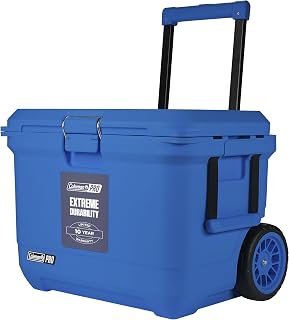
Pros
- Built for jobsite handling rather than picnic use
- Lighter than rotomolded coolers of similar capacity
- 55 quarts suits a work crew or a family
- Wheeled with a heavy duty handle
Cons
- Not rotomolded, so retention is shorter than premium coolers
- Utility styling rather than outdoor aesthetics
The Pro line is Coleman building for work rather than for weekends. The shell is reinforced where a cooler gets dropped, thrown into a truck bed, and stood on, which is a different failure mode from the one camping coolers are designed around.
At 55 quarts it covers a crew for a day or a family for a weekend, and the ultra-light framing keeps it manageable when loaded. It is not rotomolded, so retention sits in the same range as other quality injection molded coolers rather than competing with the YETI or the RTIC.
Value here is durability per unit of money rather than raw thermal performance. For a cooler that lives in a work vehicle and gets treated accordingly, that is the correct priority.
Bottom line: the hard-wearing option, and the pick if the cooler will be abused rather than looked after.
- Capacity: 55 quarts
- Construction: heavy-duty injection molded
- Weight: light for the class
- Mobility: wheels with heavy duty handle
- Use: jobsite, trade and family
- Drain: bottom drain
Trades, crews and anyone whose cooler rides in a work vehicle daily. Also a reasonable family cooler for people who would rather have durability than four day ice retention.
Rinse after every use and store with the lid propped open. On a cooler that lives outdoors, check the drain plug seal each season, since a perished plug seal is the most common reason an older cooler starts leaking meltwater into a vehicle.
How to Choose a Hard Coolers With Wheels
Quart capacity is the number on the box and it is the least useful figure for predicting whether a cooler suits you. These are the specifications that actually matter once the lid is closed.
Rotomolded Versus Injection Molded Insulation

Two manufacturing methods dominate. Injection molding produces an inner and outer shell that are then filled with foam, which is fast, cheap, and perfectly adequate for a day at a park. Rotational molding, usually shortened to rotomolded, spins the plastic inside a heated mold so the body forms as a single thick-walled piece, which is then pressure filled with foam. The result is heavier, considerably more expensive, and dramatically better at holding ice.
The practical difference shows up on day two, but the published numbers hide it. Coleman rates the Xtreme at up to five days and RTIC rates its rotomolded cooler at up to five days, which makes them look equivalent. Read the small print: those figures come from controlled laboratory conditions with the cooler pre-chilled, packed full, and left shut. In warm real world use an injection molded cooler generally delivers one to two days, while a well packed rotomolded cooler like the YETI or the RTIC genuinely reaches four or more. Compare wall thickness rather than headline days: 2.5 inches of closed cell foam on the RTIC and up to 2 inches on the YETI against a fraction of that in a double-wall injection molded body.
Gasket and latch design matter almost as much as wall thickness. A freezer style rubber gasket around the lid, combined with rubber T-latches that pull the lid down onto that gasket, seals far better than a lid that simply rests in a moulded lip. When comparing two coolers with similar wall thickness, the one with a gasket will hold ice noticeably longer.
Wheel Size Decides Where the Cooler Can Go

This is the specification most buyers skip and most regret. Small hard plastic wheels, the kind moulded into the base of budget rolling coolers, work on pavement and fail completely on sand. They sink, they stop rotating, and you end up dragging a hundred pounds by a handle designed for pulling rather than lifting.
Larger wheels with a wide contact patch spread the load and keep rolling across soft ground. The Igloo Trailmate is the clearest example on this list, riding on 10 inch never-flat wheels that the manufacturer rates for sand, mud and trails. Use that as your reference point: a wheel around 10 inches crosses soft ground, while the small moulded wheels on a conventional rolling cooler are a pavement and firm grass proposition regardless of what the marketing calls them.
Handle geometry pairs with this. A telescoping tow handle lets you pull from a standing position, which is comfortable on flat ground. A fixed loop or a rigid bar handle gives more control on uneven terrain because you can steer rather than just tow. Coolers designed for rough use tend to use the second type deliberately.
| Model | Approx capacity | Build | Terrain | Best use |
|---|---|---|---|---|
| YETI Tundra Haul | 13.8 gal, 45 cans | Rotomolded | Rough ground | Multi-day camping |
| Coleman Xtreme Rolling | 50 qt, 84 cans | Injection molded | Pavement | Day trips and tailgates |
| Igloo Trailmate Journey | 70 qt, 112 cans | Injection molded | All terrain wheels | Beach and park |
| RTIC Ultra-Light Wheeled | 52 qt, 78 cans | Rotomolded, lightened | Mixed | Weekends where weight matters |
| Igloo Maxcold Glide | 110 qt | Injection molded | Pavement | Large groups and events |
| YETI Roadie 32 | 32 qt | Rotomolded | Mixed | Two person trips |
The Two to One Ice Rule Changes Your Capacity Maths
Ice retention figures quoted by manufacturers assume the cooler is packed correctly, and correctly means roughly two parts ice to one part contents by volume. That is far more ice than most people load. It is also why a seventy quart cooler does not hold seventy quarts of drinks.
Work backwards from what you need cold. A case of twenty four cans occupies roughly the volume of a twenty quart cooler on its own, so pairing it with the recommended ice puts you at sixty quarts before food. Buying a size up is almost always the right call, and it is cheaper than discovering the shortfall at the trailhead.
Two habits stretch a given capacity further. Pre-chill the cooler with a sacrificial bag of ice for a few hours before loading, because a warm cooler spends its first hours of ice budget cooling its own walls. And use block ice at the bottom with cubes on top: blocks have less surface area for their mass and melt far more slowly, while cubes fill the gaps and cool contents quickly.
Dry Storage and Interior Layout

Everything in a cooler eventually sits in meltwater unless the design says otherwise. Sandwiches turn to pulp, cheese wrappers fill, and labels float off cans. Manufacturers address this in two ways. A dry basket is a removable tray that sits above the water line, which works until the cooler is full and the basket has to come out. A sealed dry compartment, of the kind the Ninja FrostVault builds into its front, is separated from the ice entirely and stays genuinely dry.
Look also for a drain plug positioned at the very bottom of one end, ideally one you can open without tipping the cooler. On large coolers a threaded drain with a hose fitting is a real convenience, since a hundred quart cooler full of meltwater cannot be tipped by one person. Interior dividers matter less than people expect and often just reduce usable space.
What Actually Breaks First
Insulation almost never fails. What fails is everything bolted to it, and knowing the order helps you compare two coolers that look identical in a listing. The drain plug goes first on most models, because it is a small threaded part with a rubber seal that dries out, gets cross-threaded in the dark, and is the one component in constant contact with standing water. A perished plug seal is the usual reason an older cooler starts leaking meltwater into a car boot.
Wheels and their axles come next, and specifically on coolers used at the beach. Sand works into the bearing surface, salt accelerates the corrosion, and the wheel starts to bind rather than roll. A rinse with fresh water after each beach trip does more for wheel life than any specification on the box. Where a wheel is bolted through a moulded boss rather than riding on a metal axle, that boss is the part that eventually cracks.
Latches and hinges follow. Rubber T-latches perish under UV exposure over a few seasons, and plastic hinge pins snap when a lid is forced backwards past its stop, usually by someone sitting on an open lid. Neither failure destroys a cooler, which is exactly why parts availability is worth checking before you buy. Legacy brands like Coleman and Igloo have replacement drain plugs, latches, and wheel kits available from multiple sellers for their common models, so a ten dollar part restores a cooler rather than replacing it. Newer designs and premium models often have parts only through the manufacturer. That is not a reason to avoid them, but it is a reason to keep the receipt and check what the warranty covers, since a heavy duty cooler with an unobtainable latch is a very expensive box.
Weight, Both Empty and Loaded
Rotomolded coolers are heavy before you put anything in them, and that empty weight is the hidden cost of long ice retention. A fifty quart rotomolded cooler can weigh over thirty pounds empty against ten to fifteen for an injection molded equivalent. Loaded to capacity, that difference decides whether one person can lift the cooler into a car boot at all.
This is exactly the gap products like the RTIC Ultra-Light target, trimming wall material where the thermal penalty is smallest to cut a meaningful amount of empty weight while keeping the rotomolded construction. If your cooler will be lifted into a truck bed regularly rather than only rolled, empty weight deserves as much attention as capacity.
One more consideration for anyone camping in bear country: certified bear resistant coolers must pass a standardised test and be secured with padlocks through moulded lugs to qualify. If that applies to where you camp, check certification specifically rather than assuming a heavy duty cooler qualifies.
Why You Should Trust Us
These coolers were selected from current Amazon listings using verified customer ratings and review volume as the first filter, then narrowed by construction method, wheel type, and published capacity. We compared manufacturer ice retention claims against the packing assumptions those claims depend on, and we prioritised models that state their build method rather than describing insulation in marketing terms.
We deliberately kept a spread of sizes and price levels rather than filling the list with premium rotomolded boxes, because a cooler that never leaves a car park does not need four day ice retention. More outdoor gear guides are in our sports and outdoors section.
Final Thoughts
The YETI Tundra Haul is our best overall because it is the model that behaves the same on day three as on day one. Rotomolded walls, a gasketed lid, and a single strong tow handle over substantial wheels make it the cooler to own if trips run longer than a day and the ground is not always flat.
The Coleman Xtreme Rolling Cooler takes best value by a wide margin. It is injection molded, it holds ice for a day or two rather than four, and it costs a small fraction of a rotomolded cooler. For tailgates, park days, and anything that ends before nightfall, the extra performance above it is money you do not need to spend.
After that, buy for terrain and volume. The Igloo Trailmate Journey is the one for sand. The Igloo Maxcold Glide is the one for a large group. The Ninja FrostVault is the answer if wet food has ruined a picnic for you before. The RTIC Ultra-Light is for anyone who wants rotomolded performance without a rotomolded lifting problem. And the YETI Roadie 32 is the compact option for two people. Our other buying guides cover the rest of the camp kit.
Frequently Asked Questions
How long does ice really last in a hard coolers with wheels?
An injection molded rolling cooler typically holds ice one to two days in warm weather. A rotomolded cooler holds four days or more under the same conditions, provided it was pre-chilled and packed at roughly two parts ice to one part contents. Opening the lid frequently, packing warm drinks, and leaving the cooler in direct sun all cut those figures substantially, often by half.
Will a wheeled cooler roll on sand?
Only if the wheels are large and wide. Small hard plastic wheels sink into soft sand and stop turning, at which point you are dragging the full loaded weight. Models with oversized all-terrain wheels are built specifically for this and handle beach access paths without difficulty. If beach use is the main purpose, treat wheel diameter as the first specification to check rather than capacity.
What size cooler do I need for a family weekend?
For four people over two days, a fifty to seventy quart cooler is usually right once the two to one ice ratio is accounted for. Work out the volume of food and drink first, then multiply by three for total capacity needed. Two smaller coolers, one for drinks and one for food, often outperform a single large one because the drinks cooler gets opened constantly while the food stays sealed.
Is a rotomolded cooler worth the extra cost?
It depends entirely on trip length. For day use the answer is generally no, since a cheap cooler keeps ice for the eight hours you need. For multi-day camping, fishing, or hunting where restocking ice is inconvenient, the difference is decisive. A useful test: if you have ever bought ice mid-trip, a rotomolded cooler will pay for itself in convenience rather than in money.
How should I pack a cooler in 2026?
Pre-chill the empty cooler with sacrificial ice for a few hours. Load block ice at the bottom, then contents that must stay coldest, then cubed ice filling every gap, since air space is what melts ice. Keep drinks in a separate cooler if possible so the food cooler stays shut. Drain meltwater only when you need the space, because cold water still helps hold temperature better than empty air.
Write Your Review
No reviews yet. Be the first to share your experience!