

Most people never shop for a garage door motor until the one bolted to their ceiling starts groaning, skipping, or refusing to close on a cold morning. The door itself is usually fine. The springs, tracks, and panels outlive the drive unit by years, so the job is rarely a full door replacement. It is a swap: pull down a tired opener, put up a modern one, and keep everything else in place. Our top pick is the Chamberlain C2405 myQ Smart Garage Door Opener for its blend of chain drive muscle, built in Wi-Fi, and a rail kit that mounts to the same ceiling brackets most homeowners already have.
This shortlist of 10 units covers every drive layout you can retrofit to an existing door, from Genie, LiftMaster, beamUP and more, and it is organized around the decision that actually matters during a swap: chain, belt, or wall mount. Ratings and owner feedback were pulled in October 2026. If you would rather compare manufacturers head to head instead of individual motors, our roundup of the best garage door opener brands takes that angle.

Pros
- Built in myQ Wi-Fi, so phone alerts and remote closing work without an extra bridge
- Chain drive strength at a mainstream price
- Dual LED panels light the whole bay instead of just the area under the motor
- Standard ceiling mounting, so most swaps reuse the existing header bracket and door arm
- Security+ 2.0 rolling code keeps the remote signal from being copied
Cons
- Chain noise carries into rooms directly above the garage
- No battery backup in the box, which matters in states that require it
- Ships with a seven foot rail, so eight foot doors need a separate extension kit
The C2405 is the unit most people should be looking at when an older rail opener finally quits. It is a chain drive, which means the mechanism is simple, strong, and cheap to keep running, and it uses the same ceiling mounting geometry that rail openers have used for decades. In practice that turns the job into a swap rather than a rebuild, since the header bracket, the door arm, and the ceiling angle iron usually stay put.
What separates it from a basic chain unit is the radio. Wi-Fi is built into the head, so the myQ app handles open, close, and status alerts without an extra hub sitting on a shelf somewhere. The dual LED lighting is the other quiet upgrade, spreading light across a two car bay instead of dropping a single pool under the motor.
The compromises are the ones that come with any chain. It is louder than a belt, and rooms directly above the garage will hear it cycle. There is no battery backup in the box either, so anyone in a state that requires it needs to plan for that separately. The rail is cut for a seven foot door, which covers most homes but not all of them.
Bottom line: for a standard sectional door where the garage is not under a bedroom, this is the most sensible replacement on the list. It brings modern smart control without asking for a harder install or a wall mount conversion.
- Drive type: chain
- Motor class: 1/2 HP
- Smart control: myQ Wi-Fi built into the head unit
- Lighting: dual LED panels
- Rail: standard seven foot, extension kits sold separately
- Security: Security plus 2.0 rolling code
- Included: remote control, wall control, photo eye safety sensors
- Battery backup: not included
Homeowners replacing a dead rail opener on a standard single or double sectional door who want app control without changing the mounting layout.
Less suited to anyone with a bedroom directly above the garage, where a belt drive is the better spend, or to garages that need the ceiling kept clear.
Measure the door height before ordering. The supplied rail is cut for a seven foot door and an eight foot door needs the matching extension kit.
Check the old header bracket and door arm for rust or bending. If they are sound they usually carry over, which saves an hour on the install. Photo eye sensors mount within six inches of the floor on both sides of the opening and are required by federal safety rules.

Pros
- Steel reinforced belt runs far quieter than a chain
- 3/4 HPc motor has margin for wide, insulated, or heavier doors
- Motion detecting lighting comes on when you walk into the bay
- Soft start and soft stop reduce the jolt at each end of travel
- Safe-T-Beam safety sensors included
Cons
- Wi-Fi runs through an add on Aladdin Connect module rather than being built in
- A belt costs more than a chain to replace years down the line
- Battery backup is a separate purchase
The SilentMax 1200 exists for one reason: the garage has a bedroom, nursery, or office above it and the old chain drive has become an alarm clock. Swapping to a steel reinforced belt keeps the mechanism identical, the trolley still runs along a rail, but the running noise drops to a hum that does not travel through the framing the way metal on metal does.
Genie pairs that belt with a 3/4 HPc motor, which is the right call. Quiet only holds up if the motor is not straining, and the extra torque keeps travel smooth on a wide double door or an insulated panel that carries real weight. Soft start and soft stop smooth out both ends of the cycle, which is the part people usually notice at eleven at night.
The gaps are worth knowing. Smart control is not built in, it comes through Genie's Aladdin Connect module, so anyone who wants phone alerts should budget for that. Battery backup is separate as well. And a belt, while it lasts a long time, is the more expensive consumable if the unit is still running in fifteen years.
Bottom line: this is the quiet upgrade to make when noise is the actual complaint, and the 3/4 HPc rating means you are not trading strength for silence.
- Drive type: steel reinforced belt
- Motor class: 3/4 HPc DC
- Smart control: Aladdin Connect ready, module sold separately
- Lighting: motion detecting
- Travel: soft start and soft stop
- Safety: Safe-T-Beam infrared sensors included
- Included: remote control, wall console, safety sensors
- Battery backup: sold separately
Belt drives cut the sharp metallic clatter of a chain, but no opener is silent. Most of the noise people blame on the drive actually comes from dry rollers and loose hinges.
Before the new unit goes up, spend twenty minutes on the door itself. Replacing worn steel rollers with nylon ones and snugging the hinge bolts does as much for the room above the garage as the belt does.
Test the auto reverse every month. Lay a two by four flat under the door and cycle it closed. The door must reverse when it touches the wood.
Wipe the photo eyes clean and check that both lenses face each other squarely. A misaligned sensor is the single most common reason a door refuses to close and gets blamed on the motor.

Pros
- Frees the entire ceiling for storage racks, a car lift, or a tall vehicle
- Battery backup is built in rather than sold as a module
- myQ Wi-Fi is integrated, so alerts and remote closing work out of the box
- Quiet in practice because nothing runs overhead through the framing
- Solves low headroom garages where a rail unit will not fit
Cons
- Only works on doors with a torsion spring system, not extension springs
- Needs clear wall space beside the opening for the drive head
- The install is more involved than bolting up a rail
A wall mount opener is a different animal from a rail unit. Instead of pulling a trolley along the ceiling, it bolts to the wall next to the door and turns the torsion bar directly. The result is a garage with nothing overhead, which is why this layout keeps winning in homes with ceiling storage racks, a car lift, or a truck that needs the height.
Chamberlain's version integrates the two features people usually pay extra for elsewhere. Wi-Fi is built in for myQ alerts and remote closing, and battery backup is part of the unit rather than an accessory, so the door still cycles when the power drops. That combination is what makes it the standout among the ceiling clearing options here.
The catch is structural. Jackshaft units grab the torsion bar above the door, so a garage running extension springs along the side tracks cannot take one without converting the spring system first, which is a professional job. There also needs to be clear wall beside the opening for the drive head, so check for light switches, panels, and shelving before ordering.
Bottom line: if the reason for the upgrade is ceiling space or headroom rather than noise, this is the unit to buy, provided the door already runs on torsion springs.
- Drive type: jackshaft wall mount
- Motor: DC
- Smart control: myQ Wi-Fi built in
- Power: battery backup included
- Requires: torsion spring system
- Clearance: side room beside the door opening
- Included: remote control, wall control, safety sensors
- Ceiling: no rail, no overhead motor
Look above the door opening. A torsion spring system uses a horizontal bar with springs wound around it, and that bar is what a jackshaft unit drives. Extension springs stretch along the horizontal tracks on either side instead, and they rule this layout out.
Then check the wall beside the opening for several inches of clear space, plus a nearby outlet. Relocating an outlet is the most common surprise in a wall mount conversion.
Owners of garages with low headroom, exposed ductwork, overhead storage, or a car lift, where a ceiling rail is either impossible or in the way.
Also a strong pick for anyone who wants battery backup and smart control without stacking two accessory modules onto a rail opener.

Pros
- Rated for 8 by 7 single and 16 by 7 double doors
- 3/4 HP equivalent DC motor paired with a heavy duty steel chain
- Bright LED security lighting built into the head unit
- Simple wiring with no app setup or network to configure
- Cheapest realistic route back to a working door
Cons
- No Wi-Fi, app control, or smart home integration
- Chain noise carries into rooms above the garage
- Ships with a single button remote, so extra transmitters are a separate buy
Not every garage needs an app. The BU100 is built for the case where the old unit died, the garage is detached or nobody lives above it, and the only goal is a door that opens reliably for another decade. It is a chain drive with heavy duty hardware and very little else, and that is the point.
The specification is stronger than the plain styling suggests. A 3/4 HP equivalent DC motor drives a reinforced steel chain, which covers 8 by 7 single doors and 16 by 7 double doors, and the head unit carries bright LED security lighting instead of a bulb socket that needs replacing. The install follows the standard rail pattern, so the header bracket and ceiling mount from the old opener usually carry over.
What you give up is everything on the smart side. There is no phone alert when the door has been left open, no remote closing from the office, and no integration with a broader connected home. The box also includes a single button remote, so a second car means buying another transmitter, and chain noise is chain noise.
Bottom line: the value pick of the group. If the door is the job and the phone is not part of it, this puts the money where it does the most good.
- Drive type: heavy duty steel chain
- Motor class: 3/4 HP equivalent DC
- Rated for: 8 by 7 single or 16 by 7 double doors
- Smart control: none
- Lighting: LED security lighting
- Safety: photo eye safety system included
- Included: single button remote, door control, mounting hardware
- Battery backup: not included
Skip the smart features only if you genuinely will not miss them. The one alert most owners come to rely on is the notification that the door has been open for an hour, and no basic opener sends it.
If that matters later, a separate sensor can be added to the garage without replacing the opener, which keeps this unit a reasonable long term choice.
Detached garages, workshops, rental properties, and anyone who wants a working door for the lowest sensible outlay.
Not the right pick for a garage under a bedroom, where a belt drive earns its price difference every morning.

Pros
- Professional grade hardware sold through the dealer channel
- Wi-Fi built in for myQ alerts and remote closing
- Ceiling stays completely clear, same as any jackshaft
- Long standing reputation for service life in this product line
- Quiet because the drive sits on the wall, not over your head
Cons
- The most demanding install of the units here
- Requires torsion springs and clear side room beside the opening
- Premium positioning compared with rail openers of similar strength
LiftMaster is the brand most professional installers reach for, and the 98022 is the current Premium Series wall mount, sold as the replacement for the 8500W that has been going up in garages for years. Mechanically it does what every jackshaft does, mounting beside the door and turning the torsion bar, so the ceiling is left entirely free.
The reason to pay for this one over a cheaper wall mount is the hardware standard and the support behind it. This line is what dealers install and stock parts for, Wi-Fi is integrated for myQ rather than added on, and the product has enough history that the failure modes are well understood by anyone who services garage doors for a living.
It is also the least forgiving install on this page. Working near a wound torsion bar is not a first time DIY project, and the unit needs clear wall space and a nearby outlet on the correct side of the opening. Anyone not completely certain about the spring system should have it fitted rather than attempting it.
Bottom line: the pick for owners who want the hardware a professional would install, and who are converting to a wall mount for the long haul rather than the cheapest possible fix.
- Drive type: jackshaft wall mount
- Motor: DC
- Smart control: Wi-Fi built in, myQ platform
- Replaces: the earlier 8500W in the same series
- Requires: torsion spring system
- Clearance: side room beside the door opening
- Included: remote control, wall control, safety sensors
- Ceiling: fully clear, no rail
Owners who plan to stay in the house, want the same unit a dealer would fit, and value parts availability and service support over the lowest purchase price.
Also the natural choice for garages already converted to a wall mount, where the old jackshaft is simply being replaced.
Confirm three things before ordering: the door runs on torsion springs, there is clear wall beside the opening, and there is an outlet within reach on that side.
Torsion springs hold enormous stored energy. Do not loosen, adjust, or unwind them. If the spring system needs any attention at all, bring in a garage door technician for that part of the work.

Pros
- 3/4 HPc torque at chain drive pricing
- Two pre programmed remotes and a wall console in the box
- Safe-T-Beam infrared safety sensors included
- Aladdin Connect ready if smart control is added later
- Steel chain and rail built for a long service life
Cons
- Louder than any belt drive on this list
- Smart control needs the separate Aladdin Connect module
- Standard rail is cut for a seven foot door
The ChainMax 1000 is the answer to a specific question: what if the door is heavy but the budget is not generous. It pairs a 3/4 HPc motor with a plain steel chain, which is the cheapest way to buy real torque. Wide doors, insulated panels, and older wooden sections all cycle more smoothly with that extra margin than they do on a half horsepower unit.
Genie includes two pre programmed remotes and a wall console, which is more generous than several units in this group and saves a separate purchase for a two car household. The Safe-T-Beam sensor system handles the required photo eye function, and Aladdin Connect can be added later if phone alerts become a priority.
The trade is noise. A chain moving under a 3/4 HPc motor is not subtle, and a bedroom above the garage will register every cycle. Smart control is also an extra purchase rather than something built into the head unit, and the rail as shipped assumes a seven foot door.
Bottom line: the strongest value per unit of torque here. Buy it for a wide or heavy door in a detached or unoccupied garage, and put the savings toward better rollers.
- Drive type: chain
- Motor class: 3/4 HPc DC
- Smart control: Aladdin Connect ready, module sold separately
- Rail: standard seven foot steel rail
- Safety: Safe-T-Beam infrared sensors
- Included: two three button remotes, wall console
- Battery backup: sold separately
- Best for: wide or insulated doors
The 3/4 HPc rating is aimed at double doors, insulated panels, and solid wood sections. On a light single door it will work fine but the extra torque is not doing much for you.
Measure door height before ordering. Eight foot doors need the model specific extension kit, and that kit is easier to buy at the same time than to chase down later.
Program the two included remotes before the head unit goes up on the ceiling. Reaching the learn button is far easier at bench height than on a ladder.
Set the travel limits and force settings after the door is balanced, not before. Adjusting force to compensate for tired springs masks a problem that will only get worse.

Pros
- myQ app control for alerts, remote opening, and remote closing
- Wireless entry keypad included rather than sold separately
- Familiar brand for households replacing an older Craftsman opener
- Standard rail layout keeps the swap straightforward
- LED lighting on the head unit
Cons
- Chain noise is the same as any chain drive
- 1/2 HP is the sensible ceiling for a standard door, not a heavy wooden one
- No battery backup in the box
There are a lot of aging Craftsman openers in American garages, and this is the modern unit aimed squarely at replacing them. It is a 1/2 HP chain drive on the familiar rail layout, so the mounting points and the general shape of the install match what is already up there.
The two features that matter are myQ and the keypad. myQ brings the alerts most people actually use, notably the one telling you the door has been sitting open, plus remote closing from a phone. Including the wireless keypad is a genuine saving, since an outside entry pad is one of the first accessories most households add anyway.
Its limits are honest ones. A 1/2 HP motor suits a standard sectional door and will run a balanced double door, but a solid wood carriage house door deserves more. It is a chain, so it is audible, and battery backup is not included.
Bottom line: a sensible like for like upgrade for anyone already in the Craftsman ecosystem, with the keypad in the box tipping the value in its favor.
- Drive type: chain
- Motor class: 1/2 HP
- Smart control: myQ Wi-Fi
- Lighting: LED
- Mounting: standard ceiling rail
- Included: remote control, wireless keypad, wall control, safety sensors
- Battery backup: not included
- Best for: standard single or balanced double doors
Households replacing a tired Craftsman or Sears era opener who want to stay with a familiar name and get app control in the process.
Also a good fit for anyone who wants the outside keypad included rather than buying it as a separate accessory.
myQ handles open, close, and status from the phone, and can send an alert when the door has been left open past a set time.
Note that some third party integrations on the myQ platform have required a paid add on at various points. Check the current terms if a specific smart home or delivery integration is the reason you are buying.

Pros
- Belt drive quiet at the low end of the price range
- LED bulbs included with the unit
- Simple setup with few options to configure
- Safe-T-Beam infrared safety sensors included
- Light enough package for a one day swap
Cons
- Fewer features than the SilentMax models above it
- Best suited to standard single doors rather than heavy double doors
- Smart control requires the separate Aladdin Connect module
Belt drives usually cost more than chains, and that price gap is what pushes people back toward a noisy unit they will regret. The 2055-LED Essentials exists to close that gap. It is Genie's entry belt drive, stripped of the extras, with the money concentrated on the part that matters for a garage under a bedroom.
The package is deliberately simple. LED bulbs are included, the Safe-T-Beam sensors cover the required safety function, and the rail follows the standard ceiling layout so the swap goes the same way as any other rail opener. There is not much to configure, which is a genuine advantage for a first install.
The limits track the price. It is aimed at standard single doors, so a heavy insulated double door is better served by the SilentMax 1200 or a 3/4 HPc chain unit. App control means adding the Aladdin Connect module, and the feature list stops well short of the smart wall mounts.
Bottom line: the cheapest honest way to get a quiet garage. If the door is a standard single and noise is the complaint, it solves the problem without spending on features you did not ask for.
- Drive type: belt
- Motor: DC
- Smart control: Aladdin Connect ready, module sold separately
- Lighting: LED bulbs included
- Mounting: standard ceiling rail
- Safety: Safe-T-Beam infrared sensors
- Included: remote control, wall console, safety sensors
- Best for: standard single doors
Owners of a standard single door who want belt drive quiet without paying for motion lighting, battery backup, or built in Wi-Fi.
A poor match for heavy insulated double doors, where the extra torque of a 3/4 HPc unit is worth the difference.
Check belt tension once a year. A belt that has gone slack slaps against the rail and undoes the quiet you paid for.
Run the reversal test monthly with a flat board under the door, and keep both photo eye lenses clean and aligned.

Pros
- Keeps the ceiling completely clear for racks, lifts, or tall vehicles
- Quiet in use because no motor or rail runs overhead
- Compact black housing that stays out of sight beside the door
- Useful where an attic ladder or ductwork blocks a ceiling rail
- A lower cost route into a jackshaft layout
Cons
- Needs a torsion spring system, so extension spring doors are out
- Smart features are thinner than the myQ wall mounts
- Side clearance beside the opening is required
Wall mount openers have a reputation for being the expensive option, which stops a lot of people from considering one even when their garage is the exact case they were designed for. Genie's 6072H-O is the answer to that, an entry priced jackshaft that mounts beside the door and turns the torsion bar directly.
The payoff is the same as any wall mount. The ceiling is left completely free, so storage racks, an attic ladder, ductwork, or a car lift stop being obstacles. Noise drops as well, since nothing is running through the framing above your head. The housing is compact and finished in black, so it disappears against the wall better than a ceiling unit ever does.
Where it gives ground is on features. The smart control experience is not the polished myQ setup the Chamberlain and LiftMaster wall mounts offer, and the accessory list is shorter. The structural requirements are identical though: torsion springs, clear wall space, and an outlet on the right side.
Bottom line: the pragmatic way into a wall mount. If the problem is ceiling clearance rather than app features, this gets the ceiling back for less than the premium units.
- Drive type: jackshaft wall mount
- Motor: DC
- Finish: black compact housing
- Requires: torsion spring system
- Clearance: side room beside the door opening
- Ceiling: fully clear, no rail
- Smart control: Genie Aladdin Connect ecosystem
- Best for: low headroom and overhead storage
Check for a horizontal torsion bar above the door with springs wound around it. That bar is what the unit drives. Extension springs running along the side tracks rule the layout out without a professional spring conversion.
Then confirm clear wall space beside the opening and a nearby outlet on the same side.
Compare it against the Chamberlain and LiftMaster wall mounts on two points only: whether you want built in battery backup, and whether myQ integration matters to you.
If neither is a priority, this unit delivers the same core benefit, a clear ceiling and quiet operation, for less.

Pros
- DC motor starts and stops more softly than a standard AC chain drive
- Quieter than the chain drive reputation suggests
- Budget pricing well under the mainstream smart units
- Standard rail install with no unusual mounting requirements
- Compact head unit for tight ceilings
Cons
- Smaller brand with a thinner dealer and parts network
- No myQ or Aladdin Connect ecosystem behind it
- Feature set is basic next to the mainstream units
Skylink is the outsider in this group, a smaller name selling against Chamberlain, LiftMaster, and Genie on price. The Atoms ATR-1622CK is its chain drive, and the interesting part is the motor: a DC unit rather than the AC motor most budget chain openers use.
That matters more than it sounds. DC drives ramp up and slow down instead of slamming into motion, which takes the harshest edge off chain drive noise. It will not match a belt, but it is noticeably better behaved than a basic AC chain unit at a similar price, and the install follows the usual rail pattern with no surprises.
The reservations are about the ecosystem rather than the hardware. There is no myQ or Aladdin Connect platform behind it, the accessory range is narrower, and finding a local technician who stocks parts is less certain than with the mainstream brands. For a rental or a secondary garage that is often an acceptable trade.
Bottom line: a quiet chain drive for people who want the noise reduced without paying belt drive money, as long as brand support is not a priority.
- Drive type: chain
- Motor: 1/2 HPF DC, quiet running
- Smart control: none of the major platforms
- Travel: soft start and stop from the DC drive
- Mounting: standard ceiling rail
- Safety: photo eye sensors included
- Included: remote control, wall control, safety sensors
- Best for: budget quiet swaps and secondary garages
Landlords, secondary garages, and anyone who wants the noise cut without moving up to a belt drive or a mainstream smart opener.
Less suited to a primary home garage where long term parts support and a dealer network matter.
Program the remotes at bench height before mounting the head unit, then set travel limits once the door is balanced by hand.
Keep the original manual with the unit. Parts and service information for smaller brands is harder to track down later than it is for the big three.
How to Choose a Garage Door Motor for a Door You Already Own
Replacing a drive unit is a different exercise from buying a new door. The door dictates most of the answer: its weight, its spring system, the headroom above it, and how close the nearest bedroom sits. Work through the six points below in order and the shortlist narrows itself to two or three units very quickly.
Drive Type Decides How Loud Your Mornings Are
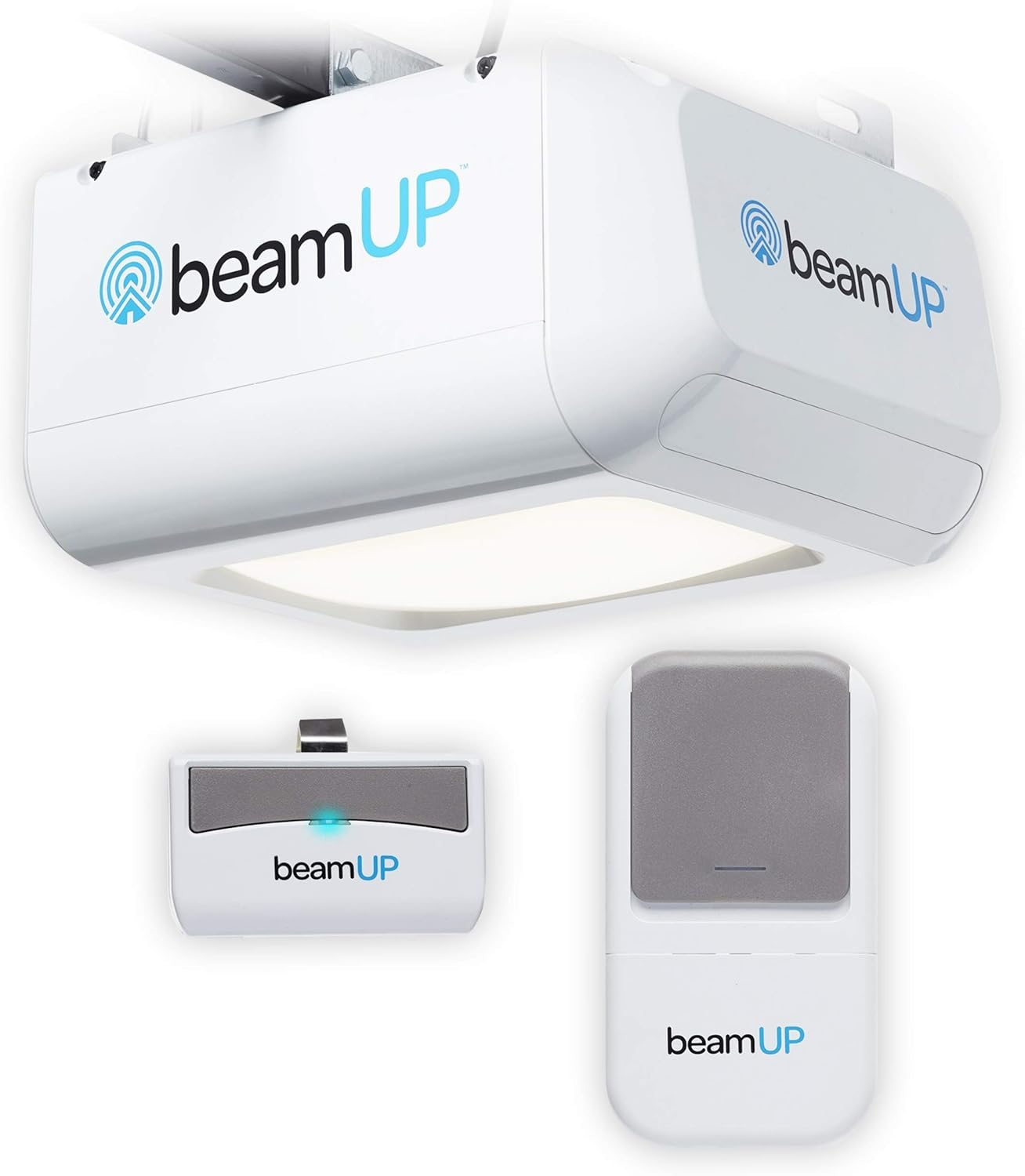
Chain drive is the oldest and cheapest layout. A metal chain pulls a trolley along a rail, which is durable and strong but transmits noise into the framing. If the garage is detached, or if nobody sleeps above it, chain is the sensible choice and the reason units like the Genie ChainMax 1000 and the beamUP Workhorse BU100 keep selling.
Belt drive swaps that chain for a steel reinforced rubber belt. The mechanism is otherwise identical, so a belt unit bolts up in exactly the same place, but the running noise drops to a soft hum. This is the upgrade to make when a bedroom, nursery, or home office shares a wall or ceiling with the garage. The Genie SilentMax 1200 and the Genie 2055-LED Essentials both sit in this camp.
Wall mount units, also called jackshaft openers, skip the ceiling rail entirely. They bolt to the wall beside the door and turn the torsion bar directly. Nothing hangs overhead, which is why they suit garages with storage racks, car lifts, or cathedral ceilings. The Chamberlain Wall Mount myQ, the LiftMaster Premium Series 98022, and the Genie 6072H-O all use this layout.
Screw drive is the fourth layout, and it is worth naming only so you can rule it out. Manufacturers have largely retired it, replacement parts are getting scarce, and there is no reason to hunt for one when a belt unit mounts to the same brackets and runs quieter.
Read the Door Weight, Not the Horsepower Sticker
A half horsepower unit is not straining to lift a two hundred pound door. Balanced torsion springs carry almost all of that weight, and the motor only supplies the nudge that gets the door moving and holds it under control. That is why a 1/2 HP class motor like the one in the Chamberlain C2405 or the Craftsman smart opener handles a standard single door without complaint.
Step up to 3/4 HPc when the door is wide, insulated, or carries solid wood panels. Double doors and heavier carriage house styles put more inertia into every cycle, and the extra torque in units like the Genie ChainMax 1000 and the Genie SilentMax 1200 keeps travel smooth instead of jerky. It also buys margin for the years when the springs drift out of adjustment before you notice.
One honest test before you buy anything: pull the emergency release, lift the door by hand to waist height, and let go. A properly balanced door holds its position. If it slams down or shoots up, the springs need service first. No motor rating fixes a spring problem, and a new opener bolted to an unbalanced door will fail early.
Rail Length and Headroom Set Hard Limits
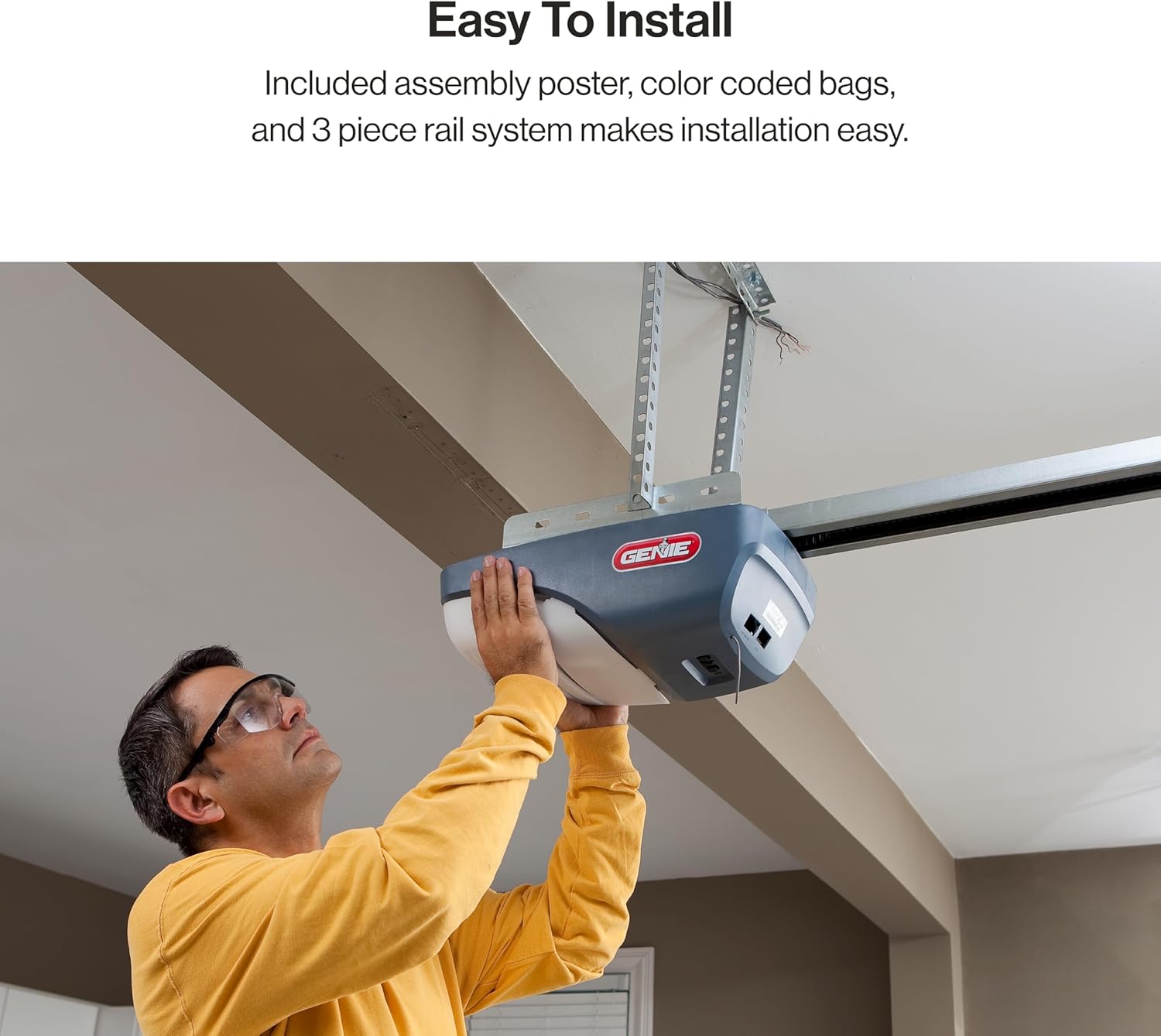
Almost every boxed rail kit is cut for a seven foot door. Eight foot doors need an extension kit, and those kits are model specific, so the time to check is before the old unit comes down. Measure the door height first, then confirm the manufacturer sells an extension for the exact model you are considering.
Headroom is the other constraint. A rail mounted opener needs roughly two inches of clear space above the top of the door travel plus room for the motor housing near the ceiling. Garages with low ceilings, exposed ductwork, or an attic ladder in the way run out of that space fast, and that is exactly the situation a wall mount unit solves. Shoppers browsing our wider tools and home improvement coverage will find the same measure first, buy second rule applies to almost every install project.
Your Spring System Decides Whether a Wall Mount Is Even Possible
Jackshaft openers drive the torsion bar that runs horizontally above the door opening. If your garage uses extension springs, the long springs stretched along the horizontal tracks on each side, there is no torsion bar to grab and a wall mount unit will not work without converting the spring system first. That conversion is a professional job and it changes the math on the upgrade.
Torsion spring setups also need side room. Plan on several inches of clear wall beside the door opening for the drive head and its bracket. Check for light switches, electrical panels, or shelving in that zone before ordering, because relocating an outlet is the kind of surprise that turns a Saturday project into a two weekend project.
Battery Backup, Safety Sensors, and Smart Control
Battery backup keeps the door cycling during an outage. Some states, California among them, require it on newly installed residential openers, so check local rules before you order. The Chamberlain Wall Mount myQ builds it in, and several other units offer it as an add on module rather than a standard part of the box.
Photo eye safety sensors have been mandatory on residential openers in the United States since 1993, and every unit here ships with a pair. They mount within six inches of the floor on both sides of the opening and they are not optional, so keep the old wiring path in mind when planning the swap.
Smart control splits into two ecosystems. Chamberlain, LiftMaster, and Craftsman units run on myQ, which brings phone alerts, scheduled closing, and delivery integrations. Genie runs Aladdin Connect, which is built into some models and sold as a module for others. If a garage door is part of a broader connected setup, it pairs naturally with a self installed home security system that already watches the rest of the entry points.
What You Can Reuse From the Old Opener

More than most people expect. The header bracket, the door arm, and the ceiling mounting angle iron are often reusable if they are not rusted or bent, which cuts both cost and install time. The electrical outlet in the ceiling stays exactly where it is on a rail swap.
Remotes and keypads are the exception. Rolling code security means an old remote almost never talks to a new logic board across brands, and often not across generations of the same brand. Budget for the remotes that come in the box and plan to reprogram every vehicle with a built in button. If you want a keypad on the outside wall, confirm the model includes one rather than assuming, and treat entry hardware as its own decision the same way you would with a combination door lock on a side entry.
| Opener | Drive layout | Motor class | Best fit |
|---|---|---|---|
| Chamberlain C2405 | Chain | 1/2 HP with myQ Wi-Fi | Standard single door, smart control wanted |
| Genie SilentMax 1200 | Belt | 3/4 HPc DC | Bedroom above the garage |
| Chamberlain Wall Mount myQ | Jackshaft | DC with battery backup | Low headroom, overhead storage |
| beamUP Workhorse BU100 | Chain | 3/4 HP equivalent DC | Detached garage, no frills swap |
| LiftMaster 98022 | Jackshaft | DC with Wi-Fi | Long service life, pro grade parts |
| Genie ChainMax 1000 | Chain | 3/4 HPc DC | Wide or insulated doors |
| Craftsman Smart Opener | Chain | 1/2 HP with myQ Wi-Fi | Replacing an aging Craftsman unit |
| Genie 2055-LED Essentials | Belt | Entry level DC | Quiet on a tight budget |
| Genie 6072H-O | Jackshaft | DC | Ceiling clearance without premium pricing |
| Skylink Atoms ATR-1622CK | Chain | 1/2 HPF DC | Quiet chain drive on a budget |
Why You Should Trust Us
Every unit on this page was selected from live Amazon listings that carry a strong customer rating and a meaningful volume of owner feedback, not from manufacturer press material. We read through published specification sheets, installation manuals, and the questions buyers ask most often, then filtered out anything that could not physically retrofit to a standard residential sectional door.
We also deliberately left out accessories that crowd search results for this term, including replacement gear kits, torsion spring sets, and standalone keypads. Those parts have their place when a specific component fails, but they are not a drive unit and mixing them into a comparison of complete openers makes the list less useful, not more. Ratings, availability, and model bundles change often, so treat this as a snapshot and confirm the current configuration on the listing before ordering.
Final Thoughts
For most homeowners swapping out a failing unit, the Chamberlain C2405 myQ Smart Garage Door Opener is the safest landing spot. It is a chain drive, so it is strong and inexpensive to live with, and the myQ radio is built in rather than bolted on, which means phone alerts and remote closing work from day one. It mounts to the same ceiling hardware a rail opener already uses, so the install stays a swap rather than a rebuild.
The beamUP Workhorse BU100 is the value pick. It skips Wi-Fi, app control, and camera features entirely and puts the money into a 3/4 HP equivalent DC motor and a heavy duty chain rated for single and double doors. For a detached garage or a workshop where nobody cares about phone notifications, it does the one job that matters and does not ask for a subscription or a network connection to do it.
If quiet is the whole point of the upgrade, the Genie SilentMax 1200 is the belt drive to buy, and its 3/4 HPc motor has enough margin for a wide insulated door. If ceiling space is the problem, the Chamberlain Wall Mount myQ frees the entire ceiling and includes battery backup, while the LiftMaster Premium Series 98022 is the pick for anyone who wants the pro installed hardware standard at home. Homeowners working through a broader list of upgrades often pair a new opener with something like a smart water shut off valve, since both protect an unattended house, and anyone set on one manufacturer can go deeper with our roundup of Genie garage door openers.
Frequently Asked Questions
How do I know if my garage door motor is dying or if the problem is the door?
Pull the emergency release cord and work the door by hand. If it is heavy, binds in the tracks, or will not stay put at waist height, the springs and rollers are the problem and a new motor will not fix it. If the door glides by hand but the powered cycle grinds, stalls, reverses for no reason, or runs the motor without moving the door, the drive unit or its gear set is failing. Grinding with no movement usually points to a stripped gear inside the housing.
Can I install a new garage door motor myself?
A rail mounted chain or belt unit is a realistic weekend project for someone comfortable on a ladder with a drill and a socket set, and it typically takes four to six hours the first time. Two people make it far easier because the rail has to be held at the header while it is bolted up. Wall mount jackshaft units are more demanding since they interact with the torsion bar, which stores enormous energy, and that part of the job belongs to a professional unless you have done it before. Never loosen or adjust torsion springs yourself.
What size garage door motor do I need for a double door?
A 3/4 HPc class motor is the comfortable answer for a standard double door, especially an insulated one. Half horsepower units are rated for many double doors too, and they will run one that is properly balanced, but the extra torque gives smoother travel and more tolerance for springs that have aged. Solid wood carriage house doors are the heaviest common case and deserve the larger motor without much debate.
Do I need battery backup on a garage door motor in 2026?
Check your state rules first, because California requires battery backup on residential openers installed there and other jurisdictions have followed with their own versions. Beyond the legal question, it is genuinely useful if the garage is your main entry, if the door is heavy enough to be awkward to lift by hand, or if outages are common where you live. Some units include it, others sell it as a module, so confirm which before ordering.
Will my old remotes work with a new garage door motor?
Usually not. Rolling code systems changed several times over the last three decades and remotes rarely carry across brands or even across generations within one brand. Plan to use the remotes included in the box, reprogram any built in vehicle buttons, and buy a matching keypad if the model does not include one. More comparisons like this one live in our articles section.

Write Your Review
No reviews yet. Be the first to share your experience!